•A form of energy
from movement
of electrons.
•Comes from the
Greek word
“electron”
ELECTRICITY
ELECTRICITY
•It is associated with
electric charge, a
property of
subatomic particles.
•Charges can be
stationary or
moving.
Unlike
charges
ATTRACT
like
charges
REPEL
STATIC ELECTRICITY
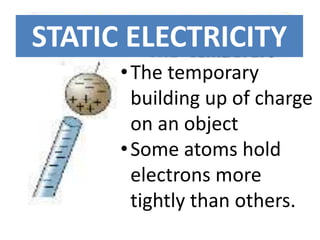
•The temporary
building up of charge
on an object
•Some atoms hold
electrons more
tightly than others.
STATIC ELECTRICITY
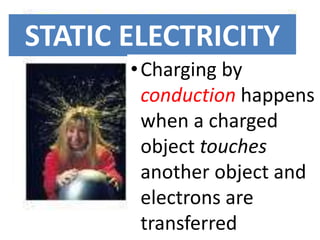
•Charging by
conduction happens
when a charged
object touches
another object and
electrons are
transferred
STATIC ELECTRICITY
• Charging by induction happens when a
charged object and is held close to
another object and that causes charges
to be rearranged
STATIC ELECTRICITY
•Charging by
friction happens
when objects rub
together and
electrons are
transferred.
Insulators and Conductors
• Some materials allow charges to be
transferred (conductor) while others do
not (insulator)
Insulators and Conductors
• Conductors:Gold,Silver,Copper,Iron,Lead
,Salt and Water.
• Insulators: Plastics,Glass,Dry air, and
Wood
Electric Current
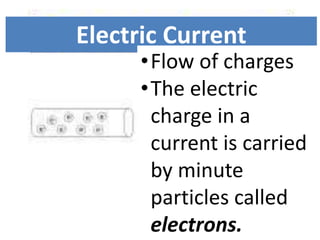
•Flow of charges
•The electric
charge in a
current is carried
by minute
particles called
electrons.
Electric Current
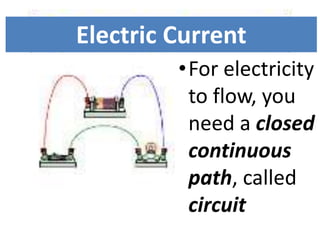
•For electricity
to flow, you
need a closed
continuous
path, called
circuit
Current
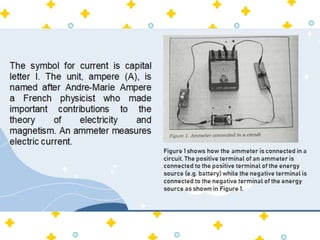
• The measure of
how many
electrons per
second.
• Also called
amperage
• Measured in
amperes
Current
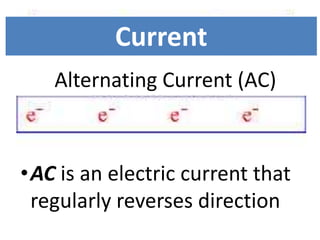
•AC is an electric current that
regularly reverses direction
Alternating Current (AC)
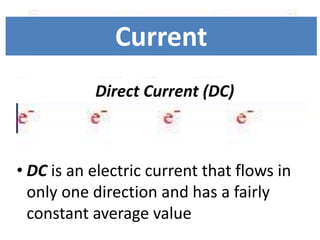
• DC is an electric current that flows in
only one direction and has a fairly
constant average value
Direct Current (DC)
Current
• In addition, for electrons to flow there
must be a potential difference between
two places
Remember: Electric potential energy-
two unlike charges
Lower potential
energy
Higher
potential
energy
Lower
potential
High
potential
electrons
Direction of flow
• Electrical pressure
• Charges flow from high voltage
to low voltage or from high PE
to low PE
Voltage
• Cells can cause voltage
that makes electrons
flow
• There are two kinds
electrochemical cells,
wet cells such as
battery and cells like
flashlight
Electrochemical Cell
• When two or more cells are
connected together we call this a
battery
Electrochemical Cell
• The cells chemical energy is used
up pushing a current round a
circuit. Current is Direct Current
Electrochemical Cell
• Allesandro Volta (1800) cell
Electrochemical Cell
• Wet Cell = Car Battery
Electrochemical Cell
• Dry Cell = Household “Battery”
Electrochemical Cell
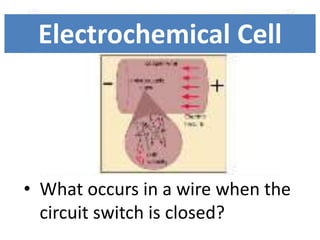
• What occurs in a wire when the
circuit switch is closed?
Electrochemical Cell
• The tendency for a
material to oppose the
flow of electrons
• Different materials have
different amounts of
resistance to the flow of
electrons.
• The unit of resistance is
ohm (Ω)
Resistance
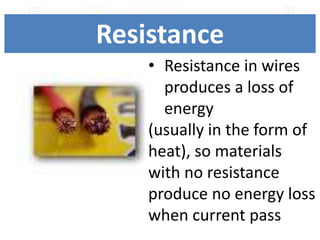
• Resistance in wires
produces a loss of
energy
(usually in the form of
heat), so materials
with no resistance
produce no energy loss
when current pass
Resistance
• Thin wires provide more resistance than do
thick wires
Which materials has higher
resistance?
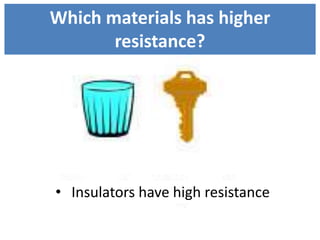
• Insulators have high resistance
Which materials has higher
resistance?
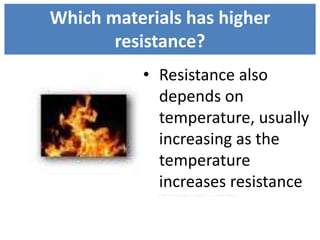
• Resistance also
depends on
temperature, usually
increasing as the
temperature
increases resistance
Which materials has higher
resistance?
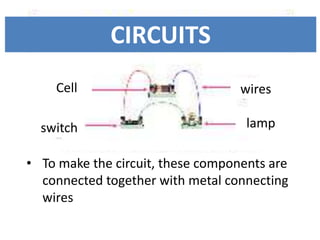
• To make the circuit, these components are
connected together with metal connecting
wires
CIRCUITS
switch
Cell wires
lamp
• To make the circuit, these components are
connected together with metal connecting
wires
CIRCUITS
switch
Cell wires
lamp
• When the switch is turned on (open), the lamp
lights up. This is because there is a continuous
path of metal for the electric current to flow
around.
CIRCUITS
• Scientist usually draw electric circuits
using symbols.
Cell lamp Switch Wires
CIRCUITS
TYPES OF CIRCUIT
SERIES PARALLEL
electricity.pptx
electricity.pptx
electricity.pptx
electricity.pptx
electricity.pptx
electricity.pptx
electricity.pptx
electricity.pptx
electricity.pptx
electricity.pptx
electricity.pptx
electricity.pptx
electricity.pptx
electricity.pptx

electricity.pptx

  • 2.
    •A form ofenergy from movement of electrons. •Comes from the Greek word “electron” ELECTRICITY
  • 3.
    ELECTRICITY •It is associatedwith electric charge, a property of subatomic particles. •Charges can be stationary or moving.
  • 4.
  • 5.
    STATIC ELECTRICITY •The temporary buildingup of charge on an object •Some atoms hold electrons more tightly than others.
  • 6.
    STATIC ELECTRICITY •Charging by conductionhappens when a charged object touches another object and electrons are transferred
  • 7.
    STATIC ELECTRICITY • Chargingby induction happens when a charged object and is held close to another object and that causes charges to be rearranged
  • 8.
    STATIC ELECTRICITY •Charging by frictionhappens when objects rub together and electrons are transferred.
  • 9.
    Insulators and Conductors •Some materials allow charges to be transferred (conductor) while others do not (insulator)
  • 10.
    Insulators and Conductors •Conductors:Gold,Silver,Copper,Iron,Lead ,Salt and Water. • Insulators: Plastics,Glass,Dry air, and Wood
  • 11.
    Electric Current •Flow ofcharges •The electric charge in a current is carried by minute particles called electrons.
  • 12.
    Electric Current •For electricity toflow, you need a closed continuous path, called circuit
  • 13.
    Current • The measureof how many electrons per second. • Also called amperage • Measured in amperes
  • 14.
    Current •AC is anelectric current that regularly reverses direction Alternating Current (AC)
  • 15.
    • DC isan electric current that flows in only one direction and has a fairly constant average value Direct Current (DC) Current
  • 19.
    • In addition,for electrons to flow there must be a potential difference between two places Remember: Electric potential energy- two unlike charges Lower potential energy Higher potential energy
  • 20.
    Lower potential High potential electrons Direction of flow •Electrical pressure • Charges flow from high voltage to low voltage or from high PE to low PE Voltage
  • 24.
    • Cells cancause voltage that makes electrons flow • There are two kinds electrochemical cells, wet cells such as battery and cells like flashlight Electrochemical Cell
  • 25.
    • When twoor more cells are connected together we call this a battery Electrochemical Cell
  • 26.
    • The cellschemical energy is used up pushing a current round a circuit. Current is Direct Current Electrochemical Cell
  • 27.
    • Allesandro Volta(1800) cell Electrochemical Cell
  • 28.
    • Wet Cell= Car Battery Electrochemical Cell
  • 29.
    • Dry Cell= Household “Battery” Electrochemical Cell
  • 30.
    • What occursin a wire when the circuit switch is closed? Electrochemical Cell
  • 31.
    • The tendencyfor a material to oppose the flow of electrons • Different materials have different amounts of resistance to the flow of electrons. • The unit of resistance is ohm (Ω) Resistance
  • 32.
    • Resistance inwires produces a loss of energy (usually in the form of heat), so materials with no resistance produce no energy loss when current pass Resistance
  • 33.
    • Thin wiresprovide more resistance than do thick wires Which materials has higher resistance?
  • 34.
    • Insulators havehigh resistance Which materials has higher resistance?
  • 35.
    • Resistance also dependson temperature, usually increasing as the temperature increases resistance Which materials has higher resistance?
  • 36.
    • To makethe circuit, these components are connected together with metal connecting wires CIRCUITS switch Cell wires lamp
  • 37.
    • To makethe circuit, these components are connected together with metal connecting wires CIRCUITS switch Cell wires lamp • When the switch is turned on (open), the lamp lights up. This is because there is a continuous path of metal for the electric current to flow around.
  • 38.
    CIRCUITS • Scientist usuallydraw electric circuits using symbols. Cell lamp Switch Wires
  • 39.
  • 40.