Social Network AnalysisFred Stutzman
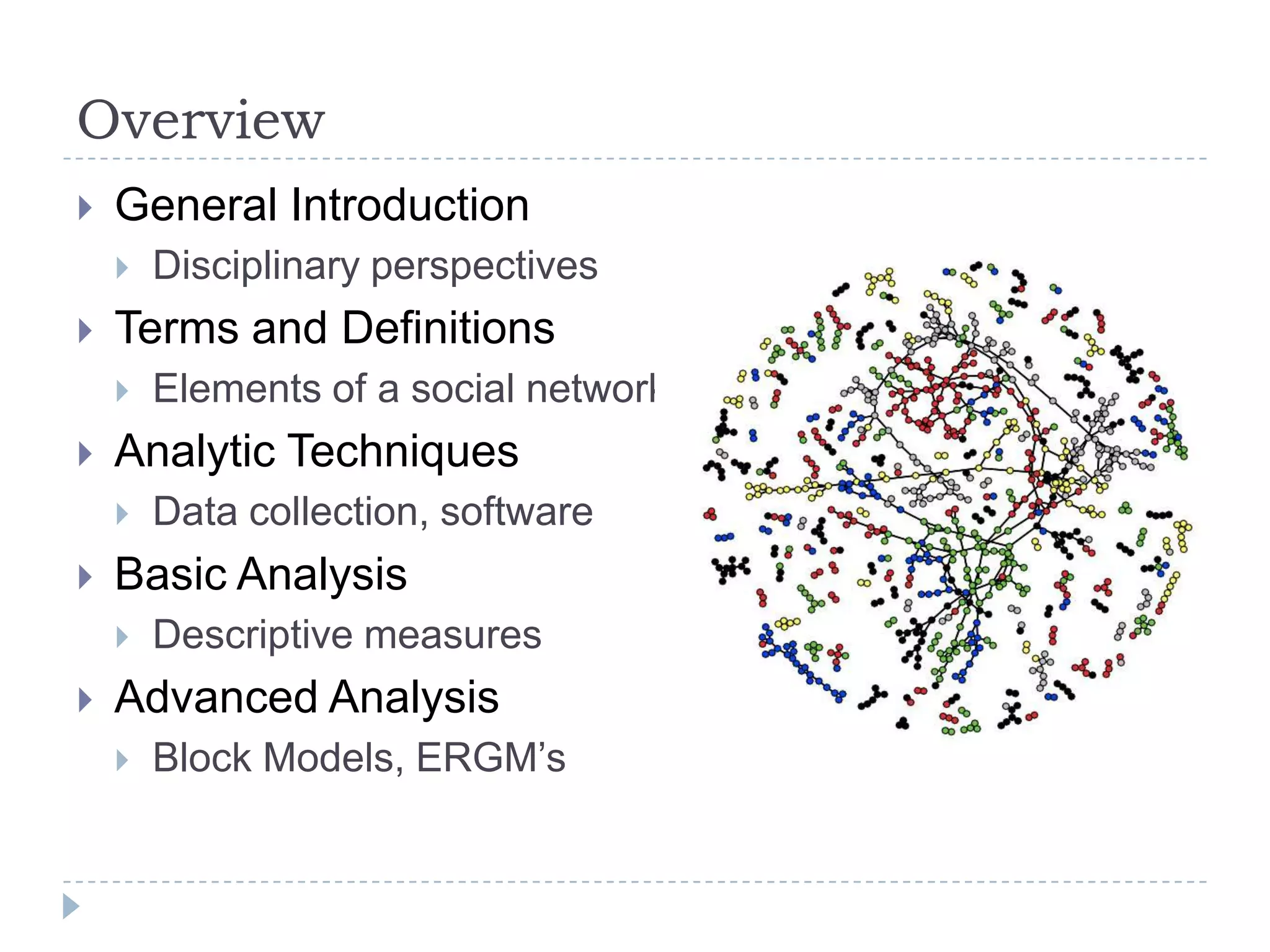
OverviewGeneral IntroductionDisciplinary perspectivesTerms and DefinitionsElements of a social networkAnalytic TechniquesData collection, softwareBasic AnalysisDescriptive measuresAdvanced AnalysisBlock Models, ERGM’s
The Social Network PerspectiveWhat is a social network?Wasserman and Faust:  “The social network perspective encompasses theories, models and applications that are expressed in terms of relational concepts and processes.  That is, relations defined by linkages among units are a fundamental component…” Wellman and Giulia:  “Social network analysis treats personal communities as networks whose composition, structure, and contents are defined from the standpoint of (a usually large sample of) focal individuals at their centers.” Burt:  “Network models describe the structure of one or more networks of relations within a system of actors.”
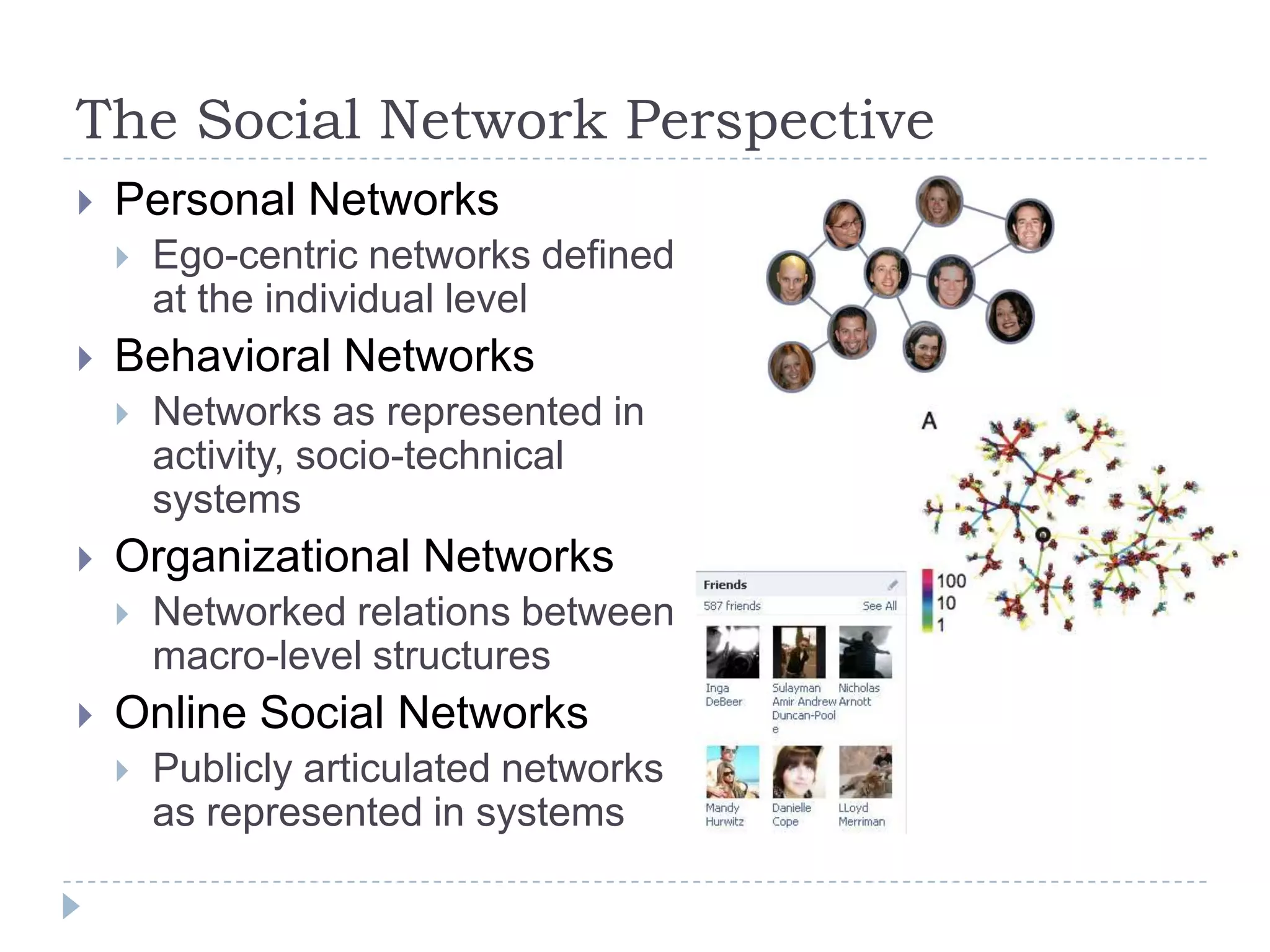
The Social Network PerspectivePersonal NetworksEgo-centric networks defined at the individual levelBehavioral NetworksNetworks as represented in activity, socio-technical systemsOrganizational NetworksNetworked relations between macro-level structuresOnline Social NetworksPublicly articulated networks as represented in systems
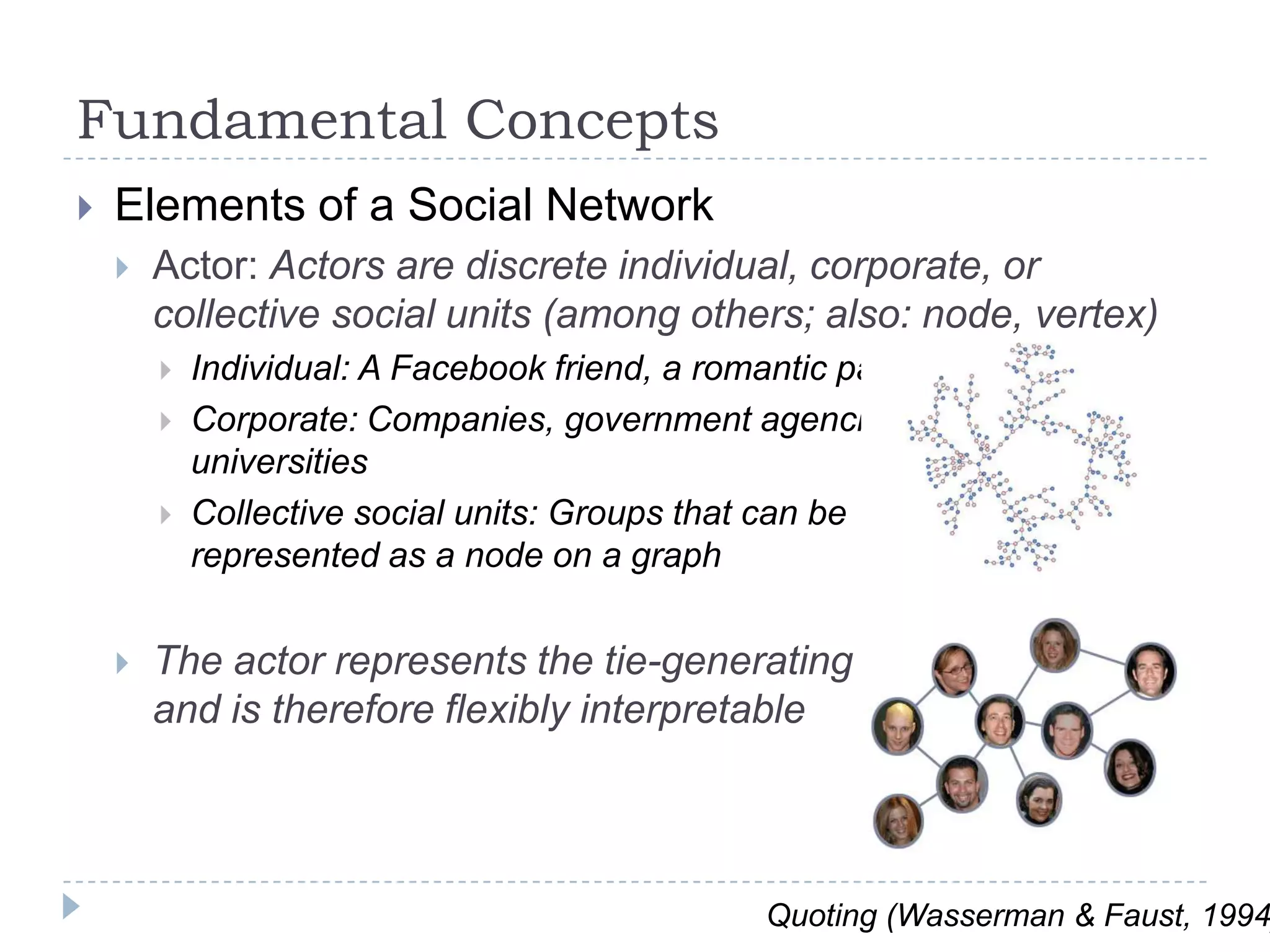
Fundamental ConceptsElements of a Social NetworkActor: Actors are discrete individual, corporate, or collective social units (among others; also: node, vertex)Individual: A Facebook friend, a romantic partnerCorporate: Companies, government agencies, universitiesCollective social units: Groups that can be represented as a node on a graphThe actor represents the tie-generating unitand is therefore flexibly interpretableQuoting (Wasserman & Faust, 1994)
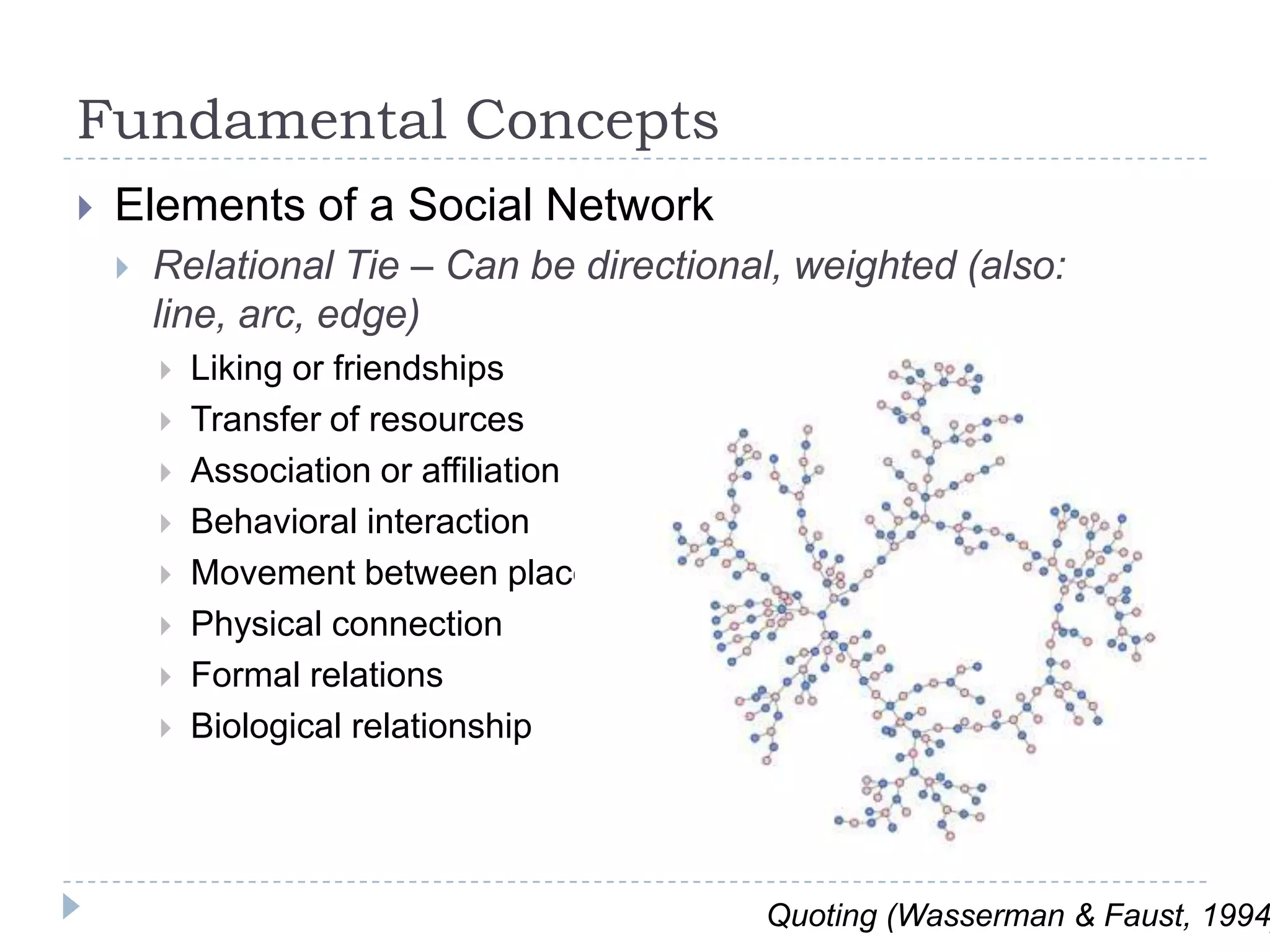
Fundamental ConceptsElements of a Social NetworkRelational Tie – Can be directional, weighted (also: line, arc, edge)Liking or friendshipsTransfer of resourcesAssociation or affiliationBehavioral interactionMovement between placesPhysical connectionFormal relationsBiological relationshipQuoting (Wasserman & Faust, 1994)
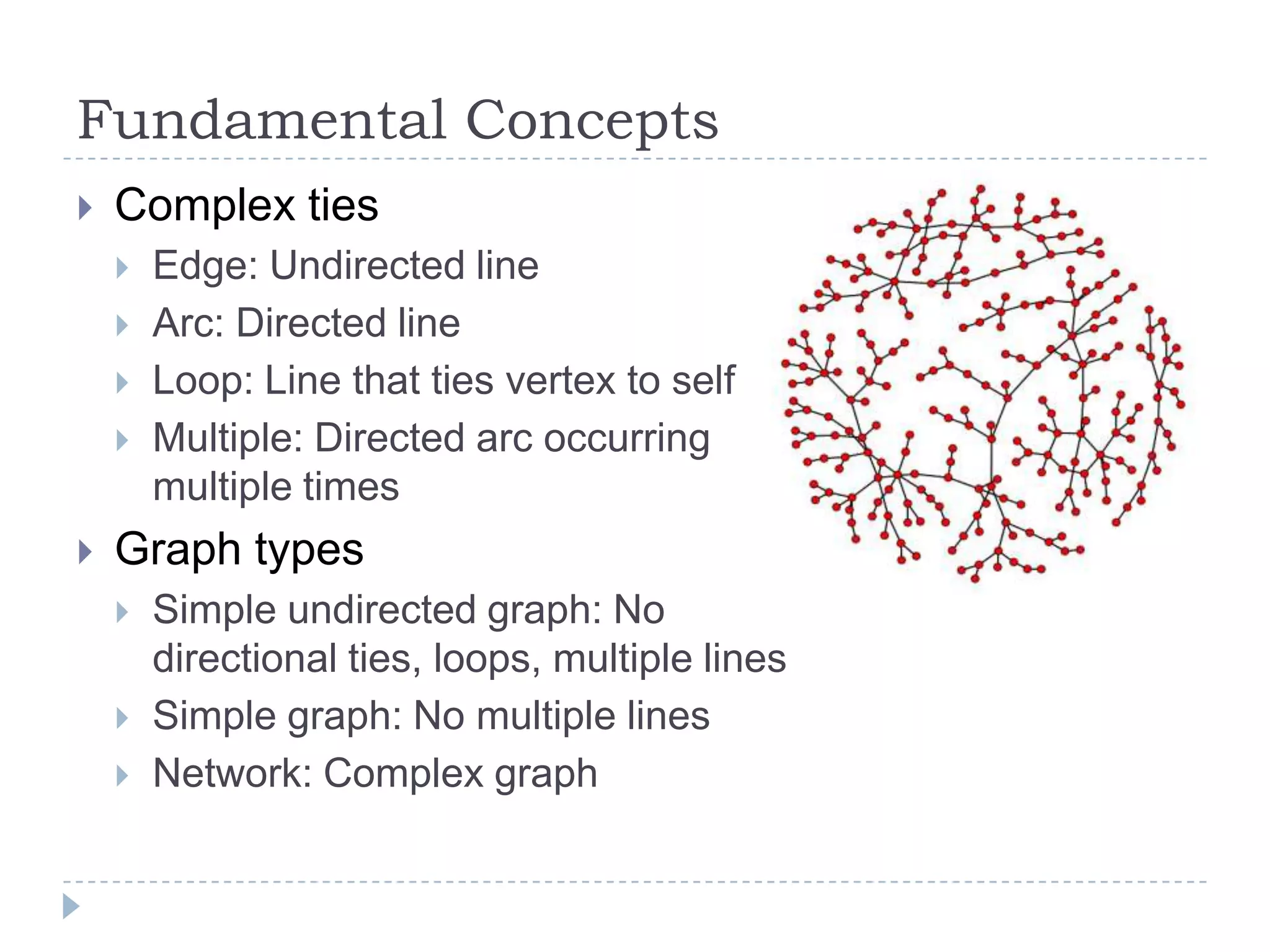
Fundamental ConceptsComplex tiesEdge: Undirected lineArc: Directed lineLoop: Line that ties vertex to selfMultiple: Directed arc occurring multiple timesGraph typesSimple undirected graph: No directional ties, loops, multiple linesSimple graph: No multiple linesNetwork: Complex graph
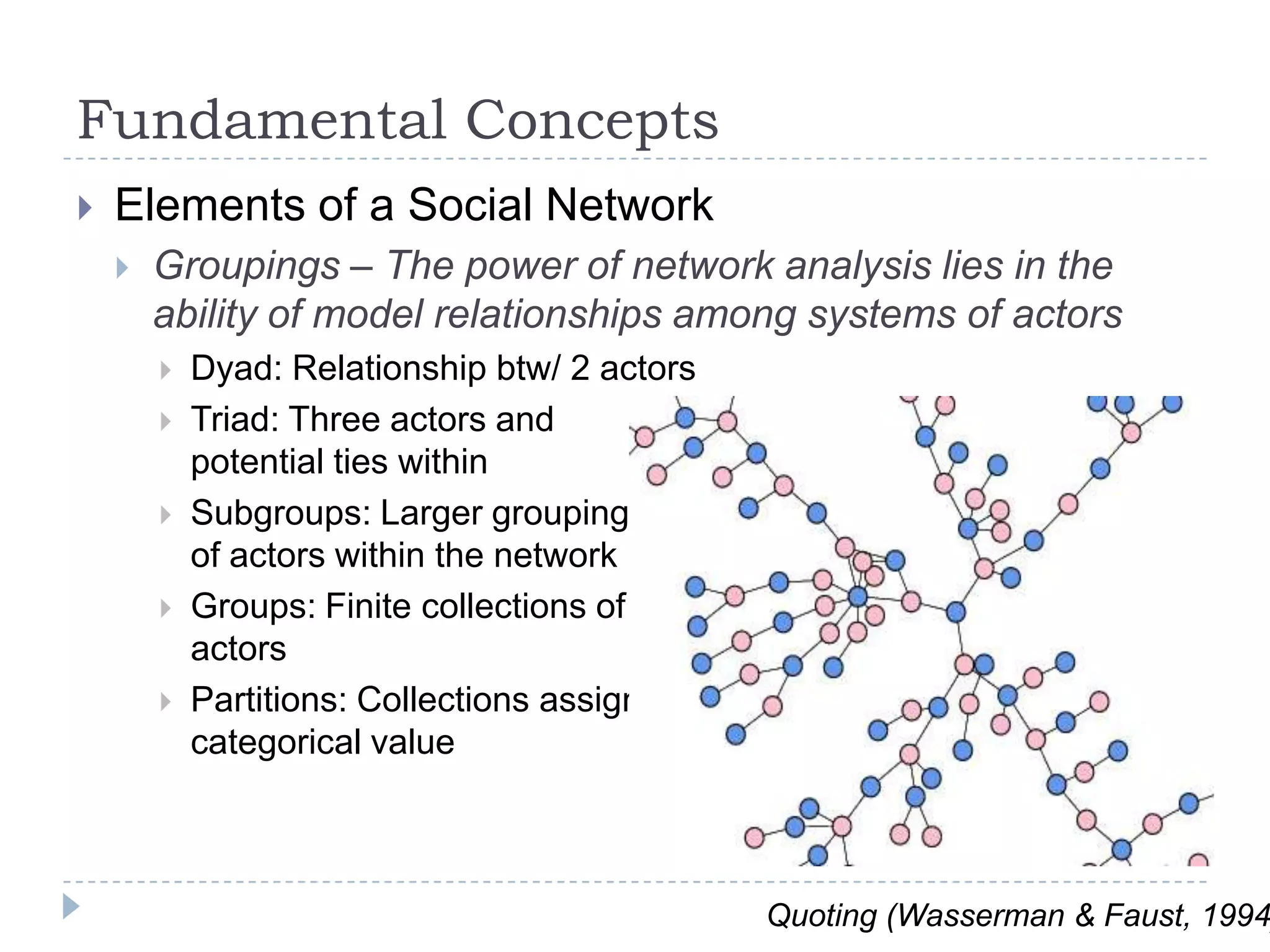
Fundamental ConceptsElements of a Social NetworkGroupings – The power of network analysis lies in the ability of model relationships among systems of actorsDyad: Relationship btw/ 2 actorsTriad: Three actors and potential ties withinSubgroups: Larger groupings of actors within the networkGroups: Finite collections ofactorsPartitions: Collections assignedcategorical valueQuoting (Wasserman & Faust, 1994)
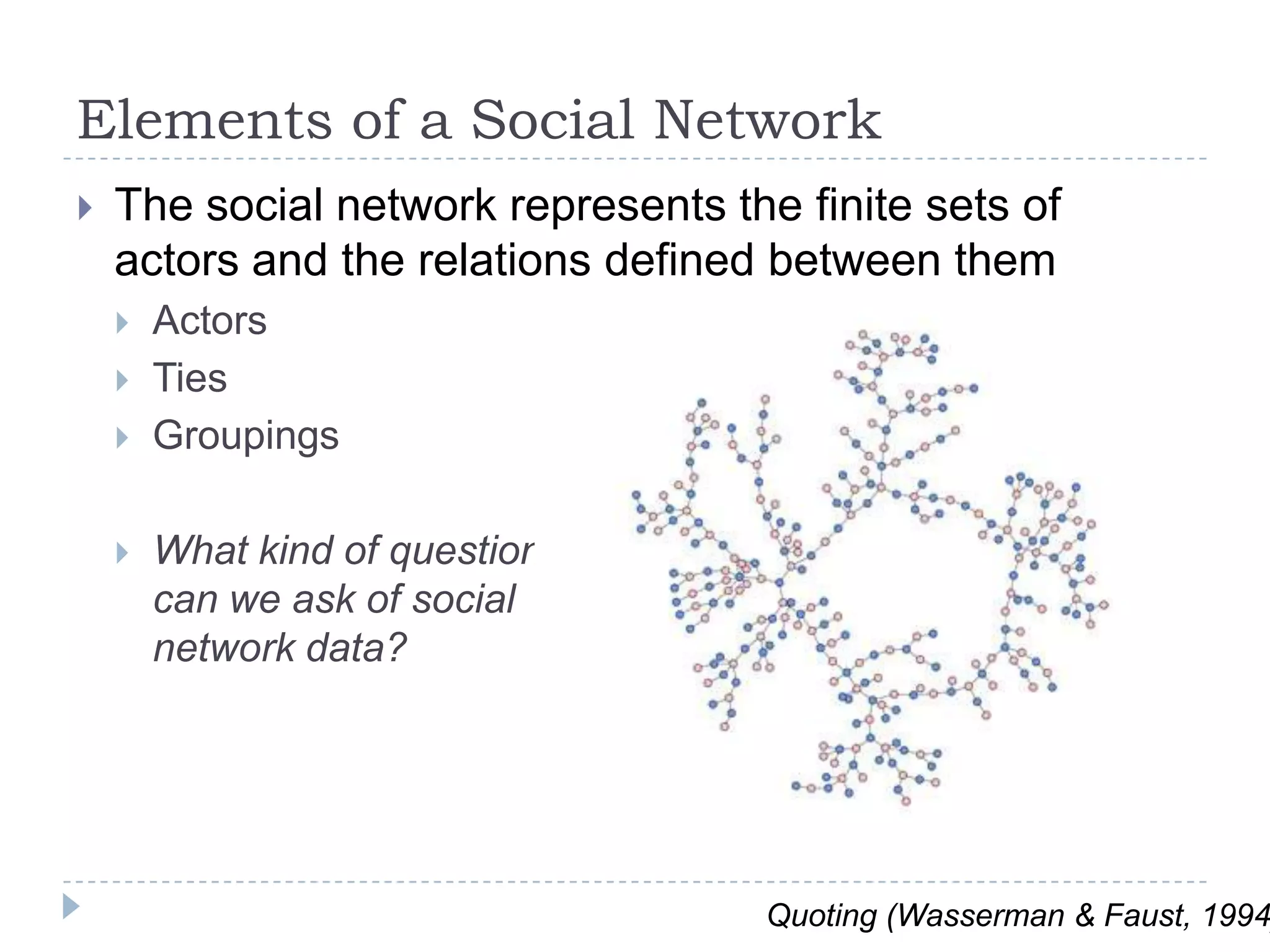
Elements of a Social NetworkThe social network represents the finite sets of actors and the relations defined between themActorsTiesGroupingsWhat kind of questions can we ask of social network data?Quoting (Wasserman & Faust, 1994)
Types of Social NetworksOne-mode network: Relations between a single set of actors	Marriage networks between peopleTransactions between companiesMovement between placesTwo-mode network: Relations between two sets of actorsDonor relationships between corporations and organizationsTwo-mode network: Affiliation network (one actor/one event)Memberships in clubs Participation on a board of directorsQuoting (Wasserman & Faust, 1994)
Types of Social NetworksEgo-centric or “personal” networksA network with a focal actor (the “ego”) and “alters” who have connections to the egoBearman/Moody study: Sexual relations w/altersGeneral Social Survey:  “From time to time, most people discuss important matters with other people.  Looking back over the last six months who are the people with whom you discussed matters that are important to you?Fischer: Relationship between geographical setting and support provided by the networkGulia and Wellman:  Supportive nature of ‘net contactsEllison, Steinfeld and Lampe: Socially supportive outcomes of Facebook useQuoting (Wasserman & Faust, 1994)
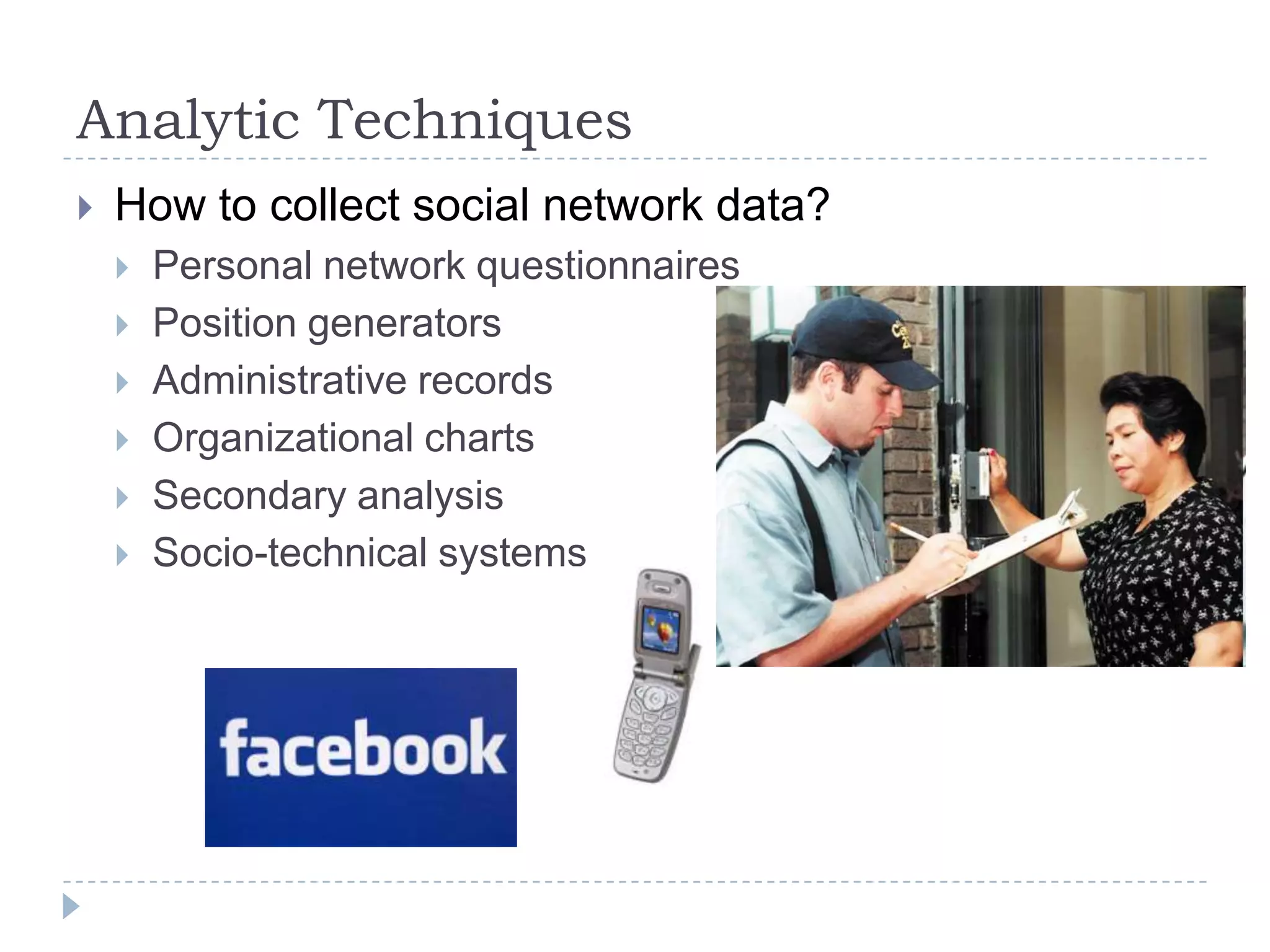
Analytic TechniquesHow to collect social network data?Personal network questionnairesPosition generatorsAdministrative recordsOrganizational chartsSecondary analysisSocio-technical systems
Analytic TechniquesWhat does SNA data look like?Edge lists[1,2 1,3 3,2]Adjacency matrix (symmetric)
Analytic TechniquesSoftware for AnalysisLarge number of software packages available for SNA Popular packagesPajek: http://vlado.fmf.uni-lj.si/pub/networks/pajek/UCINet: http://www.analytictech.com/ucinet/Gephi: http://gephi.org/Also: ORA, NodeXL, Network WorkbenchAdvanced packagesStatnet and iGraph packages in R (highly recommended): http://csde.washington.edu/statnet/JUNG, NetworkX (Libraries for Java and Ruby, C++ Lib?)Web toolsMany Eyes http://manyeyes.alphaworks.ibm.com/manyeyes/
Analyzing a Social NetworkBasic properties of social networksDescriptive statistics: How many actors, how many ties?Degree centrality: How many ties does each actor have; what kinds of actors have lots of ties, few ties.  Are more ties always better?Betweenness centrality: The connective properties of actors, hubs and authoritiesBetter to connect two disparate groups?Closeness centrality: Path length between actorsBetter to be closer to some people?Network centrality: Average path length to traverse a networkShorter paths better?Quoting (Wasserman & Faust, 1994)
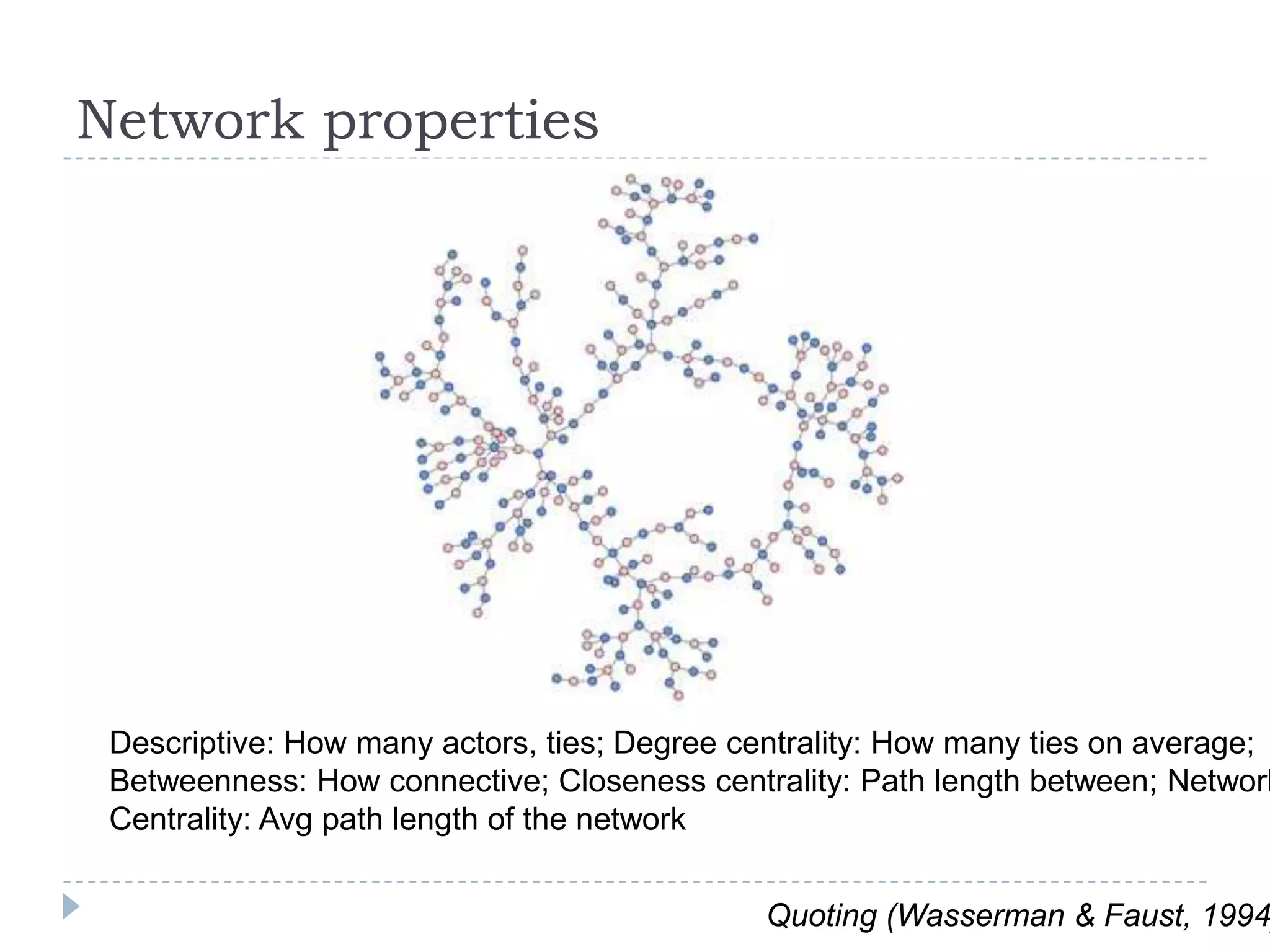
Network propertiesDescriptive: How many actors, ties; Degree centrality: How many ties on average;Betweenness: How connective; Closeness centrality: Path length between; NetworkCentrality: Avg path length of the networkQuoting (Wasserman & Faust, 1994)
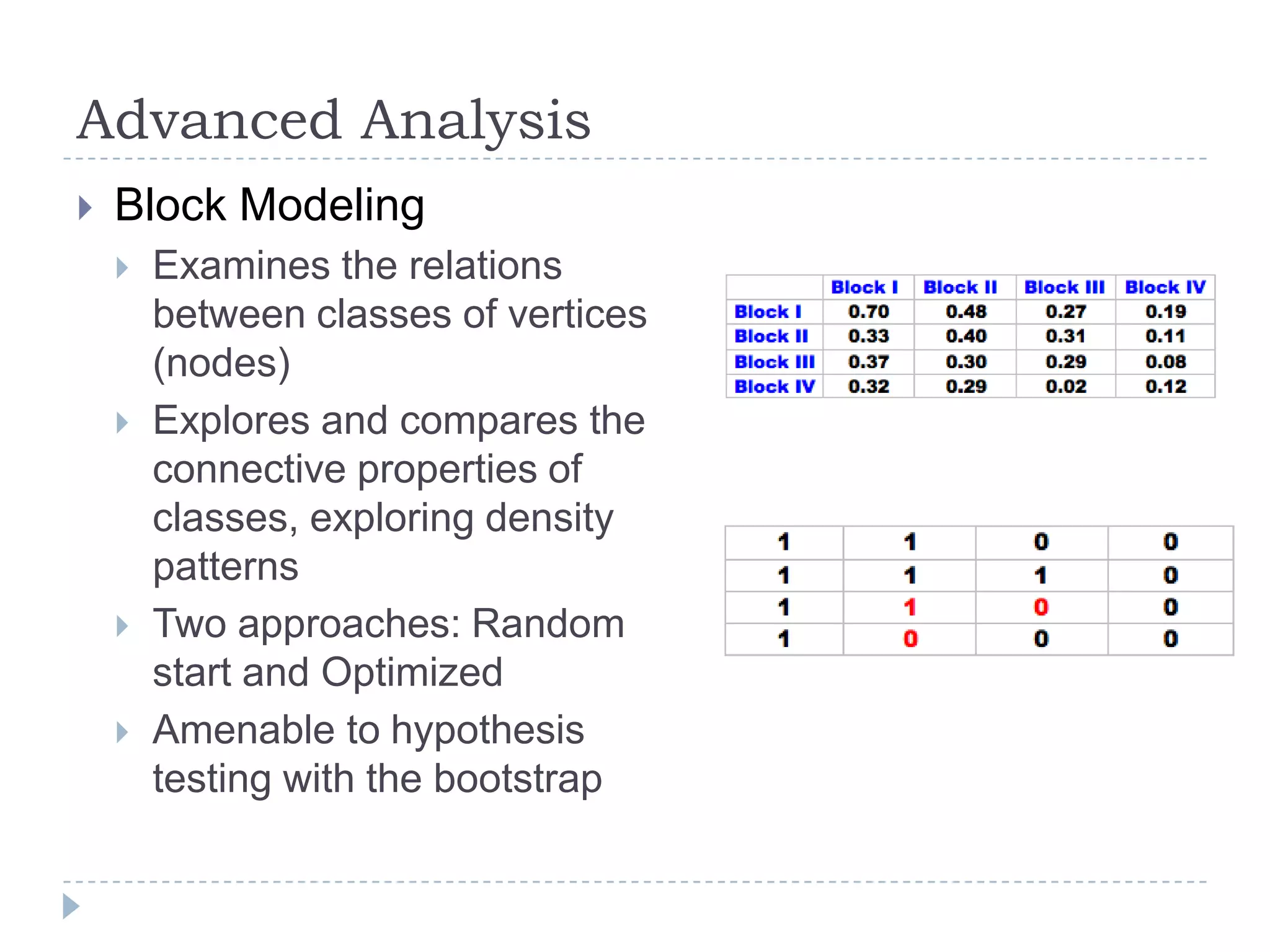
Advanced AnalysisBlock ModelingExamines the relations between classes of vertices (nodes)Explores and compares the connective properties of classes, exploring density patternsTwo approaches: Random start and OptimizedAmenable to hypothesis testing with the bootstrap
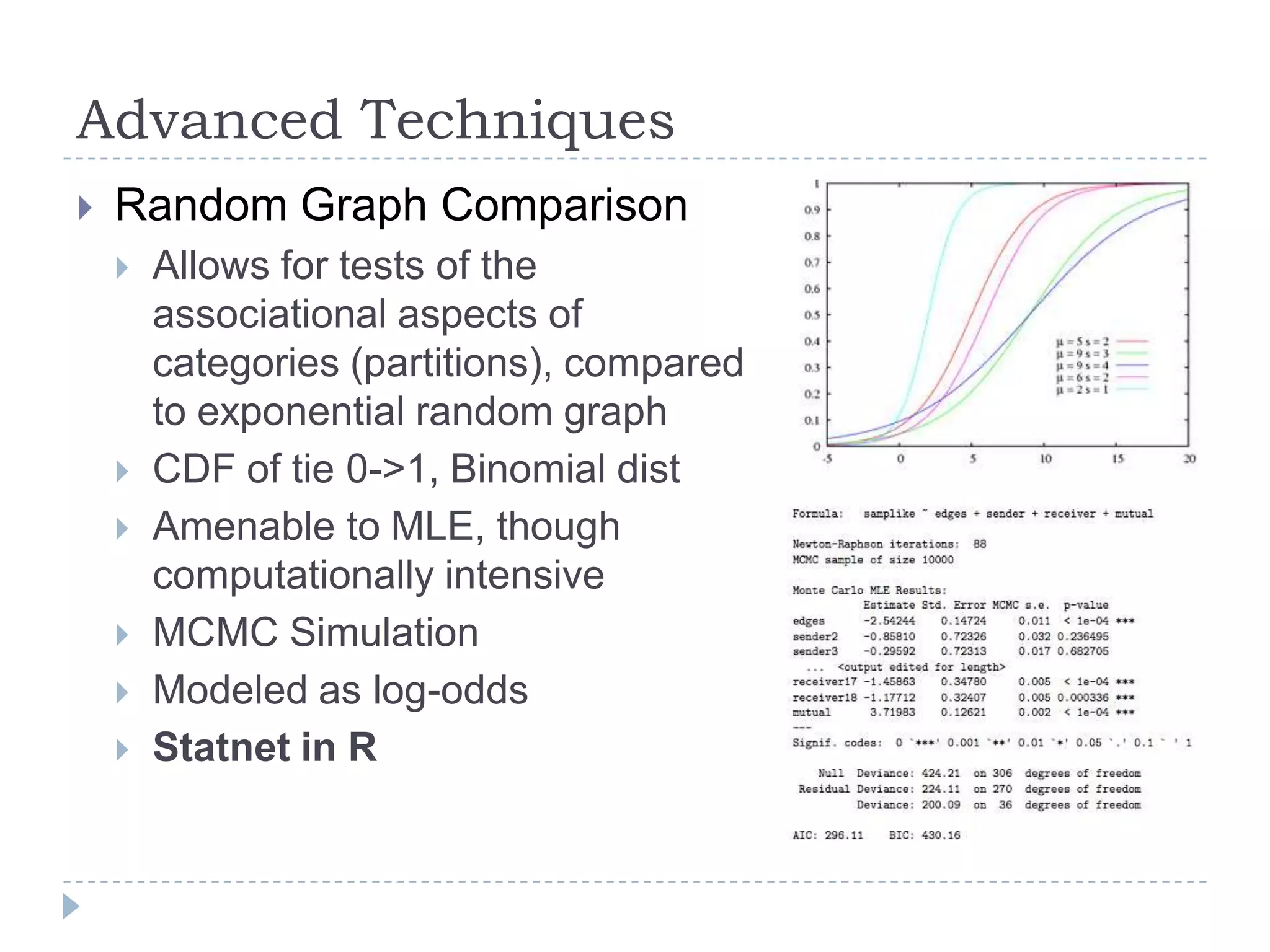
Advanced TechniquesRandom Graph ComparisonAllows for tests of the associational aspects of categories (partitions), compared to exponential random graphCDF of tie 0->1, Binomial distAmenable to MLE, though computationally intensiveMCMC Simulation Modeled as log-oddsStatnet in R
The Personal NetworkSummarizing the social networkComponents: Actors, Ties, Relationships and Groups Modes: One-Mode, Two-ModeMeasures: How many connections, who has the important connections, how dense is the network?Instruments: Name generators, position generators, scalesOutcomes: Social support, social capital, and a host of others.Why is the personal network important?
“Classic” SNA StudiesBearman, P. S., Moody, J., and Stovel, K.  (2004).  Chains of Affection: The Structure of Adolescent Romantic and Sexual Networks.  American Journal of Sociology, 110(1), 44--91.Padgett, J. and Ansell, C. K.  (1993).  Robust Action and the Rise of the Medici.  American Journal of Sociology, 98(6), 1259--1319. Framingham Heart Study in Christakis, N. and Fowler, J.  (2009).  Connected: The Surprising Power of Our Social Networks and How They Shape Our Lives.  New York, NY: Little Brown and Co.Wellman’s East York Studies, Fischer’s Personal Networks in Cities and TownsAdamic, L., Buyukkokten, O., and Adar, E.  (2003).  A Social Network Caught in the Web.  First Monday, 8(6).
ResourcesUseful Mailing ListsSOCNET CITASA (ASA)WebsitesINSNA: http://www.insna.org/SUNBELT Conference: http://www.insna.org/sunbelt/Recommended TextsDe Nooy’s et al.’s Pajek textWasserman and Faust’s Social Network AnalysisEasley and Kleinberg’s Networks, Crowds and Markets

Social Network Analysis

  • 1.
  • 2.
    OverviewGeneral IntroductionDisciplinary perspectivesTermsand DefinitionsElements of a social networkAnalytic TechniquesData collection, softwareBasic AnalysisDescriptive measuresAdvanced AnalysisBlock Models, ERGM’s
  • 3.
    The Social NetworkPerspectiveWhat is a social network?Wasserman and Faust: “The social network perspective encompasses theories, models and applications that are expressed in terms of relational concepts and processes. That is, relations defined by linkages among units are a fundamental component…” Wellman and Giulia: “Social network analysis treats personal communities as networks whose composition, structure, and contents are defined from the standpoint of (a usually large sample of) focal individuals at their centers.” Burt: “Network models describe the structure of one or more networks of relations within a system of actors.”
  • 4.
    The Social NetworkPerspectivePersonal NetworksEgo-centric networks defined at the individual levelBehavioral NetworksNetworks as represented in activity, socio-technical systemsOrganizational NetworksNetworked relations between macro-level structuresOnline Social NetworksPublicly articulated networks as represented in systems
  • 5.
    Fundamental ConceptsElements ofa Social NetworkActor: Actors are discrete individual, corporate, or collective social units (among others; also: node, vertex)Individual: A Facebook friend, a romantic partnerCorporate: Companies, government agencies, universitiesCollective social units: Groups that can be represented as a node on a graphThe actor represents the tie-generating unitand is therefore flexibly interpretableQuoting (Wasserman & Faust, 1994)
  • 6.
    Fundamental ConceptsElements ofa Social NetworkRelational Tie – Can be directional, weighted (also: line, arc, edge)Liking or friendshipsTransfer of resourcesAssociation or affiliationBehavioral interactionMovement between placesPhysical connectionFormal relationsBiological relationshipQuoting (Wasserman & Faust, 1994)
  • 7.
    Fundamental ConceptsComplex tiesEdge:Undirected lineArc: Directed lineLoop: Line that ties vertex to selfMultiple: Directed arc occurring multiple timesGraph typesSimple undirected graph: No directional ties, loops, multiple linesSimple graph: No multiple linesNetwork: Complex graph
  • 8.
    Fundamental ConceptsElements ofa Social NetworkGroupings – The power of network analysis lies in the ability of model relationships among systems of actorsDyad: Relationship btw/ 2 actorsTriad: Three actors and potential ties withinSubgroups: Larger groupings of actors within the networkGroups: Finite collections ofactorsPartitions: Collections assignedcategorical valueQuoting (Wasserman & Faust, 1994)
  • 9.
    Elements of aSocial NetworkThe social network represents the finite sets of actors and the relations defined between themActorsTiesGroupingsWhat kind of questions can we ask of social network data?Quoting (Wasserman & Faust, 1994)
  • 10.
    Types of SocialNetworksOne-mode network: Relations between a single set of actors Marriage networks between peopleTransactions between companiesMovement between placesTwo-mode network: Relations between two sets of actorsDonor relationships between corporations and organizationsTwo-mode network: Affiliation network (one actor/one event)Memberships in clubs Participation on a board of directorsQuoting (Wasserman & Faust, 1994)
  • 11.
    Types of SocialNetworksEgo-centric or “personal” networksA network with a focal actor (the “ego”) and “alters” who have connections to the egoBearman/Moody study: Sexual relations w/altersGeneral Social Survey: “From time to time, most people discuss important matters with other people.  Looking back over the last six months who are the people with whom you discussed matters that are important to you?Fischer: Relationship between geographical setting and support provided by the networkGulia and Wellman: Supportive nature of ‘net contactsEllison, Steinfeld and Lampe: Socially supportive outcomes of Facebook useQuoting (Wasserman & Faust, 1994)
  • 12.
    Analytic TechniquesHow tocollect social network data?Personal network questionnairesPosition generatorsAdministrative recordsOrganizational chartsSecondary analysisSocio-technical systems
  • 13.
    Analytic TechniquesWhat doesSNA data look like?Edge lists[1,2 1,3 3,2]Adjacency matrix (symmetric)
  • 14.
    Analytic TechniquesSoftware forAnalysisLarge number of software packages available for SNA Popular packagesPajek: http://vlado.fmf.uni-lj.si/pub/networks/pajek/UCINet: http://www.analytictech.com/ucinet/Gephi: http://gephi.org/Also: ORA, NodeXL, Network WorkbenchAdvanced packagesStatnet and iGraph packages in R (highly recommended): http://csde.washington.edu/statnet/JUNG, NetworkX (Libraries for Java and Ruby, C++ Lib?)Web toolsMany Eyes http://manyeyes.alphaworks.ibm.com/manyeyes/
  • 15.
    Analyzing a SocialNetworkBasic properties of social networksDescriptive statistics: How many actors, how many ties?Degree centrality: How many ties does each actor have; what kinds of actors have lots of ties, few ties. Are more ties always better?Betweenness centrality: The connective properties of actors, hubs and authoritiesBetter to connect two disparate groups?Closeness centrality: Path length between actorsBetter to be closer to some people?Network centrality: Average path length to traverse a networkShorter paths better?Quoting (Wasserman & Faust, 1994)
  • 16.
    Network propertiesDescriptive: Howmany actors, ties; Degree centrality: How many ties on average;Betweenness: How connective; Closeness centrality: Path length between; NetworkCentrality: Avg path length of the networkQuoting (Wasserman & Faust, 1994)
  • 17.
    Advanced AnalysisBlock ModelingExaminesthe relations between classes of vertices (nodes)Explores and compares the connective properties of classes, exploring density patternsTwo approaches: Random start and OptimizedAmenable to hypothesis testing with the bootstrap
  • 18.
    Advanced TechniquesRandom GraphComparisonAllows for tests of the associational aspects of categories (partitions), compared to exponential random graphCDF of tie 0->1, Binomial distAmenable to MLE, though computationally intensiveMCMC Simulation Modeled as log-oddsStatnet in R
  • 19.
    The Personal NetworkSummarizingthe social networkComponents: Actors, Ties, Relationships and Groups Modes: One-Mode, Two-ModeMeasures: How many connections, who has the important connections, how dense is the network?Instruments: Name generators, position generators, scalesOutcomes: Social support, social capital, and a host of others.Why is the personal network important?
  • 20.
    “Classic” SNA StudiesBearman,P. S., Moody, J., and Stovel, K. (2004). Chains of Affection: The Structure of Adolescent Romantic and Sexual Networks. American Journal of Sociology, 110(1), 44--91.Padgett, J. and Ansell, C. K. (1993). Robust Action and the Rise of the Medici. American Journal of Sociology, 98(6), 1259--1319. Framingham Heart Study in Christakis, N. and Fowler, J. (2009). Connected: The Surprising Power of Our Social Networks and How They Shape Our Lives. New York, NY: Little Brown and Co.Wellman’s East York Studies, Fischer’s Personal Networks in Cities and TownsAdamic, L., Buyukkokten, O., and Adar, E. (2003). A Social Network Caught in the Web. First Monday, 8(6).
  • 21.
    ResourcesUseful Mailing ListsSOCNETCITASA (ASA)WebsitesINSNA: http://www.insna.org/SUNBELT Conference: http://www.insna.org/sunbelt/Recommended TextsDe Nooy’s et al.’s Pajek textWasserman and Faust’s Social Network AnalysisEasley and Kleinberg’s Networks, Crowds and Markets