SOCIAL NETWORK
ANALYSIS
HASHANNA LOCKHART
WHAT IS SOCIAL NETWORK
ANALYSIS?
• Degree Centrality, Betweenness
Centrality, and Closeness CentralityMeasuring
• Data Modeling, ER Modeling, R StudioMapping
• Relationships between data that is
collectedInterpreting
BACKGROUND INFORMATION
• Social Network Analysis
• Social network researchers
evaluate the location and
grouping of actors in
networks to understand
these networks and
participants.
• Different Centralities are
used to measure the
information.
MEASURING
Degree Centrality
Measure a node’s
network activity using
degrees (the number
of direct connections a
node has).
Someone with the
most direct
connections is the
hub.
Betweenness
Centrality
The node is between
two important
constituencies
Without them, the
network can fail easily
Closeness Centrality
Node has fewer
connections
Access to all nodes in
a network more
quickly because they
have the shortest
paths
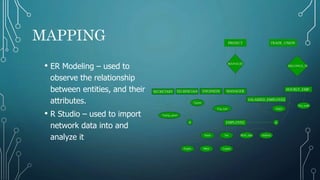
MAPPING
• ER Modeling – used to
observe the relationship
between entities, and their
attributes.
• R Studio – used to import
network data into and
analyze it
TOPICS I FOUND
HELPFUL/INTERESTING
• The idea of social network analysis
• It intrigued me that researchers find that even though two people
may not know each other directly, they may share the same network.
• The use of ER modeling in social analysis was interesting to see
because I understood the contents of an ER model and I was able to
understand why/how they use them.
IMAGE SOURCES
Background Information:
http://leadershiplearning.org/blog/zoe-madden-wood/2013-
03-28/why-social-network-analysis
Mapping:
https://www.geeksforgeeks.org/enhanced-er-model/

Social network analysis