Networked Information
Behavior in Life Transition
Fred Stutzman
Ph.D. Defense, December 8, 2010
Outline of the Talk
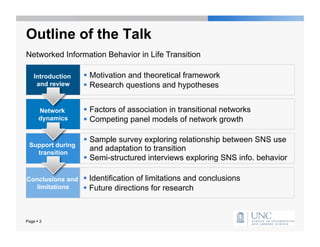
Networked Information Behavior in Life Transition

   Introduction     Motivation and theoretical framework
    and review      Research questions and hypotheses


      Network       Factors of association in transitional networks
      dynamics      Competing panel models of network growth

                    Sample survey exploring relationship between SNS use
 Support during
   transition
                     and adaptation to transition
                    Semi-structured interviews exploring SNS info. behavior

Conclusions and     Identification of limitations and conclusions
   limitations      Future directions for research


Page  2
Acknowledgements

 Dr. Gary Marchionini, advisor
 Dr. Deborah Barreau, committee member
 Dr. danah boyd, committee member
 Dr. Sri Kalyanaraman, committee member
 Paul Jones, MFA, committee member
 Chelcy Boyer Stutzman, MSLS, invaluable

Page  3
Motivation

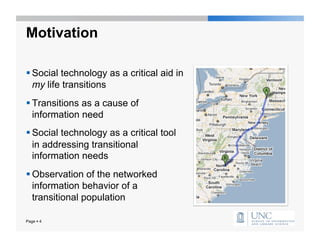
 Social technology as a critical aid in
  my life transitions
 Transitions as a cause of
  information need
 Social technology as a critical tool
  in addressing transitional
  information needs
 Observation of the networked
  information behavior of a
  transitional population

Page  4
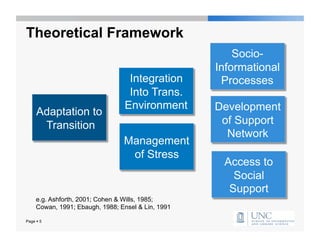
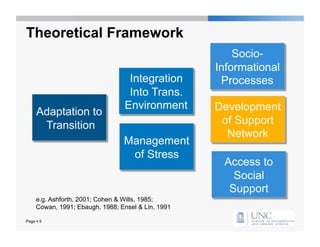
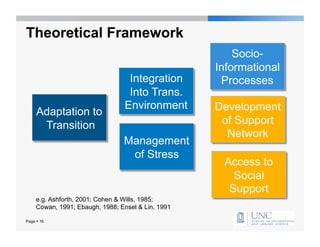
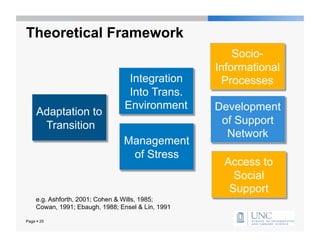
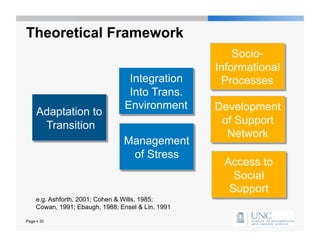
Theoretical Framework
                                                        Socio-
                                                    Informational
                                  Integration        Processes
                                  Into Trans.
                                 Environment        Development
     Adaptation to
      Transition                                     of Support
                                                      Network
                                 Management
                                  of Stress
                                                     Access to
                                                       Social
                                                      Support
     e.g. Ashforth, 2001; Cohen & Wills, 1985;
     Cowan, 1991; Ebaugh, 1988; Ensel & Lin, 1991

Page  5
Research Theme
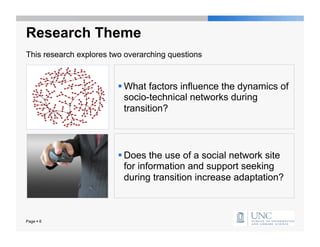
This research explores two overarching questions


                          What factors influence the dynamics of
                           socio-technical networks during
                           transition?


                          Does the use of a social network site
                           for information and support seeking
                           during transition increase adaptation?


Page  6
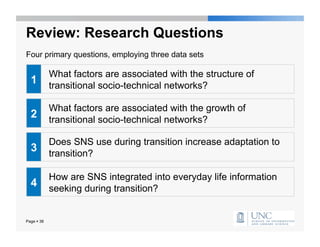
Research Questions
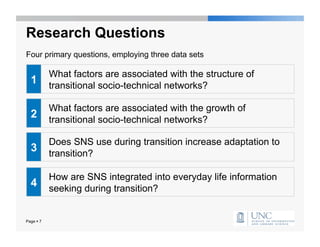
Four primary questions, employing three data sets

           What factors are associated with the structure of
  1        transitional socio-technical networks?

           What factors are associated with the growth of
  2        transitional socio-technical networks?

           Does SNS use during transition increase adaptation to
  3        transition?

           How are SNS integrated into everyday life information
  4        seeking during transition?


Page  7
Research Question 1
Factors of association in transitional networks

 What are the graph dynamics of a transitional socio-
  technical network?
   -  e.g. Morris, 1998; Wasserman & Faust, 1994

 What common factors are associated with the production
  of ties in a transitional socio-technical network?
   -  e.g. Blau, 1977; McPherson & Ranger-Moore, 1991; McPherson, Smith-
      Lovin & Cook, 2001

 Do the strength of the associative factors change over
  time?


Page  8
Theoretical Framework
                                                        Socio-
                                                    Informational
                                  Integration        Processes
                                  Into Trans.
                                 Environment        Development
     Adaptation to
      Transition                                     of Support
                                                      Network
                                 Management
                                  of Stress
                                                     Access to
                                                       Social
                                                      Support
     e.g. Ashforth, 2001; Cohen & Wills, 1985;
     Cowan, 1991; Ebaugh, 1988; Ensel & Lin, 1991

Page  9
Research Question 1
Factors of association in transitional networks

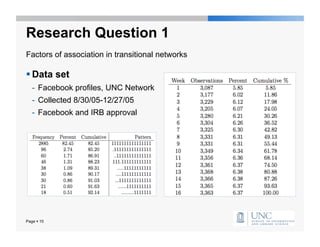
 Data set
   -  Facebook profiles, UNC Network
   -  Collected 8/30/05-12/27/05
   -  Facebook and IRB approval


Page  10
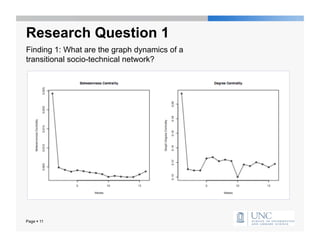
Research Question 1
Finding 1: What are the graph dynamics of a
transitional socio-technical network?


Page  11
Research Question 1
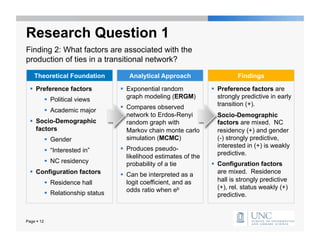
Finding 2: What factors are associated with the
production of ties in a transitional network?

    Theoretical Foundation              Analytical Approach                     Findings

    Preference factors                Exponential random              Preference factors are
              Political views          graph modeling (ERGM)            strongly predictive in early
                                       Compares observed                transition (+).
              Academic major
                                        network to Erdos-Renyi          Socio-Demographic
    Socio-Demographic                  random graph with                factors are mixed. NC
     factors                            Markov chain monte carlo         residency (+) and gender
              Gender                   simulation (MCMC)                (-) strongly predictive,
                                       Produces pseudo-                 interested in (+) is weakly
              “Interested in”                                           predictive.
                                        likelihood estimates of the
              NC residency             probability of a tie            Configuration factors
    Configuration factors             Can be interpreted as a          are mixed. Residence
              Residence hall           logit coefficient, and as        hall is strongly predictive
                                        odds ratio when eb               (+), rel. status weakly (+)
              Relationship status                                       predictive.


Page  12
Research Question 1
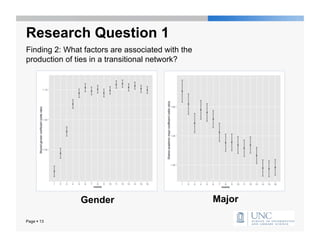
Finding 2: What factors are associated with the
production of ties in a transitional network?


               Gender                             Major

Page  13
Research Question 1
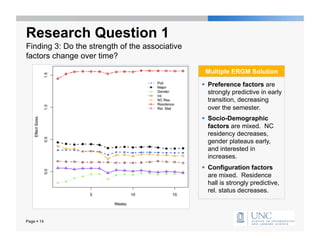
Finding 3: Do the strength of the associative
factors change over time?
                                                 Multiple ERGM Solution

                                                  Preference factors are
                                                   strongly predictive in early
                                                   transition, decreasing
                                                   over the semester.
                                                  Socio-Demographic
                                                   factors are mixed. NC
                                                   residency decreases,
                                                   gender plateaus early,
                                                   and interested in
                                                   increases.
                                                  Configuration factors
                                                   are mixed. Residence
                                                   hall is strongly predictive,
                                                   rel. status decreases.


Page  14
Research Question 2
Factors associated with growth of transitional networks

 What profile elements are significantly associated with
  network size, and at what magnitude
   -  Panel replication of Lampe, Ellison & Steinfield, 2007
   -  Novel panel model with dynamic predictor

 Does dorm placement exert a significant and robust
  effect on growth trajectories of socio-technical networks
  in transition?
   -  Data set is the freshman Facebook set employed in RQ 1 (in
      derivative form)
   -  Estimated with multi-level regression analyses


Page  15
Theoretical Framework
                                                        Socio-
                                                    Informational
                                  Integration        Processes
                                  Into Trans.
                                 Environment        Development
     Adaptation to
      Transition                                     of Support
                                                      Network
                                 Management
                                  of Stress
                                                     Access to
                                                       Social
                                                      Support
     e.g. Ashforth, 2001; Cohen & Wills, 1985;
     Cowan, 1991; Ebaugh, 1988; Ensel & Lin, 1991

Page  16
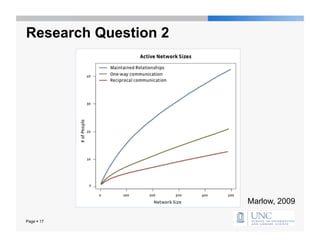
Research Question 2


                      Marlow, 2009

Page  17
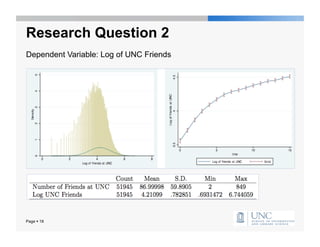
Research Question 2
Dependent Variable: Log of UNC Friends


Page  18
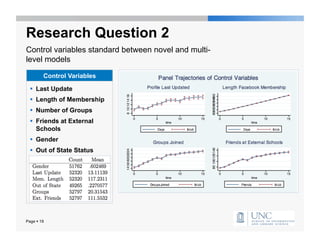
Research Question 2
Control variables standard between novel and multi-
level models

        Control Variables

    Last Update
    Length of Membership
    Number of Groups
    Friends at External
     Schools
    Gender
    Out of State Status


Page  19
Research Question 2
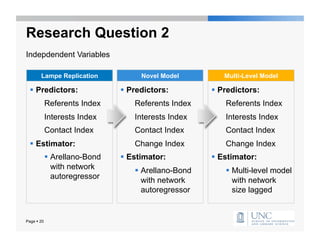
Indepdendent Variables

       Lampe Replication             Novel Model         Multi-Level Model

    Predictors:                 Predictors:           Predictors:
            Referents Index        Referents Index        Referents Index
            Interests Index        Interests Index        Interests Index
            Contact Index          Contact Index          Contact Index
    Estimator:                    Change Index           Change Index
              Arellano-Bond     Estimator:            Estimator:
               with network          Arellano-Bond         Multi-level model
               autoregressor          with network           with network
                                      autoregressor          size lagged


Page  20
Research Question 2
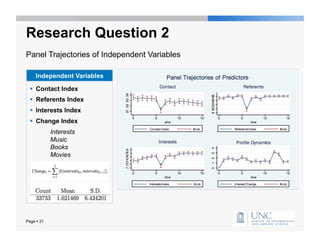
Panel Trajectories of Independent Variables

    Independent Variables

    Contact Index
    Referents Index
    Interests Index
    Change Index
            Interests
            Music
            Books
            Movies


Page  21
Research Question 2
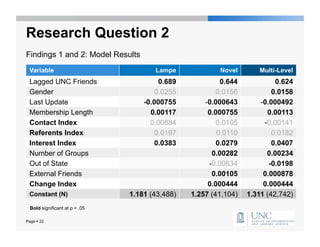
Findings 1 and 2: Model Results
 Variable                              Lampe             Novel       Multi-Level
 Lagged UNC Friends                      0.689            0.644            0.624
 Gender                                 0.0255           0.0156           0.0158
 Last Update                        -0.000755        -0.000643        -0.000492
 Membership Length                    0.00117         0.000755          0.00113
 Contact Index                        0.00884            0.0105        -0.00141
 Referents Index                        0.0197           0.0110           0.0182
 Interest Index                         0.0383           0.0279           0.0407
 Number of Groups                                      0.00282          0.00234
 Out of State                                         -0.00634           -0.0198
 External Friends                                      0.00105         0.000878
 Change Index                                         0.000444         0.000444
 Constant (N)                   1.181 (43,488)   1.257 (41,104)   1.311 (42,742)
  Bold significant at p < .05

Page  22
Research Question 2
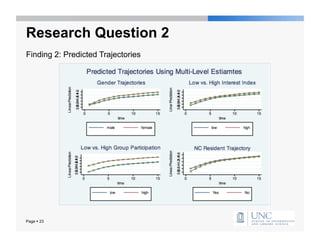
Finding 2: Predicted Trajectories


Page  23
Research Question 3
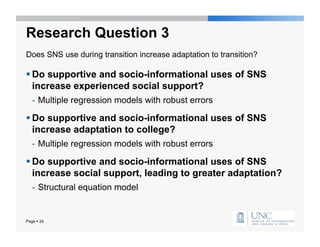
Does SNS use during transition increase adaptation to transition?

 Do supportive and socio-informational uses of SNS
  increase experienced social support?
   -  Multiple regression models with robust errors

 Do supportive and socio-informational uses of SNS
  increase adaptation to college?
   -  Multiple regression models with robust errors

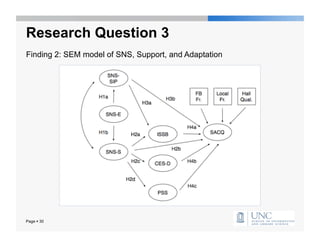
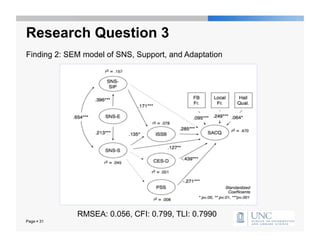
 Do supportive and socio-informational uses of SNS
  increase social support, leading to greater adaptation?
   -  Structural equation model


Page  24
Theoretical Framework
                                                        Socio-
                                                    Informational
                                  Integration        Processes
                                  Into Trans.
                                 Environment        Development
     Adaptation to
      Transition                                     of Support
                                                      Network
                                 Management
                                  of Stress
                                                     Access to
                                                       Social
                                                      Support
     e.g. Ashforth, 2001; Cohen & Wills, 1985;
     Cowan, 1991; Ebaugh, 1988; Ensel & Lin, 1991

Page  25
Research Question 3
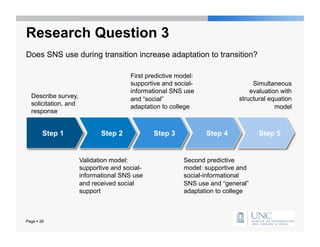
Does SNS use during transition increase adaptation to transition?

                                       First predictive model:
                                       supportive and social-                   Simultaneous
                                       informational SNS use                   evaluation with
  Describe survey,                     and “social”                        structural equation
  solicitation, and                    adaptation to college                            model
  response


        Step 1               Step 2            Step 3            Step 4           Step 5


                      Validation model:                   Second predictive
                      supportive and social-              model: supportive and
                      informational SNS use               social-informational
                      and received social                 SNS use and “general”
                      support                             adaptation to college


Page  26
Research Question 3
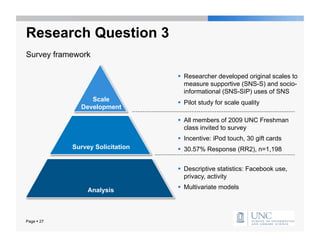
Survey framework

                                    Researcher developed original scales to
                                     measure supportive (SNS-S) and socio-
                                     informational (SNS-SIP) uses of SNS
                 Scale              Pilot study for scale quality
              Development

                                    All members of 2009 UNC Freshman
                                     class invited to survey
                                    Incentive: iPod touch, 30 gift cards
            Survey Solicitation     30.57% Response (RR2), n=1,198


                                    Descriptive statistics: Facebook use,
                                     privacy, activity

                 Analysis           Multivariate models


Page  27
Research Question 3
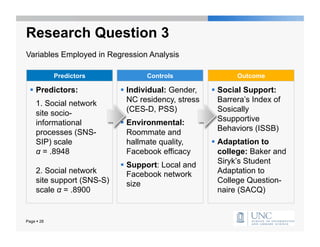
Variables Employed in Regression Analysis

            Predictors             Controls                  Outcome

    Predictors:              Individual: Gender,      Social Support:
     1. Social network         NC residency, stress      Barrera’s Index of
     site socio-               (CES-D, PSS)              Sosically
     informational            Environmental:            Ssupportive
     processes (SNS-           Roommate and              Behaviors (ISSB)
     SIP) scale                hallmate quality,        Adaptation to
     α = .8948                 Facebook efficacy         college: Baker and
                              Support: Local and        Siryk’s Student
     2. Social network         Facebook network          Adaptation to
     site support (SNS-S)      size                      College Question-
     scale α = .8900                                     naire (SACQ)


Page  28
Research Question 3
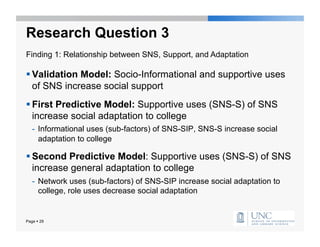
Finding 1: Relationship between SNS, Support, and Adaptation

 Validation Model: Socio-Informational and supportive uses
  of SNS increase social support
 First Predictive Model: Supportive uses (SNS-S) of SNS
  increase social adaptation to college
   -  Informational uses (sub-factors) of SNS-SIP, SNS-S increase social
      adaptation to college

 Second Predictive Model: Supportive uses (SNS-S) of SNS
  increase general adaptation to college
   -  Network uses (sub-factors) of SNS-SIP increase social adaptation to
      college, role uses decrease social adaptation


Page  29
Research Question 3
Finding 2: SEM model of SNS, Support, and Adaptation


Page  30
Research Question 3
Finding 2: SEM model of SNS, Support, and Adaptation


             RMSEA: 0.056, CFI: 0.799, TLI: 0.7990
Page  31
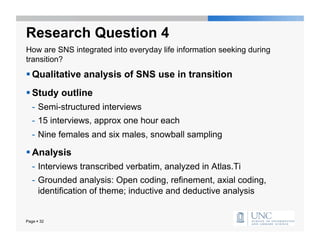
Research Question 4
How are SNS integrated into everyday life information seeking during
transition?
 Qualitative analysis of SNS use in transition
 Study outline
   -  Semi-structured interviews
   -  15 interviews, approx one hour each
   -  Nine females and six males, snowball sampling

 Analysis
   -  Interviews transcribed verbatim, analyzed in Atlas.Ti
   -  Grounded analysis: Open coding, refinement, axial coding,
      identification of theme; inductive and deductive analysis


Page  32
Theoretical Framework
                                                        Socio-
                                                    Informational
                                  Integration        Processes
                                  Into Trans.
                                 Environment        Development
     Adaptation to
      Transition                                     of Support
                                                      Network
                                 Management
                                  of Stress
                                                     Access to
                                                       Social
                                                      Support
     e.g. Ashforth, 2001; Cohen & Wills, 1985;
     Cowan, 1991; Ebaugh, 1988; Ensel & Lin, 1991

Page  33
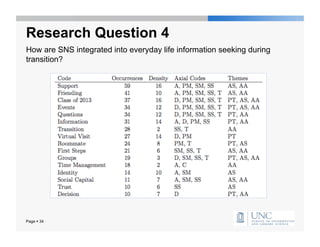
Research Question 4
How are SNS integrated into everyday life information seeking during
transition?


Page  34
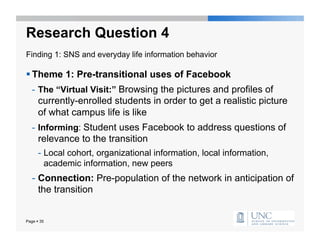
Research Question 4
Finding 1: SNS and everyday life information behavior

 Theme 1: Pre-transitional uses of Facebook
   -  The “Virtual Visit:” Browsing the pictures and profiles of
      currently-enrolled students in order to get a realistic picture
      of what campus life is like
   -  Informing: Student uses Facebook to address questions of
      relevance to the transition
      -  Local cohort, organizational information, local information,
         academic information, new peers
   -  Connection: Pre-population of the network in anticipation of
      the transition


Page  35
Research Question 4
Finding 2: SNS and everyday life information behavior

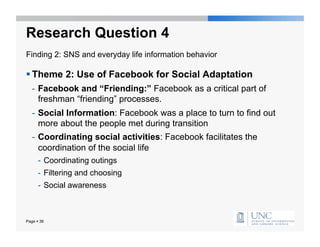
 Theme 2: Use of Facebook for Social Adaptation
   -  Facebook and “Friending:” Facebook as a critical part of
      freshman “friending” processes.
   -  Social Information: Facebook was a place to turn to find out
      more about the people met during transition
   -  Coordinating social activities: Facebook facilitates the
      coordination of the social life
      -  Coordinating outings
      -  Filtering and choosing
      -  Social awareness


Page  36
Research Question 4
Finding 3: SNS and everyday life information behavior

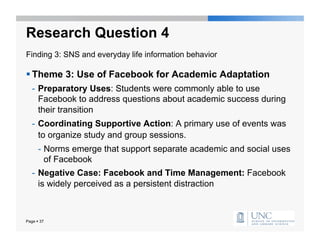
 Theme 3: Use of Facebook for Academic Adaptation
   -  Preparatory Uses: Students were commonly able to use
      Facebook to address questions about academic success during
      their transition
   -  Coordinating Supportive Action: A primary use of events was
      to organize study and group sessions.
      -  Norms emerge that support separate academic and social uses
         of Facebook
   -  Negative Case: Facebook and Time Management: Facebook
      is widely perceived as a persistent distraction


Page  37
Review: Research Questions
Four primary questions, employing three data sets

            What factors are associated with the structure of
  1         transitional socio-technical networks?

            What factors are associated with the growth of
  2         transitional socio-technical networks?

            Does SNS use during transition increase adaptation to
  3         transition?

            How are SNS integrated into everyday life information
  4         seeking during transition?


Page  38
Limitations
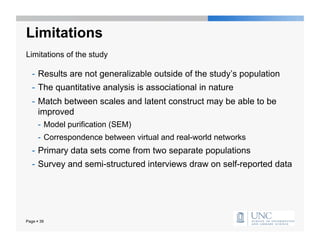
Limitations of the study

   -  Results are not generalizable outside of the study’s population
   -  The quantitative analysis is associational in nature
   -  Match between scales and latent construct may be able to be
      improved
      -  Model purification (SEM)
      -  Correspondence between virtual and real-world networks
   -  Primary data sets come from two separate populations
   -  Survey and semi-structured interviews draw on self-reported data


Page  39
Contributions
Contributions of the study

   -  Descriptive analysis of the structural dynamics of a transitional
      cohort
   -  Update of the highly-regarded Lampe et al. study of Facebook
      network growth with panel data
   -  Development of two new constructs to measure specific uses of
      social network sites during transition
   -  Identification of the relationship between SNS use, social support,
      and adaptation to transition
   -  Identification of important everyday uses of SNS during transition
      (semi-structured interviews)


Page  40
Implications and Future Directions
Next steps

  Implications
   -  “Situational Relevance” of SNS in transition – the SNS is a place where we
      can answer information needs in times of life change.
      -  Versatile – addresses a range of needs
      -  Network structure of participation creates an information rich space
      -  Identity sharing promotes positive participation
      -  Facebook, in particular, has positive norms of disclosure that facilitate transmission of
         important information
      -  Sites address “social motives” – we get something when we participate
      -  SNS has flexible infrastructure supporting ad-hoc collaboration
   -  Systems should identify and adapt to transitions
      -  Characteristics of networks make them identifiable
      -  Sites could adapt to information needs during transitional period


Page  41
Implications and Future Directions
Next steps

  Implications
   -  Facilitating interaction during transition
      -  For sites to be useful, we must find each other in transition
      -  Organizations can foster social practice to overcome technological limitation
      -  The negotiation of shared identifiers in an evolving space will continue to pose
         challenges for those wishing to take advantage of SNS during transition

  Future Research
   -  Explore new transitions: organizational, military-to-civilian life
   -  Design systems that intelligently adapt to transition
   -  Design systems and practice that encourage ad-hoc collaboration to address
      information needs, particularly those of repressed individuals within
      organizational hierarchy (whistleblowers, organizers)


Page  42
Thank you!


            fred@fredstutzman.com
            http://fredstutzman.com
            http://twitter.com/fstutzman

Page  43
References

  Ashforth, B. E. (2001). Role Transitions in Organizational Life: An Identity-Based
   Perspective. Mahwah, NJ: Lawrence Erlbaum Associates.
  Baker, R. W. and Siryk, B. (1989). Student Adaptation to College Questionnaire. Los
   Angeles, CA: Western Psychological Services.
  Cohen, S. and Wills, T. A. (1985). Stress, Social Support, and the Buffering Hypothesis.
   Psychological Bulletin, 98(2), 310--357.
  Cowan, P. A. and Hetherington, M. (1991). Family Transitions. New York: Lawrence
   Erlbaum Associates.
  Ebaugh, H. R. F. (1988). Becoming an Ex: The Process of Role Exit. Chicago, Illinois:
   University of Chicago Press.
  Lampe, C., Ellison, N. B., and Steinfield, C. (2007). A Familiar Face (Book): Profile
   Elements as Signals in an Online Social Network. In CHI '07: Proceedings of the SIGCHI
   Conference on Human Factors in Computing Systems, New York, NY, USA, 2007 (pp.
   435--444). ACM.


Page  44

Fred Stutzman Dissertation Defense

  • 1.
    Networked Information Behavior inLife Transition Fred Stutzman Ph.D. Defense, December 8, 2010
  • 2.
    Outline of theTalk Networked Information Behavior in Life Transition Introduction   Motivation and theoretical framework and review   Research questions and hypotheses Network   Factors of association in transitional networks dynamics   Competing panel models of network growth   Sample survey exploring relationship between SNS use Support during transition and adaptation to transition   Semi-structured interviews exploring SNS info. behavior Conclusions and   Identification of limitations and conclusions limitations   Future directions for research Page  2
  • 3.
    Acknowledgements  Dr. Gary Marchionini,advisor  Dr. Deborah Barreau, committee member  Dr. danah boyd, committee member  Dr. Sri Kalyanaraman, committee member  Paul Jones, MFA, committee member  Chelcy Boyer Stutzman, MSLS, invaluable Page  3
  • 4.
    Motivation  Social technology asa critical aid in my life transitions  Transitions as a cause of information need  Social technology as a critical tool in addressing transitional information needs  Observation of the networked information behavior of a transitional population Page  4
  • 5.
    Theoretical Framework Socio- Informational Integration Processes Into Trans. Environment Development Adaptation to Transition of Support Network Management of Stress Access to Social Support e.g. Ashforth, 2001; Cohen & Wills, 1985; Cowan, 1991; Ebaugh, 1988; Ensel & Lin, 1991 Page  5
  • 6.
    Research Theme This researchexplores two overarching questions  What factors influence the dynamics of socio-technical networks during transition?  Does the use of a social network site for information and support seeking during transition increase adaptation? Page  6
  • 7.
    Research Questions Four primaryquestions, employing three data sets What factors are associated with the structure of 1 transitional socio-technical networks? What factors are associated with the growth of 2 transitional socio-technical networks? Does SNS use during transition increase adaptation to 3 transition? How are SNS integrated into everyday life information 4 seeking during transition? Page  7
  • 8.
    Research Question 1 Factorsof association in transitional networks  What are the graph dynamics of a transitional socio- technical network? -  e.g. Morris, 1998; Wasserman & Faust, 1994  What common factors are associated with the production of ties in a transitional socio-technical network? -  e.g. Blau, 1977; McPherson & Ranger-Moore, 1991; McPherson, Smith- Lovin & Cook, 2001  Do the strength of the associative factors change over time? Page  8
  • 9.
    Theoretical Framework Socio- Informational Integration Processes Into Trans. Environment Development Adaptation to Transition of Support Network Management of Stress Access to Social Support e.g. Ashforth, 2001; Cohen & Wills, 1985; Cowan, 1991; Ebaugh, 1988; Ensel & Lin, 1991 Page  9
  • 10.
    Research Question 1 Factorsof association in transitional networks  Data set -  Facebook profiles, UNC Network -  Collected 8/30/05-12/27/05 -  Facebook and IRB approval Page  10
  • 11.
    Research Question 1 Finding1: What are the graph dynamics of a transitional socio-technical network? Page  11
  • 12.
    Research Question 1 Finding2: What factors are associated with the production of ties in a transitional network? Theoretical Foundation Analytical Approach Findings   Preference factors   Exponential random   Preference factors are   Political views graph modeling (ERGM) strongly predictive in early   Compares observed transition (+).   Academic major network to Erdos-Renyi   Socio-Demographic   Socio-Demographic random graph with factors are mixed. NC factors Markov chain monte carlo residency (+) and gender   Gender simulation (MCMC) (-) strongly predictive,   Produces pseudo- interested in (+) is weakly   “Interested in” predictive. likelihood estimates of the   NC residency probability of a tie   Configuration factors   Configuration factors   Can be interpreted as a are mixed. Residence   Residence hall logit coefficient, and as hall is strongly predictive odds ratio when eb (+), rel. status weakly (+)   Relationship status predictive. Page  12
  • 13.
    Research Question 1 Finding2: What factors are associated with the production of ties in a transitional network? Gender Major Page  13
  • 14.
    Research Question 1 Finding3: Do the strength of the associative factors change over time? Multiple ERGM Solution   Preference factors are strongly predictive in early transition, decreasing over the semester.   Socio-Demographic factors are mixed. NC residency decreases, gender plateaus early, and interested in increases.   Configuration factors are mixed. Residence hall is strongly predictive, rel. status decreases. Page  14
  • 15.
    Research Question 2 Factorsassociated with growth of transitional networks  What profile elements are significantly associated with network size, and at what magnitude -  Panel replication of Lampe, Ellison & Steinfield, 2007 -  Novel panel model with dynamic predictor  Does dorm placement exert a significant and robust effect on growth trajectories of socio-technical networks in transition? -  Data set is the freshman Facebook set employed in RQ 1 (in derivative form) -  Estimated with multi-level regression analyses Page  15
  • 16.
    Theoretical Framework Socio- Informational Integration Processes Into Trans. Environment Development Adaptation to Transition of Support Network Management of Stress Access to Social Support e.g. Ashforth, 2001; Cohen & Wills, 1985; Cowan, 1991; Ebaugh, 1988; Ensel & Lin, 1991 Page  16
  • 17.
    Research Question 2 Marlow, 2009 Page  17
  • 18.
    Research Question 2 DependentVariable: Log of UNC Friends Page  18
  • 19.
    Research Question 2 Controlvariables standard between novel and multi- level models Control Variables   Last Update   Length of Membership   Number of Groups   Friends at External Schools   Gender   Out of State Status Page  19
  • 20.
    Research Question 2 IndepdendentVariables Lampe Replication Novel Model Multi-Level Model   Predictors:   Predictors:   Predictors: Referents Index Referents Index Referents Index Interests Index Interests Index Interests Index Contact Index Contact Index Contact Index   Estimator: Change Index Change Index   Arellano-Bond   Estimator:   Estimator: with network   Arellano-Bond   Multi-level model autoregressor with network with network autoregressor size lagged Page  20
  • 21.
    Research Question 2 PanelTrajectories of Independent Variables Independent Variables   Contact Index   Referents Index   Interests Index   Change Index Interests Music Books Movies Page  21
  • 22.
    Research Question 2 Findings1 and 2: Model Results Variable Lampe Novel Multi-Level Lagged UNC Friends 0.689 0.644 0.624 Gender 0.0255 0.0156 0.0158 Last Update -0.000755 -0.000643 -0.000492 Membership Length 0.00117 0.000755 0.00113 Contact Index 0.00884 0.0105 -0.00141 Referents Index 0.0197 0.0110 0.0182 Interest Index 0.0383 0.0279 0.0407 Number of Groups 0.00282 0.00234 Out of State -0.00634 -0.0198 External Friends 0.00105 0.000878 Change Index 0.000444 0.000444 Constant (N) 1.181 (43,488) 1.257 (41,104) 1.311 (42,742) Bold significant at p < .05 Page  22
  • 23.
    Research Question 2 Finding2: Predicted Trajectories Page  23
  • 24.
    Research Question 3 DoesSNS use during transition increase adaptation to transition?  Do supportive and socio-informational uses of SNS increase experienced social support? -  Multiple regression models with robust errors  Do supportive and socio-informational uses of SNS increase adaptation to college? -  Multiple regression models with robust errors  Do supportive and socio-informational uses of SNS increase social support, leading to greater adaptation? -  Structural equation model Page  24
  • 25.
    Theoretical Framework Socio- Informational Integration Processes Into Trans. Environment Development Adaptation to Transition of Support Network Management of Stress Access to Social Support e.g. Ashforth, 2001; Cohen & Wills, 1985; Cowan, 1991; Ebaugh, 1988; Ensel & Lin, 1991 Page  25
  • 26.
    Research Question 3 DoesSNS use during transition increase adaptation to transition? First predictive model: supportive and social- Simultaneous informational SNS use evaluation with Describe survey, and “social” structural equation solicitation, and adaptation to college model response Step 1 Step 2 Step 3 Step 4 Step 5 Validation model: Second predictive supportive and social- model: supportive and informational SNS use social-informational and received social SNS use and “general” support adaptation to college Page  26
  • 27.
    Research Question 3 Surveyframework   Researcher developed original scales to measure supportive (SNS-S) and socio- informational (SNS-SIP) uses of SNS Scale   Pilot study for scale quality Development   All members of 2009 UNC Freshman class invited to survey   Incentive: iPod touch, 30 gift cards Survey Solicitation   30.57% Response (RR2), n=1,198   Descriptive statistics: Facebook use, privacy, activity Analysis   Multivariate models Page  27
  • 28.
    Research Question 3 VariablesEmployed in Regression Analysis Predictors Controls Outcome   Predictors:   Individual: Gender,   Social Support: 1. Social network NC residency, stress Barrera’s Index of site socio- (CES-D, PSS) Sosically informational   Environmental: Ssupportive processes (SNS- Roommate and Behaviors (ISSB) SIP) scale hallmate quality,   Adaptation to α = .8948 Facebook efficacy college: Baker and   Support: Local and Siryk’s Student 2. Social network Facebook network Adaptation to site support (SNS-S) size College Question- scale α = .8900 naire (SACQ) Page  28
  • 29.
    Research Question 3 Finding1: Relationship between SNS, Support, and Adaptation  Validation Model: Socio-Informational and supportive uses of SNS increase social support  First Predictive Model: Supportive uses (SNS-S) of SNS increase social adaptation to college -  Informational uses (sub-factors) of SNS-SIP, SNS-S increase social adaptation to college  Second Predictive Model: Supportive uses (SNS-S) of SNS increase general adaptation to college -  Network uses (sub-factors) of SNS-SIP increase social adaptation to college, role uses decrease social adaptation Page  29
  • 30.
    Research Question 3 Finding2: SEM model of SNS, Support, and Adaptation Page  30
  • 31.
    Research Question 3 Finding2: SEM model of SNS, Support, and Adaptation RMSEA: 0.056, CFI: 0.799, TLI: 0.7990 Page  31
  • 32.
    Research Question 4 Howare SNS integrated into everyday life information seeking during transition?  Qualitative analysis of SNS use in transition  Study outline -  Semi-structured interviews -  15 interviews, approx one hour each -  Nine females and six males, snowball sampling  Analysis -  Interviews transcribed verbatim, analyzed in Atlas.Ti -  Grounded analysis: Open coding, refinement, axial coding, identification of theme; inductive and deductive analysis Page  32
  • 33.
    Theoretical Framework Socio- Informational Integration Processes Into Trans. Environment Development Adaptation to Transition of Support Network Management of Stress Access to Social Support e.g. Ashforth, 2001; Cohen & Wills, 1985; Cowan, 1991; Ebaugh, 1988; Ensel & Lin, 1991 Page  33
  • 34.
    Research Question 4 Howare SNS integrated into everyday life information seeking during transition? Page  34
  • 35.
    Research Question 4 Finding1: SNS and everyday life information behavior  Theme 1: Pre-transitional uses of Facebook -  The “Virtual Visit:” Browsing the pictures and profiles of currently-enrolled students in order to get a realistic picture of what campus life is like -  Informing: Student uses Facebook to address questions of relevance to the transition -  Local cohort, organizational information, local information, academic information, new peers -  Connection: Pre-population of the network in anticipation of the transition Page  35
  • 36.
    Research Question 4 Finding2: SNS and everyday life information behavior  Theme 2: Use of Facebook for Social Adaptation -  Facebook and “Friending:” Facebook as a critical part of freshman “friending” processes. -  Social Information: Facebook was a place to turn to find out more about the people met during transition -  Coordinating social activities: Facebook facilitates the coordination of the social life -  Coordinating outings -  Filtering and choosing -  Social awareness Page  36
  • 37.
    Research Question 4 Finding3: SNS and everyday life information behavior  Theme 3: Use of Facebook for Academic Adaptation -  Preparatory Uses: Students were commonly able to use Facebook to address questions about academic success during their transition -  Coordinating Supportive Action: A primary use of events was to organize study and group sessions. -  Norms emerge that support separate academic and social uses of Facebook -  Negative Case: Facebook and Time Management: Facebook is widely perceived as a persistent distraction Page  37
  • 38.
    Review: Research Questions Fourprimary questions, employing three data sets What factors are associated with the structure of 1 transitional socio-technical networks? What factors are associated with the growth of 2 transitional socio-technical networks? Does SNS use during transition increase adaptation to 3 transition? How are SNS integrated into everyday life information 4 seeking during transition? Page  38
  • 39.
    Limitations Limitations of thestudy -  Results are not generalizable outside of the study’s population -  The quantitative analysis is associational in nature -  Match between scales and latent construct may be able to be improved -  Model purification (SEM) -  Correspondence between virtual and real-world networks -  Primary data sets come from two separate populations -  Survey and semi-structured interviews draw on self-reported data Page  39
  • 40.
    Contributions Contributions of thestudy -  Descriptive analysis of the structural dynamics of a transitional cohort -  Update of the highly-regarded Lampe et al. study of Facebook network growth with panel data -  Development of two new constructs to measure specific uses of social network sites during transition -  Identification of the relationship between SNS use, social support, and adaptation to transition -  Identification of important everyday uses of SNS during transition (semi-structured interviews) Page  40
  • 41.
    Implications and FutureDirections Next steps   Implications -  “Situational Relevance” of SNS in transition – the SNS is a place where we can answer information needs in times of life change. -  Versatile – addresses a range of needs -  Network structure of participation creates an information rich space -  Identity sharing promotes positive participation -  Facebook, in particular, has positive norms of disclosure that facilitate transmission of important information -  Sites address “social motives” – we get something when we participate -  SNS has flexible infrastructure supporting ad-hoc collaboration -  Systems should identify and adapt to transitions -  Characteristics of networks make them identifiable -  Sites could adapt to information needs during transitional period Page  41
  • 42.
    Implications and FutureDirections Next steps   Implications -  Facilitating interaction during transition -  For sites to be useful, we must find each other in transition -  Organizations can foster social practice to overcome technological limitation -  The negotiation of shared identifiers in an evolving space will continue to pose challenges for those wishing to take advantage of SNS during transition   Future Research -  Explore new transitions: organizational, military-to-civilian life -  Design systems that intelligently adapt to transition -  Design systems and practice that encourage ad-hoc collaboration to address information needs, particularly those of repressed individuals within organizational hierarchy (whistleblowers, organizers) Page  42
  • 43.
    Thank you! fred@fredstutzman.com http://fredstutzman.com http://twitter.com/fstutzman Page  43
  • 44.
    References   Ashforth, B.E. (2001). Role Transitions in Organizational Life: An Identity-Based Perspective. Mahwah, NJ: Lawrence Erlbaum Associates.   Baker, R. W. and Siryk, B. (1989). Student Adaptation to College Questionnaire. Los Angeles, CA: Western Psychological Services.   Cohen, S. and Wills, T. A. (1985). Stress, Social Support, and the Buffering Hypothesis. Psychological Bulletin, 98(2), 310--357.   Cowan, P. A. and Hetherington, M. (1991). Family Transitions. New York: Lawrence Erlbaum Associates.   Ebaugh, H. R. F. (1988). Becoming an Ex: The Process of Role Exit. Chicago, Illinois: University of Chicago Press.   Lampe, C., Ellison, N. B., and Steinfield, C. (2007). A Familiar Face (Book): Profile Elements as Signals in an Online Social Network. In CHI '07: Proceedings of the SIGCHI Conference on Human Factors in Computing Systems, New York, NY, USA, 2007 (pp. 435--444). ACM. Page  44