Presentation on Shock
DR. SHAHED IQBAL
Definition
SHOCK: Inadequate organ perfusion to meet
the tissue’s oxygenation demand.
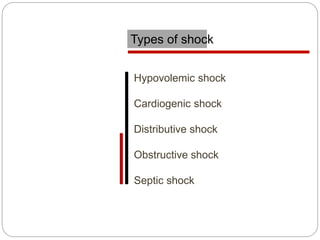
Types of shock
Hypovolemic shock
Cardiogenic shock
Distributive shock
Obstructive shock
Septic shock
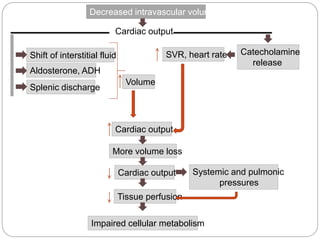
Decreased intravascular volume
Cardiac output
Shift of interstitial fluid
Aldosterone, ADH
Splenic discharge
Volume
Cardiac output
More volume loss
Tissue perfusion
Cardiac output
Impaired cellular metabolism
SVR, heart rate Catecholamine
release
Systemic and pulmonic
pressures
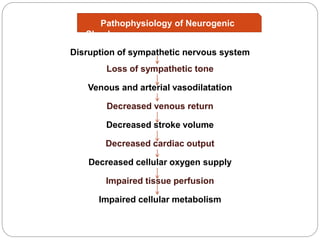
Disruption of sympathetic nervous system
Loss of sympathetic tone
Venous and arterial vasodilatation
Decreased venous return
Decreased stroke volume
Decreased cardiac output
Decreased cellular oxygen supply
Impaired tissue perfusion
Impaired cellular metabolism
Pathophysiology of Neurogenic
Shock
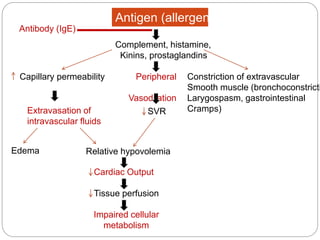
Antigen (allergen)
Antibody (IgE)
Complement, histamine,
Kinins, prostaglandins
Capillary permeability
Tissue perfusion
Extravasation of
intravascular fluids
SVR
Edema
Peripheral
Vasodilation
Relative hypovolemia
Cardiac Output
Impaired cellular
metabolism
Constriction of extravascular
Smooth muscle (bronchoconstricti
Larygospasm, gastrointestinal
Cramps)
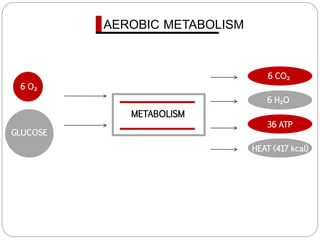
METABOLISM
AEROBIC METABOLISM
6 O₂
GLUCOSE
6 CO₂
6 H₂O
36 ATP
HEAT (417 kcal)
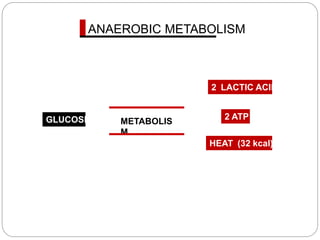
GLUCOSE
HEAT (32 kcal)
2 ATP
2 LACTIC ACID
ANAEROBIC METABOLISM
METABOLIS
M
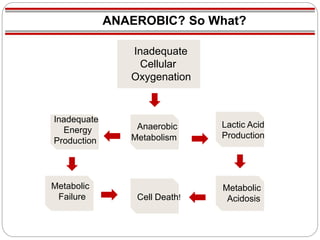
ANAEROBIC? So What?
Inadequate
Energy
Production
Anaerobic
Metabolism
Lactic Acid
Production
Metabolic
Failure Cell Death!
Metabolic
Acidosis
Inadequate
Cellular
Oxygenation
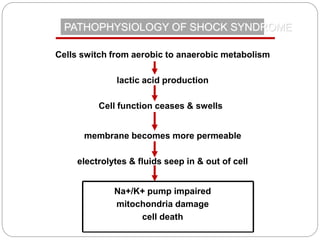
PATHOPHYSIOLOGY OF SHOCK SYNDROME
Cells switch from aerobic to anaerobic metabolism
lactic acid production
Cell function ceases & swells
membrane becomes more permeable
electrolytes & fluids seep in & out of cell
Na+/K+ pump impaired
mitochondria damage
cell death
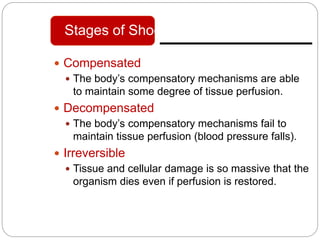
 Compensated
 The body’s compensatory mechanisms are able
to maintain some degree of tissue perfusion.
 Decompensated
 The body’s compensatory mechanisms fail to
maintain tissue perfusion (blood pressure falls).
 Irreversible
 Tissue and cellular damage is so massive that the
organism dies even if perfusion is restored.
Stages of Shock
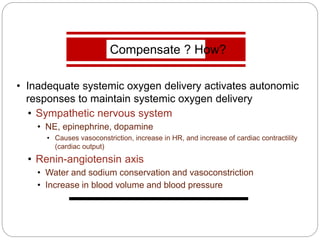
• Inadequate systemic oxygen delivery activates autonomic
responses to maintain systemic oxygen delivery
• Sympathetic nervous system
• NE, epinephrine, dopamine
• Causes vasoconstriction, increase in HR, and increase of cardiac contractility
(cardiac output)
• Renin-angiotensin axis
• Water and sodium conservation and vasoconstriction
• Increase in blood volume and blood pressure
Compensate ? How?
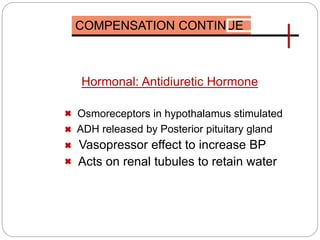
Hormonal: Antidiuretic Hormone
Osmoreceptors in hypothalamus stimulated
ADH released by Posterior pituitary gland
Vasopressor effect to increase BP
Acts on renal tubules to retain water
COMPENSATION CONTINUE
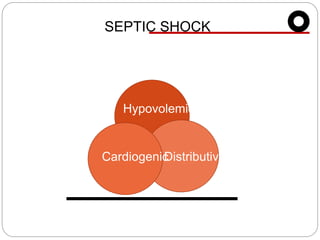
SEPTIC SHOCK
CardiogenicDistributive
Hypovolemic
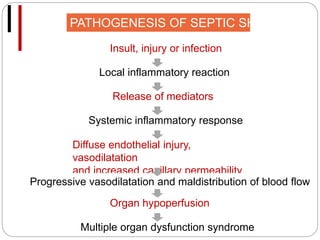
Insult, injury or infection
Local inflammatory reaction
Release of mediators
Systemic inflammatory response
Diffuse endothelial injury,
vasodilatation
and increased capillary permeability
Progressive vasodilatation and maldistribution of blood flow
Organ hypoperfusion
Multiple organ dysfunction syndrome
PATHOGENESIS OF SEPTIC SHOCK
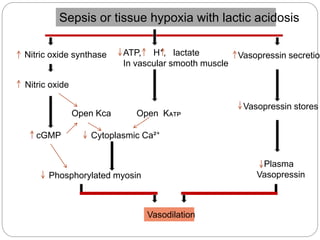
Sepsis or tissue hypoxia with lactic acidosis
Nitric oxide synthase ATP, H⁺, lactate
In vascular smooth muscle
Vasopressin secretion
Nitric oxide
Open Kca
cGMP Cytoplasmic Ca²⁺
Phosphorylated myosin
Vasodilation
Open Kᴀᴛᴘ
Vasopressin stores
Plasma
Vasopressin
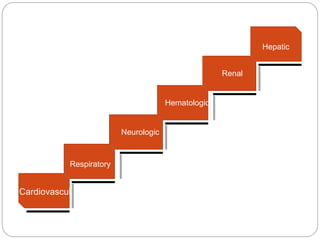
CRITERIA FOR ORGAN DYSFUNCTION
Cardiovascular
Respiratory
Neurologic
Hematologic
Renal
Hepatic
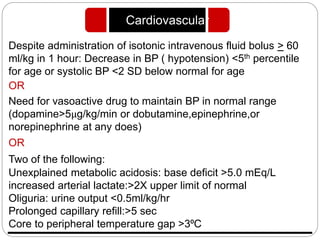
Despite administration of isotonic intravenous fluid bolus > 60
ml/kg in 1 hour: Decrease in BP ( hypotension) <5th percentile
for age or systolic BP <2 SD below normal for age
OR
Need for vasoactive drug to maintain BP in normal range
(dopamine>5μg/kg/min or dobutamine,epinephrine,or
norepinephrine at any does)
OR
Two of the following:
Unexplained metabolic acidosis: base deficit >5.0 mEq/L
increased arterial lactate:>2X upper limit of normal
Oliguria: urine output <0.5ml/kg/hr
Prolonged capillary refill:>5 sec
Core to peripheral temperature gap >3⁰C
Cardiovascular
MAP <5th PERCENTILE FOR AGE
LOWEST ACCEPTABLE SBP = 70 + [2x AGE IN YEARS]
AGE LOWEST ACCEPTABLE SBP
TERM NEONATE 60
INFANT 1-12 MONTHS 70
CHILDREN 1-10 YRS 70 +[2x AGE IN YEARS]
CHILDREN >10 YRS 90
HYPOTENSION
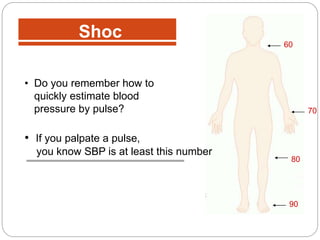
• Do you remember how to
quickly estimate blood
pressure by pulse?
60
80
70
90
• If you palpate a pulse,
you know SBP is at least this number
Shoc
k
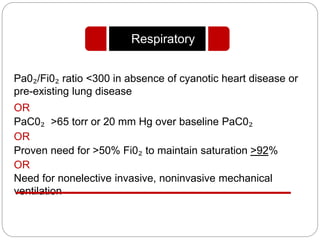
Pa0₂/Fi0₂ ratio <300 in absence of cyanotic heart disease or
pre-existing lung disease
OR
PaC0₂ >65 torr or 20 mm Hg over baseline PaC0₂
OR
Proven need for >50% Fi0₂ to maintain saturation >92%
OR
Need for nonelective invasive, noninvasive mechanical
ventilation
Respiratory
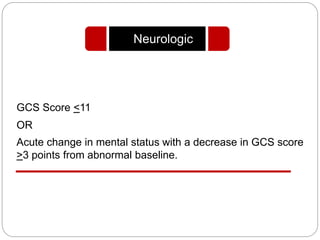
GCS Score <11
OR
Acute change in mental status with a decrease in GCS score
>3 points from abnormal baseline.
Neurologic
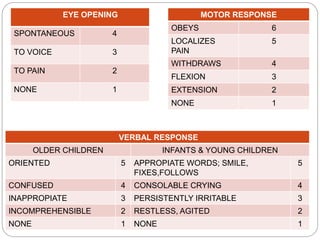
EYE OPENING
SPONTANEOUS 4
TO VOICE 3
TO PAIN 2
NONE 1
VERBAL RESPONSE
OLDER CHILDREN INFANTS & YOUNG CHILDREN
ORIENTED 5 APPROPIATE WORDS; SMILE,
FIXES,FOLLOWS
5
CONFUSED 4 CONSOLABLE CRYING 4
INAPPROPIATE 3 PERSISTENTLY IRRITABLE 3
INCOMPREHENSIBLE 2 RESTLESS, AGITED 2
NONE 1 NONE 1
MOTOR RESPONSE
OBEYS 6
LOCALIZES
PAIN
5
WITHDRAWS 4
FLEXION 3
EXTENSION 2
NONE 1
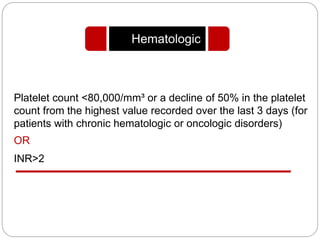
Platelet count <80,000/mm³ or a decline of 50% in the platelet
count from the highest value recorded over the last 3 days (for
patients with chronic hematologic or oncologic disorders)
OR
INR>2
Hematologic
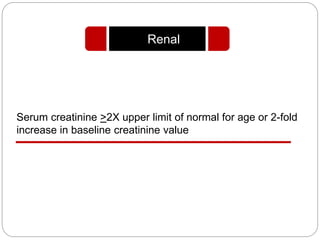
Serum creatinine >2X upper limit of normal for age or 2-fold
increase in baseline creatinine value
Renal
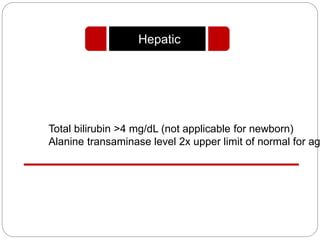
Total bilirubin >4 mg/dL (not applicable for newborn)
Alanine transaminase level 2x upper limit of normal for ag
Hepatic
INTERNATIONAL CONSENSUS
DEFINITIONS
FOR
PEDIATRIC SEPSIS
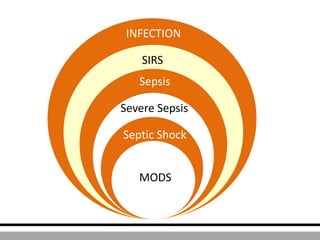
MODS
INFECTION
SIRS
Sepsis
Severe Sepsis
Septic Shock
MODS
Suspected or proven infection or a clinical syndrome
associated with high probability of infection
INFECTION
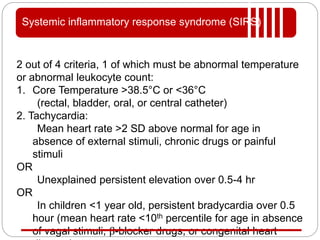
2 out of 4 criteria, 1 of which must be abnormal temperature
or abnormal leukocyte count:
1. Core Temperature >38.5°C or <36°C
(rectal, bladder, oral, or central catheter)
2. Tachycardia:
Mean heart rate >2 SD above normal for age in
absence of external stimuli, chronic drugs or painful
stimuli
OR
Unexplained persistent elevation over 0.5-4 hr
OR
In children <1 year old, persistent bradycardia over 0.5
hour (mean heart rate <10th percentile for age in absence
of vagal stimuli, β-blocker drugs, or congenital heart
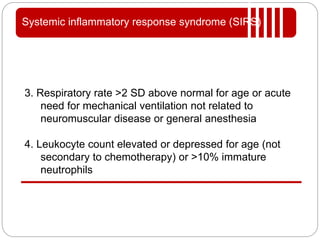
Systemic inflammatory response syndrome (SIRS)
3. Respiratory rate >2 SD above normal for age or acute
need for mechanical ventilation not related to
neuromuscular disease or general anesthesia
4. Leukocyte count elevated or depressed for age (not
secondary to chemotherapy) or >10% immature
neutrophils
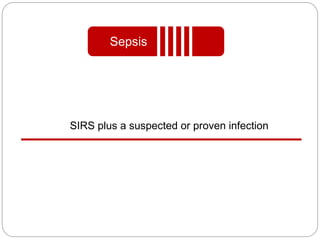
SIRS plus a suspected or proven infection
Sepsis
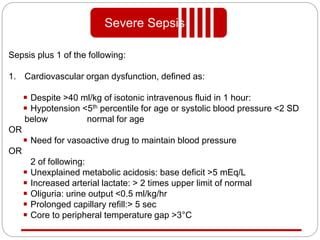
Sepsis plus 1 of the following:
1. Cardiovascular organ dysfunction, defined as:
Despite >40 ml/kg of isotonic intravenous fluid in 1 hour:
Hypotension <5th percentile for age or systolic blood pressure <2 SD
below normal for age
OR
Need for vasoactive drug to maintain blood pressure
OR
2 of following:
Unexplained metabolic acidosis: base deficit >5 mEq/L
Increased arterial lactate: > 2 times upper limit of normal
Oliguria: urine output <0.5 ml/kg/hr
Prolonged capillary refill:> 5 sec
Core to peripheral temperature gap >3°C
Severe Sepsis
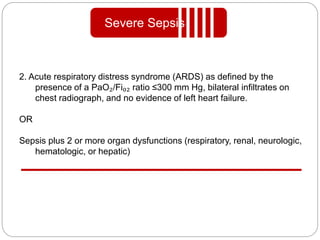
2. Acute respiratory distress syndrome (ARDS) as defined by the
presence of a PaO₂/Fi₀₂ ratio ≤300 mm Hg, bilateral infiltrates on
chest radiograph, and no evidence of left heart failure.
OR
Sepsis plus 2 or more organ dysfunctions (respiratory, renal, neurologic,
hematologic, or hepatic)
Severe Sepsis
Sepsis plus cardiovascular organ dysfunctions as defined above
Septic Shock
Presence of altered organ function such that homeostasis cannot be
maintained without medical intervention.
Multiple organ dysfunction syndrome (MODS)
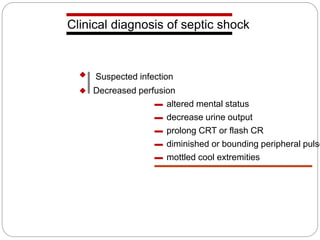
Clinical diagnosis of septic shock
Suspected infection
Decreased perfusion
altered mental status
decrease urine output
prolong CRT or flash CR
diminished or bounding peripheral pulse
mottled cool extremities
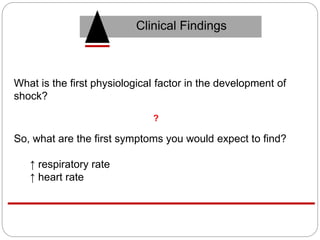
What is the first physiological factor in the development of
shock?
?
So, what are the first symptoms you would expect to find?
↑ respiratory rate
↑ heart rate
Clinical Findings
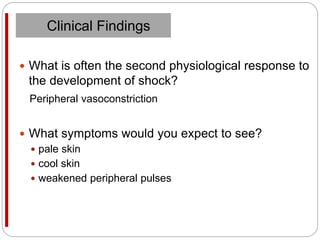
 What is often the second physiological response to
the development of shock?
Peripheral vasoconstriction
 What symptoms would you expect to see?
 pale skin
 cool skin
 weakened peripheral pulses
Clinical Findings
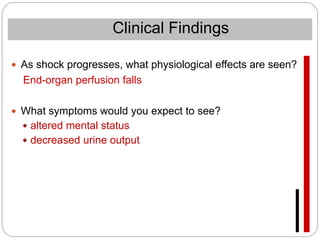
 As shock progresses, what physiological effects are seen?
End-organ perfusion falls
 What symptoms would you expect to see?
 altered mental status
 decreased urine output
Clinical Findings
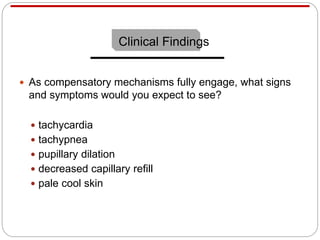
 As compensatory mechanisms fully engage, what signs
and symptoms would you expect to see?
 tachycardia
 tachypnea
 pupillary dilation
 decreased capillary refill
 pale cool skin
Clinical Findings
 When compensatory mechanisms fail, what signs and
symptoms would you expect to see?
 hypotension
 falling SpO2
 bradycardia
 loss of consciousness
 dysrhythmias
 Mods
Clinical
Findings
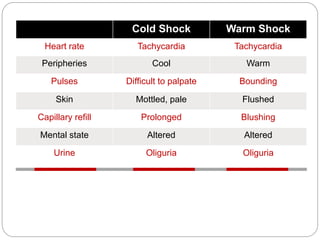
Cold Shock Warm Shock
Heart rate Tachycardia Tachycardia
Peripheries Cool Warm
Pulses Difficult to palpate Bounding
Skin Mottled, pale Flushed
Capillary refill Prolonged Blushing
Mental state Altered Altered
Urine Oliguria Oliguria
Recognize
Shock
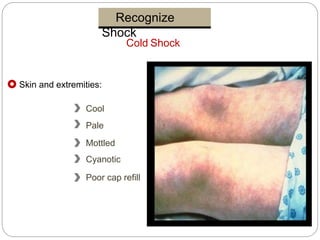
Cold Shock
Skin and extremities:
Cool
Pale
Mottled
Cyanotic
Poor cap refill
Recognize
Shock
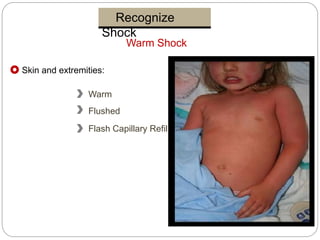
Warm Shock
Skin and extremities:
Warm
Flushed
Flash Capillary Refill
Recognize
Shock
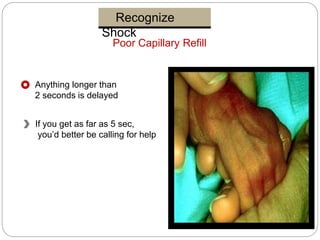
Poor Capillary Refill
Anything longer than
2 seconds is delayed
If you get as far as 5 sec,
you’d better be calling for help
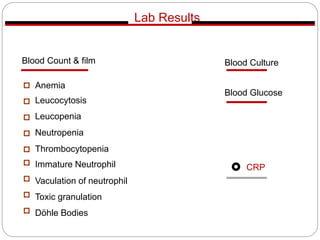
Blood Count & film
Anemia
Leucocytosis
Leucopenia
Neutropenia
Thrombocytopenia
Immature Neutrophil
Vaculation of neutrophil
Toxic granulation
Döhle Bodies
Blood Culture
Lab Results
Blood Glucose
CRP
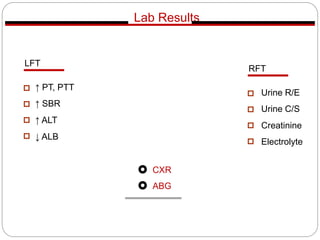
Lab Results
LFT
↑ PT, PTT
↑ SBR
↑ ALT
↓ ALB
RFT
Urine R/E
Urine C/S
Creatinine
Electrolyte
CXR
ABG
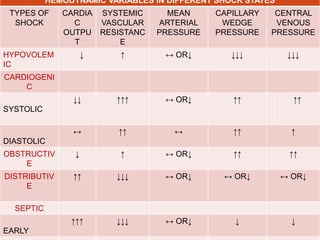
HEMODYNAMIC VARIABLES IN DIFFERENT SHOCK STATES
TYPES OF
SHOCK
CARDIA
C
OUTPU
T
SYSTEMIC
VASCULAR
RESISTANC
E
MEAN
ARTERIAL
PRESSURE
CAPILLARY
WEDGE
PRESSURE
CENTRAL
VENOUS
PRESSURE
HYPOVOLEM
IC
↓ ↑ ↔ OR↓ ↓↓↓ ↓↓↓
CARDIOGENI
C
SYSTOLIC
↓↓ ↑↑↑ ↔ OR↓ ↑↑ ↑↑
DIASTOLIC
↔ ↑↑ ↔ ↑↑ ↑
OBSTRUCTIV
E
↓ ↑ ↔ OR↓ ↑↑ ↑↑
DISTRIBUTIV
E
↑↑ ↓↓↓ ↔ OR↓ ↔ OR↓ ↔ OR↓
SEPTIC
EARLY
↑↑↑ ↓↓↓ ↔ OR↓ ↓ ↓
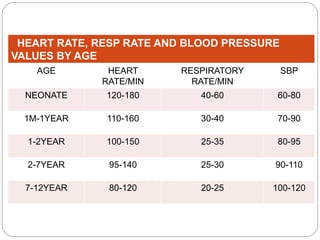
HEART RATE, RESP RATE AND BLOOD PRESSURE
VALUES BY AGE
AGE HEART
RATE/MIN
RESPIRATORY
RATE/MIN
SBP
NEONATE 120-180 40-60 60-80
1M-1YEAR 110-160 30-40 70-90
1-2YEAR 100-150 25-35 80-95
2-7YEAR 95-140 25-30 90-110
7-12YEAR 80-120 20-25 100-120
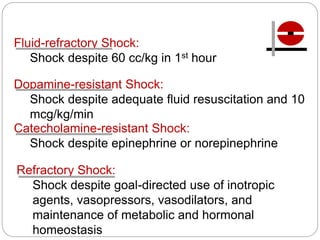
Fluid-refractory Shock:
Shock despite 60 cc/kg in 1st hour
Dopamine-resistant Shock:
Shock despite adequate fluid resuscitation and 10
mcg/kg/min
Catecholamine-resistant Shock:
Shock despite epinephrine or norepinephrine
Refractory Shock:
Shock despite goal-directed use of inotropic
agents, vasopressors, vasodilators, and
maintenance of metabolic and hormonal
homeostasis
Shock and it's classification

Shock and it's classification

  • 1.
  • 2.
    Definition SHOCK: Inadequate organperfusion to meet the tissue’s oxygenation demand.
  • 3.
    Types of shock Hypovolemicshock Cardiogenic shock Distributive shock Obstructive shock Septic shock
  • 4.
    Decreased intravascular volume Cardiacoutput Shift of interstitial fluid Aldosterone, ADH Splenic discharge Volume Cardiac output More volume loss Tissue perfusion Cardiac output Impaired cellular metabolism SVR, heart rate Catecholamine release Systemic and pulmonic pressures
  • 5.
    Disruption of sympatheticnervous system Loss of sympathetic tone Venous and arterial vasodilatation Decreased venous return Decreased stroke volume Decreased cardiac output Decreased cellular oxygen supply Impaired tissue perfusion Impaired cellular metabolism Pathophysiology of Neurogenic Shock
  • 6.
    Antigen (allergen) Antibody (IgE) Complement,histamine, Kinins, prostaglandins Capillary permeability Tissue perfusion Extravasation of intravascular fluids SVR Edema Peripheral Vasodilation Relative hypovolemia Cardiac Output Impaired cellular metabolism Constriction of extravascular Smooth muscle (bronchoconstricti Larygospasm, gastrointestinal Cramps)
  • 7.
    METABOLISM AEROBIC METABOLISM 6 O₂ GLUCOSE 6CO₂ 6 H₂O 36 ATP HEAT (417 kcal)
  • 8.
    GLUCOSE HEAT (32 kcal) 2ATP 2 LACTIC ACID ANAEROBIC METABOLISM METABOLIS M
  • 9.
    ANAEROBIC? So What? Inadequate Energy Production Anaerobic Metabolism LacticAcid Production Metabolic Failure Cell Death! Metabolic Acidosis Inadequate Cellular Oxygenation
  • 10.
    PATHOPHYSIOLOGY OF SHOCKSYNDROME Cells switch from aerobic to anaerobic metabolism lactic acid production Cell function ceases & swells membrane becomes more permeable electrolytes & fluids seep in & out of cell Na+/K+ pump impaired mitochondria damage cell death
  • 11.
     Compensated  Thebody’s compensatory mechanisms are able to maintain some degree of tissue perfusion.  Decompensated  The body’s compensatory mechanisms fail to maintain tissue perfusion (blood pressure falls).  Irreversible  Tissue and cellular damage is so massive that the organism dies even if perfusion is restored. Stages of Shock
  • 12.
    • Inadequate systemicoxygen delivery activates autonomic responses to maintain systemic oxygen delivery • Sympathetic nervous system • NE, epinephrine, dopamine • Causes vasoconstriction, increase in HR, and increase of cardiac contractility (cardiac output) • Renin-angiotensin axis • Water and sodium conservation and vasoconstriction • Increase in blood volume and blood pressure Compensate ? How?
  • 13.
    Hormonal: Antidiuretic Hormone Osmoreceptorsin hypothalamus stimulated ADH released by Posterior pituitary gland Vasopressor effect to increase BP Acts on renal tubules to retain water COMPENSATION CONTINUE
  • 14.
  • 15.
    Insult, injury orinfection Local inflammatory reaction Release of mediators Systemic inflammatory response Diffuse endothelial injury, vasodilatation and increased capillary permeability Progressive vasodilatation and maldistribution of blood flow Organ hypoperfusion Multiple organ dysfunction syndrome PATHOGENESIS OF SEPTIC SHOCK
  • 16.
    Sepsis or tissuehypoxia with lactic acidosis Nitric oxide synthase ATP, H⁺, lactate In vascular smooth muscle Vasopressin secretion Nitric oxide Open Kca cGMP Cytoplasmic Ca²⁺ Phosphorylated myosin Vasodilation Open Kᴀᴛᴘ Vasopressin stores Plasma Vasopressin
  • 17.
    CRITERIA FOR ORGANDYSFUNCTION
  • 18.
  • 19.
    Despite administration ofisotonic intravenous fluid bolus > 60 ml/kg in 1 hour: Decrease in BP ( hypotension) <5th percentile for age or systolic BP <2 SD below normal for age OR Need for vasoactive drug to maintain BP in normal range (dopamine>5μg/kg/min or dobutamine,epinephrine,or norepinephrine at any does) OR Two of the following: Unexplained metabolic acidosis: base deficit >5.0 mEq/L increased arterial lactate:>2X upper limit of normal Oliguria: urine output <0.5ml/kg/hr Prolonged capillary refill:>5 sec Core to peripheral temperature gap >3⁰C Cardiovascular
  • 20.
    MAP <5th PERCENTILEFOR AGE LOWEST ACCEPTABLE SBP = 70 + [2x AGE IN YEARS] AGE LOWEST ACCEPTABLE SBP TERM NEONATE 60 INFANT 1-12 MONTHS 70 CHILDREN 1-10 YRS 70 +[2x AGE IN YEARS] CHILDREN >10 YRS 90 HYPOTENSION
  • 21.
    • Do youremember how to quickly estimate blood pressure by pulse? 60 80 70 90 • If you palpate a pulse, you know SBP is at least this number Shoc k
  • 22.
    Pa0₂/Fi0₂ ratio <300in absence of cyanotic heart disease or pre-existing lung disease OR PaC0₂ >65 torr or 20 mm Hg over baseline PaC0₂ OR Proven need for >50% Fi0₂ to maintain saturation >92% OR Need for nonelective invasive, noninvasive mechanical ventilation Respiratory
  • 23.
    GCS Score <11 OR Acutechange in mental status with a decrease in GCS score >3 points from abnormal baseline. Neurologic
  • 24.
    EYE OPENING SPONTANEOUS 4 TOVOICE 3 TO PAIN 2 NONE 1 VERBAL RESPONSE OLDER CHILDREN INFANTS & YOUNG CHILDREN ORIENTED 5 APPROPIATE WORDS; SMILE, FIXES,FOLLOWS 5 CONFUSED 4 CONSOLABLE CRYING 4 INAPPROPIATE 3 PERSISTENTLY IRRITABLE 3 INCOMPREHENSIBLE 2 RESTLESS, AGITED 2 NONE 1 NONE 1 MOTOR RESPONSE OBEYS 6 LOCALIZES PAIN 5 WITHDRAWS 4 FLEXION 3 EXTENSION 2 NONE 1
  • 25.
    Platelet count <80,000/mm³or a decline of 50% in the platelet count from the highest value recorded over the last 3 days (for patients with chronic hematologic or oncologic disorders) OR INR>2 Hematologic
  • 26.
    Serum creatinine >2Xupper limit of normal for age or 2-fold increase in baseline creatinine value Renal
  • 27.
    Total bilirubin >4mg/dL (not applicable for newborn) Alanine transaminase level 2x upper limit of normal for ag Hepatic
  • 28.
  • 29.
  • 30.
    Suspected or proveninfection or a clinical syndrome associated with high probability of infection INFECTION
  • 31.
    2 out of4 criteria, 1 of which must be abnormal temperature or abnormal leukocyte count: 1. Core Temperature >38.5°C or <36°C (rectal, bladder, oral, or central catheter) 2. Tachycardia: Mean heart rate >2 SD above normal for age in absence of external stimuli, chronic drugs or painful stimuli OR Unexplained persistent elevation over 0.5-4 hr OR In children <1 year old, persistent bradycardia over 0.5 hour (mean heart rate <10th percentile for age in absence of vagal stimuli, β-blocker drugs, or congenital heart Systemic inflammatory response syndrome (SIRS)
  • 32.
    Systemic inflammatory responsesyndrome (SIRS) 3. Respiratory rate >2 SD above normal for age or acute need for mechanical ventilation not related to neuromuscular disease or general anesthesia 4. Leukocyte count elevated or depressed for age (not secondary to chemotherapy) or >10% immature neutrophils
  • 33.
    SIRS plus asuspected or proven infection Sepsis
  • 34.
    Sepsis plus 1of the following: 1. Cardiovascular organ dysfunction, defined as: Despite >40 ml/kg of isotonic intravenous fluid in 1 hour: Hypotension <5th percentile for age or systolic blood pressure <2 SD below normal for age OR Need for vasoactive drug to maintain blood pressure OR 2 of following: Unexplained metabolic acidosis: base deficit >5 mEq/L Increased arterial lactate: > 2 times upper limit of normal Oliguria: urine output <0.5 ml/kg/hr Prolonged capillary refill:> 5 sec Core to peripheral temperature gap >3°C Severe Sepsis
  • 35.
    2. Acute respiratorydistress syndrome (ARDS) as defined by the presence of a PaO₂/Fi₀₂ ratio ≤300 mm Hg, bilateral infiltrates on chest radiograph, and no evidence of left heart failure. OR Sepsis plus 2 or more organ dysfunctions (respiratory, renal, neurologic, hematologic, or hepatic) Severe Sepsis
  • 36.
    Sepsis plus cardiovascularorgan dysfunctions as defined above Septic Shock
  • 37.
    Presence of alteredorgan function such that homeostasis cannot be maintained without medical intervention. Multiple organ dysfunction syndrome (MODS)
  • 38.
    Clinical diagnosis ofseptic shock Suspected infection Decreased perfusion altered mental status decrease urine output prolong CRT or flash CR diminished or bounding peripheral pulse mottled cool extremities
  • 39.
    What is thefirst physiological factor in the development of shock? ? So, what are the first symptoms you would expect to find? ↑ respiratory rate ↑ heart rate Clinical Findings
  • 40.
     What isoften the second physiological response to the development of shock? Peripheral vasoconstriction  What symptoms would you expect to see?  pale skin  cool skin  weakened peripheral pulses Clinical Findings
  • 41.
     As shockprogresses, what physiological effects are seen? End-organ perfusion falls  What symptoms would you expect to see?  altered mental status  decreased urine output Clinical Findings
  • 42.
     As compensatorymechanisms fully engage, what signs and symptoms would you expect to see?  tachycardia  tachypnea  pupillary dilation  decreased capillary refill  pale cool skin Clinical Findings
  • 43.
     When compensatorymechanisms fail, what signs and symptoms would you expect to see?  hypotension  falling SpO2  bradycardia  loss of consciousness  dysrhythmias  Mods Clinical Findings
  • 44.
    Cold Shock WarmShock Heart rate Tachycardia Tachycardia Peripheries Cool Warm Pulses Difficult to palpate Bounding Skin Mottled, pale Flushed Capillary refill Prolonged Blushing Mental state Altered Altered Urine Oliguria Oliguria
  • 45.
    Recognize Shock Cold Shock Skin andextremities: Cool Pale Mottled Cyanotic Poor cap refill
  • 46.
    Recognize Shock Warm Shock Skin andextremities: Warm Flushed Flash Capillary Refill
  • 47.
    Recognize Shock Poor Capillary Refill Anythinglonger than 2 seconds is delayed If you get as far as 5 sec, you’d better be calling for help
  • 48.
    Blood Count &film Anemia Leucocytosis Leucopenia Neutropenia Thrombocytopenia Immature Neutrophil Vaculation of neutrophil Toxic granulation Döhle Bodies Blood Culture Lab Results Blood Glucose CRP
  • 49.
    Lab Results LFT ↑ PT,PTT ↑ SBR ↑ ALT ↓ ALB RFT Urine R/E Urine C/S Creatinine Electrolyte CXR ABG
  • 50.
    HEMODYNAMIC VARIABLES INDIFFERENT SHOCK STATES TYPES OF SHOCK CARDIA C OUTPU T SYSTEMIC VASCULAR RESISTANC E MEAN ARTERIAL PRESSURE CAPILLARY WEDGE PRESSURE CENTRAL VENOUS PRESSURE HYPOVOLEM IC ↓ ↑ ↔ OR↓ ↓↓↓ ↓↓↓ CARDIOGENI C SYSTOLIC ↓↓ ↑↑↑ ↔ OR↓ ↑↑ ↑↑ DIASTOLIC ↔ ↑↑ ↔ ↑↑ ↑ OBSTRUCTIV E ↓ ↑ ↔ OR↓ ↑↑ ↑↑ DISTRIBUTIV E ↑↑ ↓↓↓ ↔ OR↓ ↔ OR↓ ↔ OR↓ SEPTIC EARLY ↑↑↑ ↓↓↓ ↔ OR↓ ↓ ↓
  • 51.
    HEART RATE, RESPRATE AND BLOOD PRESSURE VALUES BY AGE AGE HEART RATE/MIN RESPIRATORY RATE/MIN SBP NEONATE 120-180 40-60 60-80 1M-1YEAR 110-160 30-40 70-90 1-2YEAR 100-150 25-35 80-95 2-7YEAR 95-140 25-30 90-110 7-12YEAR 80-120 20-25 100-120
  • 52.
    Fluid-refractory Shock: Shock despite60 cc/kg in 1st hour Dopamine-resistant Shock: Shock despite adequate fluid resuscitation and 10 mcg/kg/min Catecholamine-resistant Shock: Shock despite epinephrine or norepinephrine Refractory Shock: Shock despite goal-directed use of inotropic agents, vasopressors, vasodilators, and maintenance of metabolic and hormonal homeostasis