SHOCKSHOCK
By Dr Sneha KhobragadeBy Dr Sneha Khobragade
Guided by Dr Deepak RuparelGuided by Dr Deepak Ruparel
GMC NagpurGMC Nagpur
Definition of ShockDefinition of Shock
 Inadequate tissue perfusion to meet tissueInadequate tissue perfusion to meet tissue
demandsdemands
 Usually result of inadequate blood flowUsually result of inadequate blood flow
and/or oxygen deliveryand/or oxygen delivery
What is Shock?What is Shock?
pathophysiologypathophysiology
CLASSIFICATIONCLASSIFICATION
CAUSE?CAUSE?
Cause?Cause?
Cardiogenic
shock
Hypovolemic
shock
Septic shock
Pulse pressure Decreases Decreases Increases
Diastolic pressure Decreases Decreases Decreases
Extremities Cool Cool Warm
Nailbed blood return Slow Slow Rapid
Jugular venous pressure Increases Decreases Decreases
Respiratory creptitions +++ - -
S3,S4 gallop rhythm +++ - -
Chest radiograph Large heart,
Pulmonary edema
Diminished
cardiac size
Normal,unless
pneumonia
presesnt
Identified site of infection - - +++
Cause?Cause?
Hypovolemic shockHypovolemic shock
Decrease circulating blood volumeDecrease circulating blood volume
ClassificationClassification
 Compensation – increase endogenousCompensation – increase endogenous
catecholaminescatecholamines
 Increase HR – increase C.O., O2 deliveryIncrease HR – increase C.O., O2 delivery
 Increase SVR – increase BP (esp diastolic)Increase SVR – increase BP (esp diastolic)
 Lactic acidosisLactic acidosis
 Increase in serum lactate- early indicator ofIncrease in serum lactate- early indicator of
tissue hypoperfusiontissue hypoperfusion
 Aim- reverse organ hypoperfusionAim- reverse organ hypoperfusion
( Optimizing the tissue o2 delivery)( Optimizing the tissue o2 delivery)
- requires sufficient hemoglobin concentration- requires sufficient hemoglobin concentration
- adequate intravascular volume- adequate intravascular volume
- dobutamine (despite adequate preload, cardiac- dobutamine (despite adequate preload, cardiac
output is not sufficient)output is not sufficient)
Determinants of Oxygen DeliveryDeterminants of Oxygen Delivery
 Oxygen content = 1.34 (Hb x SaO2) +Oxygen content = 1.34 (Hb x SaO2) +
(PaO2 x 0.0031)(PaO2 x 0.0031)
 SaO2: arterial hemoglobin Oxygen saturationSaO2: arterial hemoglobin Oxygen saturation
 Hb: Hemoglobin concentrationHb: Hemoglobin concentration
 PaO2: arterial oxygen tensionPaO2: arterial oxygen tension
 To improve Oxygen contentTo improve Oxygen content
 Increase Hemoglobin concentrationIncrease Hemoglobin concentration
 Increase saturationIncrease saturation
 Cardiac outputCardiac output
 C.O. = Heart rate x stroke volumeC.O. = Heart rate x stroke volume
 To improve Cardiac outputTo improve Cardiac output
 Increase Heart rateIncrease Heart rate
 Increase Stroke VolumeIncrease Stroke Volume
 Preload – volume of blood in the ventriclePreload – volume of blood in the ventricle
 Afterload – resistance to contractionAfterload – resistance to contraction
 Contractility – force appliedContractility – force applied
ManagementManagement
 Goal :Goal :
1. control the source of hemorrhage1. control the source of hemorrhage
2. administer adequate intravascular volume2. administer adequate intravascular volume
replacementreplacement
 Clinical picture:Clinical picture:
- SBP <90 mm hg- SBP <90 mm hg
- MAP <60 mm hg- MAP <60 mm hg
- lactate > 4 mmol/L- lactate > 4 mmol/L
simultaneouslysimultaneously
- control source of bleeding- control source of bleeding
- establish vascular access- establish vascular access
(8.5 fr central venous catheter/(8.5 fr central venous catheter/
two 14 G peripheral vein catheter)two 14 G peripheral vein catheter)
 Measure hemoglobinMeasure hemoglobin
- > 9 g/dl- > 9 g/dl  administer 0.9 NaCl / RLadminister 0.9 NaCl / RL
- < 9 g/dl- < 9 g/dl  RBC transfusion until Hg >RBC transfusion until Hg >
9g/dl and correct any9g/dl and correct any
identified coagulation oridentified coagulation or
platelet abnormalitiesplatelet abnormalities
In on going hemorrhage:
- administer 2 – 4 l of crystalloid
- group ‘0’ blood should be given
Rh - positive - men and women who are in non
childbearing age
Rh - negative – women in childbearing age
- Type specific blood administered after first four
units of non-typed blood are given
- Goal – maintain hemoglobin > 9 g/dl
Adjunctive TherapiesAdjunctive Therapies
Therapy Rationale
Airway control -To provide appropriate gas exchange
- to prevent aspiration
Cardiac/hemodynamic monitoring -To identify dysrhythmias and inadequate fluid
resuscitaion
Platelet/fresh frozen plasma
adminsitration
- required because of dilutional effect
of crystalloid and blood
- Consumption due to ongoing bleeding
- Platelet count > 50,000 /mm3
Calcium chloride
Magnesium chloride
-To reverse ionized hypocalcemia and
hypomagnesemia resulting from administration
of citrate with transfused blood
Antibiotics -When open and contaminated wounds are
present
Corticosteroids -For patients presumed to have adrenal injury
and unable to mount stress response
Cardiogenic ShockCardiogenic Shock
Cardiac dysfunctionCardiac dysfunction
Inadequate circulationInadequate circulation
Compromised organ perfusionCompromised organ perfusion
when to say?when to say?
Prolonged hypotension (SBP< 90 mmhg) inProlonged hypotension (SBP< 90 mmhg) in
settings of decreased cardiac output (< 1.8settings of decreased cardiac output (< 1.8
L/min/m2 without support and <2.2 L/min/m2L/min/m2 without support and <2.2 L/min/m2
with support) despite adequate intravascularwith support) despite adequate intravascular
volume (left ventricular end-diastolic pressure >volume (left ventricular end-diastolic pressure >
18 mm Hg and/or pulmonary artery occlusion18 mm Hg and/or pulmonary artery occlusion
pressure >15 mm Hg)pressure >15 mm Hg)
EtiologyEtiology
 Acute myocardial infarctionAcute myocardial infarction
 Mechanical causesMechanical causes
 Severe cardiomyopathy /congestive heart failureSevere cardiomyopathy /congestive heart failure
 Acute myocarditisAcute myocarditis
 Calcium channel or beta blocker overdoseCalcium channel or beta blocker overdose
 Acute /severe valvular insufficiencyAcute /severe valvular insufficiency
 Obstruction to left ventricular outflowObstruction to left ventricular outflow
 Obstruction to ventricular filling
PathophysiologyPathophysiology
SymptomsSymptoms
 TachycardiaTachycardia
 TachypneaTachypnea
 Respiratory distressRespiratory distress
 Mental status changeMental status change
 Cool extremitiesCool extremities
 oliguriaoliguria
ManagementManagement
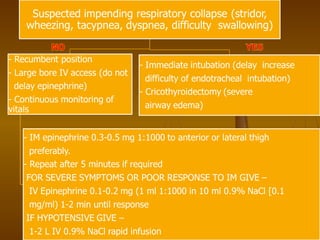
Suspected cardiogenic shockSuspected cardiogenic shock
SBP< 90 mm HgSBP< 90 mm Hg
Signs of low cardiac output stateSigns of low cardiac output state
Initial evaluation & rapid stabilizationInitial evaluation & rapid stabilization
Immediate ECGImmediate ECG
Look for evidence of AMILook for evidence of AMI
EvaluationEvaluation
Supplement oxygen/mech ventilation (for hypoxia)Supplement oxygen/mech ventilation (for hypoxia)
BP supportBP support
SBP< 90 mm Hg - dopamine (5 – 15 mcg/kg/min)SBP< 90 mm Hg - dopamine (5 – 15 mcg/kg/min)
SBP< 80 mm Hg – add norepinephrineSBP< 80 mm Hg – add norepinephrine
(1 – 20 mcg/kg/min)(1 – 20 mcg/kg/min)
Goal MAP> 65 mm HgGoal MAP> 65 mm Hg
(all pt should have intra-arterial monitoring)(all pt should have intra-arterial monitoring)
Suitable for revascularization
-PCI (Infarct artery only)
-emergent CABG
(3V dz, L main dz, PCI not
possible)
No revascularization
possible
-ct medical support
If BP stable
Consider inotropic support
-dobutamine
(2.5- 10 mcg/min)
-milrinone
(0.375-0.75 mcg/kg/min)
Avoid in hypotension, renal
failure (milrinone)
REFRACTORY SHOCK
consider left ventricular assist device, transplantation evaluation
Distributive ShockDistributive Shock
Abnormal vessel toneAbnormal vessel tone
(decreased afterload)(decreased afterload)
VasodilatationVasodilatation
Venous PoolingVenous Pooling
Decreased AfterloadDecreased Afterload
Maldistribution of regional blood flowMaldistribution of regional blood flow
 Diminished or absent sympathetic toneDiminished or absent sympathetic tone
 Reduce peripheral vascular toneReduce peripheral vascular tone
 Peripheral pooling of blood volumePeripheral pooling of blood volume
 Inadequate venous returnInadequate venous return
 Decreased perfusion, acidosis, hypotensionDecreased perfusion, acidosis, hypotension
Septic ShockSeptic Shock
 Terminology in SepsisTerminology in Sepsis
 Infection = response to micro organismInfection = response to micro organism
 Bacteremia = bug in bloodBacteremia = bug in blood
 Systemic Inflammatory Response SyndromeSystemic Inflammatory Response Syndrome
(SIRS)(SIRS)
 Sepsis = SIRS as response to a knownSepsis = SIRS as response to a known
infectioninfection
 Terminology in SepsisTerminology in Sepsis
 severe sepsis - acute organ dysfunctionsevere sepsis - acute organ dysfunction
secondary to documented or suspectedsecondary to documented or suspected
infectioninfection
 septic shock - severe sepsis + hypotension notseptic shock - severe sepsis + hypotension not
reversed with fluid resuscitationreversed with fluid resuscitation
 Multiple Organ Dysfunction Syndrome (MODS)Multiple Organ Dysfunction Syndrome (MODS)
– two or more organ dysfunction that requires– two or more organ dysfunction that requires
 Sepsis-induced tissue hypoperfusionSepsis-induced tissue hypoperfusion
- infection-induced hypotension,- infection-induced hypotension,
- elevated lactate,- elevated lactate,
- oliguria- oliguria
Recognition of Septic ShockRecognition of Septic Shock
 Early –Early – warm shockwarm shock
 Late –Late – Cold shockCold shock
Early vs Late Septic ShockEarly vs Late Septic Shock
EarlyEarly LateLate
Heart rateHeart rate TachycardiaTachycardia Tachycardia/Tachycardia/
bradycardiabradycardia
Blood pressureBlood pressure NormalNormal decreaseddecreased
PeripheralPeripheral
PerfusionPerfusion
Warm/coolWarm/cool
Dec./inc. pulsesDec./inc. pulses
CoolCool
Dec. pulsesDec. pulses
Early vs Late Septic ShockEarly vs Late Septic Shock
EarlyEarly LateLate
End-organ: skinEnd-organ: skin Dec. cap refillDec. cap refill Very dec. capVery dec. cap
RefillRefill
BrainBrain Irritable,Irritable,
restlessrestless
Lethargic,Lethargic,
unresponsiveunresponsive
KidneysKidneys OliguriaOliguria Oliguria,Oliguria,
AnuriaAnuria
DiagnosisDiagnosis
 General variables:General variables:
1. Fever (> 38.3°C)1. Fever (> 38.3°C)
Hypothermia (core temperature < 36°C)Hypothermia (core temperature < 36°C)
2.Heart rate > 90/min2.Heart rate > 90/min
3.Tachypnea3.Tachypnea
4. Altered mental status4. Altered mental status
5. Significant edema or positive fluid balance (>5. Significant edema or positive fluid balance (>
20mL/kg over 24hr)20mL/kg over 24hr)
6. Hyperglycemia (plasma glucose > 140mg/dL or6. Hyperglycemia (plasma glucose > 140mg/dL or
7.7 mmol/L) in the absence of diabetes7.7 mmol/L) in the absence of diabetes
 Inflammatory variables:Inflammatory variables:
1. Leukocytosis (WBC count > 12,000 µL–1)1. Leukocytosis (WBC count > 12,000 µL–1)
2. Leukopenia (WBC count < 4000 µL–1)2. Leukopenia (WBC count < 4000 µL–1)
3. Normal WBC count with greater than3. Normal WBC count with greater than
10% immature forms10% immature forms
4. Increased Plasma C-reactive protein4. Increased Plasma C-reactive protein
5. Increased Plasma procalcitonin5. Increased Plasma procalcitonin
 Hemodynamic variables:Hemodynamic variables:
- Arterial hypotension:- Arterial hypotension:
SBP < 90mm HgSBP < 90mm Hg
MAP < 65mm HgMAP < 65mm Hg
- SVO2 > 70%- SVO2 > 70%
- CI > 3.5 L/min/m2- CI > 3.5 L/min/m2
 Organ dysfunction variables:Organ dysfunction variables:
1.1. Arterial hypoxemia (Pao2/Fio2 < 300)Arterial hypoxemia (Pao2/Fio2 < 300)
2. Acute oliguria (urine output < 0.5mL/kg/hr2. Acute oliguria (urine output < 0.5mL/kg/hr
for at least 2 hrs despite adequate fluidfor at least 2 hrs despite adequate fluid
resuscitation)resuscitation)
3. Creatinine increase > 0.5mg/dL or 44.2 µmol/L3. Creatinine increase > 0.5mg/dL or 44.2 µmol/L
4. Coagulation abnormalities4. Coagulation abnormalities
(INR > 1.5 )(INR > 1.5 )
5. Ileus (absent bowel sounds)5. Ileus (absent bowel sounds)
6. Thrombocytopenia (platelet count < 100,000 /µL)6. Thrombocytopenia (platelet count < 100,000 /µL)
7. Hyperbilirubinemia (plasma total bilirubin >7. Hyperbilirubinemia (plasma total bilirubin >
4mg/dL or 70 µmol/L)4mg/dL or 70 µmol/L)
 Tissue perfusion variables:Tissue perfusion variables:
Hyperlactatemia (> 1 mmol/L)Hyperlactatemia (> 1 mmol/L)
Decreased capillary refill or mottlingDecreased capillary refill or mottling
Severe sepsisSevere sepsis
 Lactate above upper limits laboratoryLactate above upper limits laboratory
 Urine output < 0.5mL/kg/hr for more than 2 hrsUrine output < 0.5mL/kg/hr for more than 2 hrs
despite adequate fluid resuscitationdespite adequate fluid resuscitation
 Acute lung injury with Pao2/Fio2 < 250 in theAcute lung injury with Pao2/Fio2 < 250 in the
absence of pneumonia as infection sourceabsence of pneumonia as infection source
 Acute lung injury with Pao2/Fio2 < 200 in theAcute lung injury with Pao2/Fio2 < 200 in the
presence of pneumonia as infection sourcepresence of pneumonia as infection source
 Creatinine > 2.0mg/dL (176.8 µmol/L)Creatinine > 2.0mg/dL (176.8 µmol/L)
 Bilirubin > 2mg/dL (34.2 µmol/L)Bilirubin > 2mg/dL (34.2 µmol/L)
 Platelet count < 100,000 µLPlatelet count < 100,000 µL
 Coagulopathy (international normalized ratio >Coagulopathy (international normalized ratio >
1.5)1.5)
Treatment Strategies inTreatment Strategies in
ShockShock
MonitoringMonitoring
 Blood pressureBlood pressure
 Heart rateHeart rate
 Respiratory rateRespiratory rate
 Urine outputUrine output
 Blood CBCBlood CBC
 Pulse - oximetryPulse - oximetry
 ECGECG
 U/S , CT , X-rayU/S , CT , X-ray
Special MonitoringSpecial Monitoring
 CARDIO – VASCULAR:CARDIO – VASCULAR:
1. Central venous pressure1. Central venous pressure
2. Cardiac output :2. Cardiac output :
- Pulmonary catheter- Pulmonary catheter
- Doppler ultrasound- Doppler ultrasound
- Pulse waveform analysis- Pulse waveform analysis
 SYSTEMIC & ORGAN PERFUSIONSYSTEMIC & ORGAN PERFUSION
1. - Clinically - urine output & LOC1. - Clinically - urine output & LOC
- Sr. Lactate estimation- Sr. Lactate estimation
- Blood gas analysis- Blood gas analysis
- Mixed venous O2 saturation- Mixed venous O2 saturation
2. Newer methods2. Newer methods
- Muscle tissue O2 probes- Muscle tissue O2 probes
- Near –infrared spectroscopy- Near –infrared spectroscopy
- Sublingual capnometry- Sublingual capnometry
Severe sepsis bundleSevere sepsis bundle
 Design to optimize the timing ,sequence, andDesign to optimize the timing ,sequence, and
goals of the individual element care.goals of the individual element care.
 Includes:Includes:
- goal directed hemodynamic stabilization- goal directed hemodynamic stabilization
- early appropriate antimicrobial therapy- early appropriate antimicrobial therapy
- associated adjunctive therapy- associated adjunctive therapy
SURVIVING SEPSIS CAMPAIGN BUNDLESSURVIVING SEPSIS CAMPAIGN BUNDLES
TO BE COMPLETED WITHIN 3 HOURS:TO BE COMPLETED WITHIN 3 HOURS:
1) Measure lactate level1) Measure lactate level
2) Obtain blood cultures prior to administration of2) Obtain blood cultures prior to administration of
antibioticsantibiotics
3) Administer broad spectrum antibiotics3) Administer broad spectrum antibiotics
4) Administer 30 mL/kg crystalloid for hypotension or4) Administer 30 mL/kg crystalloid for hypotension or
lactate > 4mmol/Llactate > 4mmol/L
TO BE COMPLETED WITHIN 6 HOURS:TO BE COMPLETED WITHIN 6 HOURS:
5) Apply vasopressors (for hypotension not5) Apply vasopressors (for hypotension not
responding to initial fluid resuscitation)responding to initial fluid resuscitation)
6) persistent arterial hypotension despite volume6) persistent arterial hypotension despite volume
resuscitation or initial lactate 4 mmol/L measure:resuscitation or initial lactate 4 mmol/L measure:
- central venous pressure- central venous pressure
- central venous oxygen saturation- central venous oxygen saturation
7) Remeasure lactate7) Remeasure lactate
Fluid managementFluid management
ADJUNCTIVE THERAPIESADJUNCTIVE THERAPIES
Antibiotic ManagementAntibiotic Management
Is patient
immunocompromised?
 HIV
 Neutropenia
 Chronic corticosteroids
 Malnutrition
 Receiving chemotherapy
Give antibiotic therapy to
opportunistic pathogens
+
Bacterial pathogens
Consider likely bacterial
infection based on clinical
presenatation
Human immunodeficiency
antibodies
Extended spectrum beta-
lactamase
Methicillin resistant
staphylococcus aureus
Risk factors for healthcare-
associated infection present:
• Recent hospitalization
• residence in nursing
home/rehabilitation
• Regular visits to hospital
• Home infusion or
wound therapy
Consider nosocomial bacterial
pathogens that are potentially
antibiotic resistant:
• MRSA
• pseudomonas aeruginosa
• acinetobacter species
•Klebsiella pneumonia
• E - coli
Consider community-based
bacterial pathogens that are
antibiotic sensitive :
•Streptococcus pneumoniae
• e coli
• legionaella pneumophila
• haemophillia influenza
• klebsiella pneumonia
* Broad spectrum cephalosporin /
* Carbapenam /
* Beta-lactam /
* Fluroquinolone /
* Aminoglycoside /
* MRSA- Directed agent
(vancomycin, linezolid,
tigecycline)
Select single agent therapy:
• ceftriaxone
• fluroquinolone
• ampicillin/sulbactum
• macrolides (azithromycin,
clarithromycin, telithromycin)
Modify and/or narrow antibiotic
regimen based on organism
identified and susceptibilty
testing
Activated Protein CActivated Protein C
(drotrecogin - alpha)(drotrecogin - alpha)
 Recombinant Human Activated Protein CRecombinant Human Activated Protein C
 Prevent DIC cascade with antithrombotic activityPrevent DIC cascade with antithrombotic activity
by inhibiting factors Va & VIIIaby inhibiting factors Va & VIIIa
 May exerts anti-inflammatory effects by inhibitingMay exerts anti-inflammatory effects by inhibiting
TNF and by blocking leukocytes adhesionsTNF and by blocking leukocytes adhesions
 Side effectsSide effects
 BleedingBleeding
 Pediatric trial terminated early (03/04) due toPediatric trial terminated early (03/04) due to
no benefit to known risk of bleedingno benefit to known risk of bleeding
Anaphylactic shockAnaphylactic shock
 Immunoglobulin E mediated immediateImmunoglobulin E mediated immediate
hypersensitivity reactionhypersensitivity reaction
 It involve mast cell and basophil degranulationsIt involve mast cell and basophil degranulations
 Clinically it is indistinguishable fromClinically it is indistinguishable from
anaphylactoid reactions (direct mast cellanaphylactoid reactions (direct mast cell
degranulation)degranulation)
 Reaction develop in < 1hour after exposure toReaction develop in < 1hour after exposure to
triggering substancestriggering substances
 Initial symptoms:Initial symptoms:
- flushing- flushing
- pruritis- pruritis
- sense of doom- sense of doom
Causes?Causes?
Anaphylaxis (IgE mediated) Anaphylactoid reaction
-Foods (nuts, egg, fish, shellfish,
cows
milk)
- vaccines
- anesthetic agents
- insulin and other harmones
- antitoxins
- blood and blood products
- insect stings and bites (bee,
wasp
and ant)
- snake bites
- latex
- allergy immunotherapy
-NSAIDs
- opiates
- sulfites
- radioconstrast media
- neuromuscular blocking agents
- gamma globulin
- antisera
- exercise
Clinical ManifestationsClinical Manifestations
1. Cardiovascular collapse (shock) – seen in 20%1. Cardiovascular collapse (shock) – seen in 20%
 Results from:Results from:
- hypovolemia induced by increased vascular- hypovolemia induced by increased vascular
permeability and loss of intravascular volume.permeability and loss of intravascular volume.
- hypotension from peripheral vasodilation- hypotension from peripheral vasodilation
- myocardial depression- myocardial depression
- bradycardia- bradycardia
2. Respiratory symptoms - seen in 50% of2. Respiratory symptoms - seen in 50% of
patientspatients
 Can results in :Can results in :
- severe upper airway edema- severe upper airway edema
- bronchospasm- bronchospasm
- cardiogenic and non- cardiogenic pulmonary- cardiogenic and non- cardiogenic pulmonary
edemaedema
 Biphasic reactions occurs in 20 % within, 1 to 8Biphasic reactions occurs in 20 % within, 1 to 8
hours after initial reactionshours after initial reactions
3. Eyes :3. Eyes :
- pruritus- pruritus
- lacrimation- lacrimation
- conjunctival erythema- conjunctival erythema
- periorbital edema- periorbital edema
4. Gastrointestinal :4. Gastrointestinal :
- nausea / vomiting- nausea / vomiting
- diarrhoea- diarrhoea
- abdominal pain- abdominal pain
5. skin:5. skin:
- pruritus- pruritus
- flushing- flushing
- urticaria- urticaria
- angioedema- angioedema
6. Neurologic :6. Neurologic :
- anxiety and sense of doom- anxiety and sense of doom
- syncope- syncope
- seizures- seizures
Acute TreatmentAcute Treatment
 Remember….Remember….
- intravenous steroids have no role in the acute- intravenous steroids have no role in the acute
treatment of anaphylaxis but may preventtreatment of anaphylaxis but may prevent
phase 2 reactionphase 2 reaction
- given IV methyl prednisolone 1-2 mg/kg and- given IV methyl prednisolone 1-2 mg/kg and
continue up to 4 days (IV / Orally)continue up to 4 days (IV / Orally)
- on discharge, refer the patient to allergist for- on discharge, refer the patient to allergist for
testing and monitoring and provide with hometesting and monitoring and provide with home
epinephrine self – injectors (EpiPen)epinephrine self – injectors (EpiPen)
Practically Speaking….Practically Speaking….
 Know how to distinguish different types of shockKnow how to distinguish different types of shock
and treat accordingly.and treat accordingly.
 Look for early signs of shock.Look for early signs of shock.
 Monitor the patient using the HR, MAP, mentalMonitor the patient using the HR, MAP, mental
status, urine output.status, urine output.
 SHOCK is not equal to hypotension.SHOCK is not equal to hypotension.
 Start antibiotics within an hour !Start antibiotics within an hour !
 Do not wait for cultures or blood work.Do not wait for cultures or blood work.
THANK YOUTHANK YOU

Shock

  • 1.
    SHOCKSHOCK By Dr SnehaKhobragadeBy Dr Sneha Khobragade Guided by Dr Deepak RuparelGuided by Dr Deepak Ruparel GMC NagpurGMC Nagpur
  • 2.
    Definition of ShockDefinitionof Shock  Inadequate tissue perfusion to meet tissueInadequate tissue perfusion to meet tissue demandsdemands  Usually result of inadequate blood flowUsually result of inadequate blood flow and/or oxygen deliveryand/or oxygen delivery
  • 3.
  • 4.
  • 6.
  • 7.
  • 8.
    Cause?Cause? Cardiogenic shock Hypovolemic shock Septic shock Pulse pressureDecreases Decreases Increases Diastolic pressure Decreases Decreases Decreases Extremities Cool Cool Warm Nailbed blood return Slow Slow Rapid Jugular venous pressure Increases Decreases Decreases Respiratory creptitions +++ - - S3,S4 gallop rhythm +++ - - Chest radiograph Large heart, Pulmonary edema Diminished cardiac size Normal,unless pneumonia presesnt Identified site of infection - - +++
  • 9.
  • 10.
    Hypovolemic shockHypovolemic shock Decreasecirculating blood volumeDecrease circulating blood volume
  • 11.
  • 12.
     Compensation –increase endogenousCompensation – increase endogenous catecholaminescatecholamines  Increase HR – increase C.O., O2 deliveryIncrease HR – increase C.O., O2 delivery  Increase SVR – increase BP (esp diastolic)Increase SVR – increase BP (esp diastolic)  Lactic acidosisLactic acidosis  Increase in serum lactate- early indicator ofIncrease in serum lactate- early indicator of tissue hypoperfusiontissue hypoperfusion
  • 13.
     Aim- reverseorgan hypoperfusionAim- reverse organ hypoperfusion ( Optimizing the tissue o2 delivery)( Optimizing the tissue o2 delivery) - requires sufficient hemoglobin concentration- requires sufficient hemoglobin concentration - adequate intravascular volume- adequate intravascular volume - dobutamine (despite adequate preload, cardiac- dobutamine (despite adequate preload, cardiac output is not sufficient)output is not sufficient)
  • 14.
    Determinants of OxygenDeliveryDeterminants of Oxygen Delivery
  • 15.
     Oxygen content= 1.34 (Hb x SaO2) +Oxygen content = 1.34 (Hb x SaO2) + (PaO2 x 0.0031)(PaO2 x 0.0031)  SaO2: arterial hemoglobin Oxygen saturationSaO2: arterial hemoglobin Oxygen saturation  Hb: Hemoglobin concentrationHb: Hemoglobin concentration  PaO2: arterial oxygen tensionPaO2: arterial oxygen tension  To improve Oxygen contentTo improve Oxygen content  Increase Hemoglobin concentrationIncrease Hemoglobin concentration  Increase saturationIncrease saturation
  • 16.
     Cardiac outputCardiacoutput  C.O. = Heart rate x stroke volumeC.O. = Heart rate x stroke volume  To improve Cardiac outputTo improve Cardiac output  Increase Heart rateIncrease Heart rate  Increase Stroke VolumeIncrease Stroke Volume  Preload – volume of blood in the ventriclePreload – volume of blood in the ventricle  Afterload – resistance to contractionAfterload – resistance to contraction  Contractility – force appliedContractility – force applied
  • 17.
    ManagementManagement  Goal :Goal: 1. control the source of hemorrhage1. control the source of hemorrhage 2. administer adequate intravascular volume2. administer adequate intravascular volume replacementreplacement  Clinical picture:Clinical picture: - SBP <90 mm hg- SBP <90 mm hg - MAP <60 mm hg- MAP <60 mm hg - lactate > 4 mmol/L- lactate > 4 mmol/L
  • 18.
    simultaneouslysimultaneously - control sourceof bleeding- control source of bleeding - establish vascular access- establish vascular access (8.5 fr central venous catheter/(8.5 fr central venous catheter/ two 14 G peripheral vein catheter)two 14 G peripheral vein catheter)
  • 20.
     Measure hemoglobinMeasurehemoglobin - > 9 g/dl- > 9 g/dl  administer 0.9 NaCl / RLadminister 0.9 NaCl / RL - < 9 g/dl- < 9 g/dl  RBC transfusion until Hg >RBC transfusion until Hg > 9g/dl and correct any9g/dl and correct any identified coagulation oridentified coagulation or platelet abnormalitiesplatelet abnormalities
  • 21.
    In on goinghemorrhage: - administer 2 – 4 l of crystalloid - group ‘0’ blood should be given Rh - positive - men and women who are in non childbearing age Rh - negative – women in childbearing age - Type specific blood administered after first four units of non-typed blood are given - Goal – maintain hemoglobin > 9 g/dl
  • 23.
    Adjunctive TherapiesAdjunctive Therapies TherapyRationale Airway control -To provide appropriate gas exchange - to prevent aspiration Cardiac/hemodynamic monitoring -To identify dysrhythmias and inadequate fluid resuscitaion Platelet/fresh frozen plasma adminsitration - required because of dilutional effect of crystalloid and blood - Consumption due to ongoing bleeding - Platelet count > 50,000 /mm3 Calcium chloride Magnesium chloride -To reverse ionized hypocalcemia and hypomagnesemia resulting from administration of citrate with transfused blood Antibiotics -When open and contaminated wounds are present Corticosteroids -For patients presumed to have adrenal injury and unable to mount stress response
  • 24.
    Cardiogenic ShockCardiogenic Shock CardiacdysfunctionCardiac dysfunction Inadequate circulationInadequate circulation Compromised organ perfusionCompromised organ perfusion
  • 25.
    when to say?whento say? Prolonged hypotension (SBP< 90 mmhg) inProlonged hypotension (SBP< 90 mmhg) in settings of decreased cardiac output (< 1.8settings of decreased cardiac output (< 1.8 L/min/m2 without support and <2.2 L/min/m2L/min/m2 without support and <2.2 L/min/m2 with support) despite adequate intravascularwith support) despite adequate intravascular volume (left ventricular end-diastolic pressure >volume (left ventricular end-diastolic pressure > 18 mm Hg and/or pulmonary artery occlusion18 mm Hg and/or pulmonary artery occlusion pressure >15 mm Hg)pressure >15 mm Hg)
  • 26.
    EtiologyEtiology  Acute myocardialinfarctionAcute myocardial infarction  Mechanical causesMechanical causes  Severe cardiomyopathy /congestive heart failureSevere cardiomyopathy /congestive heart failure  Acute myocarditisAcute myocarditis  Calcium channel or beta blocker overdoseCalcium channel or beta blocker overdose  Acute /severe valvular insufficiencyAcute /severe valvular insufficiency  Obstruction to left ventricular outflowObstruction to left ventricular outflow  Obstruction to ventricular filling
  • 27.
  • 28.
    SymptomsSymptoms  TachycardiaTachycardia  TachypneaTachypnea Respiratory distressRespiratory distress  Mental status changeMental status change  Cool extremitiesCool extremities  oliguriaoliguria
  • 29.
  • 30.
    Suspected cardiogenic shockSuspectedcardiogenic shock SBP< 90 mm HgSBP< 90 mm Hg Signs of low cardiac output stateSigns of low cardiac output state Initial evaluation & rapid stabilizationInitial evaluation & rapid stabilization Immediate ECGImmediate ECG Look for evidence of AMILook for evidence of AMI
  • 31.
  • 32.
    Supplement oxygen/mech ventilation(for hypoxia)Supplement oxygen/mech ventilation (for hypoxia) BP supportBP support SBP< 90 mm Hg - dopamine (5 – 15 mcg/kg/min)SBP< 90 mm Hg - dopamine (5 – 15 mcg/kg/min) SBP< 80 mm Hg – add norepinephrineSBP< 80 mm Hg – add norepinephrine (1 – 20 mcg/kg/min)(1 – 20 mcg/kg/min) Goal MAP> 65 mm HgGoal MAP> 65 mm Hg (all pt should have intra-arterial monitoring)(all pt should have intra-arterial monitoring)
  • 34.
    Suitable for revascularization -PCI(Infarct artery only) -emergent CABG (3V dz, L main dz, PCI not possible) No revascularization possible -ct medical support If BP stable Consider inotropic support -dobutamine (2.5- 10 mcg/min) -milrinone (0.375-0.75 mcg/kg/min) Avoid in hypotension, renal failure (milrinone) REFRACTORY SHOCK consider left ventricular assist device, transplantation evaluation
  • 35.
    Distributive ShockDistributive Shock Abnormalvessel toneAbnormal vessel tone (decreased afterload)(decreased afterload)
  • 36.
    VasodilatationVasodilatation Venous PoolingVenous Pooling DecreasedAfterloadDecreased Afterload Maldistribution of regional blood flowMaldistribution of regional blood flow
  • 37.
     Diminished orabsent sympathetic toneDiminished or absent sympathetic tone  Reduce peripheral vascular toneReduce peripheral vascular tone  Peripheral pooling of blood volumePeripheral pooling of blood volume  Inadequate venous returnInadequate venous return  Decreased perfusion, acidosis, hypotensionDecreased perfusion, acidosis, hypotension
  • 38.
    Septic ShockSeptic Shock Terminology in SepsisTerminology in Sepsis  Infection = response to micro organismInfection = response to micro organism  Bacteremia = bug in bloodBacteremia = bug in blood  Systemic Inflammatory Response SyndromeSystemic Inflammatory Response Syndrome (SIRS)(SIRS)  Sepsis = SIRS as response to a knownSepsis = SIRS as response to a known infectioninfection
  • 39.
     Terminology inSepsisTerminology in Sepsis  severe sepsis - acute organ dysfunctionsevere sepsis - acute organ dysfunction secondary to documented or suspectedsecondary to documented or suspected infectioninfection  septic shock - severe sepsis + hypotension notseptic shock - severe sepsis + hypotension not reversed with fluid resuscitationreversed with fluid resuscitation  Multiple Organ Dysfunction Syndrome (MODS)Multiple Organ Dysfunction Syndrome (MODS) – two or more organ dysfunction that requires– two or more organ dysfunction that requires
  • 40.
     Sepsis-induced tissuehypoperfusionSepsis-induced tissue hypoperfusion - infection-induced hypotension,- infection-induced hypotension, - elevated lactate,- elevated lactate, - oliguria- oliguria
  • 41.
    Recognition of SepticShockRecognition of Septic Shock  Early –Early – warm shockwarm shock  Late –Late – Cold shockCold shock
  • 42.
    Early vs LateSeptic ShockEarly vs Late Septic Shock EarlyEarly LateLate Heart rateHeart rate TachycardiaTachycardia Tachycardia/Tachycardia/ bradycardiabradycardia Blood pressureBlood pressure NormalNormal decreaseddecreased PeripheralPeripheral PerfusionPerfusion Warm/coolWarm/cool Dec./inc. pulsesDec./inc. pulses CoolCool Dec. pulsesDec. pulses
  • 43.
    Early vs LateSeptic ShockEarly vs Late Septic Shock EarlyEarly LateLate End-organ: skinEnd-organ: skin Dec. cap refillDec. cap refill Very dec. capVery dec. cap RefillRefill BrainBrain Irritable,Irritable, restlessrestless Lethargic,Lethargic, unresponsiveunresponsive KidneysKidneys OliguriaOliguria Oliguria,Oliguria, AnuriaAnuria
  • 44.
    DiagnosisDiagnosis  General variables:Generalvariables: 1. Fever (> 38.3°C)1. Fever (> 38.3°C) Hypothermia (core temperature < 36°C)Hypothermia (core temperature < 36°C) 2.Heart rate > 90/min2.Heart rate > 90/min 3.Tachypnea3.Tachypnea 4. Altered mental status4. Altered mental status
  • 45.
    5. Significant edemaor positive fluid balance (>5. Significant edema or positive fluid balance (> 20mL/kg over 24hr)20mL/kg over 24hr) 6. Hyperglycemia (plasma glucose > 140mg/dL or6. Hyperglycemia (plasma glucose > 140mg/dL or 7.7 mmol/L) in the absence of diabetes7.7 mmol/L) in the absence of diabetes
  • 46.
     Inflammatory variables:Inflammatoryvariables: 1. Leukocytosis (WBC count > 12,000 µL–1)1. Leukocytosis (WBC count > 12,000 µL–1) 2. Leukopenia (WBC count < 4000 µL–1)2. Leukopenia (WBC count < 4000 µL–1) 3. Normal WBC count with greater than3. Normal WBC count with greater than 10% immature forms10% immature forms 4. Increased Plasma C-reactive protein4. Increased Plasma C-reactive protein 5. Increased Plasma procalcitonin5. Increased Plasma procalcitonin
  • 47.
     Hemodynamic variables:Hemodynamicvariables: - Arterial hypotension:- Arterial hypotension: SBP < 90mm HgSBP < 90mm Hg MAP < 65mm HgMAP < 65mm Hg - SVO2 > 70%- SVO2 > 70% - CI > 3.5 L/min/m2- CI > 3.5 L/min/m2
  • 48.
     Organ dysfunctionvariables:Organ dysfunction variables: 1.1. Arterial hypoxemia (Pao2/Fio2 < 300)Arterial hypoxemia (Pao2/Fio2 < 300) 2. Acute oliguria (urine output < 0.5mL/kg/hr2. Acute oliguria (urine output < 0.5mL/kg/hr for at least 2 hrs despite adequate fluidfor at least 2 hrs despite adequate fluid resuscitation)resuscitation) 3. Creatinine increase > 0.5mg/dL or 44.2 µmol/L3. Creatinine increase > 0.5mg/dL or 44.2 µmol/L
  • 49.
    4. Coagulation abnormalities4.Coagulation abnormalities (INR > 1.5 )(INR > 1.5 ) 5. Ileus (absent bowel sounds)5. Ileus (absent bowel sounds) 6. Thrombocytopenia (platelet count < 100,000 /µL)6. Thrombocytopenia (platelet count < 100,000 /µL) 7. Hyperbilirubinemia (plasma total bilirubin >7. Hyperbilirubinemia (plasma total bilirubin > 4mg/dL or 70 µmol/L)4mg/dL or 70 µmol/L)
  • 50.
     Tissue perfusionvariables:Tissue perfusion variables: Hyperlactatemia (> 1 mmol/L)Hyperlactatemia (> 1 mmol/L) Decreased capillary refill or mottlingDecreased capillary refill or mottling
  • 51.
    Severe sepsisSevere sepsis Lactate above upper limits laboratoryLactate above upper limits laboratory  Urine output < 0.5mL/kg/hr for more than 2 hrsUrine output < 0.5mL/kg/hr for more than 2 hrs despite adequate fluid resuscitationdespite adequate fluid resuscitation  Acute lung injury with Pao2/Fio2 < 250 in theAcute lung injury with Pao2/Fio2 < 250 in the absence of pneumonia as infection sourceabsence of pneumonia as infection source
  • 52.
     Acute lunginjury with Pao2/Fio2 < 200 in theAcute lung injury with Pao2/Fio2 < 200 in the presence of pneumonia as infection sourcepresence of pneumonia as infection source  Creatinine > 2.0mg/dL (176.8 µmol/L)Creatinine > 2.0mg/dL (176.8 µmol/L)  Bilirubin > 2mg/dL (34.2 µmol/L)Bilirubin > 2mg/dL (34.2 µmol/L)  Platelet count < 100,000 µLPlatelet count < 100,000 µL  Coagulopathy (international normalized ratio >Coagulopathy (international normalized ratio > 1.5)1.5)
  • 53.
    Treatment Strategies inTreatmentStrategies in ShockShock
  • 54.
    MonitoringMonitoring  Blood pressureBloodpressure  Heart rateHeart rate  Respiratory rateRespiratory rate  Urine outputUrine output  Blood CBCBlood CBC  Pulse - oximetryPulse - oximetry  ECGECG  U/S , CT , X-rayU/S , CT , X-ray
  • 55.
    Special MonitoringSpecial Monitoring CARDIO – VASCULAR:CARDIO – VASCULAR: 1. Central venous pressure1. Central venous pressure 2. Cardiac output :2. Cardiac output : - Pulmonary catheter- Pulmonary catheter - Doppler ultrasound- Doppler ultrasound - Pulse waveform analysis- Pulse waveform analysis
  • 56.
     SYSTEMIC &ORGAN PERFUSIONSYSTEMIC & ORGAN PERFUSION 1. - Clinically - urine output & LOC1. - Clinically - urine output & LOC - Sr. Lactate estimation- Sr. Lactate estimation - Blood gas analysis- Blood gas analysis - Mixed venous O2 saturation- Mixed venous O2 saturation 2. Newer methods2. Newer methods - Muscle tissue O2 probes- Muscle tissue O2 probes - Near –infrared spectroscopy- Near –infrared spectroscopy - Sublingual capnometry- Sublingual capnometry
  • 57.
    Severe sepsis bundleSeveresepsis bundle  Design to optimize the timing ,sequence, andDesign to optimize the timing ,sequence, and goals of the individual element care.goals of the individual element care.  Includes:Includes: - goal directed hemodynamic stabilization- goal directed hemodynamic stabilization - early appropriate antimicrobial therapy- early appropriate antimicrobial therapy - associated adjunctive therapy- associated adjunctive therapy
  • 58.
    SURVIVING SEPSIS CAMPAIGNBUNDLESSURVIVING SEPSIS CAMPAIGN BUNDLES TO BE COMPLETED WITHIN 3 HOURS:TO BE COMPLETED WITHIN 3 HOURS: 1) Measure lactate level1) Measure lactate level 2) Obtain blood cultures prior to administration of2) Obtain blood cultures prior to administration of antibioticsantibiotics 3) Administer broad spectrum antibiotics3) Administer broad spectrum antibiotics 4) Administer 30 mL/kg crystalloid for hypotension or4) Administer 30 mL/kg crystalloid for hypotension or lactate > 4mmol/Llactate > 4mmol/L
  • 59.
    TO BE COMPLETEDWITHIN 6 HOURS:TO BE COMPLETED WITHIN 6 HOURS: 5) Apply vasopressors (for hypotension not5) Apply vasopressors (for hypotension not responding to initial fluid resuscitation)responding to initial fluid resuscitation) 6) persistent arterial hypotension despite volume6) persistent arterial hypotension despite volume resuscitation or initial lactate 4 mmol/L measure:resuscitation or initial lactate 4 mmol/L measure: - central venous pressure- central venous pressure - central venous oxygen saturation- central venous oxygen saturation 7) Remeasure lactate7) Remeasure lactate
  • 60.
  • 62.
  • 64.
    Antibiotic ManagementAntibiotic Management Ispatient immunocompromised?  HIV  Neutropenia  Chronic corticosteroids  Malnutrition  Receiving chemotherapy Give antibiotic therapy to opportunistic pathogens + Bacterial pathogens Consider likely bacterial infection based on clinical presenatation Human immunodeficiency antibodies Extended spectrum beta- lactamase Methicillin resistant staphylococcus aureus
  • 65.
    Risk factors forhealthcare- associated infection present: • Recent hospitalization • residence in nursing home/rehabilitation • Regular visits to hospital • Home infusion or wound therapy Consider nosocomial bacterial pathogens that are potentially antibiotic resistant: • MRSA • pseudomonas aeruginosa • acinetobacter species •Klebsiella pneumonia • E - coli Consider community-based bacterial pathogens that are antibiotic sensitive : •Streptococcus pneumoniae • e coli • legionaella pneumophila • haemophillia influenza • klebsiella pneumonia * Broad spectrum cephalosporin / * Carbapenam / * Beta-lactam / * Fluroquinolone / * Aminoglycoside / * MRSA- Directed agent (vancomycin, linezolid, tigecycline)
  • 66.
    Select single agenttherapy: • ceftriaxone • fluroquinolone • ampicillin/sulbactum • macrolides (azithromycin, clarithromycin, telithromycin) Modify and/or narrow antibiotic regimen based on organism identified and susceptibilty testing
  • 67.
    Activated Protein CActivatedProtein C (drotrecogin - alpha)(drotrecogin - alpha)  Recombinant Human Activated Protein CRecombinant Human Activated Protein C  Prevent DIC cascade with antithrombotic activityPrevent DIC cascade with antithrombotic activity by inhibiting factors Va & VIIIaby inhibiting factors Va & VIIIa  May exerts anti-inflammatory effects by inhibitingMay exerts anti-inflammatory effects by inhibiting TNF and by blocking leukocytes adhesionsTNF and by blocking leukocytes adhesions
  • 68.
     Side effectsSideeffects  BleedingBleeding  Pediatric trial terminated early (03/04) due toPediatric trial terminated early (03/04) due to no benefit to known risk of bleedingno benefit to known risk of bleeding
  • 69.
  • 70.
     Immunoglobulin Emediated immediateImmunoglobulin E mediated immediate hypersensitivity reactionhypersensitivity reaction  It involve mast cell and basophil degranulationsIt involve mast cell and basophil degranulations  Clinically it is indistinguishable fromClinically it is indistinguishable from anaphylactoid reactions (direct mast cellanaphylactoid reactions (direct mast cell degranulation)degranulation)
  • 71.
     Reaction developin < 1hour after exposure toReaction develop in < 1hour after exposure to triggering substancestriggering substances  Initial symptoms:Initial symptoms: - flushing- flushing - pruritis- pruritis - sense of doom- sense of doom
  • 72.
    Causes?Causes? Anaphylaxis (IgE mediated)Anaphylactoid reaction -Foods (nuts, egg, fish, shellfish, cows milk) - vaccines - anesthetic agents - insulin and other harmones - antitoxins - blood and blood products - insect stings and bites (bee, wasp and ant) - snake bites - latex - allergy immunotherapy -NSAIDs - opiates - sulfites - radioconstrast media - neuromuscular blocking agents - gamma globulin - antisera - exercise
  • 73.
    Clinical ManifestationsClinical Manifestations 1.Cardiovascular collapse (shock) – seen in 20%1. Cardiovascular collapse (shock) – seen in 20%  Results from:Results from: - hypovolemia induced by increased vascular- hypovolemia induced by increased vascular permeability and loss of intravascular volume.permeability and loss of intravascular volume. - hypotension from peripheral vasodilation- hypotension from peripheral vasodilation - myocardial depression- myocardial depression - bradycardia- bradycardia
  • 74.
    2. Respiratory symptoms- seen in 50% of2. Respiratory symptoms - seen in 50% of patientspatients  Can results in :Can results in : - severe upper airway edema- severe upper airway edema - bronchospasm- bronchospasm - cardiogenic and non- cardiogenic pulmonary- cardiogenic and non- cardiogenic pulmonary edemaedema  Biphasic reactions occurs in 20 % within, 1 to 8Biphasic reactions occurs in 20 % within, 1 to 8 hours after initial reactionshours after initial reactions
  • 75.
    3. Eyes :3.Eyes : - pruritus- pruritus - lacrimation- lacrimation - conjunctival erythema- conjunctival erythema - periorbital edema- periorbital edema 4. Gastrointestinal :4. Gastrointestinal : - nausea / vomiting- nausea / vomiting - diarrhoea- diarrhoea - abdominal pain- abdominal pain
  • 76.
    5. skin:5. skin: -pruritus- pruritus - flushing- flushing - urticaria- urticaria - angioedema- angioedema 6. Neurologic :6. Neurologic : - anxiety and sense of doom- anxiety and sense of doom - syncope- syncope - seizures- seizures
  • 77.
  • 80.
     Remember….Remember…. - intravenoussteroids have no role in the acute- intravenous steroids have no role in the acute treatment of anaphylaxis but may preventtreatment of anaphylaxis but may prevent phase 2 reactionphase 2 reaction - given IV methyl prednisolone 1-2 mg/kg and- given IV methyl prednisolone 1-2 mg/kg and continue up to 4 days (IV / Orally)continue up to 4 days (IV / Orally) - on discharge, refer the patient to allergist for- on discharge, refer the patient to allergist for testing and monitoring and provide with hometesting and monitoring and provide with home epinephrine self – injectors (EpiPen)epinephrine self – injectors (EpiPen)
  • 81.
    Practically Speaking….Practically Speaking…. Know how to distinguish different types of shockKnow how to distinguish different types of shock and treat accordingly.and treat accordingly.  Look for early signs of shock.Look for early signs of shock.  Monitor the patient using the HR, MAP, mentalMonitor the patient using the HR, MAP, mental status, urine output.status, urine output.  SHOCK is not equal to hypotension.SHOCK is not equal to hypotension.  Start antibiotics within an hour !Start antibiotics within an hour !  Do not wait for cultures or blood work.Do not wait for cultures or blood work.
  • 82.

Editor's Notes