SHOCK
August, 2015
8/17/2015 1
Objectives
• Define shock
• Describe the types of shock
• Discuss the pathophysiology of shock
• Discuss the medical and nursing management
of shock
8/17/2015 2
Definition
• Is a condition when circulatory system is no
longer able to complete one of its essential
function like provision of oxygen and nutrients
to the cells of the body or removing
subsequent wastes. (Hand,2001,chavez and
vrewer,2002, Bench,2008)
8/17/2015 3
Defn…
• Shock can best be defined as a physiologic
state in which systemic blood pressure is
inadequate to deliver oxygen and nutrients to
support vital organs and cellular function
(Mikhail, 1999)
• Shock is the clinical syndrome that results
from inadequate tissue perfusion
8/17/2015 4
• Clinical manifestation → autonomic
neuroendocrine responses to hypoperfusion
breakdown of organ function
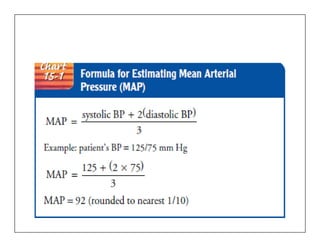
• Clinical shock is usually accompanied by
hypotension (i.e, a mean arterial pressure
(MAP) < 60 mmHg in previously normotensive
persons).
8/17/2015 5
Pathogenesis and Organ Response
1. Microcirculation /Vasoconstriction
• ↓CO leads to ↑systemic vascular resistance
(Brain & Heart)
• However, when MAP drops to 60 mmHg,
blood flow to these organs falls, and lose their
function
• Impairment of the microcirculation is central
to the pathophysiologic responses of shock
2. Cellular Responses
• Interstitial transport of nutrients is impaired
leads to accumulation of hydrogen ions,
lactate, and other products of anaerobic
metabolism → further hypotension and
hypoperfusion
•
3. Neuroendocrine Response
• Increased release of norepinephrine
• Reduced vagal activity
• Increase release of ACTH (Cortisol → lipolysis,
gluconeogensis)
• Increased pancreatic secretion of glucagon
• Renin release is increased
4. Cardiovascular Response
• Hypovolemia leads to decreased ventricular
preload that in turn reduces the stroke volume
• Systemic vascular resistance elevated
5. Pulmonary Response
• Relative increase in pulmonary vascular
resistance → Right Side Heart Failure
• Acute lung injury and subsequent acute
respiratory distress syndrome
6. Renal Response
• Acute kidney injury, a serious complication
• Kidney conserve salt and water (ADH)
Specific Forms of Shock
1. Hypovolemic Shock
• Most common form of shock
• Results either from the loss of red blood cell
mass and plasma from hemorrhage or
• Loss of plasma volume alone due to
 Extravascular fluid sequestration or
 GI (nausea & vomiting)
 Urinary, and (osmotic diuresis)
 Insensible losses ()
8/17/2015 12
Hypovolemic…
 Mild (<20% Blood Volume)
• Cool extremities
• Increased capillary refill time
• Diaphoresis
• Diaphoresis
• Collapsed veins
• Anxiety
8/17/2015 13
Hypovolemic…
 Moderate (20–40% Blood Volume)
Same, plus:
• Tachycardia
• Tachypnea
• Tachypnea
• Oliguria
• Postural changes
8/17/2015 14
Hypovolemic…
 Severe (>40% Blood Volume)
Same, plus:
• Hemodynamic instability
• Marked tachycardia
• Hypotension
• Mental status deterioration (coma)
8/17/2015 15
Management
• Volume resuscitation is initiated with the rapid
infusion of either isotonic saline or
• A balanced salt solution such as Ringer's
lactate through large bore needles
8/17/2015 16
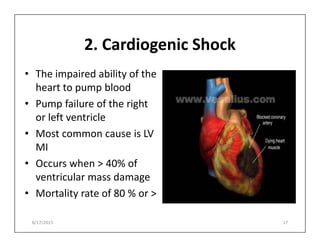
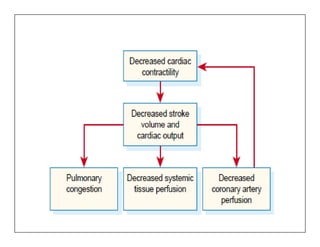
2. Cardiogenic Shock
• The impaired ability of the
heart to pump blood
• Pump failure of the right
or left ventricle
or left ventricle
• Most common cause is LV
MI
• Occurs when > 40% of
ventricular mass damage
• Mortality rate of 80 % or >
8/17/2015 17
Cardiogenic Shock: Risks/ Etiologies
• Mechanical: complications
of MI:
– Ventricular aneurysm
• Other causes:
– Cardiomyopathies
– tamponade
– tension
– Ventricular septal defect
rupture
– tension
pneumothorax
– arrhythmias
– valve disease
8/17/2015 18
3. Neurogenic Shock
• Interruption of sympathetic vasomotor input
Cervical spinal cord injury
Inadvertent cephalic migration of spinal
anesthesia, or
anesthesia, or
Devastating head injury
• In addition to arteriolar dilation, venodilation
causes pooling in the venous system, which
decreases venous return and cardiac output
Management
• Involves the relative hypovolemia and to the
loss of vasomotor tone
• Excessive volumes of fluid may be required
• Once hemorrhage has been ruled out,
norepinephrine or a pure -adrenergic agent
(phenylephrine)
Septic Shock
Systemic Inflammatory Response Syndrome
(SIRS)
• Animals mount both local and systemic responses
to microbes that traverse their epithelial barriers
and enter underlying tissues.
• Two or more of the following conditions:
1. Fever (oral temperature >38°C) or hypothermia
(<36°C);
2. Tachypnea (>24 breaths/min);
3. Tachycardia (heart rate >90 beats/min);
4. Leukocytosis (>12,000/L), leucopenia (<4,000/L),
or >10% groups
8/17/2015 22
SIRS
• SIRS may have an infectious or a noninfectious
etiology.
• If infection is suspected or proven, a patient with
SIRS is said to have sepsis.
• When sepsis is associated with dysfunction of
organs distant from the site of infection, the
patient has severe sepsis.
• Severe sepsis may be accompanied by
hypotension or evidence of hypoperfusion.
• When hypotension cannot be corrected by
infusing fluids, the diagnosis is septic shock.
8/17/2015 23
Causes of Sepsis
• Gram-negative bacteria are the most common
pathogens.
• Enterobacteriaceae, pseudomonads,
Haemophilus spp….
Other infectious agents, such as
• Gram-positive bacteria (increasingly),
Staphylococcus aureus, coagulase-negative
staphylococci, enterococci, Streptococcus
pneumoniae, other streptococci and
• Viruses and fungi
8/17/2015 24
Risk Factors
• Invasive procedures and indwelling medical
devices;
• The increased number of antibiotic-resistant
microorganisms
microorganisms
• Older population
• Malnutrition or
• Immunosuppression
• Chronic illness (e.g, DM, hepatitis).
8/17/2015 25
Clinical Manifestations
In the early stage of septic shock
• BP may remain within normal limits (or hypotensive
but responsive to fluids).
• Heart and respiratory rates elevated.
• High cardiac output with vasodilation.
• Hyperthermia (febrile) with warm, flushed skin,
bounding pulses.
• Urinary output normal or decreased.
• Gastrointestinal status compromised (e.g, nausea,
vomiting, diarrhea, or decreased bowel sounds).
• Subtle changes in mental status.
8/17/2015 26
As sepsis progresses
• Low cardiac output with vasoconstriction
• BP drops
• Skin cool and pale
• Temperature normal or below normal
• Rapid heart and respiratory rates
• Anuria and multiple organ dysfunction
progressing to failure
8/17/2015 27
• Septic shock may be manifested by atypical or
confusing clinical signs.
• Suspect septic shock in any elderly person
who develops an unexplained acute confused
state, tachypnea, or hypotension.
8/17/2015 28
Management
 Empirical therapy
• Ceftriaxon 2gm iv Bid
• Ciprofloxacin
• Clindamycin
• Vancomycin
• Vancomycin
 Removal of the Source of Infection
 Hemodynamic, Respiratory, and Metabolic
Support
 O2, IV fluid, nutritional supplementation
8/17/2015 29
Prognosis
• Approximately 20–35% of patients with severe
sepsis and 40–60% of patients with septic
shock die within 30 days.
8/17/2015 30
Nursing diagnosis
• Fluid Volume deficit R/T excessive loss of fluid or
bleeding, trauma AMB decrease blood pressure,
pulse volume, decrease skin and tongue turgor,
decrease urine output
• Decreased cardiac out put r/t decreased
Myocardial contractility, dysrthmia AMB hypoxia,
peripheral, renal, GI, cardiopulmonary, or central
Hypovolemia, decreased arterial flow & cerebral
hypoperfusion
• Risk for decreased tissue perfusion related to
hypovolemia
8/17/2015 31
Nursing Interventions
• Identify patients at risk for sepsis and septic
shock.
• Carry out all invasive procedures with correct
aseptic technique after careful hand hygiene.
• Monitor IV lines, arterial and venous puncture
sites, surgical incisions, trauma wounds,
urinary catheters, and pressure ulcers for signs
of infection.
• Reduce patient’s temperature when ordered
for temperatures higher than 40 C°
8/17/2015 32
• Administer prescribed IV fluids and medications.
• Monitor and report blood levels (BUN, and
creatinine levels; WBC; hemoglobin and Hct
levels; platelet count; coagulation studies).
• Monitor hemodynamic status, fluid intake and
output, and nutritional status.
• Monitor daily weights and serum albumin and
prealbumin levels to determine daily protein
requirements.
8/17/2015 33
Summary

shock and nursing interventions. bsc nursing students

  • 1.
  • 2.
    Objectives • Define shock •Describe the types of shock • Discuss the pathophysiology of shock • Discuss the pathophysiology of shock • Discuss the medical and nursing management of shock 8/17/2015 2
  • 3.
    Definition • Is acondition when circulatory system is no longer able to complete one of its essential function like provision of oxygen and nutrients to the cells of the body or removing to the cells of the body or removing subsequent wastes. (Hand,2001,chavez and vrewer,2002, Bench,2008) 8/17/2015 3
  • 4.
    Defn… • Shock canbest be defined as a physiologic state in which systemic blood pressure is inadequate to deliver oxygen and nutrients to support vital organs and cellular function support vital organs and cellular function (Mikhail, 1999) • Shock is the clinical syndrome that results from inadequate tissue perfusion 8/17/2015 4
  • 5.
    • Clinical manifestation→ autonomic neuroendocrine responses to hypoperfusion breakdown of organ function • Clinical shock is usually accompanied by hypotension (i.e, a mean arterial pressure (MAP) < 60 mmHg in previously normotensive persons). 8/17/2015 5
  • 7.
    Pathogenesis and OrganResponse 1. Microcirculation /Vasoconstriction • ↓CO leads to ↑systemic vascular resistance (Brain & Heart) • However, when MAP drops to 60 mmHg, • However, when MAP drops to 60 mmHg, blood flow to these organs falls, and lose their function • Impairment of the microcirculation is central to the pathophysiologic responses of shock
  • 8.
    2. Cellular Responses •Interstitial transport of nutrients is impaired leads to accumulation of hydrogen ions, lactate, and other products of anaerobic lactate, and other products of anaerobic metabolism → further hypotension and hypoperfusion •
  • 9.
    3. Neuroendocrine Response •Increased release of norepinephrine • Reduced vagal activity • Increase release of ACTH (Cortisol → lipolysis, • Increase release of ACTH (Cortisol → lipolysis, gluconeogensis) • Increased pancreatic secretion of glucagon • Renin release is increased
  • 10.
    4. Cardiovascular Response •Hypovolemia leads to decreased ventricular preload that in turn reduces the stroke volume • Systemic vascular resistance elevated 5. Pulmonary Response 5. Pulmonary Response • Relative increase in pulmonary vascular resistance → Right Side Heart Failure • Acute lung injury and subsequent acute respiratory distress syndrome
  • 11.
    6. Renal Response •Acute kidney injury, a serious complication • Kidney conserve salt and water (ADH)
  • 12.
    Specific Forms ofShock 1. Hypovolemic Shock • Most common form of shock • Results either from the loss of red blood cell mass and plasma from hemorrhage or mass and plasma from hemorrhage or • Loss of plasma volume alone due to  Extravascular fluid sequestration or  GI (nausea & vomiting)  Urinary, and (osmotic diuresis)  Insensible losses () 8/17/2015 12
  • 13.
    Hypovolemic…  Mild (<20%Blood Volume) • Cool extremities • Increased capillary refill time • Diaphoresis • Diaphoresis • Collapsed veins • Anxiety 8/17/2015 13
  • 14.
    Hypovolemic…  Moderate (20–40%Blood Volume) Same, plus: • Tachycardia • Tachypnea • Tachypnea • Oliguria • Postural changes 8/17/2015 14
  • 15.
    Hypovolemic…  Severe (>40%Blood Volume) Same, plus: • Hemodynamic instability • Marked tachycardia • Marked tachycardia • Hypotension • Mental status deterioration (coma) 8/17/2015 15
  • 16.
    Management • Volume resuscitationis initiated with the rapid infusion of either isotonic saline or • A balanced salt solution such as Ringer's • A balanced salt solution such as Ringer's lactate through large bore needles 8/17/2015 16
  • 17.
    2. Cardiogenic Shock •The impaired ability of the heart to pump blood • Pump failure of the right or left ventricle or left ventricle • Most common cause is LV MI • Occurs when > 40% of ventricular mass damage • Mortality rate of 80 % or > 8/17/2015 17
  • 18.
    Cardiogenic Shock: Risks/Etiologies • Mechanical: complications of MI: – Ventricular aneurysm • Other causes: – Cardiomyopathies – tamponade – tension – Ventricular septal defect rupture – tension pneumothorax – arrhythmias – valve disease 8/17/2015 18
  • 20.
    3. Neurogenic Shock •Interruption of sympathetic vasomotor input Cervical spinal cord injury Inadvertent cephalic migration of spinal anesthesia, or anesthesia, or Devastating head injury • In addition to arteriolar dilation, venodilation causes pooling in the venous system, which decreases venous return and cardiac output
  • 21.
    Management • Involves therelative hypovolemia and to the loss of vasomotor tone • Excessive volumes of fluid may be required • Excessive volumes of fluid may be required • Once hemorrhage has been ruled out, norepinephrine or a pure -adrenergic agent (phenylephrine)
  • 22.
    Septic Shock Systemic InflammatoryResponse Syndrome (SIRS) • Animals mount both local and systemic responses to microbes that traverse their epithelial barriers and enter underlying tissues. • Two or more of the following conditions: • Two or more of the following conditions: 1. Fever (oral temperature >38°C) or hypothermia (<36°C); 2. Tachypnea (>24 breaths/min); 3. Tachycardia (heart rate >90 beats/min); 4. Leukocytosis (>12,000/L), leucopenia (<4,000/L), or >10% groups 8/17/2015 22
  • 23.
    SIRS • SIRS mayhave an infectious or a noninfectious etiology. • If infection is suspected or proven, a patient with SIRS is said to have sepsis. • When sepsis is associated with dysfunction of • When sepsis is associated with dysfunction of organs distant from the site of infection, the patient has severe sepsis. • Severe sepsis may be accompanied by hypotension or evidence of hypoperfusion. • When hypotension cannot be corrected by infusing fluids, the diagnosis is septic shock. 8/17/2015 23
  • 24.
    Causes of Sepsis •Gram-negative bacteria are the most common pathogens. • Enterobacteriaceae, pseudomonads, Haemophilus spp…. Other infectious agents, such as Other infectious agents, such as • Gram-positive bacteria (increasingly), Staphylococcus aureus, coagulase-negative staphylococci, enterococci, Streptococcus pneumoniae, other streptococci and • Viruses and fungi 8/17/2015 24
  • 25.
    Risk Factors • Invasiveprocedures and indwelling medical devices; • The increased number of antibiotic-resistant microorganisms microorganisms • Older population • Malnutrition or • Immunosuppression • Chronic illness (e.g, DM, hepatitis). 8/17/2015 25
  • 26.
    Clinical Manifestations In theearly stage of septic shock • BP may remain within normal limits (or hypotensive but responsive to fluids). • Heart and respiratory rates elevated. • High cardiac output with vasodilation. • High cardiac output with vasodilation. • Hyperthermia (febrile) with warm, flushed skin, bounding pulses. • Urinary output normal or decreased. • Gastrointestinal status compromised (e.g, nausea, vomiting, diarrhea, or decreased bowel sounds). • Subtle changes in mental status. 8/17/2015 26
  • 27.
    As sepsis progresses •Low cardiac output with vasoconstriction • BP drops • Skin cool and pale • Skin cool and pale • Temperature normal or below normal • Rapid heart and respiratory rates • Anuria and multiple organ dysfunction progressing to failure 8/17/2015 27
  • 28.
    • Septic shockmay be manifested by atypical or confusing clinical signs. • Suspect septic shock in any elderly person who develops an unexplained acute confused state, tachypnea, or hypotension. 8/17/2015 28
  • 29.
    Management  Empirical therapy •Ceftriaxon 2gm iv Bid • Ciprofloxacin • Clindamycin • Vancomycin • Vancomycin  Removal of the Source of Infection  Hemodynamic, Respiratory, and Metabolic Support  O2, IV fluid, nutritional supplementation 8/17/2015 29
  • 30.
    Prognosis • Approximately 20–35%of patients with severe sepsis and 40–60% of patients with septic shock die within 30 days. shock die within 30 days. 8/17/2015 30
  • 31.
    Nursing diagnosis • FluidVolume deficit R/T excessive loss of fluid or bleeding, trauma AMB decrease blood pressure, pulse volume, decrease skin and tongue turgor, decrease urine output • Decreased cardiac out put r/t decreased Myocardial contractility, dysrthmia AMB hypoxia, Myocardial contractility, dysrthmia AMB hypoxia, peripheral, renal, GI, cardiopulmonary, or central Hypovolemia, decreased arterial flow & cerebral hypoperfusion • Risk for decreased tissue perfusion related to hypovolemia 8/17/2015 31
  • 32.
    Nursing Interventions • Identifypatients at risk for sepsis and septic shock. • Carry out all invasive procedures with correct aseptic technique after careful hand hygiene. • Monitor IV lines, arterial and venous puncture • Monitor IV lines, arterial and venous puncture sites, surgical incisions, trauma wounds, urinary catheters, and pressure ulcers for signs of infection. • Reduce patient’s temperature when ordered for temperatures higher than 40 C° 8/17/2015 32
  • 33.
    • Administer prescribedIV fluids and medications. • Monitor and report blood levels (BUN, and creatinine levels; WBC; hemoglobin and Hct levels; platelet count; coagulation studies). levels; platelet count; coagulation studies). • Monitor hemodynamic status, fluid intake and output, and nutritional status. • Monitor daily weights and serum albumin and prealbumin levels to determine daily protein requirements. 8/17/2015 33
  • 34.