 Section 14. Integration of Disaster Risk Reduction
Education into the School Curricula and Sangguniang
Kabataan (SK) Program and Mandatory Training for
the Public Sector Employees. - The DepED, the CHED,
the Technical Education and Skills Development
Authority (TESDA), in coordination with the OCD, the
National Youth Commission (NYC), the DOST, the
DENR, the DILG-BFP, the DOH, the DSWD and other
relevant agencies, shall integrate disaster risk
reduction and management education in the school
curricula in all level of education, including the
National Service Training Program (NSTP), whether
private or public, including formal and nonformal,
technical-vocational, indigenous learning, and out-
of-school youth courses and programs.
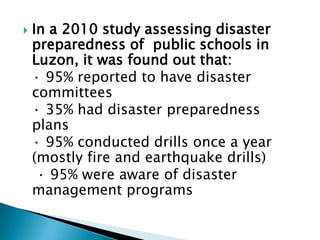
 In a 2010 study assessing disaster
preparedness of public schools in
Luzon, it was found out that:
· 95% reported to have disaster
committees
· 35% had disaster preparedness
plans
· 95% conducted drills once a year
(mostly fire and earthquake drills)
· 95% were aware of disaster
management programs
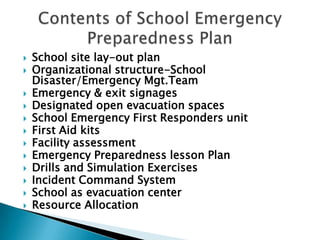
 School site lay-out plan
 Organizational structure-School
Disaster/Emergency Mgt.Team
 Emergency & exit signages
 Designated open evacuation spaces
 School Emergency First Responders unit
 First Aid kits
 Facility assessment
 Emergency Preparedness lesson Plan
 Drills and Simulation Exercises
 Incident Command System
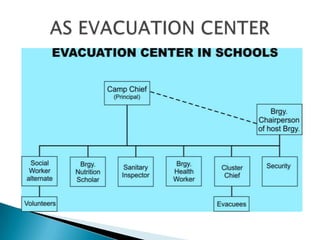
 School as evacuation center
 Resource Allocation
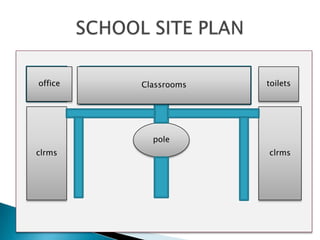
clrms clrms
toilets
pole
Classroomsoffice
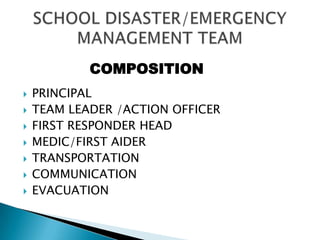
 PRINCIPAL
 TEAM LEADER /ACTION OFFICER
 FIRST RESPONDER HEAD
 MEDIC/FIRST AIDER
 TRANSPORTATION
 COMMUNICATION
 EVACUATION
COMPOSITION
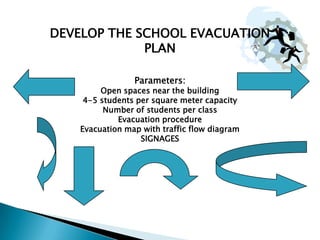
DEVELOP THE SCHOOL EVACUATION
PLAN
Parameters:
Open spaces near the building
4-5 students per square meter capacity
Number of students per class
Evacuation procedure
Evacuation map with traffic flow diagram
SIGNAGES
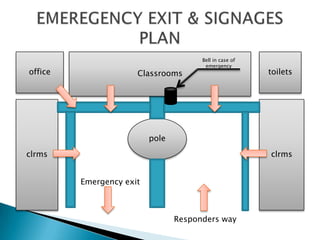
clrms clrms
toilets
pole
Classroomsoffice
Emergency exit
Responders way
Bell in case of
emergency
clrms clrms
toilets
poles
Classroomsoffice
Open
space
Open
space
FIRST RESPONDER HEAD –
MEMBERS:
 First Aid Kit
 • Medical Scissors
 • Triangular Bandage (Large, can use for
 making a sling, wrapping around one’s head,
 or fold up and use like gauze)
 • 4 x 4 Inch Gauze Pads (5 or 6 to be used as
 bandages for large cuts)
 • Bandages (for keeping gauze on)
 • Adhesive tape (one roll of 1 inch tape)
 • Sanitary napkins (control exessive bleeding)
 • Band Aids (4 or 5 strips for small cuts)
 • Antiseptic Solution (used to cleanse wounds)
 • Latex Gloves
 WATER SOURCE
 SAFE ELECTRICAL INSTALLATIONS & SUPPLY
 AVAILABILITY OF POTABLE WATER
 EMERGENCY BELLS/ BUZZERS
 SANITARY TOILETS
 PROVISION FOR EMERGENCY KITCHEN
 ROOMS FOR LACTATING MOTHERS & INFANTS
 PROVISION FOR TEMPORARY CLINIC
 PROVISION FOR STORAGE OF FOOD SUPPLY
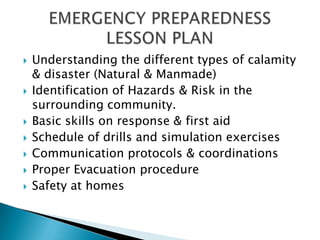
 Understanding the different types of calamity
& disaster (Natural & Manmade)
 Identification of Hazards & Risk in the
surrounding community.
 Basic skills on response & first aid
 Schedule of drills and simulation exercises
 Communication protocols & coordinations
 Proper Evacuation procedure
 Safety at homes
Scene of
incident
Seriously
Wounded/
unconscious
dead
heavily
wounded
Walking
wounded
First priority
2nd priority
3rd priority
Last priority
TRIAGE AREA
CONDUCT OF DRILL
Activity:
Orientation
Information to the
neighborhood/public
Traffic Management
Documentation
Head count
Feed-backing
STRESS DEBRIEFING GUIDE
6/16/2013 18
30% Quick Response Fund (QRF)- stand by
fund for relief and recovery programs to
normalize situation and living conditions
of people in areas stricken by disasters,
calamities, epidemics, complex
emergencies
70% Pre-disaster preparedness & post
disaster activities; evacuation center
100%
RESOURCE ALLOCATION
WE ARE COUNTING ON YOU!
LEADERS THAT WE CAN RELY ON.
PREPARING US IN THIS TIME.
THANK YOU & GOOD MORNING

4.school disaster preparedness plan

  • 2.
     Section 14.Integration of Disaster Risk Reduction Education into the School Curricula and Sangguniang Kabataan (SK) Program and Mandatory Training for the Public Sector Employees. - The DepED, the CHED, the Technical Education and Skills Development Authority (TESDA), in coordination with the OCD, the National Youth Commission (NYC), the DOST, the DENR, the DILG-BFP, the DOH, the DSWD and other relevant agencies, shall integrate disaster risk reduction and management education in the school curricula in all level of education, including the National Service Training Program (NSTP), whether private or public, including formal and nonformal, technical-vocational, indigenous learning, and out- of-school youth courses and programs.
  • 3.
     In a2010 study assessing disaster preparedness of public schools in Luzon, it was found out that: · 95% reported to have disaster committees · 35% had disaster preparedness plans · 95% conducted drills once a year (mostly fire and earthquake drills) · 95% were aware of disaster management programs
  • 4.
     School sitelay-out plan  Organizational structure-School Disaster/Emergency Mgt.Team  Emergency & exit signages  Designated open evacuation spaces  School Emergency First Responders unit  First Aid kits  Facility assessment  Emergency Preparedness lesson Plan  Drills and Simulation Exercises  Incident Command System  School as evacuation center  Resource Allocation
  • 5.
  • 6.
     PRINCIPAL  TEAMLEADER /ACTION OFFICER  FIRST RESPONDER HEAD  MEDIC/FIRST AIDER  TRANSPORTATION  COMMUNICATION  EVACUATION COMPOSITION
  • 7.
    DEVELOP THE SCHOOLEVACUATION PLAN Parameters: Open spaces near the building 4-5 students per square meter capacity Number of students per class Evacuation procedure Evacuation map with traffic flow diagram SIGNAGES
  • 8.
  • 9.
  • 10.
  • 11.
     First AidKit  • Medical Scissors  • Triangular Bandage (Large, can use for  making a sling, wrapping around one’s head,  or fold up and use like gauze)  • 4 x 4 Inch Gauze Pads (5 or 6 to be used as  bandages for large cuts)  • Bandages (for keeping gauze on)  • Adhesive tape (one roll of 1 inch tape)  • Sanitary napkins (control exessive bleeding)  • Band Aids (4 or 5 strips for small cuts)  • Antiseptic Solution (used to cleanse wounds)  • Latex Gloves
  • 12.
     WATER SOURCE SAFE ELECTRICAL INSTALLATIONS & SUPPLY  AVAILABILITY OF POTABLE WATER  EMERGENCY BELLS/ BUZZERS  SANITARY TOILETS  PROVISION FOR EMERGENCY KITCHEN  ROOMS FOR LACTATING MOTHERS & INFANTS  PROVISION FOR TEMPORARY CLINIC  PROVISION FOR STORAGE OF FOOD SUPPLY
  • 13.
     Understanding thedifferent types of calamity & disaster (Natural & Manmade)  Identification of Hazards & Risk in the surrounding community.  Basic skills on response & first aid  Schedule of drills and simulation exercises  Communication protocols & coordinations  Proper Evacuation procedure  Safety at homes
  • 14.
  • 15.
    CONDUCT OF DRILL Activity: Orientation Informationto the neighborhood/public Traffic Management Documentation Head count Feed-backing
  • 16.
  • 18.
    6/16/2013 18 30% QuickResponse Fund (QRF)- stand by fund for relief and recovery programs to normalize situation and living conditions of people in areas stricken by disasters, calamities, epidemics, complex emergencies 70% Pre-disaster preparedness & post disaster activities; evacuation center 100% RESOURCE ALLOCATION
  • 20.
    WE ARE COUNTINGON YOU! LEADERS THAT WE CAN RELY ON. PREPARING US IN THIS TIME.
  • 22.
    THANK YOU &GOOD MORNING