2.3 Vector Addition of Forces
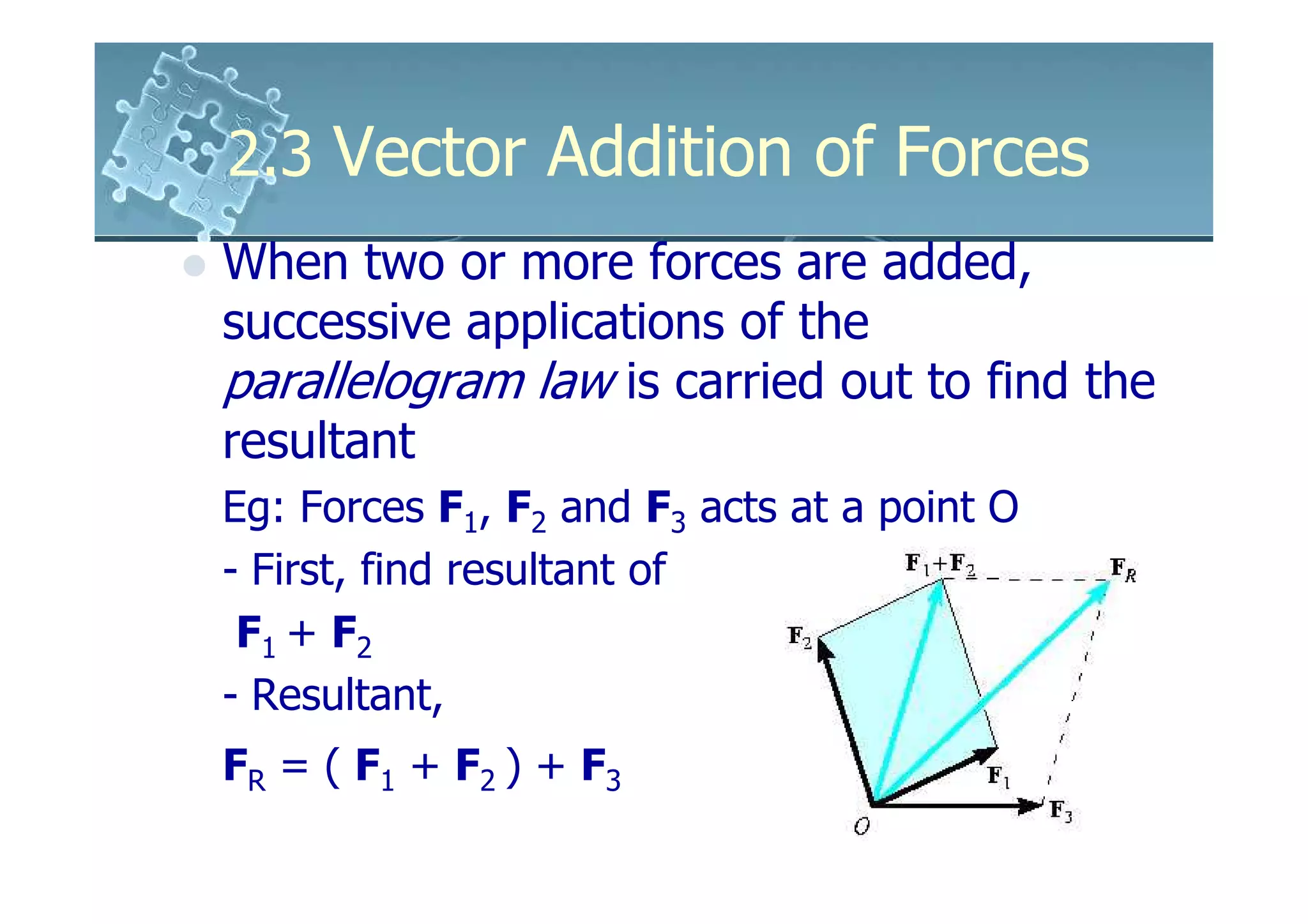
When two or more forces are added,
successive applications of the
parallelogram law is carried out to find the
resultant
Eg: Forces F1, F2 and F3 acts at a point O
- First, find resultant of
 F1 + F2
- Resultant,
FR = ( F1 + F2 ) + F3
2.3 Vector Addition of Forces
Example
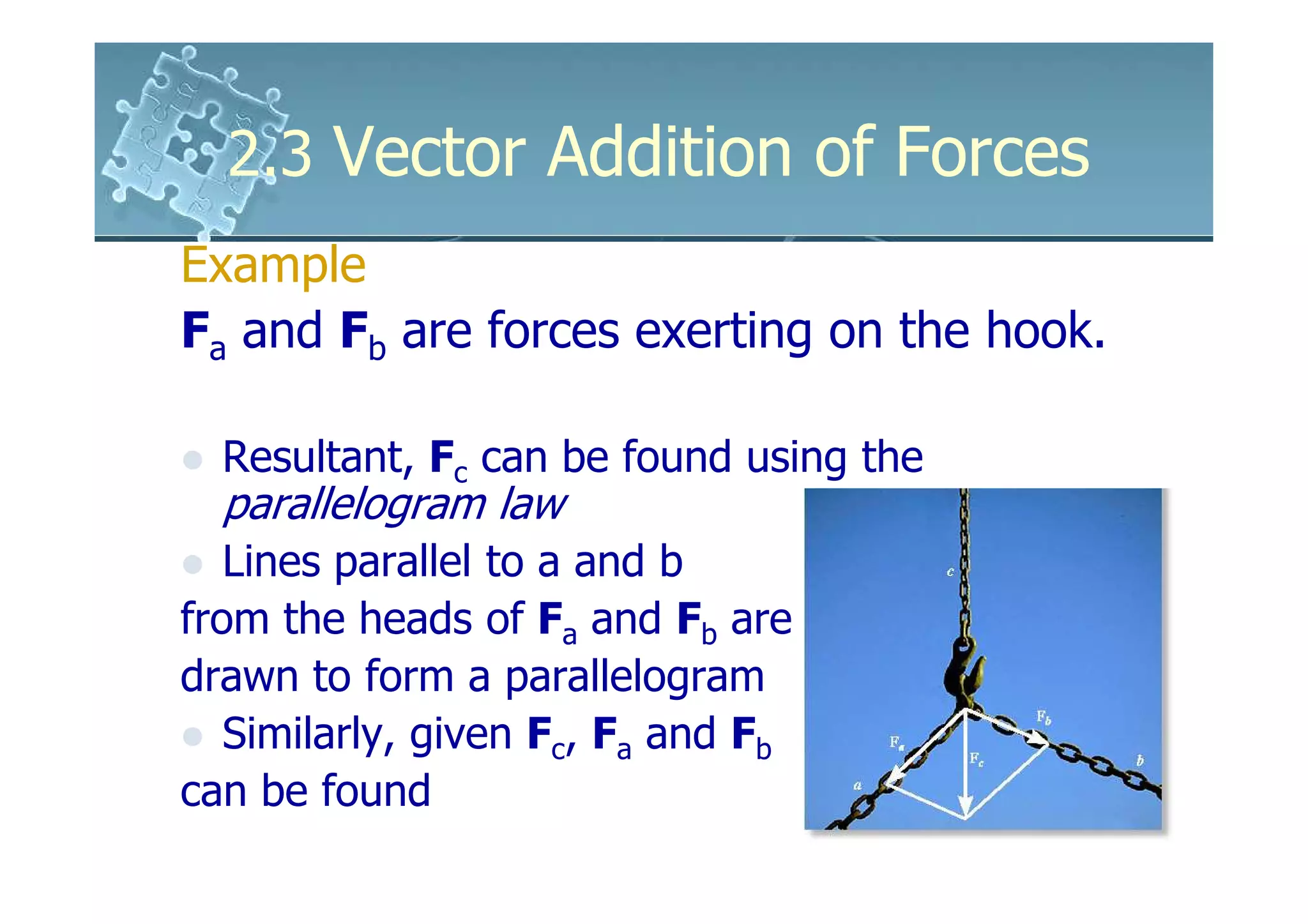
Fa and Fb are forces exerting on the hook.

  Resultant, Fc can be found using the
  parallelogram law
   Lines parallel to a and b
from the heads of Fa and Fb are
drawn to form a parallelogram
   Similarly, given Fc, Fa and Fb
can be found
2.3 Vector Addition of Forces
Procedure for Analysis
  Parallelogram Law
 - Make a sketch using the parallelogram law
 - Two components forces add to form the
 resultant force
 - Resultant force is shown by the diagonal of the
 parallelogram
 - The components is shown by the sides of the
 parallelogram
2.3 Vector Addition of Forces
Procedure for Analysis
 Parallelogram Law
 To resolve a force into components along
 two axes directed from the tail of the force
 - Start at the head, constructing lines
 parallel to the axes
 - Label all the known and unknown force
 magnitudes and angles
 - Identify the two unknown components
2.3 Vector Addition of Forces
Procedure for Analysis
  Trigonometry
 - Redraw half portion of the parallelogram
 - Magnitude of the resultant force can be
 determined by the law of cosines
 - Direction if the resultant force can be
 determined by the law of sines
2.3 Vector Addition of Forces
Procedure for Analysis
  Trigonometry
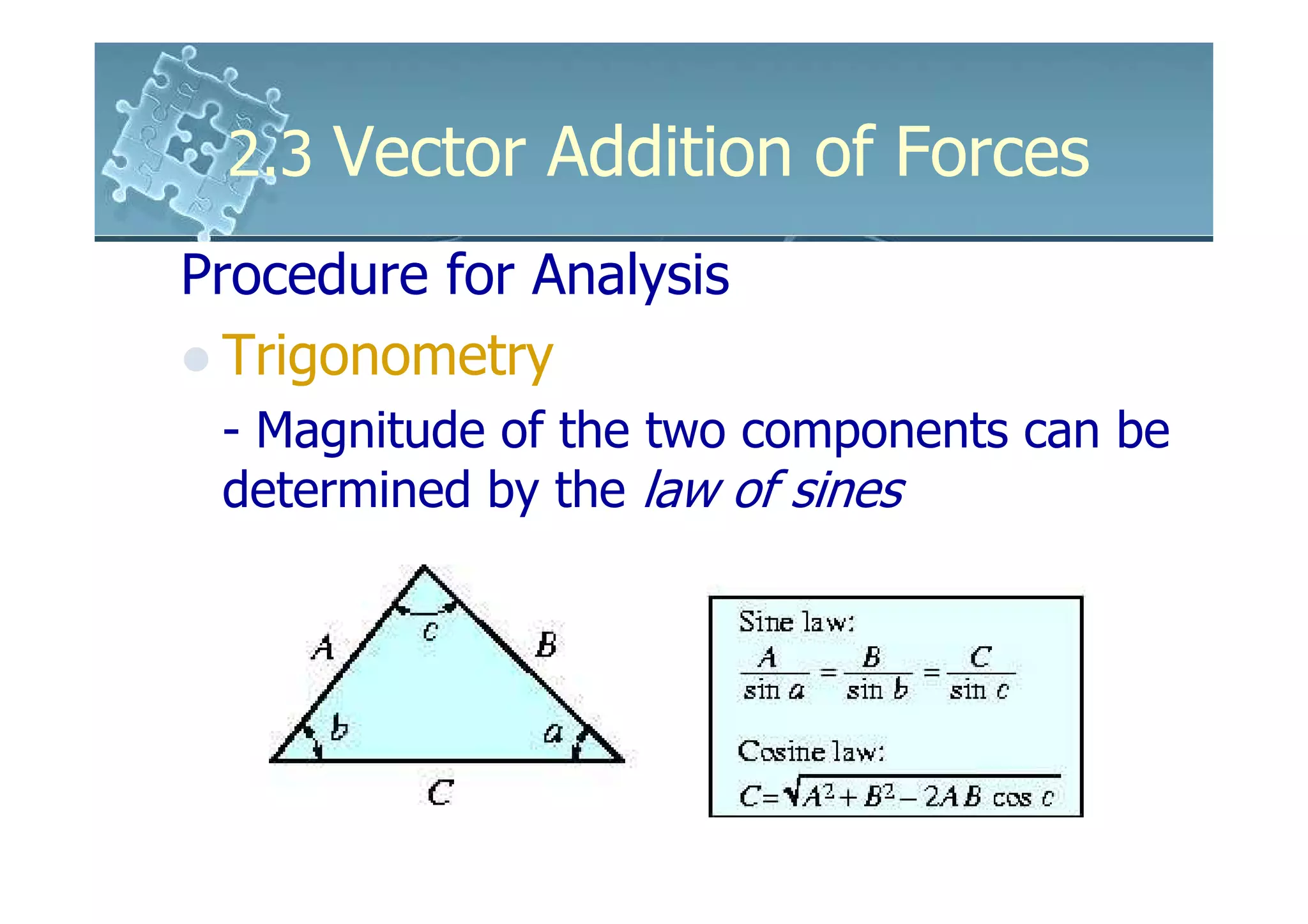
 - Magnitude of the two components can be
 determined by the law of sines
2.3 Vector Addition of Forces
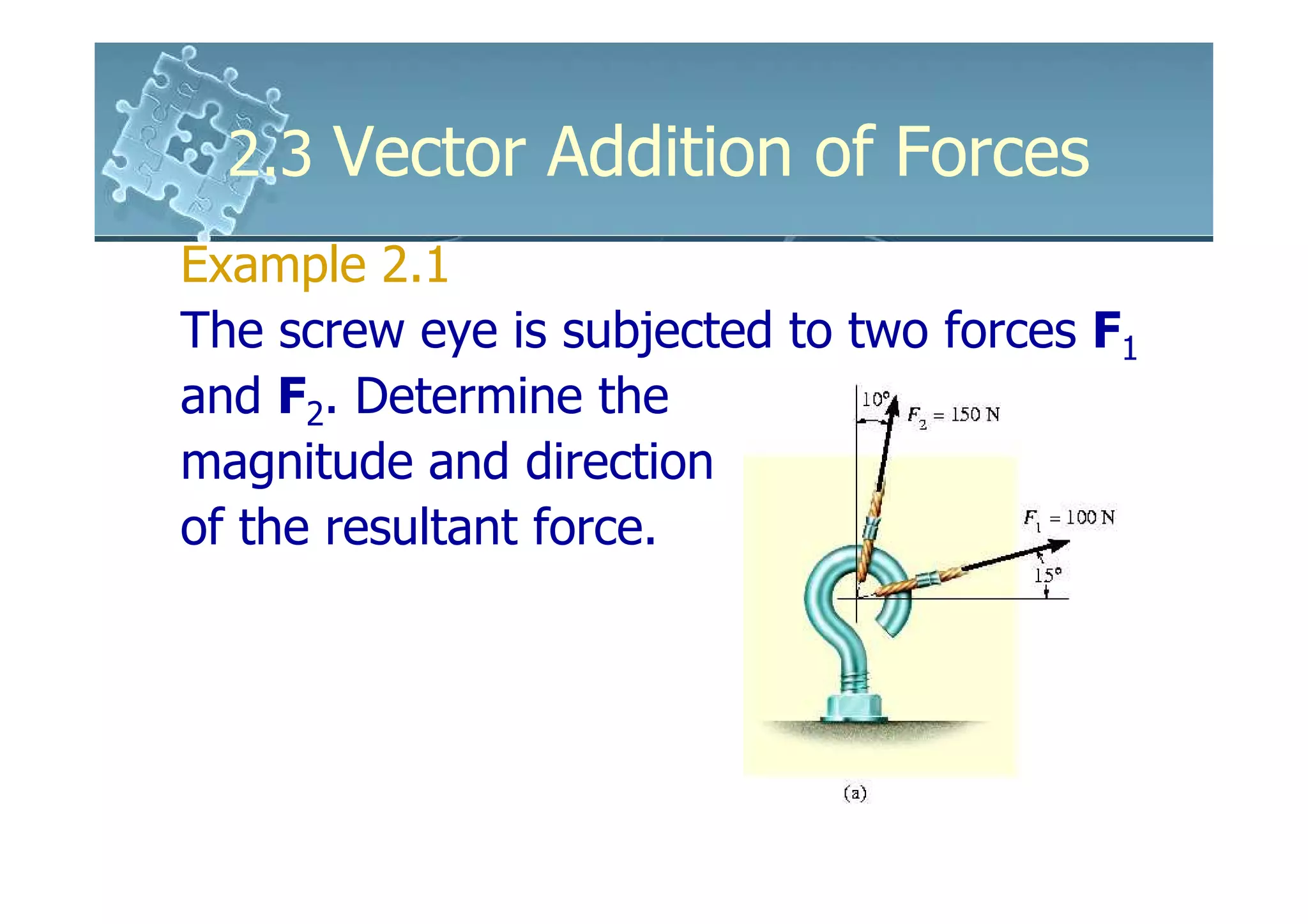
Example 2.1
The screw eye is subjected to two forces F1
and F2. Determine the
magnitude and direction
of the resultant force.
2.3 Vector Addition of Forces
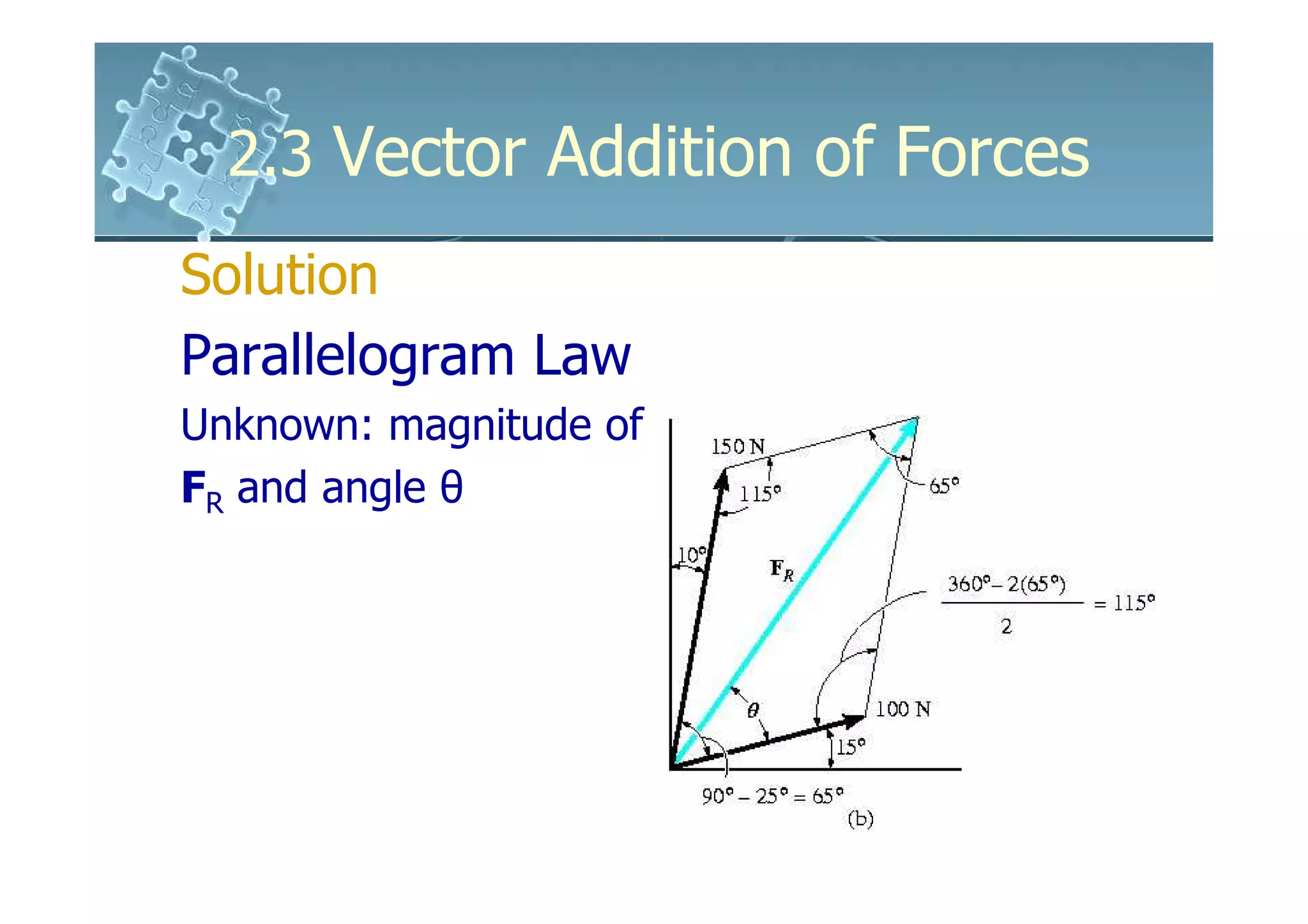
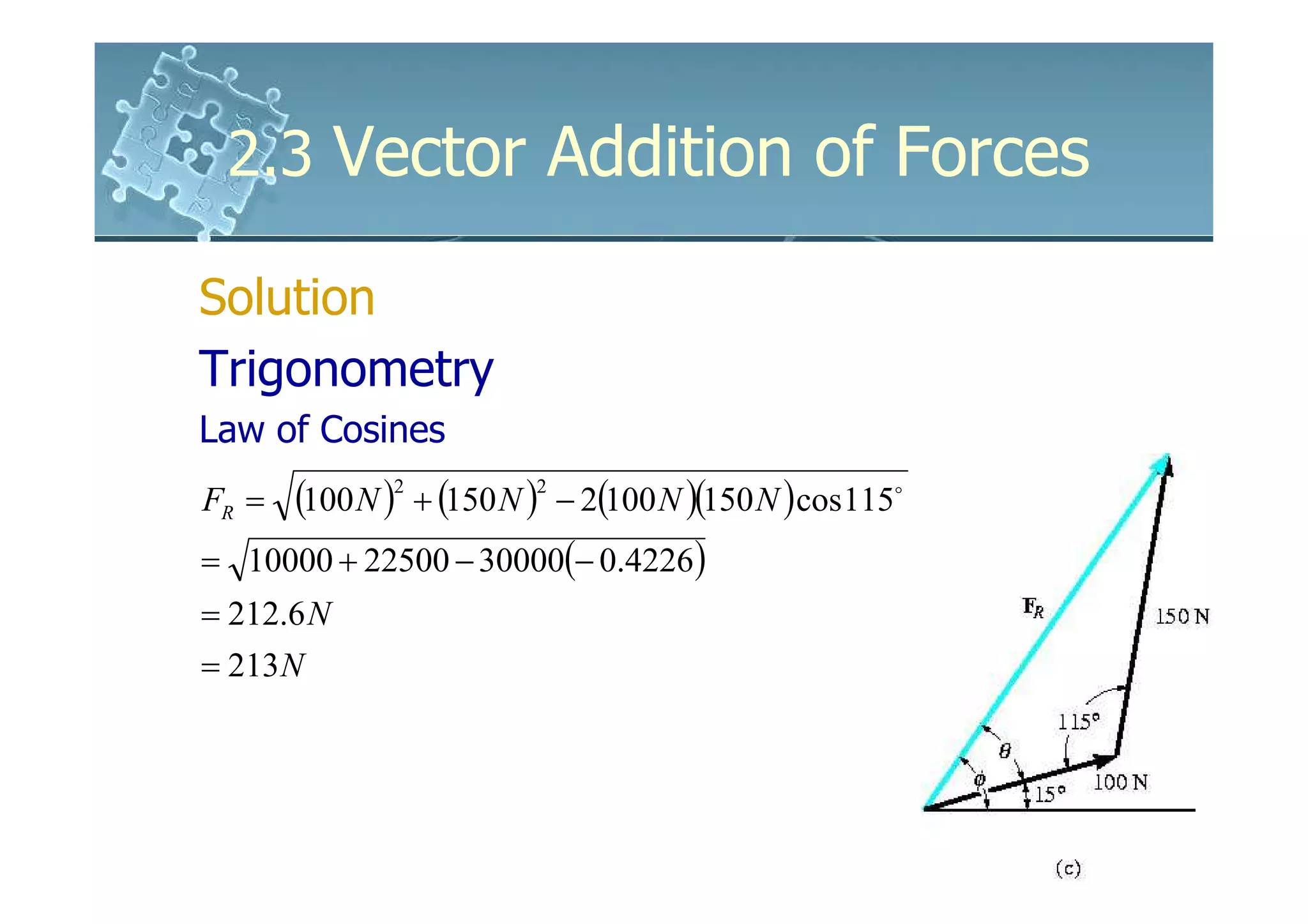
Solution
Parallelogram Law
Unknown: magnitude of
FR and angle θ
2.3 Vector Addition of Forces

Solution
Trigonometry
Law of Cosines
FR =   (100 N )2 + (150 N )2 − 2(100 N )(150 N ) cos115o
=   10000 + 22500 − 30000(− 0.4226 )
= 212.6 N
= 213 N
2.3 Vector Addition of Forces

Solution
Trigonometry
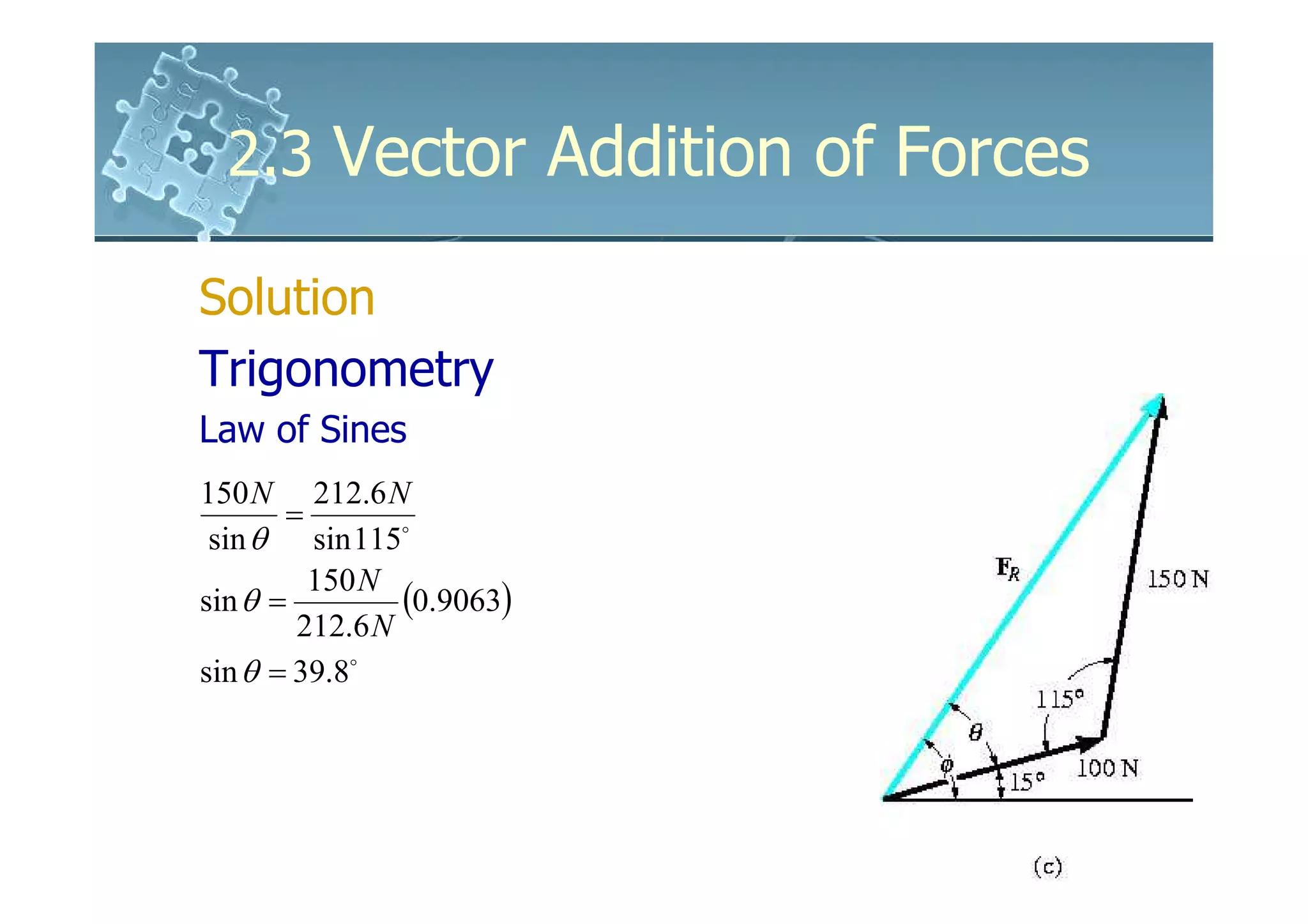
Law of Sines
150 N 212.6 N
       =
 sin θ sin 115o
         150 N
sin θ =         (0.9063)
        212.6 N
sin θ = 39.8o
2.3 Vector Addition of Forces

Solution
Trigonometry
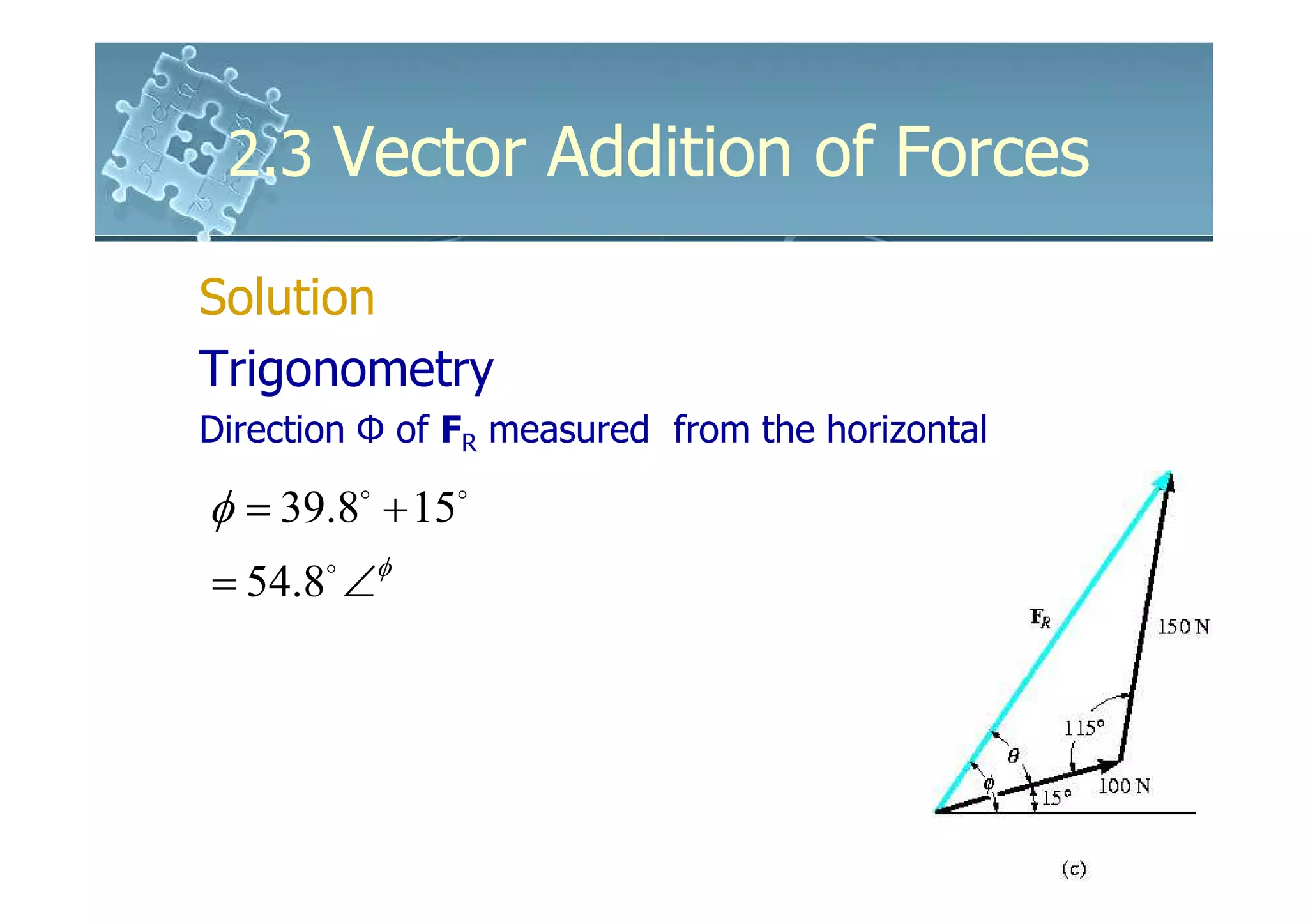
Direction Φ of FR measured from the horizontal

φ = 39.8 + 15
         o      o


= 54.8o ∠φ
2.3 Vector Addition of Forces
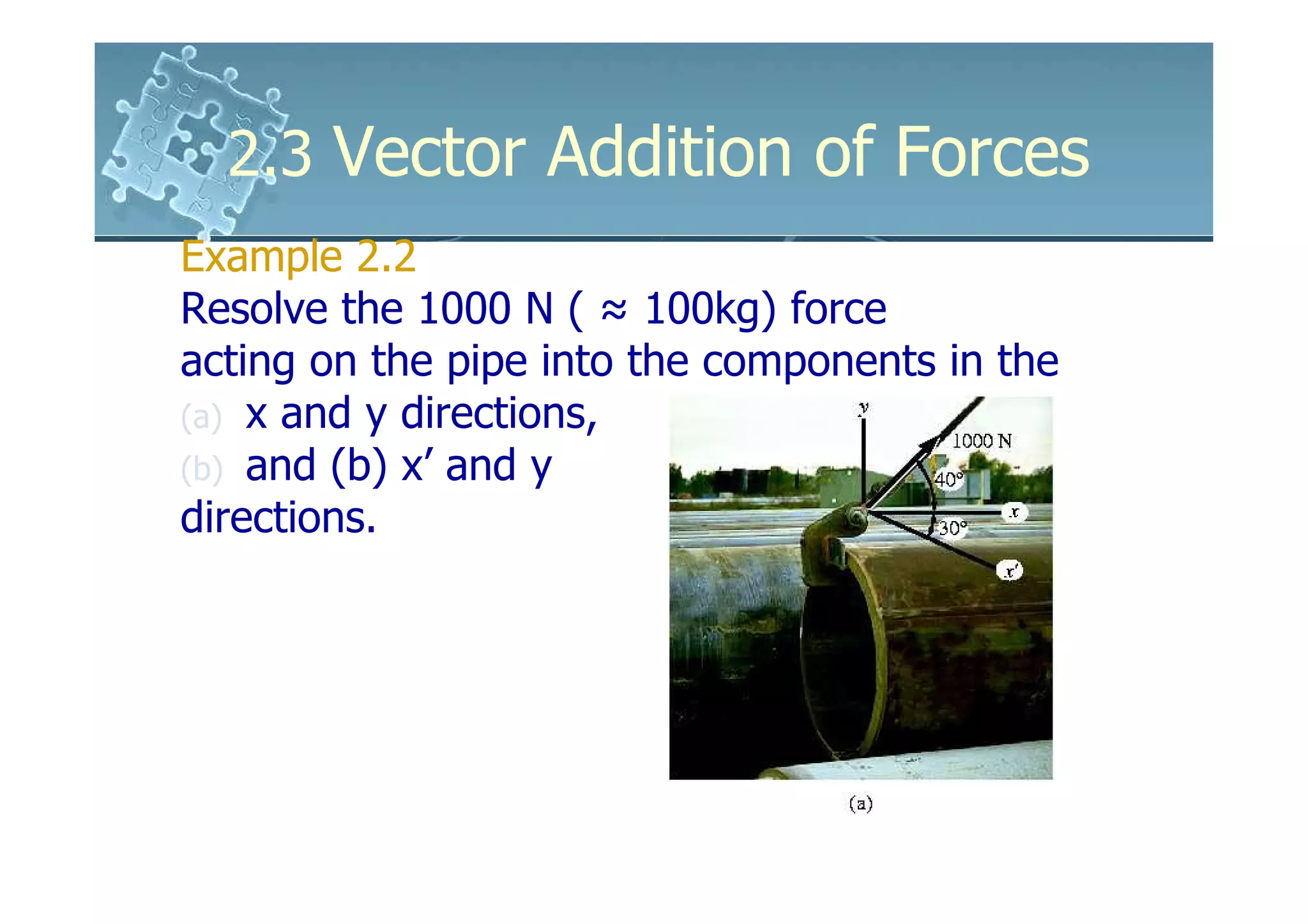
Example 2.2
Resolve the 1000 N ( ≈ 100kg) force
acting on the pipe into the components in the
(a) x and y directions,
(b) and (b) x’ and y
directions.
2.3 Vector Addition of Forces

Solution
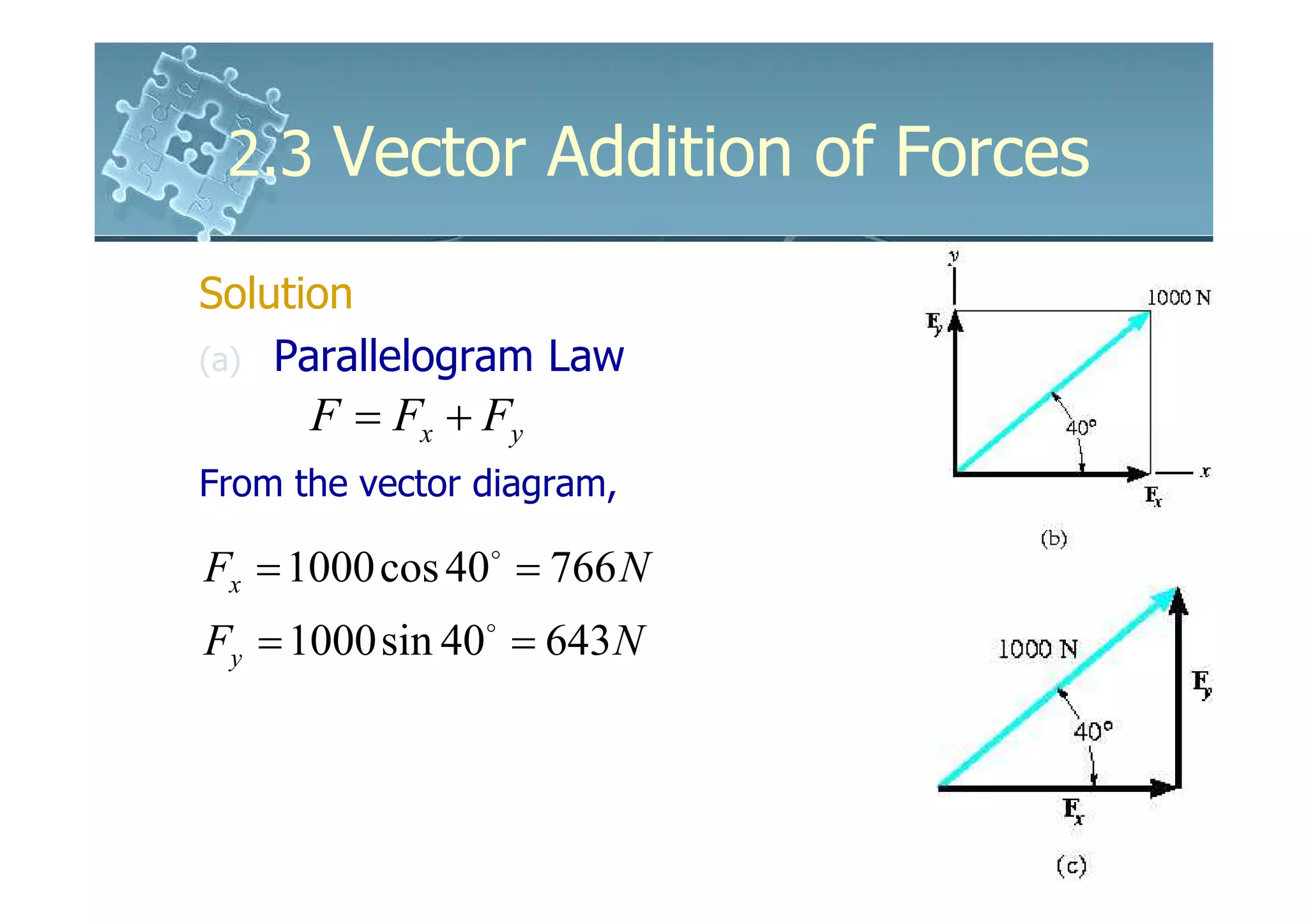
(a) Parallelogram Law
      F = Fx + Fy
From the vector diagram,

Fx = 1000 cos 40o = 766 N
Fy = 1000 sin 40o = 643 N
2.3 Vector Addition of Forces

Solution
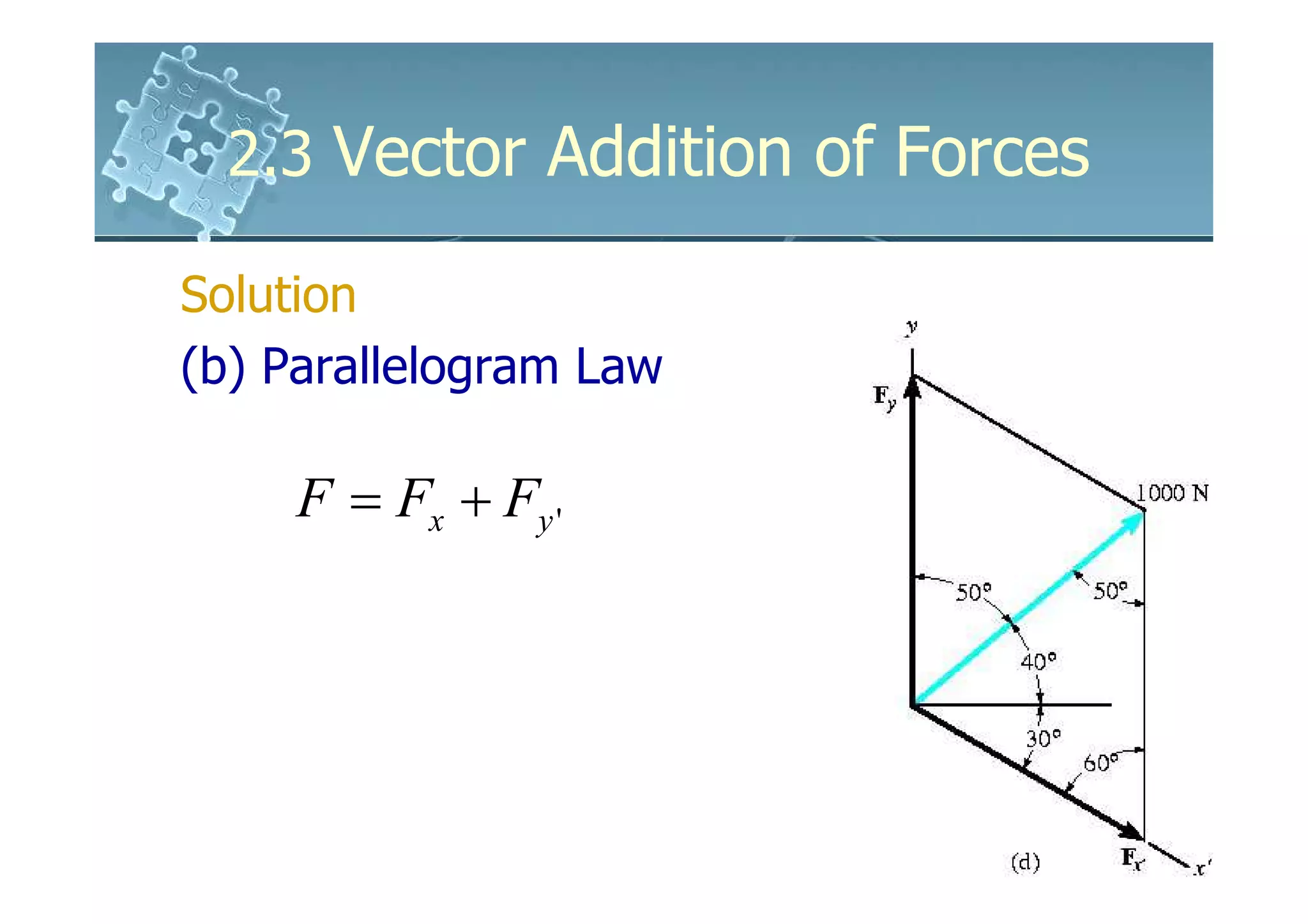
(b) Parallelogram Law

     F = Fx + Fy '
2.3 Vector Addition of Forces

     Solution
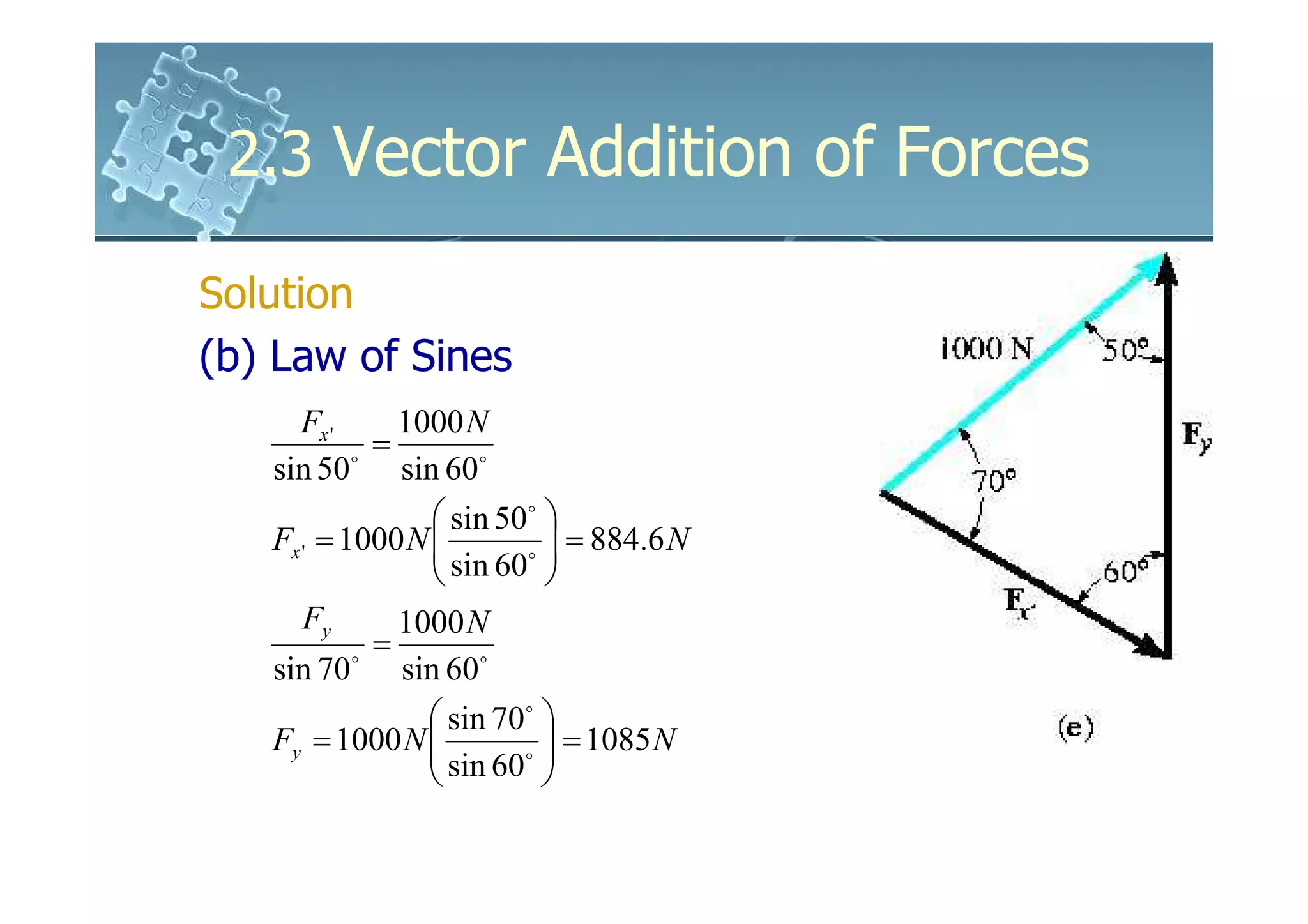
     (b) Law of Sines
           Fx '     1000 N
                  =
         sin 50o sin 60o
                        sin 50o 
         Fx ' = 1000 N 
                        sin 60o  = 884.6 N
                                 
                                
           Fy       1000 N
                o
                  =
         sin 70     sin 60o
                       sin 70o 
         Fy = 1000 N  sin 60o  = 1085 N
                                
                               
NOTE: A rough sketch drawn to scale will give some idea of the
relative magnitude of the components, as calculated here.
2.3 Vector Addition of Forces
Example 2.3
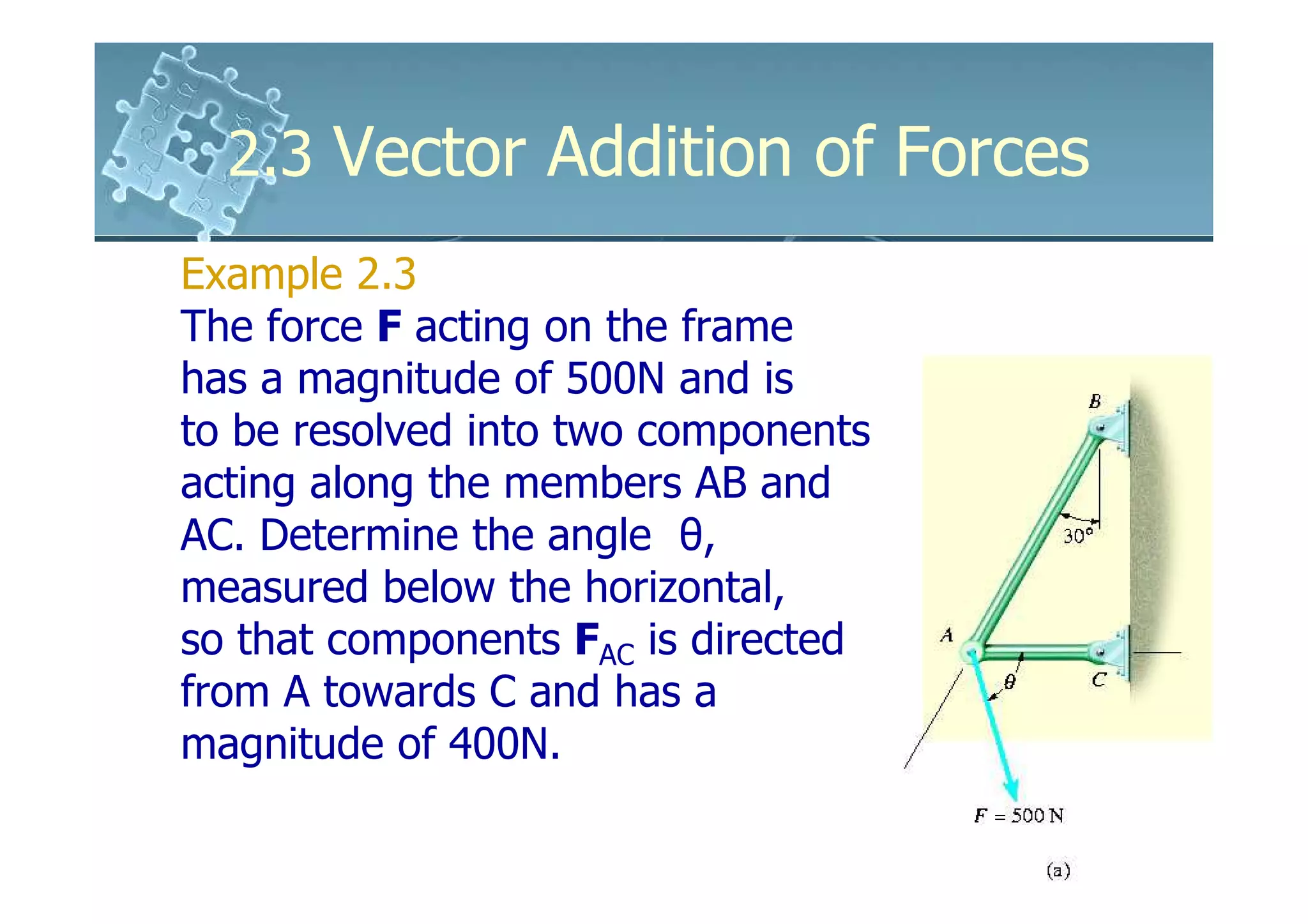
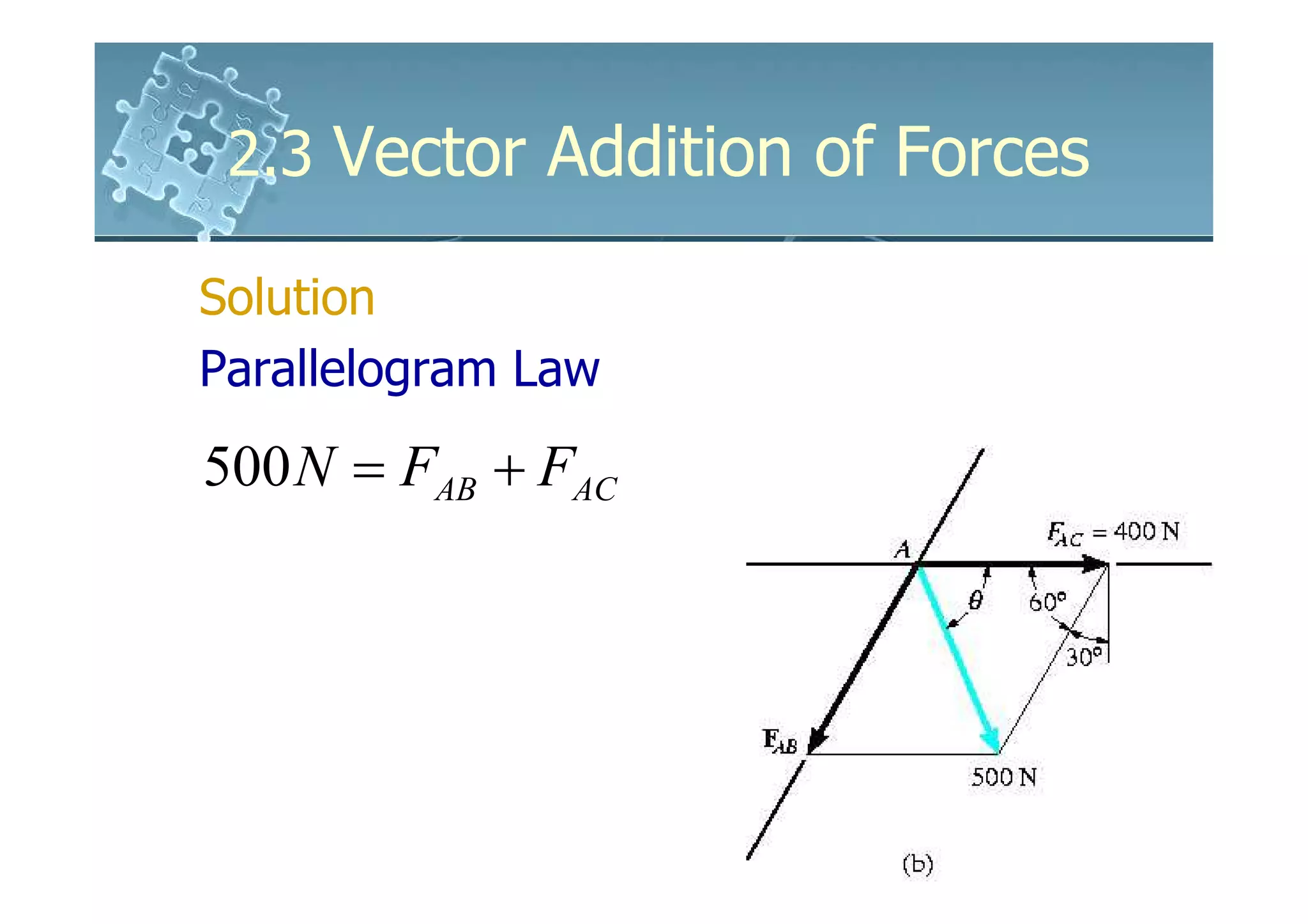
The force F acting on the frame
has a magnitude of 500N and is
to be resolved into two components
acting along the members AB and
AC. Determine the angle θ,
measured below the horizontal,
so that components FAC is directed
from A towards C and has a
magnitude of 400N.
2.3 Vector Addition of Forces

Solution
Parallelogram Law
500 N = FAB + FAC
2.3 Vector Addition of Forces

Solution
Law of Sines
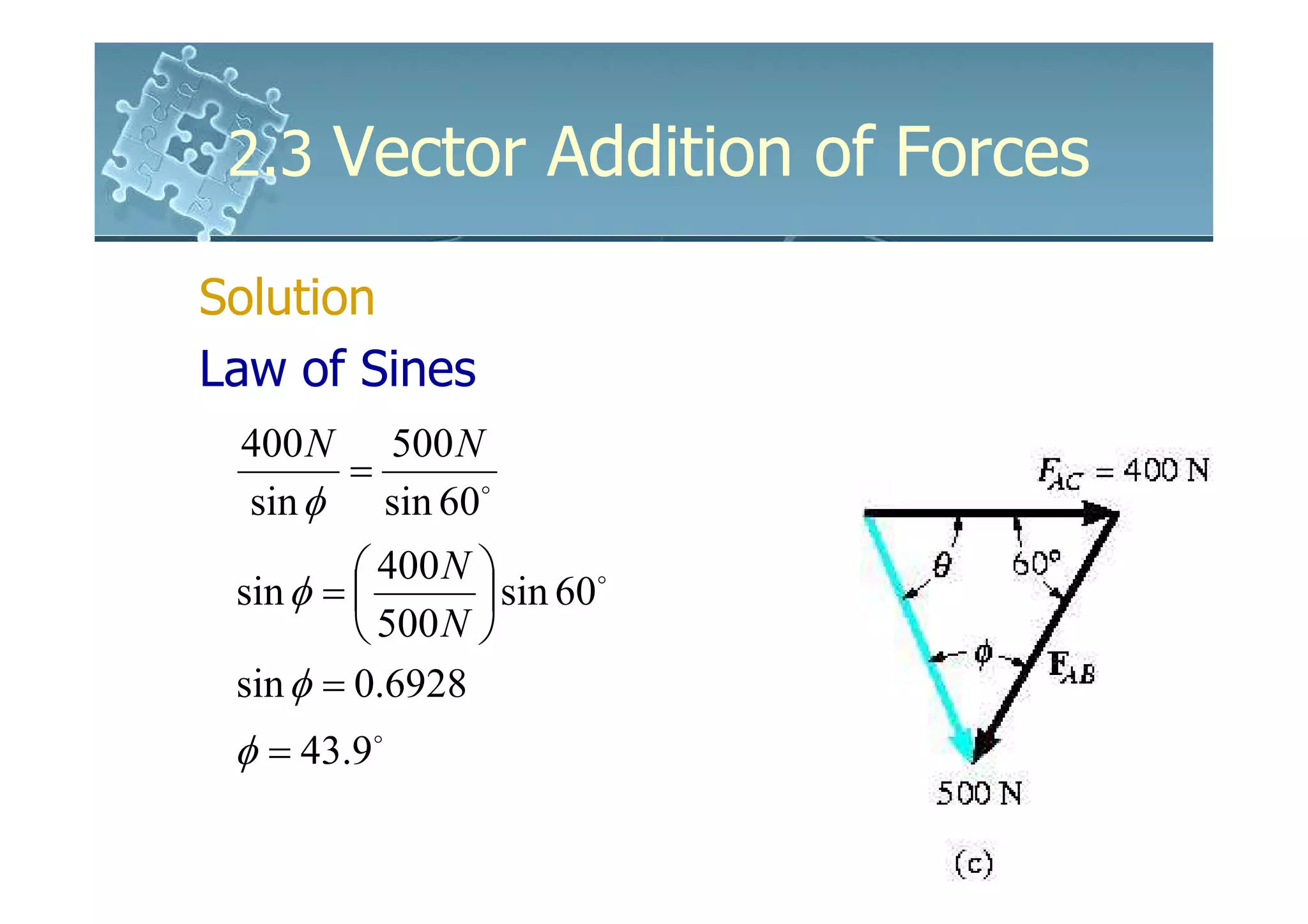
 400 N 500 N
      =
 sin φ sin 60o
          400 N 
 sin φ =         sin 60
                          o

          500 N 
 sin φ = 0.6928
 φ = 43.9o
2.3 Vector Addition of Forces

Solution
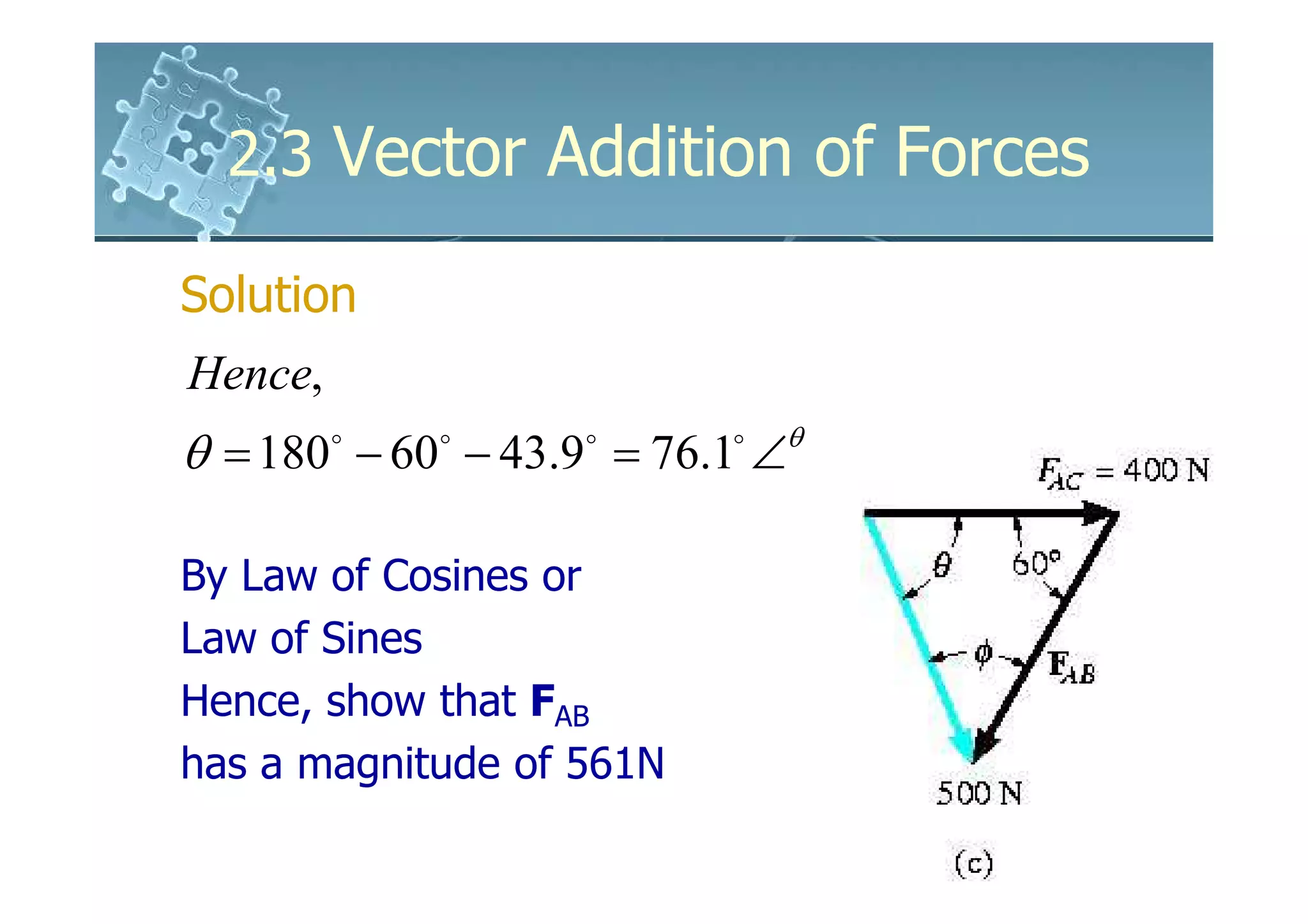
Hence,
                              θ
θ = 180 − 60 − 43.9 = 76.1 ∠
         o   o     o      o


By Law of Cosines or
Law of Sines
Hence, show that FAB
has a magnitude of 561N
2.3 Vector Addition of Forces
Solution
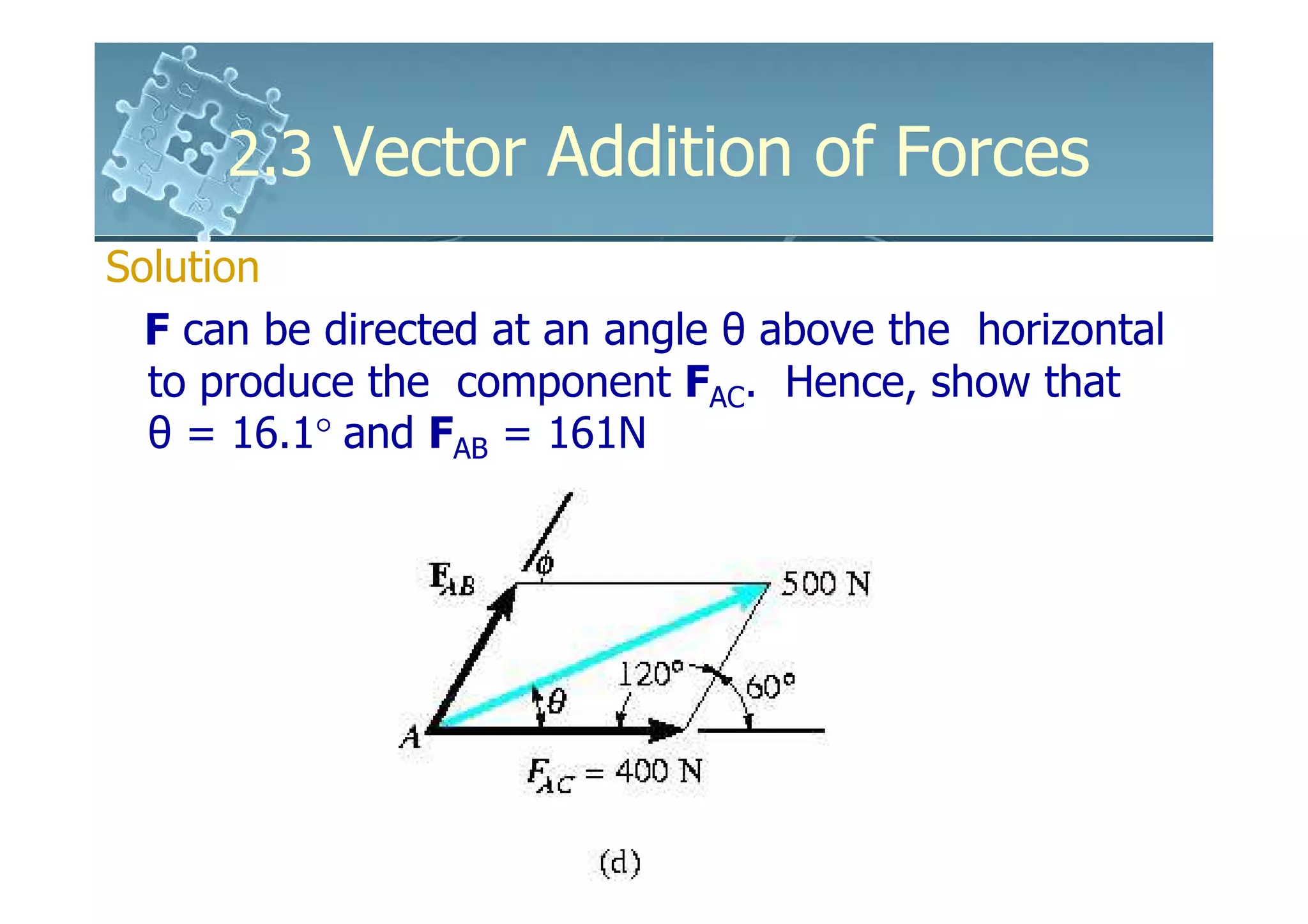
  F can be directed at an angle θ above the horizontal
  to produce the component FAC. Hence, show that
  θ = 16.1° and FAB = 161N
2.3 Vector Addition of Forces
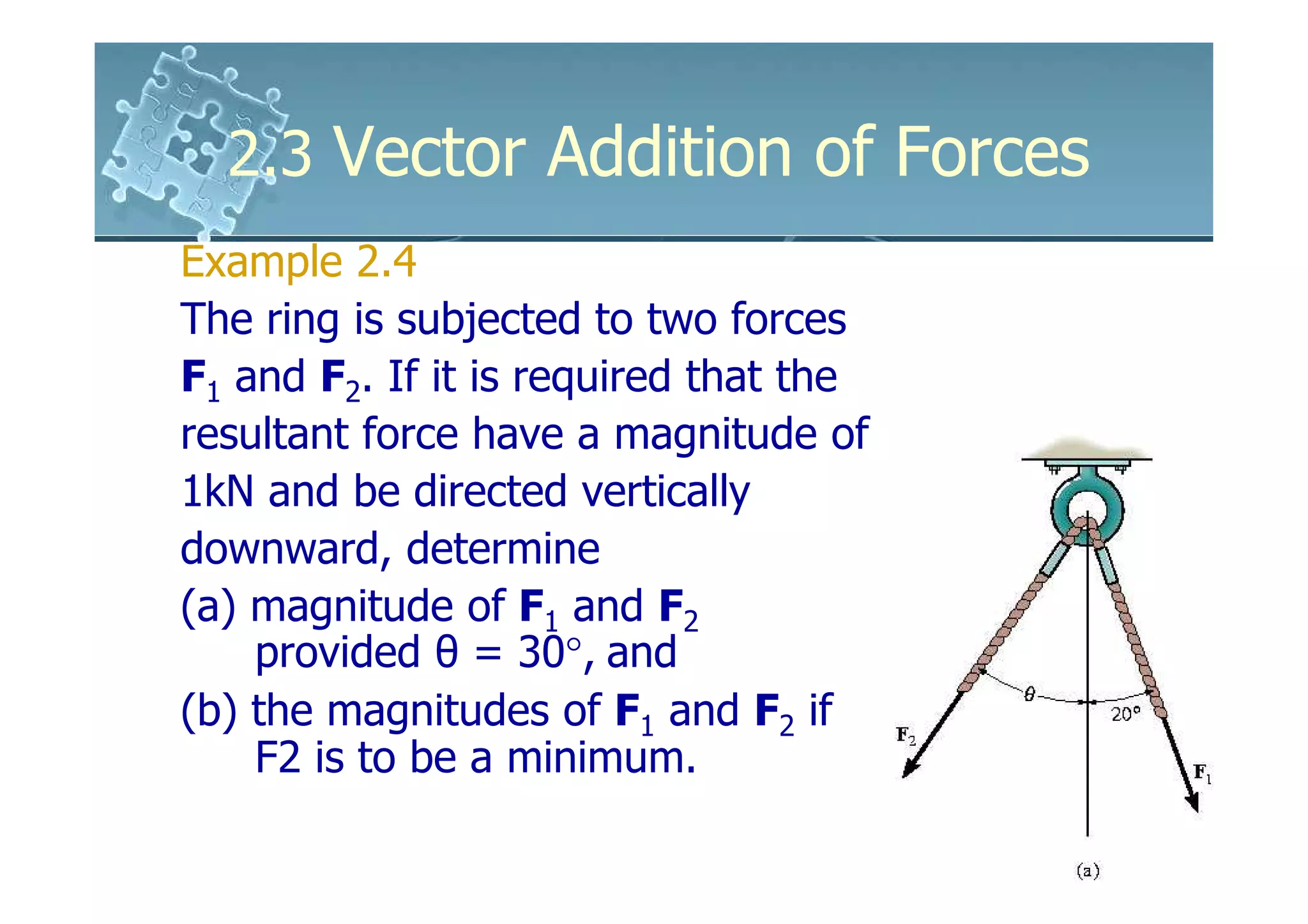
Example 2.4
The ring is subjected to two forces
F1 and F2. If it is required that the
resultant force have a magnitude of
1kN and be directed vertically
downward, determine
(a) magnitude of F1 and F2
    provided θ = 30°, and
(b) the magnitudes of F1 and F2 if
    F2 is to be a minimum.
2.3 Vector Addition of Forces
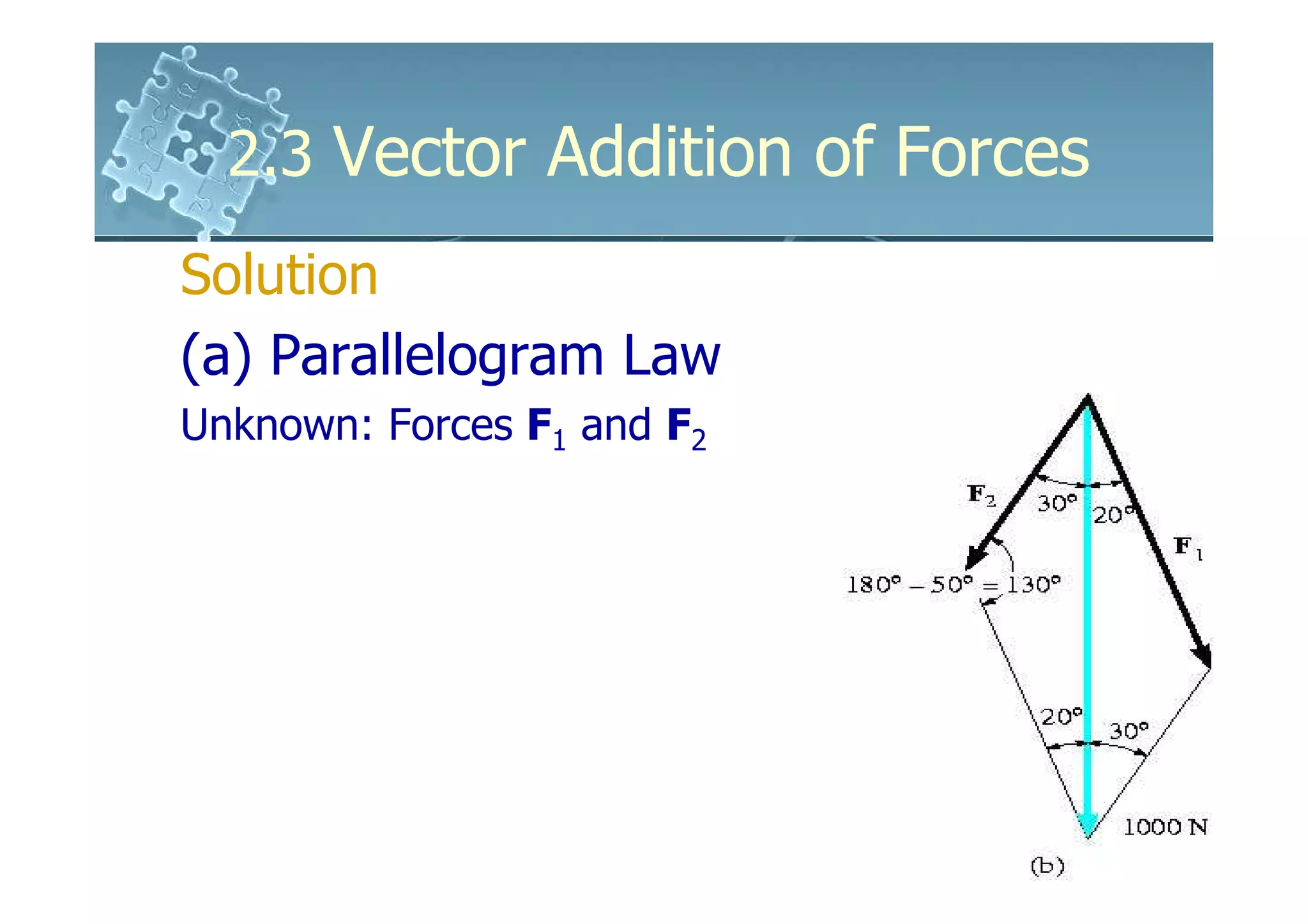
Solution
(a) Parallelogram Law
Unknown: Forces F1 and F2
2.3 Vector Addition of Forces

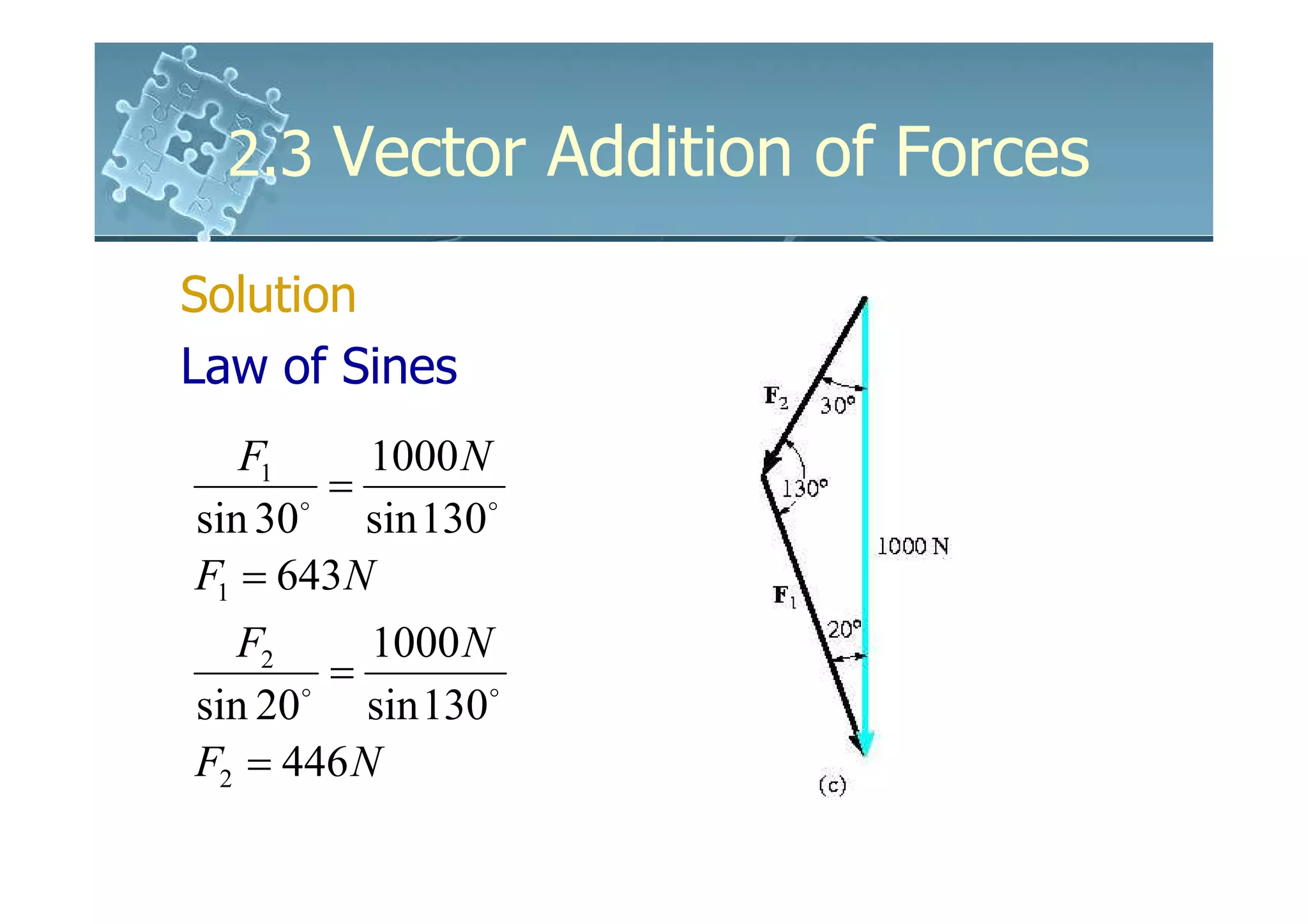
Solution
Law of Sines
   F1      1000 N
       o
         =
sin 30     sin 130o
F1 = 643N
  F2       1000 N
       o
         =
sin 20     sin 130o
F2 = 446 N
2.3 Vector Addition of Forces

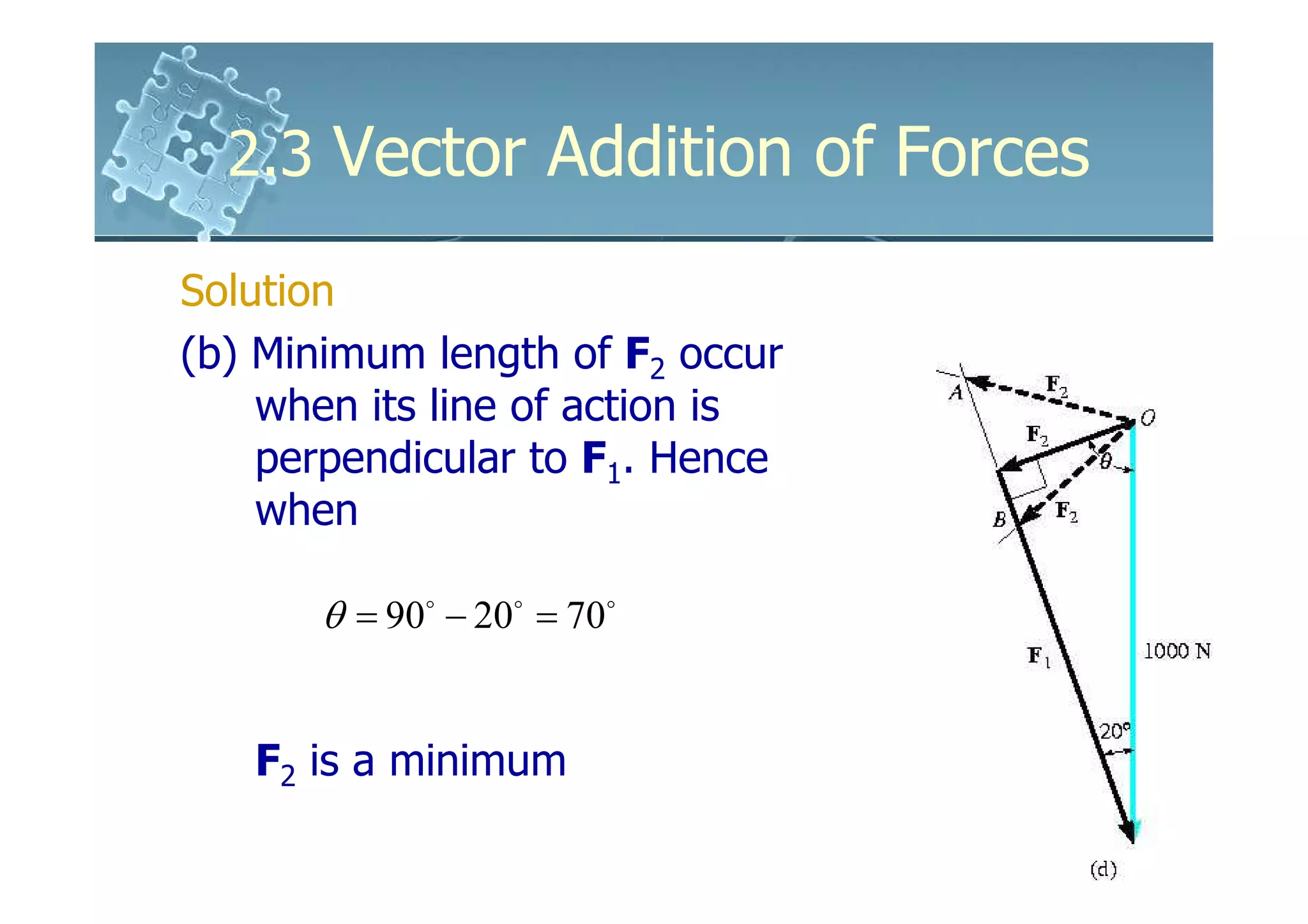
Solution
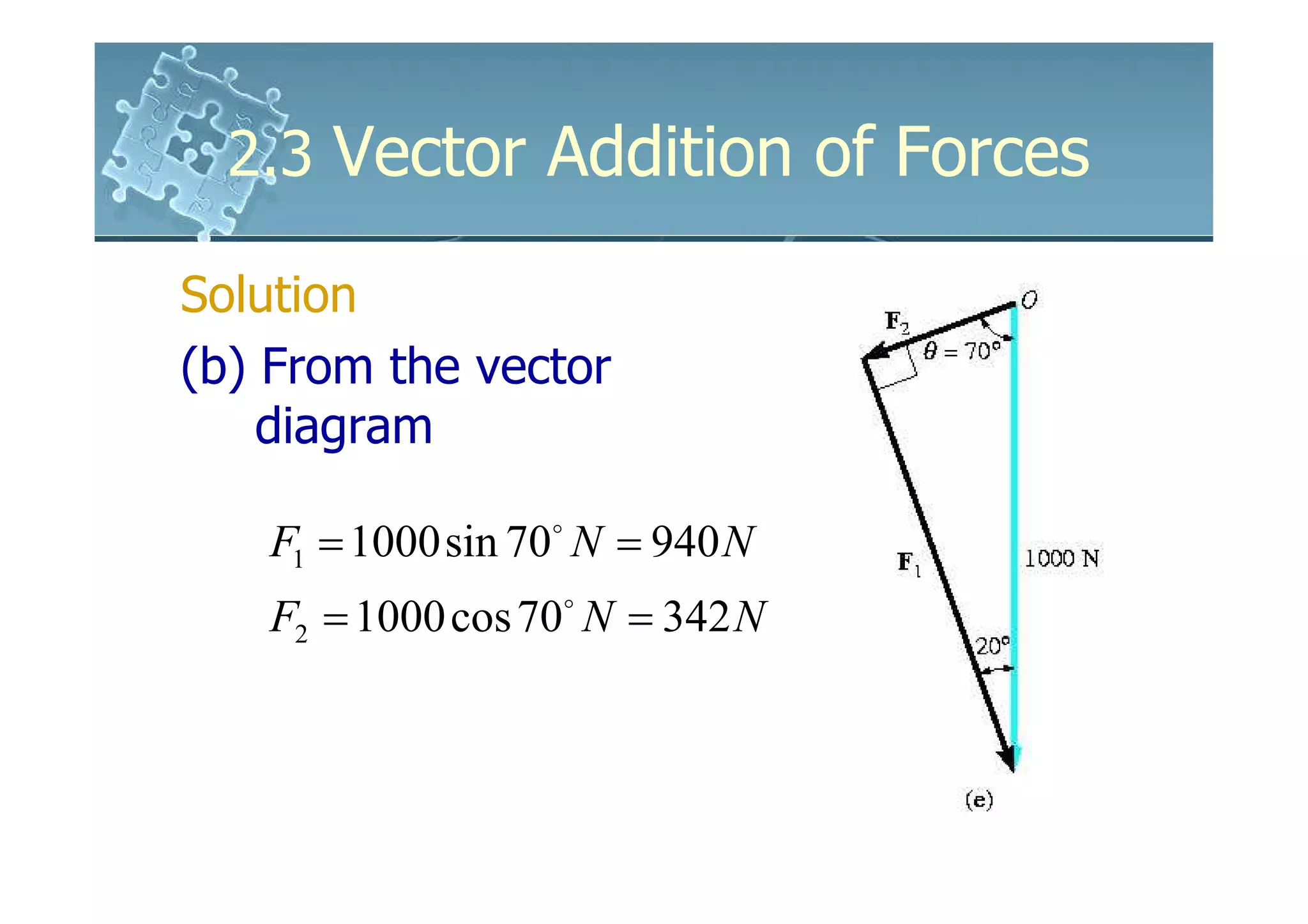
(b) Minimum length of F2 occur
    when its line of action is
    perpendicular to F1. Hence
    when

       θ = 90o − 20o = 70o


   F2 is a minimum
2.3 Vector Addition of Forces

Solution
(b) From the vector
    diagram

   F1 = 1000 sin 70o N = 940 N
   F2 = 1000 cos 70o N = 342 N

6161103 2.3 vector addition of forces

  • 1.
    2.3 Vector Additionof Forces When two or more forces are added, successive applications of the parallelogram law is carried out to find the resultant Eg: Forces F1, F2 and F3 acts at a point O - First, find resultant of F1 + F2 - Resultant, FR = ( F1 + F2 ) + F3
  • 2.
    2.3 Vector Additionof Forces Example Fa and Fb are forces exerting on the hook. Resultant, Fc can be found using the parallelogram law Lines parallel to a and b from the heads of Fa and Fb are drawn to form a parallelogram Similarly, given Fc, Fa and Fb can be found
  • 3.
    2.3 Vector Additionof Forces Procedure for Analysis Parallelogram Law - Make a sketch using the parallelogram law - Two components forces add to form the resultant force - Resultant force is shown by the diagonal of the parallelogram - The components is shown by the sides of the parallelogram
  • 4.
    2.3 Vector Additionof Forces Procedure for Analysis Parallelogram Law To resolve a force into components along two axes directed from the tail of the force - Start at the head, constructing lines parallel to the axes - Label all the known and unknown force magnitudes and angles - Identify the two unknown components
  • 5.
    2.3 Vector Additionof Forces Procedure for Analysis Trigonometry - Redraw half portion of the parallelogram - Magnitude of the resultant force can be determined by the law of cosines - Direction if the resultant force can be determined by the law of sines
  • 6.
    2.3 Vector Additionof Forces Procedure for Analysis Trigonometry - Magnitude of the two components can be determined by the law of sines
  • 7.
    2.3 Vector Additionof Forces Example 2.1 The screw eye is subjected to two forces F1 and F2. Determine the magnitude and direction of the resultant force.
  • 8.
    2.3 Vector Additionof Forces Solution Parallelogram Law Unknown: magnitude of FR and angle θ
  • 9.
    2.3 Vector Additionof Forces Solution Trigonometry Law of Cosines FR = (100 N )2 + (150 N )2 − 2(100 N )(150 N ) cos115o = 10000 + 22500 − 30000(− 0.4226 ) = 212.6 N = 213 N
  • 10.
    2.3 Vector Additionof Forces Solution Trigonometry Law of Sines 150 N 212.6 N = sin θ sin 115o 150 N sin θ = (0.9063) 212.6 N sin θ = 39.8o
  • 11.
    2.3 Vector Additionof Forces Solution Trigonometry Direction Φ of FR measured from the horizontal φ = 39.8 + 15 o o = 54.8o ∠φ
  • 12.
    2.3 Vector Additionof Forces Example 2.2 Resolve the 1000 N ( ≈ 100kg) force acting on the pipe into the components in the (a) x and y directions, (b) and (b) x’ and y directions.
  • 13.
    2.3 Vector Additionof Forces Solution (a) Parallelogram Law F = Fx + Fy From the vector diagram, Fx = 1000 cos 40o = 766 N Fy = 1000 sin 40o = 643 N
  • 14.
    2.3 Vector Additionof Forces Solution (b) Parallelogram Law F = Fx + Fy '
  • 15.
    2.3 Vector Additionof Forces Solution (b) Law of Sines Fx ' 1000 N = sin 50o sin 60o  sin 50o  Fx ' = 1000 N   sin 60o  = 884.6 N    Fy 1000 N o = sin 70 sin 60o  sin 70o  Fy = 1000 N  sin 60o  = 1085 N    NOTE: A rough sketch drawn to scale will give some idea of the relative magnitude of the components, as calculated here.
  • 16.
    2.3 Vector Additionof Forces Example 2.3 The force F acting on the frame has a magnitude of 500N and is to be resolved into two components acting along the members AB and AC. Determine the angle θ, measured below the horizontal, so that components FAC is directed from A towards C and has a magnitude of 400N.
  • 17.
    2.3 Vector Additionof Forces Solution Parallelogram Law 500 N = FAB + FAC
  • 18.
    2.3 Vector Additionof Forces Solution Law of Sines 400 N 500 N = sin φ sin 60o  400 N  sin φ =   sin 60 o  500 N  sin φ = 0.6928 φ = 43.9o
  • 19.
    2.3 Vector Additionof Forces Solution Hence, θ θ = 180 − 60 − 43.9 = 76.1 ∠ o o o o By Law of Cosines or Law of Sines Hence, show that FAB has a magnitude of 561N
  • 20.
    2.3 Vector Additionof Forces Solution F can be directed at an angle θ above the horizontal to produce the component FAC. Hence, show that θ = 16.1° and FAB = 161N
  • 21.
    2.3 Vector Additionof Forces Example 2.4 The ring is subjected to two forces F1 and F2. If it is required that the resultant force have a magnitude of 1kN and be directed vertically downward, determine (a) magnitude of F1 and F2 provided θ = 30°, and (b) the magnitudes of F1 and F2 if F2 is to be a minimum.
  • 22.
    2.3 Vector Additionof Forces Solution (a) Parallelogram Law Unknown: Forces F1 and F2
  • 23.
    2.3 Vector Additionof Forces Solution Law of Sines F1 1000 N o = sin 30 sin 130o F1 = 643N F2 1000 N o = sin 20 sin 130o F2 = 446 N
  • 24.
    2.3 Vector Additionof Forces Solution (b) Minimum length of F2 occur when its line of action is perpendicular to F1. Hence when θ = 90o − 20o = 70o F2 is a minimum
  • 25.
    2.3 Vector Additionof Forces Solution (b) From the vector diagram F1 = 1000 sin 70o N = 940 N F2 = 1000 cos 70o N = 342 N