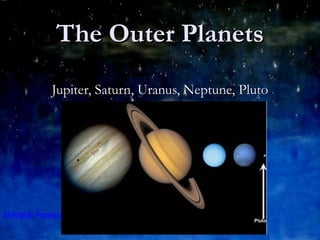
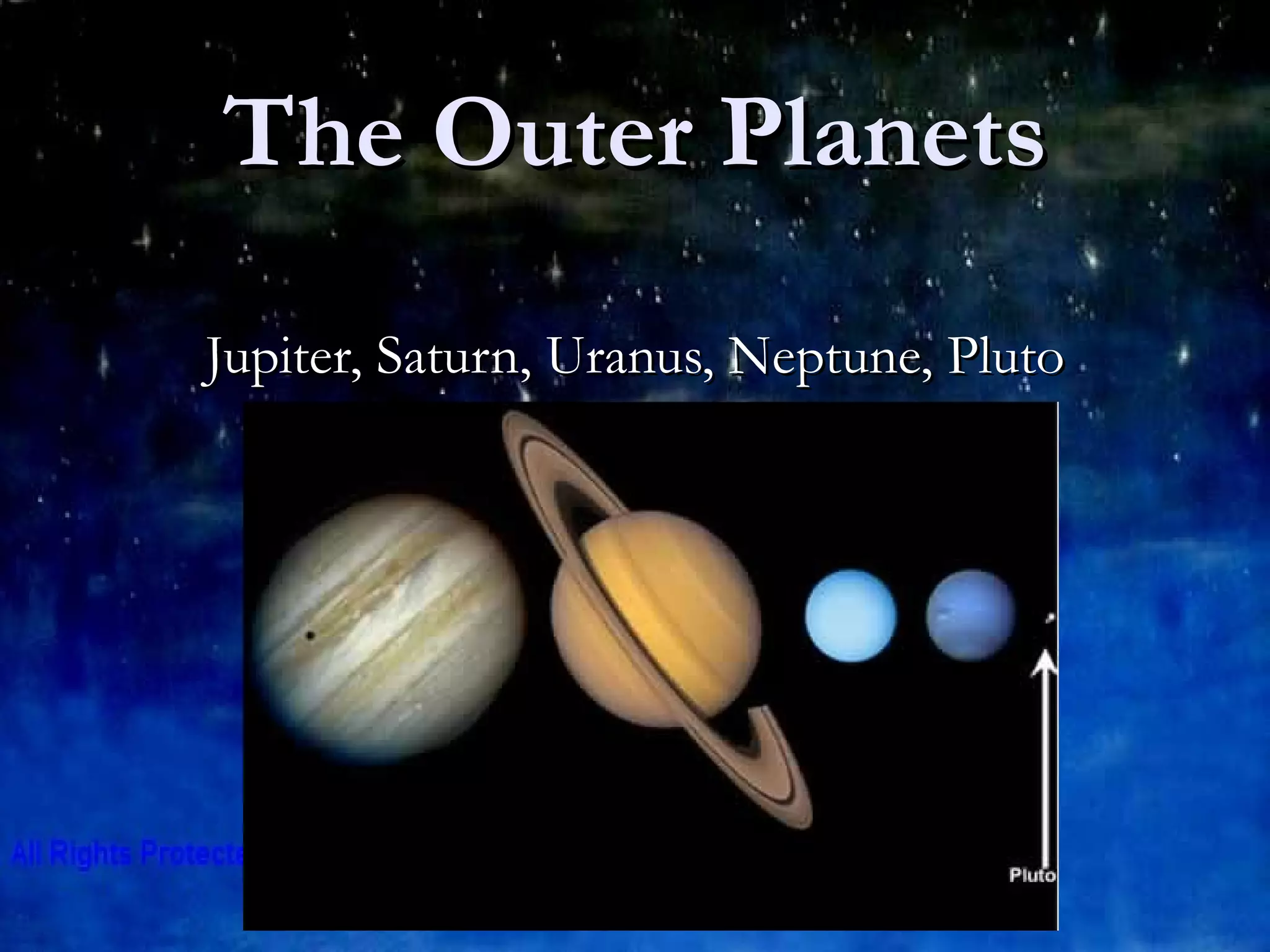
The Outer Planets Jupiter, Saturn, Uranus, Neptune, Pluto
The Outer Planets The outer planets are the five that are the furthest from the sun.  They have longer orbits than the inner planets. Jupiter, Saturn, Uranus, and Neptune are called the Gas Giants.
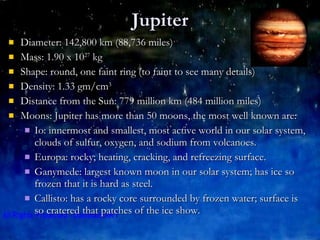
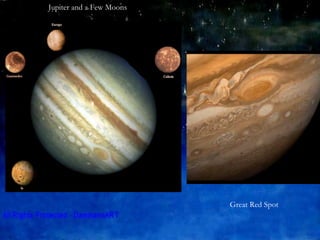
Jupiter Diameter: 142,800 km (88,736 miles)  Mass: 1.90 x 10 27  kg  Shape: round, one faint ring (to faint to see many details) Density: 1.33 gm/cm 3 Distance from the Sun: 779 million km (484 million miles) Moons: Jupiter has more than 50 moons, the most well known are: Io: innermost and smallest, most active world in our solar system, clouds of sulfur, oxygen, and sodium from volcanoes. Europa: rocky; heating, cracking, and refreezing surface. Ganymede: largest known moon in our solar system; has ice so frozen that it is hard as steel. Callisto: has a rocky core surrounded by frozen water; surface is so cratered that patches of the ice show.
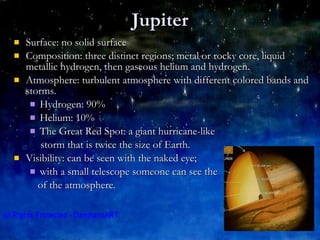
Jupiter Surface: no solid surface Composition: three distinct regions; metal or rocky core, liquid metallic hydrogen, then gaseous helium and hydrogen. Atmosphere: turbulent atmosphere with different colored bands and storms. Hydrogen: 90% Helium: 10% The Great Red Spot: a giant hurricane-like  storm that is twice the size of Earth. Visibility: can be seen with the naked eye;  with a small telescope someone can see the  of the atmosphere.
Jupiter and a Few Moons Great Red Spot
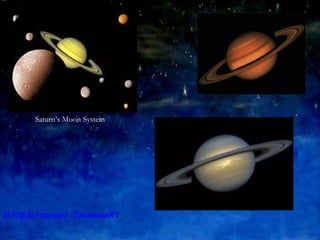
Saturn Diameter: 119,871 km (74,500 miles)   Mass: 5.688 x 10 26  kg Shape: round, known for its many rings Density: 0.69 gm/cm 3 Distance from the Sun: 1.4 Billion km (889 million miles) Moons: Saturn has many moons. There are five major moons. Titan: almost as big as Ganymede; very thick atmosphere of nitrogen that is four times as dense as Earth’s atmosphere. Rhea: icy world of a rocky core and water ice covering, airless world covered by heavily cratered ice. Lapetus: similar to Rhea, but one reddish side and one bright side. Dione: densest of Saturn’s moons, tidally locked Tethys: mostly water ice.
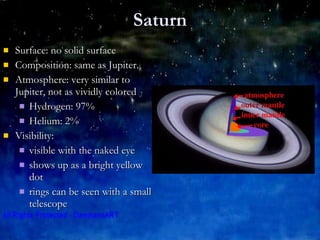
Saturn Surface: no solid surface Composition: same as Jupiter. Atmosphere: very similar to Jupiter, not as vividly colored Hydrogen: 97%  Helium: 2% Visibility:  visible with the naked eye shows up as a bright yellow dot rings can be seen with a small telescope
Saturn’s Moon System
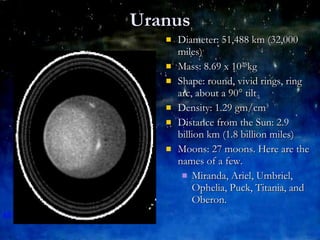
Uranus Diameter: 51,488 km (32,000 miles)  Mass: 8.69 x 10 25 kg Shape: round, vivid rings, ring arc, about a 90° tilt  Density: 1.29 gm/cm 3 Distance from the Sun: 2.9 billion km (1.8 billion miles) Moons: 27 moons. Here are the names of a few. Miranda, Ariel, Umbriel, Ophelia, Puck, Titania, and Oberon.
Uranus Surface: no solid surface, 90º tilt Composition: rocky core, highly compressed water layer, liquid hydrogen and helium, and gaseous hydrogen. Atmosphere: greenish because methane absorbs the orange and red light waves and reflects the blue-green light waves Hydrogen: 83% Helium: 15% Methane: 2% Visibility:  a telescope or binoculars are needed  use a star atlas to help locate it.
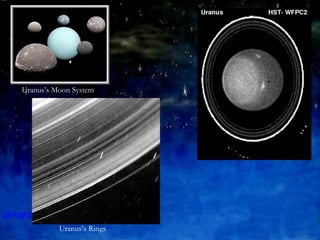
Uranus’s Moon System Uranus’s Rings
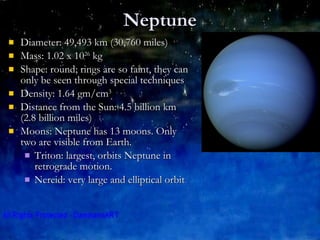
Neptune Diameter: 49,493 km (30,760 miles)  Mass: 1.02 x 10 26  kg Shape: round; rings are so faint, they can only be seen through special techniques Density: 1.64 gm/cm 3 Distance from the Sun: 4.5 billion km (2.8 billion miles) Moons: Neptune has 13 moons. Only two are visible from Earth. Triton: largest, orbits Neptune in retrograde motion. Nereid: very large and elliptical orbit
Neptune Surface: No solid surface. Composition: similar to Uranus Atmosphere: contains white, wispy methane clouds; looks blue-green because like Uranus, methane reflects the blue-green light waves rings so faint, they can only be seen through special techniques. Hydrogen: 83% Helium: 15% Methane: 2% Great Dark Spot: a storm like  Jupiter’s Great Red Spot Visibility:  a telescope or binoculars are needed use a star atlas to help locate it.
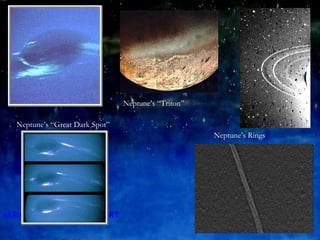
Neptune’s “Triton” Neptune’s Rings Neptune’s “Great Dark Spot”
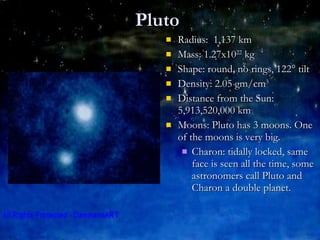
Pluto Radius:  1,137 km Mass: 1.27x10 22  kg Shape: round, no rings, 122° tilt Density: 2.05 gm/cm 3 Distance from the Sun: 5,913,520,000 km Moons: Pluto has 3 moons. One of the moons is very big.  Charon: tidally locked, same face is seen all the time, some astronomers call Pluto and Charon a double planet.
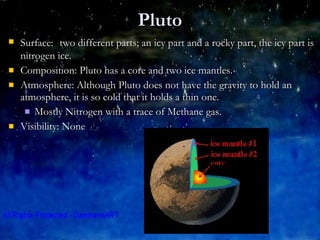
Pluto Surface:  two different parts; an icy part and a rocky part, the icy part is nitrogen ice.  Composition: Pluto has a core and two ice mantles. Atmosphere: Although Pluto does not have the gravity to hold an atmosphere, it is so cold that it holds a thin one. Mostly Nitrogen with a trace of Methane gas. Visibility: None
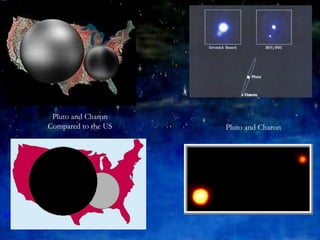
Pluto and Charon Compared to the US Pluto and Charon
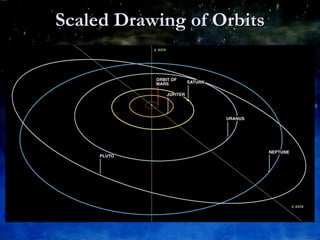
Scaled Drawing of Orbits
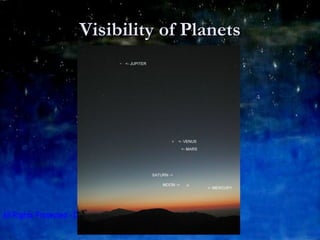
Visibility of Planets
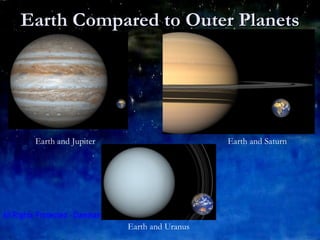
Earth Compared to Outer Planets Earth and Jupiter Earth and Saturn Earth and Uranus
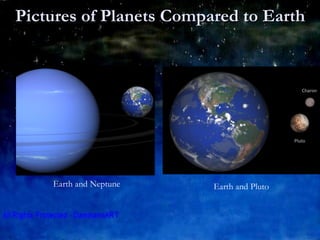
Pictures of Planets Compared to Earth Earth and Neptune Earth and Pluto
Copyright Information All facts were retrieved via Yahoo Search for Planetary Facts All pictures were retrieved via Yahoo Search for pictures Pictures of Earth with planets retrieved  © Walter Myers from www.arcadiastreet.com

The Outer Planets

  • 1.
    The Outer PlanetsJupiter, Saturn, Uranus, Neptune, Pluto
  • 2.
    The Outer PlanetsThe outer planets are the five that are the furthest from the sun. They have longer orbits than the inner planets. Jupiter, Saturn, Uranus, and Neptune are called the Gas Giants.
  • 3.
    Jupiter Diameter: 142,800km (88,736 miles) Mass: 1.90 x 10 27 kg Shape: round, one faint ring (to faint to see many details) Density: 1.33 gm/cm 3 Distance from the Sun: 779 million km (484 million miles) Moons: Jupiter has more than 50 moons, the most well known are: Io: innermost and smallest, most active world in our solar system, clouds of sulfur, oxygen, and sodium from volcanoes. Europa: rocky; heating, cracking, and refreezing surface. Ganymede: largest known moon in our solar system; has ice so frozen that it is hard as steel. Callisto: has a rocky core surrounded by frozen water; surface is so cratered that patches of the ice show.
  • 4.
    Jupiter Surface: nosolid surface Composition: three distinct regions; metal or rocky core, liquid metallic hydrogen, then gaseous helium and hydrogen. Atmosphere: turbulent atmosphere with different colored bands and storms. Hydrogen: 90% Helium: 10% The Great Red Spot: a giant hurricane-like storm that is twice the size of Earth. Visibility: can be seen with the naked eye; with a small telescope someone can see the of the atmosphere.
  • 5.
    Jupiter and aFew Moons Great Red Spot
  • 6.
    Saturn Diameter: 119,871km (74,500 miles) Mass: 5.688 x 10 26 kg Shape: round, known for its many rings Density: 0.69 gm/cm 3 Distance from the Sun: 1.4 Billion km (889 million miles) Moons: Saturn has many moons. There are five major moons. Titan: almost as big as Ganymede; very thick atmosphere of nitrogen that is four times as dense as Earth’s atmosphere. Rhea: icy world of a rocky core and water ice covering, airless world covered by heavily cratered ice. Lapetus: similar to Rhea, but one reddish side and one bright side. Dione: densest of Saturn’s moons, tidally locked Tethys: mostly water ice.
  • 7.
    Saturn Surface: nosolid surface Composition: same as Jupiter. Atmosphere: very similar to Jupiter, not as vividly colored Hydrogen: 97% Helium: 2% Visibility: visible with the naked eye shows up as a bright yellow dot rings can be seen with a small telescope
  • 8.
  • 9.
    Uranus Diameter: 51,488km (32,000 miles) Mass: 8.69 x 10 25 kg Shape: round, vivid rings, ring arc, about a 90° tilt Density: 1.29 gm/cm 3 Distance from the Sun: 2.9 billion km (1.8 billion miles) Moons: 27 moons. Here are the names of a few. Miranda, Ariel, Umbriel, Ophelia, Puck, Titania, and Oberon.
  • 10.
    Uranus Surface: nosolid surface, 90º tilt Composition: rocky core, highly compressed water layer, liquid hydrogen and helium, and gaseous hydrogen. Atmosphere: greenish because methane absorbs the orange and red light waves and reflects the blue-green light waves Hydrogen: 83% Helium: 15% Methane: 2% Visibility: a telescope or binoculars are needed use a star atlas to help locate it.
  • 11.
    Uranus’s Moon SystemUranus’s Rings
  • 12.
    Neptune Diameter: 49,493km (30,760 miles) Mass: 1.02 x 10 26 kg Shape: round; rings are so faint, they can only be seen through special techniques Density: 1.64 gm/cm 3 Distance from the Sun: 4.5 billion km (2.8 billion miles) Moons: Neptune has 13 moons. Only two are visible from Earth. Triton: largest, orbits Neptune in retrograde motion. Nereid: very large and elliptical orbit
  • 13.
    Neptune Surface: Nosolid surface. Composition: similar to Uranus Atmosphere: contains white, wispy methane clouds; looks blue-green because like Uranus, methane reflects the blue-green light waves rings so faint, they can only be seen through special techniques. Hydrogen: 83% Helium: 15% Methane: 2% Great Dark Spot: a storm like Jupiter’s Great Red Spot Visibility: a telescope or binoculars are needed use a star atlas to help locate it.
  • 14.
    Neptune’s “Triton” Neptune’sRings Neptune’s “Great Dark Spot”
  • 15.
    Pluto Radius: 1,137 km Mass: 1.27x10 22 kg Shape: round, no rings, 122° tilt Density: 2.05 gm/cm 3 Distance from the Sun: 5,913,520,000 km Moons: Pluto has 3 moons. One of the moons is very big. Charon: tidally locked, same face is seen all the time, some astronomers call Pluto and Charon a double planet.
  • 16.
    Pluto Surface: two different parts; an icy part and a rocky part, the icy part is nitrogen ice. Composition: Pluto has a core and two ice mantles. Atmosphere: Although Pluto does not have the gravity to hold an atmosphere, it is so cold that it holds a thin one. Mostly Nitrogen with a trace of Methane gas. Visibility: None
  • 17.
    Pluto and CharonCompared to the US Pluto and Charon
  • 18.
  • 19.
  • 20.
    Earth Compared toOuter Planets Earth and Jupiter Earth and Saturn Earth and Uranus
  • 21.
    Pictures of PlanetsCompared to Earth Earth and Neptune Earth and Pluto
  • 22.
    Copyright Information Allfacts were retrieved via Yahoo Search for Planetary Facts All pictures were retrieved via Yahoo Search for pictures Pictures of Earth with planets retrieved © Walter Myers from www.arcadiastreet.com