Kernel packet capture technologies
Éric Leblond
Stamus Networks
October 1, 2015
Éric Leblond (Stamus Networks) Kernel packet capture technologies October 1, 2015 1 / 54
1 Introduction
2 Why capture
3 Libcap and raw socket
4 AF_PACKET
5 PF_RING
6 AF_PACKET goes multi*
7 Netmap
8 Latest AF_PACKET evolution
9 ++zero copy
10 Conclusion
Éric Leblond (Stamus Networks) Kernel packet capture technologies October 1, 2015 2 / 54
Éric Leblond
Co-founder of Stamus Networks
Company providing network probe based on Suricata
Focusing on bringing you the best of Suricata IDS technology
Open source hacker
Suricata core developer
Netfilter core team member
Éric Leblond (Stamus Networks) Kernel packet capture technologies October 1, 2015 4 / 54
Raw socket: definition
A raw socket is an internet socket that allows direct sending and receiving of Internet
Protocol packets without any protocol-specific transport layer formatting.
Wikipedia
Éric Leblond (Stamus Networks) Kernel packet capture technologies October 1, 2015 6 / 54
"The End of the Internet"
[raw socket ...] spells catastrophe for the integrity of the Internet.
Steve Gibson in 2001
Éric Leblond (Stamus Networks) Kernel packet capture technologies October 1, 2015 7 / 54
"The End of the Internet"
Talking about introduction of raw socket in MS Windows
Allow users to write any packets
Could be used to abuse protocol and [poorly implemented] OS
More info at http://www.informit.com/articles/article.aspx?p=27289
Éric Leblond (Stamus Networks) Kernel packet capture technologies October 1, 2015 8 / 54
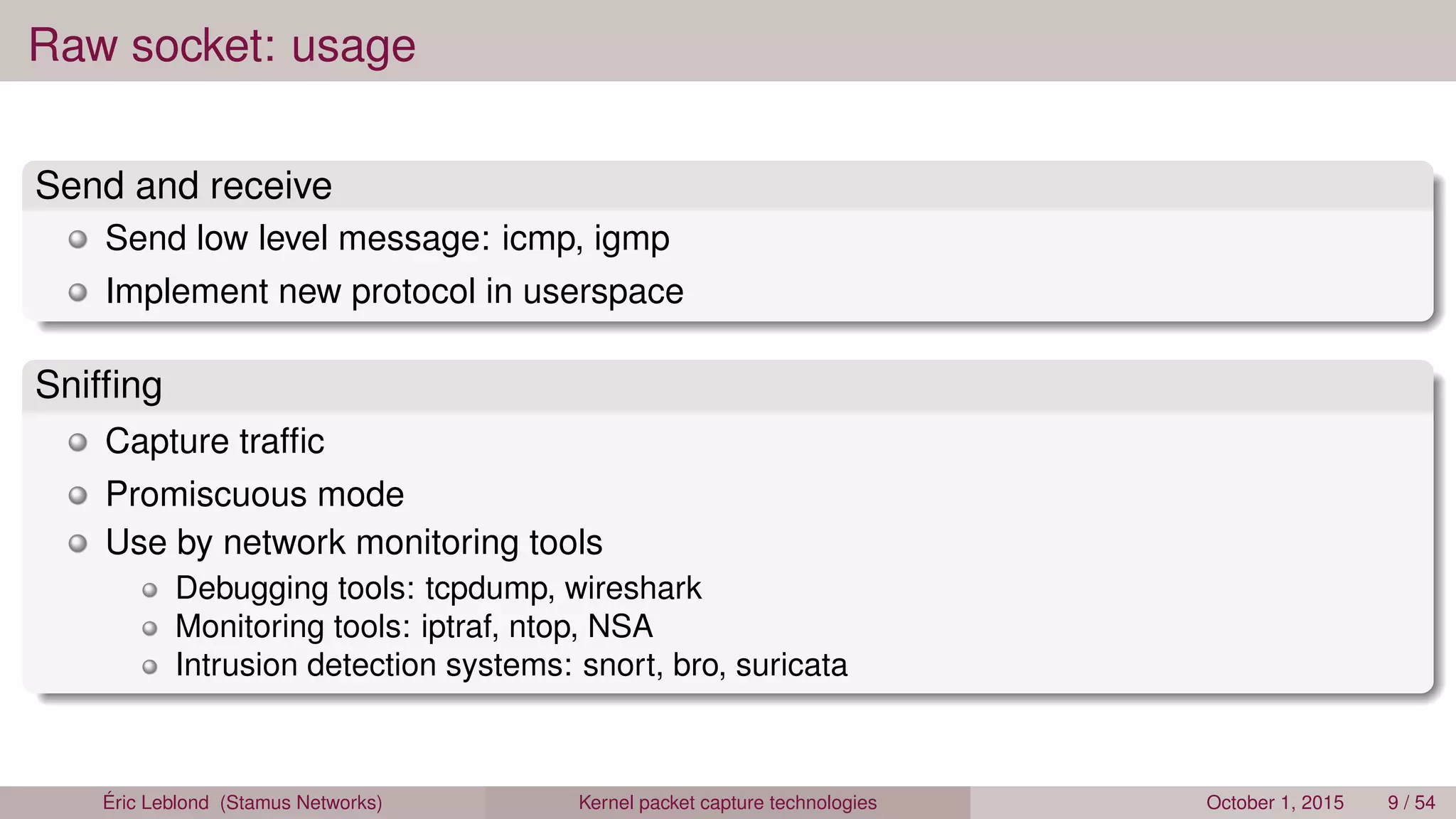
Raw socket: usage
Send and receive
Send low level message: icmp, igmp
Implement new protocol in userspace
Sniffing
Capture traffic
Promiscuous mode
Use by network monitoring tools
Debugging tools: tcpdump, wireshark
Monitoring tools: iptraf, ntop, NSA
Intrusion detection systems: snort, bro, suricata
Éric Leblond (Stamus Networks) Kernel packet capture technologies October 1, 2015 9 / 54
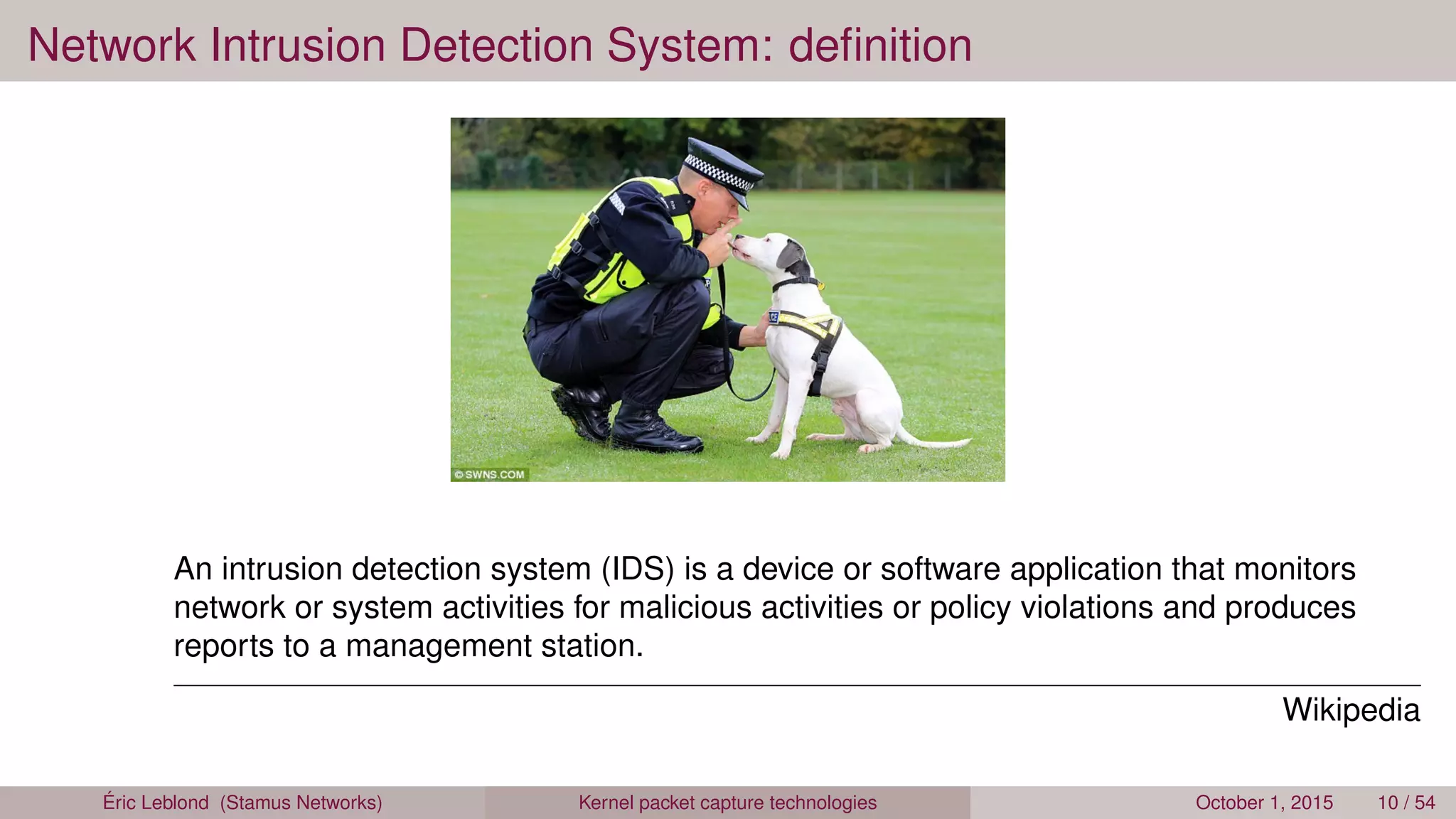
Network Intrusion Detection System: definition
An intrusion detection system (IDS) is a device or software application that monitors
network or system activities for malicious activities or policy violations and produces
reports to a management station.
Wikipedia
Éric Leblond (Stamus Networks) Kernel packet capture technologies October 1, 2015 10 / 54
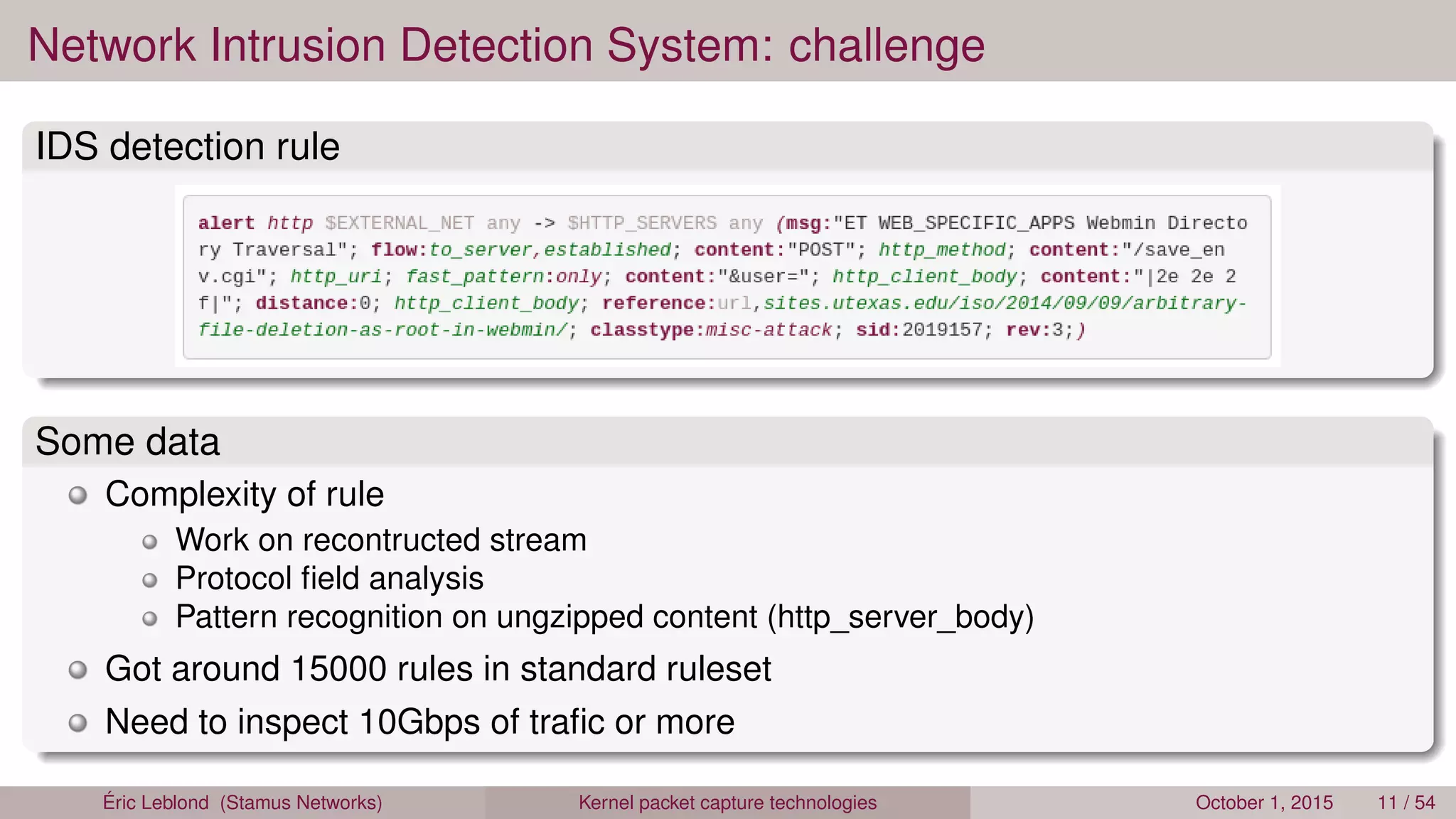
Network Intrusion Detection System: challenge
IDS detection rule
Some data
Complexity of rule
Work on recontructed stream
Protocol field analysis
Pattern recognition on ungzipped content (http_server_body)
Got around 15000 rules in standard ruleset
Need to inspect 10Gbps of trafic or more
Éric Leblond (Stamus Networks) Kernel packet capture technologies October 1, 2015 11 / 54
Suricata: Open source & multi threaded IDS
IDS and IPS engine
Get it here: http://www.suricata-ids.org
Project started in 2008
Open Source (GPLv2)
Funded by consortium members (and originaly US
government)
Run by Open Information Security Foundation (OISF)
More information about OISF at
http://www.oisf.net/
Éric Leblond (Stamus Networks) Kernel packet capture technologies October 1, 2015 12 / 54
Suricata Features
High performance, scalable through multi threading
Protocol identification
File identification, extraction, on the fly MD5 calculation
TLS handshake analysis, detect/prevent things like Diginotar
Hardware acceleration support:
Useful logging like HTTP request log, TLS certificate log, DNS logging
Lua scripting for detection
Éric Leblond (Stamus Networks) Kernel packet capture technologies October 1, 2015 13 / 54
libpcap
Multi OS abstraction for packet capture
All *nix, Windows
Multi layer: Network, USB, . . .
Éric Leblond (Stamus Networks) Kernel packet capture technologies October 1, 2015 15 / 54
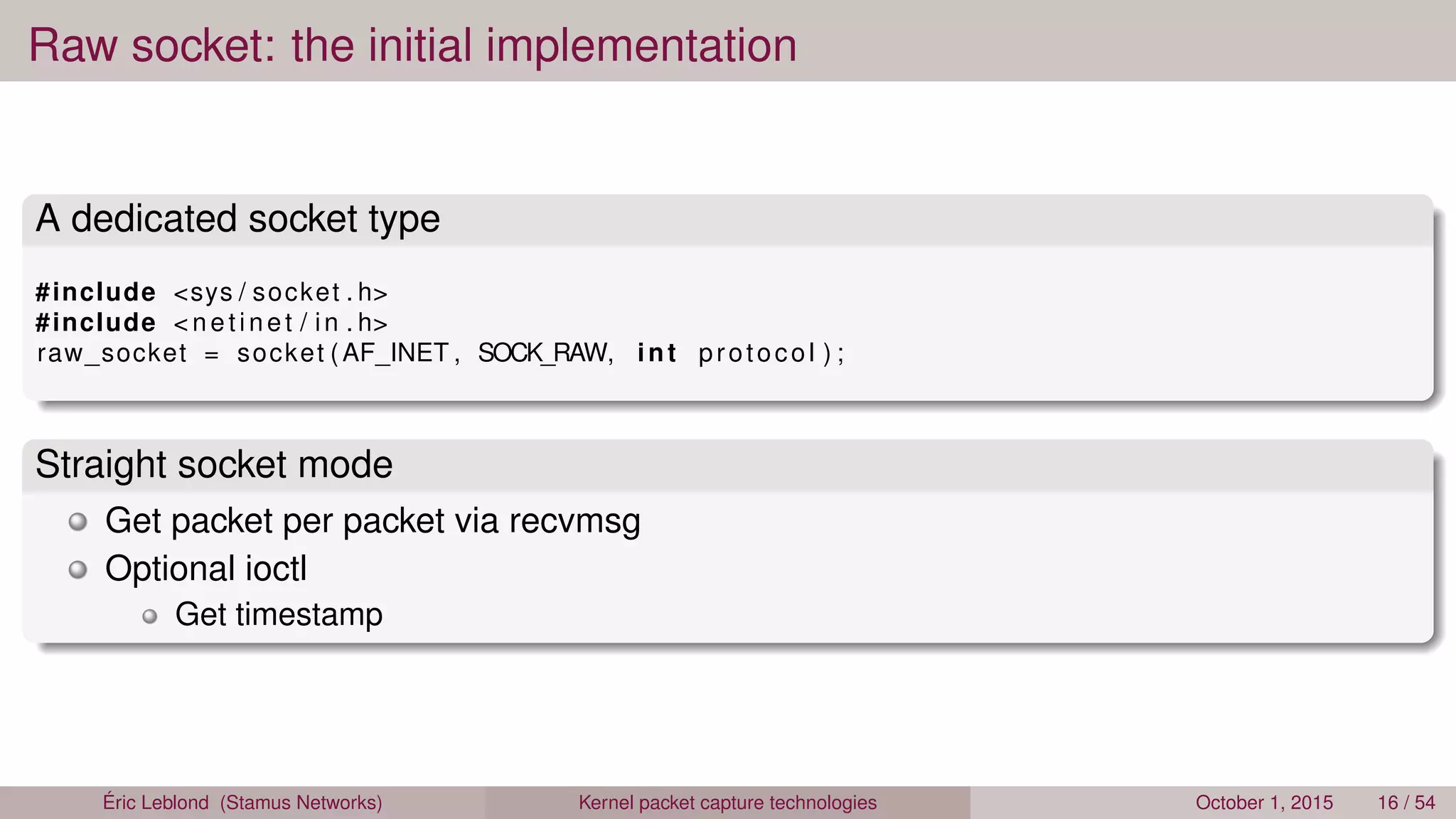
Raw socket: the initial implementation
A dedicated socket type
#include <sys / socket . h>
#include < netinet / in . h>
raw_socket = socket (AF_INET , SOCK_RAW, int protocol ) ;
Straight socket mode
Get packet per packet via recvmsg
Optional ioctl
Get timestamp
Éric Leblond (Stamus Networks) Kernel packet capture technologies October 1, 2015 16 / 54
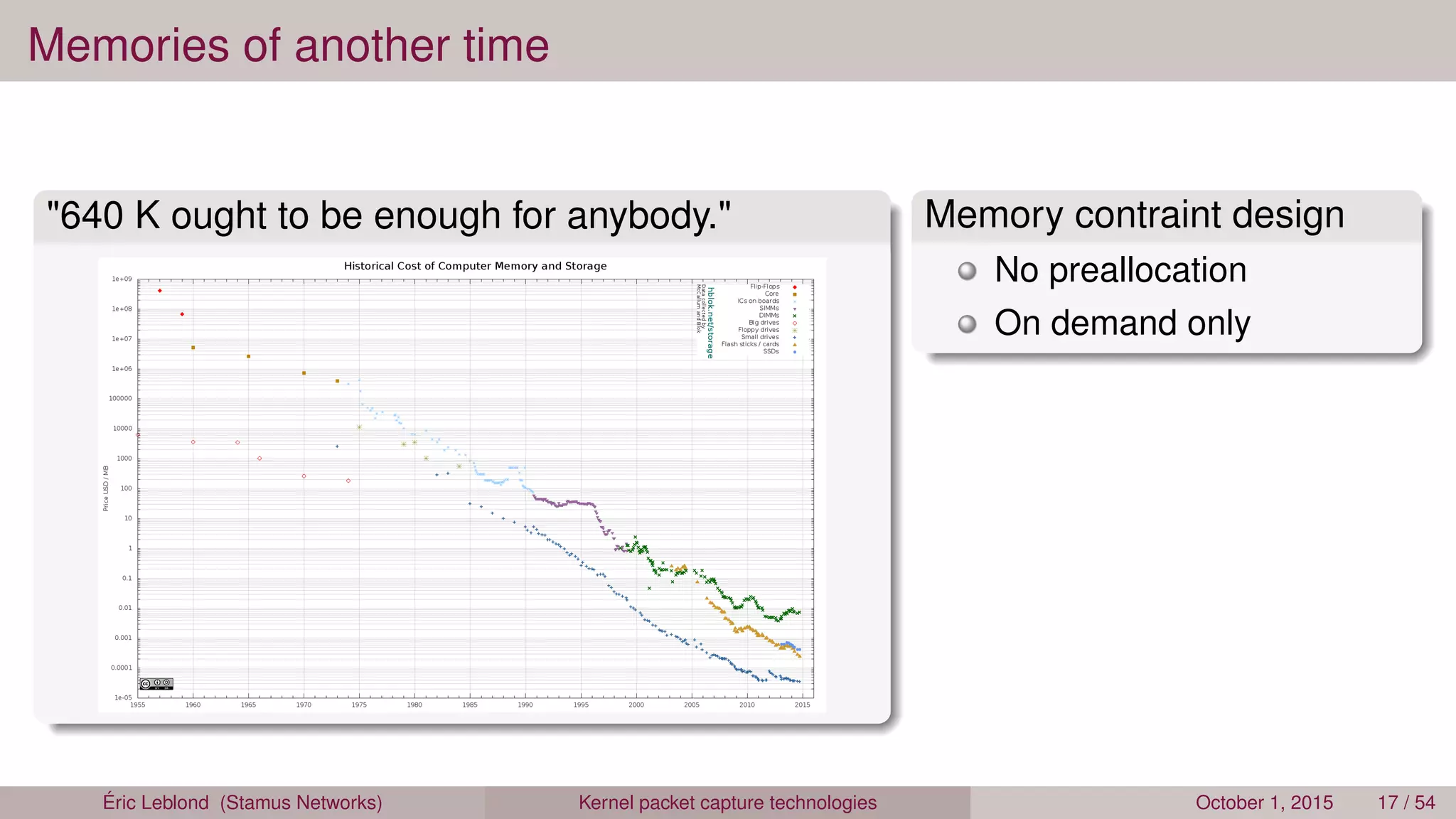
Memories of another time
"640 K ought to be enough for anybody." Memory contraint design
No preallocation
On demand only
Éric Leblond (Stamus Networks) Kernel packet capture technologies October 1, 2015 17 / 54
Disclaimer
Éric Leblond (Stamus Networks) Kernel packet capture technologies October 1, 2015 18 / 54
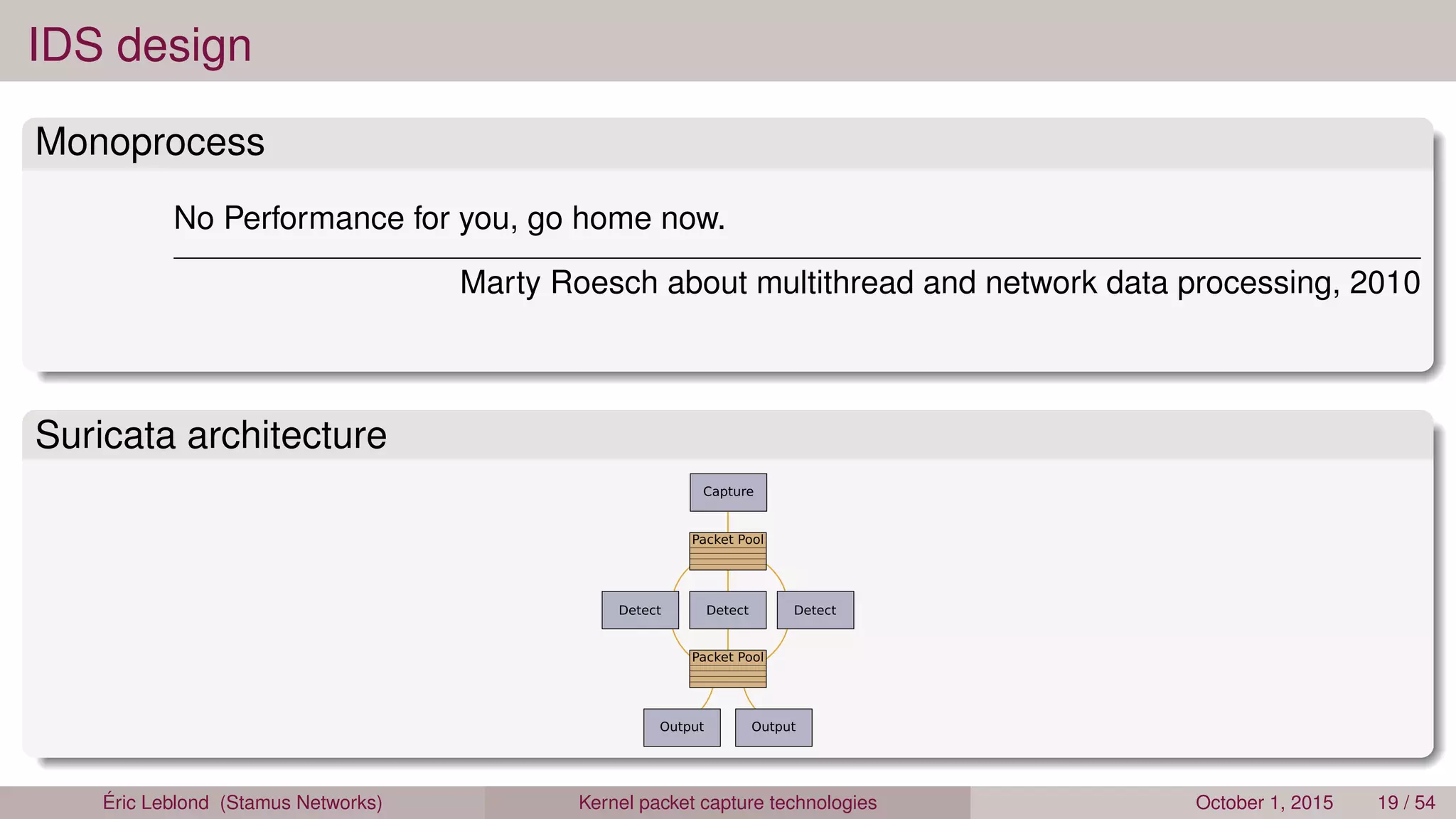
IDS design
Monoprocess
No Performance for you, go home now.
Marty Roesch about multithread and network data processing, 2010
Suricata architecture
Éric Leblond (Stamus Networks) Kernel packet capture technologies October 1, 2015 19 / 54
NAPI (2001-200?)
Reducing interrupts usage
Interrupts tempest at high packet rate
All CPU time is sued to handle the interrupts
NIC driver needs to be updated
No direct change for packet capture
Change internal to device driver
Direct performance impact on packet capture
Éric Leblond (Stamus Networks) Kernel packet capture technologies October 1, 2015 21 / 54
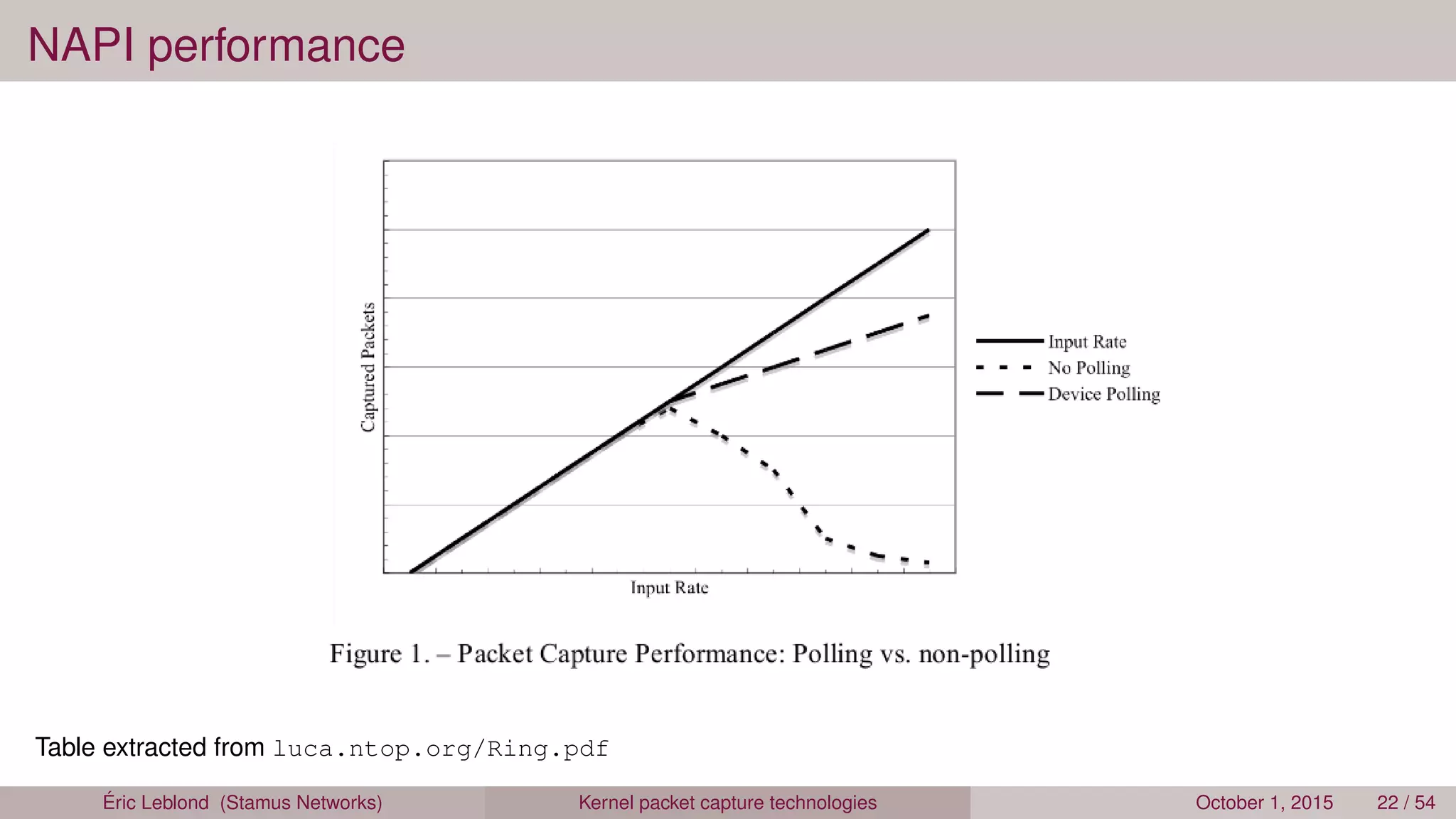
NAPI performance
Table extracted from luca.ntop.org/Ring.pdf
Éric Leblond (Stamus Networks) Kernel packet capture technologies October 1, 2015 22 / 54
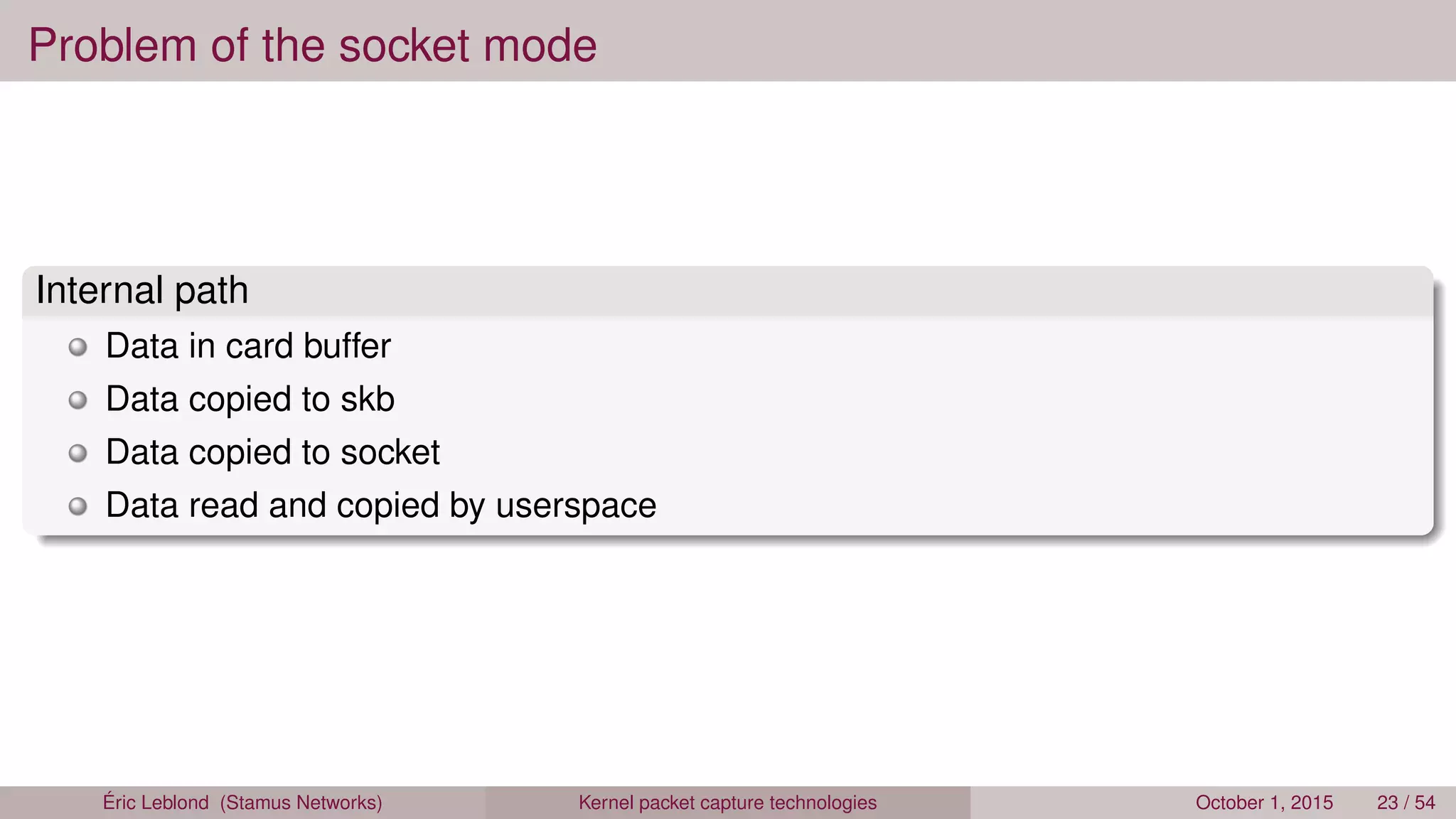
Problem of the socket mode
Internal path
Data in card buffer
Data copied to skb
Data copied to socket
Data read and copied by userspace
Éric Leblond (Stamus Networks) Kernel packet capture technologies October 1, 2015 23 / 54
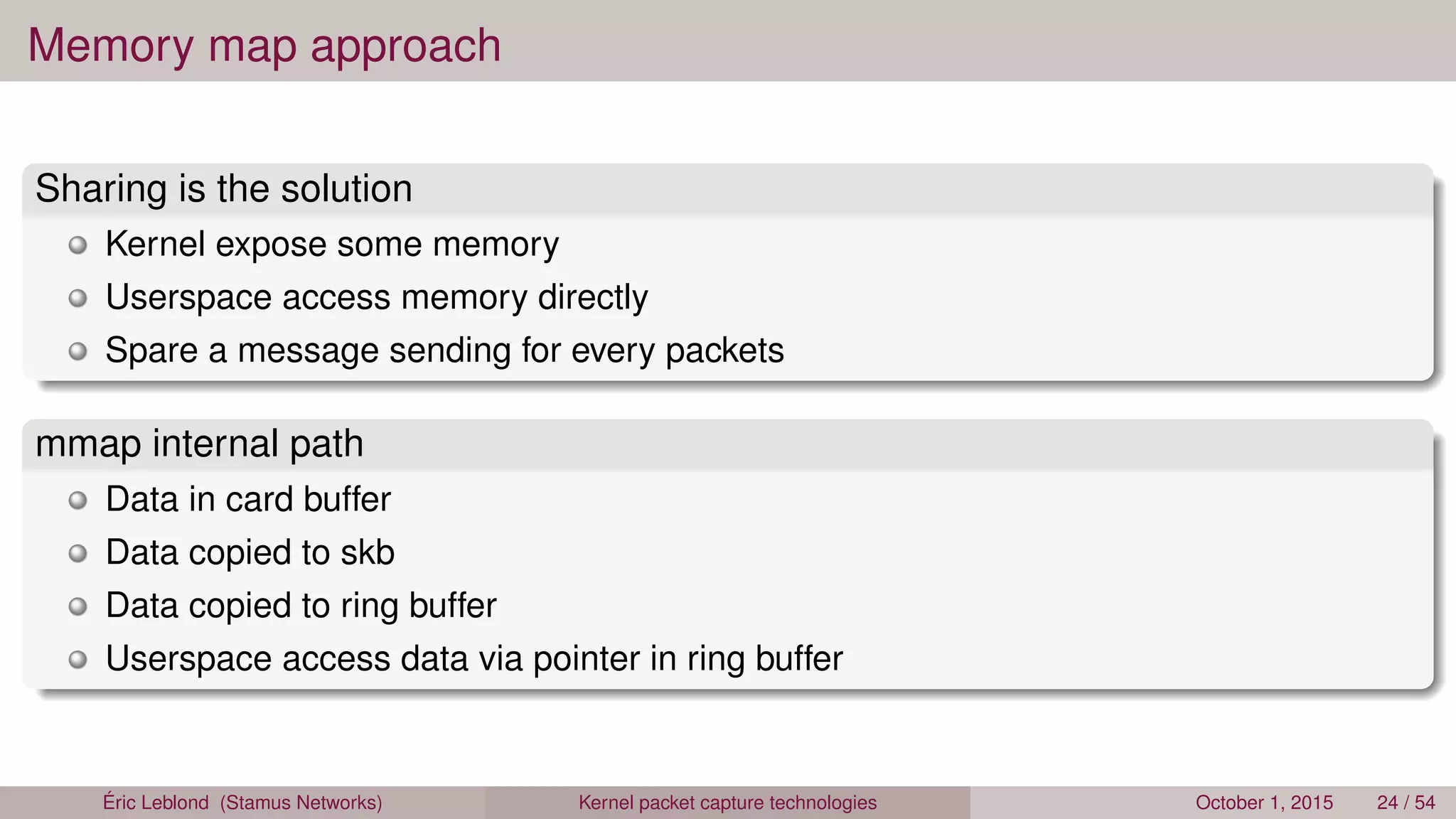
Memory map approach
Sharing is the solution
Kernel expose some memory
Userspace access memory directly
Spare a message sending for every packets
mmap internal path
Data in card buffer
Data copied to skb
Data copied to ring buffer
Userspace access data via pointer in ring buffer
Éric Leblond (Stamus Networks) Kernel packet capture technologies October 1, 2015 24 / 54
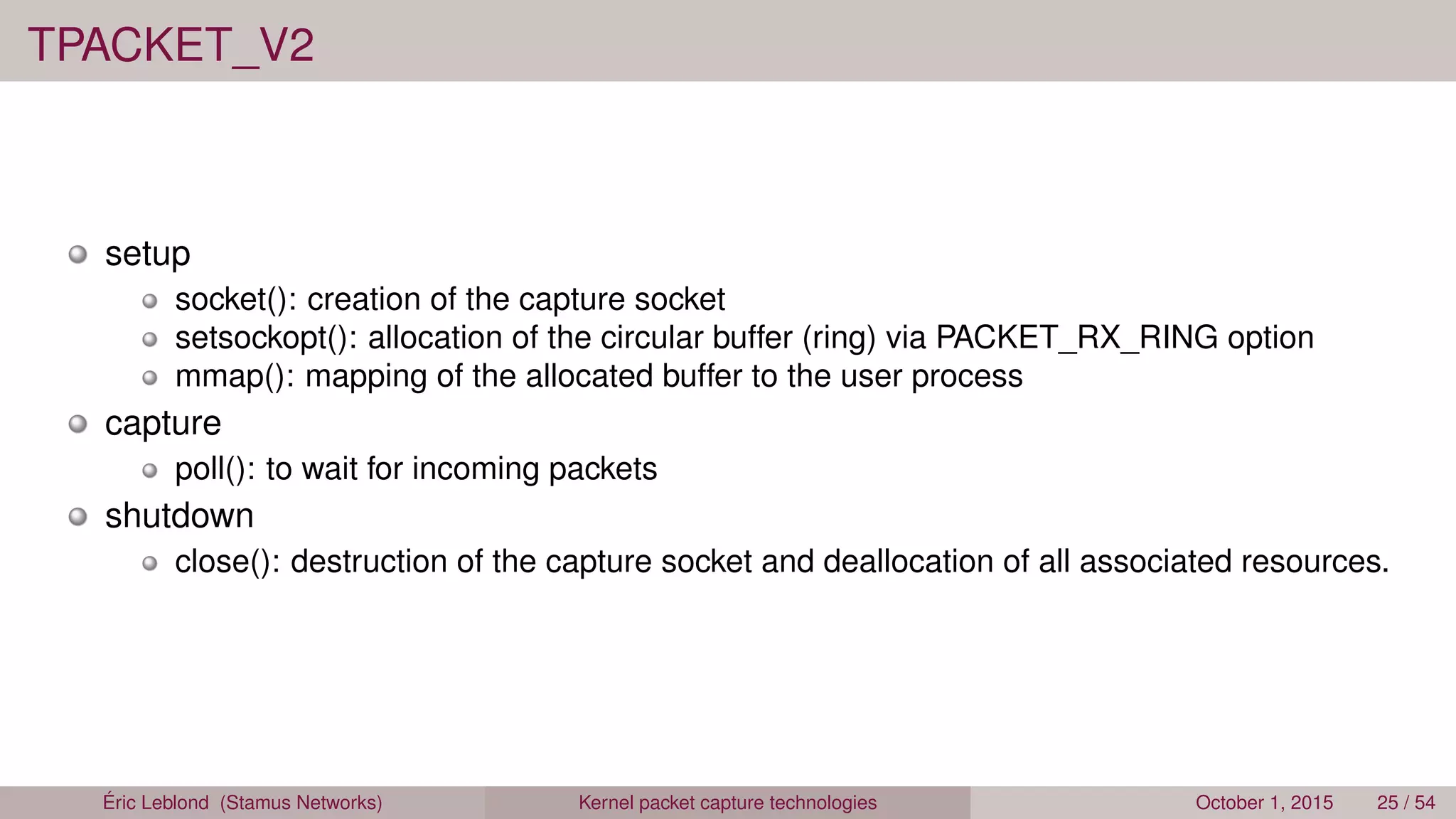
TPACKET_V2
setup
socket(): creation of the capture socket
setsockopt(): allocation of the circular buffer (ring) via PACKET_RX_RING option
mmap(): mapping of the allocated buffer to the user process
capture
poll(): to wait for incoming packets
shutdown
close(): destruction of the capture socket and deallocation of all associated resources.
Éric Leblond (Stamus Networks) Kernel packet capture technologies October 1, 2015 25 / 54
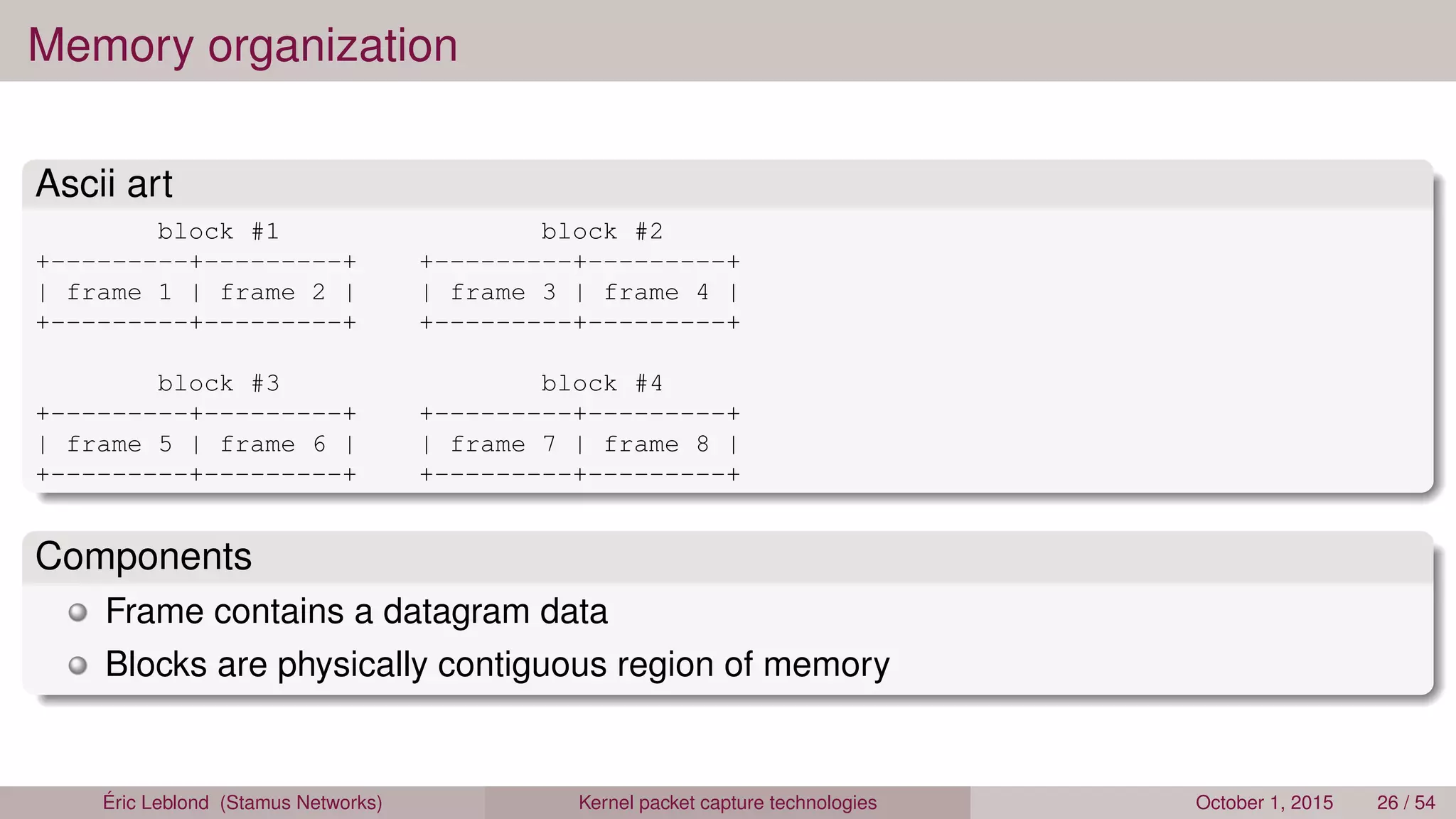
Memory organization
Ascii art
block #1 block #2
+---------+---------+ +---------+---------+
| frame 1 | frame 2 | | frame 3 | frame 4 |
+---------+---------+ +---------+---------+
block #3 block #4
+---------+---------+ +---------+---------+
| frame 5 | frame 6 | | frame 7 | frame 8 |
+---------+---------+ +---------+---------+
Components
Frame contains a datagram data
Blocks are physically contiguous region of memory
Éric Leblond (Stamus Networks) Kernel packet capture technologies October 1, 2015 26 / 54
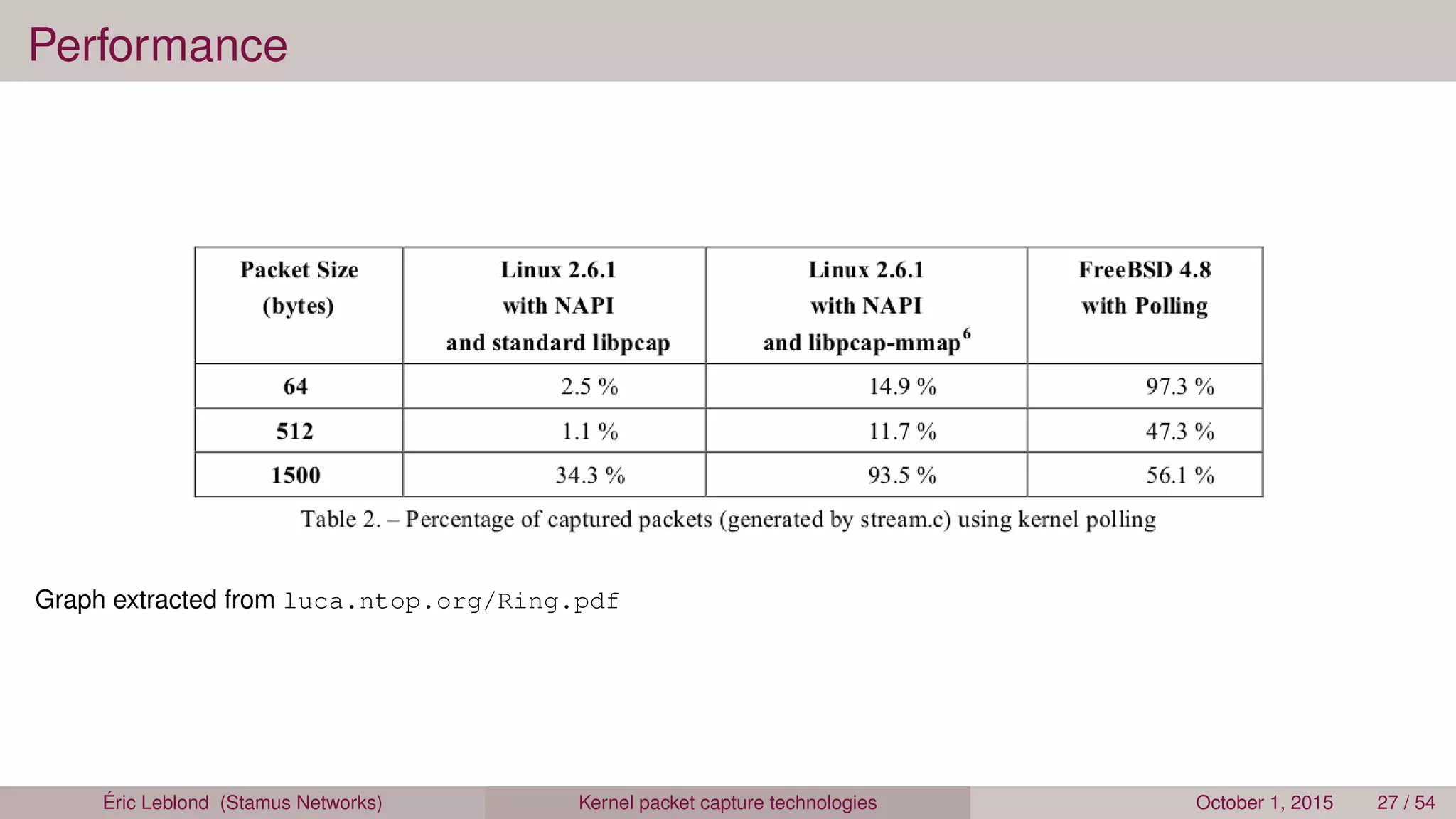
Performance
Graph extracted from luca.ntop.org/Ring.pdf
Éric Leblond (Stamus Networks) Kernel packet capture technologies October 1, 2015 27 / 54
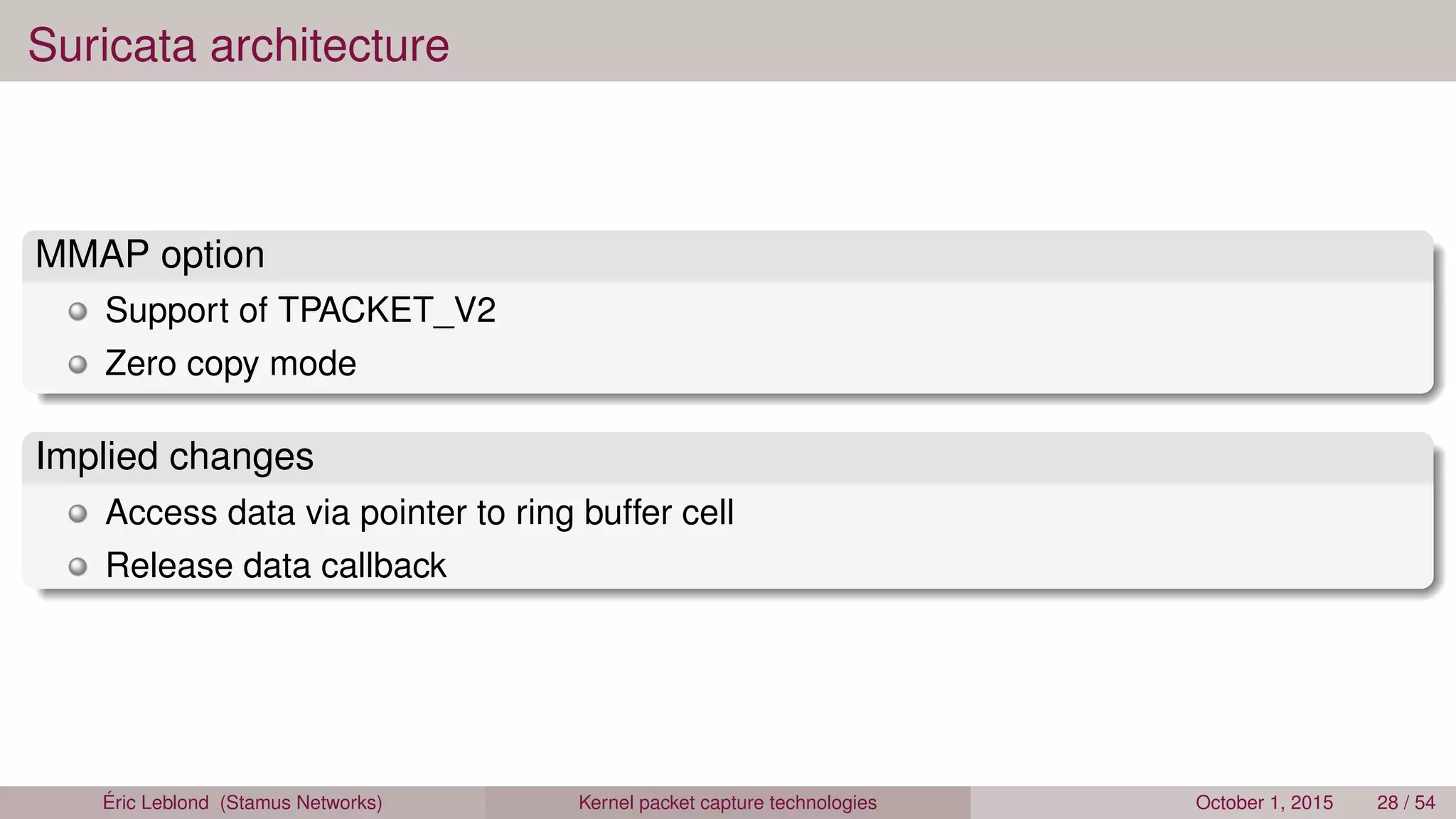
Suricata architecture
MMAP option
Support of TPACKET_V2
Zero copy mode
Implied changes
Access data via pointer to ring buffer cell
Release data callback
Éric Leblond (Stamus Networks) Kernel packet capture technologies October 1, 2015 28 / 54
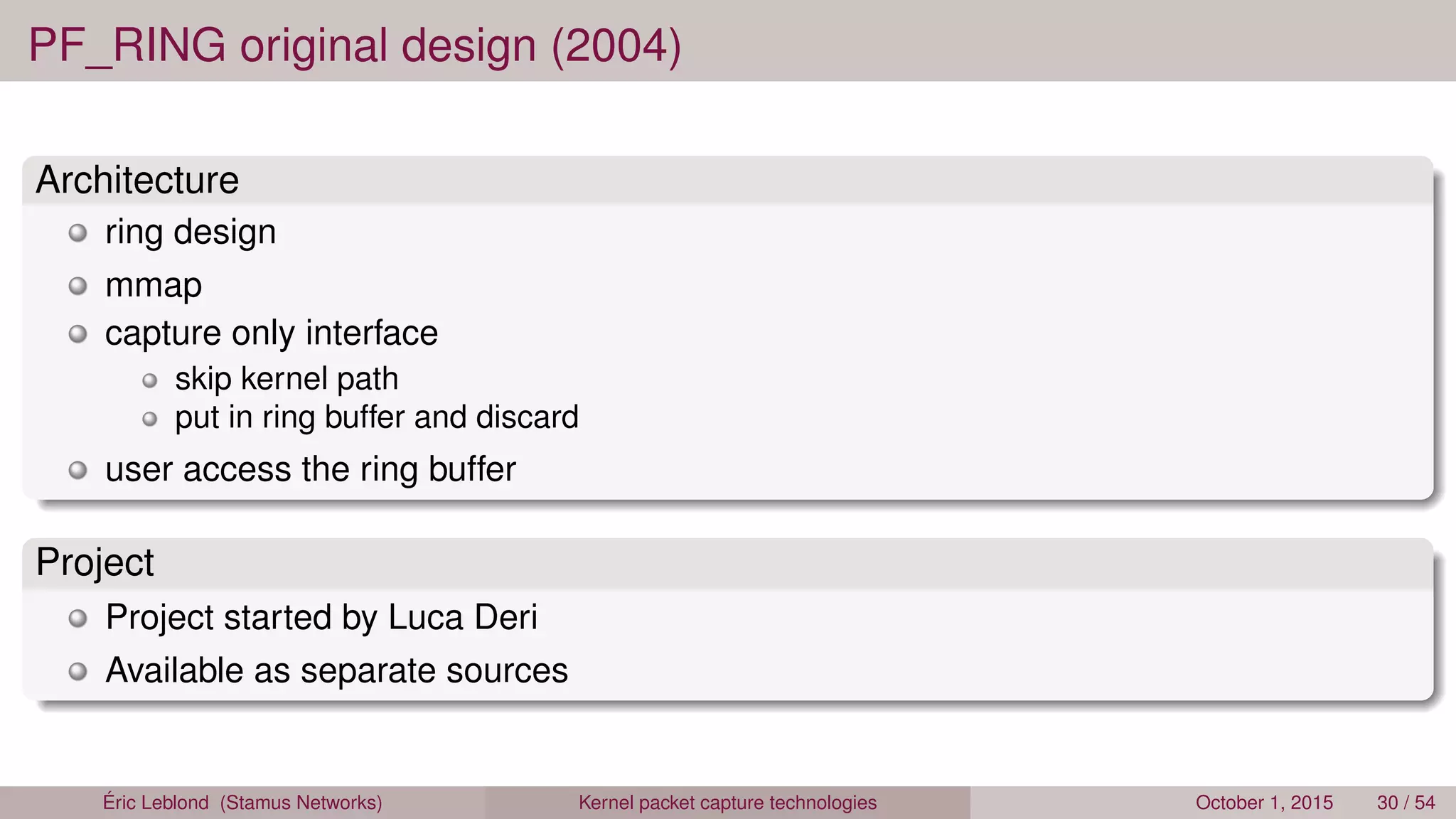
PF_RING original design (2004)
Architecture
ring design
mmap
capture only interface
skip kernel path
put in ring buffer and discard
user access the ring buffer
Project
Project started by Luca Deri
Available as separate sources
Éric Leblond (Stamus Networks) Kernel packet capture technologies October 1, 2015 30 / 54
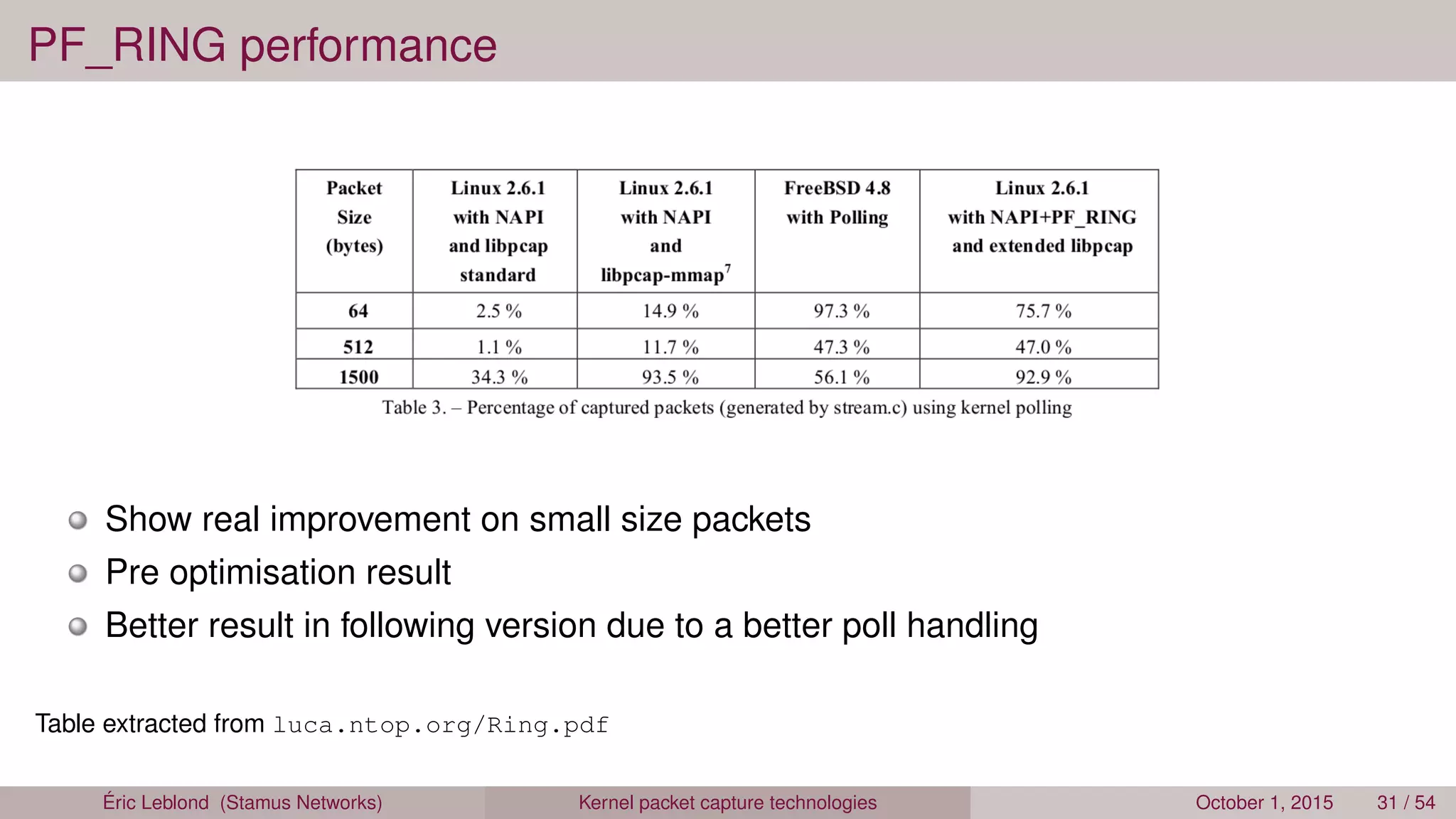
PF_RING performance
Show real improvement on small size packets
Pre optimisation result
Better result in following version due to a better poll handling
Table extracted from luca.ntop.org/Ring.pdf
Éric Leblond (Stamus Networks) Kernel packet capture technologies October 1, 2015 31 / 54
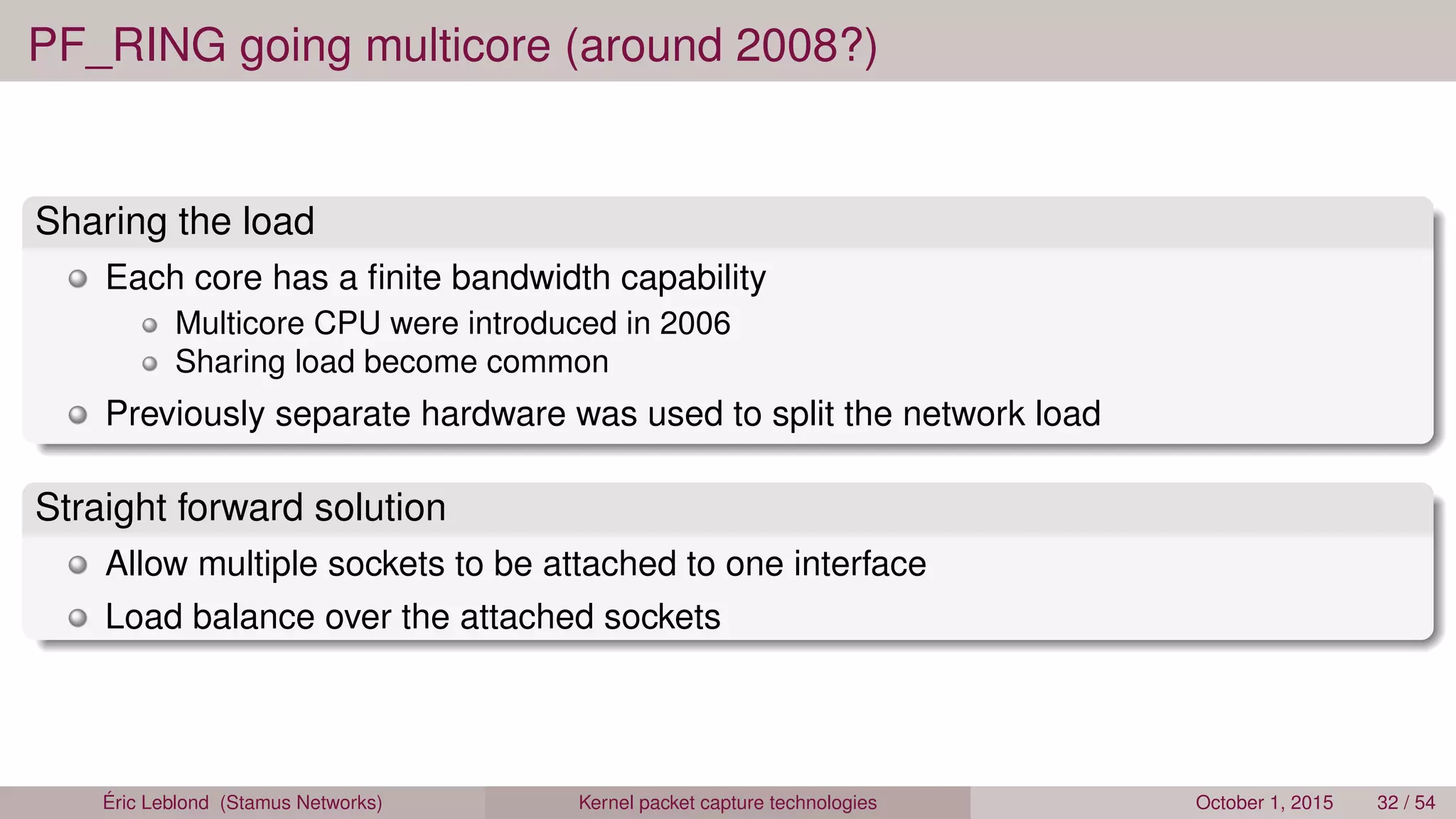
PF_RING going multicore (around 2008?)
Sharing the load
Each core has a finite bandwidth capability
Multicore CPU were introduced in 2006
Sharing load become common
Previously separate hardware was used to split the network load
Straight forward solution
Allow multiple sockets to be attached to one interface
Load balance over the attached sockets
Éric Leblond (Stamus Networks) Kernel packet capture technologies October 1, 2015 32 / 54
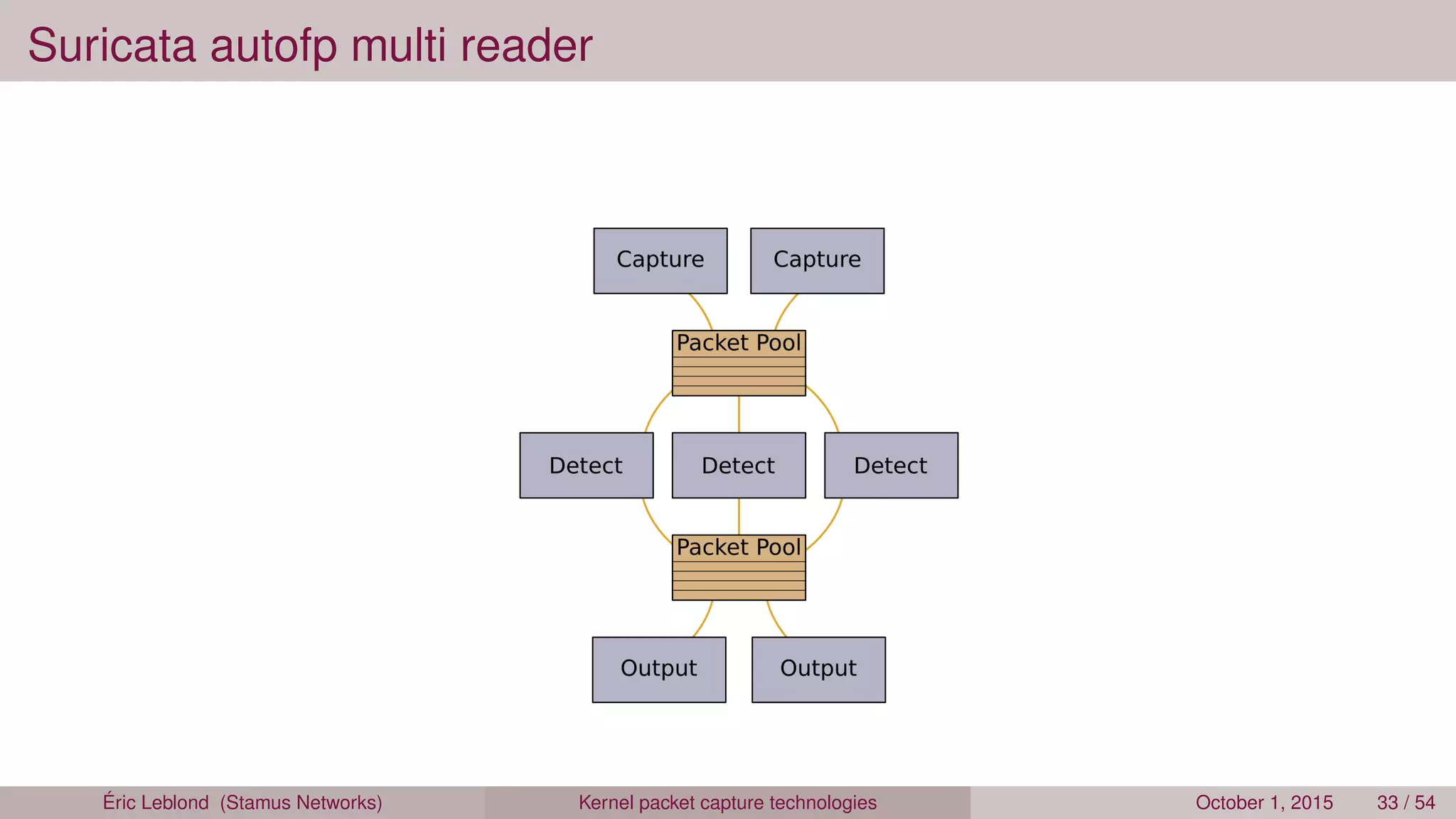
Suricata autofp multi reader
Éric Leblond (Stamus Networks) Kernel packet capture technologies October 1, 2015 33 / 54
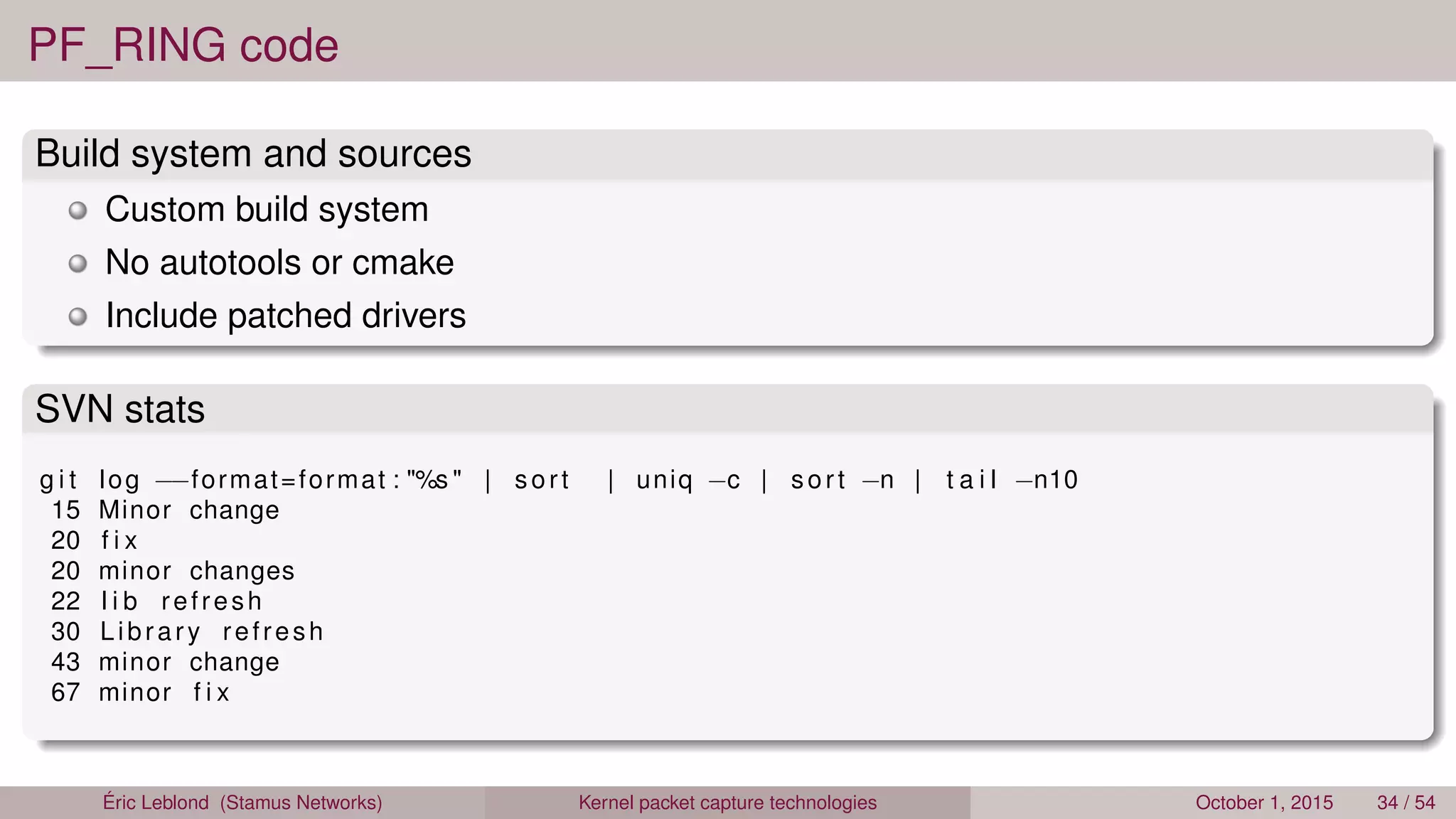
PF_RING code
Build system and sources
Custom build system
No autotools or cmake
Include patched drivers
SVN stats
g i t log −−format=format : "%s " | sort | uniq −c | sort −n | t a i l −n10
15 Minor change
20 f i x
20 minor changes
22 l i b refresh
30 Library refresh
43 minor change
67 minor f i x
Éric Leblond (Stamus Networks) Kernel packet capture technologies October 1, 2015 34 / 54
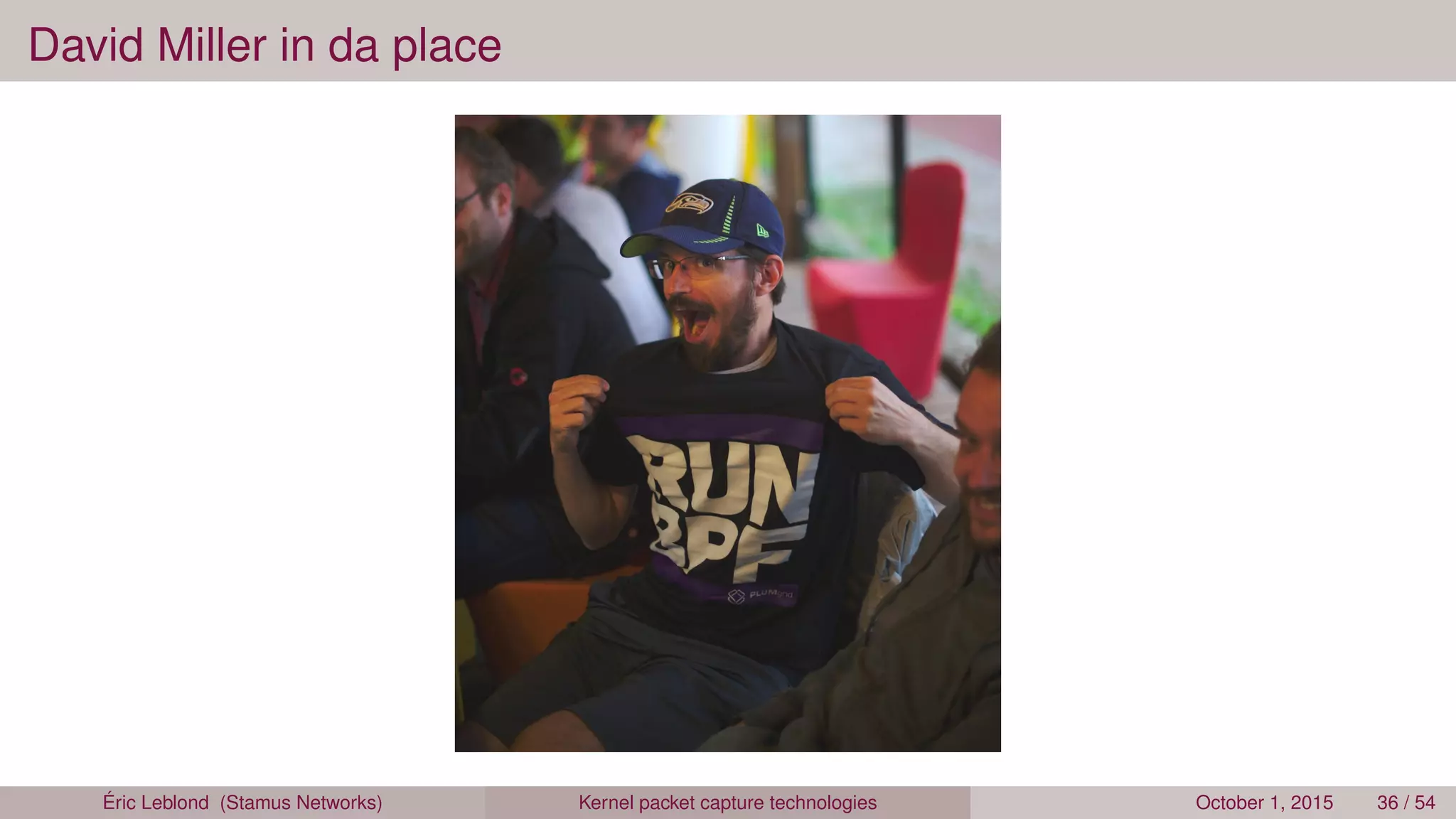
David Miller in da place
Éric Leblond (Stamus Networks) Kernel packet capture technologies October 1, 2015 36 / 54
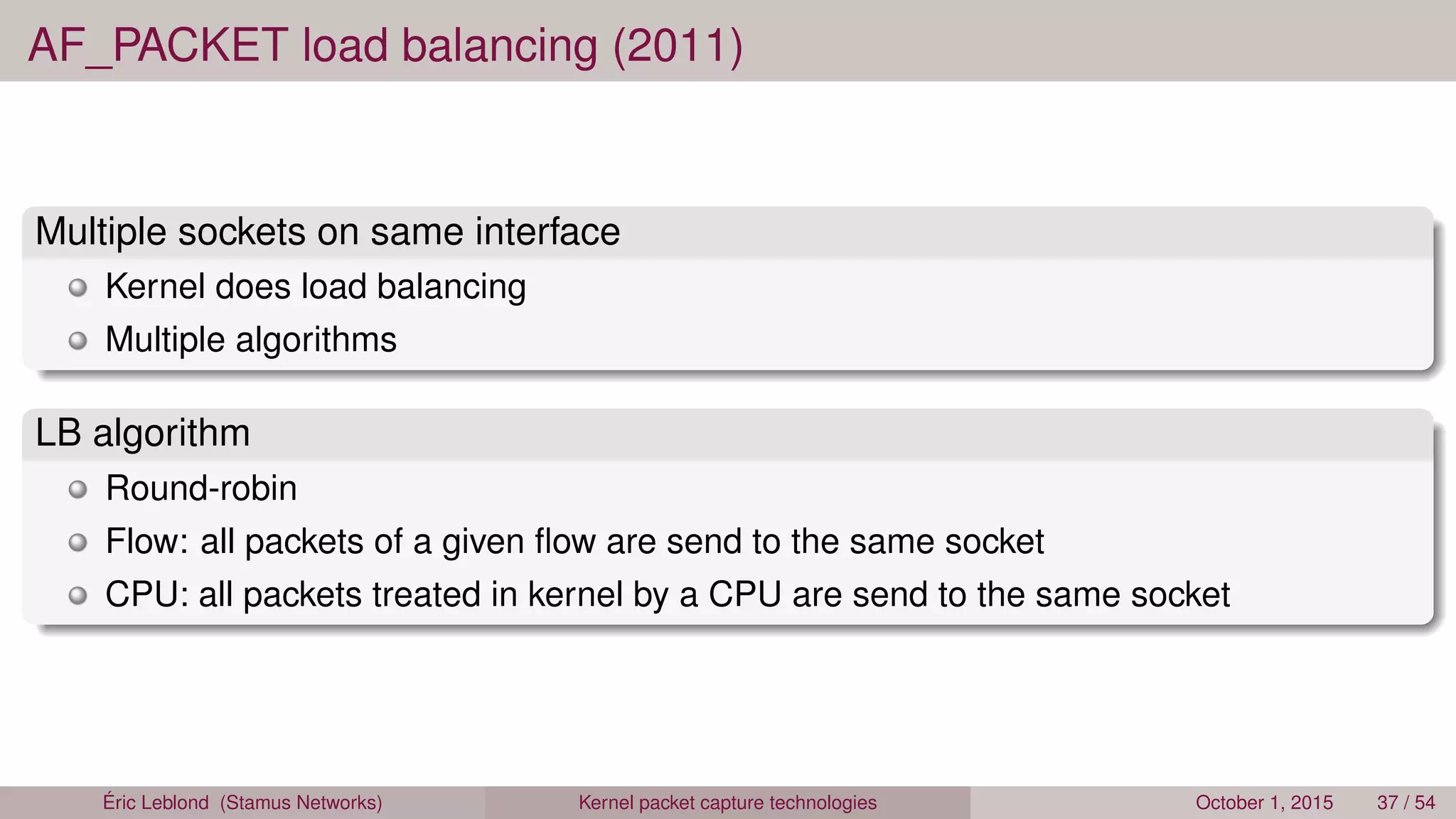
AF_PACKET load balancing (2011)
Multiple sockets on same interface
Kernel does load balancing
Multiple algorithms
LB algorithm
Round-robin
Flow: all packets of a given flow are send to the same socket
CPU: all packets treated in kernel by a CPU are send to the same socket
Éric Leblond (Stamus Networks) Kernel packet capture technologies October 1, 2015 37 / 54
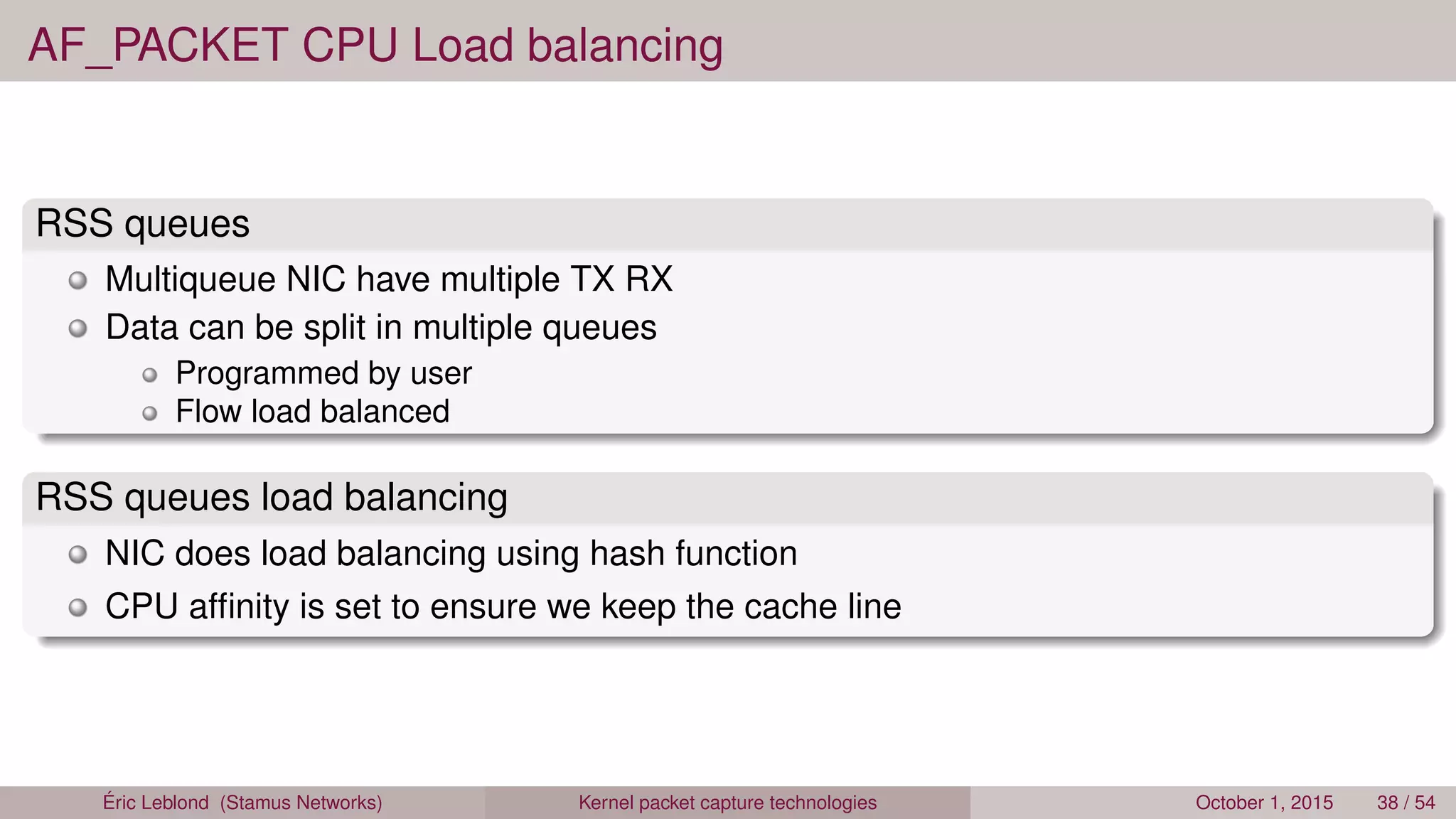
AF_PACKET CPU Load balancing
RSS queues
Multiqueue NIC have multiple TX RX
Data can be split in multiple queues
Programmed by user
Flow load balanced
RSS queues load balancing
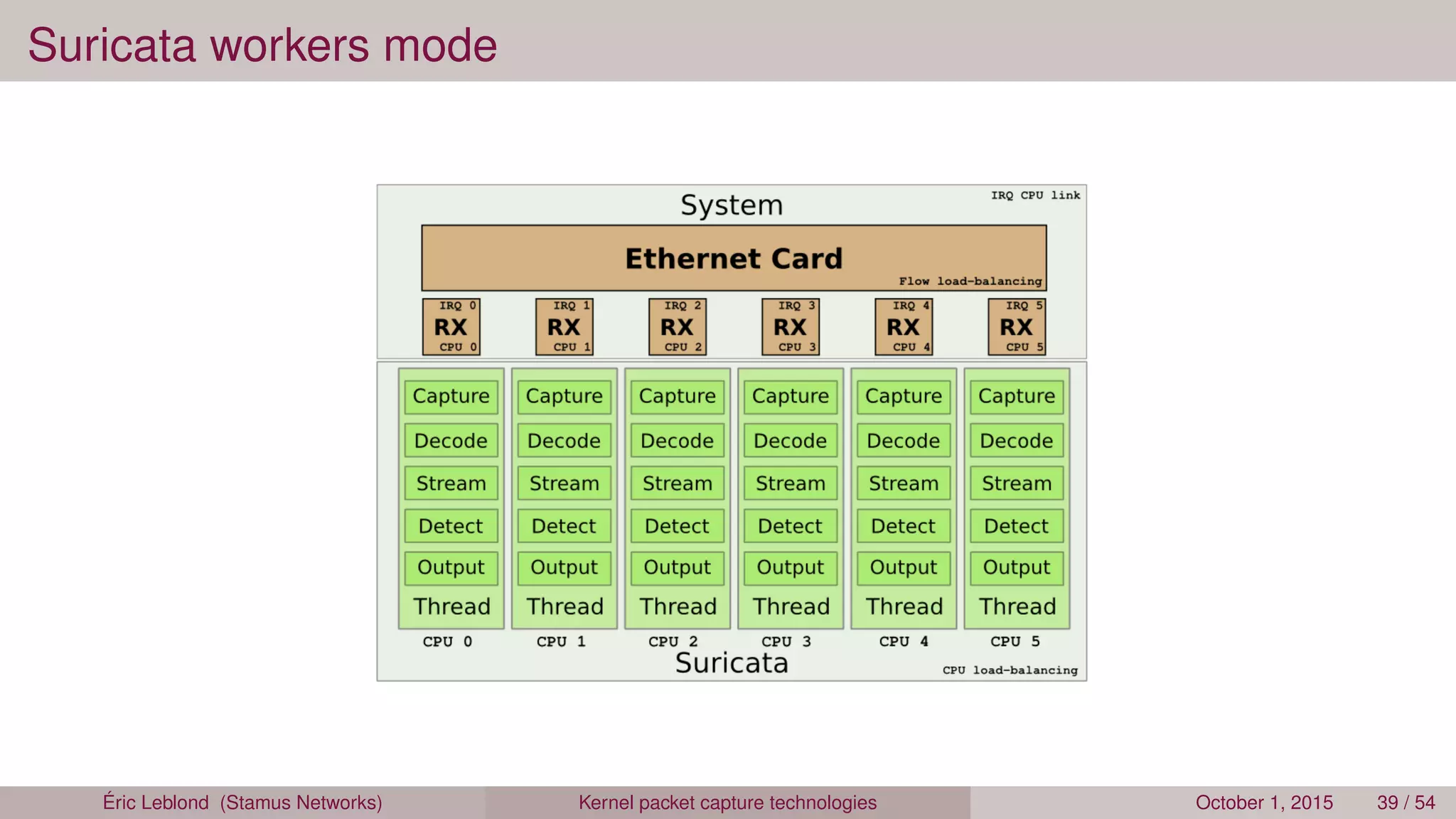
NIC does load balancing using hash function
CPU affinity is set to ensure we keep the cache line
Éric Leblond (Stamus Networks) Kernel packet capture technologies October 1, 2015 38 / 54
Suricata workers mode
Éric Leblond (Stamus Networks) Kernel packet capture technologies October 1, 2015 39 / 54
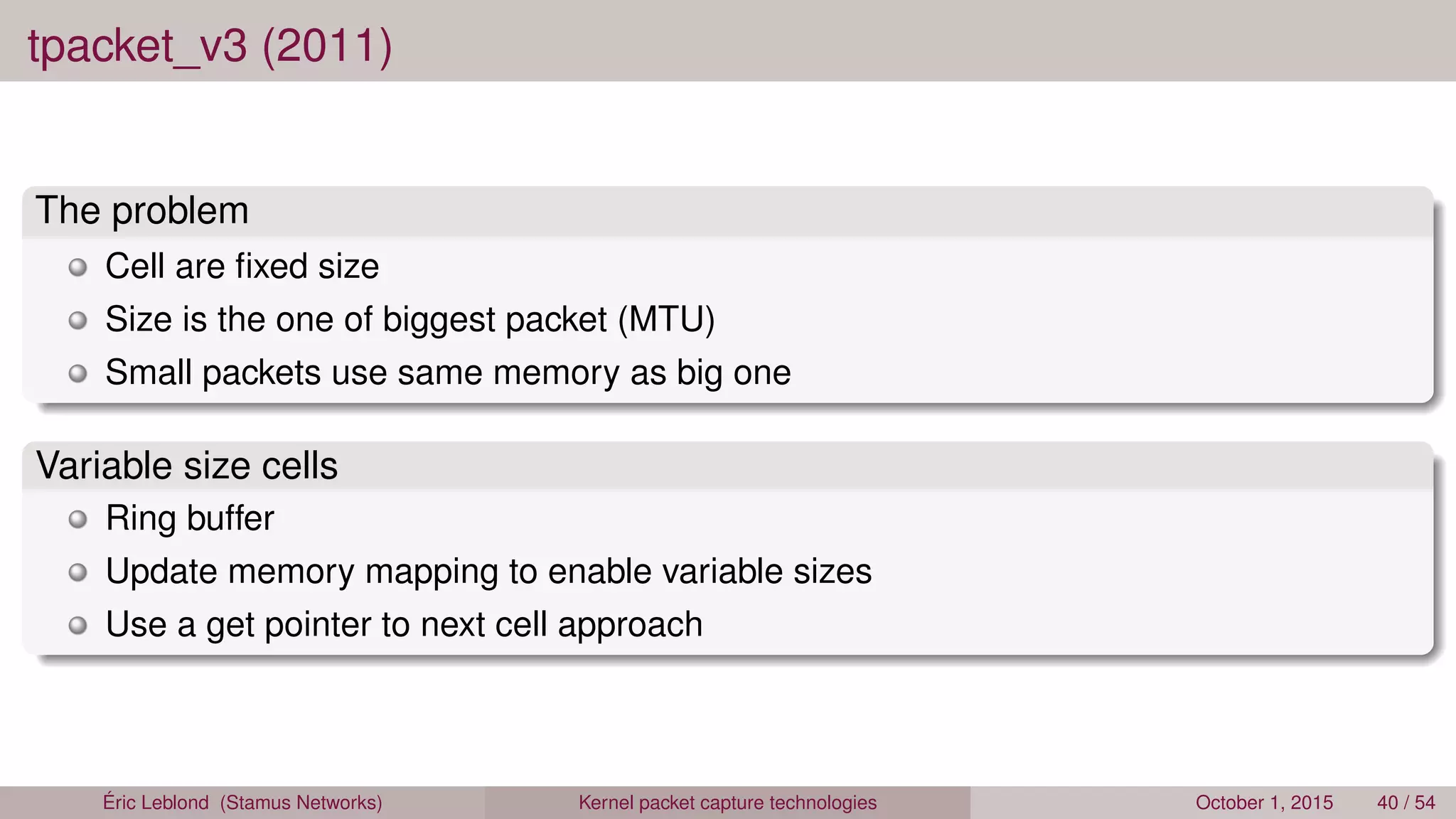
tpacket_v3 (2011)
The problem
Cell are fixed size
Size is the one of biggest packet (MTU)
Small packets use same memory as big one
Variable size cells
Ring buffer
Update memory mapping to enable variable sizes
Use a get pointer to next cell approach
Éric Leblond (Stamus Networks) Kernel packet capture technologies October 1, 2015 40 / 54
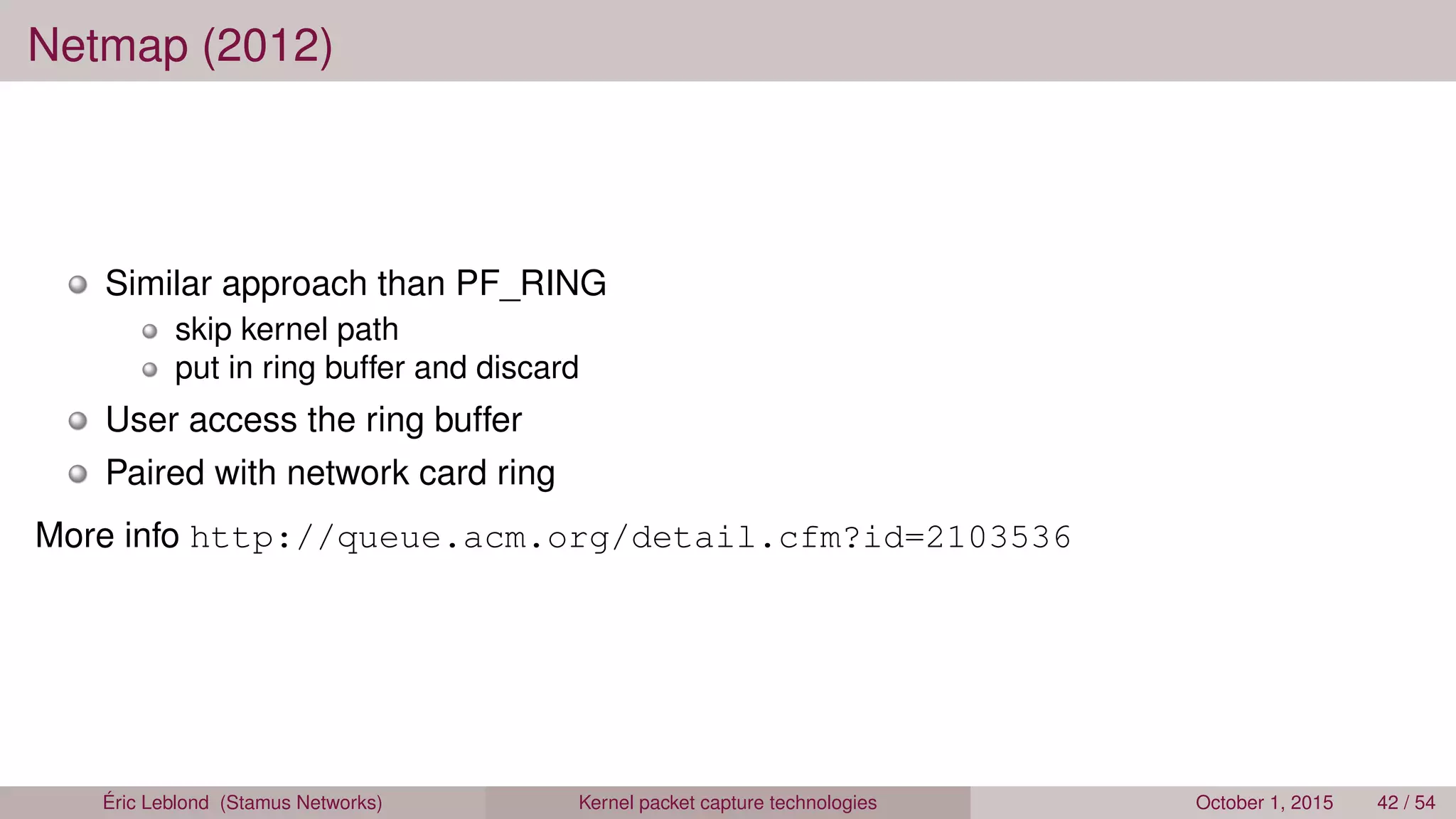
Netmap (2012)
Similar approach than PF_RING
skip kernel path
put in ring buffer and discard
User access the ring buffer
Paired with network card ring
More info http://queue.acm.org/detail.cfm?id=2103536
Éric Leblond (Stamus Networks) Kernel packet capture technologies October 1, 2015 42 / 54
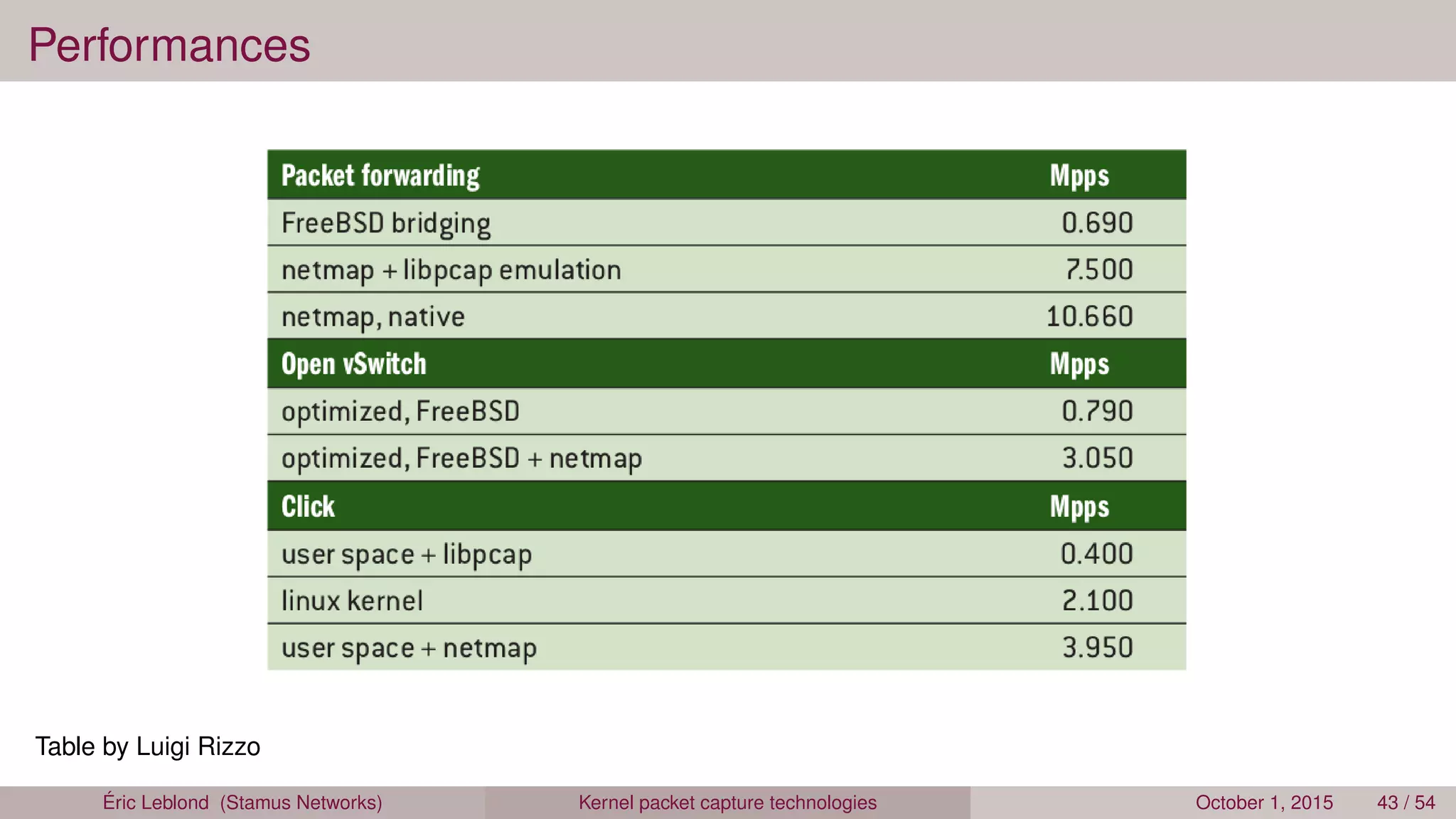
Performances
Table by Luigi Rizzo
Éric Leblond (Stamus Networks) Kernel packet capture technologies October 1, 2015 43 / 54
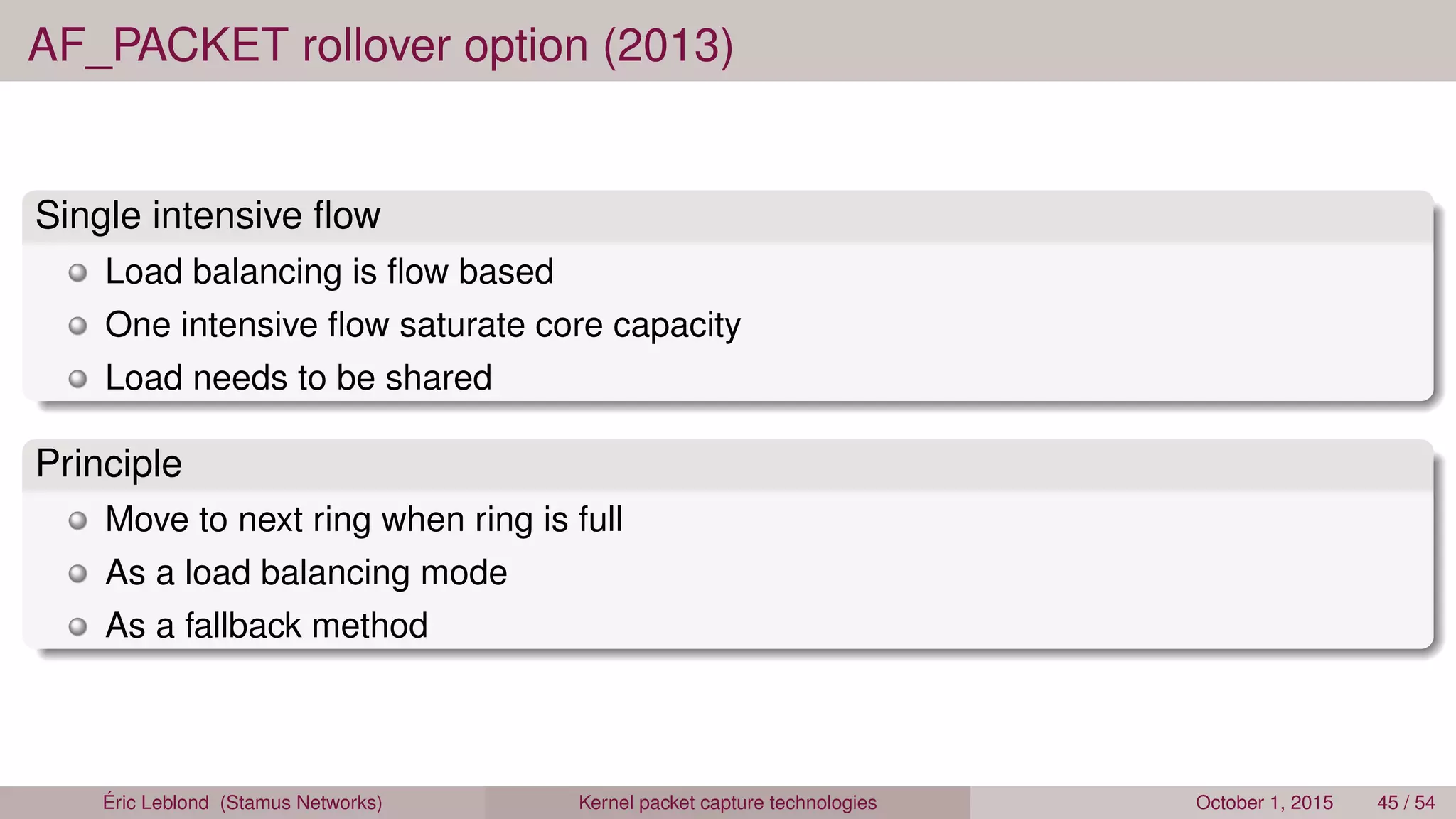
AF_PACKET rollover option (2013)
Single intensive flow
Load balancing is flow based
One intensive flow saturate core capacity
Load needs to be shared
Principle
Move to next ring when ring is full
As a load balancing mode
As a fallback method
Éric Leblond (Stamus Networks) Kernel packet capture technologies October 1, 2015 45 / 54
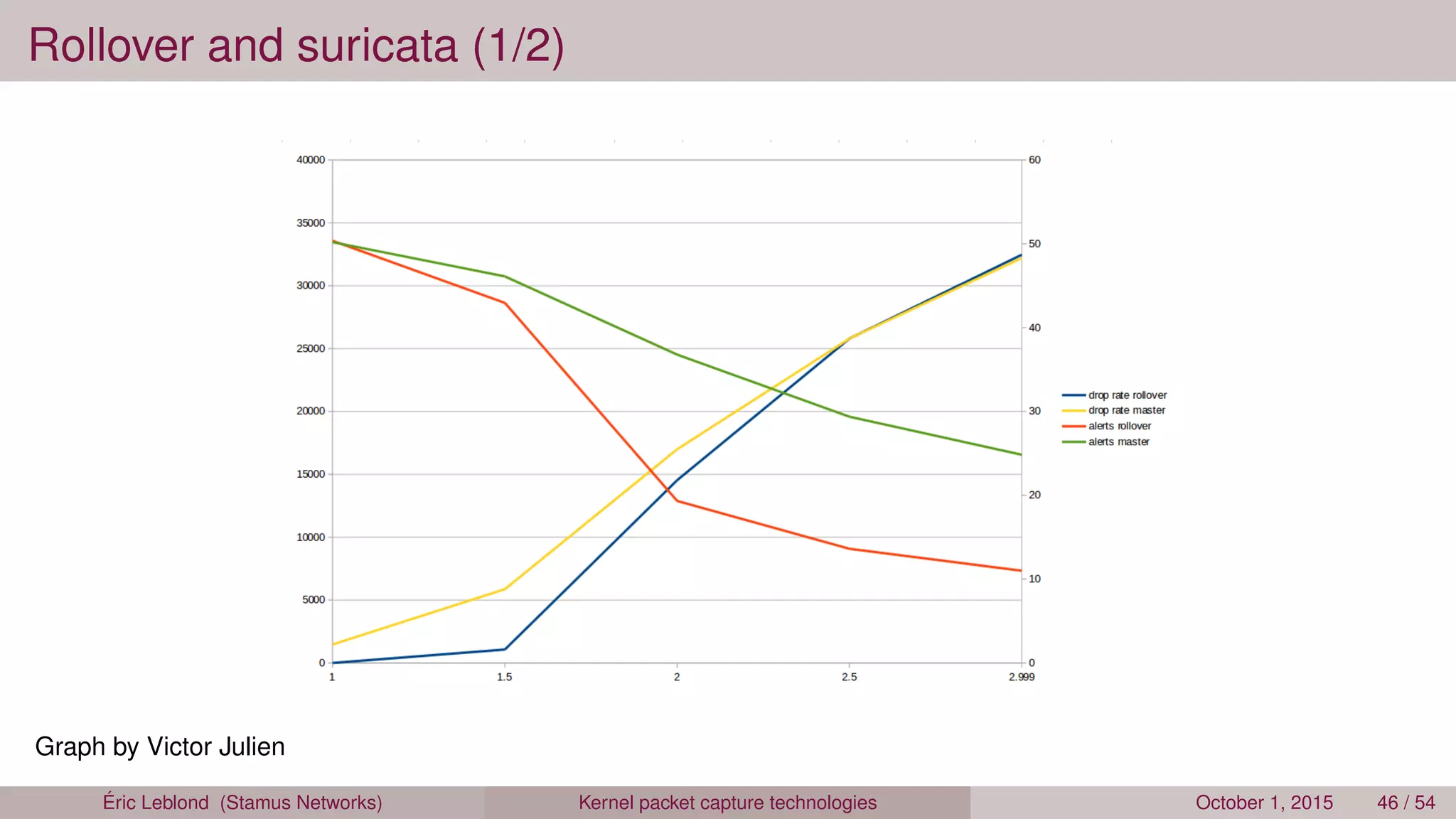
Rollover and suricata (1/2)
Graph by Victor Julien
Éric Leblond (Stamus Networks) Kernel packet capture technologies October 1, 2015 46 / 54
Rollover and suricata (2/2)
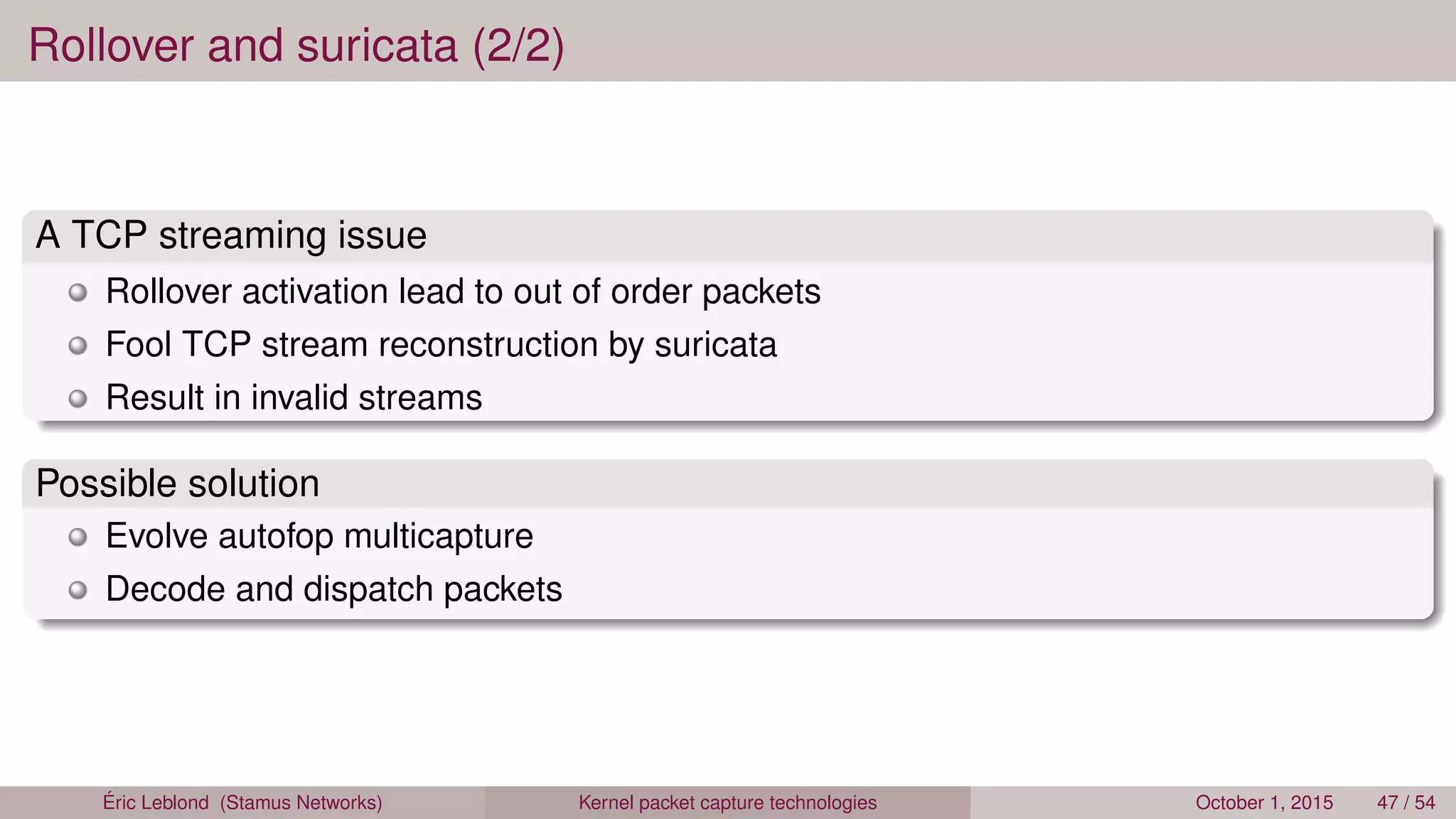
A TCP streaming issue
Rollover activation lead to out of order packets
Fool TCP stream reconstruction by suricata
Result in invalid streams
Possible solution
Evolve autofop multicapture
Decode and dispatch packets
Éric Leblond (Stamus Networks) Kernel packet capture technologies October 1, 2015 47 / 54
DPDK (2012-)
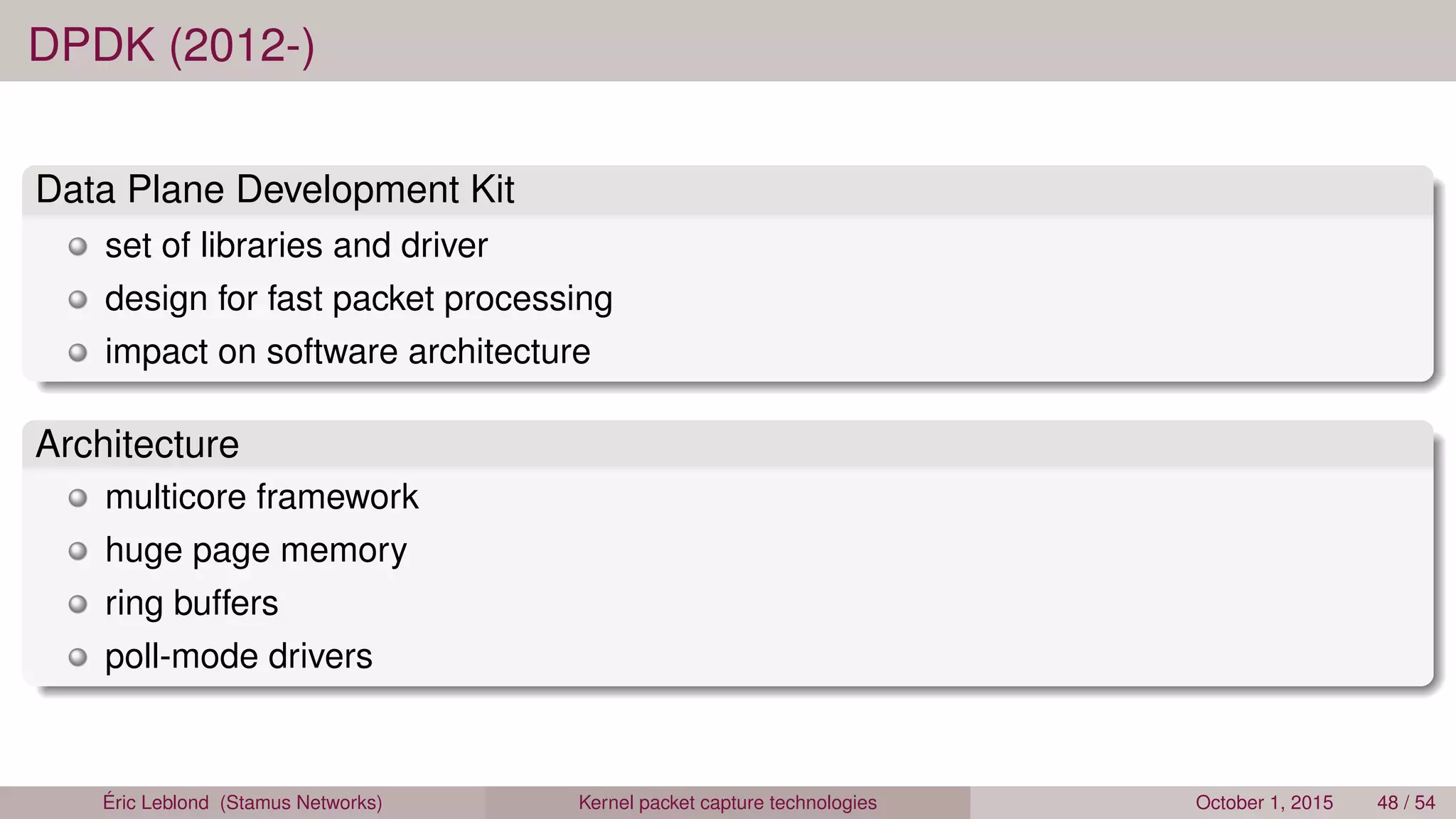
Data Plane Development Kit
set of libraries and driver
design for fast packet processing
impact on software architecture
Architecture
multicore framework
huge page memory
ring buffers
poll-mode drivers
Éric Leblond (Stamus Networks) Kernel packet capture technologies October 1, 2015 48 / 54
Suricata workers mode limit
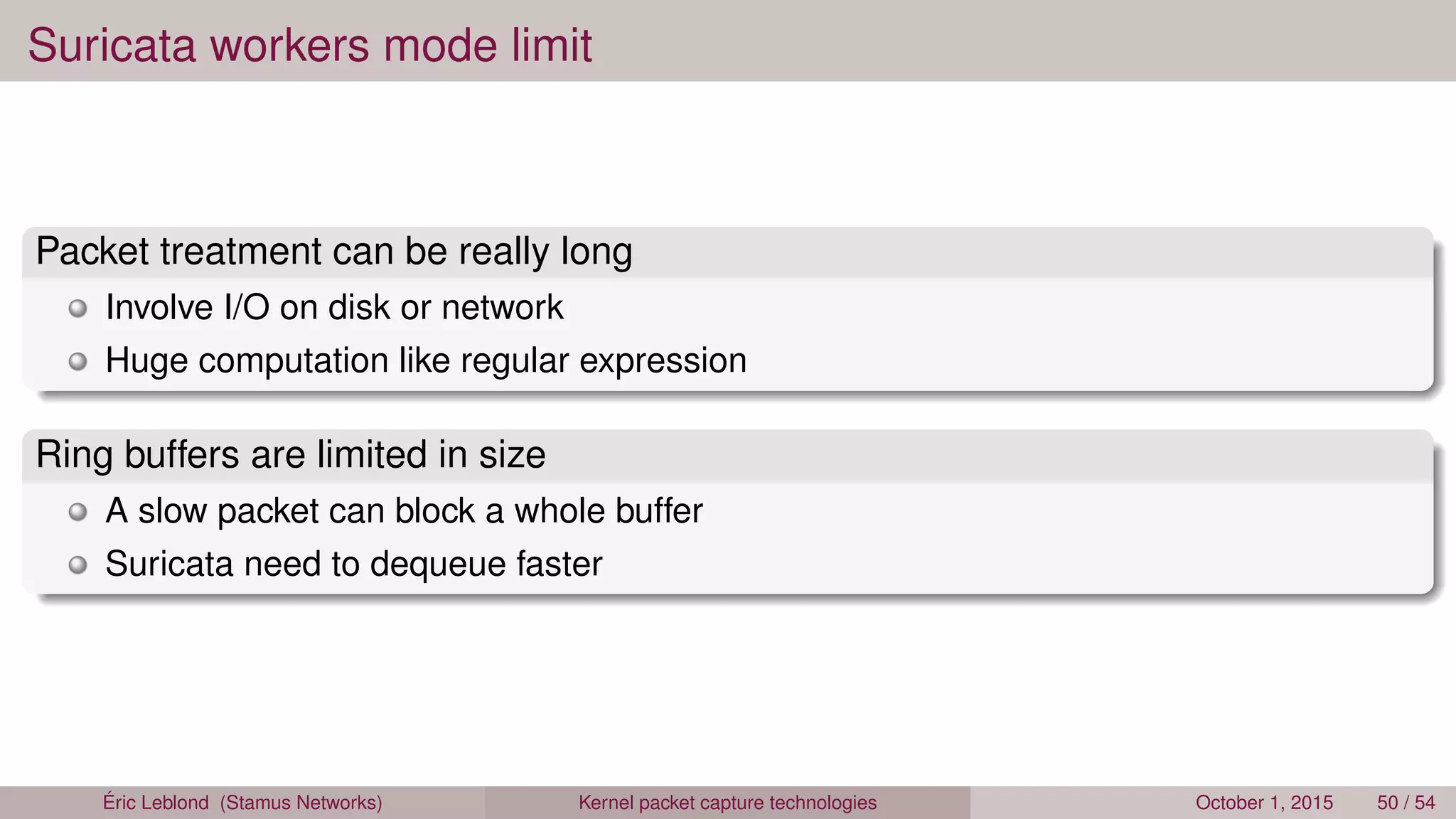
Packet treatment can be really long
Involve I/O on disk or network
Huge computation like regular expression
Ring buffers are limited in size
A slow packet can block a whole buffer
Suricata need to dequeue faster
Éric Leblond (Stamus Networks) Kernel packet capture technologies October 1, 2015 50 / 54
Need to evolve Suricata architecture
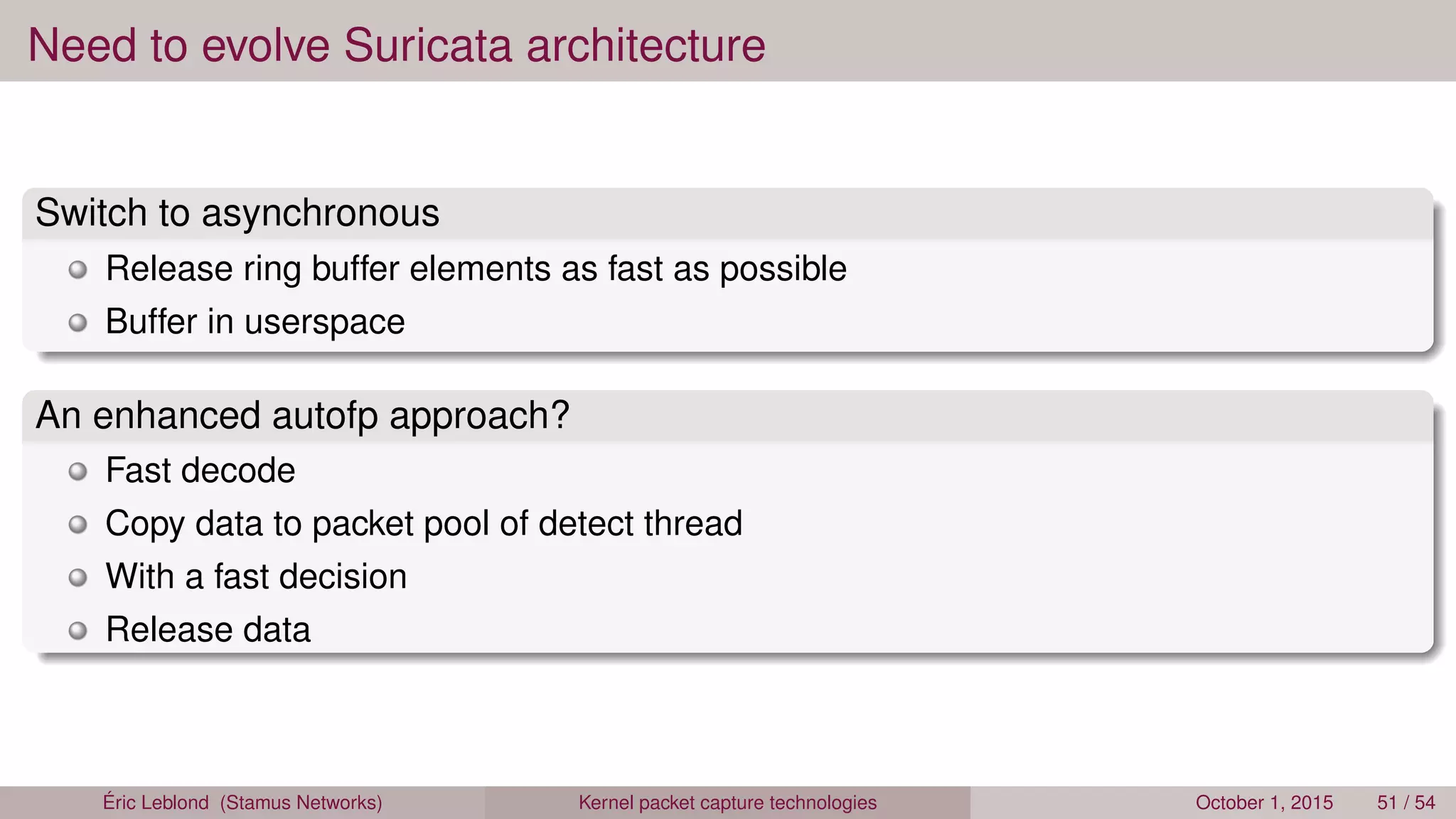
Switch to asynchronous
Release ring buffer elements as fast as possible
Buffer in userspace
An enhanced autofp approach?
Fast decode
Copy data to packet pool of detect thread
With a fast decision
Release data
Éric Leblond (Stamus Networks) Kernel packet capture technologies October 1, 2015 51 / 54
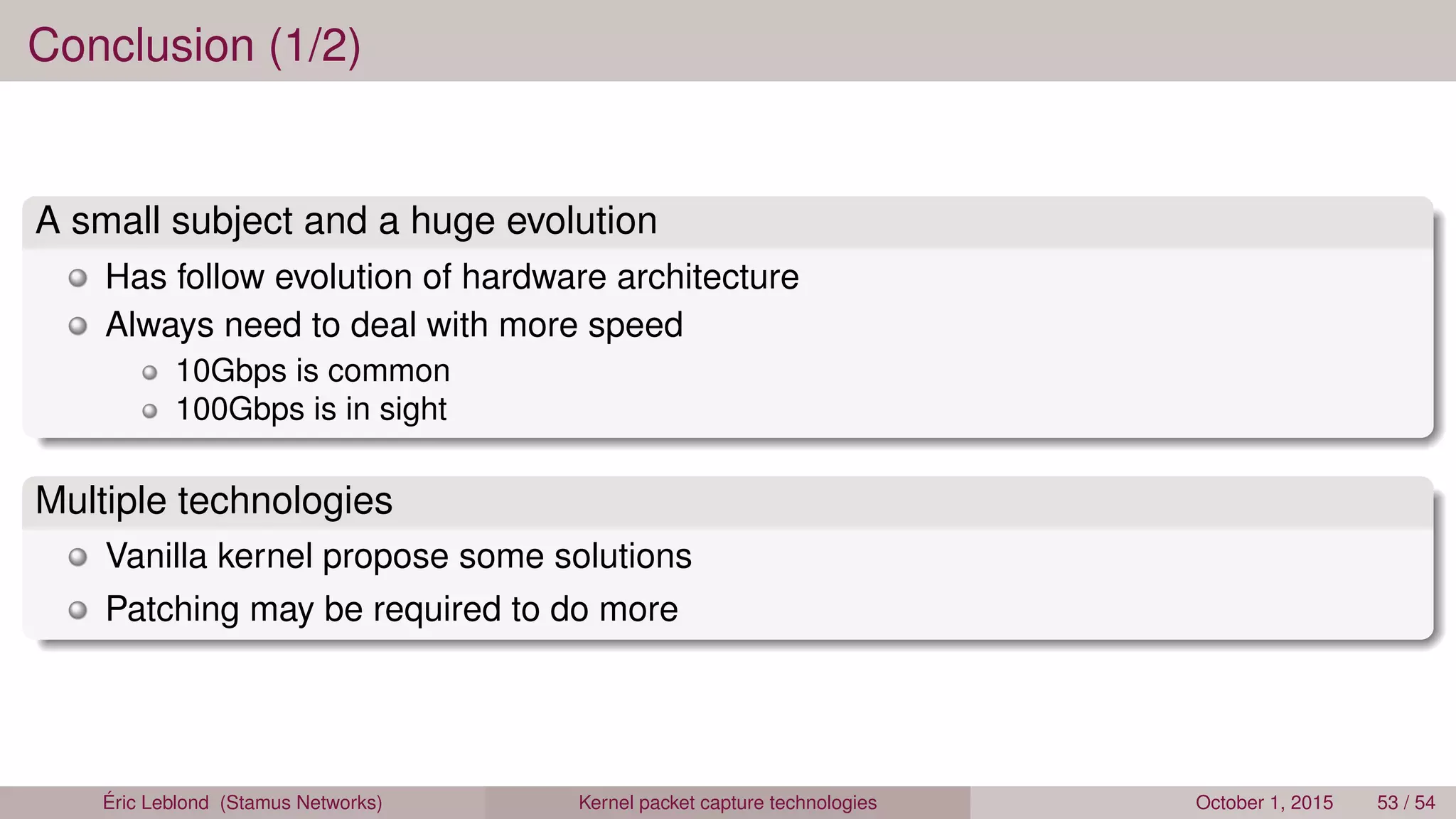
Conclusion (1/2)
A small subject and a huge evolution
Has follow evolution of hardware architecture
Always need to deal with more speed
10Gbps is common
100Gbps is in sight
Multiple technologies
Vanilla kernel propose some solutions
Patching may be required to do more
Éric Leblond (Stamus Networks) Kernel packet capture technologies October 1, 2015 53 / 54
Conclusion (2/2)
Do you have questions ?
Contact me
Mail: eleblond@stamus-networks.com
Twitter: @Regiteric
More information
Suricata: http://www.suricata-ids.org
PF_RING: http://www.ntop.org/products/packet-capture/pf_ring/
netmap: http://info.iet.unipi.it/~luigi/netmap/
dpdk: http://dpdk.org/
Éric Leblond (Stamus Networks) Kernel packet capture technologies October 1, 2015 54 / 54

Kernel Recipes 2015: Kernel packet capture technologies

  • 1.
    Kernel packet capturetechnologies Éric Leblond Stamus Networks October 1, 2015 Éric Leblond (Stamus Networks) Kernel packet capture technologies October 1, 2015 1 / 54
  • 2.
    1 Introduction 2 Whycapture 3 Libcap and raw socket 4 AF_PACKET 5 PF_RING 6 AF_PACKET goes multi* 7 Netmap 8 Latest AF_PACKET evolution 9 ++zero copy 10 Conclusion Éric Leblond (Stamus Networks) Kernel packet capture technologies October 1, 2015 2 / 54
  • 3.
    Éric Leblond Co-founder ofStamus Networks Company providing network probe based on Suricata Focusing on bringing you the best of Suricata IDS technology Open source hacker Suricata core developer Netfilter core team member Éric Leblond (Stamus Networks) Kernel packet capture technologies October 1, 2015 4 / 54
  • 4.
    Raw socket: definition Araw socket is an internet socket that allows direct sending and receiving of Internet Protocol packets without any protocol-specific transport layer formatting. Wikipedia Éric Leblond (Stamus Networks) Kernel packet capture technologies October 1, 2015 6 / 54
  • 5.
    "The End ofthe Internet" [raw socket ...] spells catastrophe for the integrity of the Internet. Steve Gibson in 2001 Éric Leblond (Stamus Networks) Kernel packet capture technologies October 1, 2015 7 / 54
  • 6.
    "The End ofthe Internet" Talking about introduction of raw socket in MS Windows Allow users to write any packets Could be used to abuse protocol and [poorly implemented] OS More info at http://www.informit.com/articles/article.aspx?p=27289 Éric Leblond (Stamus Networks) Kernel packet capture technologies October 1, 2015 8 / 54
  • 7.
    Raw socket: usage Sendand receive Send low level message: icmp, igmp Implement new protocol in userspace Sniffing Capture traffic Promiscuous mode Use by network monitoring tools Debugging tools: tcpdump, wireshark Monitoring tools: iptraf, ntop, NSA Intrusion detection systems: snort, bro, suricata Éric Leblond (Stamus Networks) Kernel packet capture technologies October 1, 2015 9 / 54
  • 8.
    Network Intrusion DetectionSystem: definition An intrusion detection system (IDS) is a device or software application that monitors network or system activities for malicious activities or policy violations and produces reports to a management station. Wikipedia Éric Leblond (Stamus Networks) Kernel packet capture technologies October 1, 2015 10 / 54
  • 9.
    Network Intrusion DetectionSystem: challenge IDS detection rule Some data Complexity of rule Work on recontructed stream Protocol field analysis Pattern recognition on ungzipped content (http_server_body) Got around 15000 rules in standard ruleset Need to inspect 10Gbps of trafic or more Éric Leblond (Stamus Networks) Kernel packet capture technologies October 1, 2015 11 / 54
  • 10.
    Suricata: Open source& multi threaded IDS IDS and IPS engine Get it here: http://www.suricata-ids.org Project started in 2008 Open Source (GPLv2) Funded by consortium members (and originaly US government) Run by Open Information Security Foundation (OISF) More information about OISF at http://www.oisf.net/ Éric Leblond (Stamus Networks) Kernel packet capture technologies October 1, 2015 12 / 54
  • 11.
    Suricata Features High performance,scalable through multi threading Protocol identification File identification, extraction, on the fly MD5 calculation TLS handshake analysis, detect/prevent things like Diginotar Hardware acceleration support: Useful logging like HTTP request log, TLS certificate log, DNS logging Lua scripting for detection Éric Leblond (Stamus Networks) Kernel packet capture technologies October 1, 2015 13 / 54
  • 12.
    libpcap Multi OS abstractionfor packet capture All *nix, Windows Multi layer: Network, USB, . . . Éric Leblond (Stamus Networks) Kernel packet capture technologies October 1, 2015 15 / 54
  • 13.
    Raw socket: theinitial implementation A dedicated socket type #include <sys / socket . h> #include < netinet / in . h> raw_socket = socket (AF_INET , SOCK_RAW, int protocol ) ; Straight socket mode Get packet per packet via recvmsg Optional ioctl Get timestamp Éric Leblond (Stamus Networks) Kernel packet capture technologies October 1, 2015 16 / 54
  • 14.
    Memories of anothertime "640 K ought to be enough for anybody." Memory contraint design No preallocation On demand only Éric Leblond (Stamus Networks) Kernel packet capture technologies October 1, 2015 17 / 54
  • 15.
    Disclaimer Éric Leblond (StamusNetworks) Kernel packet capture technologies October 1, 2015 18 / 54
  • 16.
    IDS design Monoprocess No Performancefor you, go home now. Marty Roesch about multithread and network data processing, 2010 Suricata architecture Éric Leblond (Stamus Networks) Kernel packet capture technologies October 1, 2015 19 / 54
  • 17.
    NAPI (2001-200?) Reducing interruptsusage Interrupts tempest at high packet rate All CPU time is sued to handle the interrupts NIC driver needs to be updated No direct change for packet capture Change internal to device driver Direct performance impact on packet capture Éric Leblond (Stamus Networks) Kernel packet capture technologies October 1, 2015 21 / 54
  • 18.
    NAPI performance Table extractedfrom luca.ntop.org/Ring.pdf Éric Leblond (Stamus Networks) Kernel packet capture technologies October 1, 2015 22 / 54
  • 19.
    Problem of thesocket mode Internal path Data in card buffer Data copied to skb Data copied to socket Data read and copied by userspace Éric Leblond (Stamus Networks) Kernel packet capture technologies October 1, 2015 23 / 54
  • 20.
    Memory map approach Sharingis the solution Kernel expose some memory Userspace access memory directly Spare a message sending for every packets mmap internal path Data in card buffer Data copied to skb Data copied to ring buffer Userspace access data via pointer in ring buffer Éric Leblond (Stamus Networks) Kernel packet capture technologies October 1, 2015 24 / 54
  • 21.
    TPACKET_V2 setup socket(): creation ofthe capture socket setsockopt(): allocation of the circular buffer (ring) via PACKET_RX_RING option mmap(): mapping of the allocated buffer to the user process capture poll(): to wait for incoming packets shutdown close(): destruction of the capture socket and deallocation of all associated resources. Éric Leblond (Stamus Networks) Kernel packet capture technologies October 1, 2015 25 / 54
  • 22.
    Memory organization Ascii art block#1 block #2 +---------+---------+ +---------+---------+ | frame 1 | frame 2 | | frame 3 | frame 4 | +---------+---------+ +---------+---------+ block #3 block #4 +---------+---------+ +---------+---------+ | frame 5 | frame 6 | | frame 7 | frame 8 | +---------+---------+ +---------+---------+ Components Frame contains a datagram data Blocks are physically contiguous region of memory Éric Leblond (Stamus Networks) Kernel packet capture technologies October 1, 2015 26 / 54
  • 23.
    Performance Graph extracted fromluca.ntop.org/Ring.pdf Éric Leblond (Stamus Networks) Kernel packet capture technologies October 1, 2015 27 / 54
  • 24.
    Suricata architecture MMAP option Supportof TPACKET_V2 Zero copy mode Implied changes Access data via pointer to ring buffer cell Release data callback Éric Leblond (Stamus Networks) Kernel packet capture technologies October 1, 2015 28 / 54
  • 25.
    PF_RING original design(2004) Architecture ring design mmap capture only interface skip kernel path put in ring buffer and discard user access the ring buffer Project Project started by Luca Deri Available as separate sources Éric Leblond (Stamus Networks) Kernel packet capture technologies October 1, 2015 30 / 54
  • 26.
    PF_RING performance Show realimprovement on small size packets Pre optimisation result Better result in following version due to a better poll handling Table extracted from luca.ntop.org/Ring.pdf Éric Leblond (Stamus Networks) Kernel packet capture technologies October 1, 2015 31 / 54
  • 27.
    PF_RING going multicore(around 2008?) Sharing the load Each core has a finite bandwidth capability Multicore CPU were introduced in 2006 Sharing load become common Previously separate hardware was used to split the network load Straight forward solution Allow multiple sockets to be attached to one interface Load balance over the attached sockets Éric Leblond (Stamus Networks) Kernel packet capture technologies October 1, 2015 32 / 54
  • 28.
    Suricata autofp multireader Éric Leblond (Stamus Networks) Kernel packet capture technologies October 1, 2015 33 / 54
  • 29.
    PF_RING code Build systemand sources Custom build system No autotools or cmake Include patched drivers SVN stats g i t log −−format=format : "%s " | sort | uniq −c | sort −n | t a i l −n10 15 Minor change 20 f i x 20 minor changes 22 l i b refresh 30 Library refresh 43 minor change 67 minor f i x Éric Leblond (Stamus Networks) Kernel packet capture technologies October 1, 2015 34 / 54
  • 30.
    David Miller inda place Éric Leblond (Stamus Networks) Kernel packet capture technologies October 1, 2015 36 / 54
  • 31.
    AF_PACKET load balancing(2011) Multiple sockets on same interface Kernel does load balancing Multiple algorithms LB algorithm Round-robin Flow: all packets of a given flow are send to the same socket CPU: all packets treated in kernel by a CPU are send to the same socket Éric Leblond (Stamus Networks) Kernel packet capture technologies October 1, 2015 37 / 54
  • 32.
    AF_PACKET CPU Loadbalancing RSS queues Multiqueue NIC have multiple TX RX Data can be split in multiple queues Programmed by user Flow load balanced RSS queues load balancing NIC does load balancing using hash function CPU affinity is set to ensure we keep the cache line Éric Leblond (Stamus Networks) Kernel packet capture technologies October 1, 2015 38 / 54
  • 33.
    Suricata workers mode ÉricLeblond (Stamus Networks) Kernel packet capture technologies October 1, 2015 39 / 54
  • 34.
    tpacket_v3 (2011) The problem Cellare fixed size Size is the one of biggest packet (MTU) Small packets use same memory as big one Variable size cells Ring buffer Update memory mapping to enable variable sizes Use a get pointer to next cell approach Éric Leblond (Stamus Networks) Kernel packet capture technologies October 1, 2015 40 / 54
  • 35.
    Netmap (2012) Similar approachthan PF_RING skip kernel path put in ring buffer and discard User access the ring buffer Paired with network card ring More info http://queue.acm.org/detail.cfm?id=2103536 Éric Leblond (Stamus Networks) Kernel packet capture technologies October 1, 2015 42 / 54
  • 36.
    Performances Table by LuigiRizzo Éric Leblond (Stamus Networks) Kernel packet capture technologies October 1, 2015 43 / 54
  • 37.
    AF_PACKET rollover option(2013) Single intensive flow Load balancing is flow based One intensive flow saturate core capacity Load needs to be shared Principle Move to next ring when ring is full As a load balancing mode As a fallback method Éric Leblond (Stamus Networks) Kernel packet capture technologies October 1, 2015 45 / 54
  • 38.
    Rollover and suricata(1/2) Graph by Victor Julien Éric Leblond (Stamus Networks) Kernel packet capture technologies October 1, 2015 46 / 54
  • 39.
    Rollover and suricata(2/2) A TCP streaming issue Rollover activation lead to out of order packets Fool TCP stream reconstruction by suricata Result in invalid streams Possible solution Evolve autofop multicapture Decode and dispatch packets Éric Leblond (Stamus Networks) Kernel packet capture technologies October 1, 2015 47 / 54
  • 40.
    DPDK (2012-) Data PlaneDevelopment Kit set of libraries and driver design for fast packet processing impact on software architecture Architecture multicore framework huge page memory ring buffers poll-mode drivers Éric Leblond (Stamus Networks) Kernel packet capture technologies October 1, 2015 48 / 54
  • 41.
    Suricata workers modelimit Packet treatment can be really long Involve I/O on disk or network Huge computation like regular expression Ring buffers are limited in size A slow packet can block a whole buffer Suricata need to dequeue faster Éric Leblond (Stamus Networks) Kernel packet capture technologies October 1, 2015 50 / 54
  • 42.
    Need to evolveSuricata architecture Switch to asynchronous Release ring buffer elements as fast as possible Buffer in userspace An enhanced autofp approach? Fast decode Copy data to packet pool of detect thread With a fast decision Release data Éric Leblond (Stamus Networks) Kernel packet capture technologies October 1, 2015 51 / 54
  • 43.
    Conclusion (1/2) A smallsubject and a huge evolution Has follow evolution of hardware architecture Always need to deal with more speed 10Gbps is common 100Gbps is in sight Multiple technologies Vanilla kernel propose some solutions Patching may be required to do more Éric Leblond (Stamus Networks) Kernel packet capture technologies October 1, 2015 53 / 54
  • 44.
    Conclusion (2/2) Do youhave questions ? Contact me Mail: eleblond@stamus-networks.com Twitter: @Regiteric More information Suricata: http://www.suricata-ids.org PF_RING: http://www.ntop.org/products/packet-capture/pf_ring/ netmap: http://info.iet.unipi.it/~luigi/netmap/ dpdk: http://dpdk.org/ Éric Leblond (Stamus Networks) Kernel packet capture technologies October 1, 2015 54 / 54