1
RDMA at Hyperscale: Experience and
Future Directions
Wei Bai
Microsoft Research Redmond
APNet 2023, Hong Kong
2
TL;DR
We use RDMA for storage traffic
• RoCEv2 over commodity Ethernet/IP
network
• Enabled for speeds > 100gbps, over
distances up to 100km
• ~ 70% Azure traffic (bytes and packets)
Made possible by many innovations
• DCQCN
• RDMA Estats
• PFC watchdog
• Carefully tuned libraries… and much more
Many opportunities ahead!
Azure storage overview
3
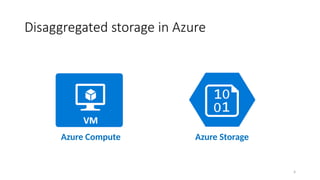
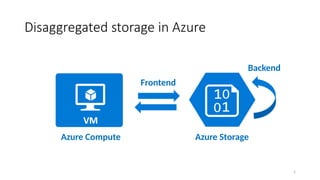
Disaggregated storage in Azure
4
Azure Storage
Azure Compute
Disaggregated storage in Azure
5
Azure Storage
Azure Compute
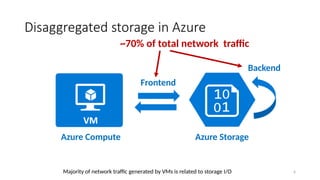
Frontend
Backend
Disaggregated storage in Azure
6
Azure Storage
Azure Compute
Frontend
Backend
~70% of total network traffic
Majority of network traffic generated by VMs is related to storage I/O
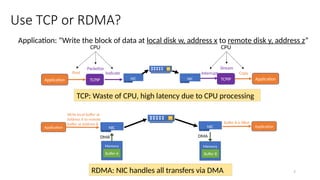
Application: “Write the block of data at local disk w, address x to remote disk y, address z”
TCP: Waste of CPU, high latency due to CPU processing
NIC Application
NIC
Application TCPIP TCPIP
Post
Packetize
Indicate Interrupt
Stream
Copy
CPU CPU
RDMA: NIC handles all transfers via DMA
NIC Application
NIC
Application
Memory
Buffer A
Write local buffer at
Address A to remote
buffer at Address B Buffer B is filled
DMA
Memory
Buffer B
DMA
7
Use TCP or RDMA?
RDMA
Benefits
benefits
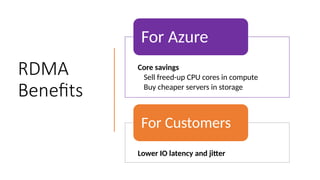
Core savings
Sell freed-up CPU cores in compute
Buy cheaper servers in storage
For Azure
Lower IO latency and jitter
For Customers
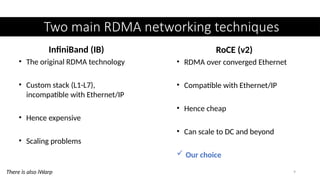
Two main RDMA networking techniques
InfiniBand (IB)
• The original RDMA technology
• Custom stack (L1-L7),
incompatible with Ethernet/IP
• Hence expensive
• Scaling problems
RoCE (v2)
• RDMA over converged Ethernet
• Compatible with Ethernet/IP
• Hence cheap
• Can scale to DC and beyond
 Our choice
9
There is also iWarp
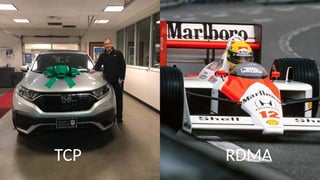
RDMA
TCP
10
Problems …
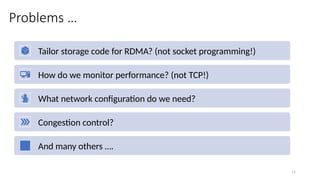
Tailor storage code for RDMA? (not socket programming!)
How do we monitor performance? (not TCP!)
What network configuration do we need?
Congestion control?
And many others ….
11
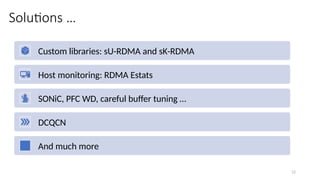
Solutions …
Custom libraries: sU-RDMA and sK-RDMA
Host monitoring: RDMA Estats
SONiC, PFC WD, careful buffer tuning …
DCQCN
And much more
12
Tailor storage code for RDMA?
Two libraries: user-space, and kernel-space (extends SMB-direct)
RDMA operations optimizations, plus TCP fallback if needed
13
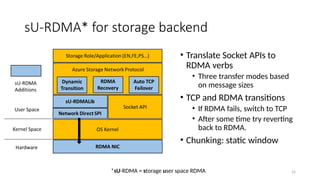
sU-RDMA* for storage backend
• Translate Socket APIs to
RDMA verbs
• Three transfer modes based
on message sizes
• TCP and RDMA transitions
• If RDMA fails, switch to TCP
• After some time try reverting
back to RDMA.
• Chunking: static window
14
*sU-RDMA = storage user space RDMA
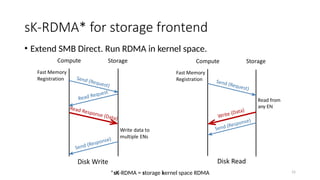
sK-RDMA* for storage frontend
15
*sK-RDMA = storage kernel space RDMA
• Extend SMB Direct. Run RDMA in kernel space.
Read from
any EN
How do we monitor RDMA
traffic?
On host: RDMA Estats and NIC counters
On routers: standard router telemetry (PFCs sent and received, per-queue traffic
and drop counters, special PFC WD summary)
16
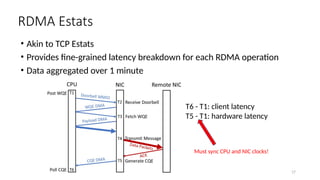
RDMA Estats
17
T6 - T1: client latency
T5 - T1: hardware latency
• Akin to TCP Estats
• Provides fine-grained latency breakdown for each RDMA operation
• Data aggregated over 1 minute
Must sync CPU and NIC clocks!
What special network
configuration do we need and
why?
Need lossless Ethernet
Sample config with SONiC
18
19
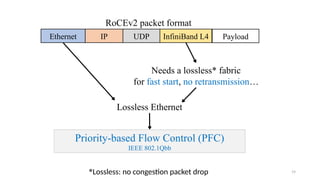
Ethernet IP UDP InfiniBand L4
RoCEv2 packet format
Needs a lossless* fabric
for fast start, no retransmission…
Priority-based Flow Control (PFC)
IEEE 802.1Qbb
Lossless Ethernet
Payload
*Lossless: no congestion packet drop
20
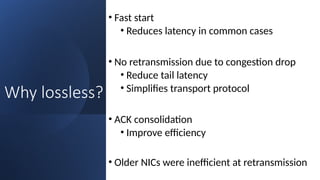
Why lossless?
• Fast start
• Reduces latency in common cases
• No retransmission due to congestion drop
• Reduce tail latency
• Simplifies transport protocol
• ACK consolidation
• Improve efficiency
• Older NICs were inefficient at retransmission
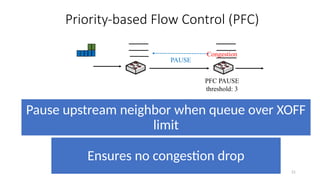
Priority-based Flow Control (PFC)
21
PFC PAUSE
threshold: 3
PAUSE
Congestion
Pause upstream neighbor when queue over XOFF
limit
Ensures no congestion drop
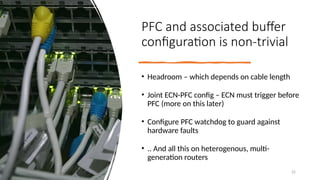
PFC and associated buffer
configuration is non-trivial
• Headroom – which depends on cable length
• Joint ECN-PFC config – ECN must trigger before
PFC (more on this later)
• Configure PFC watchdog to guard against
hardware faults
• .. And all this on heterogenous, multi-
generation routers
22
23
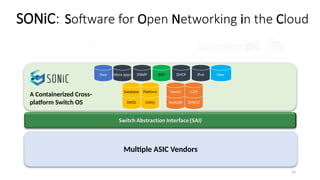
Multiple ASIC Vendors
SONiC: Software for Open Networking in the Cloud
More apps SNMP BGP DHCP IPv6
SYNCD
LLDP
RedisDB
TeamD
Utility
Platform
SWSS
Database
BGP
New New
A Containerized Cross-
platform Switch OS
24
ASIC Vendor
SONiC: Software for Open Networking in the Cloud
More apps SNMP BGP DHCP IPv6
SYNCD
LLDP
RedisDB
TeamD
Utility
Platform
SWSS
Database
BGP
New New
A Containerized Cross-
platform Switch OS
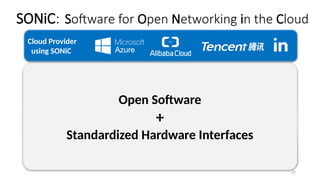
Cloud Provider
using SONiC
Open Software
+
Standardized Hardware Interfaces
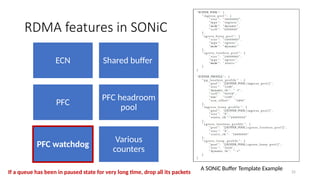
RDMA features in SONiC
ECN Shared buffer
PFC
PFC headroom
pool
PFC watchdog
Various
counters
25
A SONiC Buffer Template Example
If a queue has been in paused state for very long time, drop all its packets
Congestion control in
heterogenous environment
DCQCN
26
27
Why do we need congestion control?
PFC operates on a per-port/priority basis, not per-flow.
It can spread congestion, is unfair, and can lead to deadlocks!
Zhu et al. [SIGCOMM’15], Guo et al. [SIGCOMM’16], Hu et al. [HotNets’17]
Solution
•Minimize PFC generation using
per-flow E2E congestion control
•BUT keep PFC to allow fast start
and lower tail latency
•In other words, use PFC as a last-
resort
28
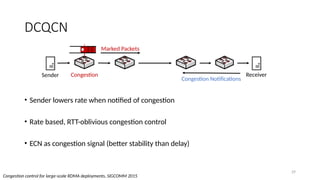
DCQCN
Sender Receiver
Congestion Notifications
Congestion
Marked Packets
• Sender lowers rate when notified of congestion
• Rate based, RTT-oblivious congestion control
• ECN as congestion signal (better stability than delay)
29
Congestion control for large-scale RDMA deployments, SIGCOMM 2015
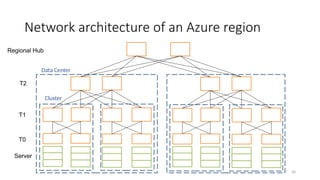
Network architecture of an Azure region
Server
T0
T1
T2
Regional Hub
Data Center
30
Cluster
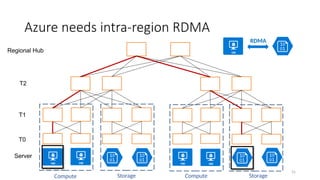
Azure needs intra-region RDMA
Server
T0
T1
T2
Regional Hub
Compute Compute
Storage Storage
31
RDMA
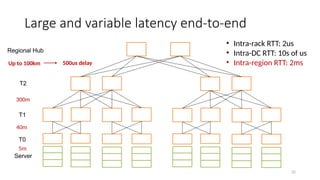
Large and variable latency end-to-end
Server
T0
T1
T2
Regional Hub
5m
40m
300m
Up to 100km
• Intra-rack RTT: 2us
• Intra-DC RTT: 10s of us
• Intra-region RTT: 2ms
500us delay
32
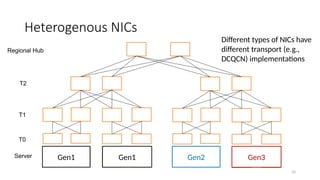
Heterogenous NICs
Server
T0
T1
T2
Regional Hub
Gen1 Gen1 Gen2 Gen3
Different types of NICs have
different transport (e.g.,
DCQCN) implementations
33
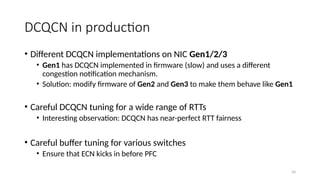
DCQCN in production
• Different DCQCN implementations on NIC Gen1/2/3
• Gen1 has DCQCN implemented in firmware (slow) and uses a different
congestion notification mechanism.
• Solution: modify firmware of Gen2 and Gen3 to make them behave like Gen1
• Careful DCQCN tuning for a wide range of RTTs
• Interesting observation: DCQCN has near-perfect RTT fairness
• Careful buffer tuning for various switches
• Ensure that ECN kicks in before PFC
34
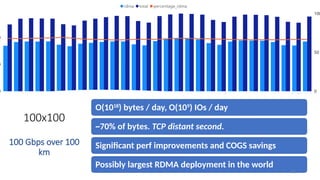
100x100
100 Gbps over 100
km
O(1018
) bytes / day, O(109
) IOs / day
~70% of bytes. TCP distant second.
Significant perf improvements and COGS savings
Possibly largest RDMA deployment in the world
35
Problems fixed, lessons and
open problems
Many new research directions
36
Problems discovered and fixed
• Congestion leaking
• Flows sent by the NIC always have near identical sending rates regardless of their congestion
degrees
• PFC and MACsec
• Different switches have no agreement on whether PFC frames sent should be encrypted or
what to do with arriving encrypted PFC frames
• Slow receiver due to loopback RDMA traffic
• Loopback RDMA traffic and inter-host RDMA traffic cause host congestion
• Fast Memory Registration (FMR) hidden fence
• The NIC processes the FMR request only after the completions of previously posted requests
37
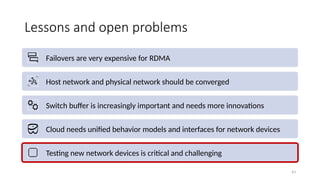
Lessons and open problems
Failovers are very expensive for RDMA
Host network and physical network should be converged
Switch buffer is increasingly important and needs more innovations
Cloud needs unified behavior models and interfaces for network devices
Testing new network devices is critical and challenging
38
Lessons and open problems
Failovers are very expensive for RDMA
Host network and physical network should be converged
Switch buffer is increasingly important and needs more innovations
Cloud needs unified behavior models and interfaces for network devices
Testing new network devices is critical and challenging
39
Lessons and open problems
Failovers are very expensive for RDMA
Host network and physical network should be converged
Switch buffer is increasingly important and needs more innovations
Cloud needs unified behavior models and interfaces for network devices
Testing new network devices is critical and challenging
40
Lessons and open problems
Failovers are very expensive for RDMA
Host network and physical network should be converged
Switch buffer is increasingly important and needs more innovations
Cloud needs unified behavior models and interfaces for network devices
Testing new network devices is critical and challenging
41
Lessons and open problems
Failovers are very expensive for RDMA
Host network and physical network should be converged
Switch buffer is increasingly important and needs more innovations
Cloud needs unified behavior models and interfaces for network devices
Testing new network devices is critical and challenging
42
Lessons and open problems
Failovers are very expensive for RDMA
Host network and physical network should be converged
Switch buffer is increasingly important and needs more innovations
Cloud needs unified behavior models and interfaces for network devices
Testing new network devices is critical and challenging
43
Husky
Understanding RDMA Microarchitecture Resources for Performance Isolation
44
Credit of slides: Xinhao Kong
45
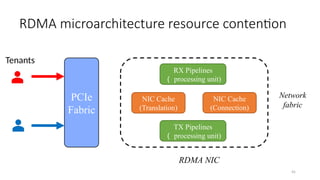
PCIe
Fabric
Tenants
TX Pipelines
( processing unit)
RX Pipelines
( processing unit)
PCIe
Fabric
Network
fabric
NIC Cache
(Translation)
NIC Cache
(Connection)
RDMA NIC
RDMA microarchitecture resource contention
TX Pipelines
( processing unit)
46
RX Pipelines
( processing unit)
PCIe
Fabric
RDMA NIC
Network
fabric
NIC Cache
(Translation)
NIC Cache
(Connection)
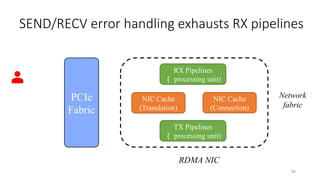
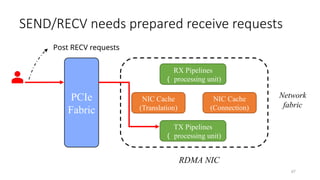
SEND/RECV error handling exhausts RX pipelines
TX Pipelines
( processing unit)
47
RX Pipelines
( processing unit)
PCIe
Fabric
RDMA NIC
Post RECV requests
Network
fabric
NIC Cache
(Translation)
NIC Cache
(Connection)
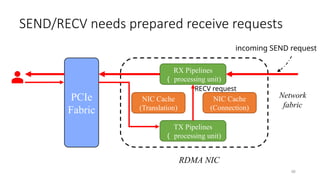
SEND/RECV needs prepared receive requests
TX Pipelines
( processing unit)
48
RX Pipelines
( processing unit)
PCIe
Fabric
RDMA NIC
Network
fabric
incoming SEND request
RECV request
NIC Cache
(Translation)
NIC Cache
(Connection)
SEND/RECV needs prepared receive requests
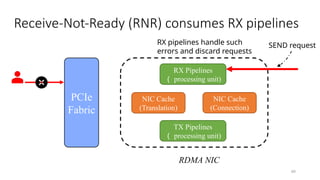
Receive-Not-Ready (RNR) consumes RX pipelines
TX Pipelines
( processing unit)
49
RX Pipelines
( processing unit)
PCIe
Fabric
RDMA NIC
SEND request
RX pipelines handle such
errors and discard requests
NIC Cache
(Translation)
NIC Cache
(Connection)
TX Pipelines
( processing unit)
50
RX Pipelines
( processing unit)
PCIe
Fabric
RDMA NIC
ANY
workloa
d
SEND request
RX pipelines handle such
errors and discard requests
NIC Cache
(Translation)
NIC Cache
(Connection)
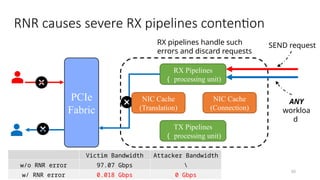
Victim Bandwidth Attacker Bandwidth
w/o RNR error 97.07 Gbps 
w/ RNR error 0.018 Gbps 0 Gbps
RNR causes severe RX pipelines contention
Lumina
Understanding the Micro-Behaviors of Hardware Offloaded Network
Stacks
51
Credit of slides: Zhuolong Yu
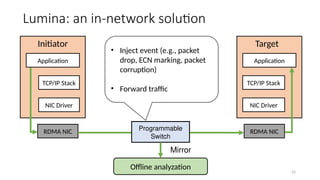
Initiator
Application
TCP/IP Stack
NIC Driver
RDMA NIC
Target
Application
TCP/IP Stack
NIC Driver
RDMA NIC
Programmable
Switch
• Inject event (e.g., packet
drop, ECN marking, packet
corruption)
• Forward traffic
Mirror
Offline analyzation 52
Lumina: an in-network solution
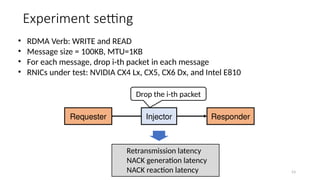
• RDMA Verb: WRITE and READ
• Message size = 100KB, MTU=1KB
• For each message, drop i-th packet in each message
• RNICs under test: NVIDIA CX4 Lx, CX5, CX6 Dx, and Intel E810
Responder
Requester Injector
Drop the i-th packet
Retransmission latency
NACK generation latency
NACK reaction latency 53
Experiment setting
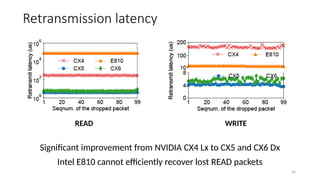
READ WRITE
Significant improvement from NVIDIA CX4 Lx to CX5 and CX6 Dx
Intel E810 cannot efficiently recover lost READ packets
54
Retransmission latency
55
Project contributors
“Empowering Azure Storage with RDMA” NSDI '23 (Operational Systems Track)
Wei Bai, Shanim Sainul Abdeen, Ankit Agrawal, Krishan Kumar Attre, Paramvir Bahl, Ameya Bhagat, Gowri Bhaskara,
Tanya Brokhman, Lei Cao, Ahmad Cheema, Rebecca Chow, Jeff Cohen, Mahmoud Elhaddad, Vivek Ette, Igal Figlin, Daniel
Firestone, Mathew George, Ilya German, Lakhmeet Ghai, Eric Green, Albert Greenberg, Manish Gupta, Randy Haagens,
Matthew Hendel, Ridwan Howlader, Neetha John, Julia Johnstone, Tom Jolly, Greg Kramer, David Kruse, Ankit Kumar,
Erica Lan, Ivan Lee, Avi Levy, Marina Lipshteyn, Xin Liu, Chen Liu, Guohan Lu, Yuemin Lu, Xiakun Lu, Vadim Makhervaks,
Ulad Malashanka, David A. Maltz, Ilias Marinos, Rohan Mehta, Sharda Murthi, Anup Namdhari, Aaron Ogus, Jitendra
Padhye, Madhav Pandya, Douglas Phillips, Adrian Power, Suraj Puri, Shachar Raindel, Jordan Rhee, Anthony Russo,
Maneesh Sah, Ali Sheriff, Chris Sparacino, Ashutosh Srivastava, Weixiang Sun, Nick Swanson, Fuhou Tian, Lukasz
Tomczyk, Vamsi Vadlamuri, Alec Wolman, Ying Xie, Joyce Yom, Lihua Yuan, Yanzhao Zhang, Brian Zill, and many others
“Understanding RDMA Microarchitecture Resources for Performance Isolation” NSDI '23
Xinhao Kong, Jingrong Chen, Wei Bai, Yechen Xu, Mahmoud Elhaddad, Shachar Raindel, Jitendra Padhye, Alvin R.
Lebeck, Danyang Zhuo
“Understanding the Micro-Behaviors of Hardware Offloaded Network Stacks with Lumina” SIGCOMM '23
Zhuolong Yu, Bowen Su, Wei Bai, Shachar Raindel, Vladimir Braverman, Xin Jin
Technical support from Arista Networks, Broadcom, Cisco, Dell, Intel, Keysight, NVIDIA
56
Thank You!

RDMA at Hyperscale: Experience and Future Directions

  • 1.
    1 RDMA at Hyperscale:Experience and Future Directions Wei Bai Microsoft Research Redmond APNet 2023, Hong Kong
  • 2.
    2 TL;DR We use RDMAfor storage traffic • RoCEv2 over commodity Ethernet/IP network • Enabled for speeds > 100gbps, over distances up to 100km • ~ 70% Azure traffic (bytes and packets) Made possible by many innovations • DCQCN • RDMA Estats • PFC watchdog • Carefully tuned libraries… and much more Many opportunities ahead!
  • 3.
  • 4.
    Disaggregated storage inAzure 4 Azure Storage Azure Compute
  • 5.
    Disaggregated storage inAzure 5 Azure Storage Azure Compute Frontend Backend
  • 6.
    Disaggregated storage inAzure 6 Azure Storage Azure Compute Frontend Backend ~70% of total network traffic Majority of network traffic generated by VMs is related to storage I/O
  • 7.
    Application: “Write theblock of data at local disk w, address x to remote disk y, address z” TCP: Waste of CPU, high latency due to CPU processing NIC Application NIC Application TCPIP TCPIP Post Packetize Indicate Interrupt Stream Copy CPU CPU RDMA: NIC handles all transfers via DMA NIC Application NIC Application Memory Buffer A Write local buffer at Address A to remote buffer at Address B Buffer B is filled DMA Memory Buffer B DMA 7 Use TCP or RDMA?
  • 8.
    RDMA Benefits benefits Core savings Sell freed-upCPU cores in compute Buy cheaper servers in storage For Azure Lower IO latency and jitter For Customers
  • 9.
    Two main RDMAnetworking techniques InfiniBand (IB) • The original RDMA technology • Custom stack (L1-L7), incompatible with Ethernet/IP • Hence expensive • Scaling problems RoCE (v2) • RDMA over converged Ethernet • Compatible with Ethernet/IP • Hence cheap • Can scale to DC and beyond  Our choice 9 There is also iWarp
  • 10.
  • 11.
    Problems … Tailor storagecode for RDMA? (not socket programming!) How do we monitor performance? (not TCP!) What network configuration do we need? Congestion control? And many others …. 11
  • 12.
    Solutions … Custom libraries:sU-RDMA and sK-RDMA Host monitoring: RDMA Estats SONiC, PFC WD, careful buffer tuning … DCQCN And much more 12
  • 13.
    Tailor storage codefor RDMA? Two libraries: user-space, and kernel-space (extends SMB-direct) RDMA operations optimizations, plus TCP fallback if needed 13
  • 14.
    sU-RDMA* for storagebackend • Translate Socket APIs to RDMA verbs • Three transfer modes based on message sizes • TCP and RDMA transitions • If RDMA fails, switch to TCP • After some time try reverting back to RDMA. • Chunking: static window 14 *sU-RDMA = storage user space RDMA
  • 15.
    sK-RDMA* for storagefrontend 15 *sK-RDMA = storage kernel space RDMA • Extend SMB Direct. Run RDMA in kernel space. Read from any EN
  • 16.
    How do wemonitor RDMA traffic? On host: RDMA Estats and NIC counters On routers: standard router telemetry (PFCs sent and received, per-queue traffic and drop counters, special PFC WD summary) 16
  • 17.
    RDMA Estats 17 T6 -T1: client latency T5 - T1: hardware latency • Akin to TCP Estats • Provides fine-grained latency breakdown for each RDMA operation • Data aggregated over 1 minute Must sync CPU and NIC clocks!
  • 18.
    What special network configurationdo we need and why? Need lossless Ethernet Sample config with SONiC 18
  • 19.
    19 Ethernet IP UDPInfiniBand L4 RoCEv2 packet format Needs a lossless* fabric for fast start, no retransmission… Priority-based Flow Control (PFC) IEEE 802.1Qbb Lossless Ethernet Payload *Lossless: no congestion packet drop
  • 20.
    20 Why lossless? • Faststart • Reduces latency in common cases • No retransmission due to congestion drop • Reduce tail latency • Simplifies transport protocol • ACK consolidation • Improve efficiency • Older NICs were inefficient at retransmission
  • 21.
    Priority-based Flow Control(PFC) 21 PFC PAUSE threshold: 3 PAUSE Congestion Pause upstream neighbor when queue over XOFF limit Ensures no congestion drop
  • 22.
    PFC and associatedbuffer configuration is non-trivial • Headroom – which depends on cable length • Joint ECN-PFC config – ECN must trigger before PFC (more on this later) • Configure PFC watchdog to guard against hardware faults • .. And all this on heterogenous, multi- generation routers 22
  • 23.
    23 Multiple ASIC Vendors SONiC:Software for Open Networking in the Cloud More apps SNMP BGP DHCP IPv6 SYNCD LLDP RedisDB TeamD Utility Platform SWSS Database BGP New New A Containerized Cross- platform Switch OS
  • 24.
    24 ASIC Vendor SONiC: Softwarefor Open Networking in the Cloud More apps SNMP BGP DHCP IPv6 SYNCD LLDP RedisDB TeamD Utility Platform SWSS Database BGP New New A Containerized Cross- platform Switch OS Cloud Provider using SONiC Open Software + Standardized Hardware Interfaces
  • 25.
    RDMA features inSONiC ECN Shared buffer PFC PFC headroom pool PFC watchdog Various counters 25 A SONiC Buffer Template Example If a queue has been in paused state for very long time, drop all its packets
  • 26.
  • 27.
    27 Why do weneed congestion control? PFC operates on a per-port/priority basis, not per-flow. It can spread congestion, is unfair, and can lead to deadlocks! Zhu et al. [SIGCOMM’15], Guo et al. [SIGCOMM’16], Hu et al. [HotNets’17]
  • 28.
    Solution •Minimize PFC generationusing per-flow E2E congestion control •BUT keep PFC to allow fast start and lower tail latency •In other words, use PFC as a last- resort 28
  • 29.
    DCQCN Sender Receiver Congestion Notifications Congestion MarkedPackets • Sender lowers rate when notified of congestion • Rate based, RTT-oblivious congestion control • ECN as congestion signal (better stability than delay) 29 Congestion control for large-scale RDMA deployments, SIGCOMM 2015
  • 30.
    Network architecture ofan Azure region Server T0 T1 T2 Regional Hub Data Center 30 Cluster
  • 31.
    Azure needs intra-regionRDMA Server T0 T1 T2 Regional Hub Compute Compute Storage Storage 31 RDMA
  • 32.
    Large and variablelatency end-to-end Server T0 T1 T2 Regional Hub 5m 40m 300m Up to 100km • Intra-rack RTT: 2us • Intra-DC RTT: 10s of us • Intra-region RTT: 2ms 500us delay 32
  • 33.
    Heterogenous NICs Server T0 T1 T2 Regional Hub Gen1Gen1 Gen2 Gen3 Different types of NICs have different transport (e.g., DCQCN) implementations 33
  • 34.
    DCQCN in production •Different DCQCN implementations on NIC Gen1/2/3 • Gen1 has DCQCN implemented in firmware (slow) and uses a different congestion notification mechanism. • Solution: modify firmware of Gen2 and Gen3 to make them behave like Gen1 • Careful DCQCN tuning for a wide range of RTTs • Interesting observation: DCQCN has near-perfect RTT fairness • Careful buffer tuning for various switches • Ensure that ECN kicks in before PFC 34
  • 35.
    100x100 100 Gbps over100 km O(1018 ) bytes / day, O(109 ) IOs / day ~70% of bytes. TCP distant second. Significant perf improvements and COGS savings Possibly largest RDMA deployment in the world 35
  • 36.
    Problems fixed, lessonsand open problems Many new research directions 36
  • 37.
    Problems discovered andfixed • Congestion leaking • Flows sent by the NIC always have near identical sending rates regardless of their congestion degrees • PFC and MACsec • Different switches have no agreement on whether PFC frames sent should be encrypted or what to do with arriving encrypted PFC frames • Slow receiver due to loopback RDMA traffic • Loopback RDMA traffic and inter-host RDMA traffic cause host congestion • Fast Memory Registration (FMR) hidden fence • The NIC processes the FMR request only after the completions of previously posted requests 37
  • 38.
    Lessons and openproblems Failovers are very expensive for RDMA Host network and physical network should be converged Switch buffer is increasingly important and needs more innovations Cloud needs unified behavior models and interfaces for network devices Testing new network devices is critical and challenging 38
  • 39.
    Lessons and openproblems Failovers are very expensive for RDMA Host network and physical network should be converged Switch buffer is increasingly important and needs more innovations Cloud needs unified behavior models and interfaces for network devices Testing new network devices is critical and challenging 39
  • 40.
    Lessons and openproblems Failovers are very expensive for RDMA Host network and physical network should be converged Switch buffer is increasingly important and needs more innovations Cloud needs unified behavior models and interfaces for network devices Testing new network devices is critical and challenging 40
  • 41.
    Lessons and openproblems Failovers are very expensive for RDMA Host network and physical network should be converged Switch buffer is increasingly important and needs more innovations Cloud needs unified behavior models and interfaces for network devices Testing new network devices is critical and challenging 41
  • 42.
    Lessons and openproblems Failovers are very expensive for RDMA Host network and physical network should be converged Switch buffer is increasingly important and needs more innovations Cloud needs unified behavior models and interfaces for network devices Testing new network devices is critical and challenging 42
  • 43.
    Lessons and openproblems Failovers are very expensive for RDMA Host network and physical network should be converged Switch buffer is increasingly important and needs more innovations Cloud needs unified behavior models and interfaces for network devices Testing new network devices is critical and challenging 43
  • 44.
    Husky Understanding RDMA MicroarchitectureResources for Performance Isolation 44 Credit of slides: Xinhao Kong
  • 45.
    45 PCIe Fabric Tenants TX Pipelines ( processingunit) RX Pipelines ( processing unit) PCIe Fabric Network fabric NIC Cache (Translation) NIC Cache (Connection) RDMA NIC RDMA microarchitecture resource contention
  • 46.
    TX Pipelines ( processingunit) 46 RX Pipelines ( processing unit) PCIe Fabric RDMA NIC Network fabric NIC Cache (Translation) NIC Cache (Connection) SEND/RECV error handling exhausts RX pipelines
  • 47.
    TX Pipelines ( processingunit) 47 RX Pipelines ( processing unit) PCIe Fabric RDMA NIC Post RECV requests Network fabric NIC Cache (Translation) NIC Cache (Connection) SEND/RECV needs prepared receive requests
  • 48.
    TX Pipelines ( processingunit) 48 RX Pipelines ( processing unit) PCIe Fabric RDMA NIC Network fabric incoming SEND request RECV request NIC Cache (Translation) NIC Cache (Connection) SEND/RECV needs prepared receive requests
  • 49.
    Receive-Not-Ready (RNR) consumesRX pipelines TX Pipelines ( processing unit) 49 RX Pipelines ( processing unit) PCIe Fabric RDMA NIC SEND request RX pipelines handle such errors and discard requests NIC Cache (Translation) NIC Cache (Connection)
  • 50.
    TX Pipelines ( processingunit) 50 RX Pipelines ( processing unit) PCIe Fabric RDMA NIC ANY workloa d SEND request RX pipelines handle such errors and discard requests NIC Cache (Translation) NIC Cache (Connection) Victim Bandwidth Attacker Bandwidth w/o RNR error 97.07 Gbps w/ RNR error 0.018 Gbps 0 Gbps RNR causes severe RX pipelines contention
  • 51.
    Lumina Understanding the Micro-Behaviorsof Hardware Offloaded Network Stacks 51 Credit of slides: Zhuolong Yu
  • 52.
    Initiator Application TCP/IP Stack NIC Driver RDMANIC Target Application TCP/IP Stack NIC Driver RDMA NIC Programmable Switch • Inject event (e.g., packet drop, ECN marking, packet corruption) • Forward traffic Mirror Offline analyzation 52 Lumina: an in-network solution
  • 53.
    • RDMA Verb:WRITE and READ • Message size = 100KB, MTU=1KB • For each message, drop i-th packet in each message • RNICs under test: NVIDIA CX4 Lx, CX5, CX6 Dx, and Intel E810 Responder Requester Injector Drop the i-th packet Retransmission latency NACK generation latency NACK reaction latency 53 Experiment setting
  • 54.
    READ WRITE Significant improvementfrom NVIDIA CX4 Lx to CX5 and CX6 Dx Intel E810 cannot efficiently recover lost READ packets 54 Retransmission latency
  • 55.
    55 Project contributors “Empowering AzureStorage with RDMA” NSDI '23 (Operational Systems Track) Wei Bai, Shanim Sainul Abdeen, Ankit Agrawal, Krishan Kumar Attre, Paramvir Bahl, Ameya Bhagat, Gowri Bhaskara, Tanya Brokhman, Lei Cao, Ahmad Cheema, Rebecca Chow, Jeff Cohen, Mahmoud Elhaddad, Vivek Ette, Igal Figlin, Daniel Firestone, Mathew George, Ilya German, Lakhmeet Ghai, Eric Green, Albert Greenberg, Manish Gupta, Randy Haagens, Matthew Hendel, Ridwan Howlader, Neetha John, Julia Johnstone, Tom Jolly, Greg Kramer, David Kruse, Ankit Kumar, Erica Lan, Ivan Lee, Avi Levy, Marina Lipshteyn, Xin Liu, Chen Liu, Guohan Lu, Yuemin Lu, Xiakun Lu, Vadim Makhervaks, Ulad Malashanka, David A. Maltz, Ilias Marinos, Rohan Mehta, Sharda Murthi, Anup Namdhari, Aaron Ogus, Jitendra Padhye, Madhav Pandya, Douglas Phillips, Adrian Power, Suraj Puri, Shachar Raindel, Jordan Rhee, Anthony Russo, Maneesh Sah, Ali Sheriff, Chris Sparacino, Ashutosh Srivastava, Weixiang Sun, Nick Swanson, Fuhou Tian, Lukasz Tomczyk, Vamsi Vadlamuri, Alec Wolman, Ying Xie, Joyce Yom, Lihua Yuan, Yanzhao Zhang, Brian Zill, and many others “Understanding RDMA Microarchitecture Resources for Performance Isolation” NSDI '23 Xinhao Kong, Jingrong Chen, Wei Bai, Yechen Xu, Mahmoud Elhaddad, Shachar Raindel, Jitendra Padhye, Alvin R. Lebeck, Danyang Zhuo “Understanding the Micro-Behaviors of Hardware Offloaded Network Stacks with Lumina” SIGCOMM '23 Zhuolong Yu, Bowen Su, Wei Bai, Shachar Raindel, Vladimir Braverman, Xin Jin Technical support from Arista Networks, Broadcom, Cisco, Dell, Intel, Keysight, NVIDIA
  • 56.

Editor's Notes

  • #1 Hello everyone, I am very happy to be here to present collective work of Azure and MSR on RDMA networking
  • #7  TCP vs RDMA : TCP: Two hosts connected by network TCP/IP stack runs on both the hosts Data transfer involves CPU on both the sides to run the TCP/IP stack RDMA: Two hosts connected by network RDMA stack runs on NIC of the two hosts Minimal involvement of CPU on both sides Application posts RDMA Write request to the NIC without kernel involvement NIC reads the buffer content and sends it over the network RDMA Write message on the network contains the destination virtual address and memory key as well as data itself NIC verifies the memory key and writes the data directly into the application buffer without CPU involvement RDMA is like a formula 1 racing car, TCP is a family minivan
  • #9 \
  • #19 Since we need a lossless fabric, and we want to run this on Ethernet networks, we need a lossless Ethernet. The protocol to realize this, is called …
  • #21 The idea of PFC is hop-by-hop flow control. The switches pause ingress port to limit buffer usage. For example, the switches have a PFC threshold of 3 packets. As packets come in, and due to congestion, the queue builds up. Once the queue length reaches the threshold, the switch pauses the previous hop for the blue priority. The previous hop will stop sending the blue packets. So the buffer will never be full and never drop packets. At the same time, other priority can still go through. Although PFC avoids packet drops, but it also causes troubles in large-scale deployments.
  • #24 SONiC stands for .. SAI provides unified interfaces and behavior models for the switch. ASIC vendors provide implementations of SAI. SAI enables switch OS to use a universal language to talk to different vendors. SONiC is built on the top of SAI.
  • #25 When we design SONiC, we take RDMA required features into consideration from the day one. But given these features, how to test them? How to ensure they work as expected?
  • #28 One naïve solution is to assign each flow a separate priority. But this is not scalable due to hardware limit. Our solution is to keep PFC, but add a per-flow E2E congestion control algorithm. Per flow congestion control reduces the switch buffer usage, thus reduce PFC generations. But we don’t want to go back to the heavyweight TCP! We want keep PFC, keep the benefits of lossless network, like no retransmissions, fast start, … The main idea is to use PFC only in emergent cases, not in the common state. Per-flow congestion control optimizes the common cases
  • #30 This figure gives the topology of an Azure region. Green ones are servers. Then there are four tiers of switches, T0, T1, T2 and RH.
  • #31 In Azure, a compute VM can fetch the blob from any storage cluster inside the region. Therefore, RDMA traffic may cross different datacenters.
  • #32 This means our RDMA traffic will experience a large RTT variation due to long haul cables between T2 and RH.
  • #33 We also need to handle heterogenous NIC hardware. [click] In Azure, different clusters use different hardware. Old clusters use CX3 while the new ones use CX4 and CX5. And they have different DCQCN implementations.
  • #46 Another finding is about SEND/RECV error handling exhaust RX pipelines.
  • #47 Before we discuss the error concretely, let’s review how SEND/RECV works. To receive the payload, in RDMA, the receiver needs to post some receive requests.
  • #48 When incoming SEND requests arrive, the NIC will consume the posted RECV requests to process the incoming requests. As this figure shows, everything goes correctly.
  • #49 However, if the receiver does not post any receive request at all. An error, called receive-not-ready will be triggered. The RX pipelines will handle such errors and discard the incoming SEND requests.
  • #50 What we observe is that - if at the same time, there is another tenant have incoming traffics, say, this blue tenant. This tenant’s traffics will be all blocked, no matter what types of workload it is. For example, if we let the victim to be a simple write traffic, its performance can drop from 97 Gbps to almost 0 after the RNR error is triggered by the attacker.
  • #52 To address this challenges, we propose Lumina, which takes an in-network solution (click) Lumina uses a programmable switch as the middlebox to inject events to the traffic. And of course, it will also forward traffic between devices. Since the middlebox may not have enough resource and flexibility to realize complex measurement, (click) we mirror all the packets from the middlebox to dedicated servers for offline analyzation.