Quantifying the Performance of Garbage Collection vs.  Explicit Memory Management Matthew Hertz Canisius College Emery Berger University of Massachusetts Amherst
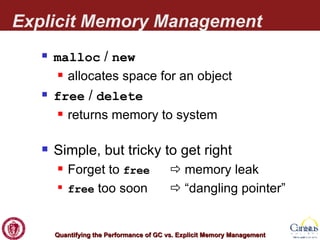
Explicit Memory Management malloc  /  new allocates space for an object free  /  delete returns memory to system Simple, but tricky to get right Forget to  free   memory leak free  too soon    “dangling pointer”
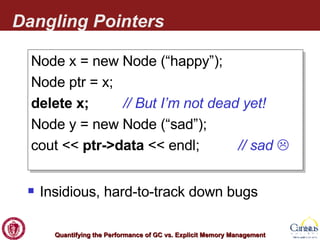
Dangling Pointers Node x = new Node (“happy”); Node ptr = x; delete x;  // But I’m not dead yet! Node y = new Node (“sad”); cout <<  ptr->data  << endl;  // sad   Insidious, hard-to-track down bugs
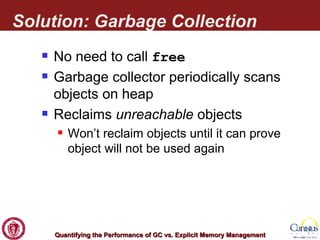
Solution: Garbage Collection No need to call  free Garbage collector periodically scans objects on heap Reclaims  unreachable  objects Won’t reclaim objects until it can prove object will not be used again
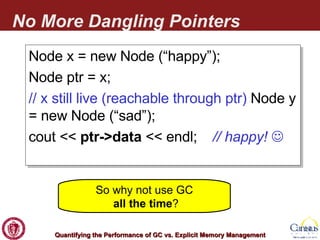
No More Dangling Pointers Node x = new Node (“happy”); Node ptr = x; // x still live (reachable through ptr)  Node y = new Node (“sad”); cout <<  ptr->data  << endl;  // happy!   So why not use GC   all the time ?
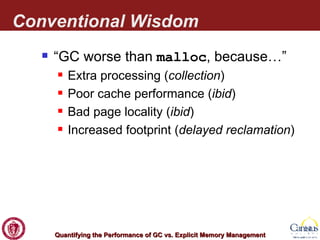
Conventional Wisdom “ GC worse than  malloc , because…” Extra processing ( collection ) Poor cache performance ( ibid ) Bad page locality ( ibid ) Increased footprint ( delayed reclamation )
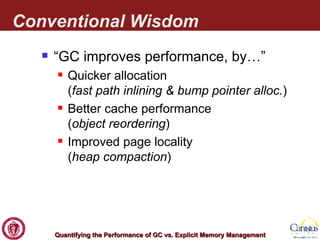
Conventional Wisdom “ GC improves performance, by…” Quicker allocation ( fast path inlining & bump pointer alloc. ) Better cache performance  ( object reordering ) Improved page locality  ( heap compaction )
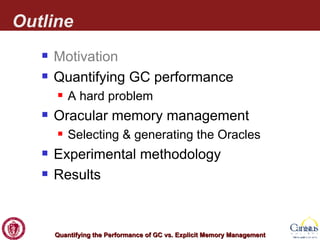
Outline Motivation Quantifying GC performance A hard problem Oracular memory management Selecting & generating the Oracles Experimental methodology Results
Quantifying GC Performance Apples-to-apples comparison Examine unaltered applications Runs differ only in memory manager Examine impact on  time  &  space
Quantifying GC Performance Evaluate state-of-art algorithms Garbage collectors Generational collectors Copying collectors Standard for Java, not compatible with C/C++ Explicit memory managers Fast, single-threaded allocators
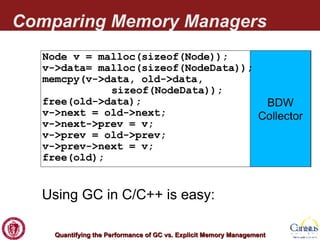
Comparing Memory Managers BDW Collector Node v = malloc(sizeof(Node)); v->data= malloc(sizeof(NodeData)); memcpy(v->data, old->data,  sizeof(NodeData)); free(old->data); v->next = old->next; v->next->prev = v; v->prev = old->prev; v->prev->next = v; free(old); Using GC in C/C++ is easy:
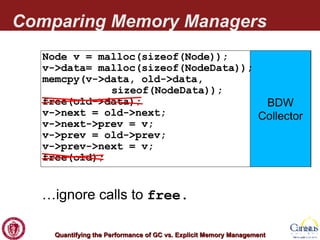
Comparing Memory Managers BDW Collector Node v = malloc(sizeof(Node)); v->data= malloc(sizeof(NodeData)); memcpy(v->data, old->data,  sizeof(NodeData)); free(old->data); v->next = old->next; v->next->prev = v; v->prev = old->prev; v->prev->next = v; free(old); … ignore calls to  free .
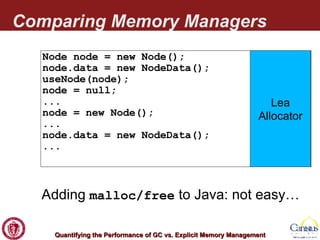
Comparing Memory Managers Lea Allocator Node node = new Node(); node.data = new NodeData(); useNode(node); node = null; ... node = new Node(); ... node.data = new NodeData(); ... Adding  malloc/free  to Java: not easy…
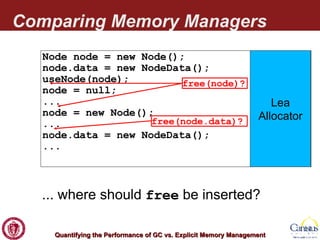
Comparing Memory Managers Lea Allocator Node node = new Node(); node.data = new NodeData(); useNode(node); node = null; ... node = new Node(); ... node.data = new NodeData(); ... ... where should  free  be inserted? free(node.data)? free(node)?
Inserting Free Calls Do not know where programmer would call  free Hints provided from  null -ing pointers Restructure code to avoid memory leaks? Tests programming skills, not memory manager Want  unaltered  applications
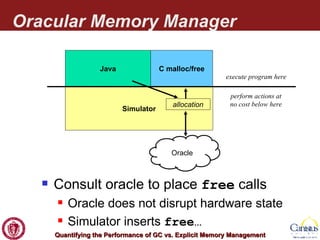
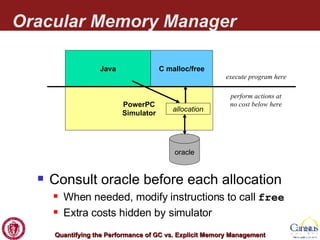
Oracular Memory Manager Oracle Consult oracle to place  free  calls Oracle does not disrupt hardware state Simulator inserts  free … Java Simulator C malloc/free perform actions at no cost below here execute program here allocation
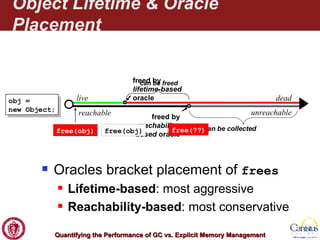
Object Lifetime & Oracle Placement Oracles bracket placement of  frees Lifetime -based : most aggressive Reachability-based : most conservative unreachable live dead reachable free(obj) obj = new Object; free(obj) free(??) freed by lifetime-based  oracle freed by reachability-based  oracle can be collected can be freed
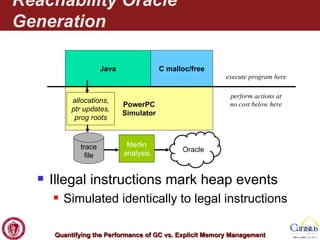
Reachability Oracle Generation Illegal instructions mark heap events Simulated identically to legal instructions Oracle Java PowerPC Simulator C malloc/free perform actions at no cost below here execute program here trace file allocations, ptr updates, prog  roots Merlin analysis
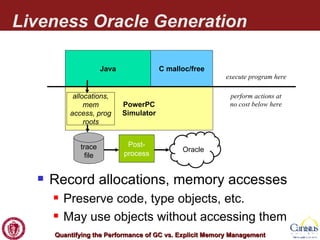
Liveness Oracle Generation Record allocations, memory accesses Preserve code, type objects, etc. May use objects without accessing them Oracle Java PowerPC Simulator C malloc/free perform actions at no cost below here execute program here trace file allocations, mem access,  prog  roots Post- process
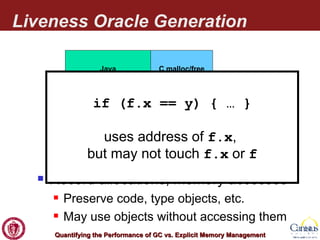
Liveness Oracle Generation Record allocations, memory accesses Preserve code, type objects, etc. May use objects without accessing them Oracle if (f.x == y) { … } uses address of  f.x ,  but may not touch  f.x  or  f Java PowerPC Simulator C malloc/free perform actions at no cost below here execute program here trace file allocation, mem access,  prog.  roots Post- process
Oracular Memory Manager Consult oracle before each allocation When needed, modify instructions to call  free Extra costs hidden by simulator Java PowerPC Simulator C malloc/free perform actions at no cost below here execute program here oracle allocation
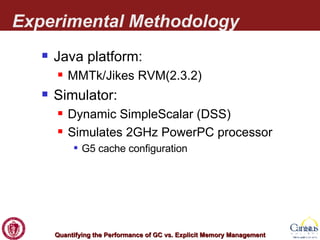
Experimental Methodology Java platform: MMTk/Jikes RVM(2.3.2)  Simulator: Dynamic SimpleScalar (DSS) Simulates 2GHz PowerPC processor G5 cache configuration
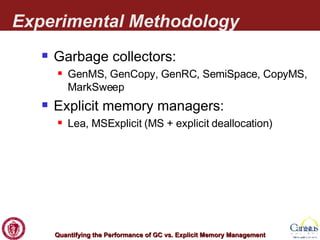
Experimental Methodology Garbage collectors: GenMS, GenCopy, GenRC, SemiSpace, CopyMS, MarkSweep Explicit memory managers: Lea, MSExplicit (MS + explicit deallocation)
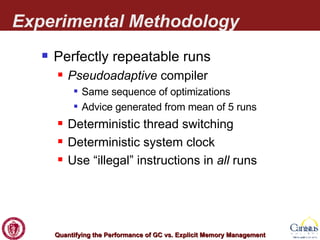
Experimental Methodology Perfectly repeatable runs Pseudoadaptive  compiler Same sequence of optimizations Advice generated from mean of 5 runs Deterministic thread switching Deterministic system clock Use “illegal” instructions in  all  runs
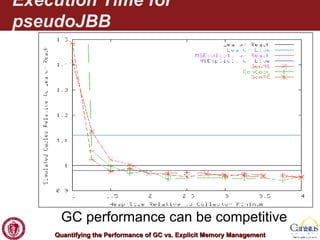
Execution Time for pseudoJBB GC performance can be competitive
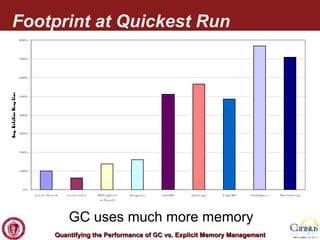
Footprint at Quickest Run GC uses much more memory
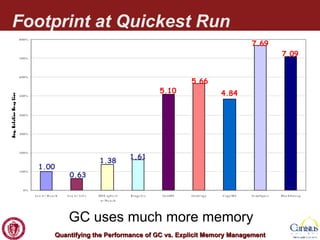
Footprint at Quickest Run GC uses much more memory 1.00 1.38 1.61 5.10 5.66 4.84 7.69 7.09 0.63
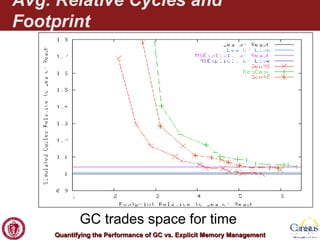
Avg. Relative Cycles and Footprint GC trades space for time
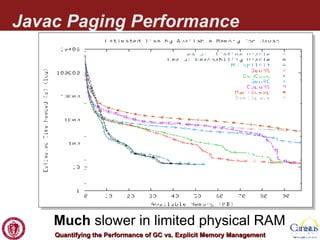
Javac Paging Performance Much  slower in limited physical RAM
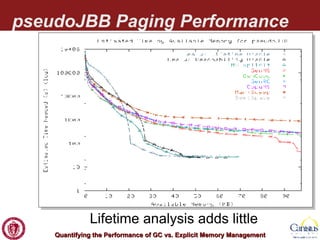
pseudoJBB Paging Performance Lifetime analysis adds little
Summary of Results Best collector equals Lea's performance… Up to 10% faster on some benchmarks ... but uses more memory Quickest runs use 5x or more memory At least twice mean footprint
Take-home: Practitioners GC ok if: system has more than 3x needed RAM, and no competition with other processes GC not so good if: Limited RAM Competition for physical memory Relies upon RAM for performance In-memory database Search engines, etc.
Take-home: Researchers GC performance  already good enough  with enough RAM Problems: Paging is a killer Performance suffers when RAM limited
Future Work Obvious dimensions Other collectors: Bookmarking collector [PLDI 05] Parallel collectors Other allocators: New version of DLmalloc (2.8.2) VAM [ISMM 05] Other architectures: Examine impact of cache size
Future Work Other memory management methods Regions, reaps
Conclusion Code available at:  http://www-cs.canisius.edu/~hertzm

Quantifying the Performance of Garbage Collection vs. Explicit Memory Management

  • 1.
    Quantifying the Performanceof Garbage Collection vs. Explicit Memory Management Matthew Hertz Canisius College Emery Berger University of Massachusetts Amherst
  • 2.
    Explicit Memory Managementmalloc / new allocates space for an object free / delete returns memory to system Simple, but tricky to get right Forget to free  memory leak free too soon  “dangling pointer”
  • 3.
    Dangling Pointers Nodex = new Node (“happy”); Node ptr = x; delete x; // But I’m not dead yet! Node y = new Node (“sad”); cout << ptr->data << endl; // sad  Insidious, hard-to-track down bugs
  • 4.
    Solution: Garbage CollectionNo need to call free Garbage collector periodically scans objects on heap Reclaims unreachable objects Won’t reclaim objects until it can prove object will not be used again
  • 5.
    No More DanglingPointers Node x = new Node (“happy”); Node ptr = x; // x still live (reachable through ptr) Node y = new Node (“sad”); cout << ptr->data << endl; // happy!  So why not use GC all the time ?
  • 6.
    Conventional Wisdom “GC worse than malloc , because…” Extra processing ( collection ) Poor cache performance ( ibid ) Bad page locality ( ibid ) Increased footprint ( delayed reclamation )
  • 7.
    Conventional Wisdom “GC improves performance, by…” Quicker allocation ( fast path inlining & bump pointer alloc. ) Better cache performance ( object reordering ) Improved page locality ( heap compaction )
  • 8.
    Outline Motivation QuantifyingGC performance A hard problem Oracular memory management Selecting & generating the Oracles Experimental methodology Results
  • 9.
    Quantifying GC PerformanceApples-to-apples comparison Examine unaltered applications Runs differ only in memory manager Examine impact on time & space
  • 10.
    Quantifying GC PerformanceEvaluate state-of-art algorithms Garbage collectors Generational collectors Copying collectors Standard for Java, not compatible with C/C++ Explicit memory managers Fast, single-threaded allocators
  • 11.
    Comparing Memory ManagersBDW Collector Node v = malloc(sizeof(Node)); v->data= malloc(sizeof(NodeData)); memcpy(v->data, old->data, sizeof(NodeData)); free(old->data); v->next = old->next; v->next->prev = v; v->prev = old->prev; v->prev->next = v; free(old); Using GC in C/C++ is easy:
  • 12.
    Comparing Memory ManagersBDW Collector Node v = malloc(sizeof(Node)); v->data= malloc(sizeof(NodeData)); memcpy(v->data, old->data, sizeof(NodeData)); free(old->data); v->next = old->next; v->next->prev = v; v->prev = old->prev; v->prev->next = v; free(old); … ignore calls to free .
  • 13.
    Comparing Memory ManagersLea Allocator Node node = new Node(); node.data = new NodeData(); useNode(node); node = null; ... node = new Node(); ... node.data = new NodeData(); ... Adding malloc/free to Java: not easy…
  • 14.
    Comparing Memory ManagersLea Allocator Node node = new Node(); node.data = new NodeData(); useNode(node); node = null; ... node = new Node(); ... node.data = new NodeData(); ... ... where should free be inserted? free(node.data)? free(node)?
  • 15.
    Inserting Free CallsDo not know where programmer would call free Hints provided from null -ing pointers Restructure code to avoid memory leaks? Tests programming skills, not memory manager Want unaltered applications
  • 16.
    Oracular Memory ManagerOracle Consult oracle to place free calls Oracle does not disrupt hardware state Simulator inserts free … Java Simulator C malloc/free perform actions at no cost below here execute program here allocation
  • 17.
    Object Lifetime &Oracle Placement Oracles bracket placement of frees Lifetime -based : most aggressive Reachability-based : most conservative unreachable live dead reachable free(obj) obj = new Object; free(obj) free(??) freed by lifetime-based oracle freed by reachability-based oracle can be collected can be freed
  • 18.
    Reachability Oracle GenerationIllegal instructions mark heap events Simulated identically to legal instructions Oracle Java PowerPC Simulator C malloc/free perform actions at no cost below here execute program here trace file allocations, ptr updates, prog roots Merlin analysis
  • 19.
    Liveness Oracle GenerationRecord allocations, memory accesses Preserve code, type objects, etc. May use objects without accessing them Oracle Java PowerPC Simulator C malloc/free perform actions at no cost below here execute program here trace file allocations, mem access, prog roots Post- process
  • 20.
    Liveness Oracle GenerationRecord allocations, memory accesses Preserve code, type objects, etc. May use objects without accessing them Oracle if (f.x == y) { … } uses address of f.x , but may not touch f.x or f Java PowerPC Simulator C malloc/free perform actions at no cost below here execute program here trace file allocation, mem access, prog. roots Post- process
  • 21.
    Oracular Memory ManagerConsult oracle before each allocation When needed, modify instructions to call free Extra costs hidden by simulator Java PowerPC Simulator C malloc/free perform actions at no cost below here execute program here oracle allocation
  • 22.
    Experimental Methodology Javaplatform: MMTk/Jikes RVM(2.3.2) Simulator: Dynamic SimpleScalar (DSS) Simulates 2GHz PowerPC processor G5 cache configuration
  • 23.
    Experimental Methodology Garbagecollectors: GenMS, GenCopy, GenRC, SemiSpace, CopyMS, MarkSweep Explicit memory managers: Lea, MSExplicit (MS + explicit deallocation)
  • 24.
    Experimental Methodology Perfectlyrepeatable runs Pseudoadaptive compiler Same sequence of optimizations Advice generated from mean of 5 runs Deterministic thread switching Deterministic system clock Use “illegal” instructions in all runs
  • 25.
    Execution Time forpseudoJBB GC performance can be competitive
  • 26.
    Footprint at QuickestRun GC uses much more memory
  • 27.
    Footprint at QuickestRun GC uses much more memory 1.00 1.38 1.61 5.10 5.66 4.84 7.69 7.09 0.63
  • 28.
    Avg. Relative Cyclesand Footprint GC trades space for time
  • 29.
    Javac Paging PerformanceMuch slower in limited physical RAM
  • 30.
    pseudoJBB Paging PerformanceLifetime analysis adds little
  • 31.
    Summary of ResultsBest collector equals Lea's performance… Up to 10% faster on some benchmarks ... but uses more memory Quickest runs use 5x or more memory At least twice mean footprint
  • 32.
    Take-home: Practitioners GCok if: system has more than 3x needed RAM, and no competition with other processes GC not so good if: Limited RAM Competition for physical memory Relies upon RAM for performance In-memory database Search engines, etc.
  • 33.
    Take-home: Researchers GCperformance already good enough with enough RAM Problems: Paging is a killer Performance suffers when RAM limited
  • 34.
    Future Work Obviousdimensions Other collectors: Bookmarking collector [PLDI 05] Parallel collectors Other allocators: New version of DLmalloc (2.8.2) VAM [ISMM 05] Other architectures: Examine impact of cache size
  • 35.
    Future Work Othermemory management methods Regions, reaps
  • 36.
    Conclusion Code availableat: http://www-cs.canisius.edu/~hertzm