PARENTERAL NUTRITION IN
NEWBORNS
Dr. Elsie Constanza
Paediatrician/Neonatologist
Karl Heusner Memorial Hospital
NEONATAL UNIT
Total body water (TBW): the total intracellular and
extracellular fluids
Extracellular fluids (ECF): the total Intravascular and
Interstitial fluids
Insensible water loss (IWL): the evaporation of water
through the skin, respiratory tract and mucous
membranes
Definitions
R. Bissinger. D. Annibale, GOLDEN HOURS, Care of the VLBWI , Chicago Ill, 2014
General Principles
 Water accounts for 75%-95% of an infant’s body
weight
 TBW is inversely proportional to GE.
 First week of life: physiologic weight loss due to
contraction of ECF.
VLBW infants – 10%-15%
Term infants – 10%
R. Bissinger. D. Annibale, GOLDEN HOURS, Care of the VLBWI , Chicago Ill, 2014
ELBW infants at lower GE have the highest Trans-
epidermal water loss (TEWL)
*Humidified incubator with Porthole sleeves ready
on admission for infants < 32weeks and/or <1,200
grams to decrease TEWL
R. Bissinger. D. Annibale, GOLDEN HOURS, Care of the VLBWI , Chicago Ill, 2014
FACTORS AFFECTING IWL
INCREASE DECREASE
Low maturity High maturity
Low relative humidity Increasing postnatal age
Ambient temperature exceeding
neutral thermal environment
High environmental relative
humidity
Skin defects (omphalocele,
gastroschisis)
High ventilator relative humidity
Phototherapy and use of radient
warmer
Oh W, Fluid and Electrolyte Management of VLBW Infants, Pediatrics and Neonatology 2012
IWL:
Intake – Output (mainly urine) - ∆ in weight
Oh W, Fluid and Electrolyte Management of VLBW Infants, Pediatrics and Neonatology 2012
Urine output: 1-3ml/kg/hr
Urine specific gravity: 1005-1012 is consistent with a balance
in TBW
Urine Osmolarity : (specific gravity – 1000) x 30
•Premature: 500mosm/l (spec. gravity 1020-1025)
•AT: 800 mosm/l (specific gravity 1030)
Serum electrolytes and Cr should be routinely monitored to
evaluate Renal Function and Fluid balance.
*Na+ / Cr / BUN
R. Bissinger. D. Annibale, GOLDEN HOURS, Care of the VLBWI , Chicago Ill, 2014
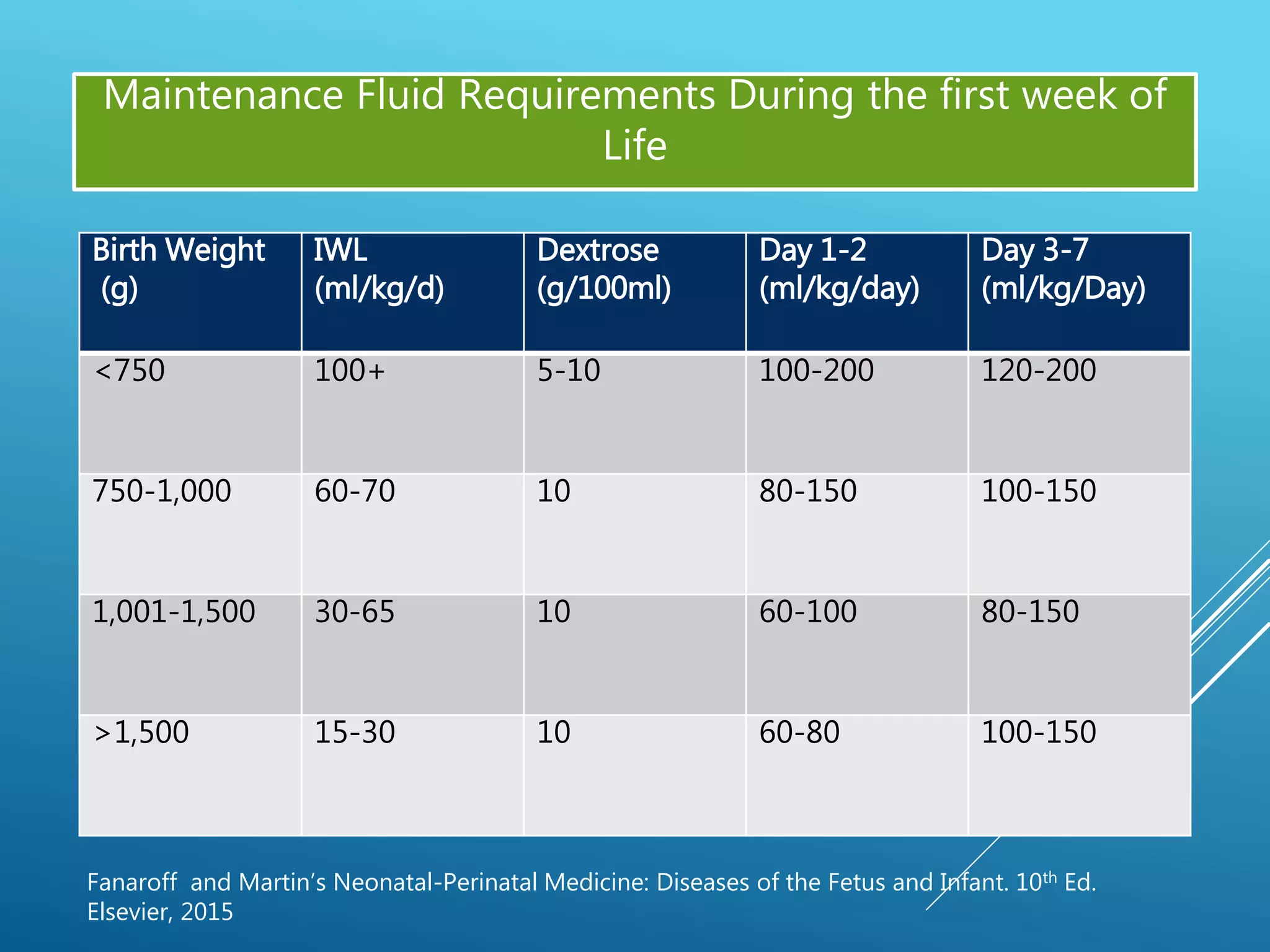
Maintenance Fluid Requirements During the first week of
Life
Birth Weight
(g)
IWL
(ml/kg/d)
Dextrose
(g/100ml)
Day 1-2
(ml/kg/day)
Day 3-7
(ml/kg/Day)
<750 100+ 5-10 100-200 120-200
750-1,000 60-70 10 80-150 100-150
1,001-1,500 30-65 10 60-100 80-150
>1,500 15-30 10 60-80 100-150
Fanaroff and Martin’s Neonatal-Perinatal Medicine: Diseases of the Fetus and Infant. 10th Ed.
Elsevier, 2015
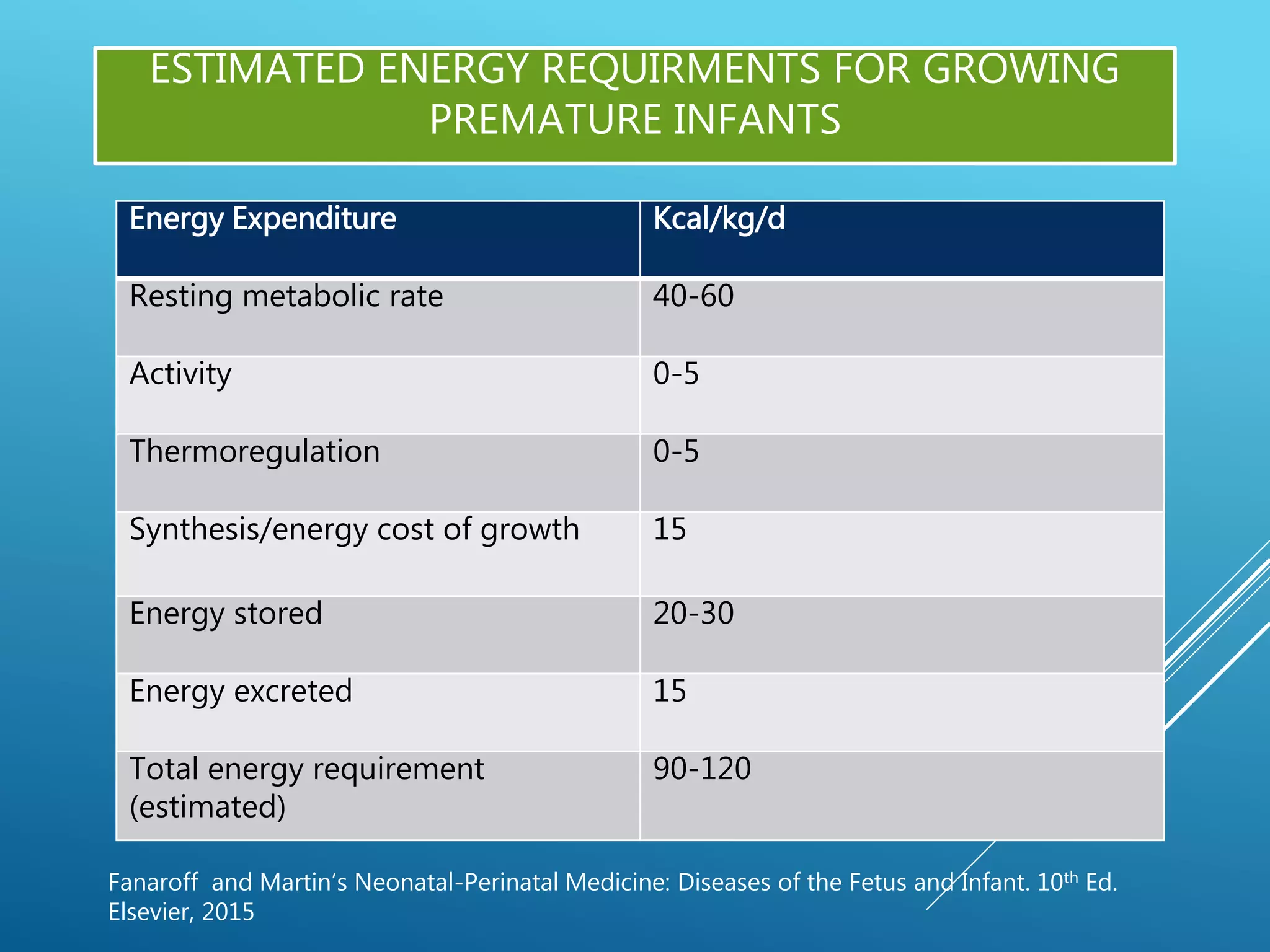
ESTIMATED ENERGY REQUIRMENTS FOR GROWING
PREMATURE INFANTS
Energy Expenditure Kcal/kg/d
Resting metabolic rate 40-60
Activity 0-5
Thermoregulation 0-5
Synthesis/energy cost of growth 15
Energy stored 20-30
Energy excreted 15
Total energy requirement
(estimated)
90-120
Fanaroff and Martin’s Neonatal-Perinatal Medicine: Diseases of the Fetus and Infant. 10th Ed.
Elsevier, 2015
RECOMMENDED ENERGY INTAKE
 American Academy of Pediatrics:
105-130 kcal/kg/day for preterm infants
 ESPGHAN (Committee on Nutrition):
110-135 kcal/kg/day
Fanaroff and Martin’s Neonatal-Perinatal Medicine: Diseases of the Fetus and Infant. 10th Ed.
Elsevier, 2015
FORMS OF ADMINISTRATION
PERIPHERAL: max osmolarity 900 mOsm/l
 Limits increase of energy , Dext 12.5%.
 Short term nutrition
 Risk of infiltration, phlebitis, thrombosis
CENTRAL : osmolarity >1000mOsm/l
 Prolonged Nutrition
 Dext > 12.5%
ASPEN Nutrition Support Practice Manual 2nd Edition, 2005
COMPONENTS
 Macronutrients
 Amino acids
 Carbohydrates
 Lipids
 Micronutrients:
 Electrolytes: Mg, K, Na
 Minerals
 Vitamins
 Calcium Gluconate
ASPEN Nutrition Support Practice Manual 2nd Edition, 2005
PREPARATION
Laminar flow hood
OSMOLARITY DEPENDS MOSTLY ON:
• DEXTROSE 5mOsml/gr
• AMINO ACIDS 10mOsml/gr
• ELECTROLYTES 1mOsml/mEq
mOsm/L:
Total of Osmol x 1000
total volume in TPN
PLASMA OSMOLARITY: 280 -290 mosm/L
2x Na + Glucose mg/dl + BUN mg/dl
18 2,8
ASPEN Nutrition Support Practice Manual 2nd Edition, 2005
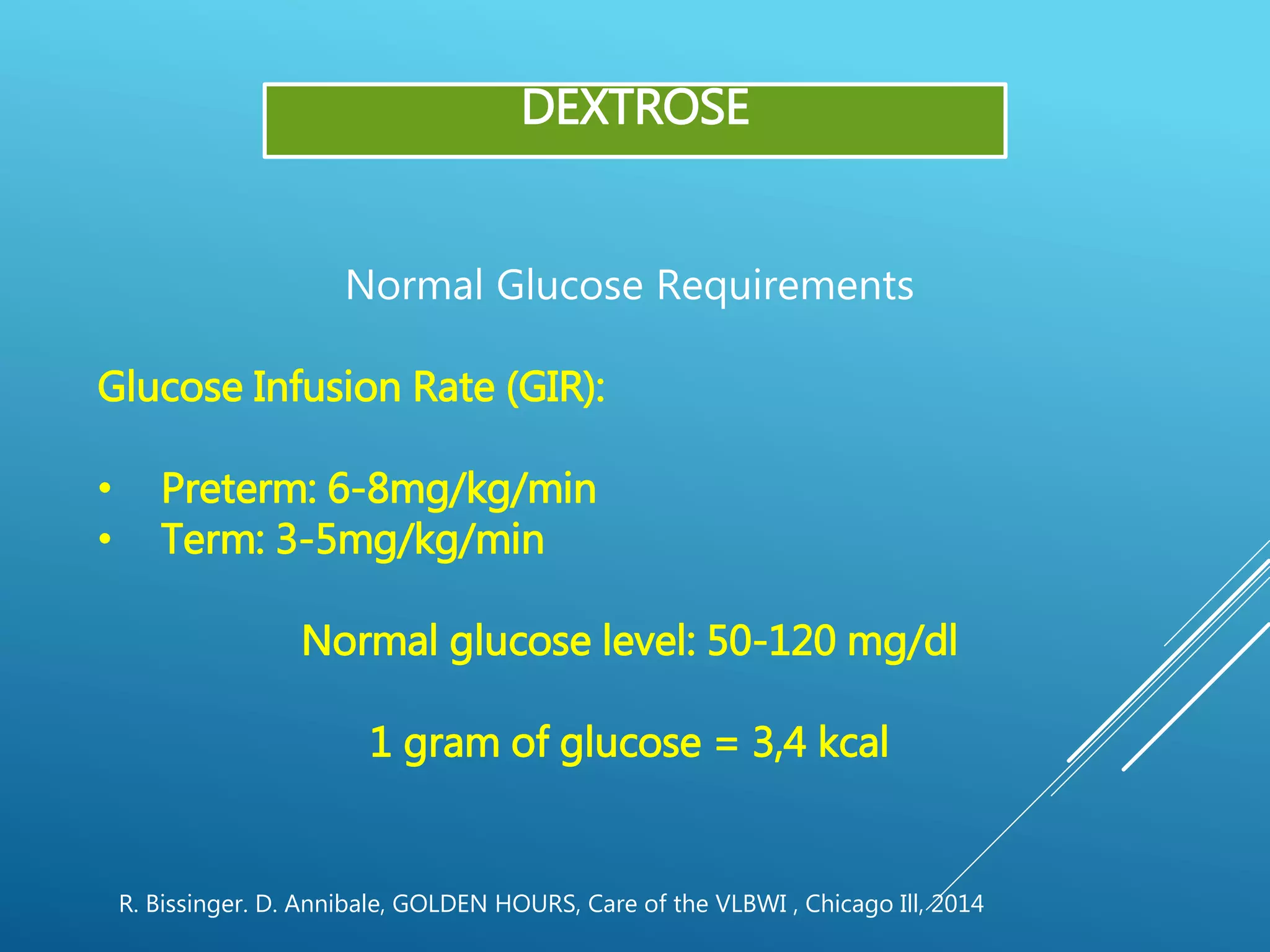
DEXTROSE
Normal Glucose Requirements
Glucose Infusion Rate (GIR):
• Preterm: 6-8mg/kg/min
• Term: 3-5mg/kg/min
Normal glucose level: 50-120 mg/dl
1 gram of glucose = 3,4 kcal
R. Bissinger. D. Annibale, GOLDEN HOURS, Care of the VLBWI , Chicago Ill, 2014
Infants who require high infusion rates
or a dextrose concentration (Tenor)
> 12.5% require placement of central venous catheter
(UVC, PICC)
Tenor: Total Glucose (g) x100
Total fluids in IV
Total grams of glucose= GIR (mg) x Weight (kg) x 1.44
R. Bissinger. D. Annibale, GOLDEN HOURS, Care of the VLBWI , Chicago Ill, 2014
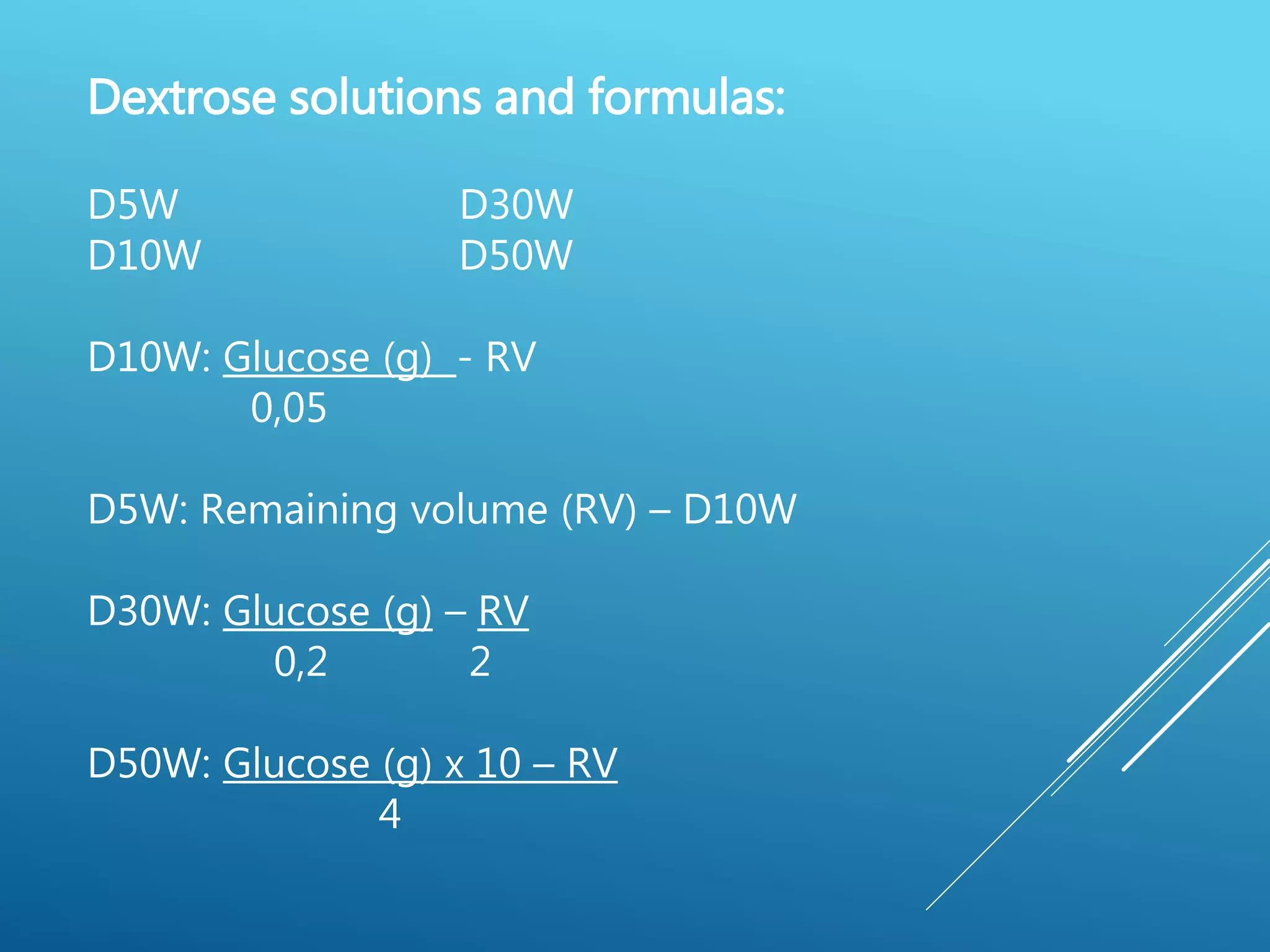
Dextrose solutions and formulas:
D5W D30W
D10W D50W
D10W: Glucose (g) - RV
0,05
D5W: Remaining volume (RV) – D10W
D30W: Glucose (g) – RV
0,2 2
D50W: Glucose (g) x 10 – RV
4
AMINO ACIDS
Recommended Protein intake:
3 – 4 g/kg/day in VLBW infants
1g of aa = 4 kcal
This account for obligate protein loss of
(1.5 – 2.0 g/kg/day)
This will:
 limits catabolism
 improve protein balance
 preserve endogenous protein stores
R. Bissinger. D. Annibale, GOLDEN HOURS, Care of the VLBWI , Chicago Ill, 2014
Parenteral Amino Acid Solutions
Aminosyn 10%
TrophAmine 10%
Primene 10%
* Presentation also available as 8,5%
Fanaroff and Martin’s Neonatal-Perinatal Medicine: Diseases of the Fetus and Infant. 10th Ed.
Elsevier, 2015
LIPIDS
Intravenous lipids:
 Prevents essential fatty acids deficiency (EFAD)
(linoleic/linolenic acids)
 Provides a significant source of non-protein energy.
 Requirments 1-4 g/kg/day
1g of lipid = 9 kcal
EFAD can be avoided with 0.5 – 1.0 g/kg/day
of IV lipids in the first 24 hrs of life.
R. Bissinger. D. Annibale, GOLDEN HOURS, Care of the VLBWI , Chicago Ill, 2014
 Intralipids are available as 10% and 20%
 20% solutions are preferred due to lower cholesterol and
plasma triglyceride levels.
 IV lipid solutions have LCT (>12C)
 Maintain serum glucose levels
 Monitor Triglycerides: <200 mg/dl and < 140mg/dl with
hyperbilirubinemia
R. Bissinger. D. Annibale, GOLDEN HOURS, Care of the VLBWI , Chicago Ill, 2014
Care should be taken in:
 Infants with unconjugated hyperbilirubinemia to
avoid bilirubin toxicity as a result of free fatty acids
displacing bilirubin from albumin binding sites.
 Infants with BPD due to release of thromboxanes
and prostaglandins, and increased pulmonary
vascular resistance
 Infants with increased sepsis risk
Lipid intake should be limited to 40% - 50% of total
calories
R. Bissinger. D. Annibale, GOLDEN HOURS, Care of the VLBWI , Chicago Ill, 2014
ELECTROLYTES: SODIO (NA+):
 Initiate:48 hrs
 Requirements:
 PT: 2 to 5
mEq/kg/day
 AT: 2 a 4
mEq/kg/day.
CLORURO DE SODIO 20%®
Descripción:
Formula
Every 100 ml contains:
Sodium Chloride USP 20,00 g
Inyectable Water c.s.
Each ml has:
3,4 mEq Sodium ion (Na+)
3,4 mEq Cloride ion (Cl-)
Osmolarity: 6.844 mOsm/l
1mOsm/l = 1mEq
(3.4x1000) x 2= 6.800 mOsm/l
ASPEN Nutrition Support Practice Manual 2nd Edition, 2005
 Can be adm. As KCL
salt or KH2PO4 salt.
 Initiate: 48 hrs
 Requirements:
 RNPT y RNT:
 1-4
mEq/kg/day.
CLORURO DE POTASIO
7,5%®
Descripción:
Formula:
Every 100 ml contains:
KCL USP 7,45 g.
Inyectable water c.s.
Every ml has:
1 mEq (K+);
1 mEq (Cl-);
Osmolarity: 2.000 mOsm/l
ASPEN Nutrition Support Practice Manual 2nd Edition, 2005
ELECTROLYTES: Potassium (K+):
 K2PO4 13,6%
 1meq/ml
 Initiate with aa.
 Dosis:20-40
mg/kg/day.
FOSFATO MONOBÁSICO DE
POTASIO
13,6%®
Formula:
Every 100 ml contains:
Monobasic K2PO4
USP 13,61 g.
Inyectable water c.s.
Every ml has:
1 mEq (K+)
1 mEq (H2PO4-)
Osmolarity: 2.000 mOsm/l
ASPEN Nutrition Support Practice Manual 2nd Edition, 2005
ELECTROLYTES: PHOSPHUROS
 Mostly found in bone tissue
 Initiate at birth
 Dosis: 1.5 – 4 mEq/kg/day.
 Adjustment to increase dose:
 Asphyxia
 NB of Diabetic mother
 PT and SGE
ASPEN Nutrition Support Practice Manual 2nd Edition, 2005
Minerals: Calcium (Ca2+)
GLUCONATO DE CALCIO 10%®
Descripción:
Formula:
Every 100 ml contains:
Calcium Gluconate USP 10,00 g
Inyectable water c.s.
Each ml has:
0,5 mEq (Ca++)
0,5 mEq (Cl2H2O14)
Osmolarity: 1000 mOsm/l
ASPEN Nutrition Support Practice Manual 2nd Edition, 2005
INCOMPATIBILITY Ca-P
RELATION CALCIUM/PHOSPHORUS =
Ca mEq/L X (P MMOL X 1.8)
Ca/P Relationship < 300 to be considered safe
Contemporary Nutritional Support Practice: a clinical guide. Saunder 2003
 Dosis: 0.25 - 0.5 mEq/kg/day
 Serum Mg levels before adm.
 Magnesium Sulphate 50% (4meq/ml)
 Osmolarity 4057 mOsm/l
ASPEN Nutrition Support Practice Manual 2nd Edition, 2005
Minerals: Magnesium (Mg)
TRACE MINERALS
 AT and PT: 0.4 – 0.6 ml/kg/day.
 Discontinue:
 Copper and manganese in hepatic
cholestasis.
 Selenium, chromium y molybdenum in
Acute Renal Disease.
ASPEN Nutrition Support Practice Manual 2nd Edition, 2005
ASPEN Interdisciplinary Nutrition Support Review Course 2001
ASPEN Nutrition Support Practice Manual 2nd Edition, 2005
ASPEN Interdisciplinary Nutrition Support Review Course 2001
VITAMINS
ASPEN Nutrition Support Practice Manual 2nd Edition, 2005
ASPEN Interdisciplinary Nutrition Support Review Course 2001
WHEN TO DISCONTINUE PN?
Discontinue Parenteral Nutrition when patient has a
Enteral Nutrition of 100cc/kg/d
Gradual omission if patient has 75% of total fluids as
Enteral Nutrition and compliment with glucose at an
adequate GIR.
ASPEN Nutrition Support Practice Manual 2nd Edition, 2005
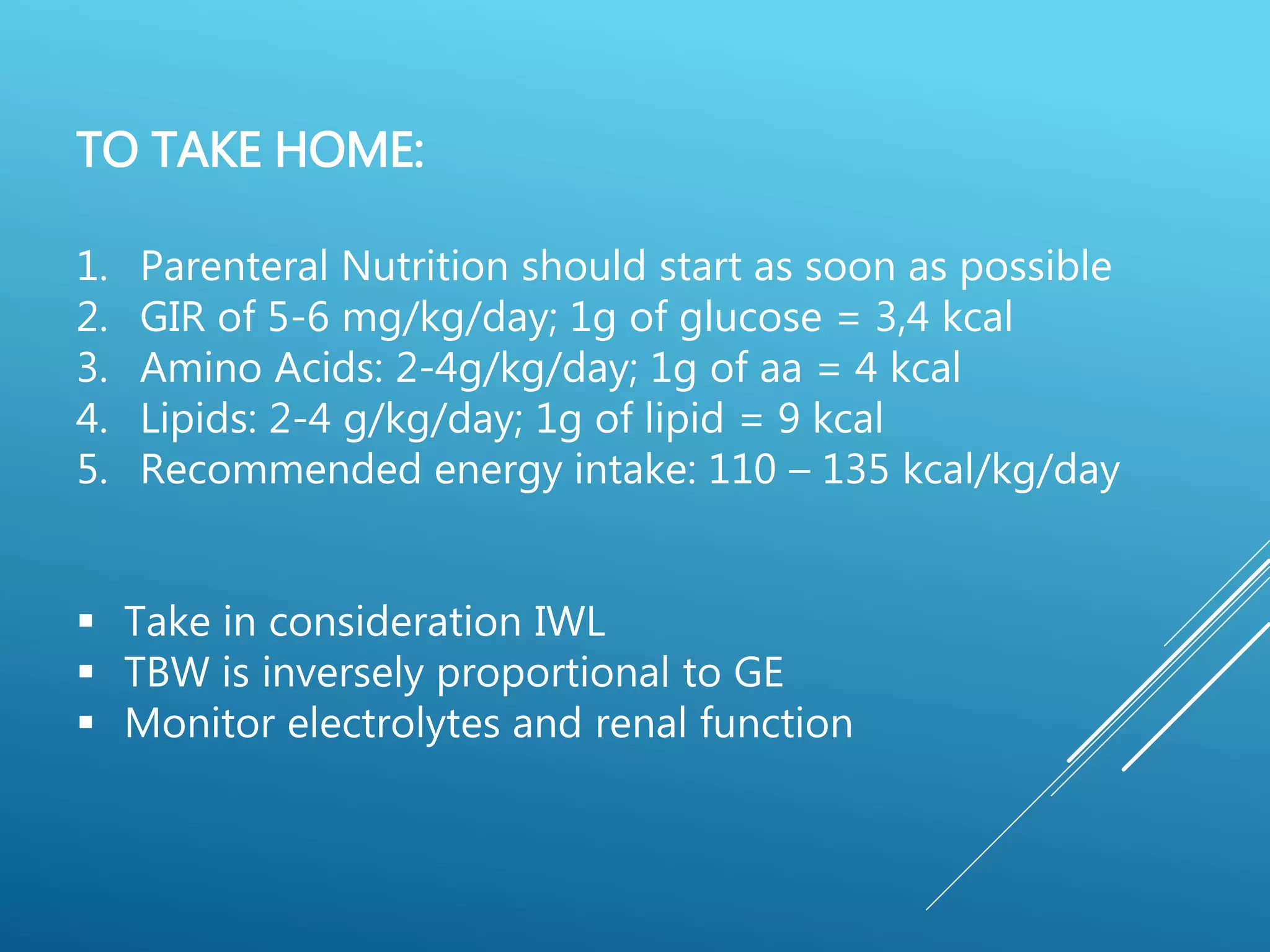
TO TAKE HOME:
1. Parenteral Nutrition should start as soon as possible
2. GIR of 5-6 mg/kg/day; 1g of glucose = 3,4 kcal
3. Amino Acids: 2-4g/kg/day; 1g of aa = 4 kcal
4. Lipids: 2-4 g/kg/day; 1g of lipid = 9 kcal
5. Recommended energy intake: 110 – 135 kcal/kg/day
 Take in consideration IWL
 TBW is inversely proportional to GE
 Monitor electrolytes and renal function
Newborn Parenteral Nutrition

Newborn Parenteral Nutrition

  • 1.
    PARENTERAL NUTRITION IN NEWBORNS Dr.Elsie Constanza Paediatrician/Neonatologist Karl Heusner Memorial Hospital NEONATAL UNIT
  • 2.
    Total body water(TBW): the total intracellular and extracellular fluids Extracellular fluids (ECF): the total Intravascular and Interstitial fluids Insensible water loss (IWL): the evaporation of water through the skin, respiratory tract and mucous membranes Definitions R. Bissinger. D. Annibale, GOLDEN HOURS, Care of the VLBWI , Chicago Ill, 2014
  • 3.
    General Principles  Wateraccounts for 75%-95% of an infant’s body weight  TBW is inversely proportional to GE.  First week of life: physiologic weight loss due to contraction of ECF. VLBW infants – 10%-15% Term infants – 10% R. Bissinger. D. Annibale, GOLDEN HOURS, Care of the VLBWI , Chicago Ill, 2014
  • 4.
    ELBW infants atlower GE have the highest Trans- epidermal water loss (TEWL) *Humidified incubator with Porthole sleeves ready on admission for infants < 32weeks and/or <1,200 grams to decrease TEWL R. Bissinger. D. Annibale, GOLDEN HOURS, Care of the VLBWI , Chicago Ill, 2014
  • 5.
    FACTORS AFFECTING IWL INCREASEDECREASE Low maturity High maturity Low relative humidity Increasing postnatal age Ambient temperature exceeding neutral thermal environment High environmental relative humidity Skin defects (omphalocele, gastroschisis) High ventilator relative humidity Phototherapy and use of radient warmer Oh W, Fluid and Electrolyte Management of VLBW Infants, Pediatrics and Neonatology 2012
  • 6.
    IWL: Intake – Output(mainly urine) - ∆ in weight Oh W, Fluid and Electrolyte Management of VLBW Infants, Pediatrics and Neonatology 2012
  • 7.
    Urine output: 1-3ml/kg/hr Urinespecific gravity: 1005-1012 is consistent with a balance in TBW Urine Osmolarity : (specific gravity – 1000) x 30 •Premature: 500mosm/l (spec. gravity 1020-1025) •AT: 800 mosm/l (specific gravity 1030) Serum electrolytes and Cr should be routinely monitored to evaluate Renal Function and Fluid balance. *Na+ / Cr / BUN R. Bissinger. D. Annibale, GOLDEN HOURS, Care of the VLBWI , Chicago Ill, 2014
  • 8.
    Maintenance Fluid RequirementsDuring the first week of Life Birth Weight (g) IWL (ml/kg/d) Dextrose (g/100ml) Day 1-2 (ml/kg/day) Day 3-7 (ml/kg/Day) <750 100+ 5-10 100-200 120-200 750-1,000 60-70 10 80-150 100-150 1,001-1,500 30-65 10 60-100 80-150 >1,500 15-30 10 60-80 100-150 Fanaroff and Martin’s Neonatal-Perinatal Medicine: Diseases of the Fetus and Infant. 10th Ed. Elsevier, 2015
  • 9.
    ESTIMATED ENERGY REQUIRMENTSFOR GROWING PREMATURE INFANTS Energy Expenditure Kcal/kg/d Resting metabolic rate 40-60 Activity 0-5 Thermoregulation 0-5 Synthesis/energy cost of growth 15 Energy stored 20-30 Energy excreted 15 Total energy requirement (estimated) 90-120 Fanaroff and Martin’s Neonatal-Perinatal Medicine: Diseases of the Fetus and Infant. 10th Ed. Elsevier, 2015
  • 10.
    RECOMMENDED ENERGY INTAKE American Academy of Pediatrics: 105-130 kcal/kg/day for preterm infants  ESPGHAN (Committee on Nutrition): 110-135 kcal/kg/day Fanaroff and Martin’s Neonatal-Perinatal Medicine: Diseases of the Fetus and Infant. 10th Ed. Elsevier, 2015
  • 11.
    FORMS OF ADMINISTRATION PERIPHERAL:max osmolarity 900 mOsm/l  Limits increase of energy , Dext 12.5%.  Short term nutrition  Risk of infiltration, phlebitis, thrombosis CENTRAL : osmolarity >1000mOsm/l  Prolonged Nutrition  Dext > 12.5% ASPEN Nutrition Support Practice Manual 2nd Edition, 2005
  • 12.
    COMPONENTS  Macronutrients  Aminoacids  Carbohydrates  Lipids  Micronutrients:  Electrolytes: Mg, K, Na  Minerals  Vitamins  Calcium Gluconate ASPEN Nutrition Support Practice Manual 2nd Edition, 2005
  • 13.
  • 14.
    OSMOLARITY DEPENDS MOSTLYON: • DEXTROSE 5mOsml/gr • AMINO ACIDS 10mOsml/gr • ELECTROLYTES 1mOsml/mEq mOsm/L: Total of Osmol x 1000 total volume in TPN PLASMA OSMOLARITY: 280 -290 mosm/L 2x Na + Glucose mg/dl + BUN mg/dl 18 2,8 ASPEN Nutrition Support Practice Manual 2nd Edition, 2005
  • 15.
    DEXTROSE Normal Glucose Requirements GlucoseInfusion Rate (GIR): • Preterm: 6-8mg/kg/min • Term: 3-5mg/kg/min Normal glucose level: 50-120 mg/dl 1 gram of glucose = 3,4 kcal R. Bissinger. D. Annibale, GOLDEN HOURS, Care of the VLBWI , Chicago Ill, 2014
  • 16.
    Infants who requirehigh infusion rates or a dextrose concentration (Tenor) > 12.5% require placement of central venous catheter (UVC, PICC) Tenor: Total Glucose (g) x100 Total fluids in IV Total grams of glucose= GIR (mg) x Weight (kg) x 1.44 R. Bissinger. D. Annibale, GOLDEN HOURS, Care of the VLBWI , Chicago Ill, 2014
  • 17.
    Dextrose solutions andformulas: D5W D30W D10W D50W D10W: Glucose (g) - RV 0,05 D5W: Remaining volume (RV) – D10W D30W: Glucose (g) – RV 0,2 2 D50W: Glucose (g) x 10 – RV 4
  • 18.
    AMINO ACIDS Recommended Proteinintake: 3 – 4 g/kg/day in VLBW infants 1g of aa = 4 kcal This account for obligate protein loss of (1.5 – 2.0 g/kg/day) This will:  limits catabolism  improve protein balance  preserve endogenous protein stores R. Bissinger. D. Annibale, GOLDEN HOURS, Care of the VLBWI , Chicago Ill, 2014
  • 19.
    Parenteral Amino AcidSolutions Aminosyn 10% TrophAmine 10% Primene 10% * Presentation also available as 8,5% Fanaroff and Martin’s Neonatal-Perinatal Medicine: Diseases of the Fetus and Infant. 10th Ed. Elsevier, 2015
  • 20.
    LIPIDS Intravenous lipids:  Preventsessential fatty acids deficiency (EFAD) (linoleic/linolenic acids)  Provides a significant source of non-protein energy.  Requirments 1-4 g/kg/day 1g of lipid = 9 kcal EFAD can be avoided with 0.5 – 1.0 g/kg/day of IV lipids in the first 24 hrs of life. R. Bissinger. D. Annibale, GOLDEN HOURS, Care of the VLBWI , Chicago Ill, 2014
  • 21.
     Intralipids areavailable as 10% and 20%  20% solutions are preferred due to lower cholesterol and plasma triglyceride levels.  IV lipid solutions have LCT (>12C)  Maintain serum glucose levels  Monitor Triglycerides: <200 mg/dl and < 140mg/dl with hyperbilirubinemia R. Bissinger. D. Annibale, GOLDEN HOURS, Care of the VLBWI , Chicago Ill, 2014
  • 22.
    Care should betaken in:  Infants with unconjugated hyperbilirubinemia to avoid bilirubin toxicity as a result of free fatty acids displacing bilirubin from albumin binding sites.  Infants with BPD due to release of thromboxanes and prostaglandins, and increased pulmonary vascular resistance  Infants with increased sepsis risk Lipid intake should be limited to 40% - 50% of total calories R. Bissinger. D. Annibale, GOLDEN HOURS, Care of the VLBWI , Chicago Ill, 2014
  • 23.
    ELECTROLYTES: SODIO (NA+): Initiate:48 hrs  Requirements:  PT: 2 to 5 mEq/kg/day  AT: 2 a 4 mEq/kg/day. CLORURO DE SODIO 20%® Descripción: Formula Every 100 ml contains: Sodium Chloride USP 20,00 g Inyectable Water c.s. Each ml has: 3,4 mEq Sodium ion (Na+) 3,4 mEq Cloride ion (Cl-) Osmolarity: 6.844 mOsm/l 1mOsm/l = 1mEq (3.4x1000) x 2= 6.800 mOsm/l ASPEN Nutrition Support Practice Manual 2nd Edition, 2005
  • 24.
     Can beadm. As KCL salt or KH2PO4 salt.  Initiate: 48 hrs  Requirements:  RNPT y RNT:  1-4 mEq/kg/day. CLORURO DE POTASIO 7,5%® Descripción: Formula: Every 100 ml contains: KCL USP 7,45 g. Inyectable water c.s. Every ml has: 1 mEq (K+); 1 mEq (Cl-); Osmolarity: 2.000 mOsm/l ASPEN Nutrition Support Practice Manual 2nd Edition, 2005 ELECTROLYTES: Potassium (K+):
  • 25.
     K2PO4 13,6% 1meq/ml  Initiate with aa.  Dosis:20-40 mg/kg/day. FOSFATO MONOBÁSICO DE POTASIO 13,6%® Formula: Every 100 ml contains: Monobasic K2PO4 USP 13,61 g. Inyectable water c.s. Every ml has: 1 mEq (K+) 1 mEq (H2PO4-) Osmolarity: 2.000 mOsm/l ASPEN Nutrition Support Practice Manual 2nd Edition, 2005 ELECTROLYTES: PHOSPHUROS
  • 26.
     Mostly foundin bone tissue  Initiate at birth  Dosis: 1.5 – 4 mEq/kg/day.  Adjustment to increase dose:  Asphyxia  NB of Diabetic mother  PT and SGE ASPEN Nutrition Support Practice Manual 2nd Edition, 2005 Minerals: Calcium (Ca2+)
  • 27.
    GLUCONATO DE CALCIO10%® Descripción: Formula: Every 100 ml contains: Calcium Gluconate USP 10,00 g Inyectable water c.s. Each ml has: 0,5 mEq (Ca++) 0,5 mEq (Cl2H2O14) Osmolarity: 1000 mOsm/l ASPEN Nutrition Support Practice Manual 2nd Edition, 2005
  • 28.
    INCOMPATIBILITY Ca-P RELATION CALCIUM/PHOSPHORUS= Ca mEq/L X (P MMOL X 1.8) Ca/P Relationship < 300 to be considered safe Contemporary Nutritional Support Practice: a clinical guide. Saunder 2003
  • 29.
     Dosis: 0.25- 0.5 mEq/kg/day  Serum Mg levels before adm.  Magnesium Sulphate 50% (4meq/ml)  Osmolarity 4057 mOsm/l ASPEN Nutrition Support Practice Manual 2nd Edition, 2005 Minerals: Magnesium (Mg)
  • 30.
    TRACE MINERALS  ATand PT: 0.4 – 0.6 ml/kg/day.  Discontinue:  Copper and manganese in hepatic cholestasis.  Selenium, chromium y molybdenum in Acute Renal Disease. ASPEN Nutrition Support Practice Manual 2nd Edition, 2005 ASPEN Interdisciplinary Nutrition Support Review Course 2001
  • 31.
    ASPEN Nutrition SupportPractice Manual 2nd Edition, 2005
  • 32.
    ASPEN Nutrition SupportPractice Manual 2nd Edition, 2005 ASPEN Interdisciplinary Nutrition Support Review Course 2001
  • 33.
  • 34.
    ASPEN Nutrition SupportPractice Manual 2nd Edition, 2005 ASPEN Interdisciplinary Nutrition Support Review Course 2001
  • 35.
    WHEN TO DISCONTINUEPN? Discontinue Parenteral Nutrition when patient has a Enteral Nutrition of 100cc/kg/d Gradual omission if patient has 75% of total fluids as Enteral Nutrition and compliment with glucose at an adequate GIR. ASPEN Nutrition Support Practice Manual 2nd Edition, 2005
  • 36.
    TO TAKE HOME: 1.Parenteral Nutrition should start as soon as possible 2. GIR of 5-6 mg/kg/day; 1g of glucose = 3,4 kcal 3. Amino Acids: 2-4g/kg/day; 1g of aa = 4 kcal 4. Lipids: 2-4 g/kg/day; 1g of lipid = 9 kcal 5. Recommended energy intake: 110 – 135 kcal/kg/day  Take in consideration IWL  TBW is inversely proportional to GE  Monitor electrolytes and renal function