ROLE OF NUTRITION IN NEONATAL
WELLBEING
Dr Harvinder Palaha
Nutrition
• In utero the foetus is nourished through the
regulatory function of placenta.
• Extra uterine adaptation depends on
successful transition to the enteral route of
nutrition.
• Parenteral route for nutrition indicated in
infants whose gastrointestinal function is
compromised or where adequate nutrition can
not be provided enterally.
Proper nutrition in infancy is essential for
normal growth
immunity to infection
optimal neurologic and cognitive development.
Providing adequate nutrition to preterm infants is challenging
because of several problems, some of them unique to these
small infants. These problems include:
immaturity of bowel function
inability to suck and swallow
high risk of necrotizing enterocolitis (NEC)
illnesses that may interfere with adequate enteral feeding (e.g.
RDS, patent ductus arteriosus)
medical interventions that preclude feeding (e.g., umbilical vessel
catheters, exchange transfusion, indomethacin therapy)
Goals of nutrition-Optimizing growth
.
• Full term babies : Breast milk takes care of nutrition.
• Preterm babies:
• Fetal intestines are structurally mature by 25 weeks
gestation
• Enteral feeding plays a key role in triggering gut
development.
• Limitations of ingesting, digesting & absorbing milk
feeds
• How do we take care of nutrition in these babies?
Nutrition & low birth weight babies
• LBW babies are not a homogenous population
• Their requirements & tolerance of individual
nutrients depends on
• Gestational age
• Postnatal age
• Associated illness
• Panel of international experts considers
separate need for infants above or below
1000gms
• Weight gain
• 16–18 g/kg/d
• Length
• 0.75-1 cm/week
• Head circumference
• 0.7 cm/week
Growth Targets
Fenton TR. BMC Pediatr. 2003;3:13; Lubchenco LO et al. Pediatrics. 1966;37:403-408.
Monitor Weight, Head Circumference, Linear growth
Extra Uterine Growth Retardation
28 wks , B.wt – 730 gms ,
RDS , Sepsis , NEC.
Extrauterine growth retardation – EUGR
Wt at 1 month 720 gm
Born at 28 wks, BW 1020 gm
RDS / Pulmonary morbidity
POOR GROWTH IN NICU
1. With – holding feeds – critical illnesses
2. Slow grading up – immature gut
3. Delayed /no TPN – concerns of costs, risks
4. Unfortified EBM, Less cal / protein intake,
Nutritional sensitivity of clinicians
25 wk
term
Parenteral nutrition
Not just survival…intact survival
• Parenteral nutrition only justified if the benefits outweigh
the hazards.
• Facilities for intensive medical & nursing care & frequent
biochemical monitoring should be available.
• Most VLBWs have slow growth and suffer
nutritional deprivation
• Current nutritional strategies unable to prevent
post-natal growth failure
• Nutrition affects developmental outcome
• Need for optimal nutrition
LBW NUTRITION : CURRENT STATUS
• Early Parenteral Nutrition
• Sustaining Lactation
• Early Enteral nutrition & fortification
• Appropriate post-discharge nutrition
• Growth Monitoring
How to optimize preterm nutrition ?
Fetal Nutrition
• Continuous supply of
glucose
• *Protein accreted at
3-4 grams/Kg/day
• *Lipids at 3
grams/kg/d .
*Ziegler EE, et al Growth 1976:40(4):329-341.
• Infants receiving parenteral nutrition should be closely
monitored for metabolic and electrolyte derangements
• Minimal enteral feeds to be started if hemodynamically
stable and no contraindications
• Transition from total parental nutrition to total enteral
nutrition should be gradual and stepwise
• Breast milk is the best milk
Parenteral Nutrition in NB
The need for Lipids
• Need total of 80 Kcal/Kg/d for growth
• Glucose:
– 8 mg/kg/min~39 Kcal
• Amino Acids:
– 3 gm/kg/d=12 Kcal
• Lipids:
– Still need ~30 Kcal for 80 total
– 2.7 g /kg
Lipids : Consensus
• Many of the dogmas that have prevented
early use of intravenous lipids have either
been disproved and not evidence based.
• There are compelling reasons for early use
of lipids, which include prevention of EFA
deficiency, provision of energy and
provision of substrate for LCPUFA
synthesis.
• Some concerns remain.
Birth weight (gms) Day 1 (ml/kg/d)
Less than 750 100-140
750 -1000 100 – 120
1000 - 1500 80 - 100
> 1500 60 - 80
Birth weight (gms) Day 1 (ml/kg/d)
< 1000 100 – 150
1000 - 1500 80 - 100
> 1500 60 - 80
Avery’s diseases of Newborn 9th
edition
Cloherty. Manual of neonatal care 7th
edition
Minimal enteral feeds (10 ml / kg / day)
Human breast milk
Feed advancement 20 ml / kg / day
Human milk fortification 100 ml / kg /day
Parenteral nutrition (ELBW < 1000g )
Aminoacids 1 – 1.5 g / kg / day Day
1
Lipids 1 – 2 g / kg / day Day
1-3
Ziegler EE –J Mat – Fed – Neonatal Med, Mar 2009
Preterm Nutrition : What is ideal practice?
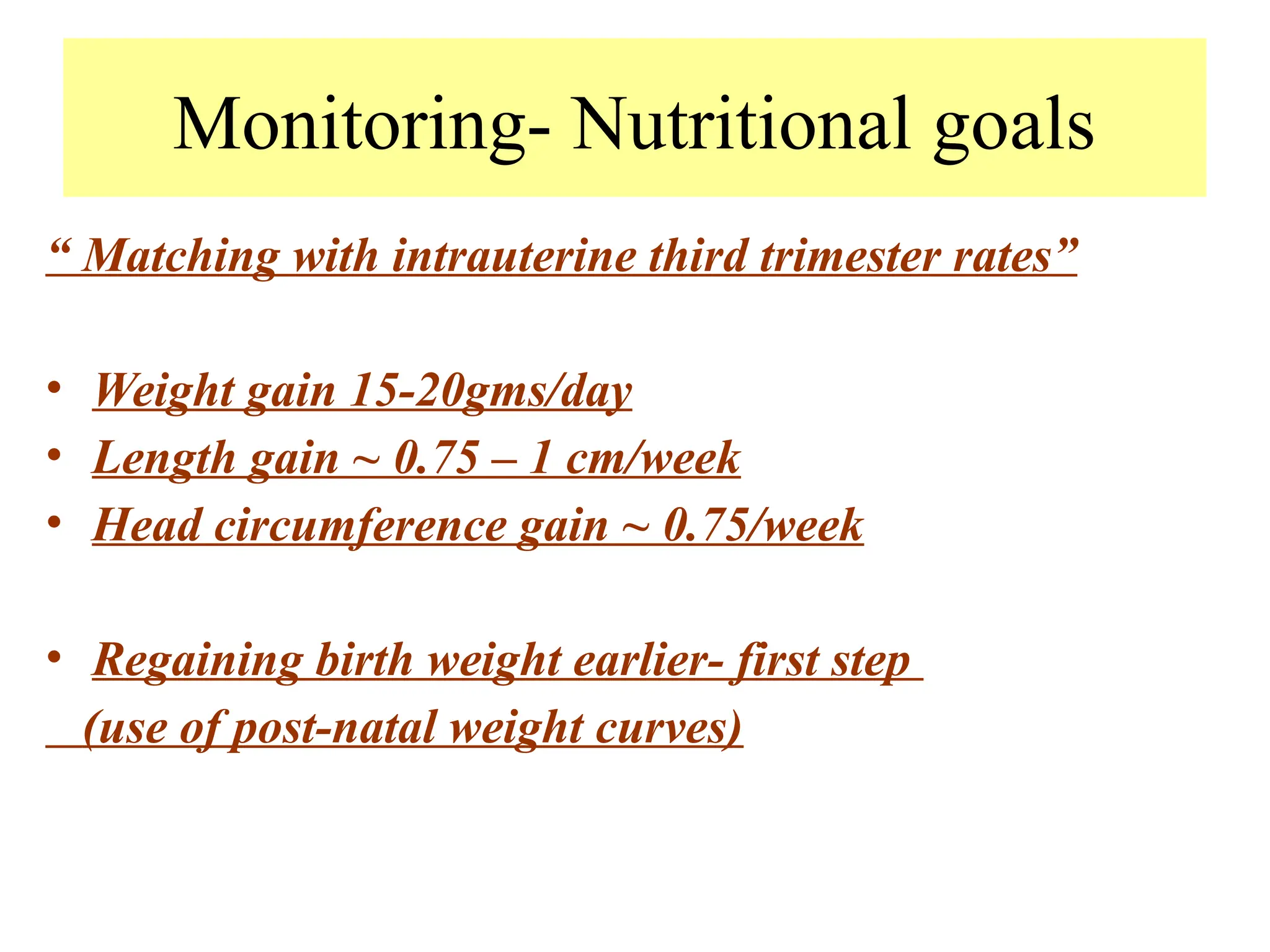
Monitoring- Nutritional goals
“ Matching with intrauterine third trimester rates”
• Weight gain 15-20gms/day
• Length gain ~ 0.75 – 1 cm/week
• Head circumference gain ~ 0.75/week
• Regaining birth weight earlier- first step
(use of post-natal weight curves)
Why PN in preterm neonates?
• Birth of a preterm LBW is a Nutritional Emergency
• 3rd
trimester of pregnancy-most nutrients are stored.
• Preterm has-minimal caloric reserve
• 1kg baby has fat only 1 % of body weight as compared
to 16%in term newborn
Goal to achieve EU growth ==IU growth
• EUGR major problem in PT-Why?
• Gastric emptying & intestinal transit times are
significantly delayed.
• Organized gut motility begins by 32-34 weeks of
gestation
• Makes PN essential for physical growth & intellectual
development.
• Infants receiving parenteral nutrition should be closely
monitored for metabolic and electrolyte derangements
• Minimal enteral feeds to be started if hemodynamically
stable and no contraindications
• Transition from total parental nutrition to total enteral
nutrition should be gradual and stepwise
• Breast milk is the best milk
Parenteral Nutrition in NB
Protocol for TPN
• What are the indications?
• When to start?
• What should be composition of TPN?
• Which units should use TPN?
• Who and how should prepare it?
• How to administer?
• Monitoring during TPN?
• How to achieve transition to TPN to TEN?
Prerequisites
• Strict asepsis during preparation and delivery
• Monitoring: clinical and metabolic
PROTOCOL FOR TOTAL PARENTERAL NUTRITION THERAPY
Meticulous approach
Multidisciplinary nutrition team
Indications
# Recommendation 1
• PT <28 weeks and/or <1000 grams
• PT <32 weeks and/or <1500 grams-unable to achieve
reasonable enteral feeds by day 3.
• Infants >32 weeks and/or >1500 grams - unlikely to
achieve 50% enteral feeds by day 5.
• Necrotizing enterocolitis
• GI obstruction
• Omphalocele/ Gastroschisis
• Volvulus
• Short Bowel Syndrome
Surgical GI conditions
# Recommendation 2
• In the ‘eligible’ preterm neonates, PN should be
started on day 1 of life, within hours of birth.
• In term neonates with surgical indications, PN
should be initiated on first day of NPO
# Recommendation 3
• ~60-70 kcal/kg are needed to meet the energy
balance and maintain nitrogen balance.
• Total energy requirements in preterm neonates 110-
120 kcal/kg (through PN) are needed for growth
(120-150 cal/kg/day).
# Recommendation 4
• Minimal glucose intake to maintain energy supply to
brain~ 4-5mg/kg/min
• Energy costs of protein synthesis and deposition ~ 2-
3mg/kg/min
• Glucose infusion rate ~6-8 mg/kg/min*
• Maximum GIR: PT- 12 mg/kg/min
Term- 13mg/kg/min
# Recommendation 5
• AA supplementation should be started on day 1
• Minimum AA dose 1.5 gm/kg/day. For positive nitrogen
balance higher dose is needed
• Adequate non-protein energy ratio (NER) should be
maintained
• Gradual step-up in the dosage by 1 gm/kg/d
• Maximum amino acid dose should not exceed
4gm/kg/day
# Recommendation 6
• Lipid supplementation should start on day1
• Should provide 25-40% of NPC
• Maximum lipid dose ~ 3gm/kg/day
• Lipids should be given as continuous infusion over 24
hours
• Serum triglycerides should be closely monitored
(< 200mg/dl)
B. Intermittent Vs continuous
• To be given separately by a constant infusion over
24 hrs ( max rate 0.25 g/kg/hr)
• Lipid clearance better with continuous infusion
• Combination with dextrose – more efficient
utilization of calories
• Lipid infusion rate > 0.25 g/kg/hr
associated with  in Po2 ( Brans et al)
Total Parenteral Nutrition is indicated
when adequate enteral nutrition can not
be provided
Ideal PN =adequate proportions of glucose,
proteins, fats, vitamins and minerals
Distribution of energy sources
Glucose = 60%
Protein= 10%
Fat = 30%
Maintaining an anabolic state of metabolism
• E intake > E expenditure + E losses (anabolic state)
“Weight gain”
• E intake < E expenditure + E losses (catabolic state)
(Energy expenditure= BMR + activity + thermoregulation + growth)
Extrauterine Malnutrition
STRICT
ASEPSIS
• TPN Calculations: manual / automatic
• Use of software desirable.
(manual calculations- 30% error)
Nutrition in ELBW- Energy balance
• BMR 65-75 cal/kg/day
• Dynamic action 10 cal/kg/day
• Excretory losses 10 cal/kg/day
• Stress~ ??
• Energy cost of growth 25 cal/kg/day
• Energy requirements of ELBW infant =110-120
cal/kg/day
(120-150cal/kg/d)
E-Expenditure without growth
Care of TPN infusion lines
• Asepsis, asepsis, and asepsis
• Avoid breaking into the central line
• No blood transfusions or drawing blood samples
from central line
• Administration of medications preferably through
separate line
• If necessary, flush the line with saline and
administer the medication
Parameter Initial period (First 3-4 days) Established PN
Weight (grams) Same time each day Same time each day
Length (cm) - Weekly
Head
circumference
(cm)
- Weekly
Blood Sugar Twice daily Once daily
Urine sugar Once daily Once daily
Blood gas Depending on hemodynamic
stability
Once weekly
Serum sodium,
Potassium,
chloride
Every 24-48 hourly, can be
done more
frequently if clinical signs
demand
Once weekly
Serum calcium,
Phosphorous,
Magnesium
Every 24-48 hourly, can be
done more
frequently if clinical signs
demand
Once weekly
Urea, Creatinine Every 48-72 hours Once weekly
Serum
Triglyceride
Before initiating and with
increment
of lipid dose
Once weekly
Liver function
test
Before initiating lipids Depending on clinical
signs
Monitoring- Biochemical
KEMH Trial
Controlgroup: 17
neonates(cTPN)
i) Amino acids= 3 grams/ kg/ day
ii) Lipids= 2 grams/ kg/day
• ETPN started within 24 hours of
life
i) Amino acids= 1 grams/ kg/day
ii) Lipids= 0 gram/ kg/day
• LTPN started within 48 hours of
life
Intervention group: 17
neonates (eTPN)
Study design: Prospective Randomized Controlled
Trial
Umesh Vaidya, Amit Tagare, Meenal Walawalkar, KEMH, 2010
CONCLUSIONS : KEM TRIAL
AGGRESSIVE PN GROUP
1. Nitrogen retention better.
2. Caloric intake were significantly higher
3. Well tolerated
4. Trend towards better weight gain & early
discharge
Umesh Vaidya, Amit Tagare, Meenal Walawalkar, KEMH, 2010
Consensus : OPTIMAL GROWTH
Early life (infancy)
Prudent to favour improved neurologic outcome
over other outcomes (Wt gain 15-20 g/kg/day)
Childhood
Avoid “rapid” catch up and adiposity
• Initial birth weight: 1280 gm
• Birth weight regained on day 34 of life: 1290 grams
• Growth velocity associated with developmental
outcome at 18–22 months’ corrected age
• N=495
• 501–1000 g
• Incidence of cerebral palsy, Mental Developmental
Index (MDI) <70, and Psychomotor Developmental
Index (PDI) <70 increased in the groups with
slower growth velocity
Significance of Ehrenkranz study
Ehrenkranz RA et al. Pediatrics. 2006;117:1253-1261.
Case, Baby of MI 28 wks, BW 1280 gm
DAYS NUTRITION
DAY 1 TPN (1.5 gm amino acids; 1.5 gm lipids)
DAY 2 minimal enteral feeding
DAY 2-8 grading up of feeds
HMF started
DAY 9-30 fortified milk- full feeds
DAY 33-34 sodium supplementation
DAY 5- 35 transition oral feeds- discharge
Weight gain: Day 9 –30 - 10 gm / day
Energy requirements in Preterms
• 120 Kcal/Kg/d if on Enteral Feeding
• 80-100 Kcal/Kg/d if on Parenteral Nutrition
• Resting energy expenditure (REE) 50 kcal/kg
• Each gram of weight gain requires 3–4.5 kcal
Therefore a weight gain of 15 g/kg/d requires
45–67 kcal above REE
AAP Committee on Nutrition. Pediatric Nutrition Handbook. 6th
ed. American Academy of
Pediatrics; 2009.
• Growth velocity associated with developmental
outcome at 18–22 months’ corrected age
• N=495
• 501–1000 g
• Incidence of cerebral palsy, Mental Developmental
Index (MDI) <70, and Psychomotor Developmental
Index (PDI) <70 increased in the groups with
slower growth velocity
Significance of Ehrenkranz study
Ehrenkranz RA et al. Pediatrics. 2006;117:1253-1261.
Early aggressive protein to reduce deficits
(Dinerstein, 2006)
Early Amino Acids
Study N Gestational
age (wks)/
BWT (g)
Protein
(g/kg/day)
Initiation
(hr of
life)
Outcome
Rivera
(1993)
23
(11*)
28.5 wks/1000
g, mean both
groups
1.5 HAA
vs 0 LAA
15 +N balance,
protein synthesis,
+insulin secretion
Thureen
(2003)
28
(15*)
27.3 wks;
945 g LAA
3 HAA vs
1 LAA
25 +N balance,
protein synthesis,
+insulin, +plasma
aminogram
27.0 wks
947 g HAA
Rivera A Jr, et al. Pediatr Res. 1993;33:106-111; Thureen PJ et al. Pediatr Res. 2003;53:24-32.
BWT=birth weight; LAA=low amino acid intake group; HAA=high amino acid
intake group
*No. in HAA group
Denne SC, J Clin Invest 1996
GLUCOSE ALONE AS NUTRITION
(26 weeks, 1000g)
BUN not correlated to protein intake (Ridout, 2005)
DEFINING GROWTH TARGETS FOR OPTIMAL
NUTRITION
23 – 37 weeks 16 g / kg / day
Weight alone ? Adiposity ?
Lipids : Tradition more than science
• Many NICUs start with IV lipids after the
first several days after birth
• Advance very slowly: 0.5, 1.0, etc. every
few days
• Effects of high glucose infusions
Early Lipid administration
“Intravenous Lipids Are
Poison”
Anonymous Neonatologist—Early 1980’s
Bilirubin Displacement: Free Fatty Acids (FFA)
• In vitro, at high molar ratios (greater than 5:1)
FFA's compete with bilirubin for albumin
binding at the secondary sites as well.1
• In vivo, there is no generation of unbound
bilirubin if FAA:Alb is below 6 2
.
1. Odell GB J Lab Clin Med. 1977 Feb;89(2):295-307
2. Andrew G J. Pediatr 88:273-279, 1976.
Lipids – Pulmonary Functions
1. Decrease pulmonary gas exchange
2. Impaired vascular tone due to formation of PG &
thromboxane – May lead to pulmonary HT
3. Infiltration of pulmonary tissue by lipid particles –
increases risk of Chronic Lung Disease
4. Increase Membrane oxidant damage –
due to peroxy lipids – free radical injuries
5. Increased incidence of Pulmonary hemorrhage
High vs Low Protein Intake for VLBW Infants
• Weight gain, g/kg/d 2.3 1.3, 3.4
• Head growth, cm/week 0.37 0.16,
0.58
• Nitrogen balance, mg/kg/d 144 129,
159
• Protein balance, g/kg/d 0.9 0.8, 1.0
• BUN, mg/dL 1.9 1.0, 2.8
• Prealbumin, mg/dL 44 24, 64
WMD
IQ Score <90 at 3 y adjusted age: RR 0.3 (0.14, 0.64)
High Protein diet is associated with a 70% reduction in
IQ<90 at 3 y adjusted age!
Premji et al, Cochrane Database of Systematic Reviews 2006 (1)
95 % CI
Issues in India
• Selection of cut off (BW) for routine early PN
• Wider availability of PN products and training
• Complete the market
• Standard PN preparations ,phosphate ,MVI prep
• Creation of TPN nutritionist cadres
• Research on short term morbidity and long term
outcomes
• SGA babies ? Eligible for early PN
• Cost reduction strategies
 28 yrs old lady delivers a male baby
weighing 1000gms at 31weeks gestation
by LSCS done i/v/o reversal of diastolic
flow on antenatal USG.
 Baby is apnoeic at birth and requires bag
and mask ventilation for 1 min after which
his vitals stabilise and he is shifted to
NICU under your care.
Antenatal USG s/o fetal compromise
 The baby intubated and put on mechanical
ventilation. He is given ‘early rescue’ of
surfactant therapy, empirical first line
antibiotics started.
 How would you ensure nutrition in this baby?
Antenatal USG s/o fetal compromise
 What would be the starting fluid volume?
 What would be the target calorie?
 How much protein / lipid/ glucose ?
 Minerals, trace elements, vitamins?
 When to start amino acids/lipids/electrolytes?
 When to start feeds?
 What would be the starting fluid volume?
 What would be the target calorie?
 How much protein / lipid/ glucose ?
 Minerals, trace elements, vitamins?
 When to start amino acids/lipids/electrolytes?
 When to start feeds?
 Fluid volume- 80cc/kg/day
 Calories- 70kcal/kg/day
 GDR-4-6mg/kg/min
 Proteins- 2gm/kg/day
 Protein/non-protein calorie ratio -1gm/30 cal
 Lipids-0.5gm/kg/min
 Calcium- 75- 150 mg/kg/day
 No Na,K
 Trace elements -
 Trophic feeds (MEN) -10cc/kg/day
 Resting metabolic rate-40-60kcal/kg/day
 No calorie allowance for growth
 Just enough calories to prevent catabolism
 Adding Lipids..................
 Total fluid volume to be given?
2/3rd
fluid restriction....? 60 – 80% of
maintenance
 Feeding decision-continue/advance/stop?
Continued, decision to advance based on
tolerance to feeds
 Optimisation of calories
Ensure GDR 6-8 mg/kg/min ; Proteins-
3gm/kg/day
Lipids ......
 D5 -medical closure of PDA achieved
 EBM ,bolus feeding through tube continued &
advanced as per protocol.
 Weaning and extubation planned.
 D 8 - abdominal distension and altered RT
aspirates, no bowel sounds. ?NEC
 Sepsis screen, biochemical parameters
evaluated.
 Antibiotics changed , decided to keep NBM ??
days
 NBM
 TN/ PPN
 Bolus feeding restarted after 14 days
 Advanced gradually , baby tolerated it well.
 Reached full feeds by 34 days of life
 On fortified human milk ( HMF) receiving
Total 140cal/kg/day ;
3 g/kg/d proteins
fluid 150 ml/kg/d
 Failure of extubation trials
 Still on ventilator
PIP – 18 ; PEEP -4 ; FiO2 21%; VR – 35/min;iT-
0.3sec
 X-ray s/o hyperinflation with reticulo-granular
pattern
 pH 7.44 pCo2 48 pO2 66 HCO3 20
 Modification of feeding volume
Restriction of feeding volume to 60-80%
 Calorie density of feeds
Isodense feeds---1ml=1 cal
 Continuous vs bolus feeds
 Associated gastro-esophageal reflux
 Prokinetics,probiotics, antacids
EBM 50cc +1 sachet HMF+ 1 ml coconut oil
provides -- -isodense feeds
50cal/50cc EBM i.e. 1cal/1cc EBM
33 cal EBM+ (67cal/100ml)
8 cal HMF+ (1sachet=8cal)
1 ml oil (1ml oil=9cal)
Total volume – 150cc/kg/d ; Total calories –150
cal/kg/day
So give either 150cc / 24hrs as continuous
feeds OR
13 cc 2hrly bolus feeds
Constituen
t
Content/
2gm
carbohydrate 1.46gm
phosphorus 25mg
Sodium 1.75 meq
potassium 3.9meq
chloride 4.4meq
protein 0.2gms
zinc 0.18gms
vitB2 20mcg
Constituen
t
Content/
2gm
manganese 1.7mcg
Vit D 38IU
biotin 0.5mcg
vitK 1.1mcg
fat 0.1gm
calcium 50mg
magnesium 4mg
energy 7.8cal
 Providing adequate calories and proteins in acutely
ill neonates may be difficult
 Early enteral feeding should be ensured
 Breast feeding is the best feed
 Optimisation of nutrition requires titration based
on clinical condition and investigations
LET US THINK NUTRITION !!!
TODAY’S NUTRITION IS
TOMORROW’S OUTCOME!
THANK YOU
Acknowledgement-
Dr Manjula Rupani
Dr Vinay Joshi
Mumbai

Neonatal Nutrition steps and problems and management

  • 1.
    ROLE OF NUTRITIONIN NEONATAL WELLBEING Dr Harvinder Palaha
  • 2.
    Nutrition • In uterothe foetus is nourished through the regulatory function of placenta. • Extra uterine adaptation depends on successful transition to the enteral route of nutrition. • Parenteral route for nutrition indicated in infants whose gastrointestinal function is compromised or where adequate nutrition can not be provided enterally.
  • 3.
    Proper nutrition ininfancy is essential for normal growth immunity to infection optimal neurologic and cognitive development. Providing adequate nutrition to preterm infants is challenging because of several problems, some of them unique to these small infants. These problems include: immaturity of bowel function inability to suck and swallow high risk of necrotizing enterocolitis (NEC) illnesses that may interfere with adequate enteral feeding (e.g. RDS, patent ductus arteriosus) medical interventions that preclude feeding (e.g., umbilical vessel catheters, exchange transfusion, indomethacin therapy)
  • 4.
    Goals of nutrition-Optimizinggrowth . • Full term babies : Breast milk takes care of nutrition. • Preterm babies: • Fetal intestines are structurally mature by 25 weeks gestation • Enteral feeding plays a key role in triggering gut development. • Limitations of ingesting, digesting & absorbing milk feeds • How do we take care of nutrition in these babies?
  • 5.
    Nutrition & lowbirth weight babies • LBW babies are not a homogenous population • Their requirements & tolerance of individual nutrients depends on • Gestational age • Postnatal age • Associated illness • Panel of international experts considers separate need for infants above or below 1000gms
  • 6.
    • Weight gain •16–18 g/kg/d • Length • 0.75-1 cm/week • Head circumference • 0.7 cm/week Growth Targets Fenton TR. BMC Pediatr. 2003;3:13; Lubchenco LO et al. Pediatrics. 1966;37:403-408. Monitor Weight, Head Circumference, Linear growth
  • 7.
    Extra Uterine GrowthRetardation 28 wks , B.wt – 730 gms , RDS , Sepsis , NEC.
  • 8.
    Extrauterine growth retardation– EUGR Wt at 1 month 720 gm Born at 28 wks, BW 1020 gm RDS / Pulmonary morbidity
  • 9.
    POOR GROWTH INNICU 1. With – holding feeds – critical illnesses 2. Slow grading up – immature gut 3. Delayed /no TPN – concerns of costs, risks 4. Unfortified EBM, Less cal / protein intake, Nutritional sensitivity of clinicians
  • 10.
  • 11.
    Parenteral nutrition Not justsurvival…intact survival • Parenteral nutrition only justified if the benefits outweigh the hazards. • Facilities for intensive medical & nursing care & frequent biochemical monitoring should be available.
  • 13.
    • Most VLBWshave slow growth and suffer nutritional deprivation • Current nutritional strategies unable to prevent post-natal growth failure • Nutrition affects developmental outcome • Need for optimal nutrition LBW NUTRITION : CURRENT STATUS
  • 14.
    • Early ParenteralNutrition • Sustaining Lactation • Early Enteral nutrition & fortification • Appropriate post-discharge nutrition • Growth Monitoring How to optimize preterm nutrition ?
  • 15.
    Fetal Nutrition • Continuoussupply of glucose • *Protein accreted at 3-4 grams/Kg/day • *Lipids at 3 grams/kg/d . *Ziegler EE, et al Growth 1976:40(4):329-341.
  • 16.
    • Infants receivingparenteral nutrition should be closely monitored for metabolic and electrolyte derangements • Minimal enteral feeds to be started if hemodynamically stable and no contraindications • Transition from total parental nutrition to total enteral nutrition should be gradual and stepwise • Breast milk is the best milk Parenteral Nutrition in NB
  • 17.
    The need forLipids • Need total of 80 Kcal/Kg/d for growth • Glucose: – 8 mg/kg/min~39 Kcal • Amino Acids: – 3 gm/kg/d=12 Kcal • Lipids: – Still need ~30 Kcal for 80 total – 2.7 g /kg
  • 18.
    Lipids : Consensus •Many of the dogmas that have prevented early use of intravenous lipids have either been disproved and not evidence based. • There are compelling reasons for early use of lipids, which include prevention of EFA deficiency, provision of energy and provision of substrate for LCPUFA synthesis. • Some concerns remain.
  • 19.
    Birth weight (gms)Day 1 (ml/kg/d) Less than 750 100-140 750 -1000 100 – 120 1000 - 1500 80 - 100 > 1500 60 - 80 Birth weight (gms) Day 1 (ml/kg/d) < 1000 100 – 150 1000 - 1500 80 - 100 > 1500 60 - 80 Avery’s diseases of Newborn 9th edition Cloherty. Manual of neonatal care 7th edition
  • 20.
    Minimal enteral feeds(10 ml / kg / day) Human breast milk Feed advancement 20 ml / kg / day Human milk fortification 100 ml / kg /day Parenteral nutrition (ELBW < 1000g ) Aminoacids 1 – 1.5 g / kg / day Day 1 Lipids 1 – 2 g / kg / day Day 1-3 Ziegler EE –J Mat – Fed – Neonatal Med, Mar 2009 Preterm Nutrition : What is ideal practice?
  • 40.
    Monitoring- Nutritional goals “Matching with intrauterine third trimester rates” • Weight gain 15-20gms/day • Length gain ~ 0.75 – 1 cm/week • Head circumference gain ~ 0.75/week • Regaining birth weight earlier- first step (use of post-natal weight curves)
  • 44.
    Why PN inpreterm neonates? • Birth of a preterm LBW is a Nutritional Emergency • 3rd trimester of pregnancy-most nutrients are stored. • Preterm has-minimal caloric reserve • 1kg baby has fat only 1 % of body weight as compared to 16%in term newborn Goal to achieve EU growth ==IU growth • EUGR major problem in PT-Why? • Gastric emptying & intestinal transit times are significantly delayed. • Organized gut motility begins by 32-34 weeks of gestation • Makes PN essential for physical growth & intellectual development.
  • 45.
    • Infants receivingparenteral nutrition should be closely monitored for metabolic and electrolyte derangements • Minimal enteral feeds to be started if hemodynamically stable and no contraindications • Transition from total parental nutrition to total enteral nutrition should be gradual and stepwise • Breast milk is the best milk Parenteral Nutrition in NB
  • 46.
    Protocol for TPN •What are the indications? • When to start? • What should be composition of TPN? • Which units should use TPN? • Who and how should prepare it? • How to administer? • Monitoring during TPN? • How to achieve transition to TPN to TEN?
  • 47.
    Prerequisites • Strict asepsisduring preparation and delivery • Monitoring: clinical and metabolic PROTOCOL FOR TOTAL PARENTERAL NUTRITION THERAPY Meticulous approach Multidisciplinary nutrition team
  • 48.
    Indications # Recommendation 1 •PT <28 weeks and/or <1000 grams • PT <32 weeks and/or <1500 grams-unable to achieve reasonable enteral feeds by day 3. • Infants >32 weeks and/or >1500 grams - unlikely to achieve 50% enteral feeds by day 5.
  • 49.
    • Necrotizing enterocolitis •GI obstruction • Omphalocele/ Gastroschisis • Volvulus • Short Bowel Syndrome Surgical GI conditions
  • 50.
    # Recommendation 2 •In the ‘eligible’ preterm neonates, PN should be started on day 1 of life, within hours of birth. • In term neonates with surgical indications, PN should be initiated on first day of NPO
  • 51.
    # Recommendation 3 •~60-70 kcal/kg are needed to meet the energy balance and maintain nitrogen balance. • Total energy requirements in preterm neonates 110- 120 kcal/kg (through PN) are needed for growth (120-150 cal/kg/day).
  • 52.
    # Recommendation 4 •Minimal glucose intake to maintain energy supply to brain~ 4-5mg/kg/min • Energy costs of protein synthesis and deposition ~ 2- 3mg/kg/min • Glucose infusion rate ~6-8 mg/kg/min* • Maximum GIR: PT- 12 mg/kg/min Term- 13mg/kg/min
  • 53.
    # Recommendation 5 •AA supplementation should be started on day 1 • Minimum AA dose 1.5 gm/kg/day. For positive nitrogen balance higher dose is needed • Adequate non-protein energy ratio (NER) should be maintained • Gradual step-up in the dosage by 1 gm/kg/d • Maximum amino acid dose should not exceed 4gm/kg/day
  • 54.
    # Recommendation 6 •Lipid supplementation should start on day1 • Should provide 25-40% of NPC • Maximum lipid dose ~ 3gm/kg/day • Lipids should be given as continuous infusion over 24 hours • Serum triglycerides should be closely monitored (< 200mg/dl)
  • 55.
    B. Intermittent Vscontinuous • To be given separately by a constant infusion over 24 hrs ( max rate 0.25 g/kg/hr) • Lipid clearance better with continuous infusion • Combination with dextrose – more efficient utilization of calories • Lipid infusion rate > 0.25 g/kg/hr associated with  in Po2 ( Brans et al)
  • 56.
    Total Parenteral Nutritionis indicated when adequate enteral nutrition can not be provided
  • 57.
    Ideal PN =adequateproportions of glucose, proteins, fats, vitamins and minerals Distribution of energy sources Glucose = 60% Protein= 10% Fat = 30%
  • 58.
    Maintaining an anabolicstate of metabolism • E intake > E expenditure + E losses (anabolic state) “Weight gain” • E intake < E expenditure + E losses (catabolic state) (Energy expenditure= BMR + activity + thermoregulation + growth) Extrauterine Malnutrition
  • 59.
  • 60.
    • TPN Calculations:manual / automatic • Use of software desirable. (manual calculations- 30% error)
  • 61.
    Nutrition in ELBW-Energy balance • BMR 65-75 cal/kg/day • Dynamic action 10 cal/kg/day • Excretory losses 10 cal/kg/day • Stress~ ?? • Energy cost of growth 25 cal/kg/day • Energy requirements of ELBW infant =110-120 cal/kg/day (120-150cal/kg/d) E-Expenditure without growth
  • 62.
    Care of TPNinfusion lines • Asepsis, asepsis, and asepsis • Avoid breaking into the central line • No blood transfusions or drawing blood samples from central line • Administration of medications preferably through separate line • If necessary, flush the line with saline and administer the medication
  • 63.
    Parameter Initial period(First 3-4 days) Established PN Weight (grams) Same time each day Same time each day Length (cm) - Weekly Head circumference (cm) - Weekly Blood Sugar Twice daily Once daily Urine sugar Once daily Once daily Blood gas Depending on hemodynamic stability Once weekly Serum sodium, Potassium, chloride Every 24-48 hourly, can be done more frequently if clinical signs demand Once weekly Serum calcium, Phosphorous, Magnesium Every 24-48 hourly, can be done more frequently if clinical signs demand Once weekly Urea, Creatinine Every 48-72 hours Once weekly Serum Triglyceride Before initiating and with increment of lipid dose Once weekly Liver function test Before initiating lipids Depending on clinical signs Monitoring- Biochemical
  • 65.
    KEMH Trial Controlgroup: 17 neonates(cTPN) i)Amino acids= 3 grams/ kg/ day ii) Lipids= 2 grams/ kg/day • ETPN started within 24 hours of life i) Amino acids= 1 grams/ kg/day ii) Lipids= 0 gram/ kg/day • LTPN started within 48 hours of life Intervention group: 17 neonates (eTPN) Study design: Prospective Randomized Controlled Trial Umesh Vaidya, Amit Tagare, Meenal Walawalkar, KEMH, 2010
  • 66.
    CONCLUSIONS : KEMTRIAL AGGRESSIVE PN GROUP 1. Nitrogen retention better. 2. Caloric intake were significantly higher 3. Well tolerated 4. Trend towards better weight gain & early discharge Umesh Vaidya, Amit Tagare, Meenal Walawalkar, KEMH, 2010
  • 67.
    Consensus : OPTIMALGROWTH Early life (infancy) Prudent to favour improved neurologic outcome over other outcomes (Wt gain 15-20 g/kg/day) Childhood Avoid “rapid” catch up and adiposity
  • 68.
    • Initial birthweight: 1280 gm • Birth weight regained on day 34 of life: 1290 grams
  • 69.
    • Growth velocityassociated with developmental outcome at 18–22 months’ corrected age • N=495 • 501–1000 g • Incidence of cerebral palsy, Mental Developmental Index (MDI) <70, and Psychomotor Developmental Index (PDI) <70 increased in the groups with slower growth velocity Significance of Ehrenkranz study Ehrenkranz RA et al. Pediatrics. 2006;117:1253-1261.
  • 70.
    Case, Baby ofMI 28 wks, BW 1280 gm DAYS NUTRITION DAY 1 TPN (1.5 gm amino acids; 1.5 gm lipids) DAY 2 minimal enteral feeding DAY 2-8 grading up of feeds HMF started DAY 9-30 fortified milk- full feeds DAY 33-34 sodium supplementation DAY 5- 35 transition oral feeds- discharge Weight gain: Day 9 –30 - 10 gm / day
  • 72.
    Energy requirements inPreterms • 120 Kcal/Kg/d if on Enteral Feeding • 80-100 Kcal/Kg/d if on Parenteral Nutrition • Resting energy expenditure (REE) 50 kcal/kg • Each gram of weight gain requires 3–4.5 kcal Therefore a weight gain of 15 g/kg/d requires 45–67 kcal above REE AAP Committee on Nutrition. Pediatric Nutrition Handbook. 6th ed. American Academy of Pediatrics; 2009.
  • 74.
    • Growth velocityassociated with developmental outcome at 18–22 months’ corrected age • N=495 • 501–1000 g • Incidence of cerebral palsy, Mental Developmental Index (MDI) <70, and Psychomotor Developmental Index (PDI) <70 increased in the groups with slower growth velocity Significance of Ehrenkranz study Ehrenkranz RA et al. Pediatrics. 2006;117:1253-1261.
  • 75.
    Early aggressive proteinto reduce deficits (Dinerstein, 2006)
  • 76.
    Early Amino Acids StudyN Gestational age (wks)/ BWT (g) Protein (g/kg/day) Initiation (hr of life) Outcome Rivera (1993) 23 (11*) 28.5 wks/1000 g, mean both groups 1.5 HAA vs 0 LAA 15 +N balance, protein synthesis, +insulin secretion Thureen (2003) 28 (15*) 27.3 wks; 945 g LAA 3 HAA vs 1 LAA 25 +N balance, protein synthesis, +insulin, +plasma aminogram 27.0 wks 947 g HAA Rivera A Jr, et al. Pediatr Res. 1993;33:106-111; Thureen PJ et al. Pediatr Res. 2003;53:24-32. BWT=birth weight; LAA=low amino acid intake group; HAA=high amino acid intake group *No. in HAA group
  • 77.
    Denne SC, JClin Invest 1996 GLUCOSE ALONE AS NUTRITION (26 weeks, 1000g)
  • 78.
    BUN not correlatedto protein intake (Ridout, 2005)
  • 79.
    DEFINING GROWTH TARGETSFOR OPTIMAL NUTRITION 23 – 37 weeks 16 g / kg / day Weight alone ? Adiposity ?
  • 80.
    Lipids : Traditionmore than science • Many NICUs start with IV lipids after the first several days after birth • Advance very slowly: 0.5, 1.0, etc. every few days • Effects of high glucose infusions
  • 81.
  • 82.
    “Intravenous Lipids Are Poison” AnonymousNeonatologist—Early 1980’s
  • 83.
    Bilirubin Displacement: FreeFatty Acids (FFA) • In vitro, at high molar ratios (greater than 5:1) FFA's compete with bilirubin for albumin binding at the secondary sites as well.1 • In vivo, there is no generation of unbound bilirubin if FAA:Alb is below 6 2 . 1. Odell GB J Lab Clin Med. 1977 Feb;89(2):295-307 2. Andrew G J. Pediatr 88:273-279, 1976.
  • 84.
    Lipids – PulmonaryFunctions 1. Decrease pulmonary gas exchange 2. Impaired vascular tone due to formation of PG & thromboxane – May lead to pulmonary HT 3. Infiltration of pulmonary tissue by lipid particles – increases risk of Chronic Lung Disease 4. Increase Membrane oxidant damage – due to peroxy lipids – free radical injuries 5. Increased incidence of Pulmonary hemorrhage
  • 85.
    High vs LowProtein Intake for VLBW Infants • Weight gain, g/kg/d 2.3 1.3, 3.4 • Head growth, cm/week 0.37 0.16, 0.58 • Nitrogen balance, mg/kg/d 144 129, 159 • Protein balance, g/kg/d 0.9 0.8, 1.0 • BUN, mg/dL 1.9 1.0, 2.8 • Prealbumin, mg/dL 44 24, 64 WMD IQ Score <90 at 3 y adjusted age: RR 0.3 (0.14, 0.64) High Protein diet is associated with a 70% reduction in IQ<90 at 3 y adjusted age! Premji et al, Cochrane Database of Systematic Reviews 2006 (1) 95 % CI
  • 86.
    Issues in India •Selection of cut off (BW) for routine early PN • Wider availability of PN products and training • Complete the market • Standard PN preparations ,phosphate ,MVI prep • Creation of TPN nutritionist cadres • Research on short term morbidity and long term outcomes • SGA babies ? Eligible for early PN • Cost reduction strategies
  • 87.
     28 yrsold lady delivers a male baby weighing 1000gms at 31weeks gestation by LSCS done i/v/o reversal of diastolic flow on antenatal USG.  Baby is apnoeic at birth and requires bag and mask ventilation for 1 min after which his vitals stabilise and he is shifted to NICU under your care. Antenatal USG s/o fetal compromise
  • 88.
     The babyintubated and put on mechanical ventilation. He is given ‘early rescue’ of surfactant therapy, empirical first line antibiotics started.  How would you ensure nutrition in this baby? Antenatal USG s/o fetal compromise
  • 89.
     What wouldbe the starting fluid volume?  What would be the target calorie?  How much protein / lipid/ glucose ?  Minerals, trace elements, vitamins?  When to start amino acids/lipids/electrolytes?  When to start feeds?
  • 90.
     What wouldbe the starting fluid volume?  What would be the target calorie?  How much protein / lipid/ glucose ?  Minerals, trace elements, vitamins?  When to start amino acids/lipids/electrolytes?  When to start feeds?
  • 91.
     Fluid volume-80cc/kg/day  Calories- 70kcal/kg/day  GDR-4-6mg/kg/min  Proteins- 2gm/kg/day  Protein/non-protein calorie ratio -1gm/30 cal  Lipids-0.5gm/kg/min  Calcium- 75- 150 mg/kg/day  No Na,K  Trace elements -  Trophic feeds (MEN) -10cc/kg/day
  • 92.
     Resting metabolicrate-40-60kcal/kg/day  No calorie allowance for growth  Just enough calories to prevent catabolism  Adding Lipids..................
  • 93.
     Total fluidvolume to be given? 2/3rd fluid restriction....? 60 – 80% of maintenance  Feeding decision-continue/advance/stop? Continued, decision to advance based on tolerance to feeds  Optimisation of calories Ensure GDR 6-8 mg/kg/min ; Proteins- 3gm/kg/day Lipids ......
  • 94.
     D5 -medicalclosure of PDA achieved  EBM ,bolus feeding through tube continued & advanced as per protocol.  Weaning and extubation planned.  D 8 - abdominal distension and altered RT aspirates, no bowel sounds. ?NEC  Sepsis screen, biochemical parameters evaluated.  Antibiotics changed , decided to keep NBM ?? days
  • 95.
  • 96.
     Bolus feedingrestarted after 14 days  Advanced gradually , baby tolerated it well.  Reached full feeds by 34 days of life  On fortified human milk ( HMF) receiving Total 140cal/kg/day ; 3 g/kg/d proteins fluid 150 ml/kg/d
  • 97.
     Failure ofextubation trials  Still on ventilator PIP – 18 ; PEEP -4 ; FiO2 21%; VR – 35/min;iT- 0.3sec  X-ray s/o hyperinflation with reticulo-granular pattern  pH 7.44 pCo2 48 pO2 66 HCO3 20
  • 98.
     Modification offeeding volume Restriction of feeding volume to 60-80%  Calorie density of feeds Isodense feeds---1ml=1 cal  Continuous vs bolus feeds  Associated gastro-esophageal reflux  Prokinetics,probiotics, antacids
  • 99.
    EBM 50cc +1sachet HMF+ 1 ml coconut oil provides -- -isodense feeds 50cal/50cc EBM i.e. 1cal/1cc EBM 33 cal EBM+ (67cal/100ml) 8 cal HMF+ (1sachet=8cal) 1 ml oil (1ml oil=9cal) Total volume – 150cc/kg/d ; Total calories –150 cal/kg/day So give either 150cc / 24hrs as continuous feeds OR 13 cc 2hrly bolus feeds
  • 100.
    Constituen t Content/ 2gm carbohydrate 1.46gm phosphorus 25mg Sodium1.75 meq potassium 3.9meq chloride 4.4meq protein 0.2gms zinc 0.18gms vitB2 20mcg Constituen t Content/ 2gm manganese 1.7mcg Vit D 38IU biotin 0.5mcg vitK 1.1mcg fat 0.1gm calcium 50mg magnesium 4mg energy 7.8cal
  • 101.
     Providing adequatecalories and proteins in acutely ill neonates may be difficult  Early enteral feeding should be ensured  Breast feeding is the best feed  Optimisation of nutrition requires titration based on clinical condition and investigations
  • 102.
    LET US THINKNUTRITION !!! TODAY’S NUTRITION IS TOMORROW’S OUTCOME!
  • 103.
    THANK YOU Acknowledgement- Dr ManjulaRupani Dr Vinay Joshi Mumbai