FINANCIAL	
  PLANNING	
  FOR	
  STARTUPS	
  
Tom	
  Schryver,	
  CFA	
  
Visi3ng	
  Lecturer,	
  Johnson	
  Graduate	
  School	
  of	
  Management	
  
Execu3ve	
  Director,	
  Center	
  for	
  Regional	
  Economic	
  Advancement	
  
Cornell	
  University	
  
Why	
  Create	
  a	
  Financial	
  Plan?	
  
•  Know	
  when	
  you’re	
  running	
  out	
  of	
  money	
  
•  Know	
  how	
  much	
  money	
  you	
  need	
  
•  Enable	
  you	
  to	
  describe	
  your	
  vision	
  
–  To	
  partners	
  
–  To	
  employees	
  
–  To	
  funders	
  
©	
  Tom	
  Schryver	
  2014,	
  All	
  Rights	
  Reserved	
  
Why	
  Pitch	
  a	
  Startup?	
  
©	
  Tom	
  Schryver	
  2014,	
  All	
  Rights	
  Reserved	
  
Why	
  Pitch	
  a	
  Startup?	
  
à	
  Generate	
  interest	
  in	
  the	
  next	
  conversa3on	
  
•  Very	
  very	
  very	
  rarely	
  will	
  anyone	
  write	
  a	
  check	
  based	
  solely	
  on	
  a	
  
pitch	
  
•  Uninformed	
  investors	
  are	
  dangerous	
  
•  Tom’s	
  rule	
  of	
  investors:	
  they	
  all	
  add	
  value,	
  the	
  ques3on	
  is	
  the	
  +/-­‐	
  
sign	
  
©	
  Tom	
  Schryver	
  2014,	
  All	
  Rights	
  Reserved	
  
Financials	
  In	
  A	
  Pitch	
  –	
  Audience	
  View	
  
•  Does	
  the	
  company	
  have	
  a	
  good	
  understanding	
  of	
  its	
  poten3al	
  
market?	
  
•  Does	
  the	
  company	
  have	
  a	
  sense	
  of	
  how	
  much	
  of	
  that	
  market	
  is	
  
obtainable?	
  	
  Are	
  poten3al	
  unit	
  sales	
  reasonable?	
  
•  Are	
  sales	
  prices	
  reasonable?	
  	
  Is	
  there	
  any	
  evidence	
  to	
  back	
  them	
  
up?	
  
•  Are	
  projected	
  costs	
  complete	
  and	
  reasonable?	
  
•  How	
  much	
  money	
  will	
  be	
  required	
  to	
  start	
  the	
  business?	
  
•  How	
  much	
  money	
  will	
  be	
  required	
  to	
  get	
  the	
  company	
  to	
  self-­‐
sustainability?	
  
•  How	
  profitable	
  could	
  the	
  company	
  be	
  at	
  maturity?	
  
©	
  Tom	
  Schryver	
  2014,	
  All	
  Rights	
  Reserved	
  
Financials	
  In	
  A	
  Pitch	
  –	
  Ideas	
  of	
  What	
  To	
  Include	
  
You	
  choose	
  what	
  you	
  think	
  investors	
  should	
  be	
  most	
  interested	
  
in	
  /	
  know	
  about	
  /	
  have	
  as	
  main	
  takeaways	
  about	
  the	
  
opportunity:	
  
•  Details	
  on	
  target	
  market:	
  size,	
  basis	
  of	
  es3ma3on,	
  es3mate	
  
on	
  how	
  much	
  is	
  obtainable	
  by	
  you	
  
•  Es3mate	
  of	
  startup	
  costs	
  with	
  details	
  on	
  major	
  items	
  
•  Projec3on	
  of	
  3me	
  to	
  ramp	
  up	
  to	
  cash	
  flow	
  breakeven	
  and	
  
total	
  startup	
  +	
  losses	
  to	
  breakeven	
  
•  Projec3on	
  of	
  profitability	
  at	
  scale	
  
©	
  Tom	
  Schryver	
  2014,	
  All	
  Rights	
  Reserved	
  
Showing	
  Returns	
  To	
  Investors	
  
•  If	
  you	
  are	
  pursuing	
  a	
  loan,	
  demonstra3ng	
  ability	
  to	
  service	
  payments	
  with	
  
a	
  safety	
  margin	
  is	
  cri3cal	
  
•  If	
  you	
  are	
  pursuing	
  an	
  equity	
  investment,	
  demonstra3ng	
  ability	
  to	
  exceed	
  
required	
  cost	
  of	
  capital	
  is	
  cri3cal	


My	
  opinion:	
  
•  Defining	
  a	
  poten3al	
  exit	
  is	
  very	
  difficult;	
  only	
  volunteer	
  it	
  if	
  an	
  exit	
  is	
  the	
  
only	
  way	
  an	
  investor	
  can	
  get	
  their	
  money	
  returned	
  (no	
  possibility	
  of	
  
dividends)	
  
•  Calcula3ng	
  an	
  IRR	
  or	
  NPV	
  on	
  investment	
  is	
  not	
  your	
  job	
  –	
  it’s	
  the	
  
investor’s:	
  give	
  them	
  the	
  informa3on	
  they	
  need	
  around	
  profit	
  poten3al	
  
and	
  allow	
  them	
  to	
  do	
  their	
  assessment	
  themselves	
  	
  
©	
  Tom	
  Schryver	
  2014,	
  All	
  Rights	
  Reserved	
  
Financials	
  In	
  A	
  Pitch	
  –	
  What	
  To	
  Avoid	
  
•  $Trillion	
  markets	
  
•  Magical	
  thinking:	
  
–  Unreasonably	
  high	
  net	
  income	
  margins	
  	
  
(sofware	
  and	
  pharma	
  rarely	
  exceed	
  30%)	
  
–  Revenue	
  growing	
  while	
  other	
  costs	
  remain	
  flat-­‐line	
  
–  Revenue	
  growth	
  without	
  marke3ng	
  expense	
  
–  Free	
  labor,	
  free	
  space,	
  no	
  insurance	
  costs,	
  etc.	
  
–  Ignoring	
  3ming	
  impacts	
  of	
  acquiring	
  inventory	
  or	
  capital	
  items	
  before	
  revenue	
  
•  Showing	
  loan	
  proceeds	
  without	
  interest	
  expense	
  or	
  repayment	
  
•  Providing	
  excessive	
  detail	
  that	
  demonstrates	
  lack	
  of	
  focus	
  on	
  key	
  
performance	
  indicators	
  
©	
  Tom	
  Schryver	
  2014,	
  All	
  Rights	
  Reserved	
  
Key	
  Building	
  Blocks	
  
•  Revenue	
  Model	
  
•  Key	
  Resources	
  
•  Cost	
  Model	
  
©	
  Tom	
  Schryver	
  2014,	
  All	
  Rights	
  Reserved	
  
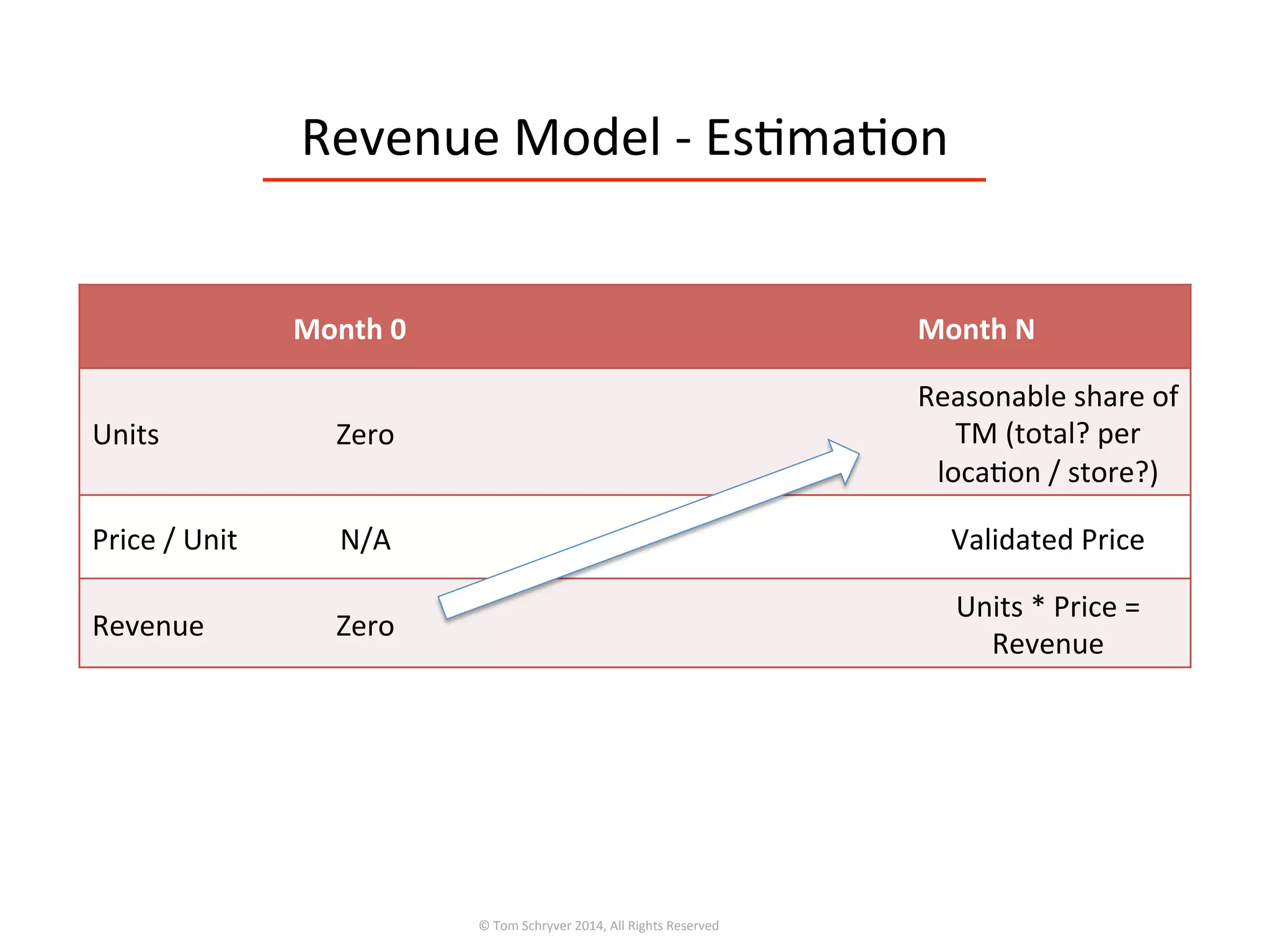
Revenue	
  Model	
  -­‐	
  Es3ma3on	
  
©	
  Tom	
  Schryver	
  2014,	
  All	
  Rights	
  Reserved	
  
Month	
  0	
   Month	
  N	
  
Units	
   Zero	
  
Reasonable	
  share	
  of	
  
TM	
  (total?	
  per	
  
loca3on	
  /	
  store?)	
  
Price	
  /	
  Unit	
   N/A	
   Validated	
  Price	
  
Revenue	
   Zero	
  
Units	
  *	
  Price	
  =	
  
Revenue	
  
Revenue	
  Model	
  -­‐	
  Details	
  
©	
  Tom	
  Schryver	
  2014,	
  All	
  Rights	
  Reserved	
  
•  Experiment	
  with	
  reasonable	
  growth	
  rates	
  
•  Es3mate	
  number	
  of	
  months	
  to	
  get	
  to	
  “N”	
  
•  Compartmentalize	
  by	
  product	
  line,	
  loca3on,	
  store,	
  etc.	
  as	
  
much	
  as	
  possible	
  
•  Must	
  stack	
  up	
  to	
  a	
  reasonable	
  share	
  of	
  reasonable	
  market	
  
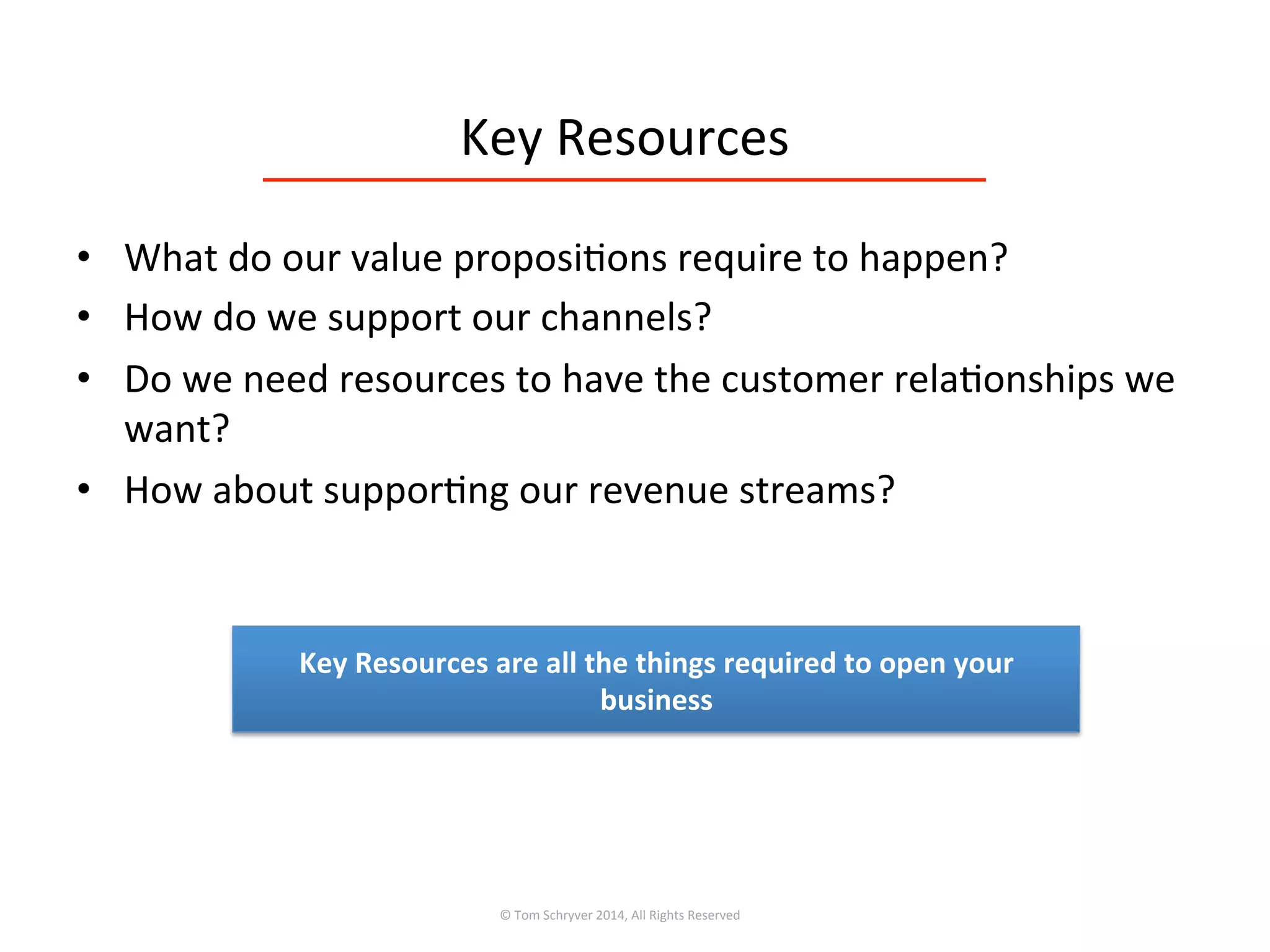
Key	
  Resources	
  
•  What	
  do	
  our	
  value	
  proposi3ons	
  require	
  to	
  happen?	
  
•  How	
  do	
  we	
  support	
  our	
  channels?	
  
•  Do	
  we	
  need	
  resources	
  to	
  have	
  the	
  customer	
  rela3onships	
  we	
  
want?	
  
•  How	
  about	
  suppor3ng	
  our	
  revenue	
  streams?	
  
©	
  Tom	
  Schryver	
  2014,	
  All	
  Rights	
  Reserved	
  
Key	
  Resources	
  are	
  all	
  the	
  things	
  required	
  to	
  open	
  your	
  
business	
  
Key	
  Resources	
  -­‐	
  Types	
  
•  Physical	
  –	
  buildings,	
  cash	
  registers,	
  phones,	
  trucks,	
  etc.	
  
•  Intellectual	
  –	
  patents,	
  databases,	
  process	
  knowledge	
  
•  Human	
  –	
  salespeople,	
  customer	
  service	
  reps,	
  store	
  managers,	
  
produc3on	
  staff,	
  R&D	
  
•  Financial	
  –	
  funds	
  to	
  pre-­‐buy	
  inventory,	
  vendor	
  financing	
  
©	
  Tom	
  Schryver	
  2014,	
  All	
  Rights	
  Reserved	
  
Key	
  Resources	
  -­‐	
  Examples	
  
•  Physical	
  –	
  Dean	
  &	
  Deluca	
  store;	
  FedEx	
  trucks	
  
•  Intellectual	
  –	
  drug	
  patent;	
  process	
  knowledge	
  on	
  how	
  to	
  
make	
  beer	
  
•  Human	
  –	
  people	
  to	
  fill	
  and	
  cap	
  toothpaste	
  tubes;	
  picking	
  
orders	
  and	
  packaging	
  goods	
  for	
  shipment;	
  people	
  to	
  answer	
  
the	
  phone	
  
•  Financial	
  –	
  money	
  to	
  buy	
  the	
  product	
  that	
  will	
  be	
  sold	
  in	
  the	
  
store,	
  or	
  to	
  buy	
  raw	
  materials	
  to	
  be	
  made	
  into	
  finished	
  goods;	
  
funds	
  to	
  cover	
  gap	
  between	
  sending	
  an	
  invoice	
  and	
  receiving	
  
payment;	
  vendor	
  lease	
  
©	
  Tom	
  Schryver	
  2014,	
  All	
  Rights	
  Reserved	
  
Key	
  Resources	
  -­‐	
  	
  Es3ma3on	
  
©	
  Tom	
  Schryver	
  2014,	
  All	
  Rights	
  Reserved	
  
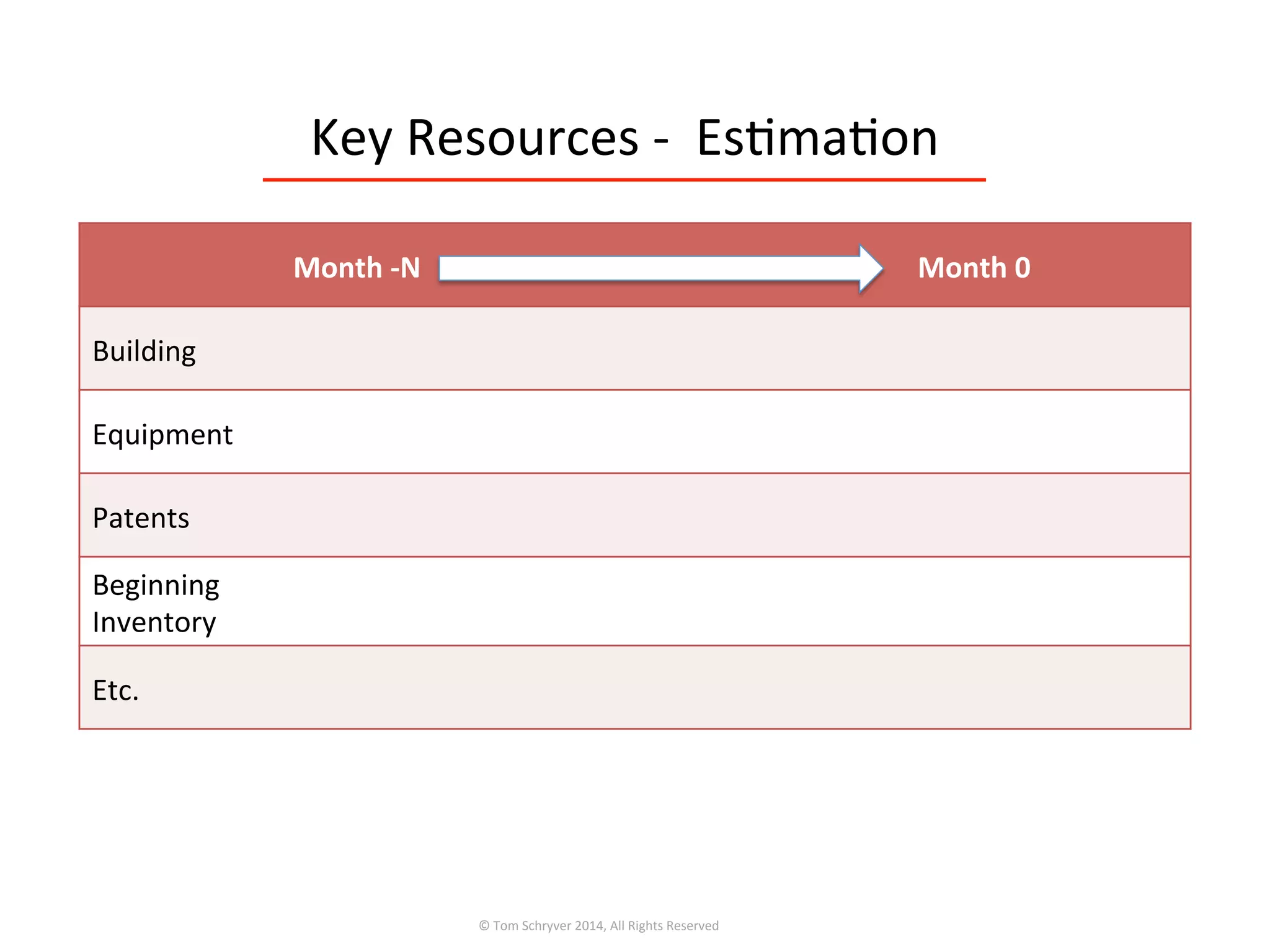
Month	
  -­‐N	
   Month	
  0	
  
Building	
  
Equipment	
  
Patents	
  
Beginning	
  
Inventory	
  
Etc.	
  
Key	
  Resources	
  
•  What	
  key	
  resources	
  will	
  be	
  required?	
  
•  What	
  are	
  a	
  few	
  hidden	
  things	
  that	
  might	
  otherwise	
  get	
  
forgoren?	
  
•  How	
  much	
  will	
  it	
  cost	
  to	
  get	
  these	
  in	
  place?	
  
©	
  Tom	
  Schryver	
  2014,	
  All	
  Rights	
  Reserved	
  
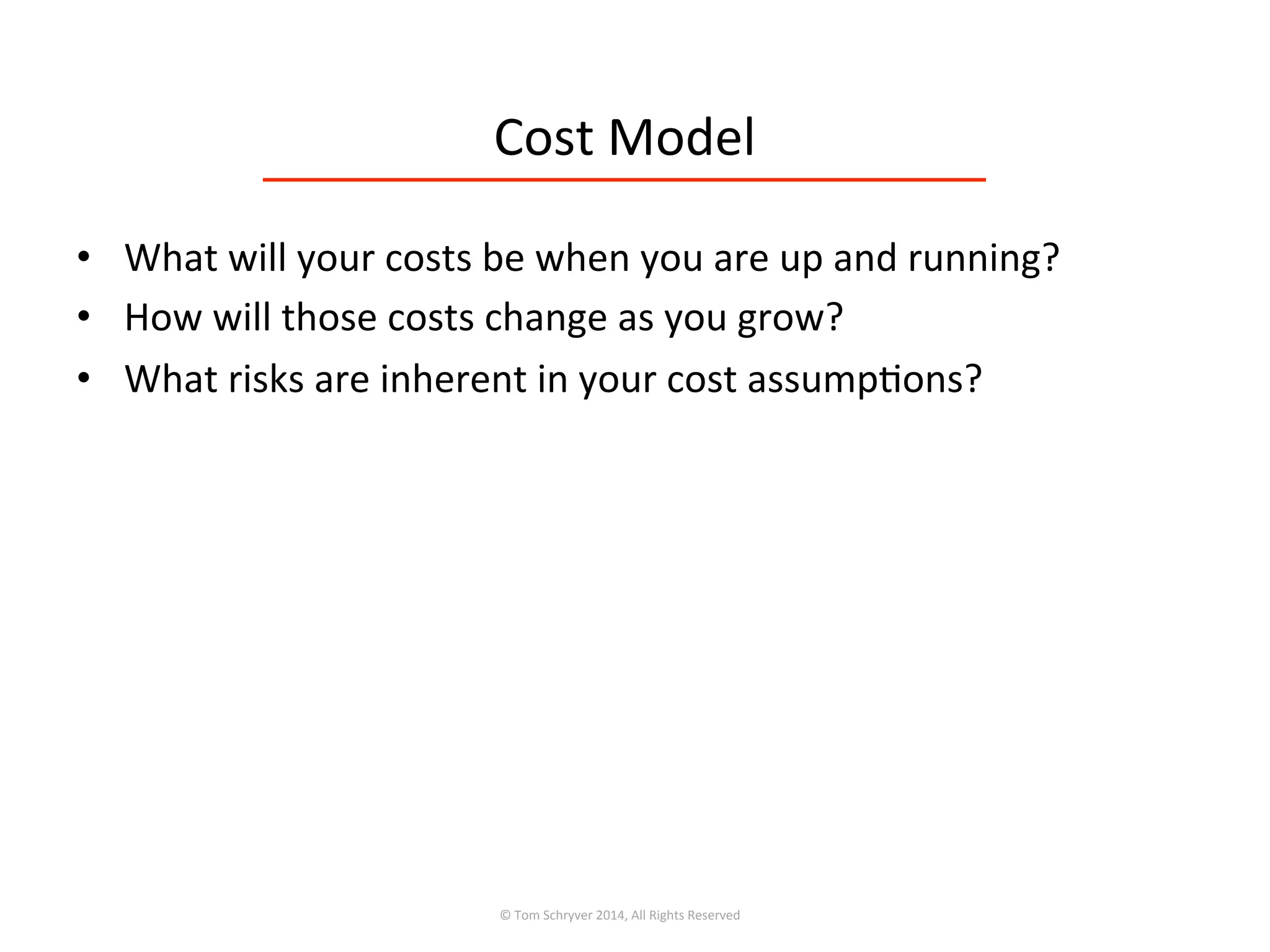
Cost	
  Model	
  
•  What	
  will	
  your	
  costs	
  be	
  when	
  you	
  are	
  up	
  and	
  running?	
  
•  How	
  will	
  those	
  costs	
  change	
  as	
  you	
  grow?	
  
•  What	
  risks	
  are	
  inherent	
  in	
  your	
  cost	
  assump3ons?	
  
©	
  Tom	
  Schryver	
  2014,	
  All	
  Rights	
  Reserved	
  
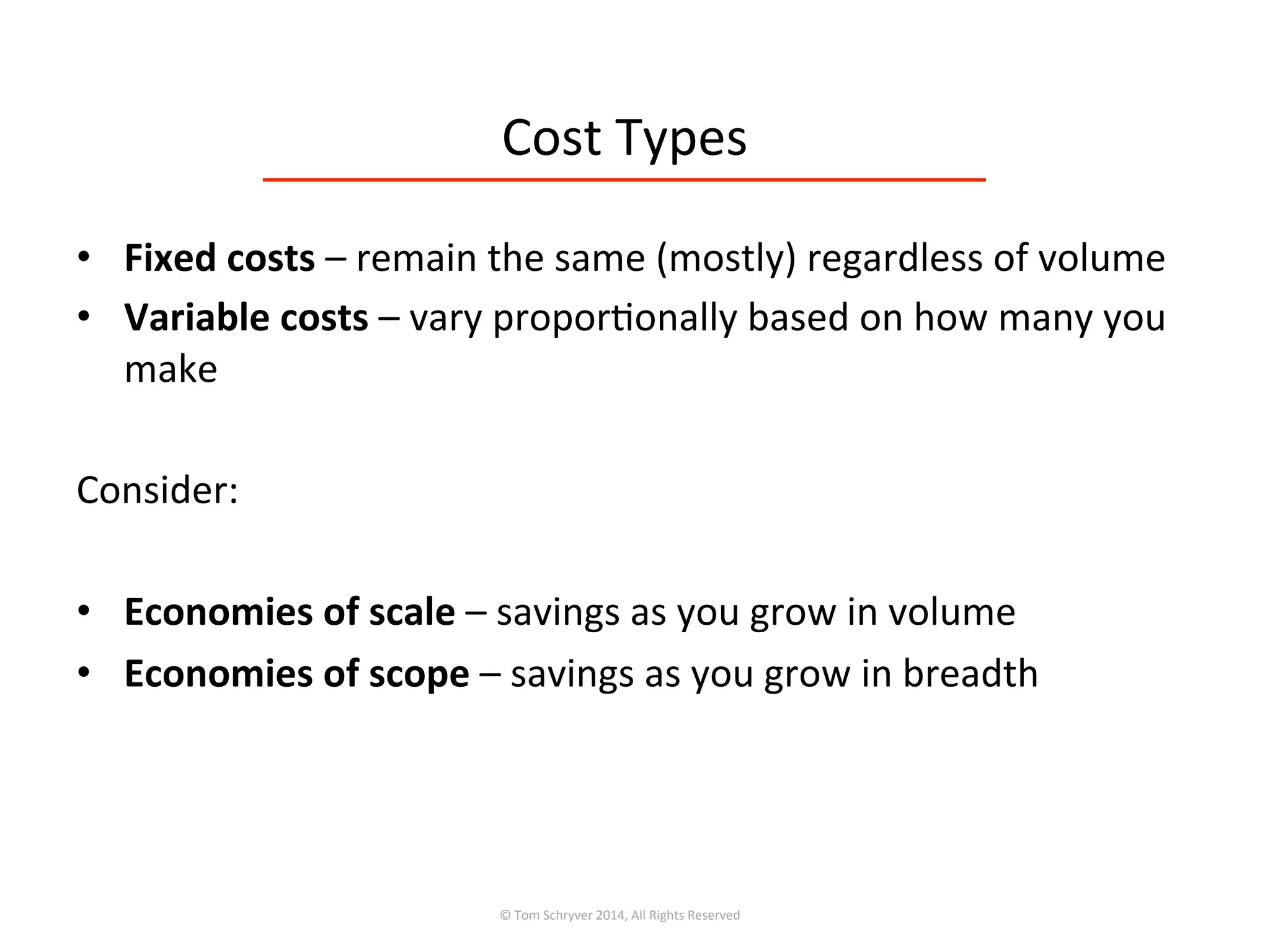
Cost	
  Types	
  
•  Fixed	
  costs	
  –	
  remain	
  the	
  same	
  (mostly)	
  regardless	
  of	
  volume	
  
•  Variable	
  costs	
  –	
  vary	
  propor3onally	
  based	
  on	
  how	
  many	
  you	
  
make	
  
Consider:	


•  Economies	
  of	
  scale	
  –	
  savings	
  as	
  you	
  grow	
  in	
  volume	
  
•  Economies	
  of	
  scope	
  –	
  savings	
  as	
  you	
  grow	
  in	
  breadth	
  
©	
  Tom	
  Schryver	
  2014,	
  All	
  Rights	
  Reserved	
  
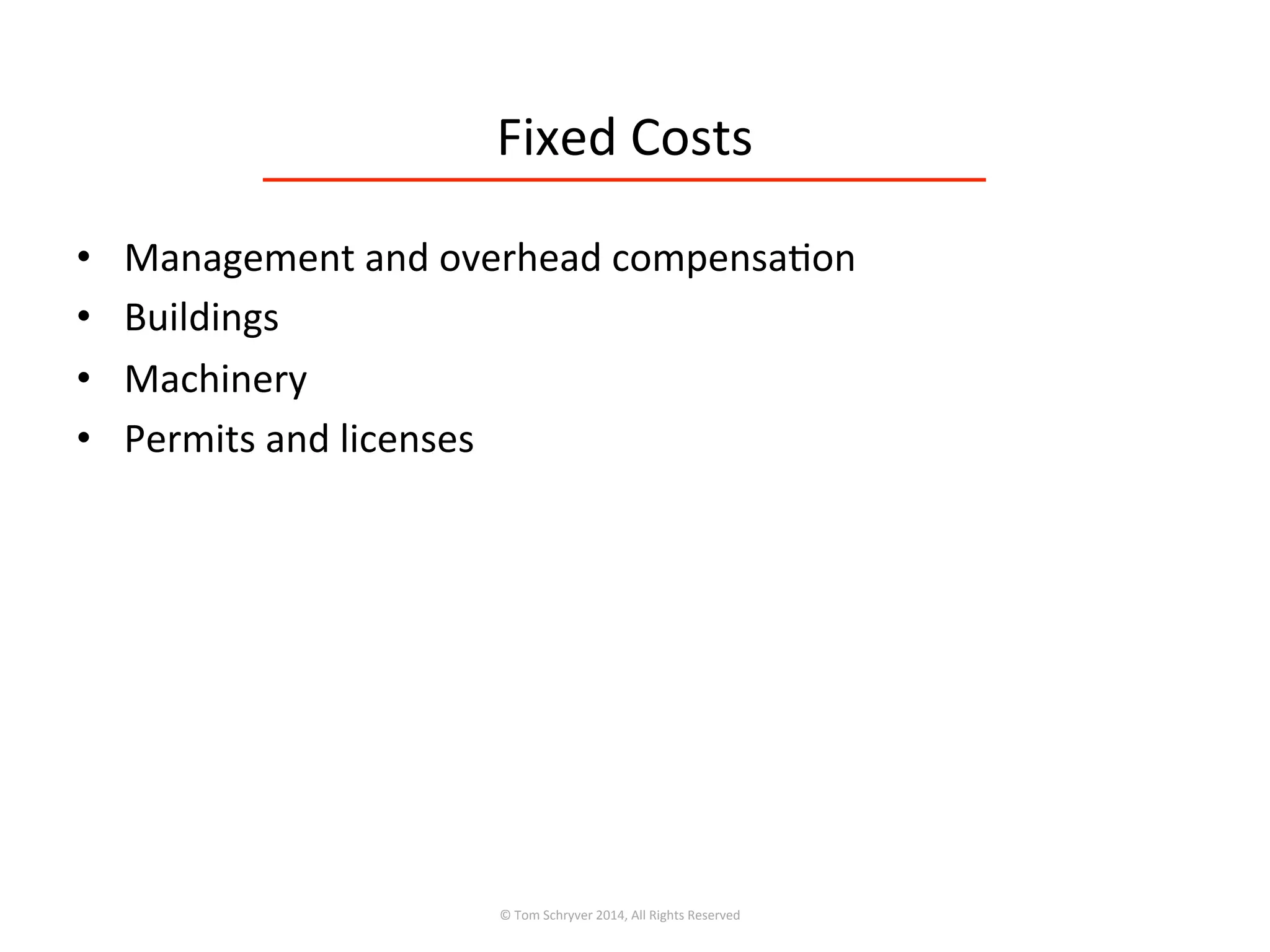
Fixed	
  Costs	
  
•  Management	
  and	
  overhead	
  compensa3on	
  
•  Buildings	
  
•  Machinery	
  
•  Permits	
  and	
  licenses	
  
©	
  Tom	
  Schryver	
  2014,	
  All	
  Rights	
  Reserved	
  
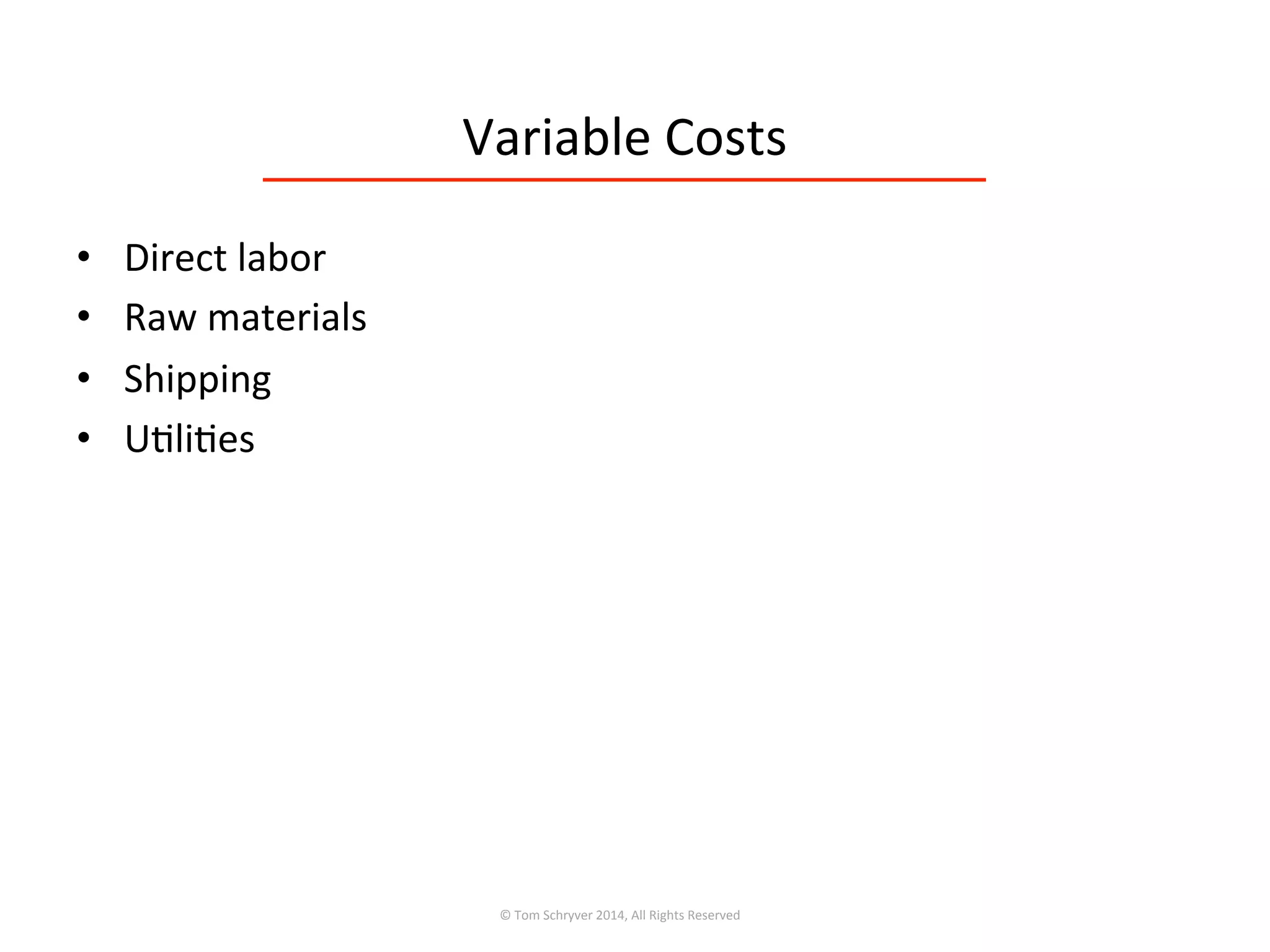
Variable	
  Costs	
  
•  Direct	
  labor	
  
•  Raw	
  materials	
  
•  Shipping	
  
•  U3li3es	
  
©	
  Tom	
  Schryver	
  2014,	
  All	
  Rights	
  Reserved	
  
Economies	
  of	
  Scale	
  
•  Buying	
  in	
  bulk	
  
•  Shipping	
  in	
  larger	
  volumes	
  
•  More	
  efficient	
  use	
  of	
  machinery	
  
•  More	
  efficient	
  use	
  of	
  labor	
  (ie:	
  specializa3on)	
  
©	
  Tom	
  Schryver	
  2014,	
  All	
  Rights	
  Reserved	
  
Economies	
  of	
  Scope	
  
•  One	
  store	
  selling	
  many	
  products	
  
•  Mul3ple	
  value	
  proposi3ons	
  for	
  a	
  single	
  customer	
  
•  Mul3ple	
  revenue	
  streams	
  from	
  the	
  same	
  transac3on	
  (product	
  
+	
  extended	
  warranty)	
  
©	
  Tom	
  Schryver	
  2014,	
  All	
  Rights	
  Reserved	
  
Categorizing	
  Expenses	
  by	
  Type:	
  COGS	
  
•  Cost	
  of	
  Goods	
  Sold	
  (COGS)	
  are	
  the	
  direct	
  costs	
  associated	
  
with	
  providing	
  the	
  product	
  or	
  service.	
  Examples:	
  
–  Direct	
  labor	
  
–  Raw	
  materials	
  
–  Warehousing	
  
–  Produc3on	
  equipment	
  
•  Revenue	
  –	
  COGS	
  =	
  Gross	
  Profit	
  
©	
  Tom	
  Schryver	
  2014,	
  All	
  Rights	
  Reserved	
  
Categorizing	
  Expenses	
  by	
  Type:	
  SG&A	
  
•  Selling,	
  General	
  and	
  Administra3ve	
  expenses	
  (SG&A)	
  are	
  the	
  
indirect	
  costs	
  associated	
  with	
  opera3ng	
  a	
  business.	
  	
  
Examples:	
  
–  Adver3sing	
  
–  Sales	
  salaries	
  and	
  commissions	
  
–  Management	
  salaries	
  
–  Fringe	
  benefits	
  
–  Office	
  rents	
  
–  Insurance	
  
•  Revenue	
  –	
  COGS	
  =	
  Gross	
  Profit	
  
•  Gross	
  Profit	
  –	
  SG&A	
  =	
  Opera3ng	
  Profit	
  
©	
  Tom	
  Schryver	
  2014,	
  All	
  Rights	
  Reserved	
  
Categorizing	
  Expenses	
  by	
  Type:	
  Non-­‐Opera3ng	
  
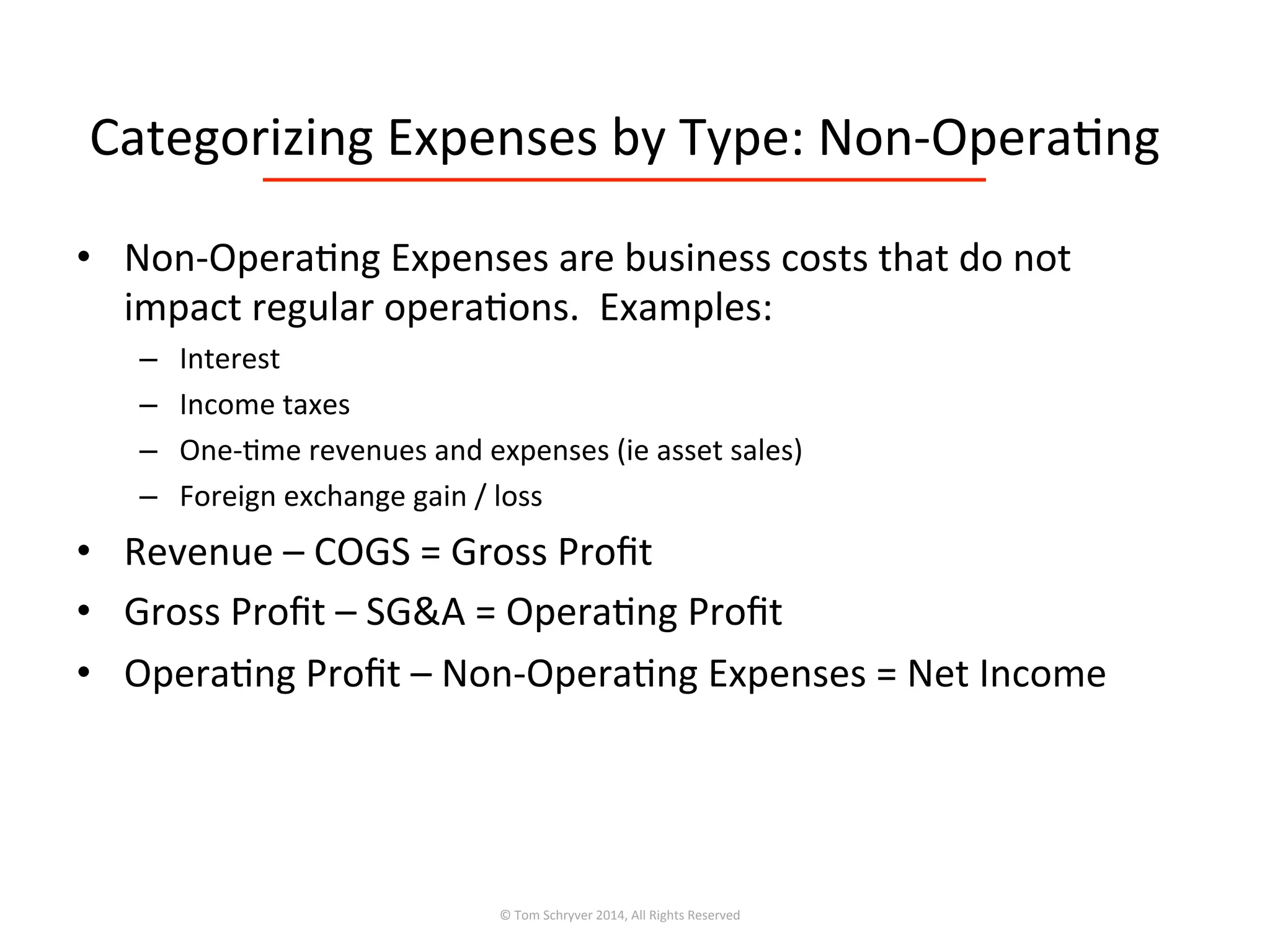
•  Non-­‐Opera3ng	
  Expenses	
  are	
  business	
  costs	
  that	
  do	
  not	
  
impact	
  regular	
  opera3ons.	
  	
  Examples:	
  
–  Interest	
  
–  Income	
  taxes	
  
–  One-­‐3me	
  revenues	
  and	
  expenses	
  (ie	
  asset	
  sales)	
  
–  Foreign	
  exchange	
  gain	
  /	
  loss	
  
•  Revenue	
  –	
  COGS	
  =	
  Gross	
  Profit	
  
•  Gross	
  Profit	
  –	
  SG&A	
  =	
  Opera3ng	
  Profit	
  
•  Opera3ng	
  Profit	
  –	
  Non-­‐Opera3ng	
  Expenses	
  =	
  Net	
  Income	
  
©	
  Tom	
  Schryver	
  2014,	
  All	
  Rights	
  Reserved	
  
Expense	
  Checklist	
  
©	
  Tom	
  Schryver	
  2014,	
  All	
  Rights	
  Reserved	
  
q  Rent	
  
q  Furnishings	
  
q  Computers	
  
q  Sofware!	
  
q  U3li3es	
  
q  Electric	
  	
  
q  Internet	
  
q  Payroll	
  
q  Payroll	
  taxes	
  
q  Workman’s	
  	
  comp	
  
q  Unemployment	
  
insurance	
  
q  Gen.	
  liab.	
  Insurance	
  
q  Key	
  man	
  Insurance	
  
q  Banking	
  and	
  Credit	
  Card	
  
fees	
  
q  Patent	
  fees	
  
q  Professional	
  services	
  
q  Cleaning	
  services	
  
q  Lawn	
  care	
  
q  Lawyers	
  
q  Accountant	
  
q  Bookkeeper	
  
q  Recrui3ng	
  
q  Other	
  freelance	
  
q  Marke3ng	
  expenses	
  
q  Web	
  development	
  
q  Print	
  
q  Conferences	
  
q  Memberships	
  
q  Ads	
  
q  trademarks	
  
q  Other	
  
q  Travel	
  
q  Discounts	
  
q  Sales	
  taxes	
  
q  Shipping	
  
q  Customs	
  
q  Supplies	
  
q  Toner!	
  
q  Misc	
  
q  Repairs	
  and	
  
Maintenance	
  
q  Facili3es	
  
q  Equipment	
  
q  Licenses	
  
q  Royal3es	
  
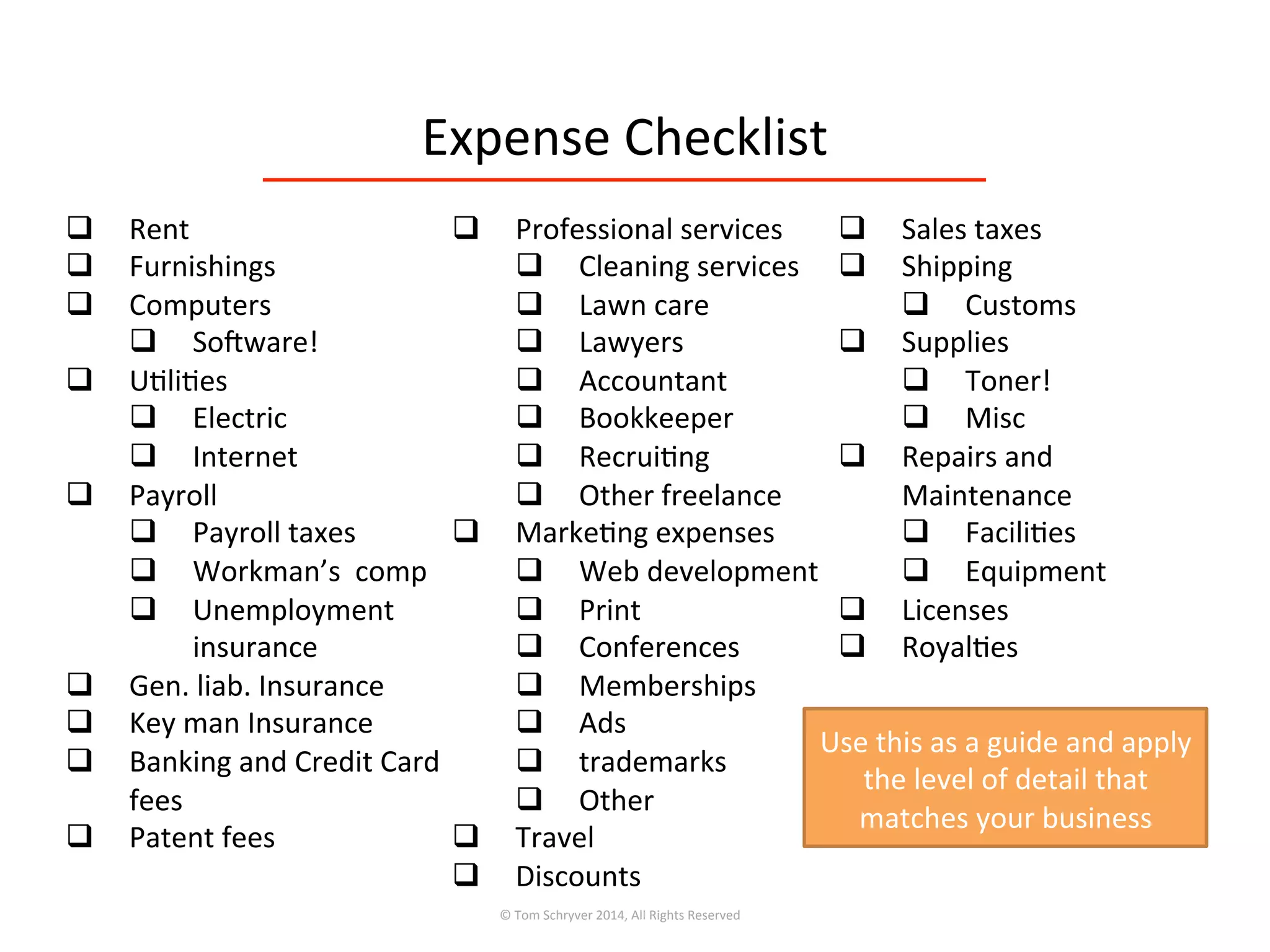
Use	
  this	
  as	
  a	
  guide	
  and	
  apply	
  
the	
  level	
  of	
  detail	
  that	
  
matches	
  your	
  business	
  
Cost	
  Model	
  -­‐	
  Es3ma3on	
  
©	
  Tom	
  Schryver	
  2014,	
  All	
  Rights	
  Reserved	
  
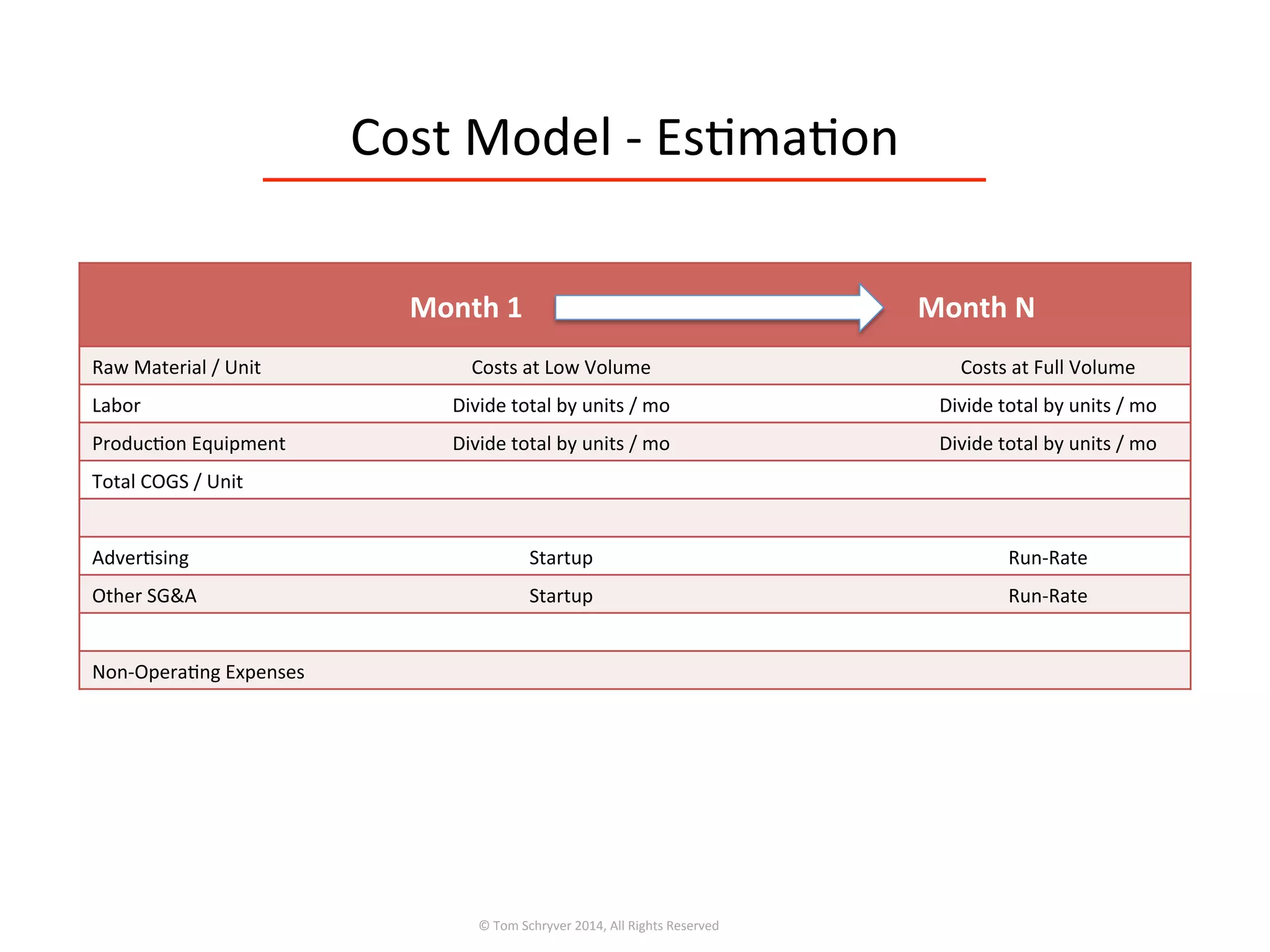
Month	
  1	
   Month	
  N	
  
Raw	
  Material	
  /	
  Unit	
   Costs	
  at	
  Low	
  Volume	
   Costs	
  at	
  Full	
  Volume	
  
Labor	
   Divide	
  total	
  by	
  units	
  /	
  mo	
   Divide	
  total	
  by	
  units	
  /	
  mo	
  
Produc3on	
  Equipment	
   Divide	
  total	
  by	
  units	
  /	
  mo	
   Divide	
  total	
  by	
  units	
  /	
  mo	
  
Total	
  COGS	
  /	
  Unit	
  
Adver3sing	
   Startup	
   Run-­‐Rate	
  
Other	
  SG&A	
   Startup	
   Run-­‐Rate	
  
Non-­‐Opera3ng	
  Expenses	
  
Cost	
  Model	
  -­‐	
  Es3ma3on	
  
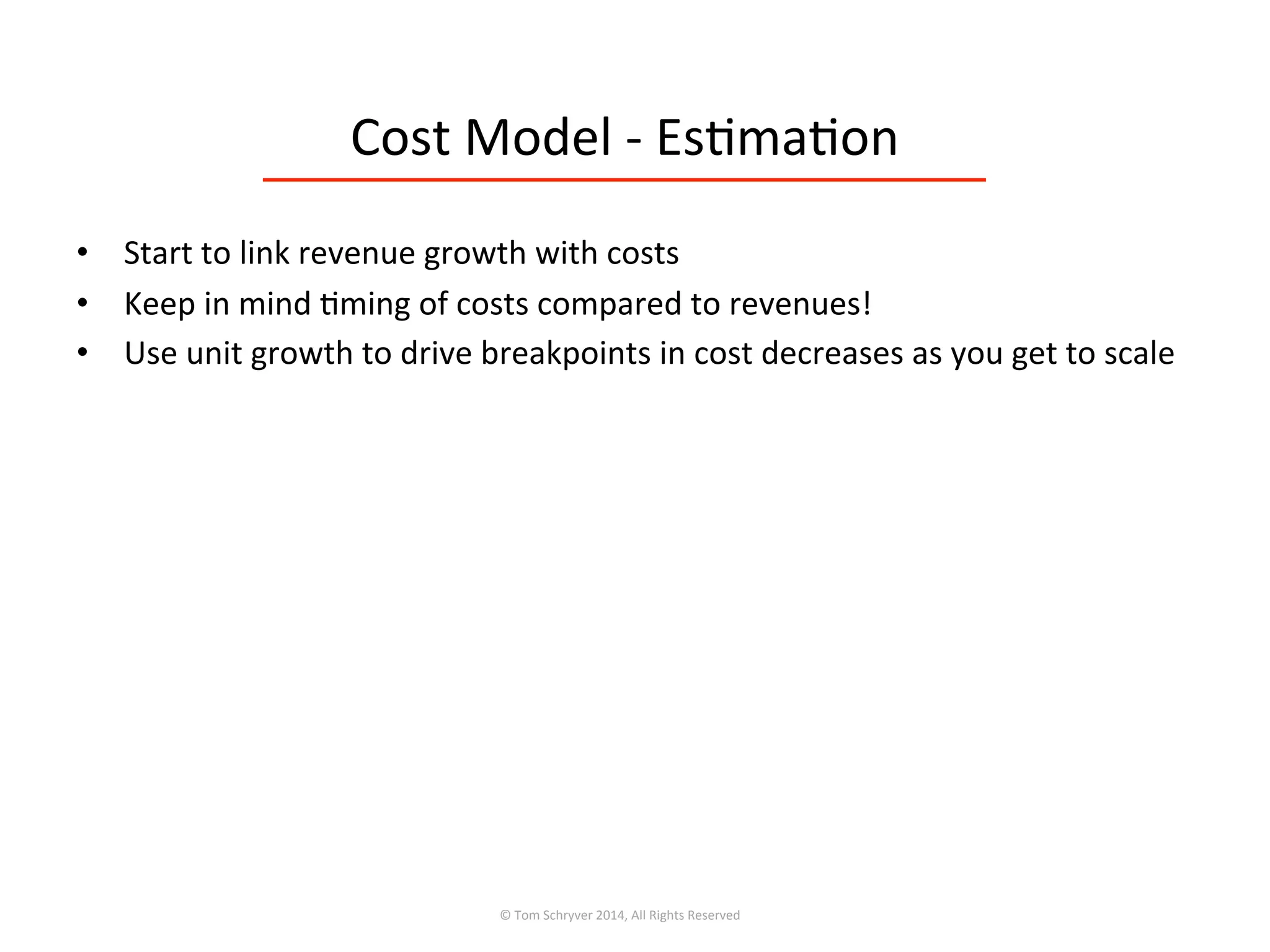
•  Start	
  to	
  link	
  revenue	
  growth	
  with	
  costs	
  
•  Keep	
  in	
  mind	
  3ming	
  of	
  costs	
  compared	
  to	
  revenues!	
  
•  Use	
  unit	
  growth	
  to	
  drive	
  breakpoints	
  in	
  cost	
  decreases	
  as	
  you	
  get	
  to	
  scale	
  
©	
  Tom	
  Schryver	
  2014,	
  All	
  Rights	
  Reserved	
  
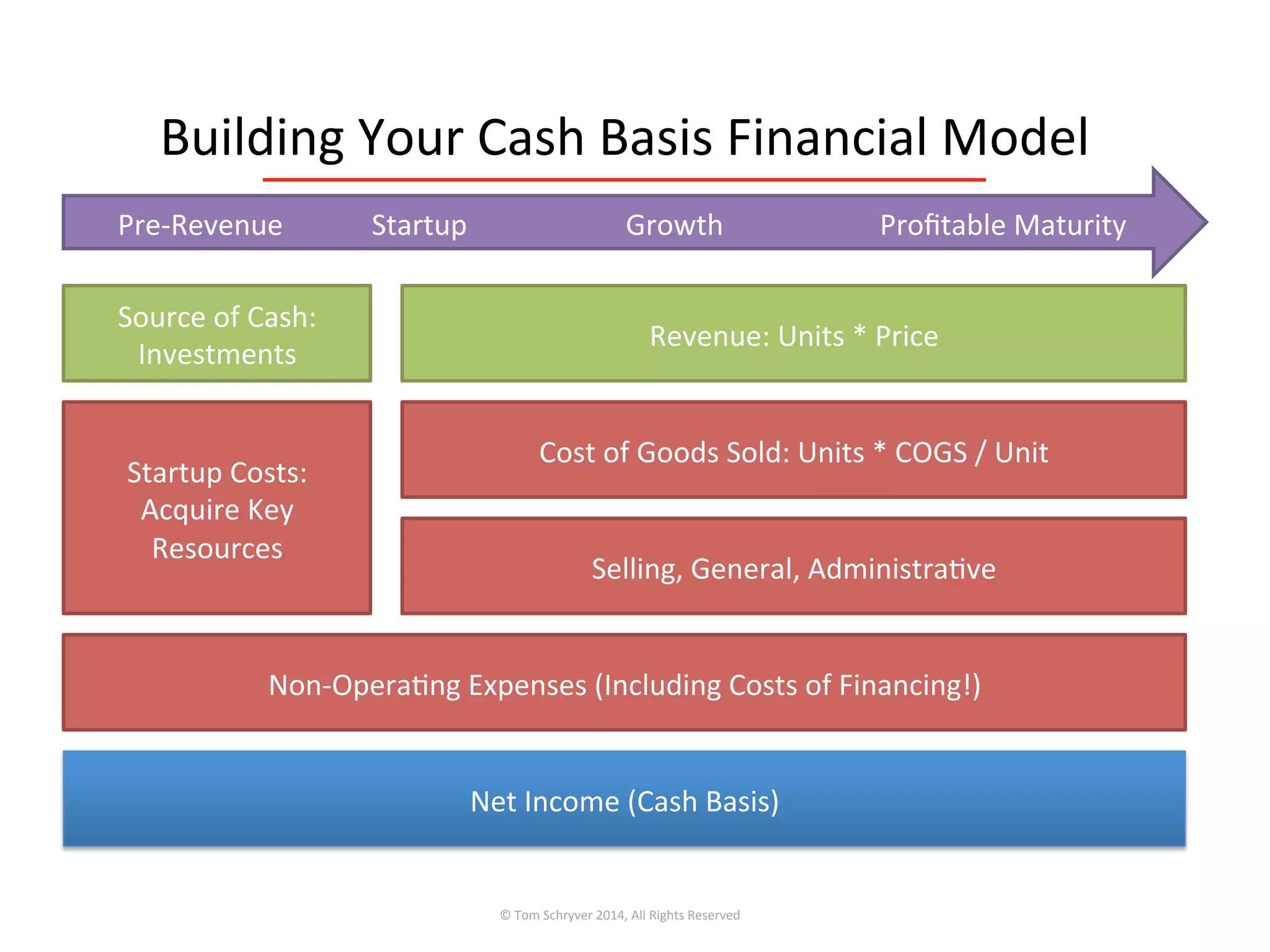
Building	
  Your	
  Cash	
  Basis	
  Financial	
  Model	
  
©	
  Tom	
  Schryver	
  2014,	
  All	
  Rights	
  Reserved	
  
Startup	
  Costs:	
  
Acquire	
  Key	
  
Resources	
  
Revenue:	
  Units	
  *	
  Price	
  
Cost	
  of	
  Goods	
  Sold:	
  Units	
  *	
  COGS	
  /	
  Unit	
  
Selling,	
  General,	
  Administra3ve	
  
Non-­‐Opera3ng	
  Expenses	
  (Including	
  Costs	
  of	
  Financing!)	
  
Net	
  Income	
  (Cash	
  Basis)	
  
Pre-­‐Revenue 	
  Startup 	
   	
  Growth 	
   	
  Profitable	
  Maturity	
  
Source	
  of	
  Cash:	
  
Investments	
  
PLUG	
  	
  
N’	
  
CHUG	
  
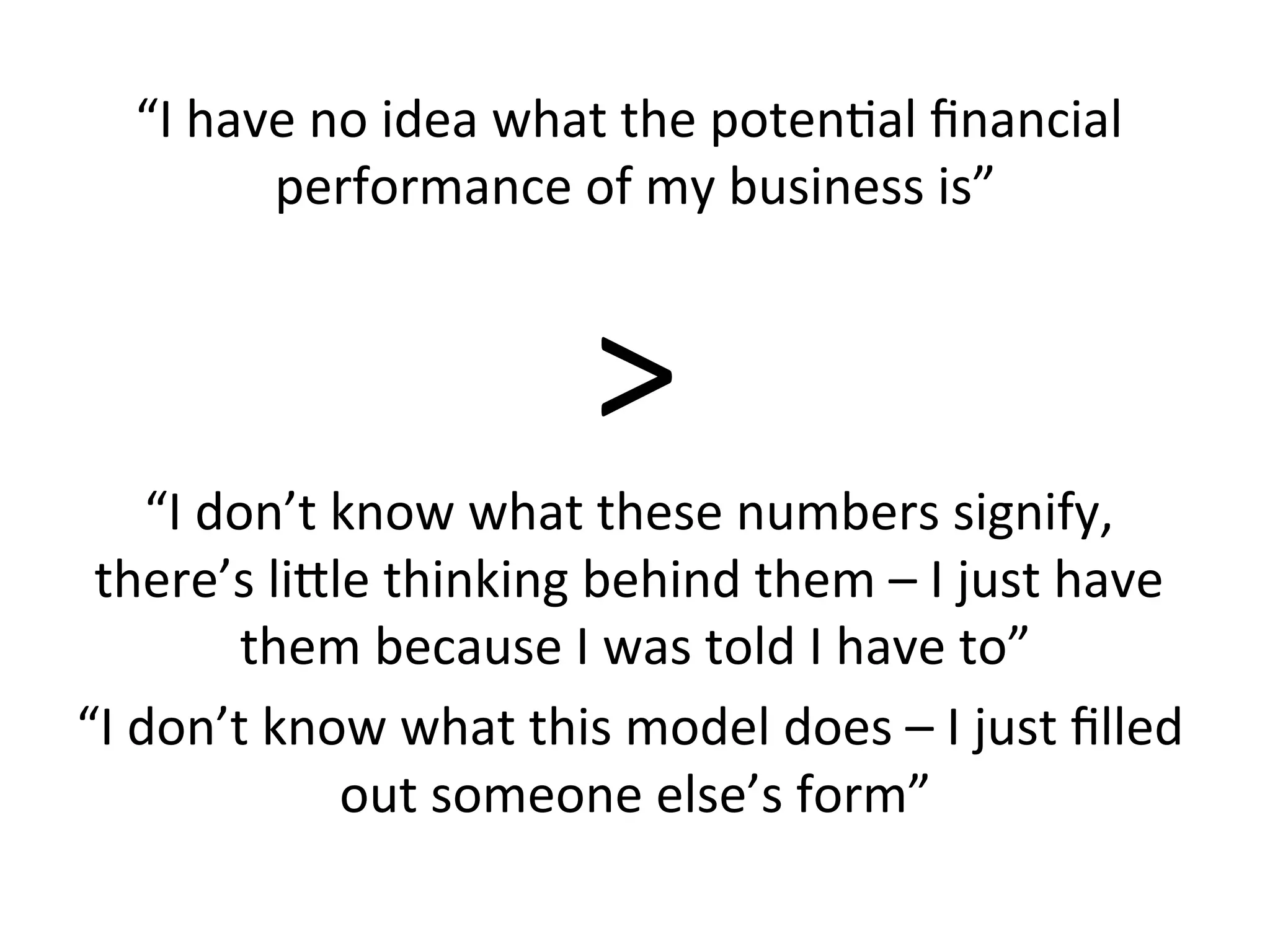
“I	
  have	
  no	
  idea	
  what	
  the	
  poten3al	
  financial	
  
performance	
  of	
  my	
  business	
  is”	
  
>	
  
“I	
  don’t	
  know	
  what	
  these	
  numbers	
  signify,	
  
there’s	
  lirle	
  thinking	
  behind	
  them	
  –	
  I	
  just	
  have	
  
them	
  because	
  I	
  was	
  told	
  I	
  have	
  to”	
  
“I	
  don’t	
  know	
  what	
  this	
  model	
  does	
  –	
  I	
  just	
  filled	
  
out	
  someone	
  else’s	
  form”	
  
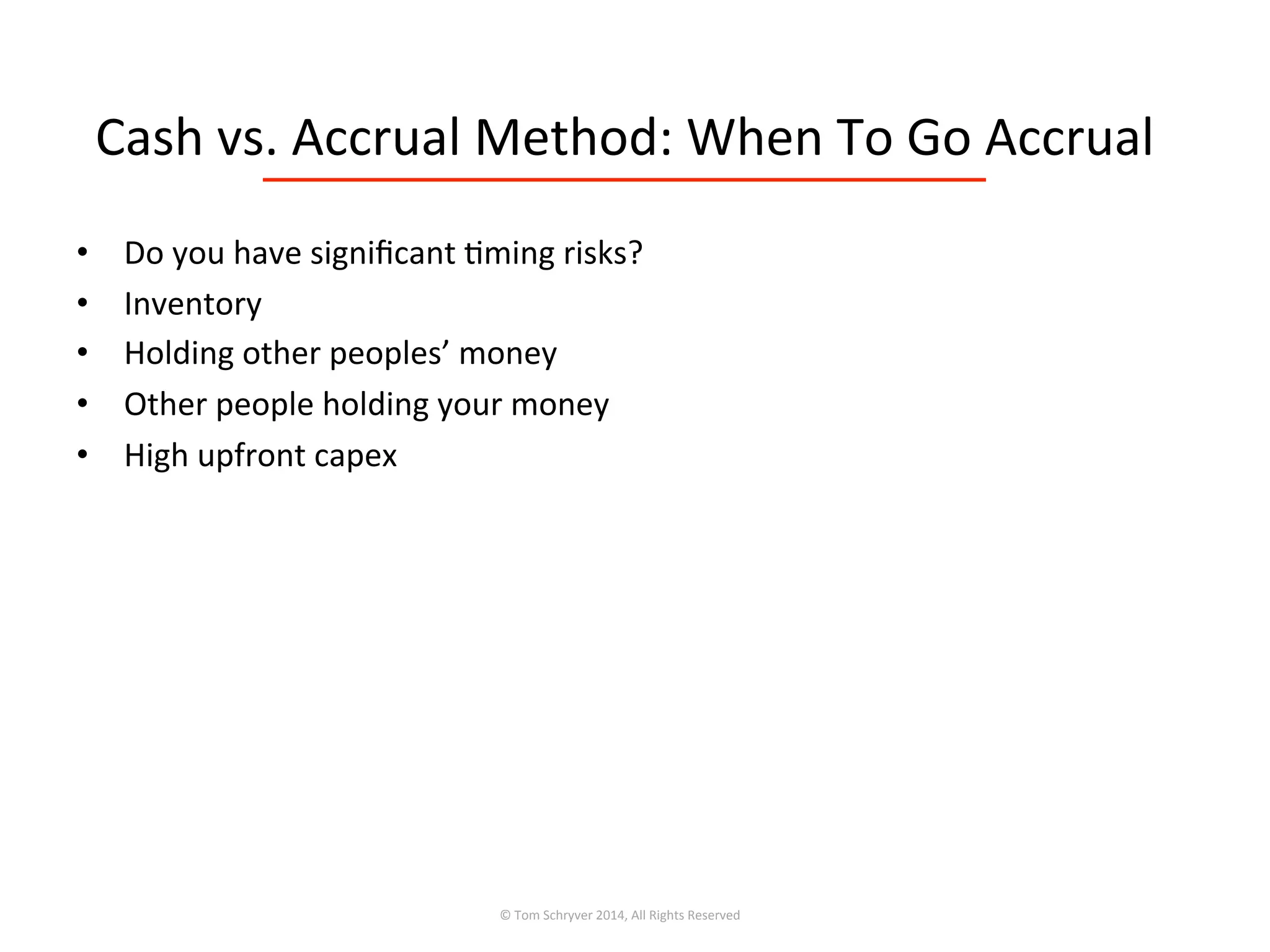
Cash	
  vs.	
  Accrual	
  Method:	
  When	
  To	
  Go	
  Accrual	
  
©	
  Tom	
  Schryver	
  2014,	
  All	
  Rights	
  Reserved	
  
•  Do	
  you	
  have	
  significant	
  3ming	
  risks?	
  
•  Inventory	
  
•  Holding	
  other	
  peoples’	
  money	
  
•  Other	
  people	
  holding	
  your	
  money	
  
•  High	
  upfront	
  capex	
  
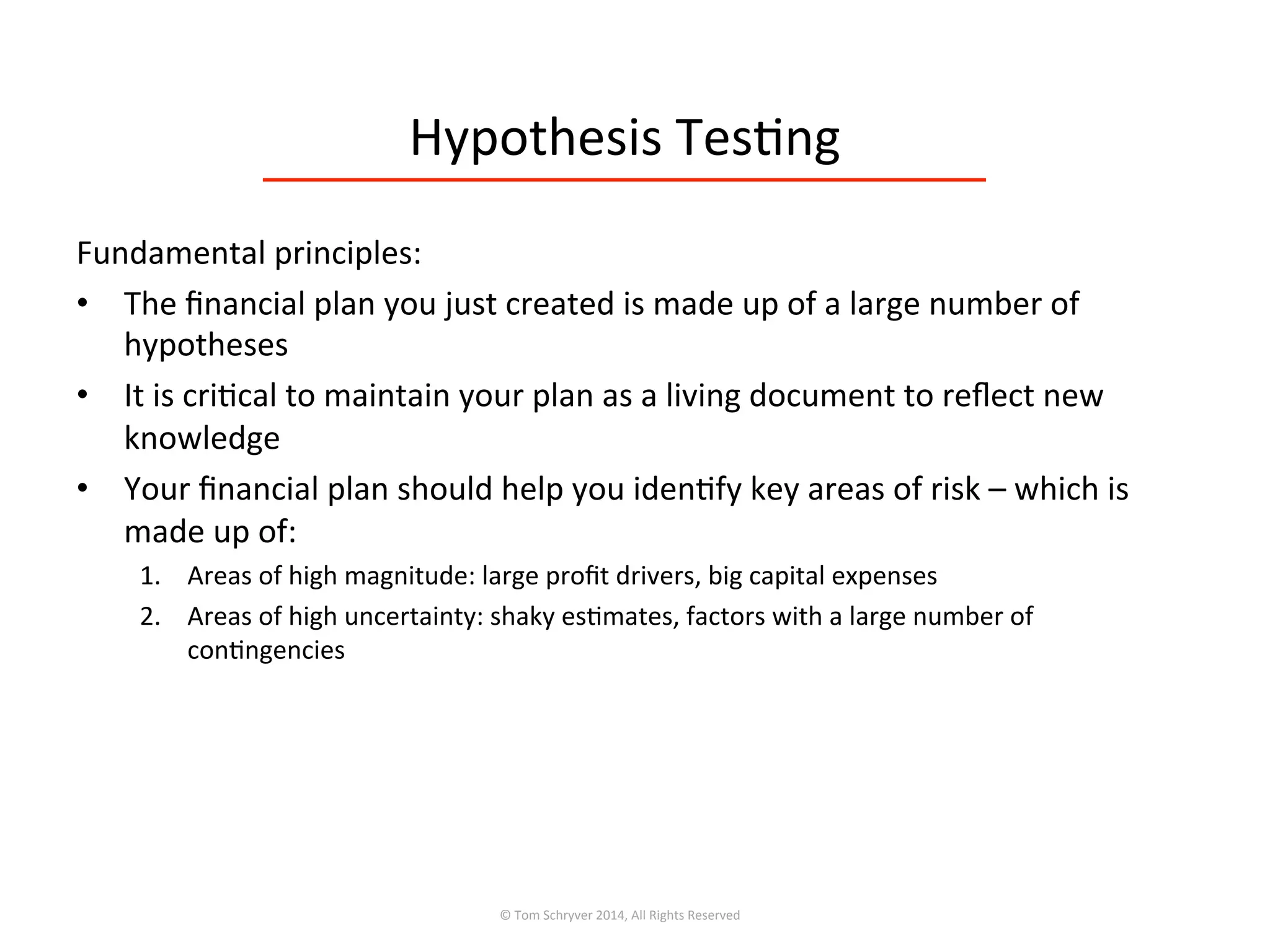
Hypothesis	
  Tes3ng	
  
©	
  Tom	
  Schryver	
  2014,	
  All	
  Rights	
  Reserved	
  
Fundamental	
  principles:	
  
•  The	
  financial	
  plan	
  you	
  just	
  created	
  is	
  made	
  up	
  of	
  a	
  large	
  number	
  of	
  
hypotheses	
  
•  It	
  is	
  cri3cal	
  to	
  maintain	
  your	
  plan	
  as	
  a	
  living	
  document	
  to	
  reflect	
  new	
  
knowledge	
  
•  Your	
  financial	
  plan	
  should	
  help	
  you	
  iden3fy	
  key	
  areas	
  of	
  risk	
  –	
  which	
  is	
  
made	
  up	
  of:	
  
1.  Areas	
  of	
  high	
  magnitude:	
  large	
  profit	
  drivers,	
  big	
  capital	
  expenses	
  
2.  Areas	
  of	
  high	
  uncertainty:	
  shaky	
  es3mates,	
  factors	
  with	
  a	
  large	
  number	
  of	
  
con3ngencies	
  
What	
  Do	
  You	
  Do	
  About	
  It?	
  
©	
  Tom	
  Schryver	
  2014,	
  All	
  Rights	
  Reserved	
  
•  If	
  an	
  item	
  is	
  substan3al	
  and	
  you	
  are	
  es3ma3ng,	
  dig	
  to	
  ensure	
  no	
  cheap	
  /	
  
free	
  informa3on	
  is	
  available	
  that	
  could	
  help	
  you	
  refine	
  
•  Treat	
  revenue	
  model,	
  key	
  resources,	
  and	
  cost	
  model	
  as	
  areas	
  of	
  testable	
  
hypotheses	
  
•  Iden3fy	
  key	
  data,	
  test,	
  and	
  measure	
  
What	
  to	
  Present	
  
©	
  Tom	
  Schryver	
  2014,	
  All	
  Rights	
  Reserved	
  
•  How	
  much	
  will	
  it	
  cost	
  to	
  get	
  started	
  –	
  and	
  how	
  long	
  
•  How	
  long	
  will	
  it	
  take	
  you	
  to	
  become	
  self-­‐sustaining	
  
•  What	
  does	
  the	
  sunny,	
  happy	
  future	
  look	
  like	
  (how	
  profitable)	
  
•  Choose	
  metrics	
  and	
  graphs	
  based	
  on	
  industry	
  norms	
  
Q&A	
  
©	
  Tom	
  Schryver	
  2014,	
  All	
  Rights	
  Reserved	
  

Basics of Startup Financial Planning

  • 1.
    FINANCIAL  PLANNING  FOR  STARTUPS   Tom  Schryver,  CFA   Visi3ng  Lecturer,  Johnson  Graduate  School  of  Management   Execu3ve  Director,  Center  for  Regional  Economic  Advancement   Cornell  University  
  • 2.
    Why  Create  a  Financial  Plan?   •  Know  when  you’re  running  out  of  money   •  Know  how  much  money  you  need   •  Enable  you  to  describe  your  vision   –  To  partners   –  To  employees   –  To  funders   ©  Tom  Schryver  2014,  All  Rights  Reserved  
  • 3.
    Why  Pitch  a  Startup?   ©  Tom  Schryver  2014,  All  Rights  Reserved  
  • 4.
    Why  Pitch  a  Startup?   à  Generate  interest  in  the  next  conversa3on   •  Very  very  very  rarely  will  anyone  write  a  check  based  solely  on  a   pitch   •  Uninformed  investors  are  dangerous   •  Tom’s  rule  of  investors:  they  all  add  value,  the  ques3on  is  the  +/-­‐   sign   ©  Tom  Schryver  2014,  All  Rights  Reserved  
  • 5.
    Financials  In  A  Pitch  –  Audience  View   •  Does  the  company  have  a  good  understanding  of  its  poten3al   market?   •  Does  the  company  have  a  sense  of  how  much  of  that  market  is   obtainable?    Are  poten3al  unit  sales  reasonable?   •  Are  sales  prices  reasonable?    Is  there  any  evidence  to  back  them   up?   •  Are  projected  costs  complete  and  reasonable?   •  How  much  money  will  be  required  to  start  the  business?   •  How  much  money  will  be  required  to  get  the  company  to  self-­‐ sustainability?   •  How  profitable  could  the  company  be  at  maturity?   ©  Tom  Schryver  2014,  All  Rights  Reserved  
  • 6.
    Financials  In  A  Pitch  –  Ideas  of  What  To  Include   You  choose  what  you  think  investors  should  be  most  interested   in  /  know  about  /  have  as  main  takeaways  about  the   opportunity:   •  Details  on  target  market:  size,  basis  of  es3ma3on,  es3mate   on  how  much  is  obtainable  by  you   •  Es3mate  of  startup  costs  with  details  on  major  items   •  Projec3on  of  3me  to  ramp  up  to  cash  flow  breakeven  and   total  startup  +  losses  to  breakeven   •  Projec3on  of  profitability  at  scale   ©  Tom  Schryver  2014,  All  Rights  Reserved  
  • 7.
    Showing  Returns  To  Investors   •  If  you  are  pursuing  a  loan,  demonstra3ng  ability  to  service  payments  with   a  safety  margin  is  cri3cal   •  If  you  are  pursuing  an  equity  investment,  demonstra3ng  ability  to  exceed   required  cost  of  capital  is  cri3cal     My  opinion:   •  Defining  a  poten3al  exit  is  very  difficult;  only  volunteer  it  if  an  exit  is  the   only  way  an  investor  can  get  their  money  returned  (no  possibility  of   dividends)   •  Calcula3ng  an  IRR  or  NPV  on  investment  is  not  your  job  –  it’s  the   investor’s:  give  them  the  informa3on  they  need  around  profit  poten3al   and  allow  them  to  do  their  assessment  themselves     ©  Tom  Schryver  2014,  All  Rights  Reserved  
  • 8.
    Financials  In  A  Pitch  –  What  To  Avoid   •  $Trillion  markets   •  Magical  thinking:   –  Unreasonably  high  net  income  margins     (sofware  and  pharma  rarely  exceed  30%)   –  Revenue  growing  while  other  costs  remain  flat-­‐line   –  Revenue  growth  without  marke3ng  expense   –  Free  labor,  free  space,  no  insurance  costs,  etc.   –  Ignoring  3ming  impacts  of  acquiring  inventory  or  capital  items  before  revenue   •  Showing  loan  proceeds  without  interest  expense  or  repayment   •  Providing  excessive  detail  that  demonstrates  lack  of  focus  on  key   performance  indicators   ©  Tom  Schryver  2014,  All  Rights  Reserved  
  • 9.
    Key  Building  Blocks   •  Revenue  Model   •  Key  Resources   •  Cost  Model   ©  Tom  Schryver  2014,  All  Rights  Reserved  
  • 10.
    Revenue  Model  -­‐  Es3ma3on   ©  Tom  Schryver  2014,  All  Rights  Reserved   Month  0   Month  N   Units   Zero   Reasonable  share  of   TM  (total?  per   loca3on  /  store?)   Price  /  Unit   N/A   Validated  Price   Revenue   Zero   Units  *  Price  =   Revenue  
  • 11.
    Revenue  Model  -­‐  Details   ©  Tom  Schryver  2014,  All  Rights  Reserved   •  Experiment  with  reasonable  growth  rates   •  Es3mate  number  of  months  to  get  to  “N”   •  Compartmentalize  by  product  line,  loca3on,  store,  etc.  as   much  as  possible   •  Must  stack  up  to  a  reasonable  share  of  reasonable  market  
  • 12.
    Key  Resources   • What  do  our  value  proposi3ons  require  to  happen?   •  How  do  we  support  our  channels?   •  Do  we  need  resources  to  have  the  customer  rela3onships  we   want?   •  How  about  suppor3ng  our  revenue  streams?   ©  Tom  Schryver  2014,  All  Rights  Reserved   Key  Resources  are  all  the  things  required  to  open  your   business  
  • 13.
    Key  Resources  -­‐  Types   •  Physical  –  buildings,  cash  registers,  phones,  trucks,  etc.   •  Intellectual  –  patents,  databases,  process  knowledge   •  Human  –  salespeople,  customer  service  reps,  store  managers,   produc3on  staff,  R&D   •  Financial  –  funds  to  pre-­‐buy  inventory,  vendor  financing   ©  Tom  Schryver  2014,  All  Rights  Reserved  
  • 14.
    Key  Resources  -­‐  Examples   •  Physical  –  Dean  &  Deluca  store;  FedEx  trucks   •  Intellectual  –  drug  patent;  process  knowledge  on  how  to   make  beer   •  Human  –  people  to  fill  and  cap  toothpaste  tubes;  picking   orders  and  packaging  goods  for  shipment;  people  to  answer   the  phone   •  Financial  –  money  to  buy  the  product  that  will  be  sold  in  the   store,  or  to  buy  raw  materials  to  be  made  into  finished  goods;   funds  to  cover  gap  between  sending  an  invoice  and  receiving   payment;  vendor  lease   ©  Tom  Schryver  2014,  All  Rights  Reserved  
  • 15.
    Key  Resources  -­‐    Es3ma3on   ©  Tom  Schryver  2014,  All  Rights  Reserved   Month  -­‐N   Month  0   Building   Equipment   Patents   Beginning   Inventory   Etc.  
  • 16.
    Key  Resources   • What  key  resources  will  be  required?   •  What  are  a  few  hidden  things  that  might  otherwise  get   forgoren?   •  How  much  will  it  cost  to  get  these  in  place?   ©  Tom  Schryver  2014,  All  Rights  Reserved  
  • 17.
    Cost  Model   • What  will  your  costs  be  when  you  are  up  and  running?   •  How  will  those  costs  change  as  you  grow?   •  What  risks  are  inherent  in  your  cost  assump3ons?   ©  Tom  Schryver  2014,  All  Rights  Reserved  
  • 18.
    Cost  Types   • Fixed  costs  –  remain  the  same  (mostly)  regardless  of  volume   •  Variable  costs  –  vary  propor3onally  based  on  how  many  you   make   Consider:     •  Economies  of  scale  –  savings  as  you  grow  in  volume   •  Economies  of  scope  –  savings  as  you  grow  in  breadth   ©  Tom  Schryver  2014,  All  Rights  Reserved  
  • 19.
    Fixed  Costs   • Management  and  overhead  compensa3on   •  Buildings   •  Machinery   •  Permits  and  licenses   ©  Tom  Schryver  2014,  All  Rights  Reserved  
  • 20.
    Variable  Costs   • Direct  labor   •  Raw  materials   •  Shipping   •  U3li3es   ©  Tom  Schryver  2014,  All  Rights  Reserved  
  • 21.
    Economies  of  Scale   •  Buying  in  bulk   •  Shipping  in  larger  volumes   •  More  efficient  use  of  machinery   •  More  efficient  use  of  labor  (ie:  specializa3on)   ©  Tom  Schryver  2014,  All  Rights  Reserved  
  • 22.
    Economies  of  Scope   •  One  store  selling  many  products   •  Mul3ple  value  proposi3ons  for  a  single  customer   •  Mul3ple  revenue  streams  from  the  same  transac3on  (product   +  extended  warranty)   ©  Tom  Schryver  2014,  All  Rights  Reserved  
  • 23.
    Categorizing  Expenses  by  Type:  COGS   •  Cost  of  Goods  Sold  (COGS)  are  the  direct  costs  associated   with  providing  the  product  or  service.  Examples:   –  Direct  labor   –  Raw  materials   –  Warehousing   –  Produc3on  equipment   •  Revenue  –  COGS  =  Gross  Profit   ©  Tom  Schryver  2014,  All  Rights  Reserved  
  • 24.
    Categorizing  Expenses  by  Type:  SG&A   •  Selling,  General  and  Administra3ve  expenses  (SG&A)  are  the   indirect  costs  associated  with  opera3ng  a  business.     Examples:   –  Adver3sing   –  Sales  salaries  and  commissions   –  Management  salaries   –  Fringe  benefits   –  Office  rents   –  Insurance   •  Revenue  –  COGS  =  Gross  Profit   •  Gross  Profit  –  SG&A  =  Opera3ng  Profit   ©  Tom  Schryver  2014,  All  Rights  Reserved  
  • 25.
    Categorizing  Expenses  by  Type:  Non-­‐Opera3ng   •  Non-­‐Opera3ng  Expenses  are  business  costs  that  do  not   impact  regular  opera3ons.    Examples:   –  Interest   –  Income  taxes   –  One-­‐3me  revenues  and  expenses  (ie  asset  sales)   –  Foreign  exchange  gain  /  loss   •  Revenue  –  COGS  =  Gross  Profit   •  Gross  Profit  –  SG&A  =  Opera3ng  Profit   •  Opera3ng  Profit  –  Non-­‐Opera3ng  Expenses  =  Net  Income   ©  Tom  Schryver  2014,  All  Rights  Reserved  
  • 26.
    Expense  Checklist   ©  Tom  Schryver  2014,  All  Rights  Reserved   q  Rent   q  Furnishings   q  Computers   q  Sofware!   q  U3li3es   q  Electric     q  Internet   q  Payroll   q  Payroll  taxes   q  Workman’s    comp   q  Unemployment   insurance   q  Gen.  liab.  Insurance   q  Key  man  Insurance   q  Banking  and  Credit  Card   fees   q  Patent  fees   q  Professional  services   q  Cleaning  services   q  Lawn  care   q  Lawyers   q  Accountant   q  Bookkeeper   q  Recrui3ng   q  Other  freelance   q  Marke3ng  expenses   q  Web  development   q  Print   q  Conferences   q  Memberships   q  Ads   q  trademarks   q  Other   q  Travel   q  Discounts   q  Sales  taxes   q  Shipping   q  Customs   q  Supplies   q  Toner!   q  Misc   q  Repairs  and   Maintenance   q  Facili3es   q  Equipment   q  Licenses   q  Royal3es   Use  this  as  a  guide  and  apply   the  level  of  detail  that   matches  your  business  
  • 27.
    Cost  Model  -­‐  Es3ma3on   ©  Tom  Schryver  2014,  All  Rights  Reserved   Month  1   Month  N   Raw  Material  /  Unit   Costs  at  Low  Volume   Costs  at  Full  Volume   Labor   Divide  total  by  units  /  mo   Divide  total  by  units  /  mo   Produc3on  Equipment   Divide  total  by  units  /  mo   Divide  total  by  units  /  mo   Total  COGS  /  Unit   Adver3sing   Startup   Run-­‐Rate   Other  SG&A   Startup   Run-­‐Rate   Non-­‐Opera3ng  Expenses  
  • 28.
    Cost  Model  -­‐  Es3ma3on   •  Start  to  link  revenue  growth  with  costs   •  Keep  in  mind  3ming  of  costs  compared  to  revenues!   •  Use  unit  growth  to  drive  breakpoints  in  cost  decreases  as  you  get  to  scale   ©  Tom  Schryver  2014,  All  Rights  Reserved  
  • 29.
    Building  Your  Cash  Basis  Financial  Model   ©  Tom  Schryver  2014,  All  Rights  Reserved   Startup  Costs:   Acquire  Key   Resources   Revenue:  Units  *  Price   Cost  of  Goods  Sold:  Units  *  COGS  /  Unit   Selling,  General,  Administra3ve   Non-­‐Opera3ng  Expenses  (Including  Costs  of  Financing!)   Net  Income  (Cash  Basis)   Pre-­‐Revenue  Startup    Growth    Profitable  Maturity   Source  of  Cash:   Investments  
  • 30.
    PLUG     N’   CHUG  
  • 31.
    “I  have  no  idea  what  the  poten3al  financial   performance  of  my  business  is”   >   “I  don’t  know  what  these  numbers  signify,   there’s  lirle  thinking  behind  them  –  I  just  have   them  because  I  was  told  I  have  to”   “I  don’t  know  what  this  model  does  –  I  just  filled   out  someone  else’s  form”  
  • 32.
    Cash  vs.  Accrual  Method:  When  To  Go  Accrual   ©  Tom  Schryver  2014,  All  Rights  Reserved   •  Do  you  have  significant  3ming  risks?   •  Inventory   •  Holding  other  peoples’  money   •  Other  people  holding  your  money   •  High  upfront  capex  
  • 33.
    Hypothesis  Tes3ng   ©  Tom  Schryver  2014,  All  Rights  Reserved   Fundamental  principles:   •  The  financial  plan  you  just  created  is  made  up  of  a  large  number  of   hypotheses   •  It  is  cri3cal  to  maintain  your  plan  as  a  living  document  to  reflect  new   knowledge   •  Your  financial  plan  should  help  you  iden3fy  key  areas  of  risk  –  which  is   made  up  of:   1.  Areas  of  high  magnitude:  large  profit  drivers,  big  capital  expenses   2.  Areas  of  high  uncertainty:  shaky  es3mates,  factors  with  a  large  number  of   con3ngencies  
  • 34.
    What  Do  You  Do  About  It?   ©  Tom  Schryver  2014,  All  Rights  Reserved   •  If  an  item  is  substan3al  and  you  are  es3ma3ng,  dig  to  ensure  no  cheap  /   free  informa3on  is  available  that  could  help  you  refine   •  Treat  revenue  model,  key  resources,  and  cost  model  as  areas  of  testable   hypotheses   •  Iden3fy  key  data,  test,  and  measure  
  • 35.
    What  to  Present   ©  Tom  Schryver  2014,  All  Rights  Reserved   •  How  much  will  it  cost  to  get  started  –  and  how  long   •  How  long  will  it  take  you  to  become  self-­‐sustaining   •  What  does  the  sunny,  happy  future  look  like  (how  profitable)   •  Choose  metrics  and  graphs  based  on  industry  norms  
  • 36.
    Q&A   ©  Tom  Schryver  2014,  All  Rights  Reserved