Going into Business:Going into Business:
Evaluate Yourself andEvaluate Yourself and
Take the First StepsTake the First Steps
Presented By:Presented By:
SCORE-CHICAGOSCORE-CHICAGO
Your presenterYour presenter
Mark LiebermanMark Lieberman
SCORESCORE
► About SCOREAbout SCORE
► Educational programsEducational programs
► One-on-oneOne-on-one
counselingcounseling
► MentoringMentoring
► ConsultingConsulting
► We offer, you chooseWe offer, you choose
If You Have to Leave Now …If You Have to Leave Now …
4 Links You Should Have4 Links You Should Have
Me:Mark.Lieberman01@gmail.comMe:Mark.Lieberman01@gmail.com
MyLinkedin:linkedin.com/in/liebermanmarkMyLinkedin:linkedin.com/in/liebermanmark
SCORE Local:SCORE Local: www.scorechicago.orgwww.scorechicago.org
SCORE National: www.score.orgSCORE National: www.score.org
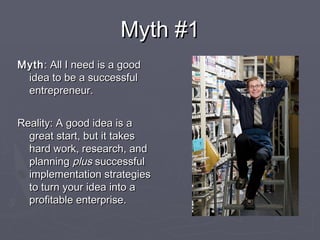
Myth #1Myth #1
MythMyth: All I need is a good: All I need is a good
idea to be a successfulidea to be a successful
entrepreneur.entrepreneur.
Reality: A good idea is aReality: A good idea is a
great start, but it takesgreat start, but it takes
hard work, research, andhard work, research, and
planningplanning plusplus successfulsuccessful
implementation strategiesimplementation strategies
to turn your idea into ato turn your idea into a
profitable enterprise.profitable enterprise.
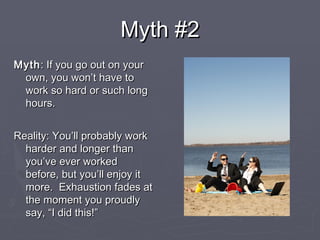
Myth #2Myth #2
MythMyth: If you go out on your: If you go out on your
own, you won’t have toown, you won’t have to
work so hard or such longwork so hard or such long
hours.hours.
Reality: You’ll probably workReality: You’ll probably work
harder and longer thanharder and longer than
you’ve ever workedyou’ve ever worked
before, but you’ll enjoy itbefore, but you’ll enjoy it
more. Exhaustion fades atmore. Exhaustion fades at
the moment you proudlythe moment you proudly
say, “I did this!”say, “I did this!”
Myth #3Myth #3
MythMyth: You’ll be able to: You’ll be able to
deduct everything so youdeduct everything so you
don’t have to pay taxes.don’t have to pay taxes.
Reality: Taxes are based onReality: Taxes are based on
netnet income, which can beincome, which can be
lowered by subtractinglowered by subtracting
expenses related to theexpenses related to the
business frombusiness from grossgross
income. Strict regulationsincome. Strict regulations
apply, so keep goodapply, so keep good
records and learn how torecords and learn how to
make the tax system workmake the tax system work
for you.for you.
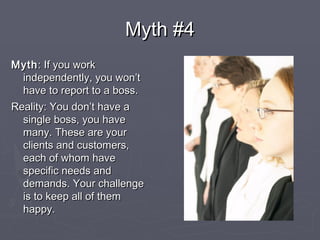
Myth #4Myth #4
MythMyth: If you work: If you work
independently, you won’tindependently, you won’t
have to report to a boss.have to report to a boss.
Reality: You don’t have aReality: You don’t have a
single boss, you havesingle boss, you have
many. These are yourmany. These are your
clients and customers,clients and customers,
each of whom haveeach of whom have
specific needs andspecific needs and
demands. Your challengedemands. Your challenge
is to keep all of themis to keep all of them
happy.happy.
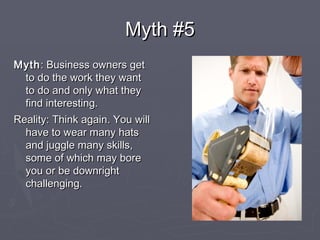
Myth #5Myth #5
MythMyth: Business owners get: Business owners get
to do the work they wantto do the work they want
to do and only what theyto do and only what they
find interesting.find interesting.
Reality: Think again. You willReality: Think again. You will
have to wear many hatshave to wear many hats
and juggle many skills,and juggle many skills,
some of which may boresome of which may bore
you or be downrightyou or be downright
challenging.challenging.
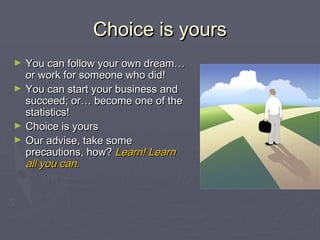
Choice is yoursChoice is yours
► You can follow your own dream…You can follow your own dream…
or work for someone who did!or work for someone who did!
► You can start your business andYou can start your business and
succeed; or… become one of thesucceed; or… become one of the
statistics!statistics!
► Choice is yoursChoice is yours
► Our advise, take someOur advise, take some
precautions, how?precautions, how? Learn! LearnLearn! Learn
all you can.all you can.
What Not To Worry AboutWhat Not To Worry About
► What type of corporationWhat type of corporation
should I have?should I have?
► Do I need an FEINDo I need an FEIN
number?number?
► What if someone steals myWhat if someone steals my
idea?idea?
► Are my expenses taxAre my expenses tax
deductible?deductible?
► How do I get a grant?How do I get a grant?
► Which logo should I pick?Which logo should I pick?
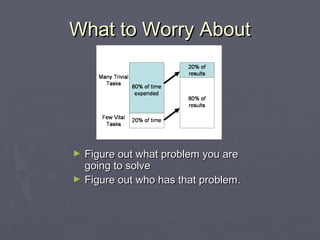
What to Worry AboutWhat to Worry About
► Figure out what problem you areFigure out what problem you are
going to solvegoing to solve
► Figure out who has that problemFigure out who has that problem..
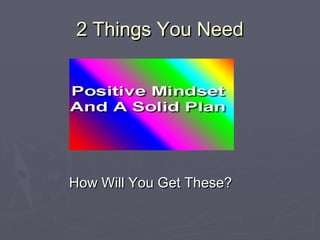
2 Things You Need2 Things You Need
How Will You Get These?How Will You Get These?
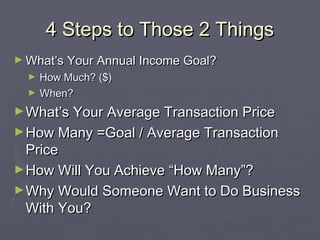
4 Steps to Those 2 Things4 Steps to Those 2 Things
► What’s Your Annual Income Goal?What’s Your Annual Income Goal?
► How Much? ($)How Much? ($)
► When?When?
►What’s Your Average Transaction PriceWhat’s Your Average Transaction Price
►How Many =Goal / Average TransactionHow Many =Goal / Average Transaction
PricePrice
►How Will You Achieve “How Many”?How Will You Achieve “How Many”?
►Why Would Someone Want to Do BusinessWhy Would Someone Want to Do Business
With You?With You?
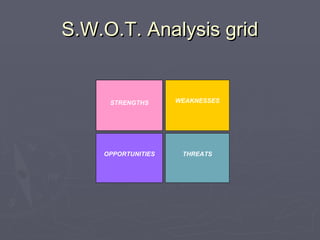
S.W.O.T. Analysis gridS.W.O.T. Analysis grid
STRENGTHS WEAKNESSES
OPPORTUNITIES THREATS
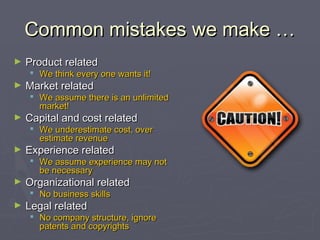
Common mistakes we make …Common mistakes we make …
► Product relatedProduct related
 We think every one wants it!We think every one wants it!
► Market relatedMarket related
 We assume there is an unlimitedWe assume there is an unlimited
market!market!
► Capital and cost relatedCapital and cost related
 We underestimate cost, overWe underestimate cost, over
estimate revenueestimate revenue
► Experience relatedExperience related
 We assumeWe assume experience may notexperience may not
be necessarybe necessary
► Organizational relatedOrganizational related
 No business skillsNo business skills
► Legal relatedLegal related
 No company structure, ignoreNo company structure, ignore
patents and copyrightspatents and copyrights
Preliminary researchPreliminary research
► Your productYour product
• Need for itNeed for it
• How much?How much?
• Demand profileDemand profile
► Your competitionYour competition
• Competitive productsCompetitive products
• How do they operate?How do they operate?
► Why your product?Why your product?
• Features and benefitsFeatures and benefits
► Barriers to entryBarriers to entry
 Cost? Competition? Regulations?Cost? Competition? Regulations?
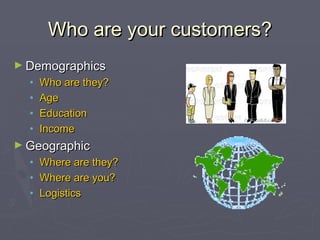
Who are your customers?Who are your customers?
► DemographicsDemographics
• Who are they?Who are they?
• AgeAge
• EducationEducation
• IncomeIncome
► GeographicGeographic
• Where are they?Where are they?
• Where are you?Where are you?
• LogisticsLogistics
Develop your ideaDevelop your idea
► Build your business modelBuild your business model
• It may be only a conceptIt may be only a concept
• It may haphazard at bestIt may haphazard at best
• It can be improvedIt can be improved
• It is a solutionIt is a solution
► Identify your customersIdentify your customers
 Target marketTarget market
► Define valueDefine value
 Cost to your customerCost to your customer
 Profit to youProfit to you
► Make it available, how?Make it available, how?
• ProductionProduction
• DistributionDistribution
• OrganizationOrganization
Check your financial healthCheck your financial health
► What can you afford?What can you afford?
► How are your finances?How are your finances?
 Good, bad or ugly? How doGood, bad or ugly? How do
you know?you know?
 Do you have your personalDo you have your personal
financial statement?financial statement?
► Why do you have toWhy do you have to
maintain your personalmaintain your personal
financial statement?financial statement?
► How to prepare one?How to prepare one?
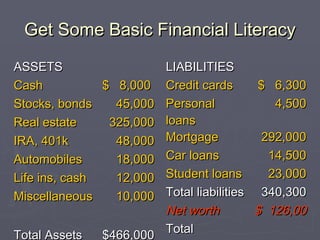
Get Some Basic Financial LiteracyGet Some Basic Financial Literacy
ASSETSASSETS
CashCash $ 8,000$ 8,000
Stocks, bondsStocks, bonds 45,00045,000
Real estateReal estate 325,000325,000
IRA, 401kIRA, 401k 48,00048,000
AutomobilesAutomobiles 18,00018,000
Life ins, cashLife ins, cash 12,00012,000
MiscellaneousMiscellaneous 10,00010,000
Total AssetsTotal Assets $466,000$466,000
LIABILITIESLIABILITIES
Credit cardsCredit cards $ 6,300$ 6,300
PersonalPersonal
loansloans
4,5004,500
MortgageMortgage 292,000292,000
Car loansCar loans 14,50014,500
Student loansStudent loans 23,00023,000
Total liabilitiesTotal liabilities 340,300340,300
Net worthNet worth $ 126,00$ 126,00
TotalTotal
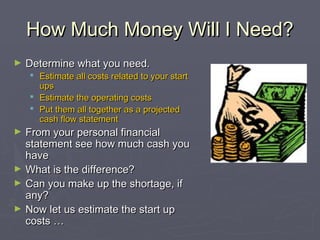
How Much Money Will I Need?How Much Money Will I Need?
► Determine what you need.Determine what you need.
 Estimate all costs related to your startEstimate all costs related to your start
upsups
 Estimate the operating costsEstimate the operating costs
 Put them all together as a projectedPut them all together as a projected
cash flow statementcash flow statement
► From your personal financialFrom your personal financial
statement see how much cash youstatement see how much cash you
havehave
► What is the difference?What is the difference?
► Can you make up the shortage, ifCan you make up the shortage, if
any?any?
► Now let us estimate the start upNow let us estimate the start up
costs …costs …
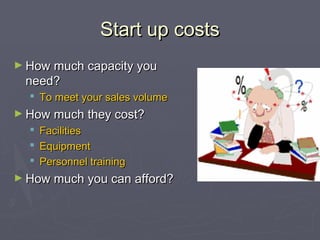
Start up costsStart up costs
► How much capacity youHow much capacity you
need?need?
 To meet your sales volumeTo meet your sales volume
► How much they cost?How much they cost?
 FacilitiesFacilities
 EquipmentEquipment
 Personnel trainingPersonnel training
► How much you can afford?How much you can afford?
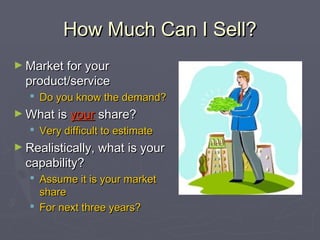
How Much Can I Sell?How Much Can I Sell?
► Market for yourMarket for your
product/serviceproduct/service
 Do you know the demand?Do you know the demand?
► What isWhat is youryour share?share?
 Very difficult to estimateVery difficult to estimate
► Realistically, what is yourRealistically, what is your
capability?capability?
 Assume it is your marketAssume it is your market
shareshare
 For next three years?For next three years?
Operating costsOperating costs
► Wages and salariesWages and salaries
 Don’t forget your salary!Don’t forget your salary!
► Materials and suppliesMaterials and supplies
► Sub-contractsSub-contracts
 Contract workersContract workers
► UtilitiesUtilities
► Interest paymentsInterest payments
► InsuranceInsurance
► Contingencies, just in case!Contingencies, just in case!
Cash flow …Cash flow …
► Don’t proceed any further withDon’t proceed any further with
out this!out this!
► Project your revenuesProject your revenues
 Know your price and volumeKnow your price and volume
 Revenue=Price x VolumeRevenue=Price x Volume
► Compile your start up andCompile your start up and
operating costs: this is youroperating costs: this is your
cash flow statementcash flow statement
► Calculate your profitCalculate your profit
 Is it positive or negative?Is it positive or negative?
► Add allAdd all negativenegative profits – this isprofits – this is
your start up costyour start up cost
Show me the money!Show me the money!
► How much capital you need?How much capital you need?
 From your cash flow analysis, whatFrom your cash flow analysis, what
you needyou need
 From your personal financialFrom your personal financial
statement, what you havestatement, what you have
 Calculate the differenceCalculate the difference
► Can you raise capital?Can you raise capital?
► 5-Cs of borrowing5-Cs of borrowing
• CharacterCharacter
• CreditCredit
• CapitalCapital
• CollateralCollateral
• ConditionsConditions
Fine-tune your business modelFine-tune your business model
► You have a viable productYou have a viable product
► You have a good teamYou have a good team
► You know how to raise capitalYou know how to raise capital
► You know the marketYou know the market
► You know how to make theYou know how to make the
product availableproduct available
► Your prices are competitiveYour prices are competitive
► You have good business skills toYou have good business skills to
operate your businessoperate your business
► You know how to monitor andYou know how to monitor and
measuremeasure
Your business plan please!Your business plan please!
► What is it?What is it?
► Why it is important?Why it is important?
► What does it include?What does it include?
• Executive summaryExecutive summary
• Your companyYour company
• Marketing planMarketing plan
• Financial projectionsFinancial projections
• Operating planOperating plan
• Risk managementRisk management
• AppendixAppendix
Don’t Reinvent the WheelDon’t Reinvent the Wheel
Templates available atTemplates available at
Score.org/resourcesScore.org/resources
Business Plan for Start-Business Plan for Start-
Up BusinessUp Business
Finance TemplatesFinance Templates
• Excel Cash Flow,Excel Cash Flow,
P&L, and BalanceP&L, and Balance
SheetSheet
Sales TemplateSales Template
Follow SCORE’S 21 hour planFollow SCORE’S 21 hour plan
► The current workshopThe current workshop
► Marketing and sellingMarketing and selling
► Financials and cashFinancials and cash
flowflow
► Accounting and riskAccounting and risk
managementmanagement
► Business planBusiness plan
► How to get financingHow to get financing
4 Links You Should Have4 Links You Should Have
Me:Mark.Lieberman01@gmail.comMe:Mark.Lieberman01@gmail.com
MyLinkedin:linkedin.com/in/liebermanmarkMyLinkedin:linkedin.com/in/liebermanmark
SCORE Local:SCORE Local: www.scorechicago.orgwww.scorechicago.org
SCORE National: www.score.orgSCORE National: www.score.org
Q&AQ&A

Going Into Business: Evaluate Yourself

  • 1.
    Going into Business:Goinginto Business: Evaluate Yourself andEvaluate Yourself and Take the First StepsTake the First Steps Presented By:Presented By: SCORE-CHICAGOSCORE-CHICAGO
  • 2.
    Your presenterYour presenter MarkLiebermanMark Lieberman
  • 3.
    SCORESCORE ► About SCOREAboutSCORE ► Educational programsEducational programs ► One-on-oneOne-on-one counselingcounseling ► MentoringMentoring ► ConsultingConsulting ► We offer, you chooseWe offer, you choose
  • 4.
    If You Haveto Leave Now …If You Have to Leave Now … 4 Links You Should Have4 Links You Should Have Me:Mark.Lieberman01@gmail.comMe:Mark.Lieberman01@gmail.com MyLinkedin:linkedin.com/in/liebermanmarkMyLinkedin:linkedin.com/in/liebermanmark SCORE Local:SCORE Local: www.scorechicago.orgwww.scorechicago.org SCORE National: www.score.orgSCORE National: www.score.org
  • 5.
    Myth #1Myth #1 MythMyth:All I need is a good: All I need is a good idea to be a successfulidea to be a successful entrepreneur.entrepreneur. Reality: A good idea is aReality: A good idea is a great start, but it takesgreat start, but it takes hard work, research, andhard work, research, and planningplanning plusplus successfulsuccessful implementation strategiesimplementation strategies to turn your idea into ato turn your idea into a profitable enterprise.profitable enterprise.
  • 6.
    Myth #2Myth #2 MythMyth:If you go out on your: If you go out on your own, you won’t have toown, you won’t have to work so hard or such longwork so hard or such long hours.hours. Reality: You’ll probably workReality: You’ll probably work harder and longer thanharder and longer than you’ve ever workedyou’ve ever worked before, but you’ll enjoy itbefore, but you’ll enjoy it more. Exhaustion fades atmore. Exhaustion fades at the moment you proudlythe moment you proudly say, “I did this!”say, “I did this!”
  • 7.
    Myth #3Myth #3 MythMyth:You’ll be able to: You’ll be able to deduct everything so youdeduct everything so you don’t have to pay taxes.don’t have to pay taxes. Reality: Taxes are based onReality: Taxes are based on netnet income, which can beincome, which can be lowered by subtractinglowered by subtracting expenses related to theexpenses related to the business frombusiness from grossgross income. Strict regulationsincome. Strict regulations apply, so keep goodapply, so keep good records and learn how torecords and learn how to make the tax system workmake the tax system work for you.for you.
  • 8.
    Myth #4Myth #4 MythMyth:If you work: If you work independently, you won’tindependently, you won’t have to report to a boss.have to report to a boss. Reality: You don’t have aReality: You don’t have a single boss, you havesingle boss, you have many. These are yourmany. These are your clients and customers,clients and customers, each of whom haveeach of whom have specific needs andspecific needs and demands. Your challengedemands. Your challenge is to keep all of themis to keep all of them happy.happy.
  • 9.
    Myth #5Myth #5 MythMyth:Business owners get: Business owners get to do the work they wantto do the work they want to do and only what theyto do and only what they find interesting.find interesting. Reality: Think again. You willReality: Think again. You will have to wear many hatshave to wear many hats and juggle many skills,and juggle many skills, some of which may boresome of which may bore you or be downrightyou or be downright challenging.challenging.
  • 10.
    Choice is yoursChoiceis yours ► You can follow your own dream…You can follow your own dream… or work for someone who did!or work for someone who did! ► You can start your business andYou can start your business and succeed; or… become one of thesucceed; or… become one of the statistics!statistics! ► Choice is yoursChoice is yours ► Our advise, take someOur advise, take some precautions, how?precautions, how? Learn! LearnLearn! Learn all you can.all you can.
  • 11.
    What Not ToWorry AboutWhat Not To Worry About ► What type of corporationWhat type of corporation should I have?should I have? ► Do I need an FEINDo I need an FEIN number?number? ► What if someone steals myWhat if someone steals my idea?idea? ► Are my expenses taxAre my expenses tax deductible?deductible? ► How do I get a grant?How do I get a grant? ► Which logo should I pick?Which logo should I pick?
  • 12.
    What to WorryAboutWhat to Worry About ► Figure out what problem you areFigure out what problem you are going to solvegoing to solve ► Figure out who has that problemFigure out who has that problem..
  • 13.
    2 Things YouNeed2 Things You Need How Will You Get These?How Will You Get These?
  • 14.
    4 Steps toThose 2 Things4 Steps to Those 2 Things ► What’s Your Annual Income Goal?What’s Your Annual Income Goal? ► How Much? ($)How Much? ($) ► When?When? ►What’s Your Average Transaction PriceWhat’s Your Average Transaction Price ►How Many =Goal / Average TransactionHow Many =Goal / Average Transaction PricePrice ►How Will You Achieve “How Many”?How Will You Achieve “How Many”? ►Why Would Someone Want to Do BusinessWhy Would Someone Want to Do Business With You?With You?
  • 15.
    S.W.O.T. Analysis gridS.W.O.T.Analysis grid STRENGTHS WEAKNESSES OPPORTUNITIES THREATS
  • 16.
    Common mistakes wemake …Common mistakes we make … ► Product relatedProduct related  We think every one wants it!We think every one wants it! ► Market relatedMarket related  We assume there is an unlimitedWe assume there is an unlimited market!market! ► Capital and cost relatedCapital and cost related  We underestimate cost, overWe underestimate cost, over estimate revenueestimate revenue ► Experience relatedExperience related  We assumeWe assume experience may notexperience may not be necessarybe necessary ► Organizational relatedOrganizational related  No business skillsNo business skills ► Legal relatedLegal related  No company structure, ignoreNo company structure, ignore patents and copyrightspatents and copyrights
  • 17.
    Preliminary researchPreliminary research ►Your productYour product • Need for itNeed for it • How much?How much? • Demand profileDemand profile ► Your competitionYour competition • Competitive productsCompetitive products • How do they operate?How do they operate? ► Why your product?Why your product? • Features and benefitsFeatures and benefits ► Barriers to entryBarriers to entry  Cost? Competition? Regulations?Cost? Competition? Regulations?
  • 18.
    Who are yourcustomers?Who are your customers? ► DemographicsDemographics • Who are they?Who are they? • AgeAge • EducationEducation • IncomeIncome ► GeographicGeographic • Where are they?Where are they? • Where are you?Where are you? • LogisticsLogistics
  • 19.
    Develop your ideaDevelopyour idea ► Build your business modelBuild your business model • It may be only a conceptIt may be only a concept • It may haphazard at bestIt may haphazard at best • It can be improvedIt can be improved • It is a solutionIt is a solution ► Identify your customersIdentify your customers  Target marketTarget market ► Define valueDefine value  Cost to your customerCost to your customer  Profit to youProfit to you ► Make it available, how?Make it available, how? • ProductionProduction • DistributionDistribution • OrganizationOrganization
  • 20.
    Check your financialhealthCheck your financial health ► What can you afford?What can you afford? ► How are your finances?How are your finances?  Good, bad or ugly? How doGood, bad or ugly? How do you know?you know?  Do you have your personalDo you have your personal financial statement?financial statement? ► Why do you have toWhy do you have to maintain your personalmaintain your personal financial statement?financial statement? ► How to prepare one?How to prepare one?
  • 21.
    Get Some BasicFinancial LiteracyGet Some Basic Financial Literacy ASSETSASSETS CashCash $ 8,000$ 8,000 Stocks, bondsStocks, bonds 45,00045,000 Real estateReal estate 325,000325,000 IRA, 401kIRA, 401k 48,00048,000 AutomobilesAutomobiles 18,00018,000 Life ins, cashLife ins, cash 12,00012,000 MiscellaneousMiscellaneous 10,00010,000 Total AssetsTotal Assets $466,000$466,000 LIABILITIESLIABILITIES Credit cardsCredit cards $ 6,300$ 6,300 PersonalPersonal loansloans 4,5004,500 MortgageMortgage 292,000292,000 Car loansCar loans 14,50014,500 Student loansStudent loans 23,00023,000 Total liabilitiesTotal liabilities 340,300340,300 Net worthNet worth $ 126,00$ 126,00 TotalTotal
  • 22.
    How Much MoneyWill I Need?How Much Money Will I Need? ► Determine what you need.Determine what you need.  Estimate all costs related to your startEstimate all costs related to your start upsups  Estimate the operating costsEstimate the operating costs  Put them all together as a projectedPut them all together as a projected cash flow statementcash flow statement ► From your personal financialFrom your personal financial statement see how much cash youstatement see how much cash you havehave ► What is the difference?What is the difference? ► Can you make up the shortage, ifCan you make up the shortage, if any?any? ► Now let us estimate the start upNow let us estimate the start up costs …costs …
  • 23.
    Start up costsStartup costs ► How much capacity youHow much capacity you need?need?  To meet your sales volumeTo meet your sales volume ► How much they cost?How much they cost?  FacilitiesFacilities  EquipmentEquipment  Personnel trainingPersonnel training ► How much you can afford?How much you can afford?
  • 24.
    How Much CanI Sell?How Much Can I Sell? ► Market for yourMarket for your product/serviceproduct/service  Do you know the demand?Do you know the demand? ► What isWhat is youryour share?share?  Very difficult to estimateVery difficult to estimate ► Realistically, what is yourRealistically, what is your capability?capability?  Assume it is your marketAssume it is your market shareshare  For next three years?For next three years?
  • 25.
    Operating costsOperating costs ►Wages and salariesWages and salaries  Don’t forget your salary!Don’t forget your salary! ► Materials and suppliesMaterials and supplies ► Sub-contractsSub-contracts  Contract workersContract workers ► UtilitiesUtilities ► Interest paymentsInterest payments ► InsuranceInsurance ► Contingencies, just in case!Contingencies, just in case!
  • 26.
    Cash flow …Cashflow … ► Don’t proceed any further withDon’t proceed any further with out this!out this! ► Project your revenuesProject your revenues  Know your price and volumeKnow your price and volume  Revenue=Price x VolumeRevenue=Price x Volume ► Compile your start up andCompile your start up and operating costs: this is youroperating costs: this is your cash flow statementcash flow statement ► Calculate your profitCalculate your profit  Is it positive or negative?Is it positive or negative? ► Add allAdd all negativenegative profits – this isprofits – this is your start up costyour start up cost
  • 27.
    Show me themoney!Show me the money! ► How much capital you need?How much capital you need?  From your cash flow analysis, whatFrom your cash flow analysis, what you needyou need  From your personal financialFrom your personal financial statement, what you havestatement, what you have  Calculate the differenceCalculate the difference ► Can you raise capital?Can you raise capital? ► 5-Cs of borrowing5-Cs of borrowing • CharacterCharacter • CreditCredit • CapitalCapital • CollateralCollateral • ConditionsConditions
  • 28.
    Fine-tune your businessmodelFine-tune your business model ► You have a viable productYou have a viable product ► You have a good teamYou have a good team ► You know how to raise capitalYou know how to raise capital ► You know the marketYou know the market ► You know how to make theYou know how to make the product availableproduct available ► Your prices are competitiveYour prices are competitive ► You have good business skills toYou have good business skills to operate your businessoperate your business ► You know how to monitor andYou know how to monitor and measuremeasure
  • 29.
    Your business planplease!Your business plan please! ► What is it?What is it? ► Why it is important?Why it is important? ► What does it include?What does it include? • Executive summaryExecutive summary • Your companyYour company • Marketing planMarketing plan • Financial projectionsFinancial projections • Operating planOperating plan • Risk managementRisk management • AppendixAppendix
  • 30.
    Don’t Reinvent theWheelDon’t Reinvent the Wheel Templates available atTemplates available at Score.org/resourcesScore.org/resources Business Plan for Start-Business Plan for Start- Up BusinessUp Business Finance TemplatesFinance Templates • Excel Cash Flow,Excel Cash Flow, P&L, and BalanceP&L, and Balance SheetSheet Sales TemplateSales Template
  • 31.
    Follow SCORE’S 21hour planFollow SCORE’S 21 hour plan ► The current workshopThe current workshop ► Marketing and sellingMarketing and selling ► Financials and cashFinancials and cash flowflow ► Accounting and riskAccounting and risk managementmanagement ► Business planBusiness plan ► How to get financingHow to get financing
  • 32.
    4 Links YouShould Have4 Links You Should Have Me:Mark.Lieberman01@gmail.comMe:Mark.Lieberman01@gmail.com MyLinkedin:linkedin.com/in/liebermanmarkMyLinkedin:linkedin.com/in/liebermanmark SCORE Local:SCORE Local: www.scorechicago.orgwww.scorechicago.org SCORE National: www.score.orgSCORE National: www.score.org
  • 34.