Remarkable Ideas 
Business Model Canvas 
Crafting your Brand 
Financial Models 
How-to Pitch 
Bradford M. Wason, Tim McIntosh & Sara Fabryka | ©2014
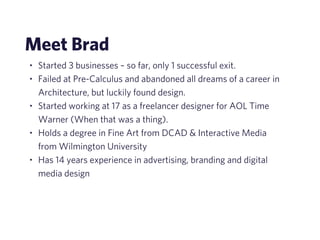
Meet Brad 
• Started 3 businesses – so far, only 1 successful exit. 
• Failed at Pre-Calculus and abandoned all dreams of a career in 
Architecture, but luckily found design. 
• Started working at 17 as a freelancer designer for AOL Time 
Warner (When that was a thing). 
• Holds a degree in Fine Art from DCAD & Interactive Media 
from Wilmington University 
• Has 14 years experience in advertising, branding and digital 
media design
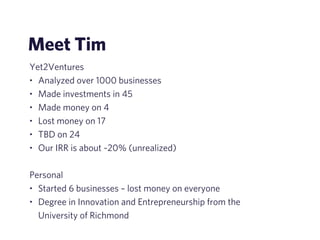
Meet Tim 
Yet2Ventures 
• Analyzed over 1000 businesses 
• Made investments in 45 
• Made money on 4 
• Lost money on 17 
• TBD on 24 
• Our IRR is about ~20% (unrealized) 
! 
Personal 
• Started 6 businesses – lost money on everyone 
• Degree in Innovation and Entrepreneurship from the 
University of Richmond
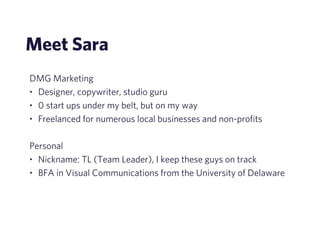
Meet Sara 
DMG Marketing 
• Designer, copywriter, studio guru 
• 0 start ups under my belt, but on my way 
• Freelanced for numerous local businesses and non-profits 
! 
Personal 
• Nickname: TL (Team Leader), I keep these guys on track 
• BFA in Visual Communications from the University of Delaware
The Startup Industry
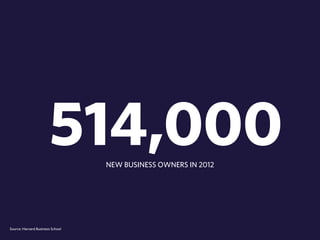
514,000 
NEW BUSINESS OWNERS IN 2012 
Source: Harvard Business School
Social Business
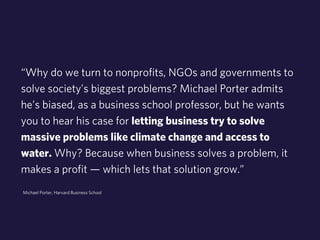
“Why do we turn to nonprofits, NGOs and governments to 
solve society’s biggest problems? Michael Porter admits 
he’s biased, as a business school professor, but he wants 
you to hear his case for letting business try to solve 
massive problems like climate change and access to 
water. Why? Because when business solves a problem, it 
makes a profit — which lets that solution grow.” 
Michael Porter, Harvard Business School
“Why aren’t we as an industry front-and-center in 
working on the great, wicked issues of our day?” 
Deborah Morrison, PhD, is the Chambers Distinguished Professor of Advertising 
University of Oregon’s School of Journalism and Communication
“The purpose of the corporation must be redefined as 
creating shared value, not just profit per se. This will 
drive the next wave of innovation and productivity 
growth in the global economy. It will also reshape 
capitalism and its relationship to society. Perhaps most 
important of all, learning how to create shared value is 
our best chance to legitimize business again.” 
Michael Porter, Harvard Business School
TRENDS 
2013 IN REVIEW. FAST FORWARD TO 2014.
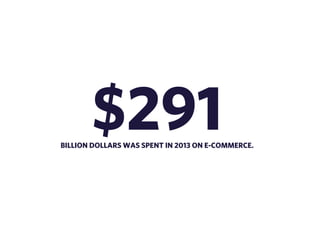
$291 
BILLION DOLLARS WAS SPENT IN 2013 ON E-COMMERCE.
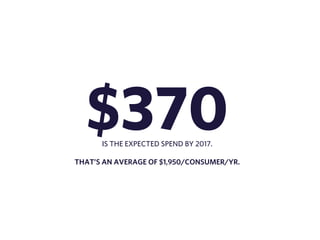
$370 IS THE EXPECTED SPEND BY 2017. 
! 
THAT’S AN AVERAGE OF $1,950/CONSUMER/YR.
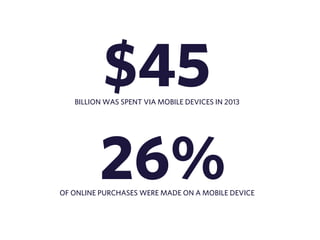
$45 
BILLION WAS SPENT VIA MOBILE DEVICES IN 2013 
26% 
OF ONLINE PURCHASES WERE MADE ON A MOBILE DEVICE
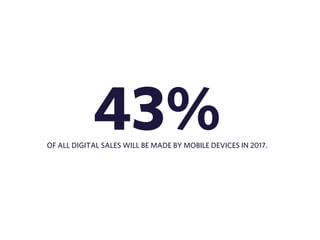
43% 
OF ALL DIGITAL SALES WILL BE MADE BY MOBILE DEVICES IN 2017.
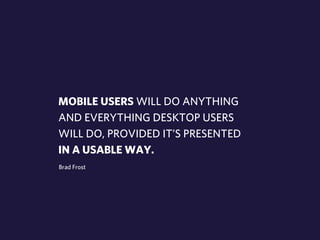
MOBILE USERS WILL DO ANYTHING 
AND EVERYTHING DESKTOP USERS 
WILL DO, PROVIDED IT’S PRESENTED 
IN A USABLE WAY. 
Brad Frost
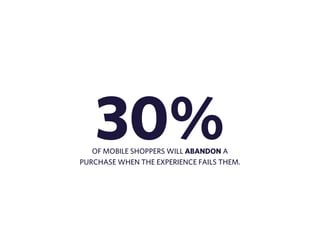
30% OF MOBILE SHOPPERS WILL ABANDON A 
PURCHASE WHEN THE EXPERIENCE FAILS THEM.
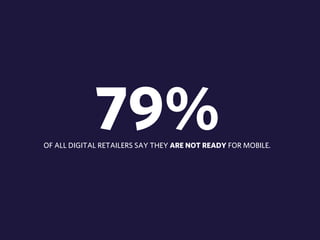
79% 
OF ALL DIGITAL RETAILERS SAY THEY ARE NOT READY FOR MOBILE.
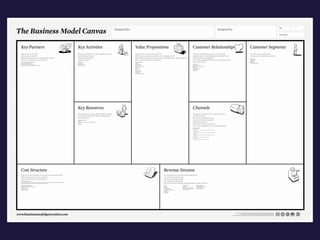
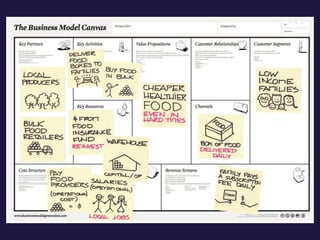
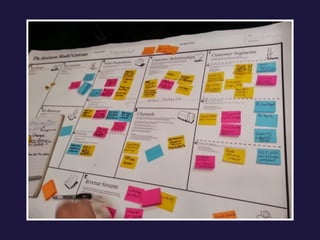
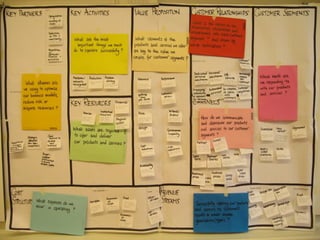
Business Model Canvas
Value Proposition 
What makes us unique?
Customer Segments 
Who are our customers?
Customer Relationship 
How are we connected to them?
Channels 
How do reach our customer?
Revenue Stream 
Where does your money come from?
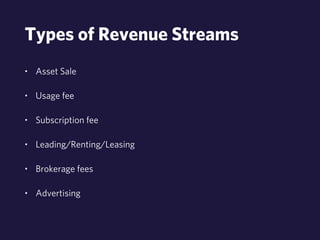
Types of Revenue Streams 
• Asset Sale 
• Usage fee 
• Subscription fee 
• Leading/Renting/Leasing 
• Brokerage fees 
• Advertising
Key Activities 
What you do to create your 
Product or Service.
Categories of Key Activities 
• Production 
• Problem Solving 
• Platform/Network
Key Partners 
Who can supplement and benefit 
what we make.
Key Partners 
• Who are our Key Partners? 
• Who are key suppliers? 
• Which Key Resources are we acquiring from partners? 
• Which Key Activities do partners perform?
Motivations for partnership 
• Optimization and economy 
• Reduction of risk and uncertainty 
• Acquisition of particular resources and activities
Key Resources 
What must we have to succeed.
Key Resources 
• What Key Resources do our Value Propositions require? 
• Our Distribution Channels? Customer Relationships? 
• Revenue Streams?
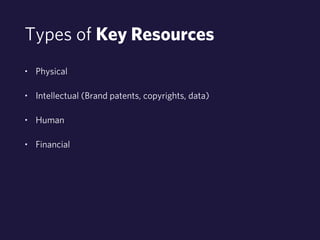
Types of Key Resources 
• Physical 
• Intellectual (Brand patents, copyrights, data) 
• Human 
• Financial
Cost Structure 
What are our primary costs for 
doing business?
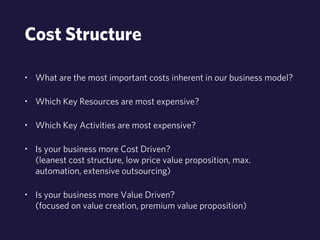
Cost Structure 
• What are the most important costs inherent in our business model? 
• Which Key Resources are most expensive? 
• Which Key Activities are most expensive? 
• Is your business more Cost Driven? 
(leanest cost structure, low price value proposition, max. 
automation, extensive outsourcing) 
• Is your business more Value Driven? 
(focused on value creation, premium value proposition)
Branding 101 
DEFINING & CRAFTING AN EXPERIENCE.
WHAT IS A BRAND? 
A brand is not a logo, not an 
identity, not a product. 
A brand is a person’s gut 
feeling about a product, 
service, or organization.
A GREAT BRAND TELLS A GREAT STORY 
And luckily we all make great stories. 
! 
Marina Willer of Wolff Olins London declared, “It’s not about 
consistency, it’s about creating stories that make sense.” 
! 
Stories are the way we connect with people and create 
relationships. If we think of brands as people or personalities, 
they need to be magical storytellers. As humans, we thrive on 
all of the emotional connections we have. We get passionate 
about them. It’s the stories we tell and hear that trigger those 
connections.
Crafting your story. 
1.) Be Real & Don’t Lie. 
! 
2.) Write down what has made an impact on you, and why 
it’s important. 
! 
3.) Go back to those 5 things you LOVE to do. What are they? 
! 
4.) Be Clear & Concise. A story has a beginning, a middle 
and an end. 
! 
5.) Leave out the sales copy, and focus on you. We’ll get to what 
you’ve done soon enough.
EAT branding 
wilmington 
newark 
lancaster 
etc.
don’t lie be real and
Date nights, drink specials, hot foodie 
happenings and insider tips. 
EAT is built by people who love food, 
great experiences and a great deal.
love what do we
food 
Source: Ezra Gregg
DRINKS 
Source: Kent Wang
PEOPLE 
Source: Matthias Ripp
PLACES 
Source: Matthias Ripp
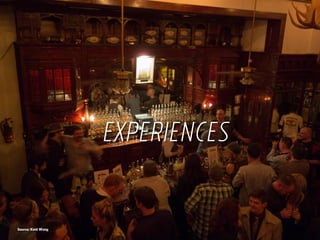
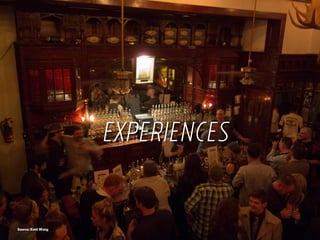
experiences 
Source: Kent Wang
story create a great
EAT is where food, drinks, places, 
experiences and great people converge. 
! 
Foodies seeking the next hot thing, 
couples looking for the perfect date 
restaurant, or folks looking for the 
best drink special on a workday, EAT will 
happily point them in the right direction.
Financial Models 
AN INSIDE LOOK FROM A ANALYSTS VIEW
What I Look for 
Solid Management team with a 
defensible business model that 
makes money 
Nice to haves are a Scalable Business Model and a Large 
and Growing Market
Solid Management Team 
• Industry Experts: Substantial experience in the space 
• Deep Team: More than one strong player 
• Experience with startups or prior business experience 
• Listens to other people: Knows how and when to pivot
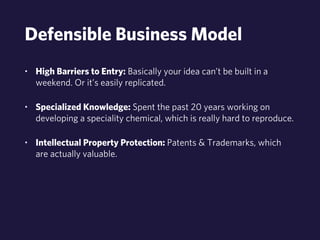
Defensible Business Model 
• High Barriers to Entry: Basically your idea can’t be built in a 
weekend. Or it’s easily replicated. 
• Specialized Knowledge: Spent the past 20 years working on 
developing a speciality chemical, which is really hard to reproduce. 
• Intellectual Property Protection: Patents & Trademarks, which 
are actually valuable.
Makes Money 
Has the potential to have earnings: there is money left over after 
expenses, interest, taxes, depreciation, and amortization.
Nice to Haves 
• Scalable Business Model: Increased revenues cost less to deliver 
than current revenues. 
• Large and Growing Market: A rising tide raises all boats.
Basic Financial Model 
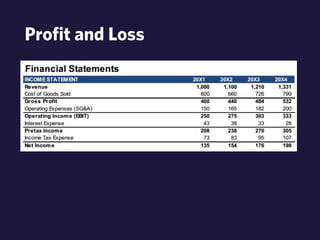
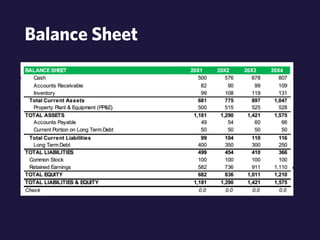
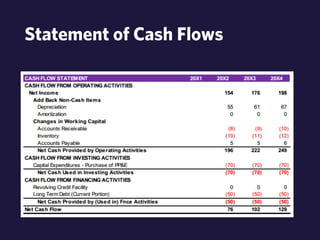
The Most Important and Least Accurate Part of the pitch: The basic 
financial model has three elements: 
• Profit & Loss 
• Balance Sheet 
• Statement of Cash Flow
Profit and Loss
Balance Sheet
Statement of Cash Flows
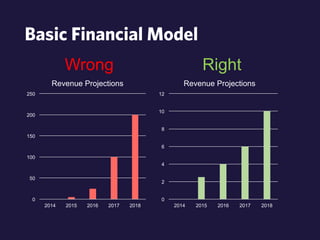
Basic Financial Model 
Wrong Right 
12 
10 
8 
6 
4 
2 
0 
Revenue Projections 
2014 2015 2016 2017 2018 
250 
200 
150 
100 
50 
0 
Revenue Projections 
2014 2015 2016 2017 2018
Basic Financial Terms 
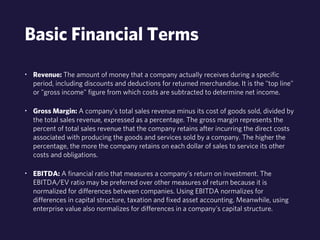
• Revenue: The amount of money that a company actually receives during a specific 
period, including discounts and deductions for returned merchandise. It is the "top line" 
or "gross income" figure from which costs are subtracted to determine net income. 
• Gross Margin: A company's total sales revenue minus its cost of goods sold, divided by 
the total sales revenue, expressed as a percentage. The gross margin represents the 
percent of total sales revenue that the company retains after incurring the direct costs 
associated with producing the goods and services sold by a company. The higher the 
percentage, the more the company retains on each dollar of sales to service its other 
costs and obligations. 
• EBITDA: A financial ratio that measures a company's return on investment. The 
EBITDA/EV ratio may be preferred over other measures of return because it is 
normalized for differences between companies. Using EBITDA normalizes for 
differences in capital structure, taxation and fixed asset accounting. Meanwhile, using 
enterprise value also normalizes for differences in a company's capital structure.
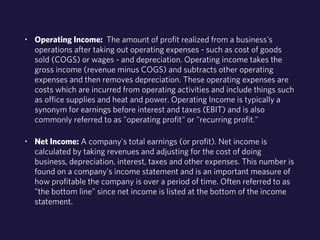
• Operating Income: The amount of profit realized from a business's 
operations after taking out operating expenses - such as cost of goods 
sold (COGS) or wages - and depreciation. Operating income takes the 
gross income (revenue minus COGS) and subtracts other operating 
expenses and then removes depreciation. These operating expenses are 
costs which are incurred from operating activities and include things such 
as office supplies and heat and power. Operating Income is typically a 
synonym for earnings before interest and taxes (EBIT) and is also 
commonly referred to as "operating profit" or "recurring profit." 
• Net Income: A company's total earnings (or profit). Net income is 
calculated by taking revenues and adjusting for the cost of doing 
business, depreciation, interest, taxes and other expenses. This number is 
found on a company's income statement and is an important measure of 
how profitable the company is over a period of time. Often referred to as 
"the bottom line" since net income is listed at the bottom of the income 
statement.
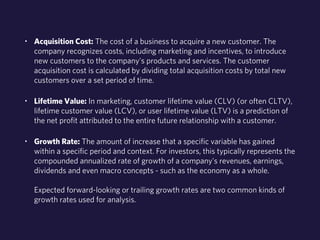
• Acquisition Cost: The cost of a business to acquire a new customer. The 
company recognizes costs, including marketing and incentives, to introduce 
new customers to the company's products and services. The customer 
acquisition cost is calculated by dividing total acquisition costs by total new 
customers over a set period of time. 
• Lifetime Value: In marketing, customer lifetime value (CLV) (or often CLTV), 
lifetime customer value (LCV), or user lifetime value (LTV) is a prediction of 
the net profit attributed to the entire future relationship with a customer. 
• Growth Rate: The amount of increase that a specific variable has gained 
within a specific period and context. For investors, this typically represents the 
compounded annualized rate of growth of a company's revenues, earnings, 
dividends and even macro concepts - such as the economy as a whole. 
Expected forward-looking or trailing growth rates are two common kinds of 
growth rates used for analysis.
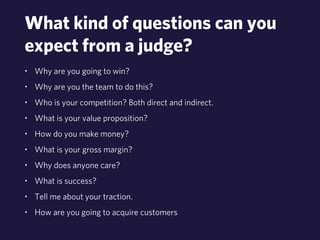
What kind of questions can you 
expect from a judge? 
• Why are you going to win? 
• Why are you the team to do this? 
• Who is your competition? Both direct and indirect. 
• What is your value proposition? 
• How do you make money? 
• What is your gross margin? 
• Why does anyone care? 
• What is success? 
• Tell me about your traction. 
• How are you going to acquire customers
A crash course in a simple model: 
www.asimplemodel.com
The Pitch
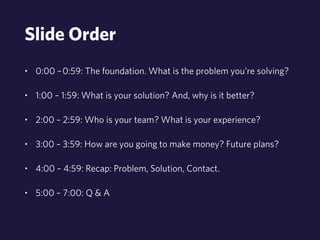
Slide Order 
• 0:00 – 0:59: The foundation. What is the problem you’re solving? 
• 1:00 – 1:59: What is your solution? And, why is it better? 
• 2:00 – 2:59: Who is your team? What is your experience? 
• 3:00 – 3:59: How are you going to make money? Future plans? 
• 4:00 – 4:59: Recap: Problem, Solution, Contact. 
• 5:00 – 7:00: Q & A
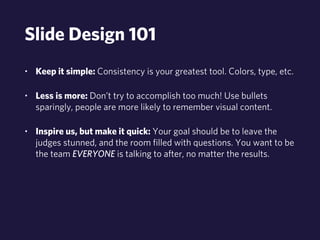
Slide Design 101 
• Keep it simple: Consistency is your greatest tool. Colors, type, etc. 
• Less is more: Don’t try to accomplish too much! Use bullets 
sparingly, people are more likely to remember visual content. 
• Inspire us, but make it quick: Your goal should be to leave the 
judges stunned, and the room filled with questions. You want to be 
the team EVERYONE is talking to after, no matter the results.
An example: EAT Wilmington
wilmington
EAT What do you want to 
tonight? 
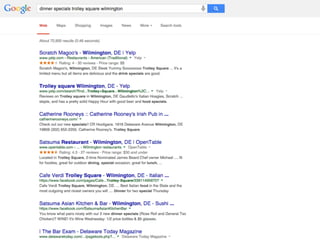
the problem:
EAT What do you want to 
tonight? 
what are you 
in the mood 
for? 
who has 
specials 
tonight? 
what’s 
happening 
around town? 
where is 
everyone 
else going?
the solution: 
E A T wilmington
E A T wilmington 
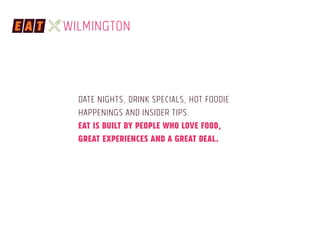
Date nights, drink specials, hot foodie 
happenings and insider tips. 
EAT is built by people who love food, 
great experiences and a great deal.
food 
Source: Ezra Gregg
DRINKS 
Source: Kent Wang
PEOPLE 
Source: Matthias Ripp
PLACES 
Source: Matthias Ripp
experiences 
Source: Kent Wang
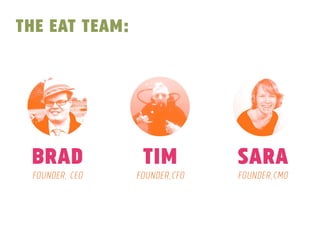
the eat team: 
Brad 
founder, CEO 
tim sara 
founder,CFO founder,CMO
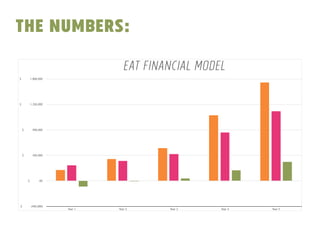
the numbers: 
EAT FINANCIAL MODEL 
$ 1,800,000 
$ 1,350,000 
$ 900,000 
$ 450,000 
$ -00 
$ (450,000) 
Year 1 Year 2 Year 3 Year 4 Year 5
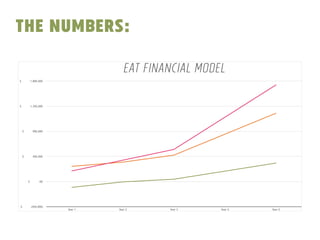
the numbers: 
EAT FINANCIAL MODEL 
$ 1,800,000 
$ 1,350,000 
$ 900,000 
$ 450,000 
$ -00 
$ (450,000) 
Year 1 Year 2 Year 3 Year 4 Year 5
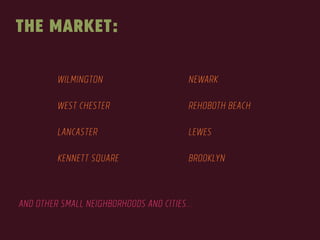
the MARKET: 
WILMINGTON 
! 
WEST CHESTER 
! 
LANCASTER 
! 
KENNETT SQUARE 
NEWARK 
! 
REHOBOTH BEACH 
! 
LEWES 
! 
BROOKLYN 
AND OTHER SMALL NEIGHBORHOODS AND CITIES…
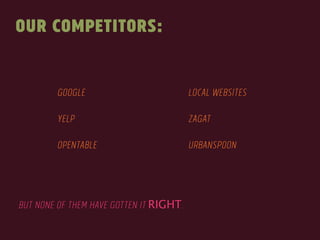
OUR COMPETITORS: 
GOOGLE 
! 
YELP 
! 
OPENTABLE 
LOCAL WEBSITES 
! 
Zagat 
! 
urbanspoon 
BUT NONE OF THEM HAVE GOTTEN IT RIGHT.
E A T wilmington 
coming soon
Questions? Let us know.
Remarkable Ideas 
Thank you! 
Bradford M. Wason, Tim McIntosh & Sara Fabryka | ©2014

How to Pitch: An insiders guide

  • 1.
    Remarkable Ideas BusinessModel Canvas Crafting your Brand Financial Models How-to Pitch Bradford M. Wason, Tim McIntosh & Sara Fabryka | ©2014
  • 2.
    Meet Brad •Started 3 businesses – so far, only 1 successful exit. • Failed at Pre-Calculus and abandoned all dreams of a career in Architecture, but luckily found design. • Started working at 17 as a freelancer designer for AOL Time Warner (When that was a thing). • Holds a degree in Fine Art from DCAD & Interactive Media from Wilmington University • Has 14 years experience in advertising, branding and digital media design
  • 3.
    Meet Tim Yet2Ventures • Analyzed over 1000 businesses • Made investments in 45 • Made money on 4 • Lost money on 17 • TBD on 24 • Our IRR is about ~20% (unrealized) ! Personal • Started 6 businesses – lost money on everyone • Degree in Innovation and Entrepreneurship from the University of Richmond
  • 4.
    Meet Sara DMGMarketing • Designer, copywriter, studio guru • 0 start ups under my belt, but on my way • Freelanced for numerous local businesses and non-profits ! Personal • Nickname: TL (Team Leader), I keep these guys on track • BFA in Visual Communications from the University of Delaware
  • 5.
  • 6.
    514,000 NEW BUSINESSOWNERS IN 2012 Source: Harvard Business School
  • 7.
  • 8.
  • 9.
  • 10.
  • 11.
    “Why do weturn to nonprofits, NGOs and governments to solve society’s biggest problems? Michael Porter admits he’s biased, as a business school professor, but he wants you to hear his case for letting business try to solve massive problems like climate change and access to water. Why? Because when business solves a problem, it makes a profit — which lets that solution grow.” Michael Porter, Harvard Business School
  • 13.
    “Why aren’t weas an industry front-and-center in working on the great, wicked issues of our day?” Deborah Morrison, PhD, is the Chambers Distinguished Professor of Advertising University of Oregon’s School of Journalism and Communication
  • 14.
    “The purpose ofthe corporation must be redefined as creating shared value, not just profit per se. This will drive the next wave of innovation and productivity growth in the global economy. It will also reshape capitalism and its relationship to society. Perhaps most important of all, learning how to create shared value is our best chance to legitimize business again.” Michael Porter, Harvard Business School
  • 15.
    TRENDS 2013 INREVIEW. FAST FORWARD TO 2014.
  • 16.
    $291 BILLION DOLLARSWAS SPENT IN 2013 ON E-COMMERCE.
  • 17.
    $370 IS THEEXPECTED SPEND BY 2017. ! THAT’S AN AVERAGE OF $1,950/CONSUMER/YR.
  • 18.
    $45 BILLION WASSPENT VIA MOBILE DEVICES IN 2013 26% OF ONLINE PURCHASES WERE MADE ON A MOBILE DEVICE
  • 19.
    43% OF ALLDIGITAL SALES WILL BE MADE BY MOBILE DEVICES IN 2017.
  • 20.
    MOBILE USERS WILLDO ANYTHING AND EVERYTHING DESKTOP USERS WILL DO, PROVIDED IT’S PRESENTED IN A USABLE WAY. Brad Frost
  • 21.
    30% OF MOBILESHOPPERS WILL ABANDON A PURCHASE WHEN THE EXPERIENCE FAILS THEM.
  • 22.
    79% OF ALLDIGITAL RETAILERS SAY THEY ARE NOT READY FOR MOBILE.
  • 23.
  • 28.
    Value Proposition Whatmakes us unique?
  • 29.
    Customer Segments Whoare our customers?
  • 30.
    Customer Relationship Howare we connected to them?
  • 31.
    Channels How doreach our customer?
  • 32.
    Revenue Stream Wheredoes your money come from?
  • 33.
    Types of RevenueStreams • Asset Sale • Usage fee • Subscription fee • Leading/Renting/Leasing • Brokerage fees • Advertising
  • 34.
    Key Activities Whatyou do to create your Product or Service.
  • 35.
    Categories of KeyActivities • Production • Problem Solving • Platform/Network
  • 36.
    Key Partners Whocan supplement and benefit what we make.
  • 37.
    Key Partners •Who are our Key Partners? • Who are key suppliers? • Which Key Resources are we acquiring from partners? • Which Key Activities do partners perform?
  • 38.
    Motivations for partnership • Optimization and economy • Reduction of risk and uncertainty • Acquisition of particular resources and activities
  • 39.
    Key Resources Whatmust we have to succeed.
  • 40.
    Key Resources •What Key Resources do our Value Propositions require? • Our Distribution Channels? Customer Relationships? • Revenue Streams?
  • 41.
    Types of KeyResources • Physical • Intellectual (Brand patents, copyrights, data) • Human • Financial
  • 42.
    Cost Structure Whatare our primary costs for doing business?
  • 43.
    Cost Structure •What are the most important costs inherent in our business model? • Which Key Resources are most expensive? • Which Key Activities are most expensive? • Is your business more Cost Driven? (leanest cost structure, low price value proposition, max. automation, extensive outsourcing) • Is your business more Value Driven? (focused on value creation, premium value proposition)
  • 44.
    Branding 101 DEFINING& CRAFTING AN EXPERIENCE.
  • 45.
    WHAT IS ABRAND? A brand is not a logo, not an identity, not a product. A brand is a person’s gut feeling about a product, service, or organization.
  • 46.
    A GREAT BRANDTELLS A GREAT STORY And luckily we all make great stories. ! Marina Willer of Wolff Olins London declared, “It’s not about consistency, it’s about creating stories that make sense.” ! Stories are the way we connect with people and create relationships. If we think of brands as people or personalities, they need to be magical storytellers. As humans, we thrive on all of the emotional connections we have. We get passionate about them. It’s the stories we tell and hear that trigger those connections.
  • 47.
    Crafting your story. 1.) Be Real & Don’t Lie. ! 2.) Write down what has made an impact on you, and why it’s important. ! 3.) Go back to those 5 things you LOVE to do. What are they? ! 4.) Be Clear & Concise. A story has a beginning, a middle and an end. ! 5.) Leave out the sales copy, and focus on you. We’ll get to what you’ve done soon enough.
  • 48.
    EAT branding wilmington newark lancaster etc.
  • 49.
  • 50.
    Date nights, drinkspecials, hot foodie happenings and insider tips. EAT is built by people who love food, great experiences and a great deal.
  • 51.
  • 52.
  • 53.
  • 54.
  • 55.
  • 56.
  • 57.
  • 58.
    EAT is wherefood, drinks, places, experiences and great people converge. ! Foodies seeking the next hot thing, couples looking for the perfect date restaurant, or folks looking for the best drink special on a workday, EAT will happily point them in the right direction.
  • 59.
    Financial Models ANINSIDE LOOK FROM A ANALYSTS VIEW
  • 60.
    What I Lookfor Solid Management team with a defensible business model that makes money Nice to haves are a Scalable Business Model and a Large and Growing Market
  • 61.
    Solid Management Team • Industry Experts: Substantial experience in the space • Deep Team: More than one strong player • Experience with startups or prior business experience • Listens to other people: Knows how and when to pivot
  • 62.
    Defensible Business Model • High Barriers to Entry: Basically your idea can’t be built in a weekend. Or it’s easily replicated. • Specialized Knowledge: Spent the past 20 years working on developing a speciality chemical, which is really hard to reproduce. • Intellectual Property Protection: Patents & Trademarks, which are actually valuable.
  • 63.
    Makes Money Hasthe potential to have earnings: there is money left over after expenses, interest, taxes, depreciation, and amortization.
  • 64.
    Nice to Haves • Scalable Business Model: Increased revenues cost less to deliver than current revenues. • Large and Growing Market: A rising tide raises all boats.
  • 65.
    Basic Financial Model The Most Important and Least Accurate Part of the pitch: The basic financial model has three elements: • Profit & Loss • Balance Sheet • Statement of Cash Flow
  • 66.
  • 67.
  • 68.
  • 69.
    Basic Financial Model Wrong Right 12 10 8 6 4 2 0 Revenue Projections 2014 2015 2016 2017 2018 250 200 150 100 50 0 Revenue Projections 2014 2015 2016 2017 2018
  • 70.
    Basic Financial Terms • Revenue: The amount of money that a company actually receives during a specific period, including discounts and deductions for returned merchandise. It is the "top line" or "gross income" figure from which costs are subtracted to determine net income. • Gross Margin: A company's total sales revenue minus its cost of goods sold, divided by the total sales revenue, expressed as a percentage. The gross margin represents the percent of total sales revenue that the company retains after incurring the direct costs associated with producing the goods and services sold by a company. The higher the percentage, the more the company retains on each dollar of sales to service its other costs and obligations. • EBITDA: A financial ratio that measures a company's return on investment. The EBITDA/EV ratio may be preferred over other measures of return because it is normalized for differences between companies. Using EBITDA normalizes for differences in capital structure, taxation and fixed asset accounting. Meanwhile, using enterprise value also normalizes for differences in a company's capital structure.
  • 71.
    • Operating Income:The amount of profit realized from a business's operations after taking out operating expenses - such as cost of goods sold (COGS) or wages - and depreciation. Operating income takes the gross income (revenue minus COGS) and subtracts other operating expenses and then removes depreciation. These operating expenses are costs which are incurred from operating activities and include things such as office supplies and heat and power. Operating Income is typically a synonym for earnings before interest and taxes (EBIT) and is also commonly referred to as "operating profit" or "recurring profit." • Net Income: A company's total earnings (or profit). Net income is calculated by taking revenues and adjusting for the cost of doing business, depreciation, interest, taxes and other expenses. This number is found on a company's income statement and is an important measure of how profitable the company is over a period of time. Often referred to as "the bottom line" since net income is listed at the bottom of the income statement.
  • 72.
    • Acquisition Cost:The cost of a business to acquire a new customer. The company recognizes costs, including marketing and incentives, to introduce new customers to the company's products and services. The customer acquisition cost is calculated by dividing total acquisition costs by total new customers over a set period of time. • Lifetime Value: In marketing, customer lifetime value (CLV) (or often CLTV), lifetime customer value (LCV), or user lifetime value (LTV) is a prediction of the net profit attributed to the entire future relationship with a customer. • Growth Rate: The amount of increase that a specific variable has gained within a specific period and context. For investors, this typically represents the compounded annualized rate of growth of a company's revenues, earnings, dividends and even macro concepts - such as the economy as a whole. Expected forward-looking or trailing growth rates are two common kinds of growth rates used for analysis.
  • 73.
    What kind ofquestions can you expect from a judge? • Why are you going to win? • Why are you the team to do this? • Who is your competition? Both direct and indirect. • What is your value proposition? • How do you make money? • What is your gross margin? • Why does anyone care? • What is success? • Tell me about your traction. • How are you going to acquire customers
  • 74.
    A crash coursein a simple model: www.asimplemodel.com
  • 75.
  • 76.
    Slide Order •0:00 – 0:59: The foundation. What is the problem you’re solving? • 1:00 – 1:59: What is your solution? And, why is it better? • 2:00 – 2:59: Who is your team? What is your experience? • 3:00 – 3:59: How are you going to make money? Future plans? • 4:00 – 4:59: Recap: Problem, Solution, Contact. • 5:00 – 7:00: Q & A
  • 77.
    Slide Design 101 • Keep it simple: Consistency is your greatest tool. Colors, type, etc. • Less is more: Don’t try to accomplish too much! Use bullets sparingly, people are more likely to remember visual content. • Inspire us, but make it quick: Your goal should be to leave the judges stunned, and the room filled with questions. You want to be the team EVERYONE is talking to after, no matter the results.
  • 78.
    An example: EATWilmington
  • 79.
  • 80.
    EAT What doyou want to tonight? the problem:
  • 81.
    EAT What doyou want to tonight? what are you in the mood for? who has specials tonight? what’s happening around town? where is everyone else going?
  • 83.
    the solution: EA T wilmington
  • 84.
    E A Twilmington Date nights, drink specials, hot foodie happenings and insider tips. EAT is built by people who love food, great experiences and a great deal.
  • 85.
  • 86.
  • 87.
  • 88.
  • 89.
  • 90.
    the eat team: Brad founder, CEO tim sara founder,CFO founder,CMO
  • 91.
    the numbers: EATFINANCIAL MODEL $ 1,800,000 $ 1,350,000 $ 900,000 $ 450,000 $ -00 $ (450,000) Year 1 Year 2 Year 3 Year 4 Year 5
  • 92.
    the numbers: EATFINANCIAL MODEL $ 1,800,000 $ 1,350,000 $ 900,000 $ 450,000 $ -00 $ (450,000) Year 1 Year 2 Year 3 Year 4 Year 5
  • 93.
    the MARKET: WILMINGTON ! WEST CHESTER ! LANCASTER ! KENNETT SQUARE NEWARK ! REHOBOTH BEACH ! LEWES ! BROOKLYN AND OTHER SMALL NEIGHBORHOODS AND CITIES…
  • 94.
    OUR COMPETITORS: GOOGLE ! YELP ! OPENTABLE LOCAL WEBSITES ! Zagat ! urbanspoon BUT NONE OF THEM HAVE GOTTEN IT RIGHT.
  • 95.
    E A Twilmington coming soon
  • 96.
  • 97.
    Remarkable Ideas Thankyou! Bradford M. Wason, Tim McIntosh & Sara Fabryka | ©2014