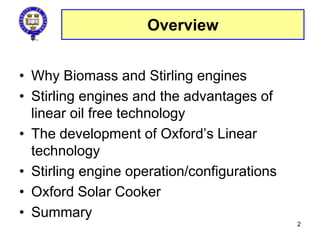
Biomass-
fuelled 5-20kW
Stirling engine
for off-grid
applications
NGST/Honeywell Hymatic
Mike Dadd, Nick Jelley,
Paul Bailey, Richard Stone
University of Oxford 1
Overview
• Why Biomass and Stirling engines
• Stirling engines and the advantages of
linear oil free technology
• The development of Oxford’s Linear
technology
• Stirling engine operation/configurations
• Oxford Solar Cooker
• Summary
2
Why Biomass?
• Alongside solar power, biomass is a key
renewable energy source in the developing
world
• Biomass:
– Can contain useful amounts of energy
– Includes various forms of waste e.g.
agricultural waste, slurry, sewage etc
– Easily generates combustible gaseous, liquid
and solid materials but NOT clean fuels
– Is often burnt to provide just heat but this is
not the most effective use of the resource 3
Why Stirling Engines?
• Stirling engines:
– Can exploit any external heat source
– Possible heat sources include solar power or biomass
fuels
– Fuel quality can be very low compared with IC engine
requirements
– Can give high efficiencies even at low power levels
e.g. 1 to 10 kW with efficiencies in range 30 – 40%
– Potential for power generation in the range 5 to 20+
kW – suited to isolated communities in the developing
world
– Can use thermal storage
4
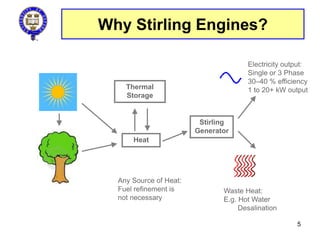
Why Stirling Engines?
Electricity output:
Single or 3 Phase
30–40 % efficiency
1 to 20+ kW output
Waste Heat:
E.g. Hot Water
Desalination
Stirling
Generator
Thermal
Storage
Heat
5
Any Source of Heat:
Fuel refinement is
not necessary
Why Stirling Engines and Biomass?
• In principle Stirling engines could be used for solar
power generation BUT:
– There are other competing technologies that can be
used to generate solar power
– Costs of PV panels in particular have fallen to a level
that discourages Stirling engine development for this
application
– SES Stirling and Infinia filed for bankruptcy (2011 and
2013 respectively) – both had invested heavily in
Solar Stirling
• Biomass/Stirling power generation in the small/medium
power range (1 – 20 kW) has much less competition
6
Biomass - Competing Technologies
• > 1 MW – Gas/steam turbines
• 100-1000 kW – Gas engines/turbines
• 1 - 100 kW – steam engines - inefficient
• 1 - 100 kW – I.C. engines cope badly with unrefined fuel.
• 1 - 20+ kW – Very well suited to Stirling engines
provided operating costs are acceptable – a real
opportunity for Stirling engine development
• < 1 kW – Thermo-electric Generators?
7
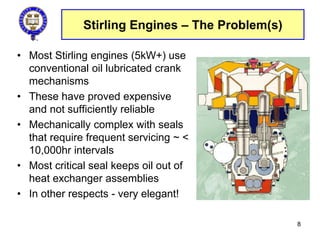
Stirling Engines – The Problem(s)
• Most Stirling engines (5kW+) use
conventional oil lubricated crank
mechanisms
• These have proved expensive
and not sufficiently reliable
• Mechanically complex with seals
that require frequent servicing ~ <
10,000hr intervals
• Most critical seal keeps oil out of
heat exchanger assemblies
• In other respects - very elegant!
8
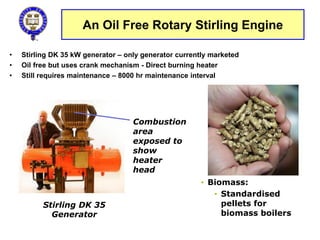
An Oil Free Rotary Stirling Engine
• Stirling DK 35 kW generator – only generator currently marketed
• Oil free but uses crank mechanism - Direct burning heater
• Still requires maintenance – 8000 hr maintenance interval
• Biomass:
• Standardised
pellets for
biomass boilers
Combustion
area
exposed to
show
heater
head
Stirling DK 35
Generator
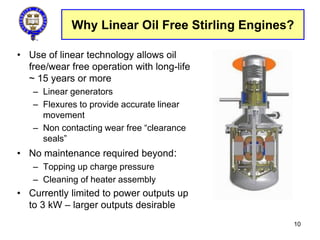
Why Linear Oil Free Stirling Engines?
• Use of linear technology allows oil
free/wear free operation with long-life
~ 15 years or more
– Linear generators
– Flexures to provide accurate linear
movement
– Non contacting wear free “clearance
seals”
• No maintenance required beyond:
– Topping up charge pressure
– Cleaning of heater assembly
• Currently limited to power outputs up
to 3 kW – larger outputs desirable
10
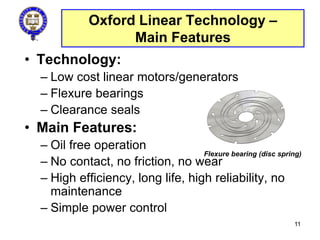
Oxford Linear Technology –
Main Features
• Technology:
– Low cost linear motors/generators
– Flexure bearings
– Clearance seals
• Main Features:
– Oil free operation
– No contact, no friction, no wear
– High efficiency, long life, high reliability, no
maintenance
– Simple power control
Flexure bearing (disc spring)
11
Development of Linear Technology at
Oxford – Original Split Stirling Cooler
COLD HEAD COMPRESSOR
PISTON CLEARANCE SEALREGENERATOR
CLEARANCE
SEAL
SPRINGS
MAGNET
DRIVE COIL
SPRINGS
COLD TIP
DISPLACER
MAGNETIC
CIRCUIT
ORIGINAL SPLIT DESIGN FOR SPACE APPLICATIONS
• 2 Motors operating
90° out of phase
• Oil free operation
• No wearing
components
• Infinite Life!!
First
Generation
Space
Cryocoolers
c.1980
12
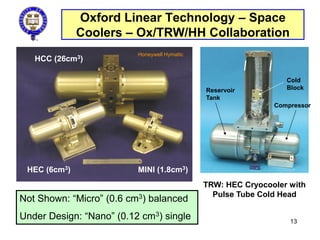
Oxford Linear Technology – Space
Coolers – Ox/TRW/HH Collaboration
HCC (26cm3)
MINI (1.8cm3)HEC (6cm3)
TRW: HEC Cryocooler with
Pulse Tube Cold Head
Not Shown: “Micro” (0.6 cm3) balanced
Under Design: “Nano” (0.12 cm3) single
Honeywell Hymatic
NGST
Reservoir
Tank
Cold
Block
Compressor
13
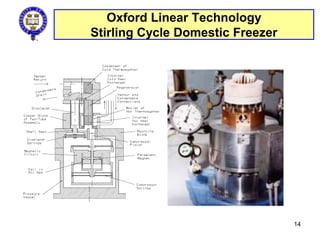
Oxford Linear Technology
Stirling Cycle Domestic Freezer
14
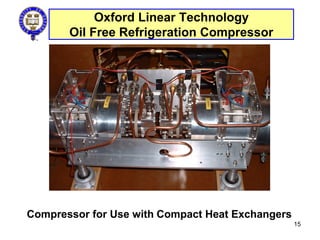
Oxford Linear Technology
Oil Free Refrigeration Compressor
Compressor for Use with Compact Heat Exchangers
15
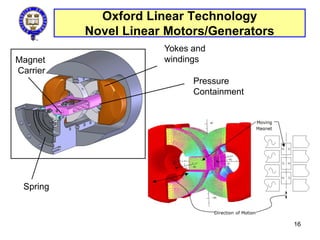
Oxford Linear Technology
Novel Linear Motors/Generators
Spring
Pressure
Containment
Magnet
Carrier
Yokes and
windings
16
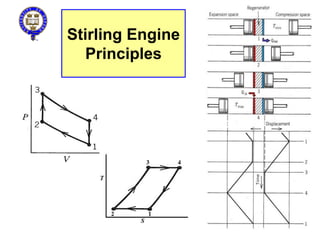
Stirling Engine
Principles
17
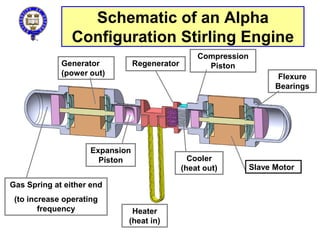
Schematic of an Alpha
Configuration Stirling Engine
Generator
(power out)
Gas Spring at either end
(to increase operating
frequency Heater
(heat in)
Cooler
(heat out)
Expansion
Piston
Flexure
Bearings
Regenerator
Compression
Piston
Slave Motor
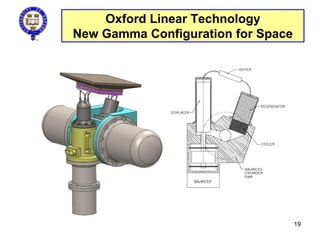
Oxford Linear Technology
New Gamma Configuration for Space
19
Oxford Linear Technology
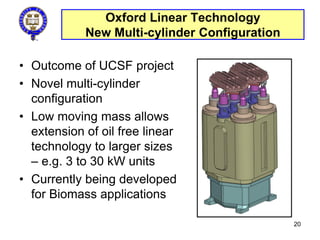
New Multi-cylinder Configuration
• Outcome of UCSF project
• Novel multi-cylinder
configuration
• Low moving mass allows
extension of oil free linear
technology to larger sizes
– e.g. 3 to 30 kW units
• Currently being developed
for Biomass applications
20
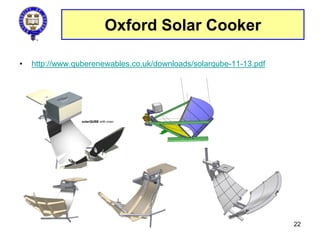
Oxford Solar Cooker
• New solar concentrator was initially intended for Solar
Stirling power applications
• Design uses novel combination of cone and parabolic
reflectors to generate high concentrations
• Reflectors can be formed from flat sheet – this allows
easy transport in flat pack form
• Currently not pursued for solar Stirling but is showing
great promise for solar cooking applications in the
developing world
• There is a collaborative project with Dytecna, with field
trials in Africa planned.
21
Oxford Solar Cooker
• http://www.quberenewables.co.uk/downloads/solarqube-11-13.pdf
22
Oxford Renewable Power Technology
Summary
• Established track record for linear
compressors/generators over 30 years
– Stirling Cycle, Pulse Tubes, JT
• Novel moving magnet motor/generator designs.
• Novel Designs of Solar Concentrators
– Suitable for Engines, CPV, Solar Cooking
• Stirling Engine Development:
– ESA space power project
– Terrestrial applications – e.g. Biomass
23
Any Questions?
mike.dadd@eng.ox.ac.uk
n.jelley@physics.ox.ac.uk
24

Cambridge | Jan-14 | Biomass-fuelled Stirling Engine for off-grid applications

  • 1.
    Biomass- fuelled 5-20kW Stirling engine foroff-grid applications NGST/Honeywell Hymatic Mike Dadd, Nick Jelley, Paul Bailey, Richard Stone University of Oxford 1
  • 2.
    Overview • Why Biomassand Stirling engines • Stirling engines and the advantages of linear oil free technology • The development of Oxford’s Linear technology • Stirling engine operation/configurations • Oxford Solar Cooker • Summary 2
  • 3.
    Why Biomass? • Alongsidesolar power, biomass is a key renewable energy source in the developing world • Biomass: – Can contain useful amounts of energy – Includes various forms of waste e.g. agricultural waste, slurry, sewage etc – Easily generates combustible gaseous, liquid and solid materials but NOT clean fuels – Is often burnt to provide just heat but this is not the most effective use of the resource 3
  • 4.
    Why Stirling Engines? •Stirling engines: – Can exploit any external heat source – Possible heat sources include solar power or biomass fuels – Fuel quality can be very low compared with IC engine requirements – Can give high efficiencies even at low power levels e.g. 1 to 10 kW with efficiencies in range 30 – 40% – Potential for power generation in the range 5 to 20+ kW – suited to isolated communities in the developing world – Can use thermal storage 4
  • 5.
    Why Stirling Engines? Electricityoutput: Single or 3 Phase 30–40 % efficiency 1 to 20+ kW output Waste Heat: E.g. Hot Water Desalination Stirling Generator Thermal Storage Heat 5 Any Source of Heat: Fuel refinement is not necessary
  • 6.
    Why Stirling Enginesand Biomass? • In principle Stirling engines could be used for solar power generation BUT: – There are other competing technologies that can be used to generate solar power – Costs of PV panels in particular have fallen to a level that discourages Stirling engine development for this application – SES Stirling and Infinia filed for bankruptcy (2011 and 2013 respectively) – both had invested heavily in Solar Stirling • Biomass/Stirling power generation in the small/medium power range (1 – 20 kW) has much less competition 6
  • 7.
    Biomass - CompetingTechnologies • > 1 MW – Gas/steam turbines • 100-1000 kW – Gas engines/turbines • 1 - 100 kW – steam engines - inefficient • 1 - 100 kW – I.C. engines cope badly with unrefined fuel. • 1 - 20+ kW – Very well suited to Stirling engines provided operating costs are acceptable – a real opportunity for Stirling engine development • < 1 kW – Thermo-electric Generators? 7
  • 8.
    Stirling Engines –The Problem(s) • Most Stirling engines (5kW+) use conventional oil lubricated crank mechanisms • These have proved expensive and not sufficiently reliable • Mechanically complex with seals that require frequent servicing ~ < 10,000hr intervals • Most critical seal keeps oil out of heat exchanger assemblies • In other respects - very elegant! 8
  • 9.
    An Oil FreeRotary Stirling Engine • Stirling DK 35 kW generator – only generator currently marketed • Oil free but uses crank mechanism - Direct burning heater • Still requires maintenance – 8000 hr maintenance interval • Biomass: • Standardised pellets for biomass boilers Combustion area exposed to show heater head Stirling DK 35 Generator
  • 10.
    Why Linear OilFree Stirling Engines? • Use of linear technology allows oil free/wear free operation with long-life ~ 15 years or more – Linear generators – Flexures to provide accurate linear movement – Non contacting wear free “clearance seals” • No maintenance required beyond: – Topping up charge pressure – Cleaning of heater assembly • Currently limited to power outputs up to 3 kW – larger outputs desirable 10
  • 11.
    Oxford Linear Technology– Main Features • Technology: – Low cost linear motors/generators – Flexure bearings – Clearance seals • Main Features: – Oil free operation – No contact, no friction, no wear – High efficiency, long life, high reliability, no maintenance – Simple power control Flexure bearing (disc spring) 11
  • 12.
    Development of LinearTechnology at Oxford – Original Split Stirling Cooler COLD HEAD COMPRESSOR PISTON CLEARANCE SEALREGENERATOR CLEARANCE SEAL SPRINGS MAGNET DRIVE COIL SPRINGS COLD TIP DISPLACER MAGNETIC CIRCUIT ORIGINAL SPLIT DESIGN FOR SPACE APPLICATIONS • 2 Motors operating 90° out of phase • Oil free operation • No wearing components • Infinite Life!! First Generation Space Cryocoolers c.1980 12
  • 13.
    Oxford Linear Technology– Space Coolers – Ox/TRW/HH Collaboration HCC (26cm3) MINI (1.8cm3)HEC (6cm3) TRW: HEC Cryocooler with Pulse Tube Cold Head Not Shown: “Micro” (0.6 cm3) balanced Under Design: “Nano” (0.12 cm3) single Honeywell Hymatic NGST Reservoir Tank Cold Block Compressor 13
  • 14.
    Oxford Linear Technology StirlingCycle Domestic Freezer 14
  • 15.
    Oxford Linear Technology OilFree Refrigeration Compressor Compressor for Use with Compact Heat Exchangers 15
  • 16.
    Oxford Linear Technology NovelLinear Motors/Generators Spring Pressure Containment Magnet Carrier Yokes and windings 16
  • 17.
  • 18.
    Schematic of anAlpha Configuration Stirling Engine Generator (power out) Gas Spring at either end (to increase operating frequency Heater (heat in) Cooler (heat out) Expansion Piston Flexure Bearings Regenerator Compression Piston Slave Motor
  • 19.
    Oxford Linear Technology NewGamma Configuration for Space 19
  • 20.
    Oxford Linear Technology NewMulti-cylinder Configuration • Outcome of UCSF project • Novel multi-cylinder configuration • Low moving mass allows extension of oil free linear technology to larger sizes – e.g. 3 to 30 kW units • Currently being developed for Biomass applications 20
  • 21.
    Oxford Solar Cooker •New solar concentrator was initially intended for Solar Stirling power applications • Design uses novel combination of cone and parabolic reflectors to generate high concentrations • Reflectors can be formed from flat sheet – this allows easy transport in flat pack form • Currently not pursued for solar Stirling but is showing great promise for solar cooking applications in the developing world • There is a collaborative project with Dytecna, with field trials in Africa planned. 21
  • 22.
    Oxford Solar Cooker •http://www.quberenewables.co.uk/downloads/solarqube-11-13.pdf 22
  • 23.
    Oxford Renewable PowerTechnology Summary • Established track record for linear compressors/generators over 30 years – Stirling Cycle, Pulse Tubes, JT • Novel moving magnet motor/generator designs. • Novel Designs of Solar Concentrators – Suitable for Engines, CPV, Solar Cooking • Stirling Engine Development: – ESA space power project – Terrestrial applications – e.g. Biomass 23
  • 24.