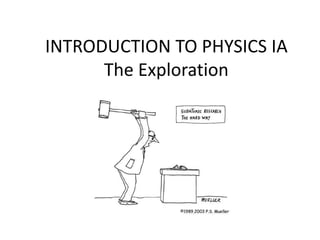
INTRODUCTION TO PHYSICS IA
The Exploration
WHAT IS IT?
An exploration of the physics involved in a topic of personal
interest
20% of the final grade (assessed out of 24)
Time = 10 hours in class
Approximately 6 – 12 page written report
Designed to be read by your peers
Mandatory to submit to achieve an overall grade
Aim
The aim of the exploration is to allow you to
demonstrate an application of your skills and
understanding of physics, whilst pursuing your
personal interests, addressing many aspects of
the learner profile, communicated effectively.
The emphasis is on:
• Exploration
• Analysis
• Evaluation
As well as communication and engagement.
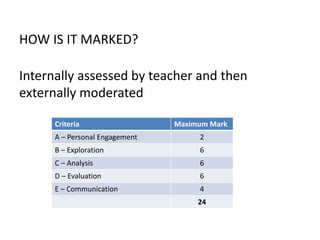
HOW IS IT MARKED?
Internally assessed by teacher and then
externally moderated
Criteria Maximum Mark
A – Personal Engagement 2
B – Exploration 6
C – Analysis 6
D – Evaluation 6
E – Communication 4
24
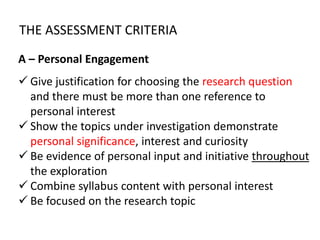
THE ASSESSMENT CRITERIA
A – Personal Engagement
 Give justification for choosing the research question
and there must be more than one reference to
personal interest
 Show the topics under investigation demonstrate
personal significance, interest and curiosity
 Be evidence of personal input and initiative throughout
the exploration
 Combine syllabus content with personal interest
 Be focused on the research topic
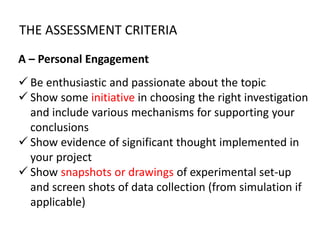
THE ASSESSMENT CRITERIA
A – Personal Engagement
 Be enthusiastic and passionate about the topic
 Show some initiative in choosing the right investigation
and include various mechanisms for supporting your
conclusions
 Show evidence of significant thought implemented in
your project
 Show snapshots or drawings of experimental set-up
and screen shots of data collection (from simulation if
applicable)
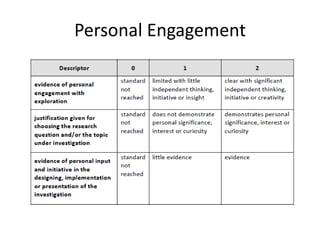
Personal Engagement
B - Exploration
 Show that sufficient social and historical, as well as scientific,
background is covered
 Have an investigation that is focused and interesting
 Organize sections of your report clearly and concisely state
the relevant scientific context and should be related to the
physics syllabus
 Appreciate the limitations of the investigation (especially if
you use a simulation)
 Independent, dependent, and controlled variables clearly
described and how they will be varied, measured and kept
constant
THE ASSESSMENT CRITERIA
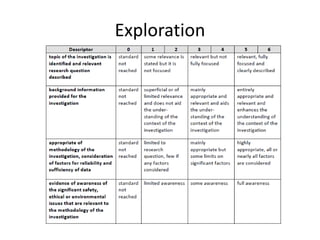
Exploration
C - Analysis
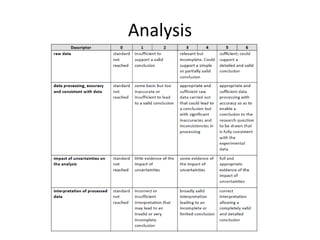
 Make a reasonable attempt at evaluative analysis
 Select, record and process appropriate data and show
an appreciation of the scope and limitation of the data
 Give no doubt that you have selected, recorded,
processed and interpreted the data in a way that
directly addresses the RQ
 Show the range of data to be adequate and the
accuracy of the data has been represented with error
bars where appropriate
THE ASSESSMENT CRITERIA
C - Analysis
 Show that the research question has been addressed,
answered, explained and understood
 See Analysis breakdown for more in-depth detail of
what is required
 Independent, dependent, and controlled variables
clearly described and how they will be varied,
measured and kept constant
 Show calculations for each step used, propagate
uncertainties effectively and determine significance of
an intercept or slope
THE ASSESSMENT CRITERIA
Analysis
D - Evaluation
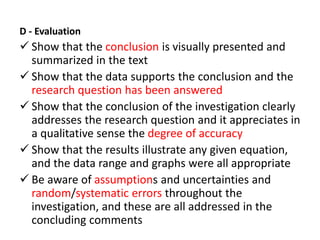
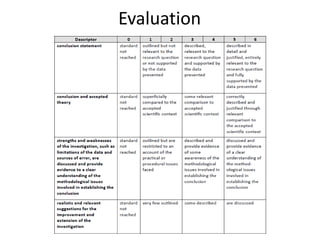
 Show that the conclusion is visually presented and
summarized in the text
 Show that the data supports the conclusion and the
research question has been answered
 Show that the conclusion of the investigation clearly
addresses the research question and it appreciates in
a qualitative sense the degree of accuracy
 Show that the results illustrate any given equation,
and the data range and graphs were all appropriate
 Be aware of assumptions and uncertainties and
random/systematic errors throughout the
investigation, and these are all addressed in the
concluding comments
Evaluation
E - Communication
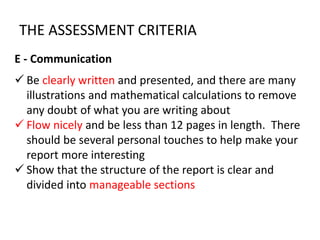
 Be clearly written and presented, and there are many
illustrations and mathematical calculations to remove
any doubt of what you are writing about
 Flow nicely and be less than 12 pages in length. There
should be several personal touches to help make your
report more interesting
 Show that the structure of the report is clear and
divided into manageable sections
THE ASSESSMENT CRITERIA
E - Communication
 Show that the experimental process to be clear and
qualitative and quantitative comments must be visible
when relevant
 Show that all calculation techniques are explained
and the graphs must illustrate what the reader is to
understand
 It is critically important that you cite all work that
you reference and have a work cited page at the end
of your report
THE ASSESSMENT CRITERIA
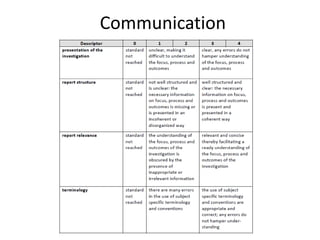
Communication
DEVELOPING THE EXPLORATION
Choose a topic that generally interests you and look
at the physics involved
Keep in mind that there must be enough scope for a
rigorous task such as:
– Hands-on
– Database
– Modelling spreadsheet
– Simulation (if open ended and interactive)
– Combination of the above.
PROCESS
 Stimulus
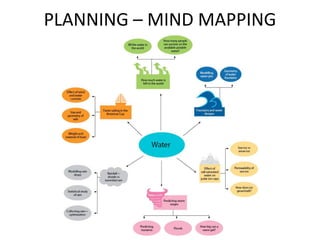
 Mind Map
 Topics
 Question
 Research
 Exploration
 First and final draft with feedback
 Final Submission
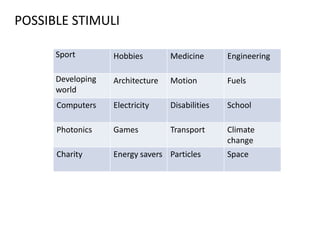
POSSIBLE STIMULI
Sport Hobbies Medicine Engineering
Developing
world
Architecture Motion Fuels
Computers Electricity Disabilities School
Photonics Games Transport Climate
change
Charity Energy savers Particles Space
PLANNING – MIND MAPPING

Physics ia 2016

  • 1.
    INTRODUCTION TO PHYSICSIA The Exploration
  • 2.
    WHAT IS IT? Anexploration of the physics involved in a topic of personal interest 20% of the final grade (assessed out of 24) Time = 10 hours in class Approximately 6 – 12 page written report Designed to be read by your peers Mandatory to submit to achieve an overall grade
  • 3.
    Aim The aim ofthe exploration is to allow you to demonstrate an application of your skills and understanding of physics, whilst pursuing your personal interests, addressing many aspects of the learner profile, communicated effectively.
  • 4.
    The emphasis ison: • Exploration • Analysis • Evaluation As well as communication and engagement.
  • 5.
    HOW IS ITMARKED? Internally assessed by teacher and then externally moderated Criteria Maximum Mark A – Personal Engagement 2 B – Exploration 6 C – Analysis 6 D – Evaluation 6 E – Communication 4 24
  • 6.
    THE ASSESSMENT CRITERIA A– Personal Engagement  Give justification for choosing the research question and there must be more than one reference to personal interest  Show the topics under investigation demonstrate personal significance, interest and curiosity  Be evidence of personal input and initiative throughout the exploration  Combine syllabus content with personal interest  Be focused on the research topic
  • 7.
    THE ASSESSMENT CRITERIA A– Personal Engagement  Be enthusiastic and passionate about the topic  Show some initiative in choosing the right investigation and include various mechanisms for supporting your conclusions  Show evidence of significant thought implemented in your project  Show snapshots or drawings of experimental set-up and screen shots of data collection (from simulation if applicable)
  • 8.
  • 9.
    B - Exploration Show that sufficient social and historical, as well as scientific, background is covered  Have an investigation that is focused and interesting  Organize sections of your report clearly and concisely state the relevant scientific context and should be related to the physics syllabus  Appreciate the limitations of the investigation (especially if you use a simulation)  Independent, dependent, and controlled variables clearly described and how they will be varied, measured and kept constant THE ASSESSMENT CRITERIA
  • 10.
  • 11.
    C - Analysis Make a reasonable attempt at evaluative analysis  Select, record and process appropriate data and show an appreciation of the scope and limitation of the data  Give no doubt that you have selected, recorded, processed and interpreted the data in a way that directly addresses the RQ  Show the range of data to be adequate and the accuracy of the data has been represented with error bars where appropriate THE ASSESSMENT CRITERIA
  • 12.
    C - Analysis Show that the research question has been addressed, answered, explained and understood  See Analysis breakdown for more in-depth detail of what is required  Independent, dependent, and controlled variables clearly described and how they will be varied, measured and kept constant  Show calculations for each step used, propagate uncertainties effectively and determine significance of an intercept or slope THE ASSESSMENT CRITERIA
  • 13.
  • 14.
    D - Evaluation Show that the conclusion is visually presented and summarized in the text  Show that the data supports the conclusion and the research question has been answered  Show that the conclusion of the investigation clearly addresses the research question and it appreciates in a qualitative sense the degree of accuracy  Show that the results illustrate any given equation, and the data range and graphs were all appropriate  Be aware of assumptions and uncertainties and random/systematic errors throughout the investigation, and these are all addressed in the concluding comments
  • 15.
  • 16.
    E - Communication Be clearly written and presented, and there are many illustrations and mathematical calculations to remove any doubt of what you are writing about  Flow nicely and be less than 12 pages in length. There should be several personal touches to help make your report more interesting  Show that the structure of the report is clear and divided into manageable sections THE ASSESSMENT CRITERIA
  • 17.
    E - Communication Show that the experimental process to be clear and qualitative and quantitative comments must be visible when relevant  Show that all calculation techniques are explained and the graphs must illustrate what the reader is to understand  It is critically important that you cite all work that you reference and have a work cited page at the end of your report THE ASSESSMENT CRITERIA
  • 18.
  • 19.
    DEVELOPING THE EXPLORATION Choosea topic that generally interests you and look at the physics involved Keep in mind that there must be enough scope for a rigorous task such as: – Hands-on – Database – Modelling spreadsheet – Simulation (if open ended and interactive) – Combination of the above.
  • 20.
    PROCESS  Stimulus  MindMap  Topics  Question  Research  Exploration  First and final draft with feedback  Final Submission
  • 21.
    POSSIBLE STIMULI Sport HobbiesMedicine Engineering Developing world Architecture Motion Fuels Computers Electricity Disabilities School Photonics Games Transport Climate change Charity Energy savers Particles Space
  • 22.