Nuclear Imaging in Cardiology Dr. Muhammad Ayub Diplomate Certification Board of Nuclear Cardiology Diplomate Certification Board  of Cardiovascular CT Assistant Professor of Cardiology Punjab Institute of Cardiology, Lahore
Applications of Nuclear Cardiology Coronary Artery Disease Assessment of LV /RV function Cardiomyopathy /Myocarditis Valvular Heart Disease Cardiac Shunts Secondary Hypertension Pulmonary Hypertension Assessment of Cardiac Transplant
Coronary Artery Disease Diagnosis of CAD Assessment of Prognosis  Risk Stratification Stable /Unstable Angina Post MI Perioperative Diabetics Assessment of Myocardial Viability Assessment of Revascularization Procedure Acute chest pain management in ER
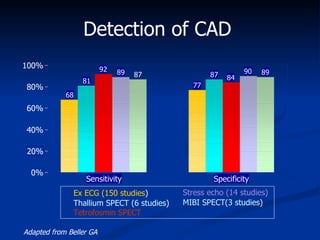
Detection of CAD 68 81 92 89 87 0% 20% 40% 60% 80% 100% Sensitivity 77 87 84 90 89 Specificity Adapted from Beller GA Ex ECG (150 studies ) Stress echo (14 studies) Thallium SPECT (6 studies ) MIBI SPECT(3 studies) Tetrofosmin SPECT
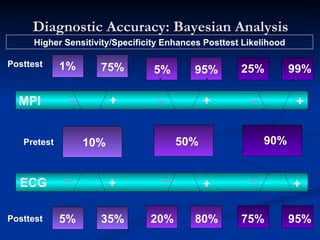
Diagnostic Accuracy: Bayesian Analysis MPI  Pretest ECG + + + 5% 35% 80% 20% 75% 95% 1% 75% 95% 5% 25% 99% Higher Sensitivity/Specificity Enhances Posttest Likelihood + + + Posttest Posttest 10% 90% 50%
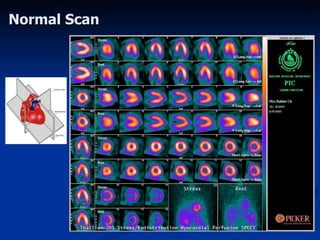
Normal Scan
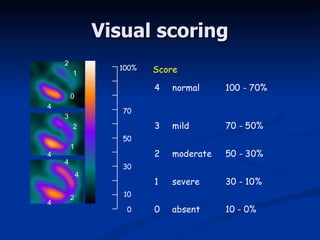
Visual scoring Score
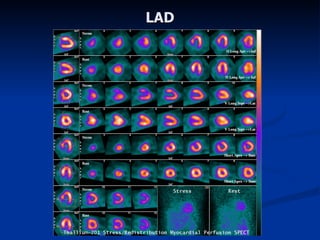
LAD
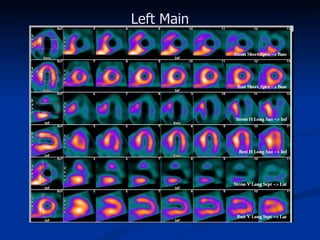
Left Main
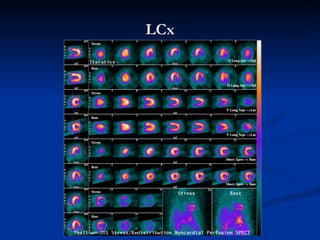
LCx
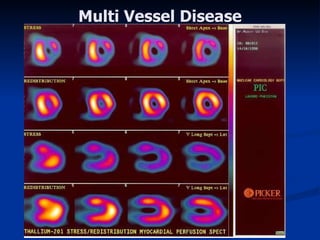
Multi Vessel Disease
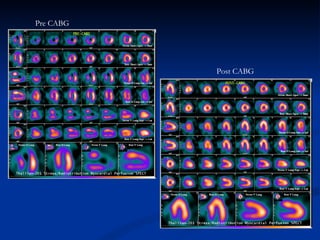
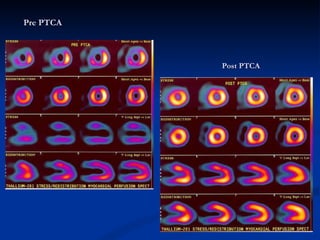
CAD Assessment of Intervention
Post CABG Pre CABG
Pre PTCA Post PTCA
Coronary Artery Disease Assessment of Prognosis
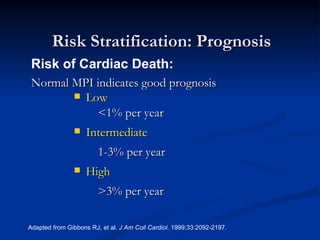
Risk Stratification: Prognosis Low  <1% per year Intermediate  1-3% per year High  >3% per year Adapted from Gibbons RJ, et al.  J Am Coll Cardiol.  1999;33:2092-2197.  Risk of Cardiac Death: Normal MPI indicates good prognosis
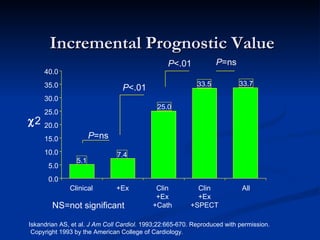
5.1 7.4 25.0 33.5 33.7 0.0 5.0 10.0 15.0 20.0 25.0 30.0 35.0 40.0 Clinical +Ex Clin +Ex +Cath Clin +Ex +SPECT All P =ns P <.01 P <.01 P =ns  2 Iskandrian AS, et al.  J Am Coll Cardiol.  1993;22:665-670. Reproduced with permission.  Copyright 1993 by the American College of Cardiology. N = 316 Incremental Prognostic Value NS=not significant
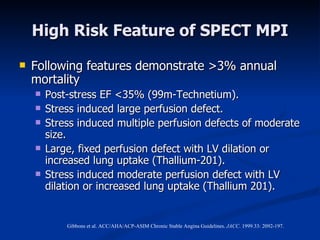
High Risk Feature of SPECT MPI Following features demonstrate >3% annual mortality Post-stress EF <35% (99m-Technetium). Stress induced large perfusion defect. Stress induced multiple perfusion defects of moderate size. Large, fixed perfusion defect with LV dilation or increased lung uptake (Thallium-201). Stress induced moderate perfusion defect with LV dilation or increased lung uptake (Thallium 201). Gibbons et al. ACC/AHA/ACP-ASIM Chronic Stable Angina Guidelines.  JACC . 1999.33: 2092-197.
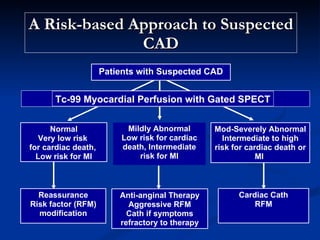
Patients with Suspected CAD Anti-anginal Therapy Aggressive RFM Cath if symptoms refractory to therapy A Risk-based Approach to Suspected CAD Cardiac Cath RFM Mod-Severely Abnormal   Intermediate to high risk for cardiac death or MI  Reassurance Risk factor (RFM) modification Normal Very low risk  for cardiac death,  Low risk for MI Mildly Abnormal Low risk for cardiac death, Intermediate risk for MI Tc-99 Myocardial Perfusion with Gated SPECT
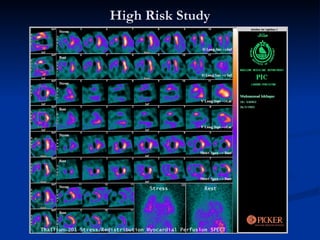
High Risk Study
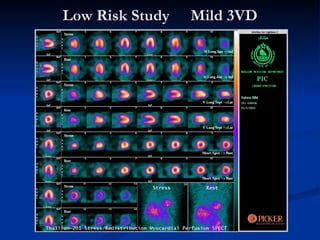
Low Risk Study  Mild 3VD
Established Prognostic Role Prognostic role of perfusion imaging has documented accuracy of risk assessment in the following populations and conditions: CAD  –  suspected or known Angina  –  stable or unstable Women Diabetics Post-MI Post-revascularization  Preoperative screening for  noncardiac surgery
Coronary Artery Disease Acute Chest Pain Management in ER
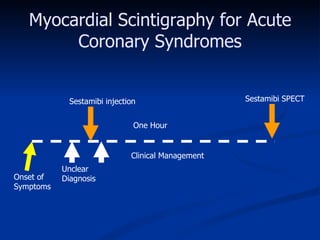
Myocardial Scintigraphy for Acute Coronary Syndromes Onset of  Symptoms Unclear Diagnosis Clinical Management Sestamibi injection Sestamibi SPECT One Hour
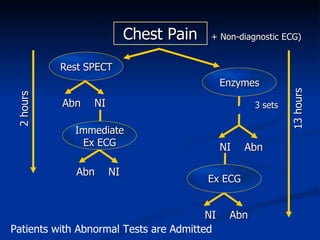
Abn NI Chest Pain + Non-diagnostic ECG) Abn NI 2 hours NI Abn NI Abn 13 hours 3 sets Patients with Abnormal Tests are Admitted Rest SPECT Immediate Ex ECG Ex ECG Enzymes
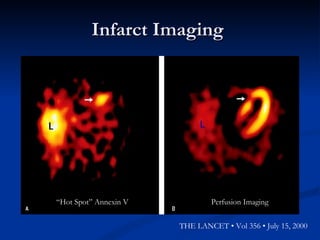
Infarct Imaging  “ Hot Spot” Annexin V Perfusion Imaging THE LANCET • Vol 356 • July 15, 2000
Coronary Artery Disease Assessment of LV Function
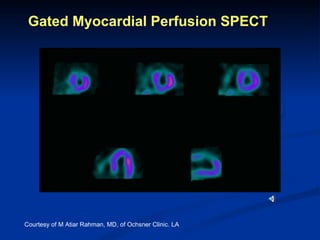
Gated Myocardial Perfusion SPECT Courtesy of M Atiar Rahman, MD, of Ochsner Clinic. LA
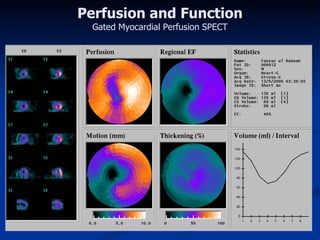
Perfusion and Function Gated Myocardial Perfusion SPECT
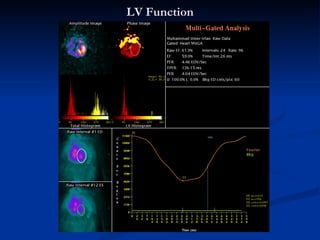
LV Function
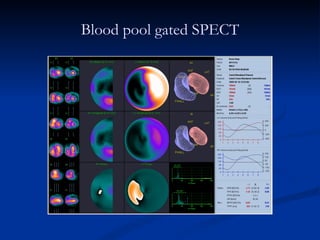
Blood pool gated SPECT
Assessment of Myocardial Viability Patients with CAD and LVF carry bad prognosis Patients with CAD and LVF have higher mortality during revascularization procedure Ischemic LVF patients can benefit from revascularization procedures if there is evidence of myocardial viability
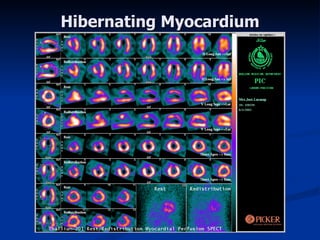
Hibernating Myocardium
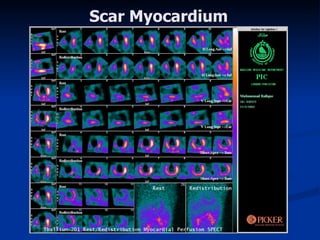
Scar Myocardium
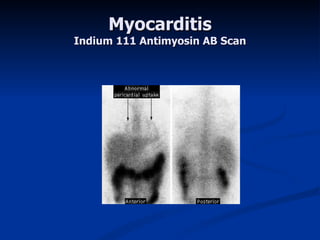
Myocarditis Indium 111 Antimyosin AB Scan
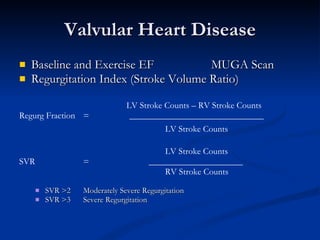
Valvular Heart Disease Baseline and Exercise EF  MUGA Scan Regurgitation Index (Stroke Volume Ratio)   LV Stroke Counts – RV Stroke Counts Regurg Fraction =  ______________________________   LV Stroke Counts     LV Stroke Counts  SVR =    _____________________   RV Stroke Counts SVR >2 Moderately Severe Regurgitation SVR >3 Severe Regurgitation
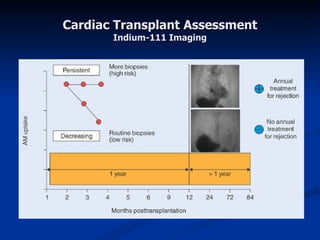
Cardiac Transplant Assessment Indium-111 Imaging
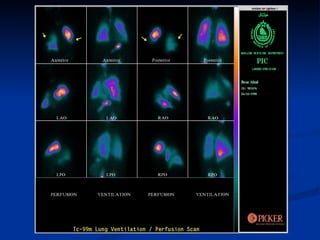
Pulmonary Hypertension Pulmonary Embolism V/Q Scan Left to Right Shunt  First Pass Study
 
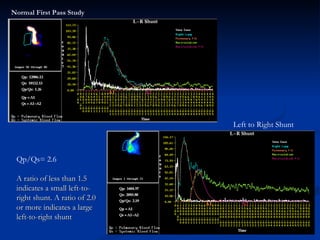
Normal First Pass Study Left to Right Shunt Qp/Qs= 2.6 A ratio of less than 1.5 indicates a small left-to-right shunt. A ratio of 2.0 or more indicates a large left-to-right shunt
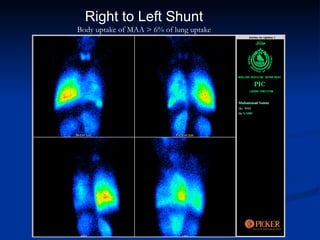
Right to Left Shunt Body uptake of MAA > 6% of lung uptake
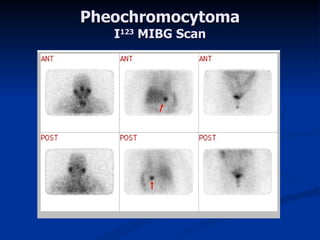
Secondary Hypertension Renal Artery Stenosis Captopril Renogram Study Pheochromocytoma I123 MIBG Scan
Pheochromocytoma I 123  MIBG Scan
Thank you for Listening

Nuclear Imaging In Cardiology Cme

  • 1.
    Nuclear Imaging inCardiology Dr. Muhammad Ayub Diplomate Certification Board of Nuclear Cardiology Diplomate Certification Board of Cardiovascular CT Assistant Professor of Cardiology Punjab Institute of Cardiology, Lahore
  • 2.
    Applications of NuclearCardiology Coronary Artery Disease Assessment of LV /RV function Cardiomyopathy /Myocarditis Valvular Heart Disease Cardiac Shunts Secondary Hypertension Pulmonary Hypertension Assessment of Cardiac Transplant
  • 3.
    Coronary Artery DiseaseDiagnosis of CAD Assessment of Prognosis Risk Stratification Stable /Unstable Angina Post MI Perioperative Diabetics Assessment of Myocardial Viability Assessment of Revascularization Procedure Acute chest pain management in ER
  • 4.
    Detection of CAD68 81 92 89 87 0% 20% 40% 60% 80% 100% Sensitivity 77 87 84 90 89 Specificity Adapted from Beller GA Ex ECG (150 studies ) Stress echo (14 studies) Thallium SPECT (6 studies ) MIBI SPECT(3 studies) Tetrofosmin SPECT
  • 5.
    Diagnostic Accuracy: BayesianAnalysis MPI Pretest ECG + + + 5% 35% 80% 20% 75% 95% 1% 75% 95% 5% 25% 99% Higher Sensitivity/Specificity Enhances Posttest Likelihood + + + Posttest Posttest 10% 90% 50%
  • 6.
  • 7.
  • 8.
  • 9.
  • 10.
  • 11.
  • 12.
    CAD Assessment ofIntervention
  • 13.
  • 14.
  • 15.
    Coronary Artery DiseaseAssessment of Prognosis
  • 16.
    Risk Stratification: PrognosisLow <1% per year Intermediate 1-3% per year High >3% per year Adapted from Gibbons RJ, et al. J Am Coll Cardiol. 1999;33:2092-2197. Risk of Cardiac Death: Normal MPI indicates good prognosis
  • 17.
    5.1 7.4 25.033.5 33.7 0.0 5.0 10.0 15.0 20.0 25.0 30.0 35.0 40.0 Clinical +Ex Clin +Ex +Cath Clin +Ex +SPECT All P =ns P <.01 P <.01 P =ns  2 Iskandrian AS, et al. J Am Coll Cardiol. 1993;22:665-670. Reproduced with permission. Copyright 1993 by the American College of Cardiology. N = 316 Incremental Prognostic Value NS=not significant
  • 18.
    High Risk Featureof SPECT MPI Following features demonstrate >3% annual mortality Post-stress EF <35% (99m-Technetium). Stress induced large perfusion defect. Stress induced multiple perfusion defects of moderate size. Large, fixed perfusion defect with LV dilation or increased lung uptake (Thallium-201). Stress induced moderate perfusion defect with LV dilation or increased lung uptake (Thallium 201). Gibbons et al. ACC/AHA/ACP-ASIM Chronic Stable Angina Guidelines. JACC . 1999.33: 2092-197.
  • 19.
    Patients with SuspectedCAD Anti-anginal Therapy Aggressive RFM Cath if symptoms refractory to therapy A Risk-based Approach to Suspected CAD Cardiac Cath RFM Mod-Severely Abnormal Intermediate to high risk for cardiac death or MI Reassurance Risk factor (RFM) modification Normal Very low risk for cardiac death, Low risk for MI Mildly Abnormal Low risk for cardiac death, Intermediate risk for MI Tc-99 Myocardial Perfusion with Gated SPECT
  • 20.
  • 21.
    Low Risk Study Mild 3VD
  • 22.
    Established Prognostic RolePrognostic role of perfusion imaging has documented accuracy of risk assessment in the following populations and conditions: CAD – suspected or known Angina – stable or unstable Women Diabetics Post-MI Post-revascularization Preoperative screening for noncardiac surgery
  • 23.
    Coronary Artery DiseaseAcute Chest Pain Management in ER
  • 24.
    Myocardial Scintigraphy forAcute Coronary Syndromes Onset of Symptoms Unclear Diagnosis Clinical Management Sestamibi injection Sestamibi SPECT One Hour
  • 25.
    Abn NI ChestPain + Non-diagnostic ECG) Abn NI 2 hours NI Abn NI Abn 13 hours 3 sets Patients with Abnormal Tests are Admitted Rest SPECT Immediate Ex ECG Ex ECG Enzymes
  • 26.
    Infarct Imaging “ Hot Spot” Annexin V Perfusion Imaging THE LANCET • Vol 356 • July 15, 2000
  • 27.
    Coronary Artery DiseaseAssessment of LV Function
  • 28.
    Gated Myocardial PerfusionSPECT Courtesy of M Atiar Rahman, MD, of Ochsner Clinic. LA
  • 29.
    Perfusion and FunctionGated Myocardial Perfusion SPECT
  • 30.
  • 31.
  • 32.
    Assessment of MyocardialViability Patients with CAD and LVF carry bad prognosis Patients with CAD and LVF have higher mortality during revascularization procedure Ischemic LVF patients can benefit from revascularization procedures if there is evidence of myocardial viability
  • 33.
  • 34.
  • 35.
    Myocarditis Indium 111Antimyosin AB Scan
  • 36.
    Valvular Heart DiseaseBaseline and Exercise EF MUGA Scan Regurgitation Index (Stroke Volume Ratio) LV Stroke Counts – RV Stroke Counts Regurg Fraction = ______________________________ LV Stroke Counts LV Stroke Counts SVR = _____________________ RV Stroke Counts SVR >2 Moderately Severe Regurgitation SVR >3 Severe Regurgitation
  • 37.
  • 38.
    Pulmonary Hypertension PulmonaryEmbolism V/Q Scan Left to Right Shunt First Pass Study
  • 39.
  • 40.
    Normal First PassStudy Left to Right Shunt Qp/Qs= 2.6 A ratio of less than 1.5 indicates a small left-to-right shunt. A ratio of 2.0 or more indicates a large left-to-right shunt
  • 41.
    Right to LeftShunt Body uptake of MAA > 6% of lung uptake
  • 42.
    Secondary Hypertension RenalArtery Stenosis Captopril Renogram Study Pheochromocytoma I123 MIBG Scan
  • 43.
  • 44.
    Thank you forListening

Editor's Notes

  • #6 For a patient with low pretest likelihood (10%), ECG testing can shift the posttest likelihood from 5% and 35% for a negative and positive test result, respectively. In contrast, nuclear testing can shift the posttest likelihood from 1% and 75% for a negative and positive test result, respectively. For patients with an intermediate pretest likelihood (50%), the ECG can shift posttest likelihood to 20% and 80% for negative and positive test results, respectively, while nuclear tests can shift posttest likelihood to 5% and 95%, respectively. For patients with a high pretest likelihood (90%), the ECG can shift posttest likelihood to 75% and 95% for negative and positive test results, respectively, while nuclear tests can shift posttest likelihood to 25% and 99%, respectively. The overall result is that both tests are more useful in the patient with intermediate likelihood of disease. In addition, the more accurate the test, the greater the shift in posttest likelihood, and the greater the clinical utility of the test.
  • #29 The gated portion of the SPECT study allows both the visual and quantitative assessment of left ventricular function. These measures include left ventricular ejection fraction and end-diastolic and end-systolic volumes. In addition, this modality achieves excellent visualization of both the endocardial and epicardial surfaces, allowing for the evaluation of left ventricular wall motion and wall thickening. In this scan, the top row represents 3 short axis images (apical, mid, and basal short-axis slices) and the bottom row represents the mid, horizontal, and vertical long-axis slices.