Peeyush Bhargava MD MBA, Zhiyun Yang MD,
Scott Adams MD
Artifacts in Myocardial Perfusion
Imaging
Louisiana State University Health Science Center, Shreveport, LA
ARRS, April 2016, Los Angeles, CA
Teaching Points
•  Recognize common artifact patterns on SPECT
(Single Photon Emission Computed Tomography)
MPI (Myocardial Perfusion Imaging)
•  Understand the causes of artifacts and how they
can be corrected or avoided
•  Target Audience: Residents, Radiologists,
Cardiologists, Nuclear Medicine Physicians
Background
•  SPECT MPI constitutes about 40% of all Nuclear
Medicine Procedures (~9 million procedures / year)
•  MPI SPECT is the most extensively validated study for
risk stratification of Coronary Artery Disease
•  Sensitivity = 85 – 90%, Specificity = 70 – 75%
•  Lower specificity is due to artifacts causing false +ves
•  One day – Rest Pharmacologic Stress Protocol
•  Dual head gamma camera with High Res Collimators
•  20% window set around 140 keV
•  Circular orbit (vs elliptical/body contouring)
•  180 degree SPECT: LPO to RAO
•  Step and shoot (20-30 sec); Frame mode (vs List)
•  Resting SPECT and post stress Gated SPECT (16 fr)
•  Filtering (lower cut off = more filtering / smoothening)
•  Processing (FBP vs OSEM)
Acquisition and Processing
Normal Study
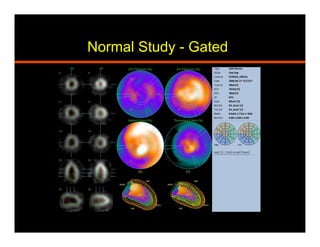
Normal Study - Gated
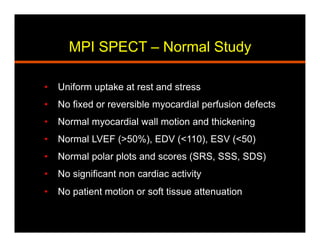
•  Uniform uptake at rest and stress
•  No fixed or reversible myocardial perfusion defects
•  Normal myocardial wall motion and thickening
•  Normal LVEF (>50%), EDV (<110), ESV (<50)
•  Normal polar plots and scores (SRS, SSS, SDS)
•  No significant non cardiac activity
•  No patient motion or soft tissue attenuation
MPI SPECT – Normal Study
•  Soft Tissue Attenuation
•  Patient Motion
•  Non Cardiac Activity
•  Non Coronary Disease
•  Image Normalization
Categories of MPI SPECT Artifacts
•  Prep. / Injection / Stress test
•  Processing Related
•  Flood Field Non Uniformity
•  COR Misalignment
•  Camera Head Misalignment
Soft Tissue Attenuation
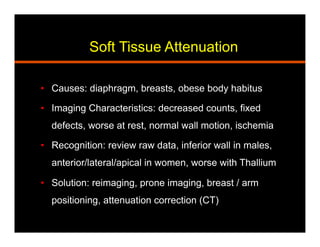
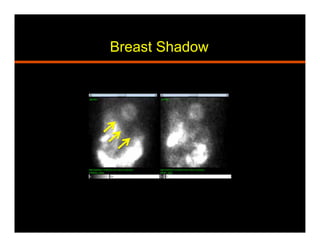
•  Causes: diaphragm, breasts, obese body habitus
•  Imaging Characteristics: decreased counts, fixed
defects, worse at rest, normal wall motion, ischemia
•  Recognition: review raw data, inferior wall in males,
anterior/lateral/apical in women, worse with Thallium
•  Solution: reimaging, prone imaging, breast / arm
positioning, attenuation correction (CT)
Diaphragmatic Attenuation
Breast Shadow
Breast Attenuation
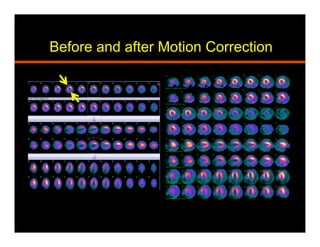
Patient Motion
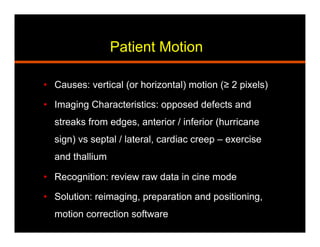
•  Causes: vertical (or horizontal) motion (≥ 2 pixels)
•  Imaging Characteristics: opposed defects and
streaks from edges, anterior / inferior (hurricane
sign) vs septal / lateral, cardiac creep – exercise
and thallium
•  Recognition: review raw data in cine mode
•  Solution: reimaging, preparation and positioning,
motion correction software
Before and after Motion Correction
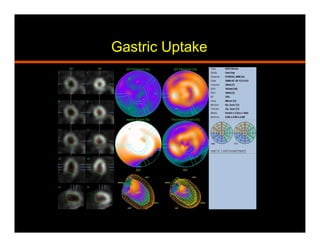
Non Cardiac Activity
•  Causes: liver, stomach, bowel or tumor uptake
•  Imaging Characteristics: scattering ! increased
counts, ramp filter artifact ! decreased counts
•  Recognition: review raw data in cine mode
•  Solution: drink water / milk, walk / low level
exercise, and reimage, optimize injection to
imaging time
Gastric Uptake
Gastric Uptake
Lymph node Uptake
Thymoma
Ascites
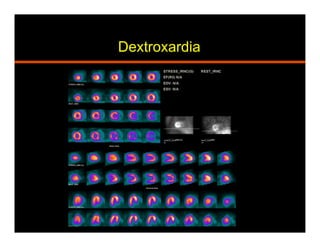
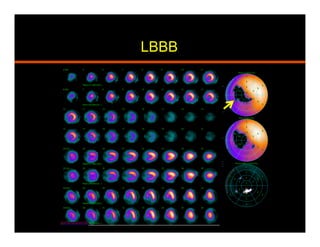
Non Coronary Disease
•  Causes: LBBB, hypertrophic cardiomyopathy, short
septum, apical thinning, balanced ischemia, dextrocardia
•  Imaging Characteristics / Recognition: perfusion defect
at increased heart rate (pharmacologic stress test),
septum > lateral wall, septal defect, apical defect, false –
ve / stunning, right sided heart / processing
•  Solution: review patient history, EKG, Echo, prior studies
LV Hypertrophy
LV Hypertrophy
RV Hypertrophy
Dextroxardia
HCM / HOCM / IHSS
LBBB
Normalization Artifacts
•  Causes: images normalized to the hottest pixel
(cardiac or non cardiac)
•  Imaging Characteristics: focal hot spot (papillary
muscle), decreased counts in myocardium
•  Solution: reprocess / reimaging, increase intensity
Normalization Artifact
Prep. / Injection / Stress test
•  Causes / Examples: inadequate preparation
(coffee / NPO, attenuators / uncomfortable) /
suboptimal IV access, suboptimal stress test
•  Recognition: low count images, artifacts from
infiltration / contamination, false negative studies
•  Solution: attention to detail, teamwork, effective
communication, ALARA
Processing Related Artifacts
•  Causes: user (technologist) / software (QPS/ECT)
•  Steps in Processing: define center, limiting ROI,
basal and apical limits, create axis
•  Recognition: review processed images: VLA
points to the right, HLA points up, equal number
of slices, comparable between rest and stress
•  Solution: reprocess
Non Uniformity Artifacts
•  Causes: flood field non uniformity
•  Imaging Characteristics: ring artifact, fixed
or reversible defect
•  Recognition: review uniformity flood
•  Solution: reimage after camera repair, Q/C
Normal PMT malfunction/
uncoupling
Poor mixing
Cracked
crystal
Poor gain alignment
(tuning) of PMTs
Collimator defect
Flood Non Uniformities
COR Misalignment
•  Causes: center of rotation misalignment
•  Imaging Characteristics: oblong cavity,
decreased activity, streaks, blurred images
•  Solution: COR correction, Q/C
Camera Head Misalignment
•  Imaging Characteristics: decreased counts,
defects similar to patient motion, blurred images
•  Recognition: review raw data
•  Solution: Camera Q/C
Camera Quality Control
1. Artifacts and pitfalls in myocardial perfusion imaging.
Burrell S, MacDonald A. J Nucl Med Technol. 2006 Dec;34(4):
193-211
2. Artifacts in planar and SPECT myocardial perfusion imaging.
Wackers FJ. Am J Card Imaging. 1992 Mar;6(1):42-57
3. How to detect and avoid myocardial perfusion SPECT
artifacts. DePuey EG 3rd. J Nucl Med. 1994 Apr;35(4):699-702
References
Contact Information
Peeyush Bhargava MD MBA
PGY 3 Radiology Resident
Phone: 832-374-2110
pbharg@lsuhsc.edu
Louisiana State University Health Science Center, Shreveport, LA

MPI-Artifacts

  • 1.
    Peeyush Bhargava MDMBA, Zhiyun Yang MD, Scott Adams MD Artifacts in Myocardial Perfusion Imaging Louisiana State University Health Science Center, Shreveport, LA ARRS, April 2016, Los Angeles, CA
  • 2.
    Teaching Points •  Recognizecommon artifact patterns on SPECT (Single Photon Emission Computed Tomography) MPI (Myocardial Perfusion Imaging) •  Understand the causes of artifacts and how they can be corrected or avoided •  Target Audience: Residents, Radiologists, Cardiologists, Nuclear Medicine Physicians
  • 3.
    Background •  SPECT MPIconstitutes about 40% of all Nuclear Medicine Procedures (~9 million procedures / year) •  MPI SPECT is the most extensively validated study for risk stratification of Coronary Artery Disease •  Sensitivity = 85 – 90%, Specificity = 70 – 75% •  Lower specificity is due to artifacts causing false +ves •  One day – Rest Pharmacologic Stress Protocol
  • 4.
    •  Dual headgamma camera with High Res Collimators •  20% window set around 140 keV •  Circular orbit (vs elliptical/body contouring) •  180 degree SPECT: LPO to RAO •  Step and shoot (20-30 sec); Frame mode (vs List) •  Resting SPECT and post stress Gated SPECT (16 fr) •  Filtering (lower cut off = more filtering / smoothening) •  Processing (FBP vs OSEM) Acquisition and Processing
  • 5.
  • 6.
  • 7.
    •  Uniform uptakeat rest and stress •  No fixed or reversible myocardial perfusion defects •  Normal myocardial wall motion and thickening •  Normal LVEF (>50%), EDV (<110), ESV (<50) •  Normal polar plots and scores (SRS, SSS, SDS) •  No significant non cardiac activity •  No patient motion or soft tissue attenuation MPI SPECT – Normal Study
  • 8.
    •  Soft TissueAttenuation •  Patient Motion •  Non Cardiac Activity •  Non Coronary Disease •  Image Normalization Categories of MPI SPECT Artifacts •  Prep. / Injection / Stress test •  Processing Related •  Flood Field Non Uniformity •  COR Misalignment •  Camera Head Misalignment
  • 9.
    Soft Tissue Attenuation • Causes: diaphragm, breasts, obese body habitus •  Imaging Characteristics: decreased counts, fixed defects, worse at rest, normal wall motion, ischemia •  Recognition: review raw data, inferior wall in males, anterior/lateral/apical in women, worse with Thallium •  Solution: reimaging, prone imaging, breast / arm positioning, attenuation correction (CT)
  • 10.
  • 11.
  • 12.
  • 13.
  • 14.
    Patient Motion •  Causes:vertical (or horizontal) motion (≥ 2 pixels) •  Imaging Characteristics: opposed defects and streaks from edges, anterior / inferior (hurricane sign) vs septal / lateral, cardiac creep – exercise and thallium •  Recognition: review raw data in cine mode •  Solution: reimaging, preparation and positioning, motion correction software
  • 15.
    Before and afterMotion Correction
  • 16.
    Non Cardiac Activity • Causes: liver, stomach, bowel or tumor uptake •  Imaging Characteristics: scattering ! increased counts, ramp filter artifact ! decreased counts •  Recognition: review raw data in cine mode •  Solution: drink water / milk, walk / low level exercise, and reimage, optimize injection to imaging time
  • 17.
  • 18.
  • 19.
  • 20.
  • 21.
  • 22.
    Non Coronary Disease • Causes: LBBB, hypertrophic cardiomyopathy, short septum, apical thinning, balanced ischemia, dextrocardia •  Imaging Characteristics / Recognition: perfusion defect at increased heart rate (pharmacologic stress test), septum > lateral wall, septal defect, apical defect, false – ve / stunning, right sided heart / processing •  Solution: review patient history, EKG, Echo, prior studies
  • 23.
  • 24.
  • 25.
  • 26.
  • 27.
    HCM / HOCM/ IHSS
  • 28.
  • 29.
    Normalization Artifacts •  Causes:images normalized to the hottest pixel (cardiac or non cardiac) •  Imaging Characteristics: focal hot spot (papillary muscle), decreased counts in myocardium •  Solution: reprocess / reimaging, increase intensity
  • 30.
  • 31.
    Prep. / Injection/ Stress test •  Causes / Examples: inadequate preparation (coffee / NPO, attenuators / uncomfortable) / suboptimal IV access, suboptimal stress test •  Recognition: low count images, artifacts from infiltration / contamination, false negative studies •  Solution: attention to detail, teamwork, effective communication, ALARA
  • 32.
    Processing Related Artifacts • Causes: user (technologist) / software (QPS/ECT) •  Steps in Processing: define center, limiting ROI, basal and apical limits, create axis •  Recognition: review processed images: VLA points to the right, HLA points up, equal number of slices, comparable between rest and stress •  Solution: reprocess
  • 33.
    Non Uniformity Artifacts • Causes: flood field non uniformity •  Imaging Characteristics: ring artifact, fixed or reversible defect •  Recognition: review uniformity flood •  Solution: reimage after camera repair, Q/C
  • 34.
    Normal PMT malfunction/ uncoupling Poormixing Cracked crystal Poor gain alignment (tuning) of PMTs Collimator defect Flood Non Uniformities
  • 35.
    COR Misalignment •  Causes:center of rotation misalignment •  Imaging Characteristics: oblong cavity, decreased activity, streaks, blurred images •  Solution: COR correction, Q/C
  • 36.
    Camera Head Misalignment • Imaging Characteristics: decreased counts, defects similar to patient motion, blurred images •  Recognition: review raw data •  Solution: Camera Q/C
  • 37.
  • 38.
    1. Artifacts andpitfalls in myocardial perfusion imaging. Burrell S, MacDonald A. J Nucl Med Technol. 2006 Dec;34(4): 193-211 2. Artifacts in planar and SPECT myocardial perfusion imaging. Wackers FJ. Am J Card Imaging. 1992 Mar;6(1):42-57 3. How to detect and avoid myocardial perfusion SPECT artifacts. DePuey EG 3rd. J Nucl Med. 1994 Apr;35(4):699-702 References
  • 39.
    Contact Information Peeyush BhargavaMD MBA PGY 3 Radiology Resident Phone: 832-374-2110 pbharg@lsuhsc.edu Louisiana State University Health Science Center, Shreveport, LA