Dr Dhananjaya Sabat MS, DNB, MNAMS
                             Assistant Professor
                     Department of Orthopedics
  Maulana Azad Medical College, New Delhi, INDIA
CHIEF COMPLAINS
 Pain
 Swelling
 Stiffness
 Mechanical Disorders (locking, giving Way, click)
 Limp
 Deformity
The exam includes several parts:
 position
 inspection
 palpation
 motion
The latter three steps are often remembered with the
  saying look, feel, move.
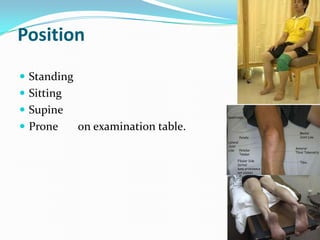
Position
 Standing
 Sitting
 Supine
 Prone      on examination table.
Inspection done while the patient
is standing
Alignment
 Genu Valgus(knock-kneed)
 Genu Varus(bowlegged)
 Flexion deformity
 Genu recurvatum

 Shortening
 Baker’s cyst
 Antalgic gait
Inspection done while supine
 Masses
 Bursae: Housemaid’s (prepatellar
 bursitis), clergyman’s (infrapatellar
 bursitis).
 Bony : Exostosis
Tumor of femur / tibia


 Scars
 Lesions
 Signs of trauma/
     previous surgery
 Swelling - effusion
 Redness
 Muscle bulk and symmetry (in particular atrophy of
  the vastus medialis)
 Displacement of the patella
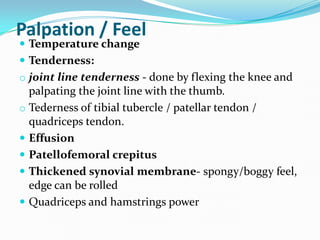
Palpation / Feel
 Temperature change
 Tenderness:
o joint line tenderness - done by flexing the knee and
  palpating the joint line with the thumb.
o Tederness of tibial tubercle / patellar tendon /
  quadriceps tendon.
 Effusion
 Patellofemoral crepitus
 Thickened synovial membrane- spongy/boggy feel,
  edge can be rolled
 Quadriceps and hamstrings power
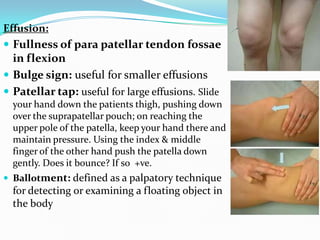
Effusion:
 Fullness of para patellar tendon fossae
  in flexion
 Bulge sign: useful for smaller effusions
 Patellar tap: useful for large effusions. Slide
  your hand down the patients thigh, pushing down
  over the suprapatellar pouch; on reaching the
  upper pole of the patella, keep your hand there and
  maintain pressure. Using the index & middle
  finger of the other hand push the patella down
  gently. Does it bounce? If so +ve.
 Ballotment: defined as a palpatory technique
  for detecting or examining a floating object in
  the body
Patellar Instability
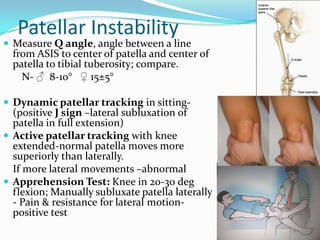
 Measure Q angle, angle between a line
  from ASIS to center of patella and center of
  patella to tibial tuberosity; compare.
    N- ♂ 8-10° ♀ 15±5°

 Dynamic patellar tracking in sitting-
  (positive J sign –lateral subluxation of
  patella in full extension)
 Active patellar tracking with knee
  extended-normal patella moves more
  superiorly than laterally.
  If more lateral movements –abnormal
 Apprehension Test: Knee in 20-30 deg
  flexion; Manually subluxate patella laterally
  - Pain & resistance for lateral motion-
  positive test
MOVE
Movement: . ACTIVE & PASSIVE
 Flexion – Extension: Normal 0-135 degrees.
 Rotation: 20-30 deg. In flexion. Nil in extension.
 Fixed flexion deformity : by passively lifting the leg
  at the heel to see if there is complete extension.
 See for crepitus during motion.
 See hip rotations, as pain can be referred from the hip.
 Observe active extension of the knee from flexed
  position.
 Repeat each movement for the opposite leg at the
  same time
TESTS FOR MENISCAL INJURY
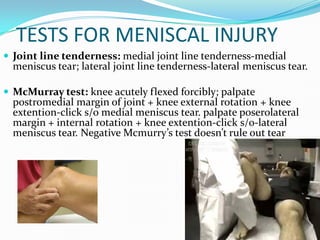
 Joint line tenderness: medial joint line tenderness-medial
  meniscus tear; lateral joint line tenderness-lateral meniscus tear.

 McMurray test: knee acutely flexed forcibly; palpate
  postromedial margin of joint + knee external rotation + knee
  extention-click s/o medial meniscus tear. palpate poserolateral
  margin + internal rotation + knee extention-click s/o-lateral
  meniscus tear. Negative Mcmurry’s test doesn’t rule out tear
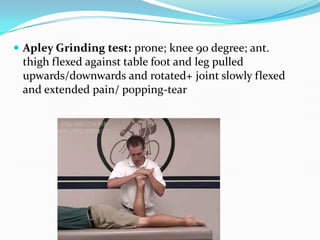
 Apley Grinding test: prone; knee 90 degree; ant.
  thigh flexed against table foot and leg pulled
  upwards/downwards and rotated+ joint slowly flexed
  and extended pain/ popping-tear
ACL: 1. Anterior drawer test
                  Supine
                  Hip-45 deg
                  Knee 90 deg
                  Stabilize foot

                 •Ensure tibia is not sagging behind-
                 otherwise false positive result
                 •Not possible in acute painful knee
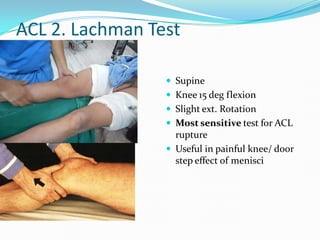
ACL 2. Lachman Test

                  Supine
                  Knee 15 deg flexion
                  Slight ext. Rotation
                  Most sensitive test for ACL
                   rupture
                  Useful in painful knee/ door
                   step effect of menisci
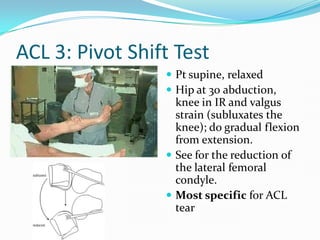
ACL 3: Pivot Shift Test
                  Pt supine, relaxed
                  Hip at 30 abduction,
                   knee in IR and valgus
                   strain (subluxates the
                   knee); do gradual flexion
                   from extension.
                  See for the reduction of
                   the lateral femoral
                   condyle.
                  Most specific for ACL
                   tear
PCL 1: Sag sign
 Knee 90
 Support heel
 Tibia sags visibly posteriorly from
  effect of gravity
 Compare silhouette both side


 Godfrey test: sag sign at 90
  flexion at hip & knee
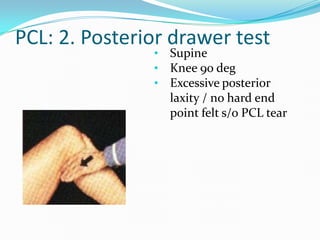
PCL: 2. Posterior drawer test
               •   Supine
               •   Knee 90 deg
               •   Excessive posterior
                   laxity / no hard end
                   point felt s/o PCL tear
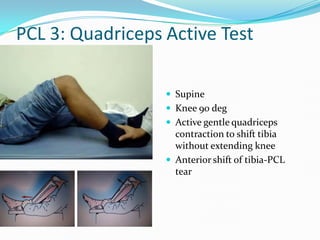
PCL 3: Quadriceps Active Test

                   Supine
                   Knee 90 deg
                   Active gentle quadriceps
                    contraction to shift tibia
                    without extending knee
                   Anterior shift of tibia-PCL
                    tear
MCL: Valgus stress test
 Supine
 Side Of Table
 Abducted Of The Side Of
  Table
 Knee Flexion 30
 Valgus Strain
 External Rotation
 Observe Stability
LCL : Varus stress test
 Varus Strain Given Similarly at
  30 deg flexion
 Observe Instability


 Palpate LCL-figure 4 Position
 LCL Torn-not Palpable
 Compare
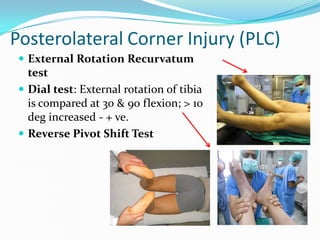
Posterolateral Corner Injury (PLC)
  External Rotation Recurvatum
   test
  Dial test: External rotation of tibia
   is compared at 30 & 90 flexion; > 10
   deg increased - + ve.
  Reverse Pivot Shift Test

Knee examination

  • 1.
    Dr Dhananjaya SabatMS, DNB, MNAMS Assistant Professor Department of Orthopedics Maulana Azad Medical College, New Delhi, INDIA
  • 2.
    CHIEF COMPLAINS  Pain Swelling  Stiffness  Mechanical Disorders (locking, giving Way, click)  Limp  Deformity
  • 3.
    The exam includesseveral parts:  position  inspection  palpation  motion The latter three steps are often remembered with the saying look, feel, move.
  • 4.
    Position  Standing  Sitting Supine  Prone on examination table.
  • 5.
    Inspection done whilethe patient is standing Alignment  Genu Valgus(knock-kneed)  Genu Varus(bowlegged)  Flexion deformity  Genu recurvatum  Shortening  Baker’s cyst  Antalgic gait
  • 7.
    Inspection done whilesupine  Masses  Bursae: Housemaid’s (prepatellar bursitis), clergyman’s (infrapatellar bursitis).  Bony : Exostosis Tumor of femur / tibia  Scars  Lesions  Signs of trauma/ previous surgery
  • 8.
     Swelling -effusion  Redness  Muscle bulk and symmetry (in particular atrophy of the vastus medialis)  Displacement of the patella
  • 9.
    Palpation / Feel Temperature change  Tenderness: o joint line tenderness - done by flexing the knee and palpating the joint line with the thumb. o Tederness of tibial tubercle / patellar tendon / quadriceps tendon.  Effusion  Patellofemoral crepitus  Thickened synovial membrane- spongy/boggy feel, edge can be rolled  Quadriceps and hamstrings power
  • 10.
    Effusion:  Fullness ofpara patellar tendon fossae in flexion  Bulge sign: useful for smaller effusions  Patellar tap: useful for large effusions. Slide your hand down the patients thigh, pushing down over the suprapatellar pouch; on reaching the upper pole of the patella, keep your hand there and maintain pressure. Using the index & middle finger of the other hand push the patella down gently. Does it bounce? If so +ve.  Ballotment: defined as a palpatory technique for detecting or examining a floating object in the body
  • 11.
    Patellar Instability  MeasureQ angle, angle between a line from ASIS to center of patella and center of patella to tibial tuberosity; compare. N- ♂ 8-10° ♀ 15±5°  Dynamic patellar tracking in sitting- (positive J sign –lateral subluxation of patella in full extension)  Active patellar tracking with knee extended-normal patella moves more superiorly than laterally. If more lateral movements –abnormal  Apprehension Test: Knee in 20-30 deg flexion; Manually subluxate patella laterally - Pain & resistance for lateral motion- positive test
  • 12.
    MOVE Movement: . ACTIVE& PASSIVE  Flexion – Extension: Normal 0-135 degrees.  Rotation: 20-30 deg. In flexion. Nil in extension.  Fixed flexion deformity : by passively lifting the leg at the heel to see if there is complete extension.  See for crepitus during motion.  See hip rotations, as pain can be referred from the hip.  Observe active extension of the knee from flexed position.  Repeat each movement for the opposite leg at the same time
  • 13.
    TESTS FOR MENISCALINJURY  Joint line tenderness: medial joint line tenderness-medial meniscus tear; lateral joint line tenderness-lateral meniscus tear.  McMurray test: knee acutely flexed forcibly; palpate postromedial margin of joint + knee external rotation + knee extention-click s/o medial meniscus tear. palpate poserolateral margin + internal rotation + knee extention-click s/o-lateral meniscus tear. Negative Mcmurry’s test doesn’t rule out tear
  • 14.
     Apley Grindingtest: prone; knee 90 degree; ant. thigh flexed against table foot and leg pulled upwards/downwards and rotated+ joint slowly flexed and extended pain/ popping-tear
  • 15.
    ACL: 1. Anteriordrawer test  Supine  Hip-45 deg  Knee 90 deg  Stabilize foot •Ensure tibia is not sagging behind- otherwise false positive result •Not possible in acute painful knee
  • 16.
    ACL 2. LachmanTest  Supine  Knee 15 deg flexion  Slight ext. Rotation  Most sensitive test for ACL rupture  Useful in painful knee/ door step effect of menisci
  • 17.
    ACL 3: PivotShift Test  Pt supine, relaxed  Hip at 30 abduction, knee in IR and valgus strain (subluxates the knee); do gradual flexion from extension.  See for the reduction of the lateral femoral condyle.  Most specific for ACL tear
  • 18.
    PCL 1: Sagsign  Knee 90  Support heel  Tibia sags visibly posteriorly from effect of gravity  Compare silhouette both side  Godfrey test: sag sign at 90 flexion at hip & knee
  • 19.
    PCL: 2. Posteriordrawer test • Supine • Knee 90 deg • Excessive posterior laxity / no hard end point felt s/o PCL tear
  • 20.
    PCL 3: QuadricepsActive Test  Supine  Knee 90 deg  Active gentle quadriceps contraction to shift tibia without extending knee  Anterior shift of tibia-PCL tear
  • 21.
    MCL: Valgus stresstest  Supine  Side Of Table  Abducted Of The Side Of Table  Knee Flexion 30  Valgus Strain  External Rotation  Observe Stability
  • 22.
    LCL : Varusstress test  Varus Strain Given Similarly at 30 deg flexion  Observe Instability  Palpate LCL-figure 4 Position  LCL Torn-not Palpable  Compare
  • 23.
    Posterolateral Corner Injury(PLC)  External Rotation Recurvatum test  Dial test: External rotation of tibia is compared at 30 & 90 flexion; > 10 deg increased - + ve.  Reverse Pivot Shift Test