OBSERVED STATIONS
28TH APRIL; 2013
• The OSCE Questions & Answers are prepared by
the faculty for the benefit of Post graduate
students and some are contributed from faculty
• These Questions and answers are made for the
students to understand the pattern of OSCE and
not meant to completely cover the subject of
Pediatrics.
• Answer are checked from standard textbook in
case of doubt plz email
ashwinborade@yahoo.com
• Counsel a parent whose child has been
diagnosed with dyslexia
• Dr. Nivedita / Dr.Pote
Marks 10
• Introduction ½
• Explains the meaning Dyslexia 1
• Explains the causes of Dyslexia 1
• Explains age wise approach – Remediation to Accomodation 1
• Approach to include 5 parts of speech i.e. phonemic
awareness, phonics, fluency, vocabulary, and comprehension
strategies 2
• Accommodation techniques – Extra time for exam, laptops with
spell checkers, recorded books, lecture notes 1
• Non use routine performance test for assessment ½
• Help groups ½
• Role of medicines 1
• Gives positive encouragement 1
• Thanks ½
• A 2 yr old child presents to emergency
department with severe pallor. Take the
history of the child from mother.
• Dr. Parimal
Marks 10
• Introduces himself and tries to make the mother comfortable 0.5 marks
• Asks onset sudden or gradual 1 mark
• history of bleeding or bluish spots 1 mark
• History of associated symptoms : fever, failure to thrive 1 mark
• Recurrent blood transfusions 1 mark
• History of associated jaundice 1 mark
• History of worm infestation 0.5 mark
• Birth history 0.5 mark
• Community and religion and history of consanguinity 1 mark
• Dietary history 0.5 mark
• Family history 0.5 mark
• Drug history 1 mark
• Thanks 0.5 mark
• EXAMINATION OF B.P IN A 10 YEAR OLD
• Dr. Meghna / Dr. Nadkarni
Marks 10
• Rapport with patient and Bystander 1
• Choice of cuff size 1
• Positioning of the patient 1
• Site of tubing in relation to artery is correct 1
• Initial palpation, then auscultation method 2
• Rate of deflation is correct 1
• Reconfirm reading/ ask for BP chart 1
• To say if reading is normal or otherwise 1
• Thanking patient and bystander 1
• Administer MMR Vaccine to this 17 month old
child who is otherwise normal.
• Dr. Ashwin Borade
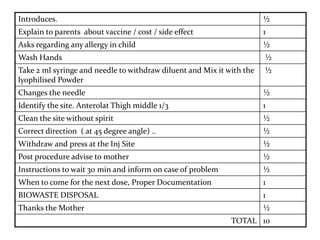
Introduces. ½
Explain to parents about vaccine / cost / side effect 1
Asks regarding any allergy in child ½
Wash Hands ½
Take 2 ml syringe and needle to withdraw diluent and Mix it with the
lyophilised Powder
½
Changes the needle ½
Identify the site. Anterolat Thigh middle 1/3 1
Clean the site without spirit ½
Correct direction ( at 45 degree angle) .. ½
Withdraw and press at the Inj Site ½
Post procedure advise to mother ½
Instructions to wait 30 min and inform on case of problem ½
When to come for the next dose, Proper Documentation 1
BIOWASTE DISPOSAL 1
Thanks the Mother ½
TOTAL 10
History taking
• 18 month old boy presented with fever with
rash 8days
• Take the appropriate history
• Dr. Rushikesh
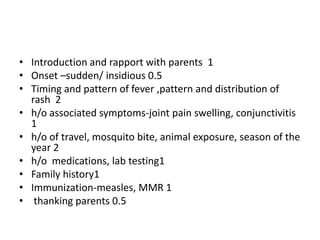
• Introduction and rapport with parents 1
• Onset –sudden/ insidious 0.5
• Timing and pattern of fever ,pattern and distribution of
rash 2
• h/o associated symptoms-joint pain swelling, conjunctivitis
1
• h/o of travel, mosquito bite, animal exposure, season of the
year 2
• h/o medications, lab testing1
• Family history1
• Immunization-measles, MMR 1
• thanking parents 0.5
Clinical examination
• Do the musculoskeletal examination of this 8
year old boy
• Dr. Niraj
• Introduction rapport, permission for examination[1]
• INSPECTION-observe child sit, stand, walk looks and
reports obvious abnormalities in gait, muscle [2]
• PALPATION-swelling tenderness deformities ,abn
curvatures in spine [2]
• RANGE OF MOVTS-IN major joints of UL AND LL [1]
• SPINE- INSP,PALP of spine, forward bending(touching
toes without bending knees)assess flexion extension
,lateral flexion,rotation [2]
• Reporting impression to examiner[1]
• Thanking child and parents[1]
Counseling
• 29weeks male 1.1kg delivered just
now, developed grunting
• Counsel about the immediate treatment plan
hospital stay and future prognosis
• Dr. Mayuri D
• Introduces, asks language, establishes rapport with parents[1]
• Importance of early CPAP, and surfactant replacement
therapy, need for mechanical ventilation [2]
• Frequent blood gases ,xrays and relevant blood testing and cultures
[1]
• Monitor for expected complications-air leaks pulmonary
haemorrhage,apnea,septicemia [1]
• Need for long hospital stay till child accepts orally
tolerates, euthermic, weighs at least 1.5kg,discharge check with
screen for cong anomalies, rop, hearing [2]
• Prognosis-prolonged oxygen
requirement(BPD),ROP, neurodevelopmental impairment [2]
• Thanks, asks for doubts [1]
Newborn examination
• Check weight length/height head
circumference of the new born
• Discuss cord and eye care with the mother
• Dr. Ashish D.
• Introduction and rapport [1]
• Take permission for examination, washes hands [1]
• Weight-removes cloths adjusts 0,removes parallax,reports wt to
examiner[ 2]
• Length-head at 0 movable end at feet, reports L to examiner[1]
• HC-uses nonstretchable tape, covers areas of max protuberance of
occiput and point just above glabella, reports to examiner [2]
• Cord care-clean stump with soap and water, allow to dry [1]
• Eye care-wipe eyes with sterile moist cotton, no routine topical
antibiotics [1]
• Thanking mother [1]
Procedure
• Demonstrate liver biopsy procedure with
given material
• Dr. Preeta Mathur
• Takes consent [1]
• Asks for pre procedure work up-CBC, coagulation profile,
LFTS [1]
• Position ,painting and draping the area [1]
• Administer local anesthesia [1]
• Checks liver biopsy needle, uses correct technique, checks
movement of needle with respiration after entering in liver
[2]
• Sends piece of biopsy in formalin bulb [1]
• Applies benzoin, monitors abdominal girth post procedure
[2]
• Dispose in BMW [1]
Developmental assessment
• Assess the developmental age of the child
• Dr Sandeep K / Dr Dhongade
• Introduction and rapport with child [1]
• DOLL-asks to tell the parts [1]
• Paper-good enough draw a man test, shows
number of body parts drawn by the child[ 2]
• Crayons, pencils- scribbles, copies circle,
rectangle, triangle, hexagon [2]
• Cubes-makes tower of 6,9,12,makes bridge[ 2]
• Tells developmental age to examiner and says
thanks to child/parent [2]
http://oscepediatrics.blogspot.in/

OSCE Pediatrics Observed Stations (Mock Exam Apr 2013)

  • 1.
  • 2.
    • The OSCEQuestions & Answers are prepared by the faculty for the benefit of Post graduate students and some are contributed from faculty • These Questions and answers are made for the students to understand the pattern of OSCE and not meant to completely cover the subject of Pediatrics. • Answer are checked from standard textbook in case of doubt plz email ashwinborade@yahoo.com
  • 3.
    • Counsel aparent whose child has been diagnosed with dyslexia • Dr. Nivedita / Dr.Pote
  • 4.
    Marks 10 • Introduction½ • Explains the meaning Dyslexia 1 • Explains the causes of Dyslexia 1 • Explains age wise approach – Remediation to Accomodation 1 • Approach to include 5 parts of speech i.e. phonemic awareness, phonics, fluency, vocabulary, and comprehension strategies 2 • Accommodation techniques – Extra time for exam, laptops with spell checkers, recorded books, lecture notes 1 • Non use routine performance test for assessment ½ • Help groups ½ • Role of medicines 1 • Gives positive encouragement 1 • Thanks ½
  • 5.
    • A 2yr old child presents to emergency department with severe pallor. Take the history of the child from mother. • Dr. Parimal
  • 6.
    Marks 10 • Introduceshimself and tries to make the mother comfortable 0.5 marks • Asks onset sudden or gradual 1 mark • history of bleeding or bluish spots 1 mark • History of associated symptoms : fever, failure to thrive 1 mark • Recurrent blood transfusions 1 mark • History of associated jaundice 1 mark • History of worm infestation 0.5 mark • Birth history 0.5 mark • Community and religion and history of consanguinity 1 mark • Dietary history 0.5 mark • Family history 0.5 mark • Drug history 1 mark • Thanks 0.5 mark
  • 7.
    • EXAMINATION OFB.P IN A 10 YEAR OLD • Dr. Meghna / Dr. Nadkarni
  • 8.
    Marks 10 • Rapportwith patient and Bystander 1 • Choice of cuff size 1 • Positioning of the patient 1 • Site of tubing in relation to artery is correct 1 • Initial palpation, then auscultation method 2 • Rate of deflation is correct 1 • Reconfirm reading/ ask for BP chart 1 • To say if reading is normal or otherwise 1 • Thanking patient and bystander 1
  • 9.
    • Administer MMRVaccine to this 17 month old child who is otherwise normal. • Dr. Ashwin Borade
  • 10.
    Introduces. ½ Explain toparents about vaccine / cost / side effect 1 Asks regarding any allergy in child ½ Wash Hands ½ Take 2 ml syringe and needle to withdraw diluent and Mix it with the lyophilised Powder ½ Changes the needle ½ Identify the site. Anterolat Thigh middle 1/3 1 Clean the site without spirit ½ Correct direction ( at 45 degree angle) .. ½ Withdraw and press at the Inj Site ½ Post procedure advise to mother ½ Instructions to wait 30 min and inform on case of problem ½ When to come for the next dose, Proper Documentation 1 BIOWASTE DISPOSAL 1 Thanks the Mother ½ TOTAL 10
  • 11.
    History taking • 18month old boy presented with fever with rash 8days • Take the appropriate history • Dr. Rushikesh
  • 12.
    • Introduction andrapport with parents 1 • Onset –sudden/ insidious 0.5 • Timing and pattern of fever ,pattern and distribution of rash 2 • h/o associated symptoms-joint pain swelling, conjunctivitis 1 • h/o of travel, mosquito bite, animal exposure, season of the year 2 • h/o medications, lab testing1 • Family history1 • Immunization-measles, MMR 1 • thanking parents 0.5
  • 13.
    Clinical examination • Dothe musculoskeletal examination of this 8 year old boy • Dr. Niraj
  • 14.
    • Introduction rapport,permission for examination[1] • INSPECTION-observe child sit, stand, walk looks and reports obvious abnormalities in gait, muscle [2] • PALPATION-swelling tenderness deformities ,abn curvatures in spine [2] • RANGE OF MOVTS-IN major joints of UL AND LL [1] • SPINE- INSP,PALP of spine, forward bending(touching toes without bending knees)assess flexion extension ,lateral flexion,rotation [2] • Reporting impression to examiner[1] • Thanking child and parents[1]
  • 15.
    Counseling • 29weeks male1.1kg delivered just now, developed grunting • Counsel about the immediate treatment plan hospital stay and future prognosis • Dr. Mayuri D
  • 16.
    • Introduces, askslanguage, establishes rapport with parents[1] • Importance of early CPAP, and surfactant replacement therapy, need for mechanical ventilation [2] • Frequent blood gases ,xrays and relevant blood testing and cultures [1] • Monitor for expected complications-air leaks pulmonary haemorrhage,apnea,septicemia [1] • Need for long hospital stay till child accepts orally tolerates, euthermic, weighs at least 1.5kg,discharge check with screen for cong anomalies, rop, hearing [2] • Prognosis-prolonged oxygen requirement(BPD),ROP, neurodevelopmental impairment [2] • Thanks, asks for doubts [1]
  • 17.
    Newborn examination • Checkweight length/height head circumference of the new born • Discuss cord and eye care with the mother • Dr. Ashish D.
  • 18.
    • Introduction andrapport [1] • Take permission for examination, washes hands [1] • Weight-removes cloths adjusts 0,removes parallax,reports wt to examiner[ 2] • Length-head at 0 movable end at feet, reports L to examiner[1] • HC-uses nonstretchable tape, covers areas of max protuberance of occiput and point just above glabella, reports to examiner [2] • Cord care-clean stump with soap and water, allow to dry [1] • Eye care-wipe eyes with sterile moist cotton, no routine topical antibiotics [1] • Thanking mother [1]
  • 19.
    Procedure • Demonstrate liverbiopsy procedure with given material • Dr. Preeta Mathur
  • 20.
    • Takes consent[1] • Asks for pre procedure work up-CBC, coagulation profile, LFTS [1] • Position ,painting and draping the area [1] • Administer local anesthesia [1] • Checks liver biopsy needle, uses correct technique, checks movement of needle with respiration after entering in liver [2] • Sends piece of biopsy in formalin bulb [1] • Applies benzoin, monitors abdominal girth post procedure [2] • Dispose in BMW [1]
  • 21.
    Developmental assessment • Assessthe developmental age of the child • Dr Sandeep K / Dr Dhongade
  • 22.
    • Introduction andrapport with child [1] • DOLL-asks to tell the parts [1] • Paper-good enough draw a man test, shows number of body parts drawn by the child[ 2] • Crayons, pencils- scribbles, copies circle, rectangle, triangle, hexagon [2] • Cubes-makes tower of 6,9,12,makes bridge[ 2] • Tells developmental age to examiner and says thanks to child/parent [2]
  • 23.