PHYSICAL
EXAMINATION
PRESENTED BY:
R.SIVABARATHY
M.SC(N) 1ST YEAR
CON
JIPMER
Physical examination of a child involves a
complete head to foot examination, including
all the system with the special emphasis on
the areas most probably affected, as per the
history taken. It usually begin with an
inspection of the general apperance of the
child.
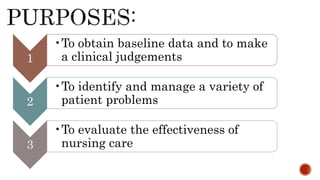
1
•To obtain baseline data and to make
a clinical judgements
2
•To identify and manage a variety of
patient problems
3
•To evaluate the effectiveness of
nursing care
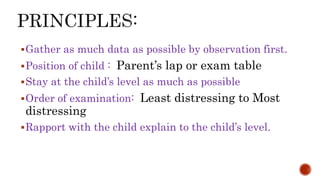
Gather as much data as possible by observation first.
Position of child : Parent’s lap or exam table
Stay at the child’s level as much as possible
Order of examination: Least distressing to Most
distressing
Rapport with the child explain to the child’s level.
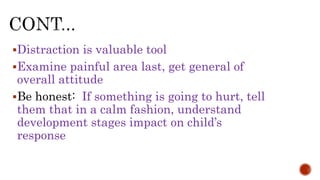
Distraction is valuable tool
Examine painful area last, get general of
overall attitude
Be honest: If something is going to hurt, tell
them that in a calm fashion, understand
development stages impact on child’s
response
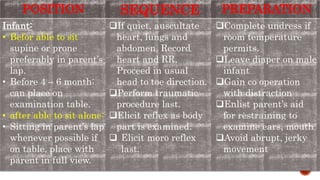
POSITION SEQUENCE PREPARATION
Infant:
• Befor able to sit
supine or prone
preferably in parent’s
lap.
• Before 4 – 6 month:
can place on
examination table.
• after able to sit alone:
• Sitting in parent’s lap
whenever possible if
on table, place with
parent in full view.
If quiet, auscultate
heart, lungs and
abdomen. Record
heart and RR.
Proceed in usual
head to toe direction.
Perform traumatic
procedure last.
Elicit reflex as body
part is examined.
 Elicit moro reflex
last.
Complete undress if
room temperature
permits.
Leave diaper on male
infant
Gain co operation
with distraction
Enlist parent’s aid
for restraining to
examine ears, mouth
Avoid abrupt, jerky
movement
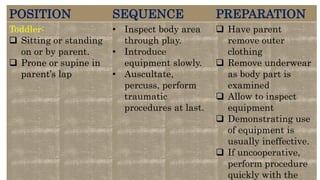
POSITION SEQUENCE PREPARATION
Toddler:
 Sitting or standing
on or by parent.
 Prone or supine in
parent’s lap
• Inspect body area
through play.
• Introduce
equipment slowly.
• Auscultate,
percuss, perform
traumatic
procedures at last.
 Have parent
remove outer
clothing
 Remove underwear
as body part is
examined
 Allow to inspect
equipment
 Demonstrating use
of equipment is
usually ineffective.
 If uncooperative,
perform procedure
quickly with the
POSITION SEQUENCE PREPARATION
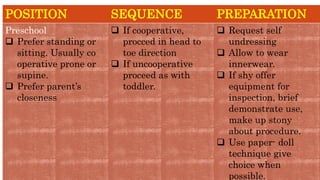
Preschool
 Prefer standing or
sitting. Usually co
operative prone or
supine.
 Prefer parent’s
closeness
 If cooperative,
procced in head to
toe direction
 If uncooperative
proceed as with
toddler.
 Request self
undressing
 Allow to wear
innerwear.
 If shy offer
equipment for
inspection, brief
demonstrate use,
make up stony
about procedure.
 Use paper- doll
technique give
choice when
possible.
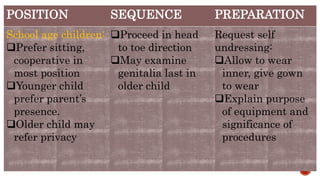
POSITION SEQUENCE PREPARATION
School age children:
Prefer sitting,
cooperative in
most position
Younger child
prefer parent’s
presence.
Older child may
refer privacy
Proceed in head
to toe direction
May examine
genitalia last in
older child
Request self
undressing:
Allow to wear
inner, give gown
to wear
Explain purpose
of equipment and
significance of
procedures
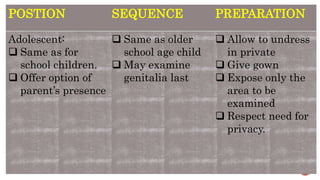
POSTION SEQUENCE PREPARATION
Adolescent:
 Same as for
school children.
 Offer option of
parent’s presence
 Same as older
school age child
 May examine
genitalia last
 Allow to undress
in private
 Give gown
 Expose only the
area to be
examined
 Respect need for
privacy.
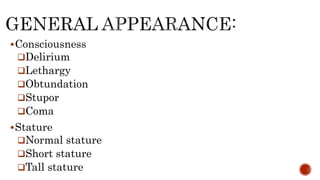
Consciousness
Delirium
Lethargy
Obtundation
Stupor
Coma
Stature
Normal stature
Short stature
Tall stature
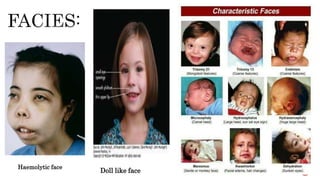
FACIES:
Mongoloid facies
Cushingoid facies
Haemolytic facies
Doll like face
Hepatic facies
Cretinoid facies.
Haemolytic face
Doll like face
Posture and position:
Observe the posture, position and types of body moment.
The child in pain may favor a body part, the child with low
esteem or a feeling of rejection may assume a slumped, careless
and apathetic pose.
Hygiene:
Note the child hygiene in term of cleanliness, unusal body
odor, the condition of hair, nails, teeth, neck and feet and the
condition of clothing possible instances of neglect,
inadequate financial resources, housing difficulties or lack of
knowledge concerning children’s need.
Behaviour include the child’s personality, activity
level, reaction to stress, request, frustration,
interaction with others.
Degree of alertness and response to stimuli
development can be assessed by carefully observing
the child
Record an overall estimate of the child’s speech
development, motor skills, co ordination and recent
area of achievement.
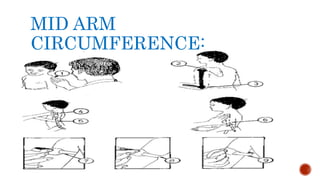
MID ARM
CIRCUMFERENCE:
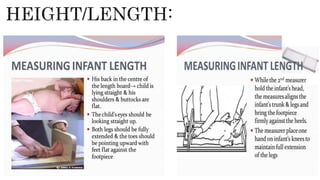
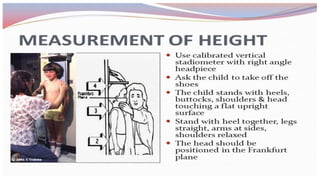
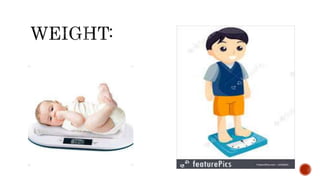
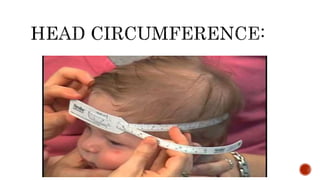
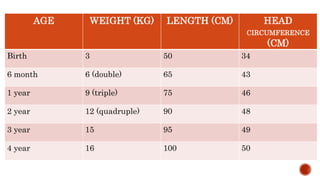
AGE WEIGHT (KG) LENGTH (CM) HEAD
CIRCUMFERENCE
(CM)
Birth 3 50 34
6 month 6 (double) 65 43
1 year 9 (triple) 75 46
2 year 12 (quadruple) 90 48
3 year 15 95 49
4 year 16 100 50
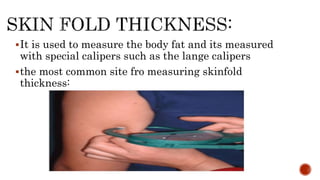
It is used to measure the body fat and its measured
with special calipers such as the lange calipers
the most common site fro measuring skinfold
thickness:
Temperature
Pulse
Respiration
Blood pressure
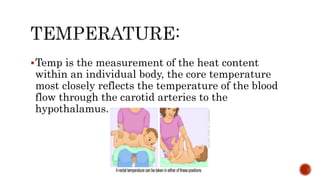
Temp is the measurement of the heat content
within an individual body, the core temperature
most closely reflects the temperature of the blood
flow through the carotid arteries to the
hypothalamus.
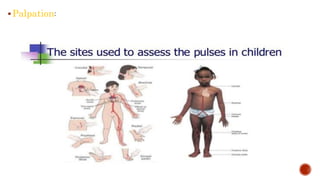
A satisfactory pulse can be taken radially in
children older than 2 years of age.
In infants and young children, the apical pulse is
heard.
Count the pulse for 1 min in infant and young
children because of possible irregularities in
rhythm.
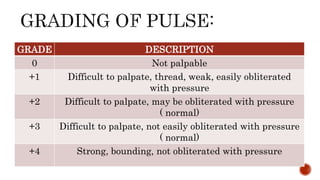
GRADE DESCRIPTION
0 Not palpable
+1 Difficult to palpate, thread, weak, easily obliterated
with pressure
+2 Difficult to palpate, may be obliterated with pressure
( normal)
+3 Difficult to palpate, not easily obliterated with pressure
( normal)
+4 Strong, bounding, not obliterated with pressure
The oscillometric BP monitoring method is a
reliable screening tool used in a variety of age
groups.
Use an appropriate size cuff 2/3rd width of
upper arm for upper arm pressure (cuff
bladder width should be approximately 40%
of mid arm circumference)
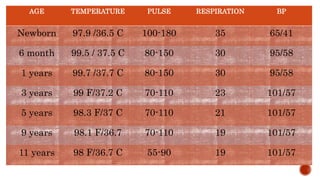
AGE TEMPERATURE PULSE RESPIRATION BP
Newborn 97.9 /36.5 C 100-180 35 65/41
6 month 99.5 / 37.5 C 80-150 30 95/58
1 years 99.7 /37.7 C 80-150 30 95/58
3 years 99 F/37.2 C 70-110 23 101/57
5 years 98.3 F/37 C 70-110 21 101/57
9 years 98.1 F/36.7 70-110 19 101/57
11 years 98 F/36.7 C 55-90 19 101/57
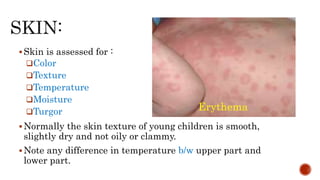
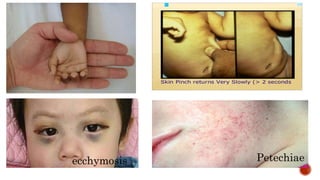
Skin is assessed for :
Color
Texture
Temperature
Moisture
Turgor
Normally the skin texture of young children is smooth,
slightly dry and not oily or clammy.
Note any difference in temperature b/w upper part and
lower part.
Erythema
Petechiaeecchymosis
Assess the edema:
Edema scale:
0.5 cm = +
1 cm = ++
1.5 cm = +++
2 cm = ++++
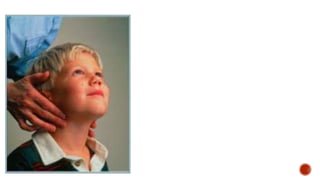
Palpate nodes using the distal portion of the fingers and gently but
firmly pressing in a circular motion along the region where the
nodes are normally present.
During assessment nodes in the head and neck, tilt the child’s
head upward slightly.
This facilitates palpation of the submental, submandibular,
tonsillar and cervical nodes.
Palpate the axillary nodes with the child’s arm relaxed at the side
but slightly abduction.
Inguinal node with the child in supine position.
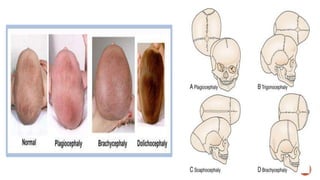
Inspect scalp and hair for dandruff, pediculosis and texture of the
hair.
Palpate fontanelle for size, shape, tension and closure
Palpate skull for patent or overriding sutures, fractures or
swellings.
Evaluate range of motion by asking the older child to look in each
direction or by manually putting the younger child through each
position.
Size
shape
Inspection of eye brows, alignment and lashes
Spacing of the eyes refers to the distance between
both eyes.
Canthral index is derived from the ratio of the
distance between inner and outer canthi of both
eyes multiple by 100.
Normal CI is 3 – 8. if CI is < less than 3cm then its
called hypotelorism, if CI is more than 8cm then its
called hypertelorism.
Screen visual fields by confirmation.
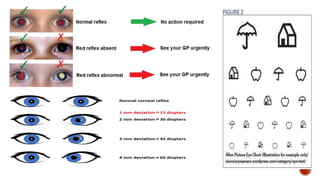
Corneal reflection shine
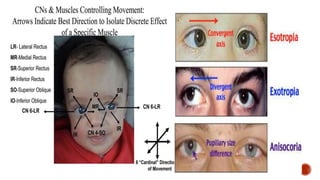
Extra ocular movement
Pupillary reaction (PERRLA)
Visual acuity test with the use of snellen chart
Inspection of internal structure
REACTION TO ACCOMDATION:
Hold an object about 10 cm from the bridge of the
client’s nose
Ask the client to look first at the top of the object
and then at a distant object behind the penlight.
Observe the pupil responses. The pupils should
constrict when looking at the near object and
dilate when looking at the far object
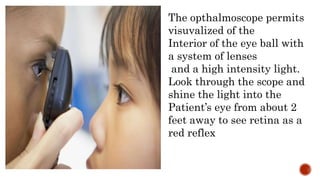
The opthalmoscope permits
visuvalized of the
Interior of the eye ball with
a system of lenses
and a high intensity light.
Look through the scope and
shine the light into the
Patient’s eye from about 2
feet away to see retina as a
red reflex
Externally:
Check the alignment
Palpate the mastoid process for tenderness or deformity
Inspect the skin surface around the ear for small
openings, extra tags of skin, or sinuses. If the sinuses is
found, note this because it may represent a fistula that
drains into some area of the neck or ear.
Assess the ear of hygiene, note the presence of cerumen.
Discharges.
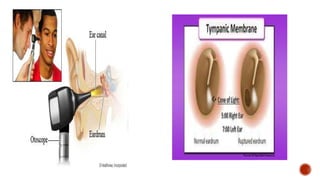
Internally
The head of the otoscope permits visuvalized of the tymphanic
membrane by use of a bright light, a magnifying glass, and a
speculum
Inspect the ear canal and middle ear structure noting any
redness, drainage or deformity
Normal colour of the ear drum
Shiny translucent
Pearly gray
Abnormal findings:
Erythema: otitis media, purulent discharge, serous otitis media
with effusion.
Conductive hearing loss is due to mechanical dysfunction of inner
or middle ear.
Audiometry and other hearing test can be done.
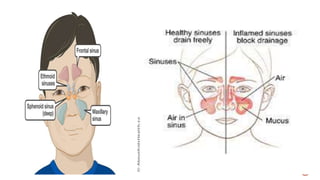
Observe the location, symmentry in size and
diameter of the nares.
Observe ala nasi for sign of flaring.
Inspect the nasal cavity
Palapate the frontal sinuses below eyebrows and
maxillary sinuses below zygomatic arch for any
tenderness.
Size: normally the outer edge of the mouth lies on a
perpendicular line drooped from the center of the either
pupil, with the eyes looking straight.
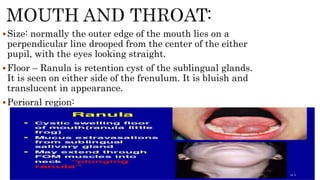
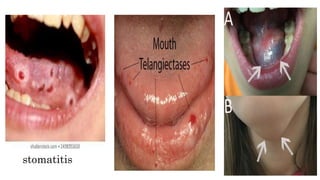
Floor – Ranula is retention cyst of the sublingual glands.
It is seen on either side of the frenulum. It is bluish and
translucent in appearance.
Perioral region:
stomatitis
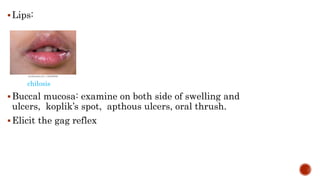
Lips:
chilosis
Buccal mucosa: examine on both side of swelling and
ulcers, koplik’s spot, apthous ulcers, oral thrush.
Elicit the gag reflex
Examine the oropharynx and note the size
and color of the tonsils.
They are normally the same color as the
surroundings mucosal glandular rather than
smooth in appearance.
 Report any swelling , redness or white areas
on the tonsils.
Grade 1: the tonsils are behind the tonsillar pillars.
Grade 2: the tonsils are between the pillars and the
uvula
Grade 3: the tonsils touch the uvula
Grade 4 : on or both tonsils extended to the midline
of the oropharynx.
Teeth:
Malocculsion is an improper dental alignment where the
upper teeth do not align properly with lower teeth.
Inspect the teeth for number in each dental arch, fro
hygiene and for occlusion or bite.
Brown spots in the grevices of the crown of the tooth or
between the teeth may be caries.
Chalky white to yellow or brown areas on the enamel
may indicate fluorosis.
Teeth may appear greenish black may be stained
temporarily from ingestion of supplement iron,
Examine the gum (gingiva) surrounding the teeth.
The color is normally coral pink and surface
texture is stippled, similar to the appearance of a
orange peel.
Assess the gums for hypertrophy, swollen, red and
spongy gums that bleed easily.
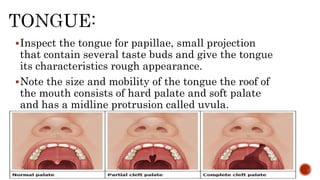
Inspect the tongue for papillae, small projection
that contain several taste buds and give the tongue
its characteristics rough appearance.
Note the size and mobility of the tongue the roof of
the mouth consists of hard palate and soft palate
and has a midline protrusion called uvula.
Inspect the symmentry, scars or other lesions.
Palpate the neck to detect areas of tenderness,
deformity, masses, distended neck veins, carotid
artery pulsation and thyroid gland enlargement.
ROM , nuchal rigidity and JVD.
in
Inspection:
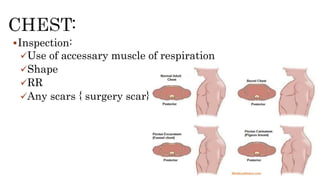
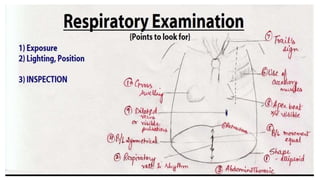
Use of accessary muscle of respiration
Shape
RR
Any scars { surgery scar}
Inspection:
Observe the rate, rhythm, depth and effort
of breathing
Note whether the expiratory phase is
prolonged.
Listen for obvious abnormal sounds with
breathing
Observe for retraction and use of accessory
muscle.
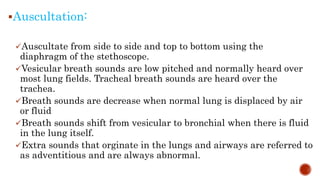
Auscultation:
Auscultate from side to side and top to bottom using the
diaphragm of the stethoscope.
Vesicular breath sounds are low pitched and normally heard over
most lung fields. Tracheal breath sounds are heard over the
trachea.
Breath sounds are decrease when normal lung is displaced by air
or fluid
Breath sounds shift from vesicular to bronchial when there is fluid
in the lung itself.
Extra sounds that orginate in the lungs and airways are referred to
as adventitious and are always abnormal.
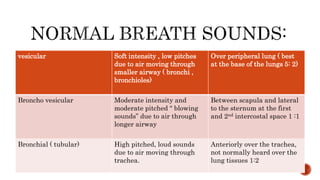
vesicular Soft intensity , low pitches
due to air moving through
smaller airway ( bronchi ,
bronchioles)
Over peripheral lung ( best
at the base of the lungs 5: 2)
Broncho vesicular Moderate intensity and
moderate pitched “ blowing
sounds” due to air through
longer airway
Between scapula and lateral
to the sternum at the first
and 2nd intercostal space 1 :1
Bronchial ( tubular) High pitched, loud sounds
due to air moving through
trachea.
Anteriorly over the trachea,
not normally heard over the
lung tissues 1:2
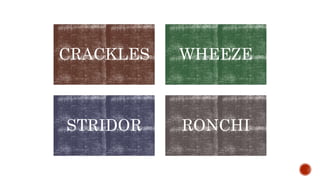
CRACKLES WHEEZE
STRIDOR RONCHI
Crackles: fine, short, interepted crackling sound high
pitched due to the air passing through fluid/ mucous in the
air passage.
Gurgles: continuous, low pitched, coarse, gurgling, harsh ,
louder sounds due to the air passing through narrowed air
passages by tumor, secretion, swelling.
Friction : crackling sounds during the inspiration and
expiration due to the rubbing together of inflamed pleura.
Wheeze: continuous, high pitched, squeaky musical sounds
best heard on expiration due to air passage through
constricted bronchi
CARDIOVASCULAR
SYSTEM:
Inspection:
Are there the features of down syndrome,
turner’s syndrome or marfan’s syndrome.
Cynosis,hands,edema.
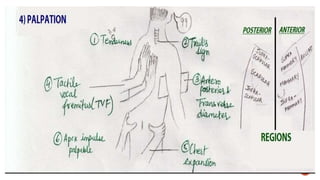
Palpation:
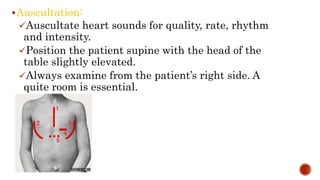
Auscultation:
Auscultate heart sounds for quality, rate, rhythm
and intensity.
Position the patient supine with the head of the
table slightly elevated.
Always examine from the patient’s right side. A
quite room is essential.
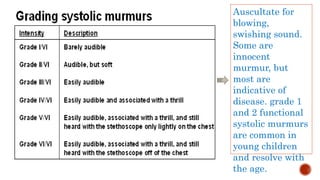
Auscultate for
blowing,
swishing sound.
Some are
innocent
murmur, but
most are
indicative of
disease. grade 1
and 2 functional
systolic murmurs
are common in
young children
and resolve with
the age.
GASTROINTESTIN
AL SYSTEM:
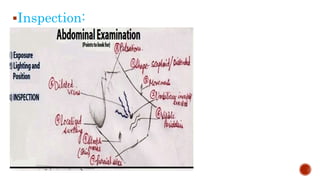
Inspection:
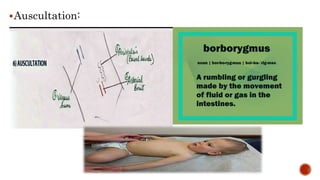
Auscultation:
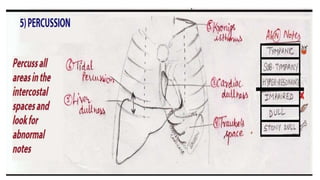
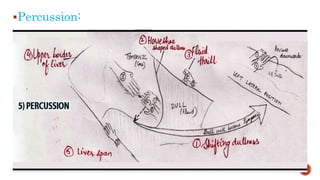
Percussion:
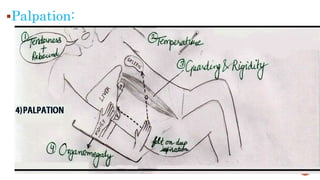
Palpation:
Examination of the genital conveniently
follows assessment of the abdomen while the
child is still supine.
In adolescents inspection of the genitalia may
be left to the end of the examination.
Respect the privacy by covering the lower
abdomen with the gown.
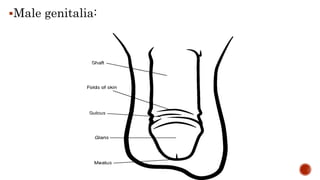
Male genitalia:
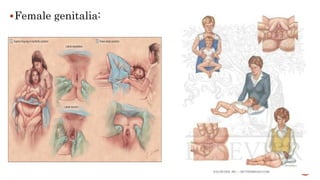
Female genitalia:
MUSCULOSKELETAL
SYSYTEM:
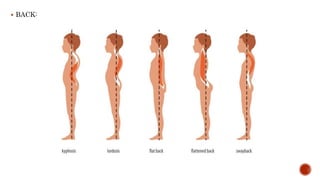
 BACK:
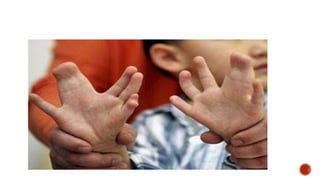
EXTREMITIES:
Inspect each extremities for symmentry,
color, syndactyly, polydactyly and
abnormalities like bow leg, knock knee or
club foot.
Joints:
Examine each major joint for any areas of
tenderness, swelling or heat.
Evaluate joints for ROM.
Muscles:
Examine muscle tone and muscle strength.
Mental status :
Assess the level of consciousness facial expression and
body language, speech, cognition and functioning.
Cranial nerves: observe for ptosis III, facial droop or
asymmetry VII, hoarse voice X, articulation of work
(V,VII,X,XII), abnormal eye position (III,IV,VI), abnormal
or asymmetrical pupils (II,III).
Muscle tone – ask the patient to relax.
Flex and extend the patient’s fingers, wrist and
elbow
Flex and extend patient’s ankle and knee, there is
normally a small, continuous resistance to passive
movement
Observe for decrease/flaccid or increase tone (
rigid/spastic)
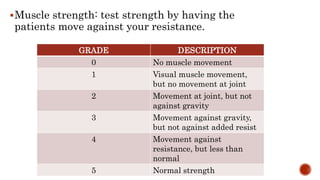
Muscle strength: test strength by having the
patients move against your resistance.
GRADE DESCRIPTION
0 No muscle movement
1 Visual muscle movement,
but no movement at joint
2 Movement at joint, but not
against gravity
3 Movement against gravity,
but not against added resist
4 Movement against
resistance, but less than
normal
5 Normal strength
Point to point movement: ask the patient to touch
the index finger and their nose alternatively
several times.
Romberg test: ask the patient to stand with the
feet together and eyes closed for 5 – 10 sec without
support.
Gait – ask the patient to walk across the room ,
turn and come back, walk heel to toe in a straight
line and walk on their toes in a straight line.
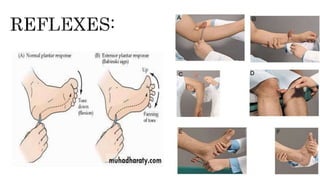
Biceps: patient should be partially flexed at the
elbow with the palm down and place the thumb or
finger firmly on the biceps tendon. Strike the finger
with the reflex hammer.
Triceps: support the upper arm and let the
patient’s forearm hang free and strike the triceps
tendon above the elbow with the broad side of the
hammer
Brachioradialis: have the patient rest the forearm
on the abdomen or lap, strike the radius about 1.2
inches above the wrist and watch for flexion and
supination of the forearm
 0 = no response
+1 = minimal activity ( hypoactive)
+2 = normal response
Here I applied VIRGINIA HENDERSON’S
THEORY.
Nurse need to assess the needs of human being
based on the 14 component of basic nursing care.
Title: Physical examination findings among
children and adolescence with obesity, an evidence
based review.
1.Marlow R, Redding A. Marlow’s textbook of pediatric nursing.
Elseiver south Asia edition. 6th 2013.
2.Datta p.A textbook of pediatric nursing, jaypee brothers medical
publishers ltd.2013.
3.Hockenberry J. Wilson P, Wong’s essential of pediatric nursing
elseiver south asia ed. 8th .2012.
4.Gupta P. textbook of paediatrics. CSP publishers. New Delhi. 2013.
5.Pancahli P. textbook paediatric nursing. New delhi. Paras Medical
Publication. 2016.

Physical examination

  • 1.
  • 2.
    Physical examination ofa child involves a complete head to foot examination, including all the system with the special emphasis on the areas most probably affected, as per the history taken. It usually begin with an inspection of the general apperance of the child.
  • 3.
    1 •To obtain baselinedata and to make a clinical judgements 2 •To identify and manage a variety of patient problems 3 •To evaluate the effectiveness of nursing care
  • 4.
    Gather as muchdata as possible by observation first. Position of child : Parent’s lap or exam table Stay at the child’s level as much as possible Order of examination: Least distressing to Most distressing Rapport with the child explain to the child’s level.
  • 5.
    Distraction is valuabletool Examine painful area last, get general of overall attitude Be honest: If something is going to hurt, tell them that in a calm fashion, understand development stages impact on child’s response
  • 7.
    POSITION SEQUENCE PREPARATION Infant: •Befor able to sit supine or prone preferably in parent’s lap. • Before 4 – 6 month: can place on examination table. • after able to sit alone: • Sitting in parent’s lap whenever possible if on table, place with parent in full view. If quiet, auscultate heart, lungs and abdomen. Record heart and RR. Proceed in usual head to toe direction. Perform traumatic procedure last. Elicit reflex as body part is examined.  Elicit moro reflex last. Complete undress if room temperature permits. Leave diaper on male infant Gain co operation with distraction Enlist parent’s aid for restraining to examine ears, mouth Avoid abrupt, jerky movement
  • 8.
    POSITION SEQUENCE PREPARATION Toddler: Sitting or standing on or by parent.  Prone or supine in parent’s lap • Inspect body area through play. • Introduce equipment slowly. • Auscultate, percuss, perform traumatic procedures at last.  Have parent remove outer clothing  Remove underwear as body part is examined  Allow to inspect equipment  Demonstrating use of equipment is usually ineffective.  If uncooperative, perform procedure quickly with the
  • 9.
    POSITION SEQUENCE PREPARATION Preschool Prefer standing or sitting. Usually co operative prone or supine.  Prefer parent’s closeness  If cooperative, procced in head to toe direction  If uncooperative proceed as with toddler.  Request self undressing  Allow to wear innerwear.  If shy offer equipment for inspection, brief demonstrate use, make up stony about procedure.  Use paper- doll technique give choice when possible.
  • 10.
    POSITION SEQUENCE PREPARATION Schoolage children: Prefer sitting, cooperative in most position Younger child prefer parent’s presence. Older child may refer privacy Proceed in head to toe direction May examine genitalia last in older child Request self undressing: Allow to wear inner, give gown to wear Explain purpose of equipment and significance of procedures
  • 11.
    POSTION SEQUENCE PREPARATION Adolescent: Same as for school children.  Offer option of parent’s presence  Same as older school age child  May examine genitalia last  Allow to undress in private  Give gown  Expose only the area to be examined  Respect need for privacy.
  • 12.
  • 13.
    FACIES: Mongoloid facies Cushingoid facies Haemolyticfacies Doll like face Hepatic facies Cretinoid facies.
  • 14.
  • 15.
    Posture and position: Observethe posture, position and types of body moment. The child in pain may favor a body part, the child with low esteem or a feeling of rejection may assume a slumped, careless and apathetic pose. Hygiene: Note the child hygiene in term of cleanliness, unusal body odor, the condition of hair, nails, teeth, neck and feet and the condition of clothing possible instances of neglect, inadequate financial resources, housing difficulties or lack of knowledge concerning children’s need.
  • 16.
    Behaviour include thechild’s personality, activity level, reaction to stress, request, frustration, interaction with others. Degree of alertness and response to stimuli development can be assessed by carefully observing the child Record an overall estimate of the child’s speech development, motor skills, co ordination and recent area of achievement.
  • 22.
  • 23.
    AGE WEIGHT (KG)LENGTH (CM) HEAD CIRCUMFERENCE (CM) Birth 3 50 34 6 month 6 (double) 65 43 1 year 9 (triple) 75 46 2 year 12 (quadruple) 90 48 3 year 15 95 49 4 year 16 100 50
  • 24.
    It is usedto measure the body fat and its measured with special calipers such as the lange calipers the most common site fro measuring skinfold thickness:
  • 25.
  • 26.
    Temp is themeasurement of the heat content within an individual body, the core temperature most closely reflects the temperature of the blood flow through the carotid arteries to the hypothalamus.
  • 27.
    A satisfactory pulsecan be taken radially in children older than 2 years of age. In infants and young children, the apical pulse is heard. Count the pulse for 1 min in infant and young children because of possible irregularities in rhythm.
  • 28.
    GRADE DESCRIPTION 0 Notpalpable +1 Difficult to palpate, thread, weak, easily obliterated with pressure +2 Difficult to palpate, may be obliterated with pressure ( normal) +3 Difficult to palpate, not easily obliterated with pressure ( normal) +4 Strong, bounding, not obliterated with pressure
  • 30.
    The oscillometric BPmonitoring method is a reliable screening tool used in a variety of age groups. Use an appropriate size cuff 2/3rd width of upper arm for upper arm pressure (cuff bladder width should be approximately 40% of mid arm circumference)
  • 31.
    AGE TEMPERATURE PULSERESPIRATION BP Newborn 97.9 /36.5 C 100-180 35 65/41 6 month 99.5 / 37.5 C 80-150 30 95/58 1 years 99.7 /37.7 C 80-150 30 95/58 3 years 99 F/37.2 C 70-110 23 101/57 5 years 98.3 F/37 C 70-110 21 101/57 9 years 98.1 F/36.7 70-110 19 101/57 11 years 98 F/36.7 C 55-90 19 101/57
  • 32.
    Skin is assessedfor : Color Texture Temperature Moisture Turgor Normally the skin texture of young children is smooth, slightly dry and not oily or clammy. Note any difference in temperature b/w upper part and lower part. Erythema
  • 33.
  • 34.
    Assess the edema: Edemascale: 0.5 cm = + 1 cm = ++ 1.5 cm = +++ 2 cm = ++++
  • 35.
    Palpate nodes usingthe distal portion of the fingers and gently but firmly pressing in a circular motion along the region where the nodes are normally present. During assessment nodes in the head and neck, tilt the child’s head upward slightly. This facilitates palpation of the submental, submandibular, tonsillar and cervical nodes. Palpate the axillary nodes with the child’s arm relaxed at the side but slightly abduction. Inguinal node with the child in supine position.
  • 37.
    Inspect scalp andhair for dandruff, pediculosis and texture of the hair. Palpate fontanelle for size, shape, tension and closure Palpate skull for patent or overriding sutures, fractures or swellings. Evaluate range of motion by asking the older child to look in each direction or by manually putting the younger child through each position. Size shape
  • 39.
    Inspection of eyebrows, alignment and lashes Spacing of the eyes refers to the distance between both eyes. Canthral index is derived from the ratio of the distance between inner and outer canthi of both eyes multiple by 100. Normal CI is 3 – 8. if CI is < less than 3cm then its called hypotelorism, if CI is more than 8cm then its called hypertelorism.
  • 40.
    Screen visual fieldsby confirmation. Corneal reflection shine Extra ocular movement Pupillary reaction (PERRLA) Visual acuity test with the use of snellen chart Inspection of internal structure
  • 41.
    REACTION TO ACCOMDATION: Holdan object about 10 cm from the bridge of the client’s nose Ask the client to look first at the top of the object and then at a distant object behind the penlight. Observe the pupil responses. The pupils should constrict when looking at the near object and dilate when looking at the far object
  • 44.
    The opthalmoscope permits visuvalizedof the Interior of the eye ball with a system of lenses and a high intensity light. Look through the scope and shine the light into the Patient’s eye from about 2 feet away to see retina as a red reflex
  • 45.
    Externally: Check the alignment Palpatethe mastoid process for tenderness or deformity Inspect the skin surface around the ear for small openings, extra tags of skin, or sinuses. If the sinuses is found, note this because it may represent a fistula that drains into some area of the neck or ear. Assess the ear of hygiene, note the presence of cerumen. Discharges.
  • 46.
    Internally The head ofthe otoscope permits visuvalized of the tymphanic membrane by use of a bright light, a magnifying glass, and a speculum Inspect the ear canal and middle ear structure noting any redness, drainage or deformity Normal colour of the ear drum Shiny translucent Pearly gray Abnormal findings: Erythema: otitis media, purulent discharge, serous otitis media with effusion. Conductive hearing loss is due to mechanical dysfunction of inner or middle ear. Audiometry and other hearing test can be done.
  • 48.
    Observe the location,symmentry in size and diameter of the nares. Observe ala nasi for sign of flaring. Inspect the nasal cavity Palapate the frontal sinuses below eyebrows and maxillary sinuses below zygomatic arch for any tenderness.
  • 50.
    Size: normally theouter edge of the mouth lies on a perpendicular line drooped from the center of the either pupil, with the eyes looking straight. Floor – Ranula is retention cyst of the sublingual glands. It is seen on either side of the frenulum. It is bluish and translucent in appearance. Perioral region:
  • 51.
  • 52.
    Lips: chilosis Buccal mucosa: examineon both side of swelling and ulcers, koplik’s spot, apthous ulcers, oral thrush. Elicit the gag reflex
  • 53.
    Examine the oropharynxand note the size and color of the tonsils. They are normally the same color as the surroundings mucosal glandular rather than smooth in appearance.  Report any swelling , redness or white areas on the tonsils.
  • 54.
    Grade 1: thetonsils are behind the tonsillar pillars. Grade 2: the tonsils are between the pillars and the uvula Grade 3: the tonsils touch the uvula Grade 4 : on or both tonsils extended to the midline of the oropharynx.
  • 55.
    Teeth: Malocculsion is animproper dental alignment where the upper teeth do not align properly with lower teeth. Inspect the teeth for number in each dental arch, fro hygiene and for occlusion or bite. Brown spots in the grevices of the crown of the tooth or between the teeth may be caries. Chalky white to yellow or brown areas on the enamel may indicate fluorosis. Teeth may appear greenish black may be stained temporarily from ingestion of supplement iron,
  • 56.
    Examine the gum(gingiva) surrounding the teeth. The color is normally coral pink and surface texture is stippled, similar to the appearance of a orange peel. Assess the gums for hypertrophy, swollen, red and spongy gums that bleed easily.
  • 57.
    Inspect the tonguefor papillae, small projection that contain several taste buds and give the tongue its characteristics rough appearance. Note the size and mobility of the tongue the roof of the mouth consists of hard palate and soft palate and has a midline protrusion called uvula.
  • 58.
    Inspect the symmentry,scars or other lesions. Palpate the neck to detect areas of tenderness, deformity, masses, distended neck veins, carotid artery pulsation and thyroid gland enlargement. ROM , nuchal rigidity and JVD. in
  • 60.
    Inspection: Use of accessarymuscle of respiration Shape RR Any scars { surgery scar}
  • 61.
    Inspection: Observe the rate,rhythm, depth and effort of breathing Note whether the expiratory phase is prolonged. Listen for obvious abnormal sounds with breathing Observe for retraction and use of accessory muscle.
  • 65.
    Auscultation: Auscultate from sideto side and top to bottom using the diaphragm of the stethoscope. Vesicular breath sounds are low pitched and normally heard over most lung fields. Tracheal breath sounds are heard over the trachea. Breath sounds are decrease when normal lung is displaced by air or fluid Breath sounds shift from vesicular to bronchial when there is fluid in the lung itself. Extra sounds that orginate in the lungs and airways are referred to as adventitious and are always abnormal.
  • 66.
    vesicular Soft intensity, low pitches due to air moving through smaller airway ( bronchi , bronchioles) Over peripheral lung ( best at the base of the lungs 5: 2) Broncho vesicular Moderate intensity and moderate pitched “ blowing sounds” due to air through longer airway Between scapula and lateral to the sternum at the first and 2nd intercostal space 1 :1 Bronchial ( tubular) High pitched, loud sounds due to air moving through trachea. Anteriorly over the trachea, not normally heard over the lung tissues 1:2
  • 67.
  • 68.
    Crackles: fine, short,interepted crackling sound high pitched due to the air passing through fluid/ mucous in the air passage. Gurgles: continuous, low pitched, coarse, gurgling, harsh , louder sounds due to the air passing through narrowed air passages by tumor, secretion, swelling. Friction : crackling sounds during the inspiration and expiration due to the rubbing together of inflamed pleura. Wheeze: continuous, high pitched, squeaky musical sounds best heard on expiration due to air passage through constricted bronchi
  • 69.
  • 70.
    Inspection: Are there thefeatures of down syndrome, turner’s syndrome or marfan’s syndrome. Cynosis,hands,edema.
  • 71.
  • 72.
    Auscultation: Auscultate heart soundsfor quality, rate, rhythm and intensity. Position the patient supine with the head of the table slightly elevated. Always examine from the patient’s right side. A quite room is essential.
  • 73.
    Auscultate for blowing, swishing sound. Someare innocent murmur, but most are indicative of disease. grade 1 and 2 functional systolic murmurs are common in young children and resolve with the age.
  • 74.
  • 75.
  • 76.
  • 77.
  • 78.
  • 80.
    Examination of thegenital conveniently follows assessment of the abdomen while the child is still supine. In adolescents inspection of the genitalia may be left to the end of the examination. Respect the privacy by covering the lower abdomen with the gown.
  • 81.
  • 82.
  • 83.
  • 84.
  • 85.
    EXTREMITIES: Inspect each extremitiesfor symmentry, color, syndactyly, polydactyly and abnormalities like bow leg, knock knee or club foot. Joints: Examine each major joint for any areas of tenderness, swelling or heat. Evaluate joints for ROM. Muscles: Examine muscle tone and muscle strength.
  • 87.
    Mental status : Assessthe level of consciousness facial expression and body language, speech, cognition and functioning. Cranial nerves: observe for ptosis III, facial droop or asymmetry VII, hoarse voice X, articulation of work (V,VII,X,XII), abnormal eye position (III,IV,VI), abnormal or asymmetrical pupils (II,III).
  • 88.
    Muscle tone –ask the patient to relax. Flex and extend the patient’s fingers, wrist and elbow Flex and extend patient’s ankle and knee, there is normally a small, continuous resistance to passive movement Observe for decrease/flaccid or increase tone ( rigid/spastic)
  • 89.
    Muscle strength: teststrength by having the patients move against your resistance. GRADE DESCRIPTION 0 No muscle movement 1 Visual muscle movement, but no movement at joint 2 Movement at joint, but not against gravity 3 Movement against gravity, but not against added resist 4 Movement against resistance, but less than normal 5 Normal strength
  • 90.
    Point to pointmovement: ask the patient to touch the index finger and their nose alternatively several times. Romberg test: ask the patient to stand with the feet together and eyes closed for 5 – 10 sec without support. Gait – ask the patient to walk across the room , turn and come back, walk heel to toe in a straight line and walk on their toes in a straight line.
  • 92.
    Biceps: patient shouldbe partially flexed at the elbow with the palm down and place the thumb or finger firmly on the biceps tendon. Strike the finger with the reflex hammer. Triceps: support the upper arm and let the patient’s forearm hang free and strike the triceps tendon above the elbow with the broad side of the hammer Brachioradialis: have the patient rest the forearm on the abdomen or lap, strike the radius about 1.2 inches above the wrist and watch for flexion and supination of the forearm
  • 93.
     0 =no response +1 = minimal activity ( hypoactive) +2 = normal response
  • 94.
    Here I appliedVIRGINIA HENDERSON’S THEORY. Nurse need to assess the needs of human being based on the 14 component of basic nursing care.
  • 95.
    Title: Physical examinationfindings among children and adolescence with obesity, an evidence based review.
  • 96.
    1.Marlow R, ReddingA. Marlow’s textbook of pediatric nursing. Elseiver south Asia edition. 6th 2013. 2.Datta p.A textbook of pediatric nursing, jaypee brothers medical publishers ltd.2013. 3.Hockenberry J. Wilson P, Wong’s essential of pediatric nursing elseiver south asia ed. 8th .2012. 4.Gupta P. textbook of paediatrics. CSP publishers. New Delhi. 2013. 5.Pancahli P. textbook paediatric nursing. New delhi. Paras Medical Publication. 2016.