Business Readiness Planning Checklist
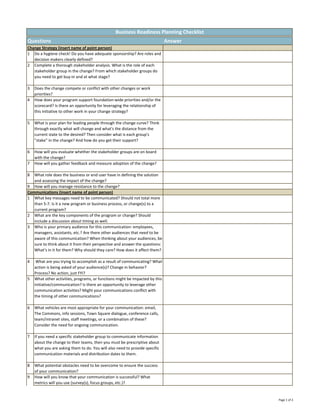
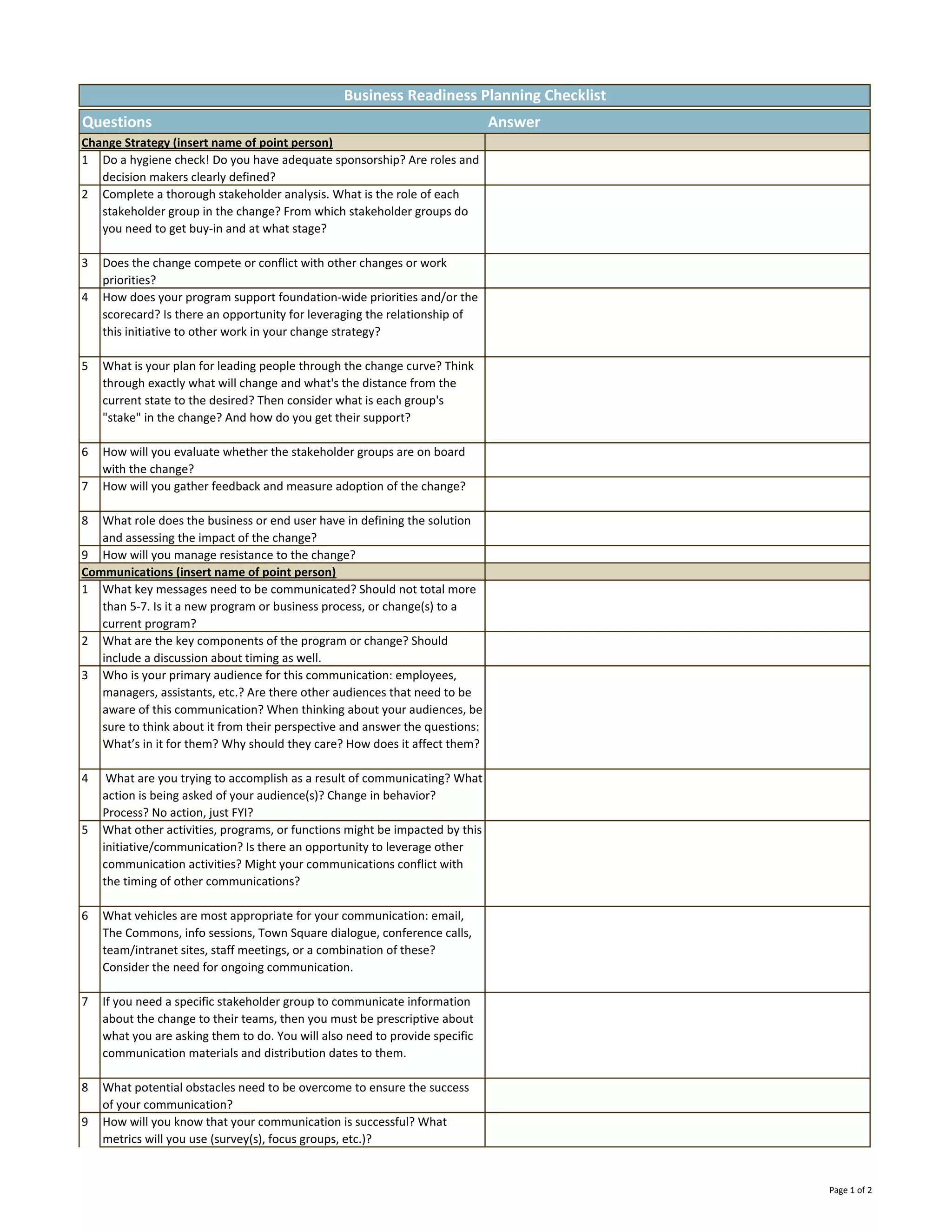
Questions                                                                     Answer
Change Strategy (insert name of point person)
1 Do a hygiene check! Do you have adequate sponsorship? Are roles and
   decision makers clearly defined?
2 Complete a thorough stakeholder analysis. What is the role of each
   stakeholder group in the change? From which stakeholder groups do
   you need to get buy-in and at what stage?

3   Does the change compete or conflict with other changes or work
    priorities?
4   How does your program support foundation-wide priorities and/or the
    scorecard? Is there an opportunity for leveraging the relationship of
    this initiative to other work in your change strategy?

5   What is your plan for leading people through the change curve? Think
    through exactly what will change and what's the distance from the
    current state to the desired? Then consider what is each group's
    "stake" in the change? And how do you get their support?

6   How will you evaluate whether the stakeholder groups are on board
    with the change?
7   How will you gather feedback and measure adoption of the change?

8  What role does the business or end user have in defining the solution
   and assessing the impact of the change?
9 How will you manage resistance to the change?
Communications (insert name of point person)
1 What key messages need to be communicated? Should not total more
   than 5-7. Is it a new program or business process, or change(s) to a
   current program?
2 What are the key components of the program or change? Should
   include a discussion about timing as well.
3 Who is your primary audience for this communication: employees,
   managers, assistants, etc.? Are there other audiences that need to be
   aware of this communication? When thinking about your audiences, be
   sure to think about it from their perspective and answer the questions:
   What’s in it for them? Why should they care? How does it affect them?

4    What are you trying to accomplish as a result of communicating? What
    action is being asked of your audience(s)? Change in behavior?
    Process? No action, just FYI?
5   What other activities, programs, or functions might be impacted by this
    initiative/communication? Is there an opportunity to leverage other
    communication activities? Might your communications conflict with
    the timing of other communications?

6   What vehicles are most appropriate for your communication: email,
    The Commons, info sessions, Town Square dialogue, conference calls,
    team/intranet sites, staff meetings, or a combination of these?
    Consider the need for ongoing communication.

7   If you need a specific stakeholder group to communicate information
    about the change to their teams, then you must be prescriptive about
    what you are asking them to do. You will also need to provide specific
    communication materials and distribution dates to them.

8   What potential obstacles need to be overcome to ensure the success
    of your communication?
9   How will you know that your communication is successful? What
    metrics will you use (survey(s), focus groups, etc.)?


                                                                                         Page 1 of 2
Business Readiness Planning Checklist
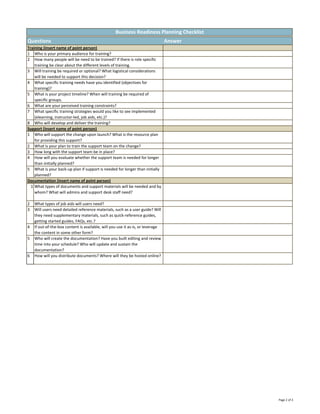
Questions                                                                        Answer
Training (insert name of point person)
1 Who is your primary audience for training?
2 How many people will be need to be trained? If there is role specific
    training be clear about the different levels of training.
3 Will training be required or optional? What logistical considerations
    will be needed to support this decision?
4 What specific training needs have you identified (objectives for
    training)?
5 What is your project timeline? When will training be required of
    specific groups.
6 What are your perceived training constraints?
7 What specific training strategies would you like to see implemented
    (elearning, instructor-led, job aids, etc.)?
8 Who will develop and deliver the training?
Support (insert name of point person)
1 Who will support the change upon launch? What is the resource plan
    for providing this support?
2 What is your plan to train the support team on the change?
3 How long with the support team be in place?
4 How will you evaluate whether the support team is needed for longer
    than initially planned?
5 What is your back-up plan if support is needed for longer than initially
    planned?
Documentation (insert name of point person)
  1 What types of documents and support materials will be needed and by
    whom? What will admins and support desk staff need?

2   What types of job aids will users need?
3   Will users need detailed reference materials, such as a user guide? Will
    they need supplementary materials, such as quick-reference guides,
    getting started guides, FAQs, etc.?
4   If out-of-the-box content is available, will you use it as-is, or leverage
    the content in some other form?
5   Who will create the documentation? Have you built editing and review
    time into your schedule? Who will update and sustain the
    documentation?
6   How will you distribute documents? Where will they be hosted online?


                                                                                           Page 2 of 2

Business Readiness Planning Checklist

  • 1.
    Business Readiness PlanningChecklist Questions Answer Change Strategy (insert name of point person) 1 Do a hygiene check! Do you have adequate sponsorship? Are roles and decision makers clearly defined? 2 Complete a thorough stakeholder analysis. What is the role of each stakeholder group in the change? From which stakeholder groups do you need to get buy-in and at what stage? 3 Does the change compete or conflict with other changes or work priorities? 4 How does your program support foundation-wide priorities and/or the scorecard? Is there an opportunity for leveraging the relationship of this initiative to other work in your change strategy? 5 What is your plan for leading people through the change curve? Think through exactly what will change and what's the distance from the current state to the desired? Then consider what is each group's "stake" in the change? And how do you get their support? 6 How will you evaluate whether the stakeholder groups are on board with the change? 7 How will you gather feedback and measure adoption of the change? 8 What role does the business or end user have in defining the solution and assessing the impact of the change? 9 How will you manage resistance to the change? Communications (insert name of point person) 1 What key messages need to be communicated? Should not total more than 5-7. Is it a new program or business process, or change(s) to a current program? 2 What are the key components of the program or change? Should include a discussion about timing as well. 3 Who is your primary audience for this communication: employees, managers, assistants, etc.? Are there other audiences that need to be aware of this communication? When thinking about your audiences, be sure to think about it from their perspective and answer the questions: What’s in it for them? Why should they care? How does it affect them? 4 What are you trying to accomplish as a result of communicating? What action is being asked of your audience(s)? Change in behavior? Process? No action, just FYI? 5 What other activities, programs, or functions might be impacted by this initiative/communication? Is there an opportunity to leverage other communication activities? Might your communications conflict with the timing of other communications? 6 What vehicles are most appropriate for your communication: email, The Commons, info sessions, Town Square dialogue, conference calls, team/intranet sites, staff meetings, or a combination of these? Consider the need for ongoing communication. 7 If you need a specific stakeholder group to communicate information about the change to their teams, then you must be prescriptive about what you are asking them to do. You will also need to provide specific communication materials and distribution dates to them. 8 What potential obstacles need to be overcome to ensure the success of your communication? 9 How will you know that your communication is successful? What metrics will you use (survey(s), focus groups, etc.)? Page 1 of 2
  • 2.
    Business Readiness PlanningChecklist Questions Answer Training (insert name of point person) 1 Who is your primary audience for training? 2 How many people will be need to be trained? If there is role specific training be clear about the different levels of training. 3 Will training be required or optional? What logistical considerations will be needed to support this decision? 4 What specific training needs have you identified (objectives for training)? 5 What is your project timeline? When will training be required of specific groups. 6 What are your perceived training constraints? 7 What specific training strategies would you like to see implemented (elearning, instructor-led, job aids, etc.)? 8 Who will develop and deliver the training? Support (insert name of point person) 1 Who will support the change upon launch? What is the resource plan for providing this support? 2 What is your plan to train the support team on the change? 3 How long with the support team be in place? 4 How will you evaluate whether the support team is needed for longer than initially planned? 5 What is your back-up plan if support is needed for longer than initially planned? Documentation (insert name of point person) 1 What types of documents and support materials will be needed and by whom? What will admins and support desk staff need? 2 What types of job aids will users need? 3 Will users need detailed reference materials, such as a user guide? Will they need supplementary materials, such as quick-reference guides, getting started guides, FAQs, etc.? 4 If out-of-the-box content is available, will you use it as-is, or leverage the content in some other form? 5 Who will create the documentation? Have you built editing and review time into your schedule? Who will update and sustain the documentation? 6 How will you distribute documents? Where will they be hosted online? Page 2 of 2