Webinar Program Business Case
Purpose

The purpose of this tool is to help you design a Business Case for an investment in a
Webinar Program. A Business Case is a formal management communication document
used to justify and plan a project or investment by providing an opportunity overview, key
success factors, assumptions & decision-making criterion, business impact analysis,
sensitivity analysis, risks, contingency plans, and action-oriented recommendations.


How to Use this Template

Complete the following sections with your project team and/or stakeholders. Cut & paste
this information into a document that reflects your corporate image, and deliver your
Business Case to senior executives to sponsor the project.
Title Page


                 [Insert Company Name or Logo]


         Business Case – (Company XYZ Webinar Program)


                      [Insert Completion Date]


                Completed By: [Insert Project Manager Name]
               Completed For: [Insert Project Sponsor Name]
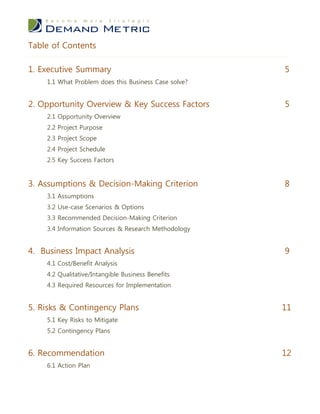
Table of Contents

1. Executive Summary                                  5
    1.1 What Problem does this Business Case solve?


2. Opportunity Overview & Key Success Factors         5
    2.1 Opportunity Overview
    2.2 Project Purpose
    2.3 Project Scope
    2.4 Project Schedule
    2.5 Key Success Factors


3. Assumptions & Decision-Making Criterion            8
    3.1 Assumptions
    3.2 Use-case Scenarios & Options
    3.3 Recommended Decision-Making Criterion
    3.4 Information Sources & Research Methodology


4. Business Impact Analysis                           9
    4.1 Cost/Benefit Analysis
    4.2 Qualitative/Intangible Business Benefits
    4.3 Required Resources for Implementation


5. Risks & Contingency Plans                          11
    5.1 Key Risks to Mitigate
    5.2 Contingency Plans


6. Recommendation                                     12
    6.1 Action Plan
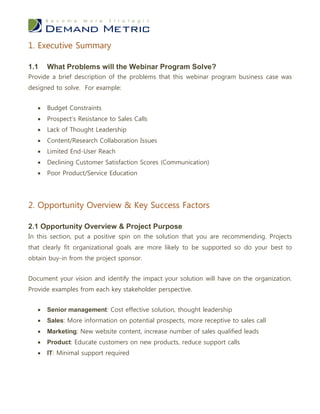
1. Executive Summary

1.1    What Problems will the Webinar Program Solve?
Provide a brief description of the problems that this webinar program business case was
designed to solve. For example:


      Budget Constraints
      Prospect’s Resistance to Sales Calls
      Lack of Thought Leadership
      Content/Research Collaboration Issues
      Limited End-User Reach
      Declining Customer Satisfaction Scores (Communication)
      Poor Product/Service Education


2. Opportunity Overview & Key Success Factors

2.1 Opportunity Overview & Project Purpose
In this section, put a positive spin on the solution that you are recommending. Projects
that clearly fit organizational goals are more likely to be supported so do your best to
obtain buy-in from the project sponsor.


Document your vision and identify the impact your solution will have on the organization.
Provide examples from each key stakeholder perspective.


      Senior management: Cost effective solution, thought leadership
      Sales: More information on potential prospects, more receptive to sales call
      Marketing: New website content, increase number of sales qualified leads
      Product: Educate customers on new products, reduce support calls
      IT: Minimal support required
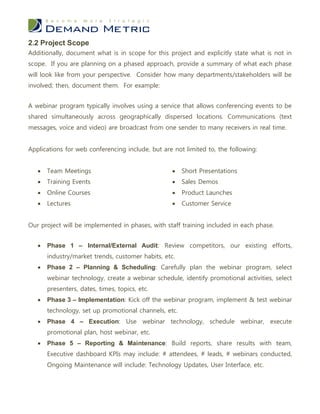
2.2 Project Scope
Additionally, document what is in scope for this project and explicitly state what is not in
scope. If you are planning on a phased approach, provide a summary of what each phase
will look like from your perspective. Consider how many departments/stakeholders will be
involved; then, document them. For example:


A webinar program typically involves using a service that allows conferencing events to be
shared simultaneously across geographically dispersed locations. Communications (text
messages, voice and video) are broadcast from one sender to many receivers in real time.


Applications for web conferencing include, but are not limited to, the following:


      Team Meetings                                  Short Presentations
      Training Events                                Sales Demos
      Online Courses                                 Product Launches
      Lectures                                       Customer Service


Our project will be implemented in phases, with staff training included in each phase.


      Phase 1 – Internal/External Audit: Review competitors, our existing efforts,
       industry/market trends, customer habits, etc.
      Phase 2 – Planning & Scheduling: Carefully plan the webinar program, select
       webinar technology, create a webinar schedule, identify promotional activities, select
       presenters, dates, times, topics, etc.
      Phase 3 – Implementation: Kick off the webinar program, implement & test webinar
       technology, set up promotional channels, etc.
      Phase 4 – Execution: Use webinar technology, schedule webinar, execute
       promotional plan, host webinar, etc.
      Phase 5 – Reporting & Maintenance: Build reports, share results with team,
       Executive dashboard KPIs may include: # attendees, # leads, # webinars conducted,
       Ongoing Maintenance will include: Technology Updates, User Interface, etc.
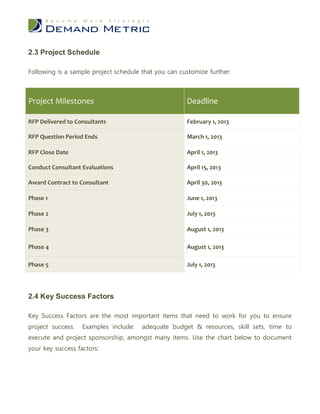
2.3 Project Schedule

Following is a sample project schedule that you can customize further:


Project Milestones                                    Deadline

RFP Delivered to Consultants                          February 1, 2013

RFP Question Period Ends                              March 1, 2013

RFP Close Date                                        April 1, 2013

Conduct Consultant Evaluations                        April 15, 2013

Award Contract to Consultant                          April 30, 2013

Phase 1                                               June 1, 2013

Phase 2                                               July 1, 2013

Phase 3                                               August 1, 2013

Phase 4                                               August 1, 2013

Phase 5                                               July 1, 2013


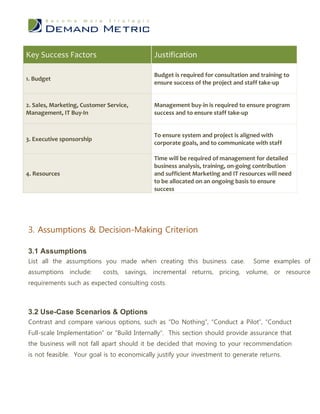
2.4 Key Success Factors

Key Success Factors are the most important items that need to work for you to ensure
project success.   Examples include:   adequate budget & resources, skill sets, time to
execute and project sponsorship, amongst many items. Use the chart below to document
your key success factors:
Key Success Factors                         Justification

                                            Budget is required for consultation and training to
1. Budget
                                            ensure success of the project and staff take-up


2. Sales, Marketing, Customer Service,      Management buy-in is required to ensure program
Management, IT Buy-In                       success and to ensure staff take-up


                                            To ensure system and project is aligned with
3. Executive sponsorship
                                            corporate goals, and to communicate with staff

                                            Time will be required of management for detailed
                                            business analysis, training, on-going contribution
4. Resources                                and sufficient Marketing and IT resources will need
                                            to be allocated on an ongoing basis to ensure
                                            success


3. Assumptions & Decision-Making Criterion

3.1 Assumptions
List all the assumptions you made when creating this business case.              Some examples of
assumptions include:        costs, savings, incremental returns, pricing, volume, or resource
requirements such as expected consulting costs.


3.2 Use-Case Scenarios & Options
Contrast and compare various options, such as “Do Nothing”, “Conduct a Pilot”, “Conduct
Full-scale Implementation” or “Build Internally”. This section should provide assurance that
the business will not fall apart should it be decided that moving to your recommendation
is not feasible. Your goal is to economically justify your investment to generate returns.
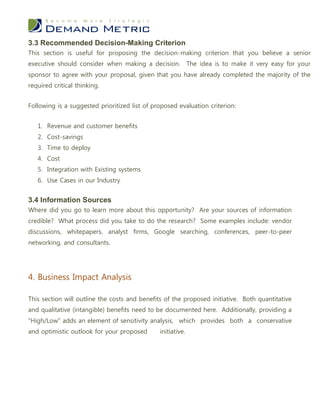
3.3 Recommended Decision-Making Criterion
This section is useful for proposing the decision-making criterion that you believe a senior
executive should consider when making a decision.            The idea is to make it very easy for your
sponsor to agree with your proposal, given that you have already completed the majority of the
required critical thinking.


Following is a suggested prioritized list of proposed evaluation criterion:


   1. Revenue and customer benefits
   2. Cost-savings
   3. Time to deploy
   4. Cost
   5. Integration with Existing systems
   6. Use Cases in our Industry


3.4 Information Sources
Where did you go to learn more about this opportunity? Are your sources of information
credible? What process did you take to do the research? Some examples include: vendor
discussions, whitepapers, analyst firms, Google searching, conferences, peer-to-peer
networking, and consultants.


4. Business Impact Analysis

This section will outline the costs and benefits of the proposed initiative. Both quantitative
and qualitative (intangible) benefits need to be documented here. Additionally, providing a
“High/Low” adds an element of sensitivity analysis, which provides both a conservative
and optimistic outlook for your proposed       initiative.
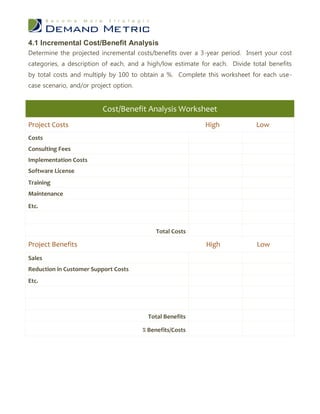
4.1 Incremental Cost/Benefit Analysis
Determine the projected incremental costs/benefits over a 3-year period. Insert your cost
categories, a description of each, and a high/low estimate for each. Divide total benefits
by total costs and multiply by 100 to obtain a %. Complete this worksheet for each use-
case scenario, and/or project option.


                          Cost/Benefit Analysis Worksheet
Project Costs                                               High             Low
Costs
Consulting Fees
Implementation Costs
Software License
Training
Maintenance
Etc.


                                            Total Costs

Project Benefits                                            High              Low
Sales
Reduction in Customer Support Costs
Etc.


                                          Total Benefits

                                        % Benefits/Costs
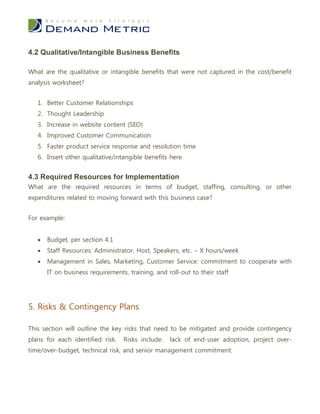
4.2 Qualitative/Intangible Business Benefits

What are the qualitative or intangible benefits that were not captured in the cost/benefit
analysis worksheet?


   1. Better Customer Relationships
   2. Thought Leadership
   3. Increase in website content (SEO)
   4. Improved Customer Communication
   5. Faster product service response and resolution time
   6. Insert other qualitative/intangible benefits here


4.3 Required Resources for Implementation
What are the required resources in terms of budget, staffing, consulting, or other
expenditures related to moving forward with this business case?


For example:


      Budget, per section 4.1
      Staff Resources: Administrator, Host, Speakers, etc. – X hours/week
      Management in Sales, Marketing, Customer Service: commitment to cooperate with
       IT on business requirements, training, and roll-out to their staff


5. Risks & Contingency Plans

This section will outline the key risks that need to be mitigated and provide contingency
plans for each identified risk.   Risks include:   lack of end-user adoption, project over-
time/over-budget, technical risk, and senior management commitment.
5.1 Key Risks to Mitigate

For example:


   1. Lack of senior management commitment
   2. Lack of end-user adoption
   3. Technical risk


5.2 Contingency Plans

What is the contingency plan for each of the preceding risks?


For example:


      To ensure commitment of managers in sales, marketing, and customer service
       departments, there will be a virtual committee/team formed for the Webinar
       Program. This team will be lead by X, and their job will be to identify specific
       business requirements, ensure two-way communication with staff, identify training
       requirements, and measure benefits gained.


      To ensure buy-in from staff, the committee will be responsible for establishing a
       communication and change plan with a phased implementation. Management will
       also communicate upcoming changes with staff, highlighting the benefits of using
       Webinar Program to staff and customers. After each phase of implementation, the
       group will gather feedback from the staff to incorporate updates or changes in the
       next phase.


      Ensuring our current IT infrastructure is compatible with the technology that has
       been selected.
6. Recommendation

What is your proposed course of action? Insert your recommendations here.


6.1 Action Plan

   1. Approve budget
   2. Approve staff resource allocation to project
   3. Approve formation of Webinar Program Management Committee to proceed with
      managing and reporting on the progress of the project

Webinar program business case template

  • 1.
    Webinar Program BusinessCase Purpose The purpose of this tool is to help you design a Business Case for an investment in a Webinar Program. A Business Case is a formal management communication document used to justify and plan a project or investment by providing an opportunity overview, key success factors, assumptions & decision-making criterion, business impact analysis, sensitivity analysis, risks, contingency plans, and action-oriented recommendations. How to Use this Template Complete the following sections with your project team and/or stakeholders. Cut & paste this information into a document that reflects your corporate image, and deliver your Business Case to senior executives to sponsor the project.
  • 2.
    Title Page [Insert Company Name or Logo] Business Case – (Company XYZ Webinar Program) [Insert Completion Date] Completed By: [Insert Project Manager Name] Completed For: [Insert Project Sponsor Name]
  • 3.
    Table of Contents 1.Executive Summary 5 1.1 What Problem does this Business Case solve? 2. Opportunity Overview & Key Success Factors 5 2.1 Opportunity Overview 2.2 Project Purpose 2.3 Project Scope 2.4 Project Schedule 2.5 Key Success Factors 3. Assumptions & Decision-Making Criterion 8 3.1 Assumptions 3.2 Use-case Scenarios & Options 3.3 Recommended Decision-Making Criterion 3.4 Information Sources & Research Methodology 4. Business Impact Analysis 9 4.1 Cost/Benefit Analysis 4.2 Qualitative/Intangible Business Benefits 4.3 Required Resources for Implementation 5. Risks & Contingency Plans 11 5.1 Key Risks to Mitigate 5.2 Contingency Plans 6. Recommendation 12 6.1 Action Plan
  • 4.
    1. Executive Summary 1.1 What Problems will the Webinar Program Solve? Provide a brief description of the problems that this webinar program business case was designed to solve. For example:  Budget Constraints  Prospect’s Resistance to Sales Calls  Lack of Thought Leadership  Content/Research Collaboration Issues  Limited End-User Reach  Declining Customer Satisfaction Scores (Communication)  Poor Product/Service Education 2. Opportunity Overview & Key Success Factors 2.1 Opportunity Overview & Project Purpose In this section, put a positive spin on the solution that you are recommending. Projects that clearly fit organizational goals are more likely to be supported so do your best to obtain buy-in from the project sponsor. Document your vision and identify the impact your solution will have on the organization. Provide examples from each key stakeholder perspective.  Senior management: Cost effective solution, thought leadership  Sales: More information on potential prospects, more receptive to sales call  Marketing: New website content, increase number of sales qualified leads  Product: Educate customers on new products, reduce support calls  IT: Minimal support required
  • 5.
    2.2 Project Scope Additionally,document what is in scope for this project and explicitly state what is not in scope. If you are planning on a phased approach, provide a summary of what each phase will look like from your perspective. Consider how many departments/stakeholders will be involved; then, document them. For example: A webinar program typically involves using a service that allows conferencing events to be shared simultaneously across geographically dispersed locations. Communications (text messages, voice and video) are broadcast from one sender to many receivers in real time. Applications for web conferencing include, but are not limited to, the following:  Team Meetings  Short Presentations  Training Events  Sales Demos  Online Courses  Product Launches  Lectures  Customer Service Our project will be implemented in phases, with staff training included in each phase.  Phase 1 – Internal/External Audit: Review competitors, our existing efforts, industry/market trends, customer habits, etc.  Phase 2 – Planning & Scheduling: Carefully plan the webinar program, select webinar technology, create a webinar schedule, identify promotional activities, select presenters, dates, times, topics, etc.  Phase 3 – Implementation: Kick off the webinar program, implement & test webinar technology, set up promotional channels, etc.  Phase 4 – Execution: Use webinar technology, schedule webinar, execute promotional plan, host webinar, etc.  Phase 5 – Reporting & Maintenance: Build reports, share results with team, Executive dashboard KPIs may include: # attendees, # leads, # webinars conducted, Ongoing Maintenance will include: Technology Updates, User Interface, etc.
  • 6.
    2.3 Project Schedule Followingis a sample project schedule that you can customize further: Project Milestones Deadline RFP Delivered to Consultants February 1, 2013 RFP Question Period Ends March 1, 2013 RFP Close Date April 1, 2013 Conduct Consultant Evaluations April 15, 2013 Award Contract to Consultant April 30, 2013 Phase 1 June 1, 2013 Phase 2 July 1, 2013 Phase 3 August 1, 2013 Phase 4 August 1, 2013 Phase 5 July 1, 2013 2.4 Key Success Factors Key Success Factors are the most important items that need to work for you to ensure project success. Examples include: adequate budget & resources, skill sets, time to execute and project sponsorship, amongst many items. Use the chart below to document your key success factors:
  • 7.
    Key Success Factors Justification Budget is required for consultation and training to 1. Budget ensure success of the project and staff take-up 2. Sales, Marketing, Customer Service, Management buy-in is required to ensure program Management, IT Buy-In success and to ensure staff take-up To ensure system and project is aligned with 3. Executive sponsorship corporate goals, and to communicate with staff Time will be required of management for detailed business analysis, training, on-going contribution 4. Resources and sufficient Marketing and IT resources will need to be allocated on an ongoing basis to ensure success 3. Assumptions & Decision-Making Criterion 3.1 Assumptions List all the assumptions you made when creating this business case. Some examples of assumptions include: costs, savings, incremental returns, pricing, volume, or resource requirements such as expected consulting costs. 3.2 Use-Case Scenarios & Options Contrast and compare various options, such as “Do Nothing”, “Conduct a Pilot”, “Conduct Full-scale Implementation” or “Build Internally”. This section should provide assurance that the business will not fall apart should it be decided that moving to your recommendation is not feasible. Your goal is to economically justify your investment to generate returns.
  • 8.
    3.3 Recommended Decision-MakingCriterion This section is useful for proposing the decision-making criterion that you believe a senior executive should consider when making a decision. The idea is to make it very easy for your sponsor to agree with your proposal, given that you have already completed the majority of the required critical thinking. Following is a suggested prioritized list of proposed evaluation criterion: 1. Revenue and customer benefits 2. Cost-savings 3. Time to deploy 4. Cost 5. Integration with Existing systems 6. Use Cases in our Industry 3.4 Information Sources Where did you go to learn more about this opportunity? Are your sources of information credible? What process did you take to do the research? Some examples include: vendor discussions, whitepapers, analyst firms, Google searching, conferences, peer-to-peer networking, and consultants. 4. Business Impact Analysis This section will outline the costs and benefits of the proposed initiative. Both quantitative and qualitative (intangible) benefits need to be documented here. Additionally, providing a “High/Low” adds an element of sensitivity analysis, which provides both a conservative and optimistic outlook for your proposed initiative.
  • 9.
    4.1 Incremental Cost/BenefitAnalysis Determine the projected incremental costs/benefits over a 3-year period. Insert your cost categories, a description of each, and a high/low estimate for each. Divide total benefits by total costs and multiply by 100 to obtain a %. Complete this worksheet for each use- case scenario, and/or project option. Cost/Benefit Analysis Worksheet Project Costs High Low Costs Consulting Fees Implementation Costs Software License Training Maintenance Etc. Total Costs Project Benefits High Low Sales Reduction in Customer Support Costs Etc. Total Benefits % Benefits/Costs
  • 10.
    4.2 Qualitative/Intangible BusinessBenefits What are the qualitative or intangible benefits that were not captured in the cost/benefit analysis worksheet? 1. Better Customer Relationships 2. Thought Leadership 3. Increase in website content (SEO) 4. Improved Customer Communication 5. Faster product service response and resolution time 6. Insert other qualitative/intangible benefits here 4.3 Required Resources for Implementation What are the required resources in terms of budget, staffing, consulting, or other expenditures related to moving forward with this business case? For example:  Budget, per section 4.1  Staff Resources: Administrator, Host, Speakers, etc. – X hours/week  Management in Sales, Marketing, Customer Service: commitment to cooperate with IT on business requirements, training, and roll-out to their staff 5. Risks & Contingency Plans This section will outline the key risks that need to be mitigated and provide contingency plans for each identified risk. Risks include: lack of end-user adoption, project over- time/over-budget, technical risk, and senior management commitment.
  • 11.
    5.1 Key Risksto Mitigate For example: 1. Lack of senior management commitment 2. Lack of end-user adoption 3. Technical risk 5.2 Contingency Plans What is the contingency plan for each of the preceding risks? For example:  To ensure commitment of managers in sales, marketing, and customer service departments, there will be a virtual committee/team formed for the Webinar Program. This team will be lead by X, and their job will be to identify specific business requirements, ensure two-way communication with staff, identify training requirements, and measure benefits gained.  To ensure buy-in from staff, the committee will be responsible for establishing a communication and change plan with a phased implementation. Management will also communicate upcoming changes with staff, highlighting the benefits of using Webinar Program to staff and customers. After each phase of implementation, the group will gather feedback from the staff to incorporate updates or changes in the next phase.  Ensuring our current IT infrastructure is compatible with the technology that has been selected.
  • 12.
    6. Recommendation What isyour proposed course of action? Insert your recommendations here. 6.1 Action Plan 1. Approve budget 2. Approve staff resource allocation to project 3. Approve formation of Webinar Program Management Committee to proceed with managing and reporting on the progress of the project