Iayn G Clark
International Strategic Management
Clients: examples of current & past



















Advanced Recognition Ltd (software)
AFA Polytek BV (plastics)
Alucanco Greece SA (cans)
Avis Rent a Car SpA, SA, GmbH & Ltd
BankAmerica
Barclays Bank
Bradford & Bingley
Bran & Luebbe GmbH (controls)
Citigroup
Coca Cola Ltd
Deloittes
Encom Ltd (cable TV)
Exide Ltd, SA & SA (batteries)
Franklin GmbH and Ltd (elect. publish)
Gifi SA (retail)
Imation BV (medical/IT ex 3M)
Klopman International SpA (fabrics)
La Casera SA (bottling)

 Lansing Ltd, SA & BV (Hyster and Yale
forklifts)
 Mannesmann GmbH (various)
 MBNA
 Peak Technologies Ltd (data capture)
 Pistern Bully GmbH (snowploughs)
 Purolite Ltd (chemicals)
 Scarman Trust
 Stanlake Search
 Sunrise software
 Stelax Inc (steel)
 Terra Nitrogen Ltd. (fertilices, ex ICI)
 UCA
 Uniroyal Srl BV, & Inc. (herbicides)
 Valentec Ltd & GmbH (airbags)
 Vibac SpA (adhesive tapes)
 Valentec Ltd (armaments)
 Zephyr Ltd (car components)
His story
His story
Her story
His story
Her story
His story
His story
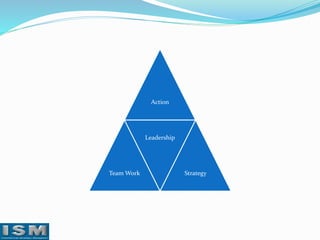
Action

Leadership

Team Work

Strategy
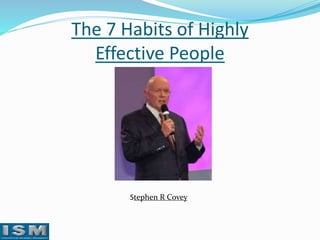
The 7 Habits of Highly
Effective People

Stephen R Covey
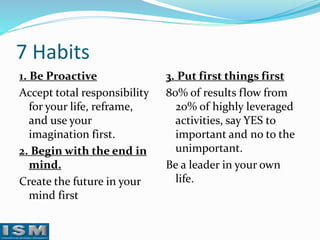
7 Habits
1. Be Proactive
Accept total responsibility
for your life, reframe,
and use your
imagination first.
2. Begin with the end in
mind.
Create the future in your
mind first

3. Put first things first
80% of results flow from
20% of highly leveraged
activities, say YES to
important and no to the
unimportant.
Be a leader in your own
life.
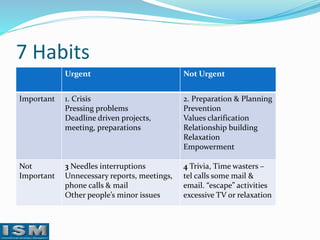
7 Habits
Urgent

Not Urgent

Important

1. Crisis
Pressing problems
Deadline driven projects,
meeting, preparations

2. Preparation & Planning
Prevention
Values clarification
Relationship building
Relaxation
Empowerment

Not
Important

3 Needles interruptions
Unnecessary reports, meetings,
phone calls & mail
Other people’s minor issues

4 Trivia, Time wasters –
tel calls some mail &
email. “escape” activities
excessive TV or relaxation
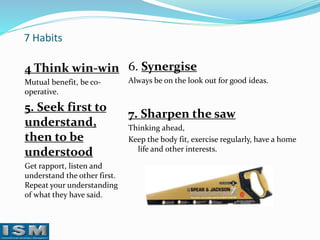
7 Habits

4 Think win-win 6. Synergise
Mutual benefit, be cooperative.

5. Seek first to
understand,
then to be
understood
Get rapport, listen and
understand the other first.
Repeat your understanding
of what they have said.

Always be on the look out for good ideas.

7. Sharpen the saw
Thinking ahead,
Keep the body fit, exercise regularly, have a home
life and other interests.
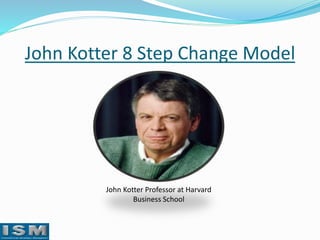
John Kotter 8 Step Change Model

John Kotter Professor at Harvard
Business School
Step One: Create Urgency
 Identify potential threats.
 Examine opportunities.
 Start honest discussions.

 Request support from others.
Step Two: Form a Powerful
Coalition
 Identify the true leaders.
 Get emotional commitment from these key people.
 Work on team building.

 Check your team for weak areas.
 Ensure that you have a good mix of people.
Step Three:
Create a Vision for Change
 Review the values that are central to the change.
 Captures what you "see" as the future of your

organization.
 Create a strategy to execute that vision.
 Ensure team knows the vision.
 Practice your "vision speech" often.
Step Four: Communicate the
Vision
 Talk often about your change vision.
 Address peoples' concerns and anxieties.
 Apply your vision to all aspects of operations

 Lead by example.
Step Five: Remove Obstacles
 Identify or hire change leaders.
 Ensure organisational structure is in line with your

vision.
 Recognize and reward people for making change
happen.
 Identify people who are resisting the change, and help
them see what's needed.
 Take action to quickly remove barriers (human or
otherwise).
Step Six: Create Short-term Wins
 Look for quick wins.
 Avoid early targets that are expensive.
 Analyse the potential pros and cons of your targets.

 Reward the people who help you meet the targets.
Step Seven: Build on the Change
 After every win, analyse what went right and what

needs improving.
 Set goals to continue building on the momentum
you've achieved.
 Ensure continuous improvement (Kaizen).
 Keep ideas fresh by bringing in new change agents and
leaders for your change coalition.
Step Eight: Anchor the Changes in
Corporate Culture
 Talk about progress every chance you get.
 Tell success stories about the change process,
 Include the change ideals and values when hiring and

training new staff.
 Publicly recognize key members of your original
change coalition.
 Create plans to replace key leaders of change.
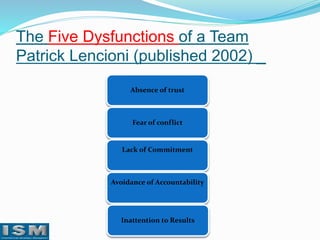
The Five Dysfunctions of a Team
Patrick Lencioni (published 2002) _
Absence of trust

Fear of conflict

Lack of Commitment

Avoidance of Accountability

Inattention to Results
1. Absence of Trust
 Need a certain comfort level in the team
 Willing to be vulnerable with one another
 Willing to admit their mistakes and weaknesses,

 Able to ask for help
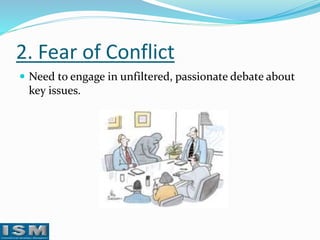
2. Fear of Conflict
 Need to engage in unfiltered, passionate debate about

key issues.
3. Lack of Commitment
 Need to be part of the decision making process.
 Resolve conflicts.
 Commit to a clear plan of action.
4. Avoidance of Accountability
 Need peer-to-peer accountability.
5. Inattention to Results
 Results monitored regularly.
 Avoid individual ego and recognition becoming more

important than collective team results.
The Rewards
 Competitive advantages.
 More accomplished in less time.
 Make higher quality decisions.

 Stick to those decisions by eliminating politics and

confusion.
 Employees feel more job satisfaction.
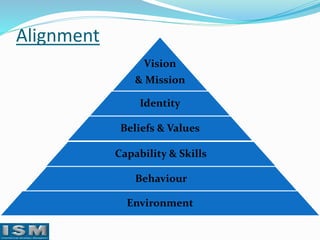
Alignment
Vision
& Mission
Identity
Vision
Beliefs & Values
Capability & Skills
Behaviour
Environment
Getting staff to improve performance:
1. They don’t know how.
2. They don’t know why.
3. They didn’t know they should.
4. They can’t (lack of resources).
5. Too painful (or uncomfortable).
6. No consequences.
7. “My way is best”
8. It is not what they do.
The study: 1,100 companies were examined, 180 questions each
Results: 3 factors found to highly correlated (statistically with a
chi-squared test for significance of 0.997).
What three factors were found which lead to excellence?
CEO skill, style, vision or brilliance, Brilliant product, 1st class
marketing – none of these
Strategy, a word of military origin,
refers to a plan of action designed to
achieve a particular goal
Vincent Lombardi
Teams do not go physically flat, they go
mentally stale.
Transformational Leadership
“The goal of transformational leadership is to transform
people and organisations in the literal sense – to change
them in mind and heart; enlarge vision, insight and
understanding; clarify purpose; make behaviour congruent
with beliefs and principles or values; and bring about
changes that are permanent, self-perpetuating and
momentum building”.
Steven Covey
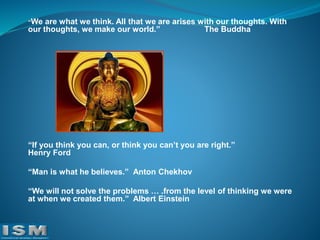
“We

are what we think. All that we are arises with our thoughts. With
our thoughts, we make our world.”
The Buddha

“If you think you can, or think you can’t you are right.”
Henry Ford
“Man is what he believes.” Anton Chekhov

“We will not solve the problems … .from the level of thinking we were
at when we created them.” Albert Einstein
“Until

one is committed, there is
hesitancy, the chance to draw back,
always ineffectiveness. Concerning all
acts of initiative (and creation), there is
one elementary truth the ignorance of
which kills countless ideas and splendid
plans: that the moment one definitely
commits oneself, then Providence
moves too”. - Goethe
References.
 John Kotter A professor at Harvard Business





School 8 Step Change Model
The Five Dysfunctions of a Team by Patrick
Lencioni (published 2002)
Stephen R Covey The 7 Habits of Highly Effective
People
Alignment: Bertrand Russell, Gregory Bateson,
Robert Dilts & Todd Epstein
SWOT analysis Albert Humphrey
Thank you for your interest

Contact details:
International Strategic Management Limited
Telephone: (44) (0) 20 7183 5164
Email: iayngclark@ismuk.com
Website: www.ismuk.com

Business transformation workshop feb 2014

  • 1.
    Iayn G Clark InternationalStrategic Management
  • 2.
    Clients: examples ofcurrent & past                   Advanced Recognition Ltd (software) AFA Polytek BV (plastics) Alucanco Greece SA (cans) Avis Rent a Car SpA, SA, GmbH & Ltd BankAmerica Barclays Bank Bradford & Bingley Bran & Luebbe GmbH (controls) Citigroup Coca Cola Ltd Deloittes Encom Ltd (cable TV) Exide Ltd, SA & SA (batteries) Franklin GmbH and Ltd (elect. publish) Gifi SA (retail) Imation BV (medical/IT ex 3M) Klopman International SpA (fabrics) La Casera SA (bottling)  Lansing Ltd, SA & BV (Hyster and Yale forklifts)  Mannesmann GmbH (various)  MBNA  Peak Technologies Ltd (data capture)  Pistern Bully GmbH (snowploughs)  Purolite Ltd (chemicals)  Scarman Trust  Stanlake Search  Sunrise software  Stelax Inc (steel)  Terra Nitrogen Ltd. (fertilices, ex ICI)  UCA  Uniroyal Srl BV, & Inc. (herbicides)  Valentec Ltd & GmbH (airbags)  Vibac SpA (adhesive tapes)  Valentec Ltd (armaments)  Zephyr Ltd (car components)
  • 3.
  • 4.
  • 5.
  • 6.
  • 7.
  • 8.
  • 9.
  • 10.
  • 11.
    The 7 Habitsof Highly Effective People Stephen R Covey
  • 12.
    7 Habits 1. BeProactive Accept total responsibility for your life, reframe, and use your imagination first. 2. Begin with the end in mind. Create the future in your mind first 3. Put first things first 80% of results flow from 20% of highly leveraged activities, say YES to important and no to the unimportant. Be a leader in your own life.
  • 13.
    7 Habits Urgent Not Urgent Important 1.Crisis Pressing problems Deadline driven projects, meeting, preparations 2. Preparation & Planning Prevention Values clarification Relationship building Relaxation Empowerment Not Important 3 Needles interruptions Unnecessary reports, meetings, phone calls & mail Other people’s minor issues 4 Trivia, Time wasters – tel calls some mail & email. “escape” activities excessive TV or relaxation
  • 14.
    7 Habits 4 Thinkwin-win 6. Synergise Mutual benefit, be cooperative. 5. Seek first to understand, then to be understood Get rapport, listen and understand the other first. Repeat your understanding of what they have said. Always be on the look out for good ideas. 7. Sharpen the saw Thinking ahead, Keep the body fit, exercise regularly, have a home life and other interests.
  • 15.
    John Kotter 8Step Change Model John Kotter Professor at Harvard Business School
  • 16.
    Step One: CreateUrgency  Identify potential threats.  Examine opportunities.  Start honest discussions.  Request support from others.
  • 17.
    Step Two: Forma Powerful Coalition  Identify the true leaders.  Get emotional commitment from these key people.  Work on team building.  Check your team for weak areas.  Ensure that you have a good mix of people.
  • 18.
    Step Three: Create aVision for Change  Review the values that are central to the change.  Captures what you "see" as the future of your organization.  Create a strategy to execute that vision.  Ensure team knows the vision.  Practice your "vision speech" often.
  • 19.
    Step Four: Communicatethe Vision  Talk often about your change vision.  Address peoples' concerns and anxieties.  Apply your vision to all aspects of operations  Lead by example.
  • 20.
    Step Five: RemoveObstacles  Identify or hire change leaders.  Ensure organisational structure is in line with your vision.  Recognize and reward people for making change happen.  Identify people who are resisting the change, and help them see what's needed.  Take action to quickly remove barriers (human or otherwise).
  • 21.
    Step Six: CreateShort-term Wins  Look for quick wins.  Avoid early targets that are expensive.  Analyse the potential pros and cons of your targets.  Reward the people who help you meet the targets.
  • 22.
    Step Seven: Buildon the Change  After every win, analyse what went right and what needs improving.  Set goals to continue building on the momentum you've achieved.  Ensure continuous improvement (Kaizen).  Keep ideas fresh by bringing in new change agents and leaders for your change coalition.
  • 23.
    Step Eight: Anchorthe Changes in Corporate Culture  Talk about progress every chance you get.  Tell success stories about the change process,  Include the change ideals and values when hiring and training new staff.  Publicly recognize key members of your original change coalition.  Create plans to replace key leaders of change.
  • 24.
    The Five Dysfunctionsof a Team Patrick Lencioni (published 2002) _ Absence of trust Fear of conflict Lack of Commitment Avoidance of Accountability Inattention to Results
  • 25.
    1. Absence ofTrust  Need a certain comfort level in the team  Willing to be vulnerable with one another  Willing to admit their mistakes and weaknesses,  Able to ask for help
  • 26.
    2. Fear ofConflict  Need to engage in unfiltered, passionate debate about key issues.
  • 27.
    3. Lack ofCommitment  Need to be part of the decision making process.  Resolve conflicts.  Commit to a clear plan of action.
  • 28.
    4. Avoidance ofAccountability  Need peer-to-peer accountability.
  • 29.
    5. Inattention toResults  Results monitored regularly.  Avoid individual ego and recognition becoming more important than collective team results.
  • 30.
    The Rewards  Competitiveadvantages.  More accomplished in less time.  Make higher quality decisions.  Stick to those decisions by eliminating politics and confusion.  Employees feel more job satisfaction.
  • 31.
    Alignment Vision & Mission Identity Vision Beliefs &Values Capability & Skills Behaviour Environment
  • 32.
    Getting staff toimprove performance: 1. They don’t know how. 2. They don’t know why. 3. They didn’t know they should. 4. They can’t (lack of resources). 5. Too painful (or uncomfortable). 6. No consequences. 7. “My way is best” 8. It is not what they do.
  • 33.
    The study: 1,100companies were examined, 180 questions each Results: 3 factors found to highly correlated (statistically with a chi-squared test for significance of 0.997). What three factors were found which lead to excellence? CEO skill, style, vision or brilliance, Brilliant product, 1st class marketing – none of these
  • 34.
    Strategy, a wordof military origin, refers to a plan of action designed to achieve a particular goal
  • 35.
    Vincent Lombardi Teams donot go physically flat, they go mentally stale.
  • 36.
    Transformational Leadership “The goalof transformational leadership is to transform people and organisations in the literal sense – to change them in mind and heart; enlarge vision, insight and understanding; clarify purpose; make behaviour congruent with beliefs and principles or values; and bring about changes that are permanent, self-perpetuating and momentum building”. Steven Covey
  • 37.
    “We are what wethink. All that we are arises with our thoughts. With our thoughts, we make our world.” The Buddha “If you think you can, or think you can’t you are right.” Henry Ford “Man is what he believes.” Anton Chekhov “We will not solve the problems … .from the level of thinking we were at when we created them.” Albert Einstein
  • 38.
    “Until one is committed,there is hesitancy, the chance to draw back, always ineffectiveness. Concerning all acts of initiative (and creation), there is one elementary truth the ignorance of which kills countless ideas and splendid plans: that the moment one definitely commits oneself, then Providence moves too”. - Goethe
  • 39.
    References.  John KotterA professor at Harvard Business     School 8 Step Change Model The Five Dysfunctions of a Team by Patrick Lencioni (published 2002) Stephen R Covey The 7 Habits of Highly Effective People Alignment: Bertrand Russell, Gregory Bateson, Robert Dilts & Todd Epstein SWOT analysis Albert Humphrey
  • 40.
    Thank you foryour interest Contact details: International Strategic Management Limited Telephone: (44) (0) 20 7183 5164 Email: iayngclark@ismuk.com Website: www.ismuk.com