Random Graphs & Graph Randomization Procedures
Measuring Networks: Connectivity
Reachability x Volume  Phase Transitions
Random Graphs & Graph Randomization
1) Intro: Purpose?
2) Basic Random Graphs
1) Erdos Random Graphs
2) Degree Constrained
3) General constraints: set of all graphs that…
4) Algorithmic approaches
3) Random graph applications
1) Connectivity
2) Small Worlds
3) Triad Distributions
4) Simulations
4) Measurement uncertainty
1) Bootstrap SEs
5) Permutation Models
1) QAP
2) Peer Influence Models
6) Latent Space Models
Introduction to Random & Stochastic
Why random graphs?
Inference:
• Network inference differs from many of the inference problems we are used to.
• We have the population (by assumption)
• Want to know what the process underlying network formation might be
• Random graphs thus create one (reasonable?) comparison group.
• Common association tests (correlations, regressions, etc.) assume case
independence; randomization provides a non-parametric way to evaluate
statistical significance.
• Sampling: There are few well-established ways to partially sample a network;
random graph tools are making that possible.
Introduction to Random & Stochastic
Why random graphs?
Simulation:
We often want to test measures, models or methods on a large collection of networks
with known properties.
• Purely random graphs have very well-known mathematical properties
• By adding random information to networks with known properties, we can bridge
data-collection gaps
• Models are at the state now that we can often infer global network structure from
network samples
Introduction to Random & Stochastic
Simple Random Graphs
Erdős-Renyi graphs
Simplest random graph: given a graph of n nodes, assume all edges have equal
probability of being present.
Or
A graph chosen at random from the set of all graphs with N nodes and M edges.
Number of unique undirected graph patterns by number of nodes
Enumeration is
impossible…so we
use construction
rules that ensure
even probability of
all graphs in the
space.
* Note a subtle difference here: the G(N,P) model will have random variability in number of edges due to random chance…ignorable in limit of
large networks.
In a Erdos random graph - each dyad has the same probability of being tied –so algorithm is a simple
coin-flip on each dyad.*
degree will be Poisson distributed, and the nodes with high degree are likely to be at the intuitive
center.
Introduction to Random & Stochastic
Simple Random Graphs
Simple Bernoulli graph with 1000 nodes and average degree=2.4  p=0.0024.
Introduction to Random & Stochastic
Simple Random Graphs
Network connectivity
changes rapidly as a
function of network
volume.
In a purely random
network, when the
average degree is <1,
the network is always
disconnected. When it
is >2, there is a “giant
component” that takes
up most of the network.
Note that this is
dependent on mean
degree, so applies to
networks of any size.
Average Degree
Introduction to Random & Stochastic
Simple Random Graphs
Introduction to Random & Stochastic
Simple Random Graphs
Because random graphs are so well-known, we know exactly what expected values
are for many features…
Compare randomly
generated to expected
Introduction to Random & Stochastic
Simple Random Graphs
Because random graphs are so well-known, we know exactly what expected values
are for many features…
Introduction to Random & Stochastic
Less Simple Random Graphs…
Simple random is a very poor model for real life, so not really a fair null.
Imagine you know the mixing by category in a network, you can use that to
generate a network that has correct probability by mixing category:
mixprob
wht blk oth
wht .0096 .0016 .0065
blk .0013 .0085 .0045
oth .0054 .0045 .0067
…so generate a random
graph with similar mixing
probability
Observed
Introduction to Random & Stochastic
Less Simple Random Graphs…
Simple random is a very poor model for real life, so not really a fair null.
Imagine you know the mixing by category in a network, you can use that to
generate a network that has correct probability by mixing category:
mixprob
wht blk oth
wht .0096 .0016 .0065
blk .0013 .0085 .0045
oth .0054 .0045 .0067
…so generate a random
graph with similar mixing
probability
Random
Introduction to Random & Stochastic
Less Simple Random Graphs…
Simple random is a very poor model for real life, so not really a fair null.
Imagine you know the mixing by category in a network, you can use that to
generate a network that has correct probability by mixing category:
mixprob
wht blk oth
wht .0096 .0016 .0065
blk .0013 .0085 .0045
oth .0054 .0045 .0067
…so generate a random
graph with similar mixing
probability
Degree distributions
don’t match
Simple random is a very poor model for real life, so not really a fair null.
Imagine you know the mixing by category in a network, you can use that to
generate a network that has correct probability by mixing category:
Introduction to Random & Stochastic
Less Simple Random Graphs…
We can condition on more features – degree distribution, dyad distribution, mixing…
These can take us a long ways towards getting a reasonable null.
Some are easy:
-fixing just the in-degree OR the out-degree  random selection on row/col
- fixing both in & out: a “zipper” method
- generate a set of half-edges for each node’s degree, randomly sort, put back
together
Edge-matching random permutation
Can easily generate networks with appropriate degree
distributions by generating “edge stems” and sorting:
a
Degree:
1: 2
2: 2
3: 1
b
di=1
c
c
di=2
d
d
f
f
di=3
f
(need to ensure you have a valid edge list!)
Introduction to Random & Stochastic
Less Simple Random Graphs…
Introduction to Random & Stochastic
Less Simple Random Graphs…
PAJEK gives you the unconditional expected values:
------------------------------------------------------------------------------
Triadic Census 2. i:peoplejwms884homeworkprison.net (67)
------------------------------------------------------------------------------
Working...
----------------------------------------------------------------------------
Type Number of triads (ni) Expected (ei) (ni-ei)/ei
----------------------------------------------------------------------------
1 - 003 39221 37227.47 0.05
2 - 012 5860 9587.83 -0.39
3 - 102 2336 205.78 10.35
4 - 021D 61 205.78 -0.70
5 - 021U 80 205.78 -0.61
6 - 021C 103 411.55 -0.75
7 - 111D 105 17.67 4.94
8 - 111U 69 17.67 2.91
9 - 030T 13 17.67 -0.26
10 - 030C 1 5.89 -0.83
11 - 201 12 0.38 30.65
12 - 120D 15 0.38 38.56
13 - 120U 7 0.38 17.46
14 - 120C 5 0.76 5.59
15 - 210 12 0.03 367.67
16 - 300 5 0.00 21471.04
----------------------------------------------------------------------------
Chi-Square: 137414.3919***
6 cells (37.50%) have expected frequencies less than 5.
The minimum expected cell frequency is 0.00.
Introduction to Random & Stochastic
Less Simple Random Graphs…
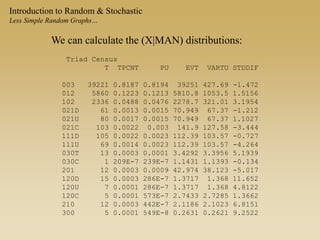
We can calculate the (X|MAN) distributions:
Triad Census
T TPCNT PU EVT VARTU STDDIF
003 39221 0.8187 0.8194 39251 427.69 -1.472
012 5860 0.1223 0.1213 5810.8 1053.5 1.5156
102 2336 0.0488 0.0476 2278.7 321.01 3.1954
021D 61 0.0013 0.0015 70.949 67.37 -1.212
021U 80 0.0017 0.0015 70.949 67.37 1.1027
021C 103 0.0022 0.003 141.9 127.58 -3.444
111D 105 0.0022 0.0023 112.39 103.57 -0.727
111U 69 0.0014 0.0023 112.39 103.57 -4.264
030T 13 0.0003 0.0001 3.4292 3.3956 5.1939
030C 1 209E-7 239E-7 1.1431 1.1393 -0.134
201 12 0.0003 0.0009 42.974 38.123 -5.017
120D 15 0.0003 286E-7 1.3717 1.368 11.652
120U 7 0.0001 286E-7 1.3717 1.368 4.8122
120C 5 0.0001 573E-7 2.7433 2.7285 1.3662
210 12 0.0003 442E-7 2.1186 2.1023 6.8151
300 5 0.0001 549E-8 0.2631 0.2621 9.2522
Introduction to Random & Stochastic
Less Simple Random Graphs…
Network Sub-Structure: Triads
003
(0)
012
(1)
102
021D
021U
021C
(2)
111D
111U
030T
030C
(3)
201
120D
120U
120C
(4)
210
(5)
300
(6)
Intransitive
Transitive
Mixed
Introduction to Random & Stochastic
Applications
An Example of the triad census
Type Number of triads
---------------------------------------
1 - 003 21
---------------------------------------
2 - 012 26
3 - 102 11
4 - 021D 1
5 - 021U 5
6 - 021C 3
7 - 111D 2
8 - 111U 5
9 - 030T 3
10 - 030C 1
11 - 201 1
12 - 120D 1
13 - 120U 1
14 - 120C 1
15 - 210 1
16 - 300 1
---------------------------------------
Sum (2 - 16): 63
Introduction to Random & Stochastic
Applications
-100
0
100
200
300
400
t-value
Triad Census Distributions
Standardized Difference from Expected
Data from Add Health
012 102 021D 021U 021C 111D 111U 030T 030C 201 120D 120U 120C 210 300
Introduction to Random & Stochastic
Applications
As with undirected graphs, you can use the type of triads allowed
to characterize the total graph. But now the potential patterns are
much more diverse
1) All triads are 030T:
A perfect linear hierarchy.
Introduction to Random & Stochastic
Applications
Cluster Structure, allows triads: {003, 300, 102}
M M
N*
M M
N*
N* N*
N*
Eugene
Johnsen (1985,
1986) specifies
a number of
structures that
result from
various triad
configurations
1
1
1
1
Introduction to Random & Stochastic
Applications
PRC{300,102, 003, 120D, 120U, 030T, 021D, 021U} Ranked Cluster:
M M
N*
M M
N*
M
A*A*
A*A*
A*A*
A*A*
1
1
1
1
1
1
1
1
1
0
1
1
1
1 0
0
0
0 0 0 0
0 0
0 0
And many more...
Introduction to Random & Stochastic
Applications
Substantively, specifying a set of triads defines a behavioral mechanism,
and we can use the distribution of triads in a network to test whether the
hypothesized mechanism is active.
We do this by (1) counting the number of each triad type in a given
network and (2) comparing it to the expected number, given some random
distribution of ties in the network.
See Wasserman and Faust, Chapter 14 for computation details (and I have
code if you want) that will generate these distributions, if you so choose.
Introduction to Random & Stochastic
Applications
Triad:
003
012
102
021D
021U
021C
111D
111U
030T
030C
201
120D
120U
120C
210
300
BA
Triad Micro-Models:
BA: Ballance (Cartwright and Harary, ‘56) CL: Clustering Model (Davis. ‘67)
RC: Ranked Cluster (Davis & Leinhardt, ‘72) R2C: Ranked 2-Clusters (Johnsen, ‘85)
TR: Transitivity (Davis and Leinhardt, ‘71) HC: Hierarchical Cliques (Johnsen, ‘85)
39+: Model that fits D&L’s 742 mats N :39-72 p1-p4: Johnsen, 1986. Process Agreement
Models.
CL RC R2C TR HC 39+ p1 p2 p3 p4
Measuring Networks
Triads:
Structural Indices based on the distribution of triads
The observed distribution of triads can be fit to the hypothesized structures
using weighting vectors for each type of triad.
ll
μlTl
T
T


 )()(l
Where:
l = 16 element weighting vector for the triad types
T = the observed triad census
mT= the expected value of T
T = the variance-covariance matrix for T
Introduction to Random & Stochastic
Applications
For the Add Health data, the observed distribution of the tau statistic
for various models was:
Indicating that a ranked-cluster model fits the best.
Introduction to Random & Stochastic
Applications
Prosper
Introduction to Random & Stochastic
Applications
Travers and Milgram’s work on the small world is responsible for the
standard belief that “everyone is connected by a chain of about 6
steps.”
Two questions:
Given what we know about networks, what is the longest path (defined
by handshakes) that separates any two people?
Is 6 steps a long distance or a short distance?
Introduction to Random & Stochastic
Applications
If nobody’s contacts overlapped, we’d
reach everyone very quickly. Six would be
a large number.
If ties overlap at random…we’d reach each
other almost as quickly. Six would still be
a large number.
Is 6 steps a long distance or a short distance?
Introduction to Random & Stochastic
Applications
0
20%
40%
60%
80%
100%
PercentContacted
0 1 2 3 4 5 6 7 8 9 10 11 12 13 14 15
Remove
Degree = 4
Degree = 3
Degree = 2
Random Reachability:
By number of close friends
Introduction to Random & Stochastic
Applications
0
0.2
0.4
0.6
0.8
1
ProportionReached
0 1 2 3 4 5 6 7 8 9 10 11 12 13 14
Remove
"Pine Brook Jr. High"
Random graph
Observed
Introduction to Random & Stochastic
Applications
Milgram’s test: Send a packet from sets of randomly selected people to a stockbroker in
Boston
Random Boston
Random Nebraska
Boston Stockbrokers
Introduction to Random & Stochastic
Applications
Most chains found their way
through a small number of
intermediaries.
Understanding why this is true has
been called the “Small-World
Problem,” which has since been
generalized to a much more formal
understanding of tie patterns in large
networks.
For purposes of flow through graphs,
distance is a primary concern so long
as transmission is uncertain.
Introduction to Random & Stochastic
Applications
Based on Milgram’s (1967) famous
work, the substantive point is that
networks are structured such that
even when most of our
connections are local, any pair of
people can be connected by a
fairly small number of relational
steps.
Introduction to Random & Stochastic
Applications
Watts says there are 4 conditions that make the small world phenomenon
interesting:
1) The network is large - O(Billions)
2) The network is sparse - people are connected to a small fraction of
the total network
3) The network is decentralized -- no single (or small #) of stars
4) The network is highly clustered -- most friendship circles are
overlapping
Introduction to Random & Stochastic
Applications
Formally, we can characterize a graph through 2 statistics.
1) The characteristic path length, L
The average length of the shortest paths connecting
any two actors.
(note this only works for connected graphs)
2) The clustering coefficient, C
•Version 1: the average local density. That is, Cv =
ego-network density, and C = Cv/n
•Version 2: transitivity ratio. Number of closed triads
divided by the number of closed and open triads.
A small world graph is any graph with a relatively small L
and a relatively large C.
Introduction to Random & Stochastic
Applications
The most clustered graph is
Watt’s “Caveman” graph:
Compared to random
graphs, C is large and L is
long. The intuition, then, is
that clustered graphs tend to
have (relatively) long
characteristic path lengths.
The small world
phenomenon rests on the
opposite: high clustering
and short path distances.
How?
Introduction to Random & Stochastic
Applications
C=Large, L is
Small =
SW Graphs
Simulate networks
with a parameter (a)
that governs the
proportion of ties
that are clustered
compared to the
proportion that are
randomly
distributed across
the network:
Introduction to Random & Stochastic
Applications
Why does this work? Key is
fraction of shortcuts in the network
In a highly clustered, ordered
network, a single random
connection will create a shortcut
that lowers L dramatically
Watts demonstrates that
Small world graphs occur
in graphs with a small
number of shortcuts
Introduction to Random & Stochastic
Applications
How do we know if an observed graph fits the SW model?
Random expectations:
For basic one-mode networks (such as acquaintance nets), we can
get approximate random values for L and C as:
Lrandom ~ ln(n) / ln(k)
Crandom ~ k / n
As k and n get large.
Note that C essentially approaches zero as N increases, and K is assumed
fixed. This formula uses the density-based measure of C, but the
substantive implications are similar for the triad formula.
Introduction to Random & Stochastic
Applications
Reverse the random
graph problem,
given average tie
volume and
population size,
what’s the expected
size of a
subpopulation?
http://www.soc.duke.edu/~jmoody77/Hydra/scaleupcalc.htm
Introduction to Random & Stochastic
Applications
Comparing multiple networks: QAP
The substantive question is how one set of relations (or dyadic attributes) relates to
another.
For example:
• Do marriage ties correlate with business ties in the Medici family network?
• Are friendship relations correlated with joint membership in a club?
Introduction to Random & Stochastic
Using randomizations to avoid parametric assumptions
Assessing the correlation is straight forward, as we simply correlate each
corresponding cell of the two matrices:
Marriage
1 ACCIAIUOL 0 0 0 0 0 0 0 0 1 0 0 0 0 0 0 0
2 ALBIZZI 0 0 0 0 0 1 1 0 1 0 0 0 0 0 0 0
3 BARBADORI 0 0 0 0 1 0 0 0 1 0 0 0 0 0 0 0
4 BISCHERI 0 0 0 0 0 0 1 0 0 0 1 0 0 0 1 0
5 CASTELLAN 0 0 1 0 0 0 0 0 0 0 1 0 0 0 1 0
6 GINORI 0 1 0 0 0 0 0 0 0 0 0 0 0 0 0 0
7 GUADAGNI 0 1 0 1 0 0 0 1 0 0 0 0 0 0 0 1
8 LAMBERTES 0 0 0 0 0 0 1 0 0 0 0 0 0 0 0 0
9 MEDICI 1 1 1 0 0 0 0 0 0 0 0 0 1 1 0 1
10 PAZZI 0 0 0 0 0 0 0 0 0 0 0 0 0 1 0 0
11 PERUZZI 0 0 0 1 1 0 0 0 0 0 0 0 0 0 1 0
12 PUCCI 0 0 0 0 0 0 0 0 0 0 0 0 0 0 0 0
13 RIDOLFI 0 0 0 0 0 0 0 0 1 0 0 0 0 0 1 1
14 SALVIATI 0 0 0 0 0 0 0 0 1 1 0 0 0 0 0 0
15 STROZZI 0 0 0 1 1 0 0 0 0 0 1 0 1 0 0 0
16 TORNABUON 0 0 0 0 0 0 1 0 1 0 0 0 1 0 0 0
Business
1 0 0 0 0 0 0 0 0 0 0 0 0 0 0 0 0
2 0 0 0 0 0 0 0 0 0 0 0 0 0 0 0 0
3 0 0 0 0 1 1 0 0 1 0 1 0 0 0 0 0
4 0 0 0 0 0 0 1 1 0 0 1 0 0 0 0 0
5 0 0 1 0 0 0 0 1 0 0 1 0 0 0 0 0
6 0 0 1 0 0 0 0 0 1 0 0 0 0 0 0 0
7 0 0 0 1 0 0 0 1 0 0 0 0 0 0 0 0
8 0 0 0 1 1 0 1 0 0 0 1 0 0 0 0 0
9 0 0 1 0 0 1 0 0 0 1 0 0 0 1 0 1
10 0 0 0 0 0 0 0 0 1 0 0 0 0 0 0 0
11 0 0 1 1 1 0 0 1 0 0 0 0 0 0 0 0
12 0 0 0 0 0 0 0 0 0 0 0 0 0 0 0 0
13 0 0 0 0 0 0 0 0 0 0 0 0 0 0 0 0
14 0 0 0 0 0 0 0 0 1 0 0 0 0 0 0 0
15 0 0 0 0 0 0 0 0 0 0 0 0 0 0 0 0
16 0 0 0 0 0 0 0 0 1 0 0 0 0 0 0 0
Dyads:
1 2 0 0
1 3 0 0
1 4 0 0
1 5 0 0
1 6 0 0
1 7 0 0
1 8 0 0
1 9 1 0
1 10 0 0
1 11 0 0
1 12 0 0
1 13 0 0
1 14 0 0
1 15 0 0
1 16 0 0
2 1 0 0
2 3 0 0
2 4 0 0
2 5 0 0
2 6 1 0
2 7 1 0
2 8 0 0
2 9 1 0
2 10 0 0
2 11 0 0
2 12 0 0
2 13 0 0
2 14 0 0
2 15 0 0
2 16 0 0
Correlation:
1 0.3718679
0.3718679 1
Introduction to Random & Stochastic
Using randomizations to avoid parametric assumptions
But is the observed value statistically significant?
Can’t use standard inference, since the assumptions are violated. Instead, we use a
permutation approach.
Essentially, we are asking whether the observed correlation is large (small) compared
to that which we would get if the assignment of variables to nodes were random, but
the interdependencies within variables were maintained.
Do this by randomly sorting the rows and columns of the matrix, then re-estimating
the correlation.
Introduction to Random & Stochastic
Using randomizations to avoid parametric assumptions
Comparing multiple networks: QAP
When you permute, you have to permute both the rows and the columns
simultaneously to maintain the interdependencies in the data:
ID ORIG
A 0 1 2 3 4
B 0 0 1 2 3
C 0 0 0 1 2
D 0 0 0 0 1
E 0 0 0 0 0
Sorted
A 0 3 1 2 4
D 0 0 0 0 1
B 0 2 0 1 3
C 0 1 0 0 2
E 0 0 0 0 0
Introduction to Random & Stochastic
Using randomizations to avoid parametric assumptions
Procedure:
1. Calculate the observed correlation
2. for K iterations do:
a) randomly sort one of the matrices
b) recalculate the correlation
c) store the outcome
3. compare the observed correlation to the distribution of
correlations created by the random permutations.
Introduction to Random & Stochastic
Using randomizations to avoid parametric assumptions
Introduction to Random & Stochastic
Using randomizations to avoid parametric assumptions
QAP MATRIX CORRELATION
--------------------------------------------------------------------------------
Observed matrix: PadgBUS
Structure matrix: PadgMAR
# of Permutations: 2500
Random seed: 356
Univariate statistics
1 2
PadgBUS PadgMAR
------- -------
1 Mean 0.125 0.167
2 Std Dev 0.331 0.373
3 Sum 30.000 40.000
4 Variance 0.109 0.139
5 SSQ 30.000 40.000
6 MCSSQ 26.250 33.333
7 Euc Norm 5.477 6.325
8 Minimum 0.000 0.000
9 Maximum 1.000 1.000
10 N of Obs 240.000 240.000
Hubert's gamma: 16.000
Bivariate Statistics
1 2 3 4 5 6 7
Value Signif Avg SD P(Large) P(Small) NPerm
--------- --------- --------- --------- --------- --------- ---------
1 Pearson Correlation: 0.372 0.000 0.001 0.092 0.000 1.000 2500.000
2 Simple Matching: 0.842 0.000 0.750 0.027 0.000 1.000 2500.000
3 Jaccard Coefficient: 0.296 0.000 0.079 0.046 0.000 1.000 2500.000
4 Goodman-Kruskal Gamma: 0.797 0.000 -0.064 0.382 0.000 1.000 2500.000
5 Hamming Distance: 38.000 0.000 59.908 5.581 1.000 0.000 2500.000
This can be done
simply in UCINET
…
Also in R
Using the same logic,we can estimate alternative models, such as
regression, logits, probits, etc. Only complication is that you need
to permute all of the independent matrices in the same way each
iteration.
Introduction to Random & Stochastic
Using randomizations to avoid parametric assumptions
NODE ADJMAT SAMERCE SAMESEX
1 0 1 1 1 0 0 0 0 0 0 1 0 0 1 0 0 0 1 0 0 1 1 0 0 1 1 0
2 1 0 1 0 0 0 1 0 0 1 0 0 0 1 0 0 0 1 0 0 0 0 1 1 0 0 1
3 1 1 0 0 1 0 1 0 0 0 0 0 1 0 1 1 1 0 1 0 0 1 0 0 1 1 0
4 1 0 0 0 1 0 0 0 0 0 0 1 0 0 1 1 1 0 1 0 1 0 0 0 1 1 0
5 0 0 1 1 0 1 0 1 0 1 1 0 0 0 0 0 0 1 0 1 0 0 0 1 0 0 1
6 0 0 0 0 1 0 0 1 1 0 0 1 1 0 0 1 1 0 0 1 0 0 1 0 0 0 1
7 0 1 1 0 0 0 0 0 0 0 0 1 1 0 1 0 1 0 1 0 1 1 0 0 0 1 0
8 0 0 0 0 1 1 0 0 1 0 0 1 1 0 1 1 0 0 1 0 1 1 0 0 1 0 0
9 0 0 0 0 0 1 0 1 0 1 1 0 0 1 0 0 0 0 0 1 0 0 1 1 0 0 0
Introduction to Random & Stochastic
Using randomizations to avoid parametric assumptions
Distance (Dij=abs(Yi-Yj)
.000 .277 .228 .181 .278 .298 .095 .307 .481
.277 .000 .049 .096 .555 .575 .182 .584 .758
.228 .049 .000 .047 .506 .526 .134 .535 .710
.181 .096 .047 .000 .459 .479 .087 .488 .663
.278 .555 .506 .459 .000 .020 .372 .029 .204
.298 .575 .526 .479 .020 .000 .392 .009 .184
.095 .182 .134 .087 .372 .392 .000 .401 .576
.307 .584 .535 .488 .029 .009 .401 .000 .175
.481 .758 .710 .663 .204 .184 .576 .175 .000
Y
0.32
0.59
0.54
0.50
0.04
0.02
0.41
0.01
-0.17
Introduction to Random & Stochastic
Using randomizations to avoid parametric assumptions
# of permutations: 2000
Diagonal valid? NO
Random seed: 995
Dependent variable: EX_SIM
Expected values: C:moodyClassessoc884examplesUCINETmrqap-predicted
Independent variables: EX_SSEX
EX_SRCE
EX_ADJ
Number of valid observations among the X variables = 72
N = 72
Number of permutations performed: 1999
MODEL FIT
R-square Adj R-Sqr Probability # of Obs
-------- --------- ----------- -----------
0.289 0.269 0.059 72
REGRESSION COEFFICIENTS
Un-stdized Stdized Proportion Proportion
Independent Coefficient Coefficient Significance As Large As Small
----------- ----------- ----------- ------------ ----------- -----------
Intercept 0.460139 0.000000 0.034 0.034 0.966
EX_SSEX -0.073787 -0.170620 0.140 0.860 0.140
EX_SRCE -0.020472 -0.047338 0.272 0.728 0.272
EX_ADJ -0.239896 -0.536211 0.012 0.988 0.012
Peer-influence results on similarity
dyad model, using QAP
Introduction to Random & Stochastic
Using randomizations to avoid parametric assumptions
Introduction to Random & Stochastic
Using randomizations to avoid parametric assumptions
Introduction to Random & Stochastic
Using randomizations to avoid parametric assumptions
Introduction to Random & Stochastic
Using randomizations to avoid parametric assumptions
Introduction to Random & Stochastic
Latent Space Models
Z = a dimension in some unknown space that, once accounted
for makes ties independent. Z is effectively chosen with
respect to some latent cluster-space, G. These “groups” define
different social sources for association.
Introduction to Random & Stochastic
Latent Space Models
Z = a dimension in some unknown
space that, once accounted for makes
ties independent. Z is effectively
chosen with respect to some latent
cluster-space, G. These “groups”
define different social sources for
association.
Introduction to Random & Stochastic
Latent Space Models
Introduction to Random & Stochastic
Latent Space Models
Prosper data,
with three
groups
Introduction to Random & Stochastic
Latent Space Models
Prosper data,
with three
groups
(posterior
density plots)
Introduction to Random & Stochastic
Latent Space Models
07 Statistical approaches to randomization (2016)

07 Statistical approaches to randomization (2016)

  • 1.
    Random Graphs &Graph Randomization Procedures Measuring Networks: Connectivity Reachability x Volume  Phase Transitions
  • 2.
    Random Graphs &Graph Randomization 1) Intro: Purpose? 2) Basic Random Graphs 1) Erdos Random Graphs 2) Degree Constrained 3) General constraints: set of all graphs that… 4) Algorithmic approaches 3) Random graph applications 1) Connectivity 2) Small Worlds 3) Triad Distributions 4) Simulations 4) Measurement uncertainty 1) Bootstrap SEs 5) Permutation Models 1) QAP 2) Peer Influence Models 6) Latent Space Models
  • 3.
    Introduction to Random& Stochastic Why random graphs? Inference: • Network inference differs from many of the inference problems we are used to. • We have the population (by assumption) • Want to know what the process underlying network formation might be • Random graphs thus create one (reasonable?) comparison group. • Common association tests (correlations, regressions, etc.) assume case independence; randomization provides a non-parametric way to evaluate statistical significance. • Sampling: There are few well-established ways to partially sample a network; random graph tools are making that possible.
  • 4.
    Introduction to Random& Stochastic Why random graphs? Simulation: We often want to test measures, models or methods on a large collection of networks with known properties. • Purely random graphs have very well-known mathematical properties • By adding random information to networks with known properties, we can bridge data-collection gaps • Models are at the state now that we can often infer global network structure from network samples
  • 5.
    Introduction to Random& Stochastic Simple Random Graphs Erdős-Renyi graphs Simplest random graph: given a graph of n nodes, assume all edges have equal probability of being present. Or A graph chosen at random from the set of all graphs with N nodes and M edges. Number of unique undirected graph patterns by number of nodes Enumeration is impossible…so we use construction rules that ensure even probability of all graphs in the space. * Note a subtle difference here: the G(N,P) model will have random variability in number of edges due to random chance…ignorable in limit of large networks.
  • 6.
    In a Erdosrandom graph - each dyad has the same probability of being tied –so algorithm is a simple coin-flip on each dyad.* degree will be Poisson distributed, and the nodes with high degree are likely to be at the intuitive center. Introduction to Random & Stochastic Simple Random Graphs
  • 7.
    Simple Bernoulli graphwith 1000 nodes and average degree=2.4  p=0.0024. Introduction to Random & Stochastic Simple Random Graphs
  • 8.
    Network connectivity changes rapidlyas a function of network volume. In a purely random network, when the average degree is <1, the network is always disconnected. When it is >2, there is a “giant component” that takes up most of the network. Note that this is dependent on mean degree, so applies to networks of any size. Average Degree Introduction to Random & Stochastic Simple Random Graphs
  • 9.
    Introduction to Random& Stochastic Simple Random Graphs Because random graphs are so well-known, we know exactly what expected values are for many features… Compare randomly generated to expected
  • 10.
    Introduction to Random& Stochastic Simple Random Graphs Because random graphs are so well-known, we know exactly what expected values are for many features…
  • 11.
    Introduction to Random& Stochastic Less Simple Random Graphs… Simple random is a very poor model for real life, so not really a fair null. Imagine you know the mixing by category in a network, you can use that to generate a network that has correct probability by mixing category: mixprob wht blk oth wht .0096 .0016 .0065 blk .0013 .0085 .0045 oth .0054 .0045 .0067 …so generate a random graph with similar mixing probability Observed
  • 12.
    Introduction to Random& Stochastic Less Simple Random Graphs… Simple random is a very poor model for real life, so not really a fair null. Imagine you know the mixing by category in a network, you can use that to generate a network that has correct probability by mixing category: mixprob wht blk oth wht .0096 .0016 .0065 blk .0013 .0085 .0045 oth .0054 .0045 .0067 …so generate a random graph with similar mixing probability Random
  • 13.
    Introduction to Random& Stochastic Less Simple Random Graphs… Simple random is a very poor model for real life, so not really a fair null. Imagine you know the mixing by category in a network, you can use that to generate a network that has correct probability by mixing category: mixprob wht blk oth wht .0096 .0016 .0065 blk .0013 .0085 .0045 oth .0054 .0045 .0067 …so generate a random graph with similar mixing probability Degree distributions don’t match
  • 14.
    Simple random isa very poor model for real life, so not really a fair null. Imagine you know the mixing by category in a network, you can use that to generate a network that has correct probability by mixing category: Introduction to Random & Stochastic Less Simple Random Graphs… We can condition on more features – degree distribution, dyad distribution, mixing… These can take us a long ways towards getting a reasonable null. Some are easy: -fixing just the in-degree OR the out-degree  random selection on row/col - fixing both in & out: a “zipper” method - generate a set of half-edges for each node’s degree, randomly sort, put back together
  • 15.
    Edge-matching random permutation Caneasily generate networks with appropriate degree distributions by generating “edge stems” and sorting: a Degree: 1: 2 2: 2 3: 1 b di=1 c c di=2 d d f f di=3 f (need to ensure you have a valid edge list!) Introduction to Random & Stochastic Less Simple Random Graphs…
  • 16.
    Introduction to Random& Stochastic Less Simple Random Graphs…
  • 17.
    PAJEK gives youthe unconditional expected values: ------------------------------------------------------------------------------ Triadic Census 2. i:peoplejwms884homeworkprison.net (67) ------------------------------------------------------------------------------ Working... ---------------------------------------------------------------------------- Type Number of triads (ni) Expected (ei) (ni-ei)/ei ---------------------------------------------------------------------------- 1 - 003 39221 37227.47 0.05 2 - 012 5860 9587.83 -0.39 3 - 102 2336 205.78 10.35 4 - 021D 61 205.78 -0.70 5 - 021U 80 205.78 -0.61 6 - 021C 103 411.55 -0.75 7 - 111D 105 17.67 4.94 8 - 111U 69 17.67 2.91 9 - 030T 13 17.67 -0.26 10 - 030C 1 5.89 -0.83 11 - 201 12 0.38 30.65 12 - 120D 15 0.38 38.56 13 - 120U 7 0.38 17.46 14 - 120C 5 0.76 5.59 15 - 210 12 0.03 367.67 16 - 300 5 0.00 21471.04 ---------------------------------------------------------------------------- Chi-Square: 137414.3919*** 6 cells (37.50%) have expected frequencies less than 5. The minimum expected cell frequency is 0.00. Introduction to Random & Stochastic Less Simple Random Graphs…
  • 18.
    We can calculatethe (X|MAN) distributions: Triad Census T TPCNT PU EVT VARTU STDDIF 003 39221 0.8187 0.8194 39251 427.69 -1.472 012 5860 0.1223 0.1213 5810.8 1053.5 1.5156 102 2336 0.0488 0.0476 2278.7 321.01 3.1954 021D 61 0.0013 0.0015 70.949 67.37 -1.212 021U 80 0.0017 0.0015 70.949 67.37 1.1027 021C 103 0.0022 0.003 141.9 127.58 -3.444 111D 105 0.0022 0.0023 112.39 103.57 -0.727 111U 69 0.0014 0.0023 112.39 103.57 -4.264 030T 13 0.0003 0.0001 3.4292 3.3956 5.1939 030C 1 209E-7 239E-7 1.1431 1.1393 -0.134 201 12 0.0003 0.0009 42.974 38.123 -5.017 120D 15 0.0003 286E-7 1.3717 1.368 11.652 120U 7 0.0001 286E-7 1.3717 1.368 4.8122 120C 5 0.0001 573E-7 2.7433 2.7285 1.3662 210 12 0.0003 442E-7 2.1186 2.1023 6.8151 300 5 0.0001 549E-8 0.2631 0.2621 9.2522 Introduction to Random & Stochastic Less Simple Random Graphs…
  • 19.
  • 20.
    An Example ofthe triad census Type Number of triads --------------------------------------- 1 - 003 21 --------------------------------------- 2 - 012 26 3 - 102 11 4 - 021D 1 5 - 021U 5 6 - 021C 3 7 - 111D 2 8 - 111U 5 9 - 030T 3 10 - 030C 1 11 - 201 1 12 - 120D 1 13 - 120U 1 14 - 120C 1 15 - 210 1 16 - 300 1 --------------------------------------- Sum (2 - 16): 63 Introduction to Random & Stochastic Applications
  • 21.
    -100 0 100 200 300 400 t-value Triad Census Distributions StandardizedDifference from Expected Data from Add Health 012 102 021D 021U 021C 111D 111U 030T 030C 201 120D 120U 120C 210 300 Introduction to Random & Stochastic Applications
  • 22.
    As with undirectedgraphs, you can use the type of triads allowed to characterize the total graph. But now the potential patterns are much more diverse 1) All triads are 030T: A perfect linear hierarchy. Introduction to Random & Stochastic Applications
  • 23.
    Cluster Structure, allowstriads: {003, 300, 102} M M N* M M N* N* N* N* Eugene Johnsen (1985, 1986) specifies a number of structures that result from various triad configurations 1 1 1 1 Introduction to Random & Stochastic Applications
  • 24.
    PRC{300,102, 003, 120D,120U, 030T, 021D, 021U} Ranked Cluster: M M N* M M N* M A*A* A*A* A*A* A*A* 1 1 1 1 1 1 1 1 1 0 1 1 1 1 0 0 0 0 0 0 0 0 0 0 0 And many more... Introduction to Random & Stochastic Applications
  • 25.
    Substantively, specifying aset of triads defines a behavioral mechanism, and we can use the distribution of triads in a network to test whether the hypothesized mechanism is active. We do this by (1) counting the number of each triad type in a given network and (2) comparing it to the expected number, given some random distribution of ties in the network. See Wasserman and Faust, Chapter 14 for computation details (and I have code if you want) that will generate these distributions, if you so choose. Introduction to Random & Stochastic Applications
  • 26.
    Triad: 003 012 102 021D 021U 021C 111D 111U 030T 030C 201 120D 120U 120C 210 300 BA Triad Micro-Models: BA: Ballance(Cartwright and Harary, ‘56) CL: Clustering Model (Davis. ‘67) RC: Ranked Cluster (Davis & Leinhardt, ‘72) R2C: Ranked 2-Clusters (Johnsen, ‘85) TR: Transitivity (Davis and Leinhardt, ‘71) HC: Hierarchical Cliques (Johnsen, ‘85) 39+: Model that fits D&L’s 742 mats N :39-72 p1-p4: Johnsen, 1986. Process Agreement Models. CL RC R2C TR HC 39+ p1 p2 p3 p4 Measuring Networks Triads:
  • 27.
    Structural Indices basedon the distribution of triads The observed distribution of triads can be fit to the hypothesized structures using weighting vectors for each type of triad. ll μlTl T T    )()(l Where: l = 16 element weighting vector for the triad types T = the observed triad census mT= the expected value of T T = the variance-covariance matrix for T Introduction to Random & Stochastic Applications
  • 28.
    For the AddHealth data, the observed distribution of the tau statistic for various models was: Indicating that a ranked-cluster model fits the best. Introduction to Random & Stochastic Applications
  • 29.
    Prosper Introduction to Random& Stochastic Applications
  • 30.
    Travers and Milgram’swork on the small world is responsible for the standard belief that “everyone is connected by a chain of about 6 steps.” Two questions: Given what we know about networks, what is the longest path (defined by handshakes) that separates any two people? Is 6 steps a long distance or a short distance? Introduction to Random & Stochastic Applications
  • 31.
    If nobody’s contactsoverlapped, we’d reach everyone very quickly. Six would be a large number. If ties overlap at random…we’d reach each other almost as quickly. Six would still be a large number. Is 6 steps a long distance or a short distance? Introduction to Random & Stochastic Applications
  • 32.
    0 20% 40% 60% 80% 100% PercentContacted 0 1 23 4 5 6 7 8 9 10 11 12 13 14 15 Remove Degree = 4 Degree = 3 Degree = 2 Random Reachability: By number of close friends Introduction to Random & Stochastic Applications
  • 33.
    0 0.2 0.4 0.6 0.8 1 ProportionReached 0 1 23 4 5 6 7 8 9 10 11 12 13 14 Remove "Pine Brook Jr. High" Random graph Observed Introduction to Random & Stochastic Applications
  • 34.
    Milgram’s test: Senda packet from sets of randomly selected people to a stockbroker in Boston Random Boston Random Nebraska Boston Stockbrokers Introduction to Random & Stochastic Applications
  • 35.
    Most chains foundtheir way through a small number of intermediaries. Understanding why this is true has been called the “Small-World Problem,” which has since been generalized to a much more formal understanding of tie patterns in large networks. For purposes of flow through graphs, distance is a primary concern so long as transmission is uncertain. Introduction to Random & Stochastic Applications
  • 36.
    Based on Milgram’s(1967) famous work, the substantive point is that networks are structured such that even when most of our connections are local, any pair of people can be connected by a fairly small number of relational steps. Introduction to Random & Stochastic Applications
  • 37.
    Watts says thereare 4 conditions that make the small world phenomenon interesting: 1) The network is large - O(Billions) 2) The network is sparse - people are connected to a small fraction of the total network 3) The network is decentralized -- no single (or small #) of stars 4) The network is highly clustered -- most friendship circles are overlapping Introduction to Random & Stochastic Applications
  • 38.
    Formally, we cancharacterize a graph through 2 statistics. 1) The characteristic path length, L The average length of the shortest paths connecting any two actors. (note this only works for connected graphs) 2) The clustering coefficient, C •Version 1: the average local density. That is, Cv = ego-network density, and C = Cv/n •Version 2: transitivity ratio. Number of closed triads divided by the number of closed and open triads. A small world graph is any graph with a relatively small L and a relatively large C. Introduction to Random & Stochastic Applications
  • 39.
    The most clusteredgraph is Watt’s “Caveman” graph: Compared to random graphs, C is large and L is long. The intuition, then, is that clustered graphs tend to have (relatively) long characteristic path lengths. The small world phenomenon rests on the opposite: high clustering and short path distances. How? Introduction to Random & Stochastic Applications
  • 40.
    C=Large, L is Small= SW Graphs Simulate networks with a parameter (a) that governs the proportion of ties that are clustered compared to the proportion that are randomly distributed across the network: Introduction to Random & Stochastic Applications
  • 41.
    Why does thiswork? Key is fraction of shortcuts in the network In a highly clustered, ordered network, a single random connection will create a shortcut that lowers L dramatically Watts demonstrates that Small world graphs occur in graphs with a small number of shortcuts Introduction to Random & Stochastic Applications
  • 42.
    How do weknow if an observed graph fits the SW model? Random expectations: For basic one-mode networks (such as acquaintance nets), we can get approximate random values for L and C as: Lrandom ~ ln(n) / ln(k) Crandom ~ k / n As k and n get large. Note that C essentially approaches zero as N increases, and K is assumed fixed. This formula uses the density-based measure of C, but the substantive implications are similar for the triad formula. Introduction to Random & Stochastic Applications
  • 43.
    Reverse the random graphproblem, given average tie volume and population size, what’s the expected size of a subpopulation? http://www.soc.duke.edu/~jmoody77/Hydra/scaleupcalc.htm Introduction to Random & Stochastic Applications
  • 44.
    Comparing multiple networks:QAP The substantive question is how one set of relations (or dyadic attributes) relates to another. For example: • Do marriage ties correlate with business ties in the Medici family network? • Are friendship relations correlated with joint membership in a club? Introduction to Random & Stochastic Using randomizations to avoid parametric assumptions
  • 45.
    Assessing the correlationis straight forward, as we simply correlate each corresponding cell of the two matrices: Marriage 1 ACCIAIUOL 0 0 0 0 0 0 0 0 1 0 0 0 0 0 0 0 2 ALBIZZI 0 0 0 0 0 1 1 0 1 0 0 0 0 0 0 0 3 BARBADORI 0 0 0 0 1 0 0 0 1 0 0 0 0 0 0 0 4 BISCHERI 0 0 0 0 0 0 1 0 0 0 1 0 0 0 1 0 5 CASTELLAN 0 0 1 0 0 0 0 0 0 0 1 0 0 0 1 0 6 GINORI 0 1 0 0 0 0 0 0 0 0 0 0 0 0 0 0 7 GUADAGNI 0 1 0 1 0 0 0 1 0 0 0 0 0 0 0 1 8 LAMBERTES 0 0 0 0 0 0 1 0 0 0 0 0 0 0 0 0 9 MEDICI 1 1 1 0 0 0 0 0 0 0 0 0 1 1 0 1 10 PAZZI 0 0 0 0 0 0 0 0 0 0 0 0 0 1 0 0 11 PERUZZI 0 0 0 1 1 0 0 0 0 0 0 0 0 0 1 0 12 PUCCI 0 0 0 0 0 0 0 0 0 0 0 0 0 0 0 0 13 RIDOLFI 0 0 0 0 0 0 0 0 1 0 0 0 0 0 1 1 14 SALVIATI 0 0 0 0 0 0 0 0 1 1 0 0 0 0 0 0 15 STROZZI 0 0 0 1 1 0 0 0 0 0 1 0 1 0 0 0 16 TORNABUON 0 0 0 0 0 0 1 0 1 0 0 0 1 0 0 0 Business 1 0 0 0 0 0 0 0 0 0 0 0 0 0 0 0 0 2 0 0 0 0 0 0 0 0 0 0 0 0 0 0 0 0 3 0 0 0 0 1 1 0 0 1 0 1 0 0 0 0 0 4 0 0 0 0 0 0 1 1 0 0 1 0 0 0 0 0 5 0 0 1 0 0 0 0 1 0 0 1 0 0 0 0 0 6 0 0 1 0 0 0 0 0 1 0 0 0 0 0 0 0 7 0 0 0 1 0 0 0 1 0 0 0 0 0 0 0 0 8 0 0 0 1 1 0 1 0 0 0 1 0 0 0 0 0 9 0 0 1 0 0 1 0 0 0 1 0 0 0 1 0 1 10 0 0 0 0 0 0 0 0 1 0 0 0 0 0 0 0 11 0 0 1 1 1 0 0 1 0 0 0 0 0 0 0 0 12 0 0 0 0 0 0 0 0 0 0 0 0 0 0 0 0 13 0 0 0 0 0 0 0 0 0 0 0 0 0 0 0 0 14 0 0 0 0 0 0 0 0 1 0 0 0 0 0 0 0 15 0 0 0 0 0 0 0 0 0 0 0 0 0 0 0 0 16 0 0 0 0 0 0 0 0 1 0 0 0 0 0 0 0 Dyads: 1 2 0 0 1 3 0 0 1 4 0 0 1 5 0 0 1 6 0 0 1 7 0 0 1 8 0 0 1 9 1 0 1 10 0 0 1 11 0 0 1 12 0 0 1 13 0 0 1 14 0 0 1 15 0 0 1 16 0 0 2 1 0 0 2 3 0 0 2 4 0 0 2 5 0 0 2 6 1 0 2 7 1 0 2 8 0 0 2 9 1 0 2 10 0 0 2 11 0 0 2 12 0 0 2 13 0 0 2 14 0 0 2 15 0 0 2 16 0 0 Correlation: 1 0.3718679 0.3718679 1 Introduction to Random & Stochastic Using randomizations to avoid parametric assumptions
  • 46.
    But is theobserved value statistically significant? Can’t use standard inference, since the assumptions are violated. Instead, we use a permutation approach. Essentially, we are asking whether the observed correlation is large (small) compared to that which we would get if the assignment of variables to nodes were random, but the interdependencies within variables were maintained. Do this by randomly sorting the rows and columns of the matrix, then re-estimating the correlation. Introduction to Random & Stochastic Using randomizations to avoid parametric assumptions
  • 47.
    Comparing multiple networks:QAP When you permute, you have to permute both the rows and the columns simultaneously to maintain the interdependencies in the data: ID ORIG A 0 1 2 3 4 B 0 0 1 2 3 C 0 0 0 1 2 D 0 0 0 0 1 E 0 0 0 0 0 Sorted A 0 3 1 2 4 D 0 0 0 0 1 B 0 2 0 1 3 C 0 1 0 0 2 E 0 0 0 0 0 Introduction to Random & Stochastic Using randomizations to avoid parametric assumptions
  • 48.
    Procedure: 1. Calculate theobserved correlation 2. for K iterations do: a) randomly sort one of the matrices b) recalculate the correlation c) store the outcome 3. compare the observed correlation to the distribution of correlations created by the random permutations. Introduction to Random & Stochastic Using randomizations to avoid parametric assumptions
  • 49.
    Introduction to Random& Stochastic Using randomizations to avoid parametric assumptions
  • 50.
    QAP MATRIX CORRELATION -------------------------------------------------------------------------------- Observedmatrix: PadgBUS Structure matrix: PadgMAR # of Permutations: 2500 Random seed: 356 Univariate statistics 1 2 PadgBUS PadgMAR ------- ------- 1 Mean 0.125 0.167 2 Std Dev 0.331 0.373 3 Sum 30.000 40.000 4 Variance 0.109 0.139 5 SSQ 30.000 40.000 6 MCSSQ 26.250 33.333 7 Euc Norm 5.477 6.325 8 Minimum 0.000 0.000 9 Maximum 1.000 1.000 10 N of Obs 240.000 240.000 Hubert's gamma: 16.000 Bivariate Statistics 1 2 3 4 5 6 7 Value Signif Avg SD P(Large) P(Small) NPerm --------- --------- --------- --------- --------- --------- --------- 1 Pearson Correlation: 0.372 0.000 0.001 0.092 0.000 1.000 2500.000 2 Simple Matching: 0.842 0.000 0.750 0.027 0.000 1.000 2500.000 3 Jaccard Coefficient: 0.296 0.000 0.079 0.046 0.000 1.000 2500.000 4 Goodman-Kruskal Gamma: 0.797 0.000 -0.064 0.382 0.000 1.000 2500.000 5 Hamming Distance: 38.000 0.000 59.908 5.581 1.000 0.000 2500.000 This can be done simply in UCINET … Also in R
  • 51.
    Using the samelogic,we can estimate alternative models, such as regression, logits, probits, etc. Only complication is that you need to permute all of the independent matrices in the same way each iteration. Introduction to Random & Stochastic Using randomizations to avoid parametric assumptions
  • 52.
    NODE ADJMAT SAMERCESAMESEX 1 0 1 1 1 0 0 0 0 0 0 1 0 0 1 0 0 0 1 0 0 1 1 0 0 1 1 0 2 1 0 1 0 0 0 1 0 0 1 0 0 0 1 0 0 0 1 0 0 0 0 1 1 0 0 1 3 1 1 0 0 1 0 1 0 0 0 0 0 1 0 1 1 1 0 1 0 0 1 0 0 1 1 0 4 1 0 0 0 1 0 0 0 0 0 0 1 0 0 1 1 1 0 1 0 1 0 0 0 1 1 0 5 0 0 1 1 0 1 0 1 0 1 1 0 0 0 0 0 0 1 0 1 0 0 0 1 0 0 1 6 0 0 0 0 1 0 0 1 1 0 0 1 1 0 0 1 1 0 0 1 0 0 1 0 0 0 1 7 0 1 1 0 0 0 0 0 0 0 0 1 1 0 1 0 1 0 1 0 1 1 0 0 0 1 0 8 0 0 0 0 1 1 0 0 1 0 0 1 1 0 1 1 0 0 1 0 1 1 0 0 1 0 0 9 0 0 0 0 0 1 0 1 0 1 1 0 0 1 0 0 0 0 0 1 0 0 1 1 0 0 0 Introduction to Random & Stochastic Using randomizations to avoid parametric assumptions
  • 53.
    Distance (Dij=abs(Yi-Yj) .000 .277.228 .181 .278 .298 .095 .307 .481 .277 .000 .049 .096 .555 .575 .182 .584 .758 .228 .049 .000 .047 .506 .526 .134 .535 .710 .181 .096 .047 .000 .459 .479 .087 .488 .663 .278 .555 .506 .459 .000 .020 .372 .029 .204 .298 .575 .526 .479 .020 .000 .392 .009 .184 .095 .182 .134 .087 .372 .392 .000 .401 .576 .307 .584 .535 .488 .029 .009 .401 .000 .175 .481 .758 .710 .663 .204 .184 .576 .175 .000 Y 0.32 0.59 0.54 0.50 0.04 0.02 0.41 0.01 -0.17 Introduction to Random & Stochastic Using randomizations to avoid parametric assumptions
  • 54.
    # of permutations:2000 Diagonal valid? NO Random seed: 995 Dependent variable: EX_SIM Expected values: C:moodyClassessoc884examplesUCINETmrqap-predicted Independent variables: EX_SSEX EX_SRCE EX_ADJ Number of valid observations among the X variables = 72 N = 72 Number of permutations performed: 1999 MODEL FIT R-square Adj R-Sqr Probability # of Obs -------- --------- ----------- ----------- 0.289 0.269 0.059 72 REGRESSION COEFFICIENTS Un-stdized Stdized Proportion Proportion Independent Coefficient Coefficient Significance As Large As Small ----------- ----------- ----------- ------------ ----------- ----------- Intercept 0.460139 0.000000 0.034 0.034 0.966 EX_SSEX -0.073787 -0.170620 0.140 0.860 0.140 EX_SRCE -0.020472 -0.047338 0.272 0.728 0.272 EX_ADJ -0.239896 -0.536211 0.012 0.988 0.012 Peer-influence results on similarity dyad model, using QAP Introduction to Random & Stochastic Using randomizations to avoid parametric assumptions
  • 55.
    Introduction to Random& Stochastic Using randomizations to avoid parametric assumptions
  • 56.
    Introduction to Random& Stochastic Using randomizations to avoid parametric assumptions
  • 57.
    Introduction to Random& Stochastic Using randomizations to avoid parametric assumptions
  • 58.
    Introduction to Random& Stochastic Latent Space Models
  • 59.
    Z = adimension in some unknown space that, once accounted for makes ties independent. Z is effectively chosen with respect to some latent cluster-space, G. These “groups” define different social sources for association. Introduction to Random & Stochastic Latent Space Models
  • 60.
    Z = adimension in some unknown space that, once accounted for makes ties independent. Z is effectively chosen with respect to some latent cluster-space, G. These “groups” define different social sources for association. Introduction to Random & Stochastic Latent Space Models
  • 61.
    Introduction to Random& Stochastic Latent Space Models
  • 62.
    Prosper data, with three groups Introductionto Random & Stochastic Latent Space Models
  • 63.
    Prosper data, with three groups (posterior densityplots) Introduction to Random & Stochastic Latent Space Models