Applying Quality Function Deployment method 
for Business Architecture Alignment 
Dmitry Kudryavtsev 
Lev Grigoriev 
Ivan Koryshev 
1, 2, 3 
1 
1 
1 
2 
3 
ECIME 2014 
8th European Conference on 
IS Management and Evaluation 
University of Ghent 
Citation: Kudryavtsev D., Grigoriev L., Koryshev I. Applying Quality Function Deployment method for business architecture alignment. Proceedings of the 8th European Conference on IS Management and Evaluation (ECIME 2014), Ghent, Belgium, 11-12 September 2014, 118-127.
Applying Quality Function Deployment method for Business Architecture Strategic Alignment, ECIME 2014 
Outline 
1.Introduction: the problem of Strategic Alignment 
2.QFD and its role in strategic management 
3.Business architecture alignment method (Way of thinking and working) 
4.Meta-model and viewpoints (Way of modeling) 
5.IT support - ORG-Master (Way of supporting) 
6.Application of the approach 
7.Related work 
8.Conclusions 
2
Applying Quality Function Deployment method for Business Architecture Strategic Alignment, ECIME 2014 
Strategic alignment and basic works 
Everyday operations, transformation efforts, performance measures and personnel behaviour at all levels must be aligned with strategy. 
The need for alignment arises when distinct disciplines influence each other and their coordination is required to achieve certain goals. 
Labovitz, G., & Rosansky, V. (1997). The power of alignment: How great companies stay centered and accomplish extraordinary things. John Wiley & Sons, Inc. 
Henderson, J. C. and Venkatraman, N. (1993) Strategic Alignment: Leveraging information technology for transforming organisations. IBM Systems Journal, 32(1), pp 4- 16. 
Kaplan, R. S., and Norton, D. P. (2004). Strategy Maps. Harvard Business School Publishing, Boston, Massachusetts 
Kaplan, R., & Norton, D. P. (2006). Alignment: Using the balanced scorecard to create corporate synergies. Harvard Business Press. 
Joshi, M. P., Kathuria, R., & Porth, S. J. (2003). Alignment of strategic priorities and performance: an integration of operations and strategic management perspectives. Journal of Operations Management, 21(3), pp 353-369. 
3
Applying Quality Function Deployment method for Business Architecture Strategic Alignment, ECIME 2014 
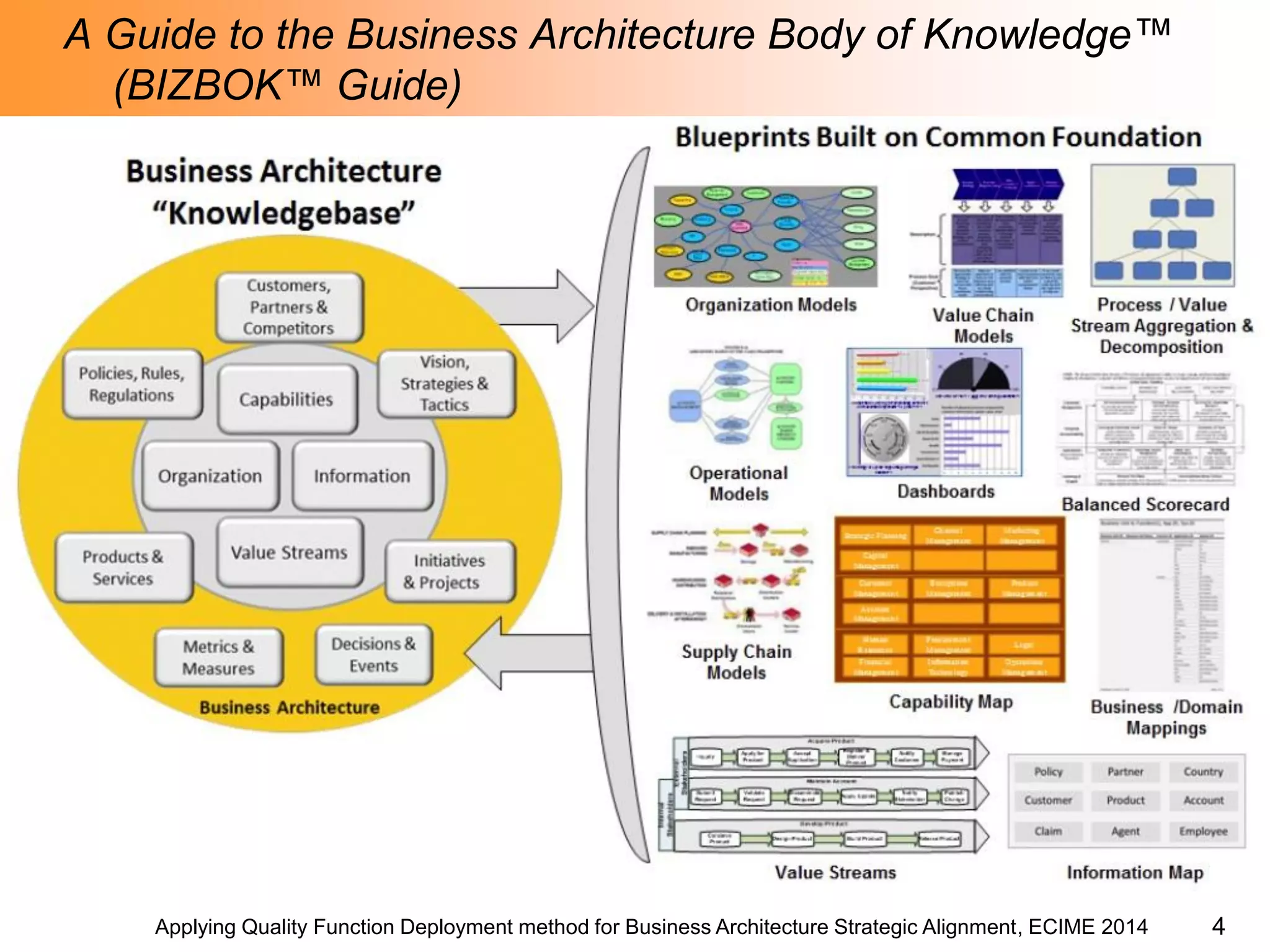
A Guide to the Business Architecture Body of Knowledge™ (BIZBOK™ Guide) 
4
Applying Quality Function Deployment method for Business Architecture Strategic Alignment, ECIME 2014 
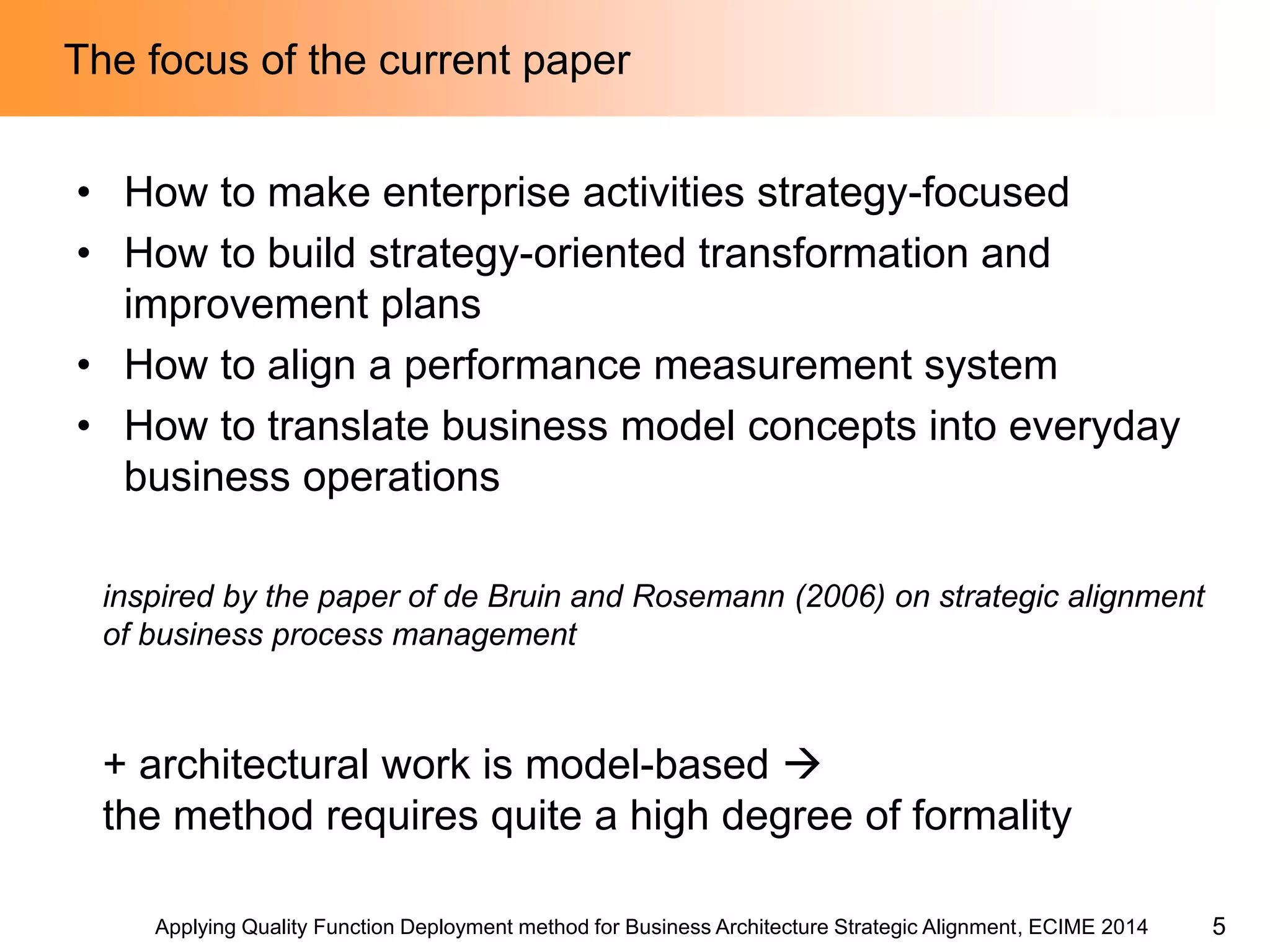
The focus of the current paper 
•How to make enterprise activities strategy-focused 
•How to build strategy-oriented transformation and improvement plans 
•How to align a performance measurement system 
•How to translate business model concepts into everyday business operations 
inspired by the paper of de Bruin and Rosemann (2006) on strategic alignment of business process management 
+ architectural work is model-based  
the method requires quite a high degree of formality 
5
Applying Quality Function Deployment method for Business Architecture Strategic Alignment, ECIME 2014 
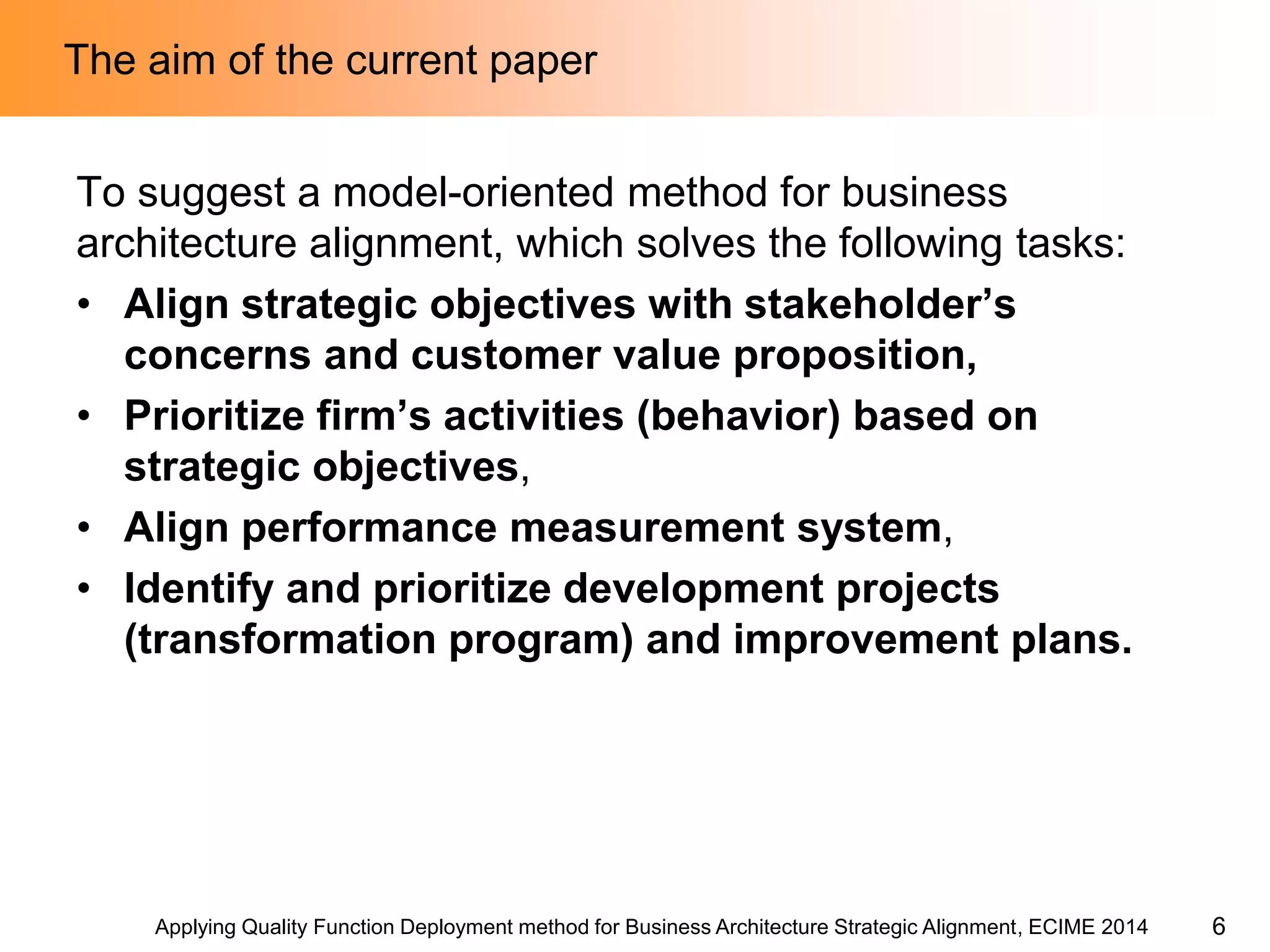
The aim of the current paper 
To suggest a model-oriented method for business architecture alignment, which solves the following tasks: 
•Align strategic objectives with stakeholder’s concerns and customer value proposition, 
•Prioritize firm’s activities (behavior) based on strategic objectives, 
•Align performance measurement system, 
•Identify and prioritize development projects (transformation program) and improvement plans. 
6
Applying Quality Function Deployment method for Business Architecture Strategic Alignment, ECIME 2014 
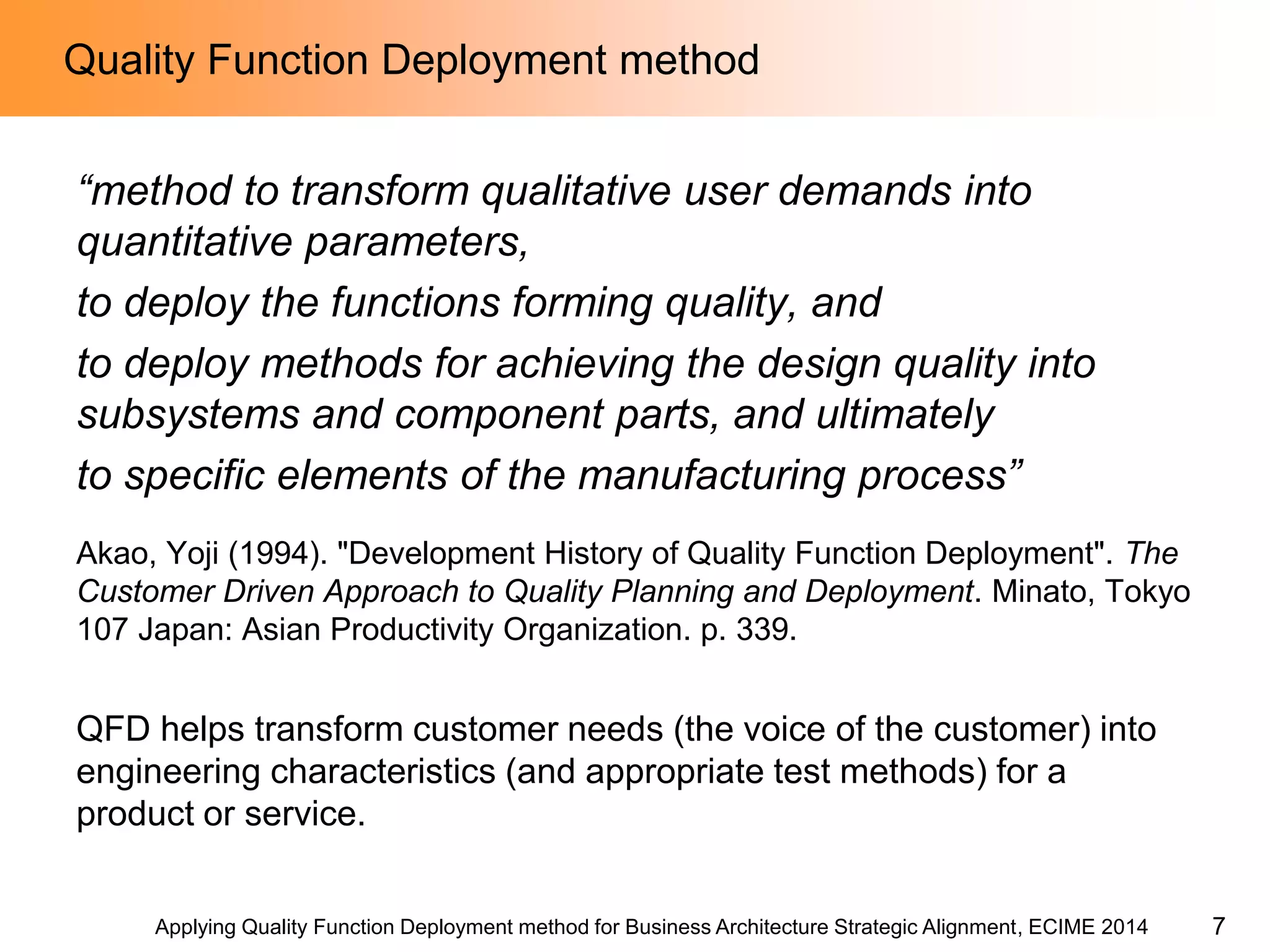
Quality Function Deployment method 
“method to transform qualitative user demands into quantitative parameters, 
to deploy the functions forming quality, and 
to deploy methods for achieving the design quality into subsystems and component parts, and ultimately 
to specific elements of the manufacturing process” 
Akao, Yoji (1994). "Development History of Quality Function Deployment". The Customer Driven Approach to Quality Planning and Deployment. Minato, Tokyo 107 Japan: Asian Productivity Organization. p. 339. 
QFD helps transform customer needs (the voice of the customer) into engineering characteristics (and appropriate test methods) for a product or service. 
7
Applying Quality Function Deployment method for Business Architecture Strategic Alignment, ECIME 2014 
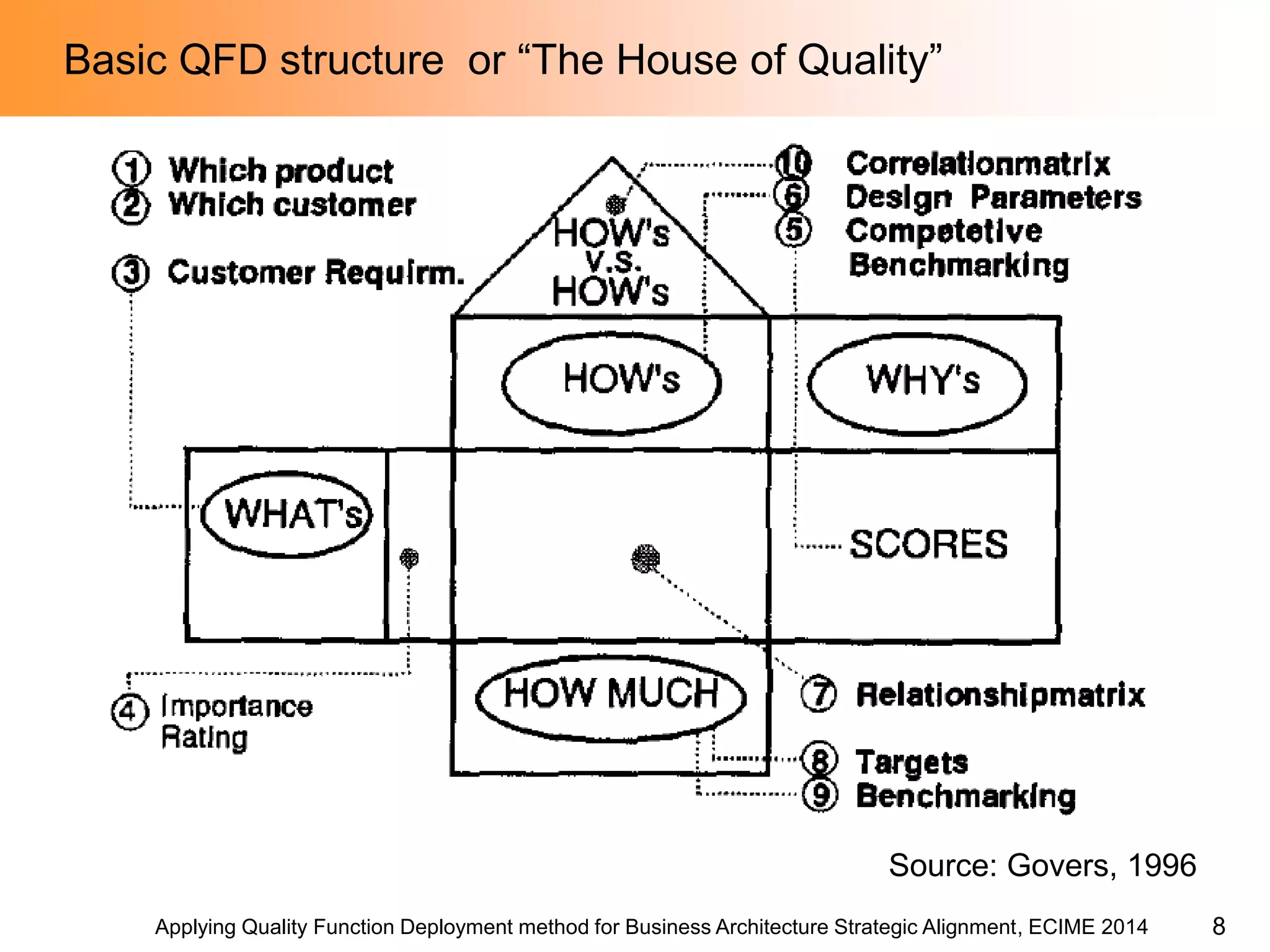
Basic QFD structure or “The House of Quality” 
Source: Govers, 1996 
8
Applying Quality Function Deployment method for Business Architecture Strategic Alignment, ECIME 2014 
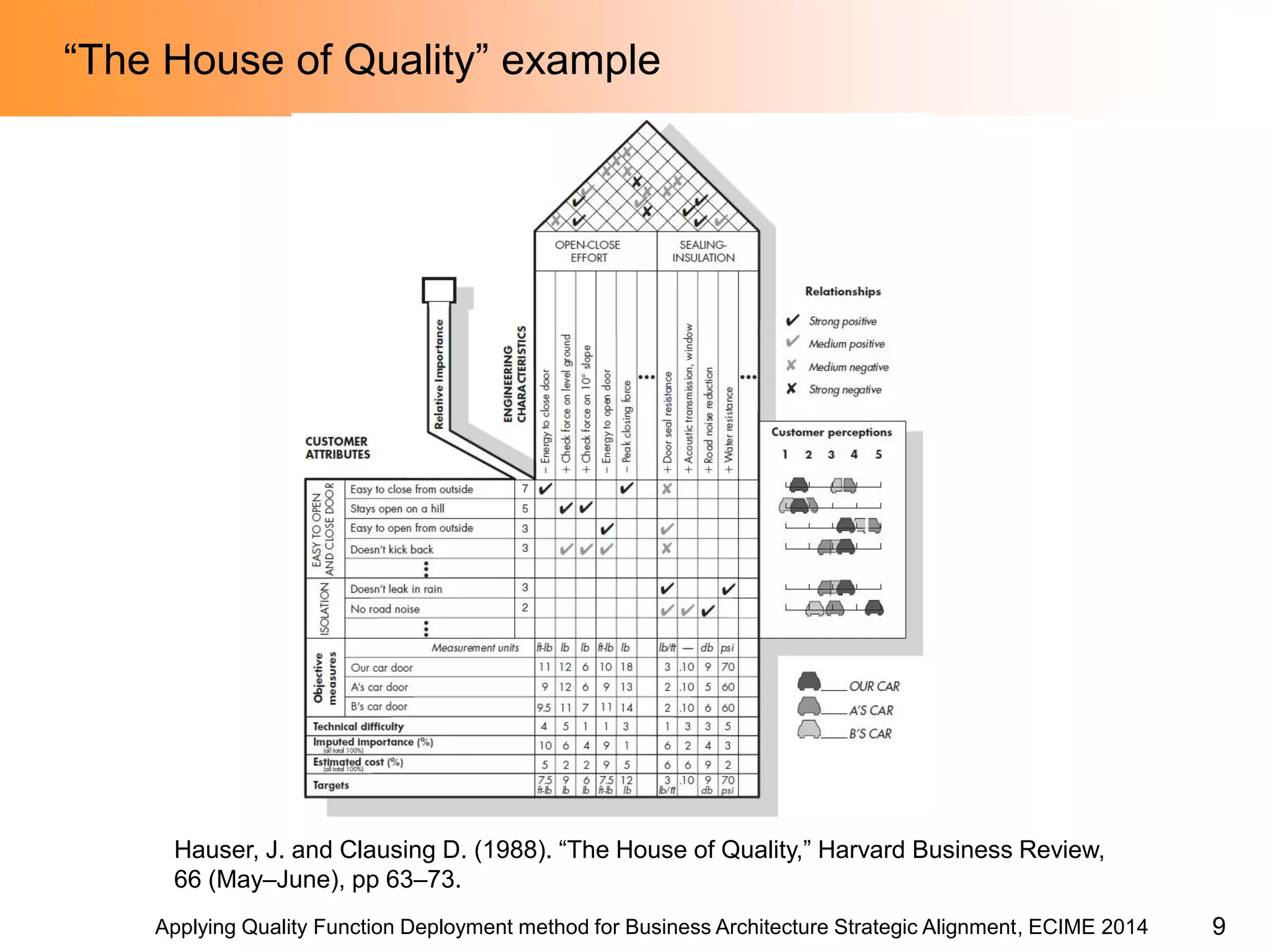
“The House of Quality” example 
Hauser, J. and Clausing D. (1988). “The House of Quality,” Harvard Business Review, 66 (May–June), pp 63–73. 
9
Applying Quality Function Deployment method for Business Architecture Strategic Alignment, ECIME 2014 
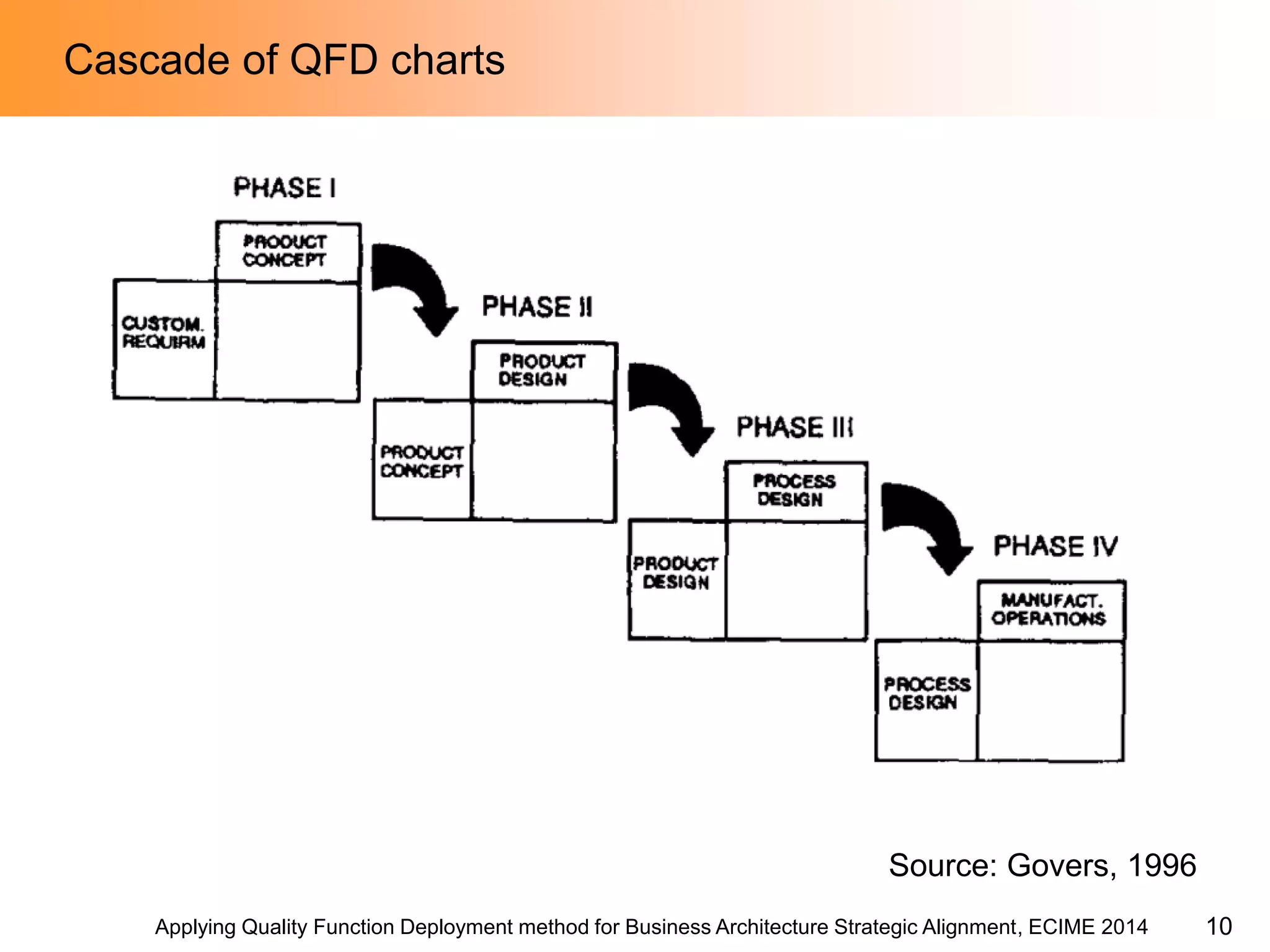
Cascade of QFD charts 
Source: Govers, 1996 
10
Applying Quality Function Deployment method for Business Architecture Strategic Alignment, ECIME 2014 
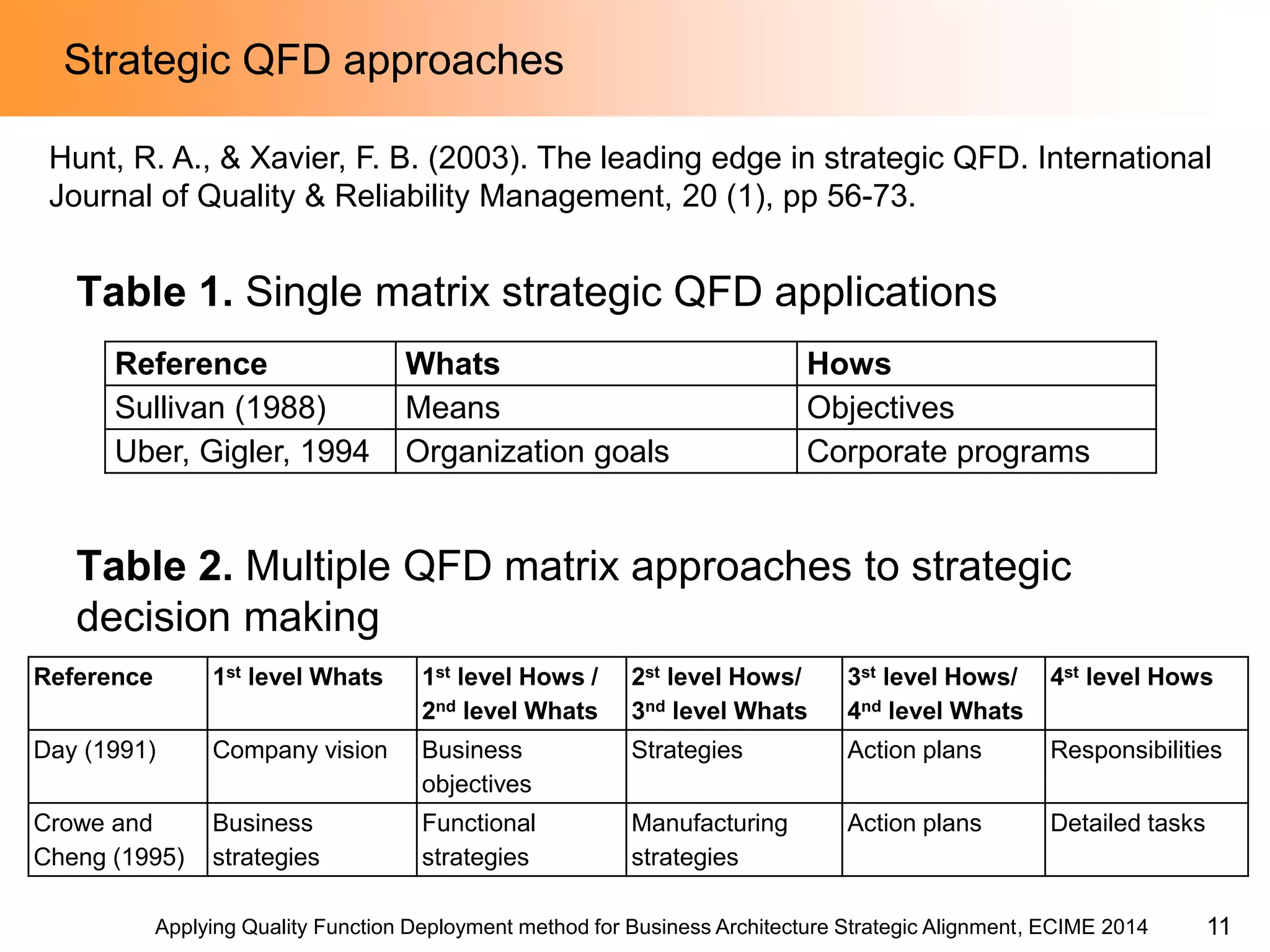
Strategic QFD approaches 
Table 1. Single matrix strategic QFD applications 
Table 2. Multiple QFD matrix approaches to strategic decision making 
Reference 
Whats 
Hows 
Sullivan (1988) 
Means 
Objectives 
Uber, Gigler, 1994 
Organization goals 
Corporate programs 
Reference 
1st level Whats 
1st level Hows / 
2nd level Whats 
2st level Hows/ 
3nd level Whats 
3st level Hows/ 
4nd level Whats 
4st level Hows 
Day (1991) 
Company vision 
Business objectives 
Strategies 
Action plans 
Responsibilities 
Crowe and Cheng (1995) 
Business strategies 
Functional strategies 
Manufacturing strategies 
Action plans 
Detailed tasks 
11 
Hunt, R. A., & Xavier, F. B. (2003). The leading edge in strategic QFD. International Journal of Quality & Reliability Management, 20 (1), pp 56-73.
Applying Quality Function Deployment method for Business Architecture Strategic Alignment, ECIME 2014 
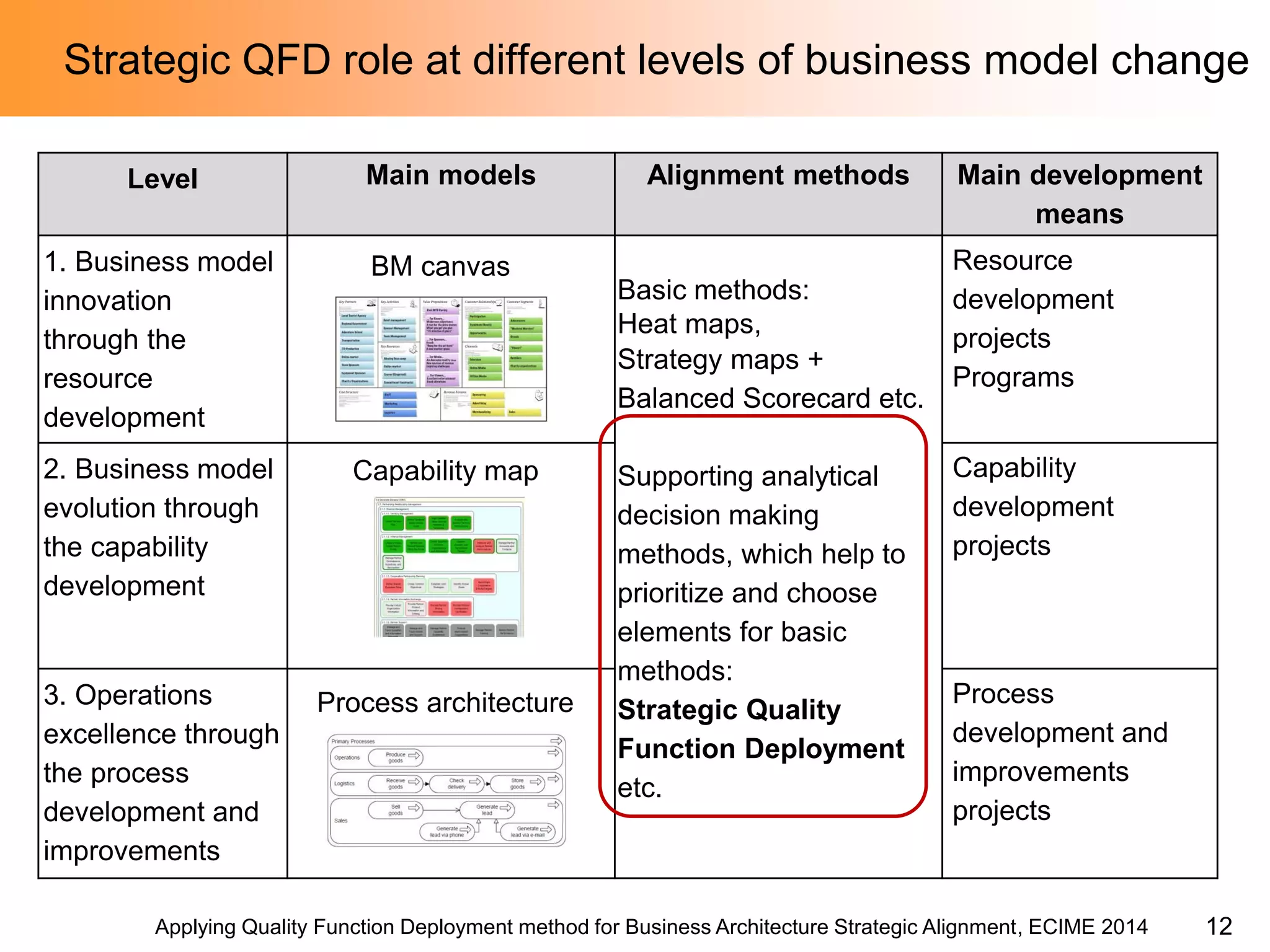
Strategic QFD role at different levels of business model change 
Level 
Main models 
Alignment methods 
Main development means 
1. Business model innovation 
through the resource development 
Basic methods: 
Heat maps, 
Strategy maps + Balanced Scorecard etc. 
Supporting analytical decision making methods, which help to prioritize and choose elements for basic methods: 
Strategic Quality Function Deployment etc. 
Resource development projects 
Programs 
2. Business model evolution through the capability development 
Capability development projects 
3. Operations excellence through the process development and improvements 
Process development and improvements projects 
BM canvas 
Capability map 
Process architecture 
12
Applying Quality Function Deployment method for Business Architecture Strategic Alignment, ECIME 2014 
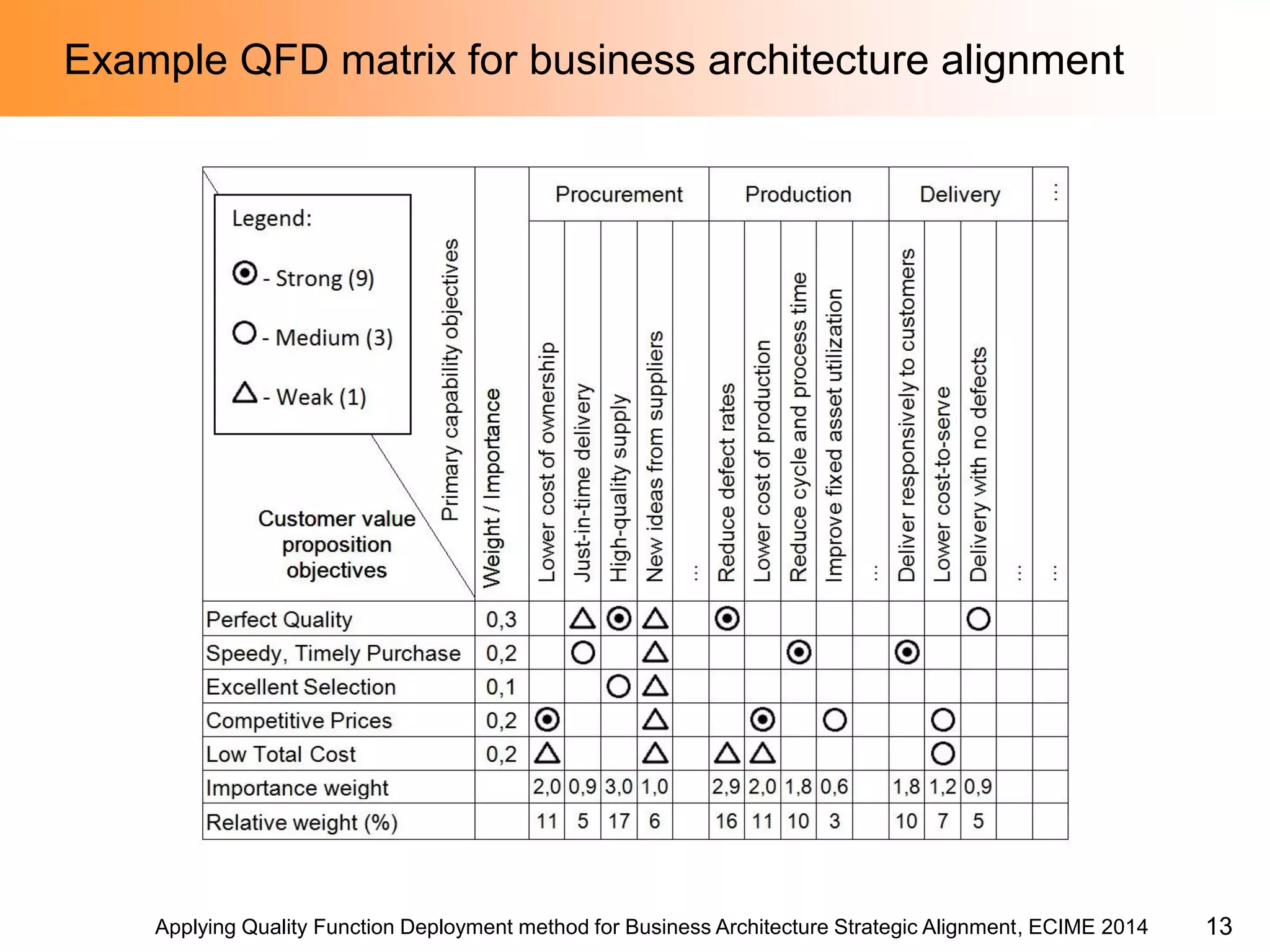
Example QFD matrix for business architecture alignment 
13
Applying Quality Function Deployment method for Business Architecture Strategic Alignment, ECIME 2014 
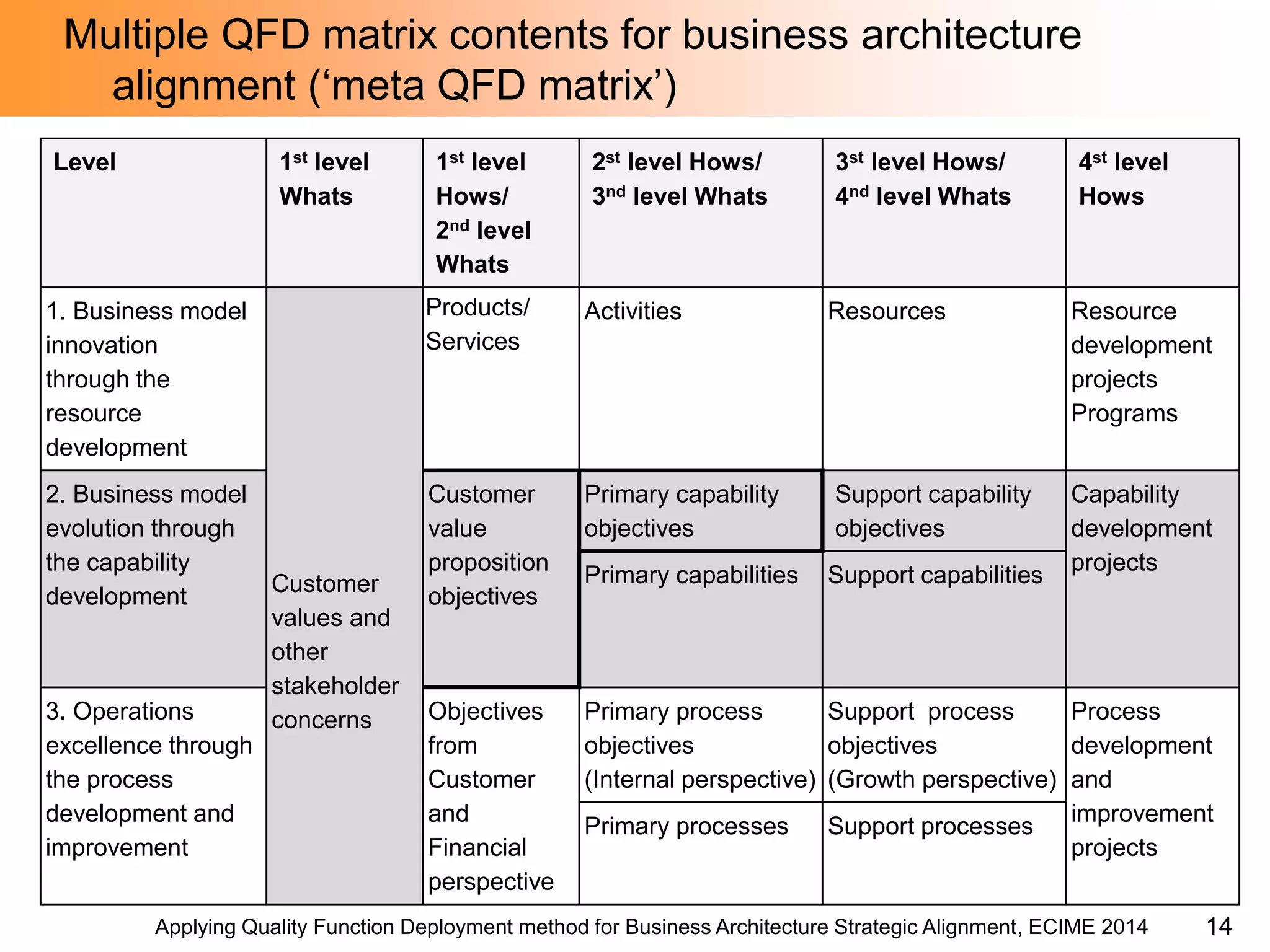
Multiple QFD matrix contents for business architecture alignment (‘meta QFD matrix’) 
Level 
1st level Whats 
1st level Hows/ 
2nd level Whats 
2st level Hows/ 
3nd level Whats 
3st level Hows/ 
4nd level Whats 
4st level Hows 
1. Business model innovation 
through the resource development 
Customer values and other stakeholder concerns 
Products/ Services 
Activities 
Resources 
Resource development projects 
Programs 
2. Business model evolution through the capability development 
Customer value proposition objectives 
Primary capability 
objectives 
Support capability objectives 
Capability development projects 
Primary capabilities 
Support capabilities 
3. Operations excellence through the process development and improvement 
Objectives 
from Customer and Financial perspective 
Primary process objectives 
(Internal perspective) 
Support process objectives 
(Growth perspective) 
Process development and improvement projects 
Primary processes 
Support processes 
14
Applying Quality Function Deployment method for Business Architecture Strategic Alignment, ECIME 2014 
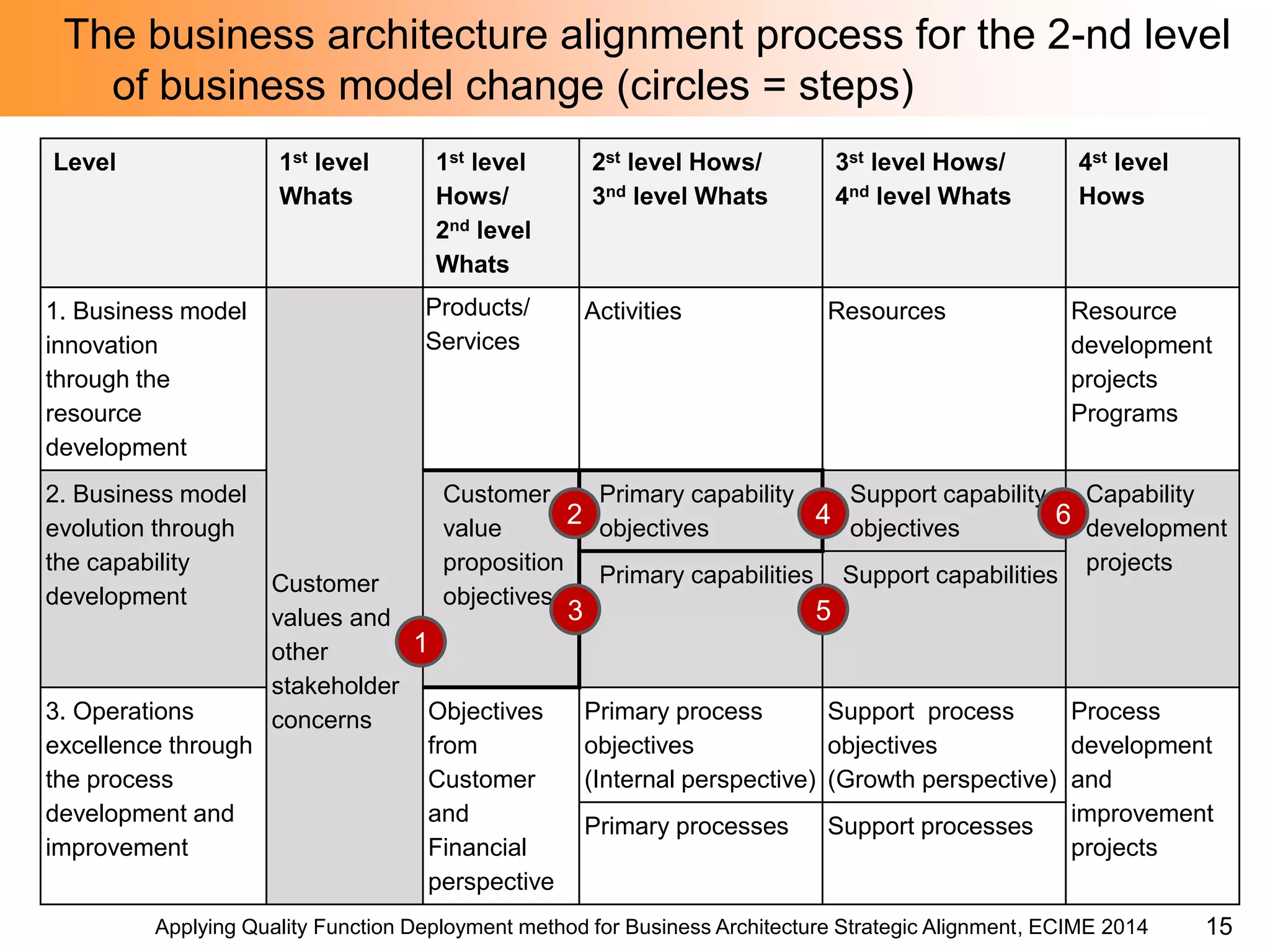
The business architecture alignment process for the 2-nd level of business model change (circles = steps) 
Level 
1st level Whats 
1st level Hows/ 
2nd level Whats 
2st level Hows/ 
3nd level Whats 
3st level Hows/ 
4nd level Whats 
4st level Hows 
1. Business model innovation 
through the resource development 
Customer values and other stakeholder concerns 
Products/ Services 
Activities 
Resources 
Resource development projects 
Programs 
2. Business model evolution through the capability development 
Customer value proposition objectives 
Primary capability 
objectives 
Support capability objectives 
Capability development projects 
Primary capabilities 
Support capabilities 
3. Operations excellence through the process development and improvement 
Objectives 
from Customer and Financial perspective 
Primary process objectives 
(Internal perspective) 
Support process objectives 
(Growth perspective) 
Process development and improvement projects 
Primary processes 
Support processes 
1 
2 
3 
4 
5 
6 
15
Applying Quality Function Deployment method for Business Architecture Strategic Alignment, ECIME 2014 
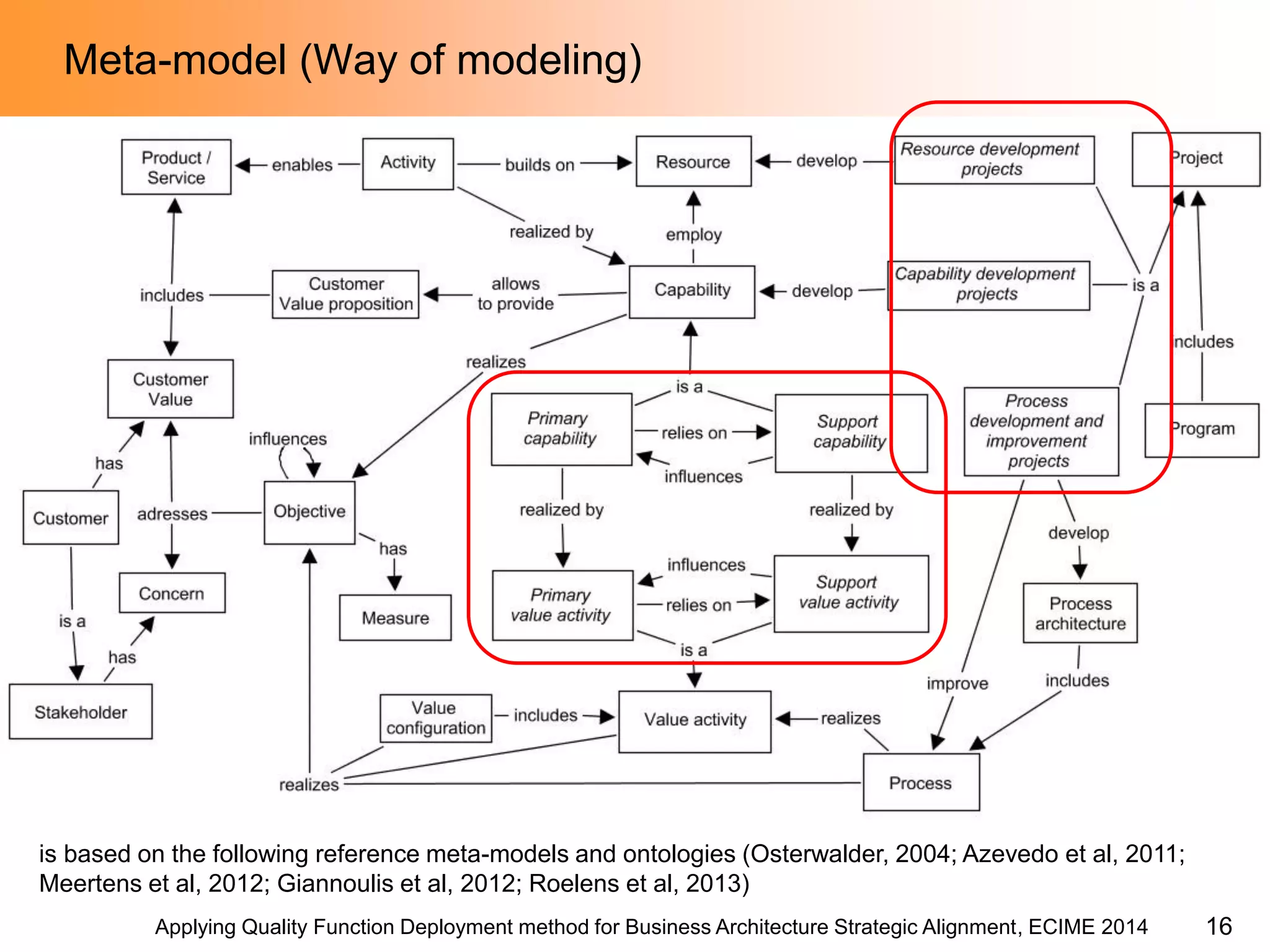
Meta-model (Way of modeling) 
is based on the following reference meta-models and ontologies (Osterwalder, 2004; Azevedo et al, 2011; Meertens et al, 2012; Giannoulis et al, 2012; Roelens et al, 2013) 
16
Applying Quality Function Deployment method for Business Architecture Strategic Alignment, ECIME 2014 
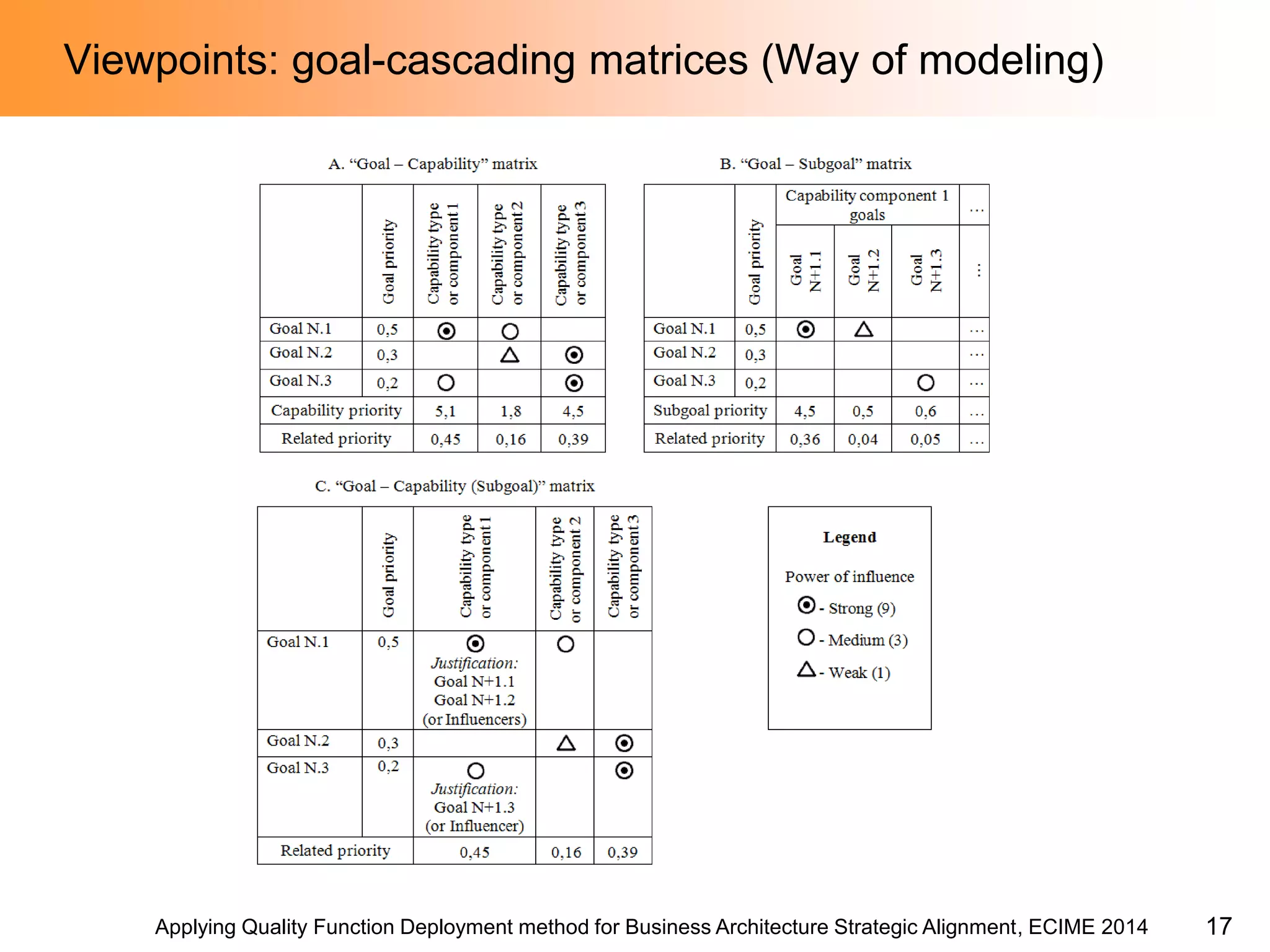
Viewpoints: goal-cascading matrices (Way of modeling) 
17
Applying Quality Function Deployment method for Business Architecture Strategic Alignment, ECIME 2014 
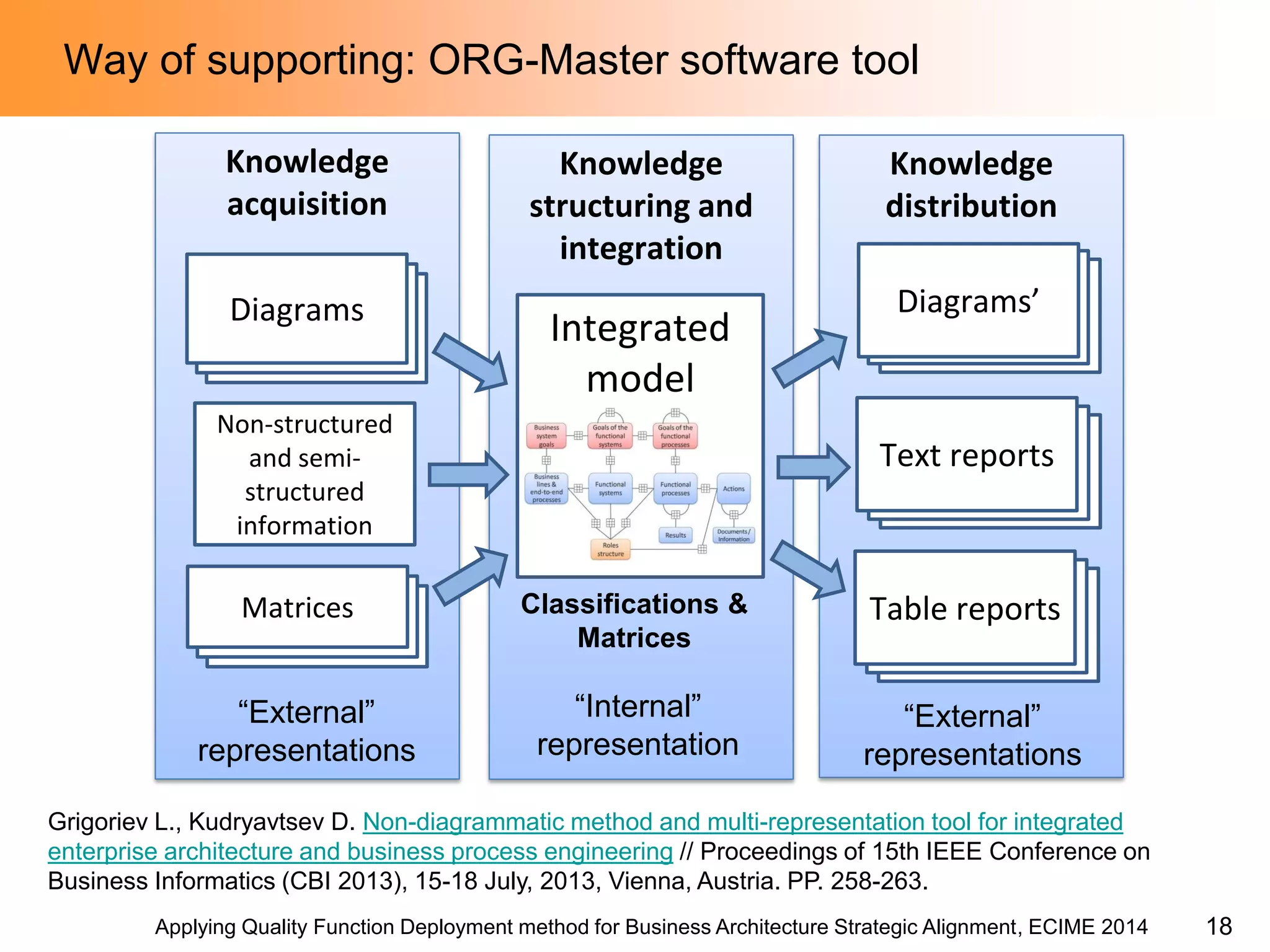
Way of supporting: ORG-Master software tool 
Knowledge distribution 
Knowledge acquisition 
Knowledge structuring and integration 
Non-structured and semi- structured information 
Integrated model 
Diagrams 
Matrices 
“Internal” representation 
Diagrams’ 
Text reports 
Table reports 
Classifications & Matrices 
“External” representations 
Grigoriev L., Kudryavtsev D. Non-diagrammatic method and multi-representation tool for integrated enterprise architecture and business process engineering // Proceedings of 15th IEEE Conference on Business Informatics (CBI 2013), 15-18 July, 2013, Vienna, Austria. PP. 258-263. 
18
Applying Quality Function Deployment method for Business Architecture Strategic Alignment, ECIME 2014 
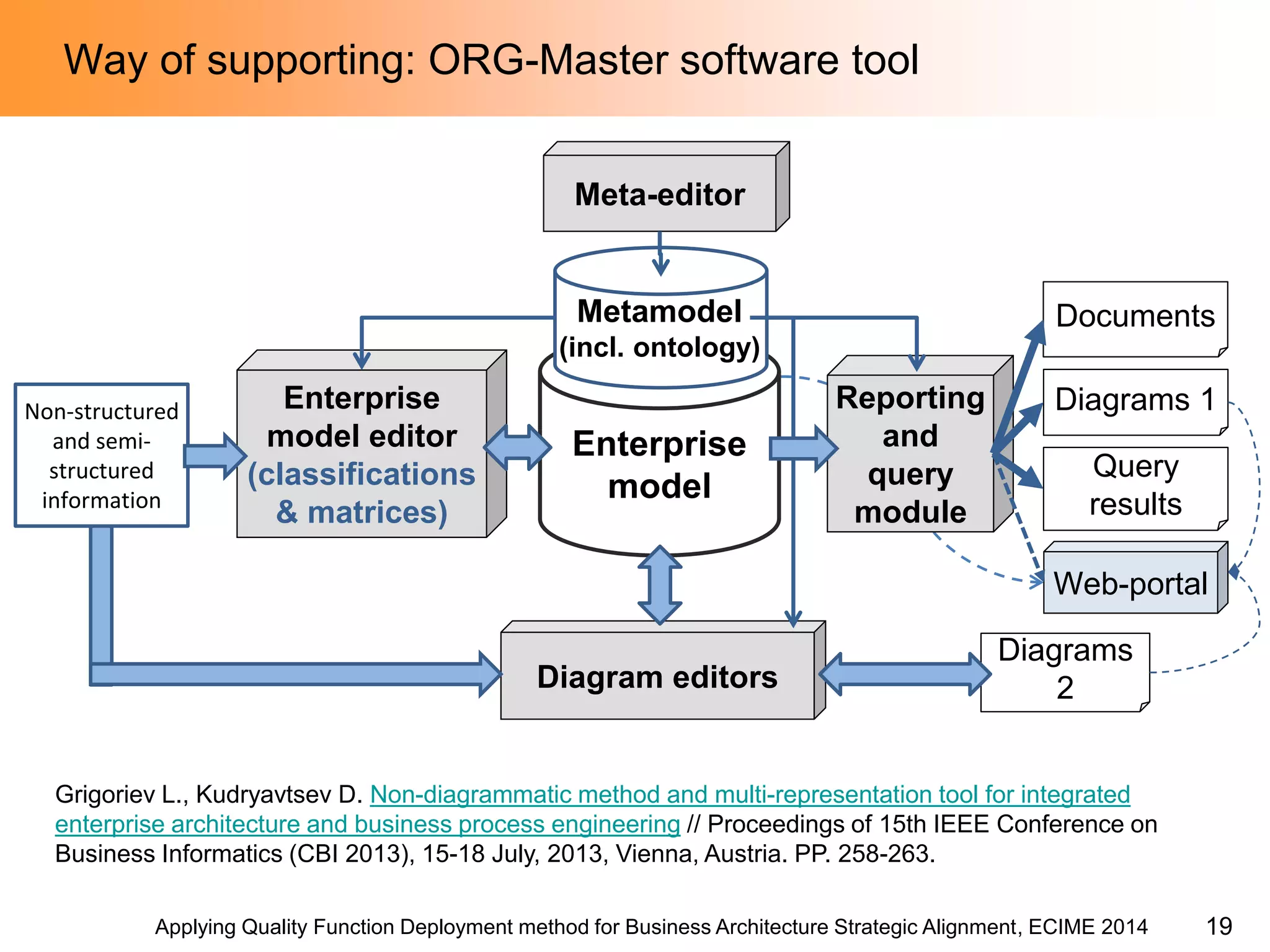
Way of supporting: ORG-Master software tool 
Enterprise model editor 
(classifications & matrices) 
Enterprise 
model 
Reporting and query module 
Documents 
Diagrams 2 
Meta-editor 
Diagram editors 
Query results 
Diagrams 1 
Metamodel 
(incl. ontology) 
Web-portal 
Non-structured and semi- structured information 
Grigoriev L., Kudryavtsev D. Non-diagrammatic method and multi-representation tool for integrated enterprise architecture and business process engineering // Proceedings of 15th IEEE Conference on Business Informatics (CBI 2013), 15-18 July, 2013, Vienna, Austria. PP. 258-263. 
19
Applying Quality Function Deployment method for Business Architecture Strategic Alignment, ECIME 2014 
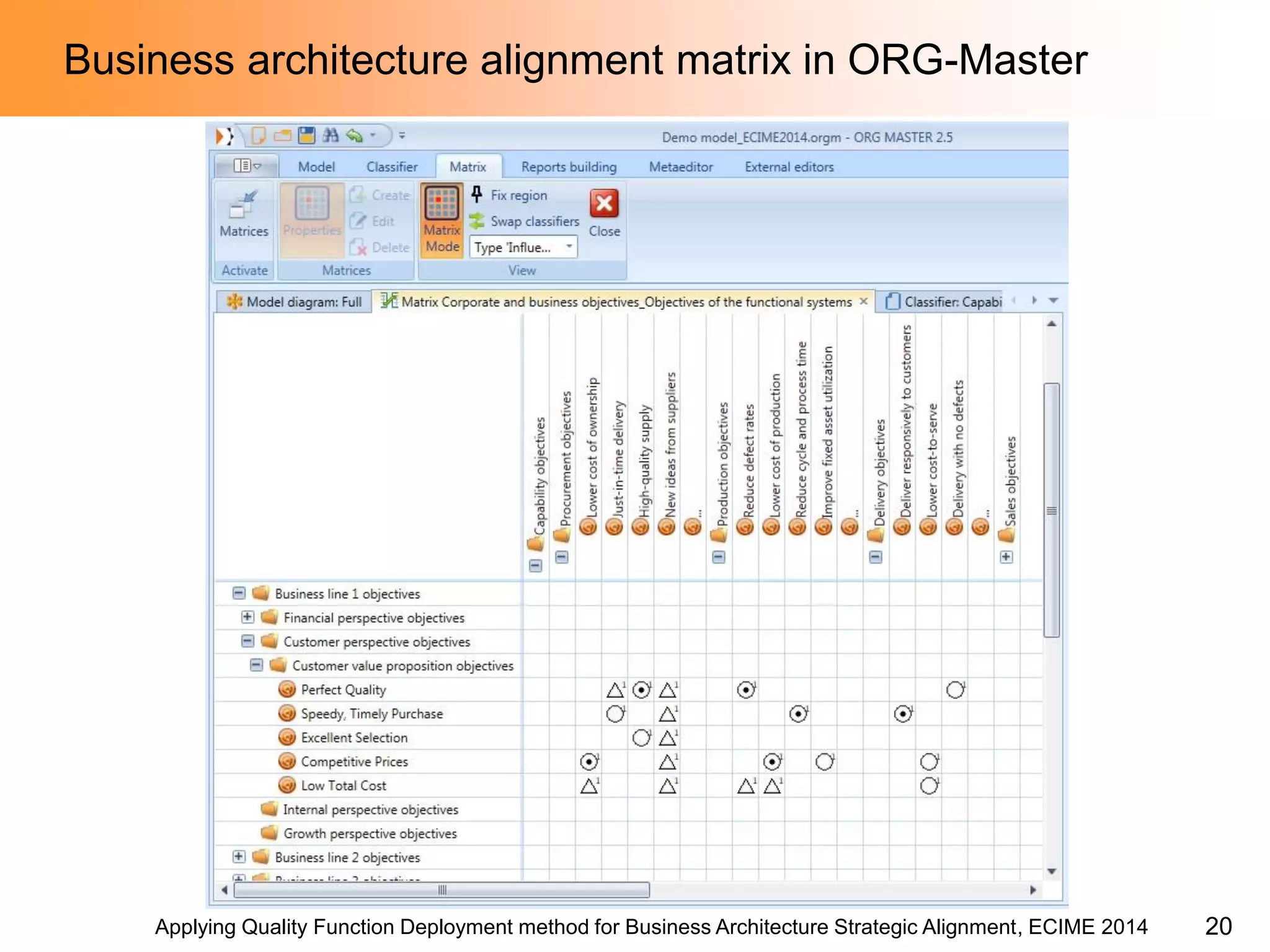
Business architecture alignment matrix in ORG-Master 
20
Applying Quality Function Deployment method for Business Architecture Strategic Alignment, ECIME 2014 
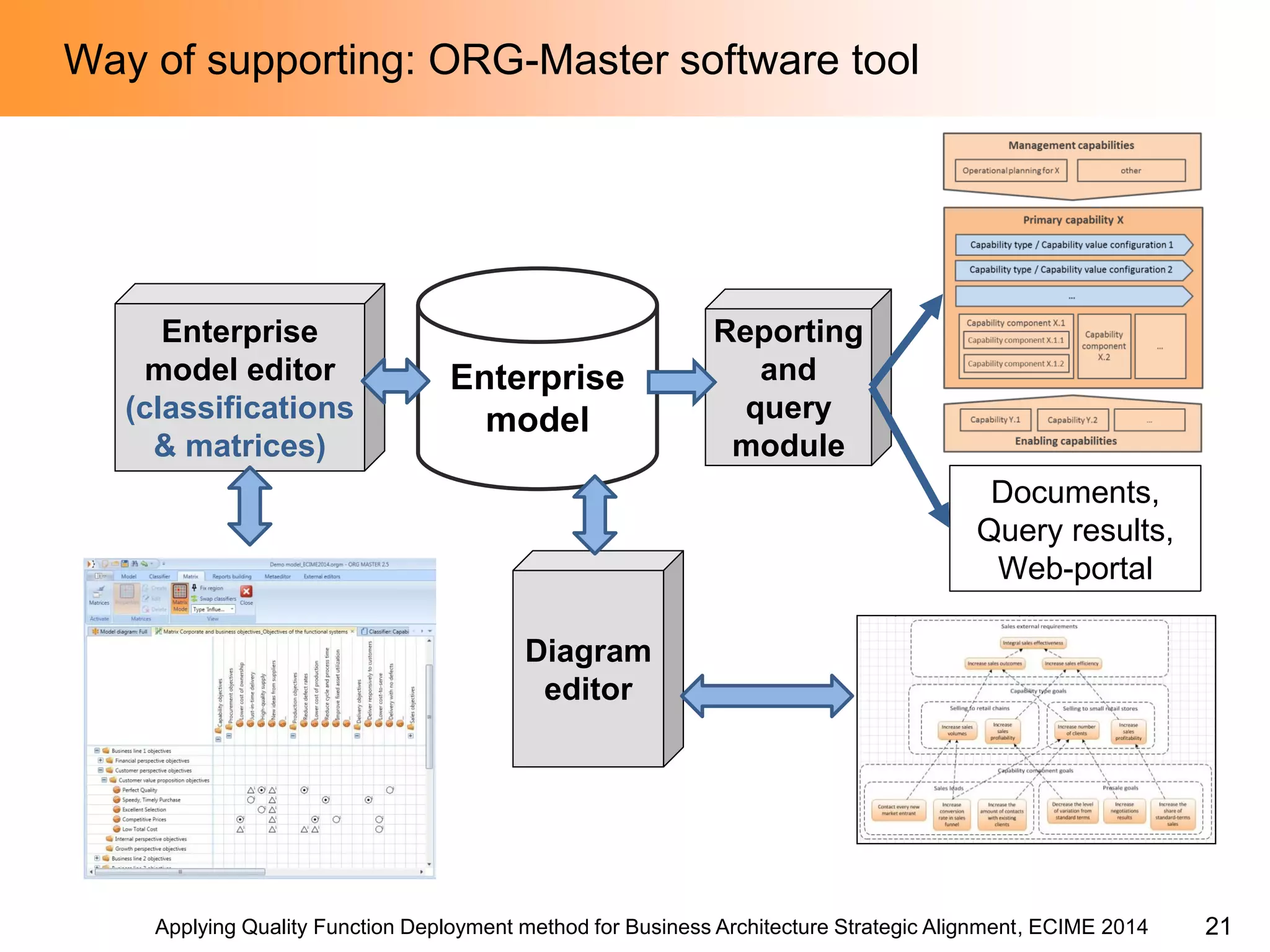
Way of supporting: ORG-Master software tool 
Enterprise model editor 
(classifications & matrices) 
Enterprise 
model 
Reporting and query module 
Documents, 
Query results, 
Web-portal 
Diagram 
editor 
21
Applying Quality Function Deployment method for Business Architecture Strategic Alignment, ECIME 2014 
Application of the approach 
This methodology or its parts helped to develop and deploy: 
•corporate strategies for 5 companies, 
•business strategies for 7 companies, 
•functional strategies for 4 companies. 
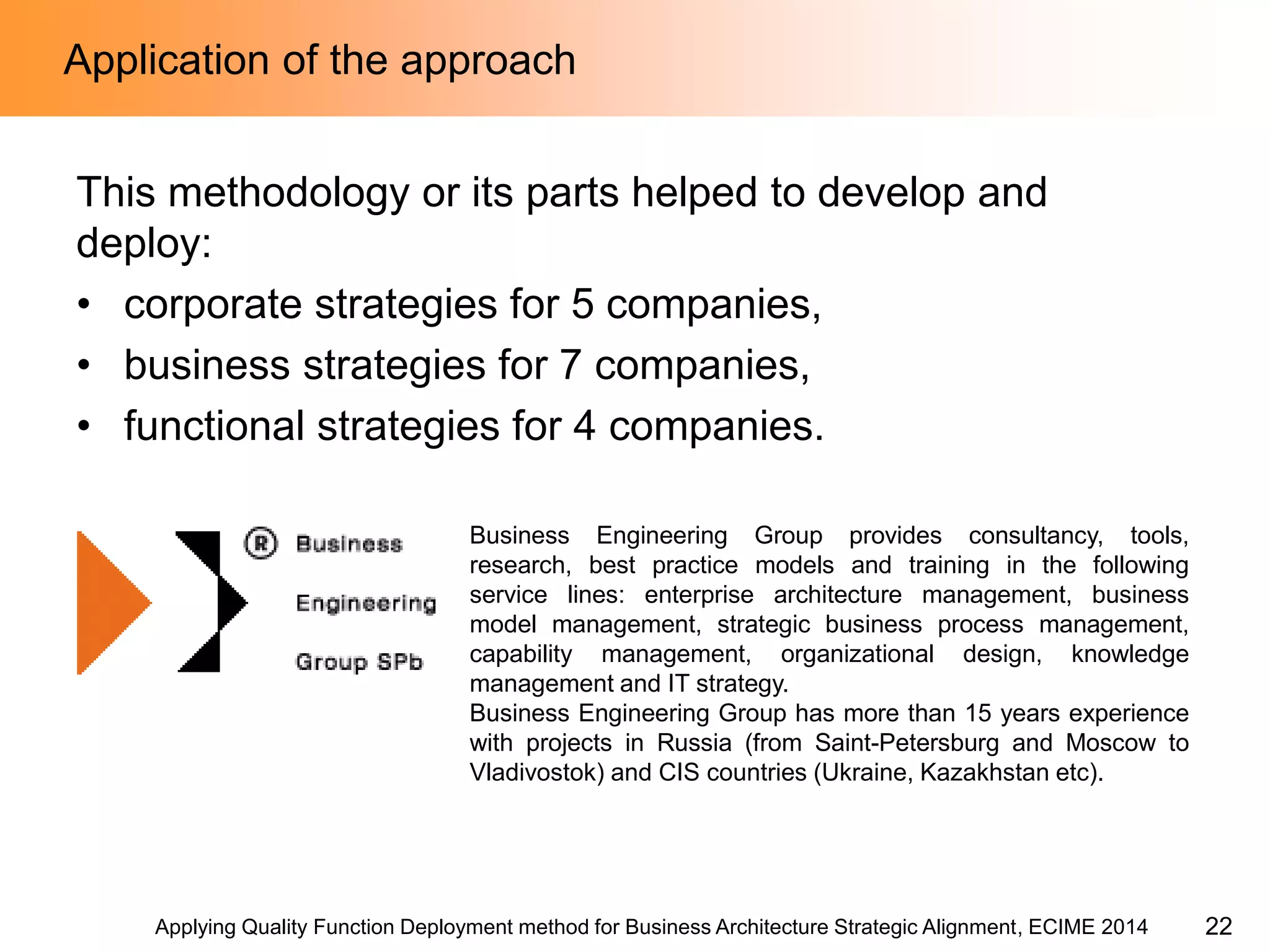
Business Engineering Group provides consultancy, tools, research, best practice models and training in the following service lines: enterprise architecture management, business model management, strategic business process management, capability management, organizational design, knowledge management and IT strategy. 
Business Engineering Group has more than 15 years experience with projects in Russia (from Saint-Petersburg and Moscow to Vladivostok) and CIS countries (Ukraine, Kazakhstan etc). 
22
Applying Quality Function Deployment method for Business Architecture Strategic Alignment, ECIME 2014 
Related work 
Alignment methods for business behaviour / activities 
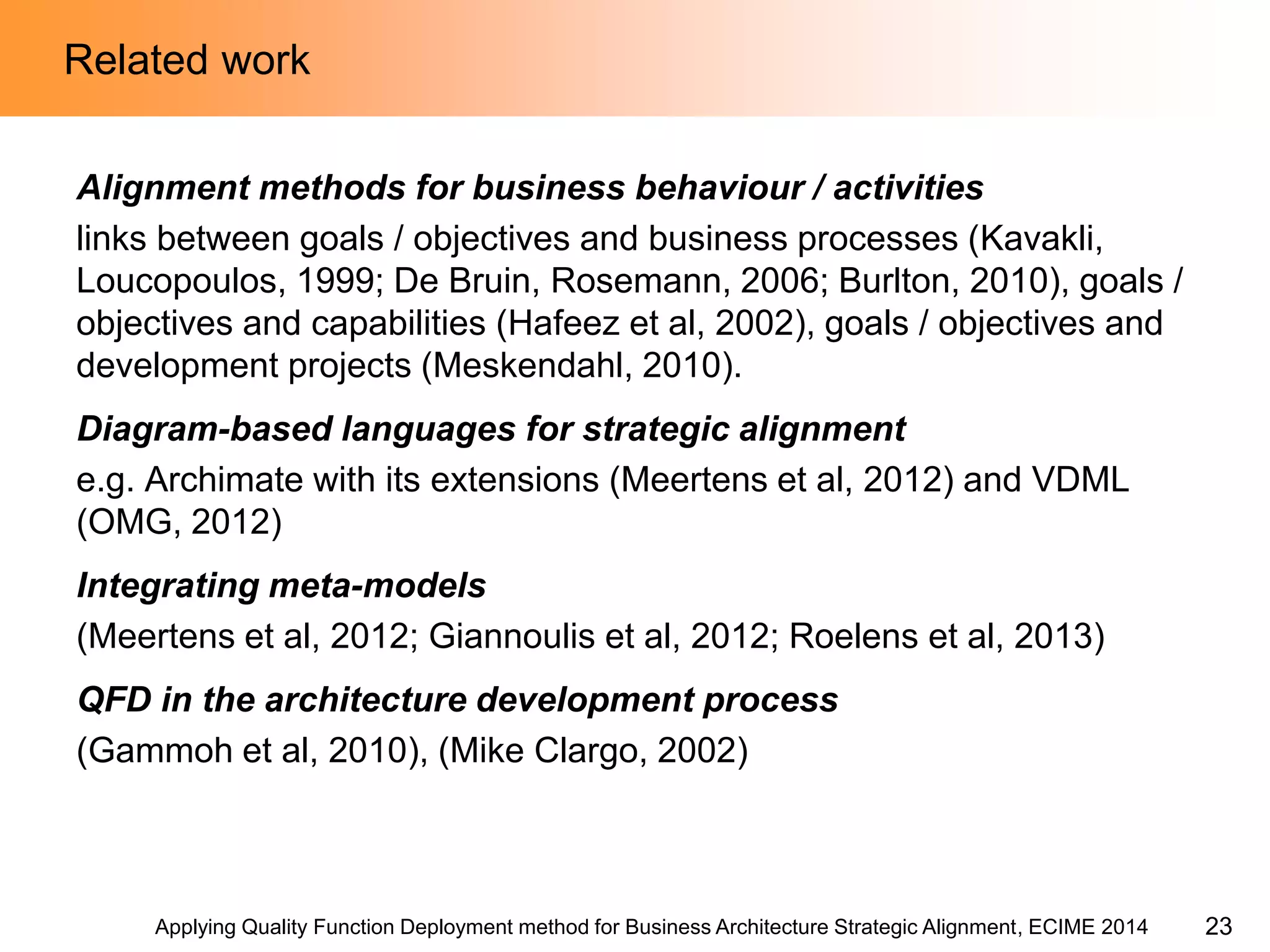
links between goals / objectives and business processes (Kavakli, Loucopoulos, 1999; De Bruin, Rosemann, 2006; Burlton, 2010), goals / objectives and capabilities (Hafeez et al, 2002), goals / objectives and development projects (Meskendahl, 2010). 
Diagram-based languages for strategic alignment 
e.g. Archimate with its extensions (Meertens et al, 2012) and VDML (OMG, 2012) 
Integrating meta-models 
(Meertens et al, 2012; Giannoulis et al, 2012; Roelens et al, 2013) 
QFD in the architecture development process 
(Gammoh et al, 2010), (Mike Clargo, 2002) 
23
Applying Quality Function Deployment method for Business Architecture Strategic Alignment, ECIME 2014 
Conclusion: Specialties of the suggested methodology 
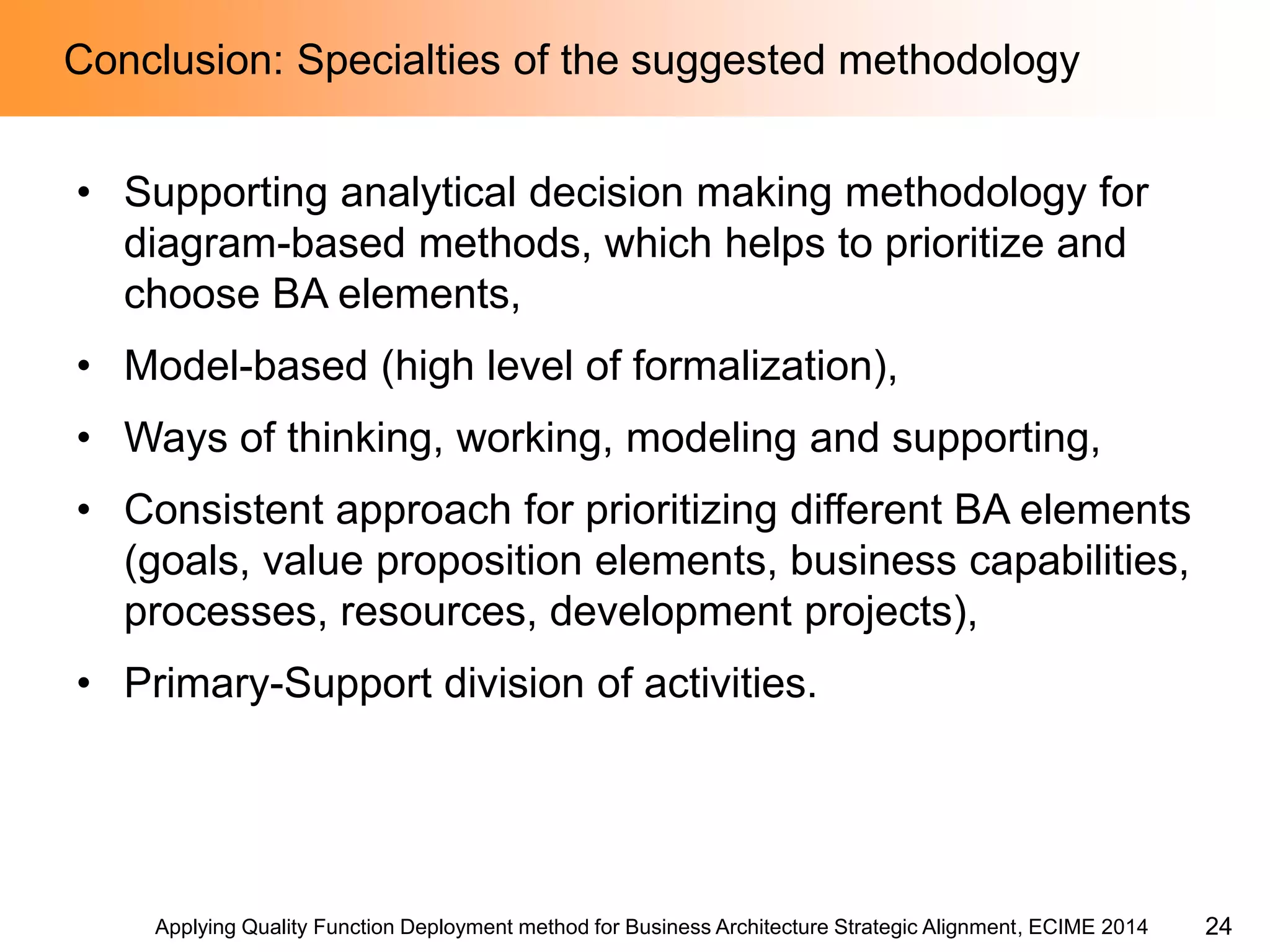
•Supporting analytical decision making methodology for diagram-based methods, which helps to prioritize and choose BA elements, 
•Model-based (high level of formalization), 
•Ways of thinking, working, modeling and supporting, 
•Consistent approach for prioritizing different BA elements (goals, value proposition elements, business capabilities, processes, resources, development projects), 
•Primary-Support division of activities. 
24
Applying Quality Function Deployment method for Business Architecture Strategic Alignment, ECIME 2014 
Conclusion: Current/Future work 
•Extended demonstration of implementation (e.g. case study) 
•More explicit evaluation 
•Calculation plugin for the tool (ORG-Master) 
25
26 
Thanks 
Questions? 
Dmitry Kudryavtev 
dmitry.ku@gmail.com 
http://www.linkedin.com/profile/view?id=17582861 
https://twitter.com/kudryavtsev_d 
Lev Grigoriev 
griglev@gmail.com 
Ivan Koryshev 
ikory@mail.ru

Applying Quality Function Deployment method for business architecture alignment

  • 1.
    Applying Quality FunctionDeployment method for Business Architecture Alignment Dmitry Kudryavtsev Lev Grigoriev Ivan Koryshev 1, 2, 3 1 1 1 2 3 ECIME 2014 8th European Conference on IS Management and Evaluation University of Ghent Citation: Kudryavtsev D., Grigoriev L., Koryshev I. Applying Quality Function Deployment method for business architecture alignment. Proceedings of the 8th European Conference on IS Management and Evaluation (ECIME 2014), Ghent, Belgium, 11-12 September 2014, 118-127.
  • 2.
    Applying Quality FunctionDeployment method for Business Architecture Strategic Alignment, ECIME 2014 Outline 1.Introduction: the problem of Strategic Alignment 2.QFD and its role in strategic management 3.Business architecture alignment method (Way of thinking and working) 4.Meta-model and viewpoints (Way of modeling) 5.IT support - ORG-Master (Way of supporting) 6.Application of the approach 7.Related work 8.Conclusions 2
  • 3.
    Applying Quality FunctionDeployment method for Business Architecture Strategic Alignment, ECIME 2014 Strategic alignment and basic works Everyday operations, transformation efforts, performance measures and personnel behaviour at all levels must be aligned with strategy. The need for alignment arises when distinct disciplines influence each other and their coordination is required to achieve certain goals. Labovitz, G., & Rosansky, V. (1997). The power of alignment: How great companies stay centered and accomplish extraordinary things. John Wiley & Sons, Inc. Henderson, J. C. and Venkatraman, N. (1993) Strategic Alignment: Leveraging information technology for transforming organisations. IBM Systems Journal, 32(1), pp 4- 16. Kaplan, R. S., and Norton, D. P. (2004). Strategy Maps. Harvard Business School Publishing, Boston, Massachusetts Kaplan, R., & Norton, D. P. (2006). Alignment: Using the balanced scorecard to create corporate synergies. Harvard Business Press. Joshi, M. P., Kathuria, R., & Porth, S. J. (2003). Alignment of strategic priorities and performance: an integration of operations and strategic management perspectives. Journal of Operations Management, 21(3), pp 353-369. 3
  • 4.
    Applying Quality FunctionDeployment method for Business Architecture Strategic Alignment, ECIME 2014 A Guide to the Business Architecture Body of Knowledge™ (BIZBOK™ Guide) 4
  • 5.
    Applying Quality FunctionDeployment method for Business Architecture Strategic Alignment, ECIME 2014 The focus of the current paper •How to make enterprise activities strategy-focused •How to build strategy-oriented transformation and improvement plans •How to align a performance measurement system •How to translate business model concepts into everyday business operations inspired by the paper of de Bruin and Rosemann (2006) on strategic alignment of business process management + architectural work is model-based  the method requires quite a high degree of formality 5
  • 6.
    Applying Quality FunctionDeployment method for Business Architecture Strategic Alignment, ECIME 2014 The aim of the current paper To suggest a model-oriented method for business architecture alignment, which solves the following tasks: •Align strategic objectives with stakeholder’s concerns and customer value proposition, •Prioritize firm’s activities (behavior) based on strategic objectives, •Align performance measurement system, •Identify and prioritize development projects (transformation program) and improvement plans. 6
  • 7.
    Applying Quality FunctionDeployment method for Business Architecture Strategic Alignment, ECIME 2014 Quality Function Deployment method “method to transform qualitative user demands into quantitative parameters, to deploy the functions forming quality, and to deploy methods for achieving the design quality into subsystems and component parts, and ultimately to specific elements of the manufacturing process” Akao, Yoji (1994). "Development History of Quality Function Deployment". The Customer Driven Approach to Quality Planning and Deployment. Minato, Tokyo 107 Japan: Asian Productivity Organization. p. 339. QFD helps transform customer needs (the voice of the customer) into engineering characteristics (and appropriate test methods) for a product or service. 7
  • 8.
    Applying Quality FunctionDeployment method for Business Architecture Strategic Alignment, ECIME 2014 Basic QFD structure or “The House of Quality” Source: Govers, 1996 8
  • 9.
    Applying Quality FunctionDeployment method for Business Architecture Strategic Alignment, ECIME 2014 “The House of Quality” example Hauser, J. and Clausing D. (1988). “The House of Quality,” Harvard Business Review, 66 (May–June), pp 63–73. 9
  • 10.
    Applying Quality FunctionDeployment method for Business Architecture Strategic Alignment, ECIME 2014 Cascade of QFD charts Source: Govers, 1996 10
  • 11.
    Applying Quality FunctionDeployment method for Business Architecture Strategic Alignment, ECIME 2014 Strategic QFD approaches Table 1. Single matrix strategic QFD applications Table 2. Multiple QFD matrix approaches to strategic decision making Reference Whats Hows Sullivan (1988) Means Objectives Uber, Gigler, 1994 Organization goals Corporate programs Reference 1st level Whats 1st level Hows / 2nd level Whats 2st level Hows/ 3nd level Whats 3st level Hows/ 4nd level Whats 4st level Hows Day (1991) Company vision Business objectives Strategies Action plans Responsibilities Crowe and Cheng (1995) Business strategies Functional strategies Manufacturing strategies Action plans Detailed tasks 11 Hunt, R. A., & Xavier, F. B. (2003). The leading edge in strategic QFD. International Journal of Quality & Reliability Management, 20 (1), pp 56-73.
  • 12.
    Applying Quality FunctionDeployment method for Business Architecture Strategic Alignment, ECIME 2014 Strategic QFD role at different levels of business model change Level Main models Alignment methods Main development means 1. Business model innovation through the resource development Basic methods: Heat maps, Strategy maps + Balanced Scorecard etc. Supporting analytical decision making methods, which help to prioritize and choose elements for basic methods: Strategic Quality Function Deployment etc. Resource development projects Programs 2. Business model evolution through the capability development Capability development projects 3. Operations excellence through the process development and improvements Process development and improvements projects BM canvas Capability map Process architecture 12
  • 13.
    Applying Quality FunctionDeployment method for Business Architecture Strategic Alignment, ECIME 2014 Example QFD matrix for business architecture alignment 13
  • 14.
    Applying Quality FunctionDeployment method for Business Architecture Strategic Alignment, ECIME 2014 Multiple QFD matrix contents for business architecture alignment (‘meta QFD matrix’) Level 1st level Whats 1st level Hows/ 2nd level Whats 2st level Hows/ 3nd level Whats 3st level Hows/ 4nd level Whats 4st level Hows 1. Business model innovation through the resource development Customer values and other stakeholder concerns Products/ Services Activities Resources Resource development projects Programs 2. Business model evolution through the capability development Customer value proposition objectives Primary capability objectives Support capability objectives Capability development projects Primary capabilities Support capabilities 3. Operations excellence through the process development and improvement Objectives from Customer and Financial perspective Primary process objectives (Internal perspective) Support process objectives (Growth perspective) Process development and improvement projects Primary processes Support processes 14
  • 15.
    Applying Quality FunctionDeployment method for Business Architecture Strategic Alignment, ECIME 2014 The business architecture alignment process for the 2-nd level of business model change (circles = steps) Level 1st level Whats 1st level Hows/ 2nd level Whats 2st level Hows/ 3nd level Whats 3st level Hows/ 4nd level Whats 4st level Hows 1. Business model innovation through the resource development Customer values and other stakeholder concerns Products/ Services Activities Resources Resource development projects Programs 2. Business model evolution through the capability development Customer value proposition objectives Primary capability objectives Support capability objectives Capability development projects Primary capabilities Support capabilities 3. Operations excellence through the process development and improvement Objectives from Customer and Financial perspective Primary process objectives (Internal perspective) Support process objectives (Growth perspective) Process development and improvement projects Primary processes Support processes 1 2 3 4 5 6 15
  • 16.
    Applying Quality FunctionDeployment method for Business Architecture Strategic Alignment, ECIME 2014 Meta-model (Way of modeling) is based on the following reference meta-models and ontologies (Osterwalder, 2004; Azevedo et al, 2011; Meertens et al, 2012; Giannoulis et al, 2012; Roelens et al, 2013) 16
  • 17.
    Applying Quality FunctionDeployment method for Business Architecture Strategic Alignment, ECIME 2014 Viewpoints: goal-cascading matrices (Way of modeling) 17
  • 18.
    Applying Quality FunctionDeployment method for Business Architecture Strategic Alignment, ECIME 2014 Way of supporting: ORG-Master software tool Knowledge distribution Knowledge acquisition Knowledge structuring and integration Non-structured and semi- structured information Integrated model Diagrams Matrices “Internal” representation Diagrams’ Text reports Table reports Classifications & Matrices “External” representations “External” representations Grigoriev L., Kudryavtsev D. Non-diagrammatic method and multi-representation tool for integrated enterprise architecture and business process engineering // Proceedings of 15th IEEE Conference on Business Informatics (CBI 2013), 15-18 July, 2013, Vienna, Austria. PP. 258-263. 18
  • 19.
    Applying Quality FunctionDeployment method for Business Architecture Strategic Alignment, ECIME 2014 Way of supporting: ORG-Master software tool Enterprise model editor (classifications & matrices) Enterprise model Reporting and query module Documents Diagrams 2 Meta-editor Diagram editors Query results Diagrams 1 Metamodel (incl. ontology) Web-portal Non-structured and semi- structured information Grigoriev L., Kudryavtsev D. Non-diagrammatic method and multi-representation tool for integrated enterprise architecture and business process engineering // Proceedings of 15th IEEE Conference on Business Informatics (CBI 2013), 15-18 July, 2013, Vienna, Austria. PP. 258-263. 19
  • 20.
    Applying Quality FunctionDeployment method for Business Architecture Strategic Alignment, ECIME 2014 Business architecture alignment matrix in ORG-Master 20
  • 21.
    Applying Quality FunctionDeployment method for Business Architecture Strategic Alignment, ECIME 2014 Way of supporting: ORG-Master software tool Enterprise model editor (classifications & matrices) Enterprise model Reporting and query module Documents, Query results, Web-portal Diagram editor 21
  • 22.
    Applying Quality FunctionDeployment method for Business Architecture Strategic Alignment, ECIME 2014 Application of the approach This methodology or its parts helped to develop and deploy: •corporate strategies for 5 companies, •business strategies for 7 companies, •functional strategies for 4 companies. Business Engineering Group provides consultancy, tools, research, best practice models and training in the following service lines: enterprise architecture management, business model management, strategic business process management, capability management, organizational design, knowledge management and IT strategy. Business Engineering Group has more than 15 years experience with projects in Russia (from Saint-Petersburg and Moscow to Vladivostok) and CIS countries (Ukraine, Kazakhstan etc). 22
  • 23.
    Applying Quality FunctionDeployment method for Business Architecture Strategic Alignment, ECIME 2014 Related work Alignment methods for business behaviour / activities links between goals / objectives and business processes (Kavakli, Loucopoulos, 1999; De Bruin, Rosemann, 2006; Burlton, 2010), goals / objectives and capabilities (Hafeez et al, 2002), goals / objectives and development projects (Meskendahl, 2010). Diagram-based languages for strategic alignment e.g. Archimate with its extensions (Meertens et al, 2012) and VDML (OMG, 2012) Integrating meta-models (Meertens et al, 2012; Giannoulis et al, 2012; Roelens et al, 2013) QFD in the architecture development process (Gammoh et al, 2010), (Mike Clargo, 2002) 23
  • 24.
    Applying Quality FunctionDeployment method for Business Architecture Strategic Alignment, ECIME 2014 Conclusion: Specialties of the suggested methodology •Supporting analytical decision making methodology for diagram-based methods, which helps to prioritize and choose BA elements, •Model-based (high level of formalization), •Ways of thinking, working, modeling and supporting, •Consistent approach for prioritizing different BA elements (goals, value proposition elements, business capabilities, processes, resources, development projects), •Primary-Support division of activities. 24
  • 25.
    Applying Quality FunctionDeployment method for Business Architecture Strategic Alignment, ECIME 2014 Conclusion: Current/Future work •Extended demonstration of implementation (e.g. case study) •More explicit evaluation •Calculation plugin for the tool (ORG-Master) 25
  • 26.
    26 Thanks Questions? Dmitry Kudryavtev dmitry.ku@gmail.com http://www.linkedin.com/profile/view?id=17582861 https://twitter.com/kudryavtsev_d Lev Grigoriev griglev@gmail.com Ivan Koryshev ikory@mail.ru