
An Empirical Evaluation
of Capability Modelling
using Design Rationale
George Bravos , Pericles Loucopoulos, Christina Stratigaki, Dimitris Valvis
Fresh TL-Harokopio University
Overview
Context
Capability meta-model
Use cases
Objectives
Design rationale
Instantiations
Observations
Contribution & Future work
7/29/2014
2
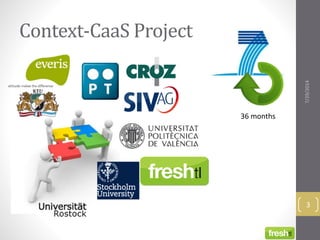
Context-CaaS Project
7/29/2014
3
36 months
Context-Business Capability
• It is a way of linking enterprise aspects to software solutions.
• Several efforts include:
• information system agility1,2,
• service-orientation3,4,
• software process improvement5 and
• business-IT alignment6,7,8
7/29/2014
4
1. Sambamurthy, V., A. Bharadwaj, and V. Grover, Shaping Agility through Digital Options: Reconceptualizing the Role of IT in Contemporary Firms. MIS Quarterly, 2003.
27(2): p. 237-263.
2. Weill, P., M. Subramani, and M. Broadbent, IT Infrastructure for Strategic Agility. Sloan Management Review, 2002. 44(1): p. 57-65.
3. OPENGROUP. ArchiMate - Modelling Language for Enterprise Architecture, V2.0. 2012; Available from: https://www2.opengroup.org/ogsys/catalog/c118.
4. OPENGROUP. TOGAF - Enterprise Architecture Methodology, Version 9.1. 2012; Available from: http://www.opengroup.org/togaf/.
5. Curtis, B., B. Hefley, and S. Miller, People Capability Maturity Model (P-CMM) Version 2.0, Second Edition, 2009, SEI Institute, Carnegie Mellon University.
6. Danesh, M.H. and E. Yu, Modeling Dynamic Capabilities to Reason about Information Systems Flexibility, CAiSE 2014 (Submitted), 2014.
7. Ulrich, W. and M. Rosen, The Business Capability Map: Building a Foundation for Business/IT Alignment, 2012, Cutter Consortium for Business and Enterprise
Architecture.
8. Zdravkovic, J., J. Stirna, and M. Henkel, Modeling Business Capabilities and Context Dependent Delivery by Cloud Services, CAiSE 2013, 2013: Valencia, Spain.
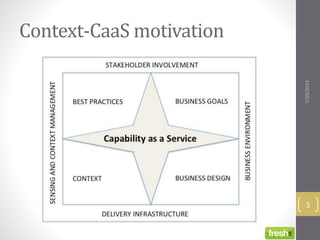
Context-CaaS motivation
7/29/2014
5
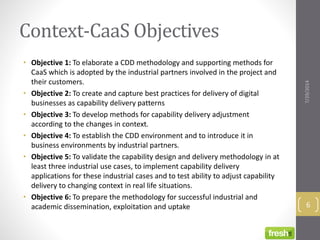
Context-CaaS Objectives
• Objective 1: To elaborate a CDD methodology and supporting methods for
CaaS which is adopted by the industrial partners involved in the project and
their customers.
• Objective 2: To create and capture best practices for delivery of digital
businesses as capability delivery patterns
• Objective 3: To develop methods for capability delivery adjustment
according to the changes in context.
• Objective 4: To establish the CDD environment and to introduce it in
business environments by industrial partners.
• Objective 5: To validate the capability design and delivery methodology in at
least three industrial use cases, to implement capability delivery
applications for these industrial cases and to test ability to adjust capability
delivery to changing context in real life situations.
• Objective 6: To prepare the methodology for successful industrial and
academic dissemination, exploitation and uptake
7/29/2014
6
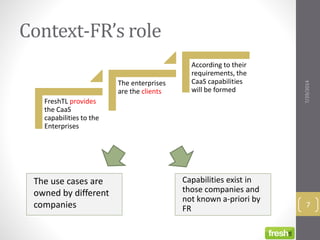
Context-FR’s role
7/29/2014
7
FreshTL provides
the CaaS
capabilities to the
Enterprises
The enterprises
are the clients
According to their
requirements, the
CaaS capabilities
will be formed
Capabilities exist in
those companies and
not known a-priori by
FR
The use cases are
owned by different
companies
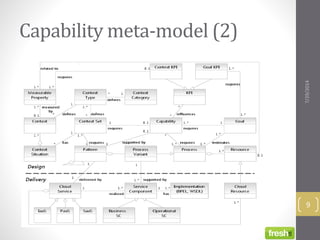
Capability meta-model (1)
Early version of the CaaS framework
The focus of the meta-model (core components):
representation of Goals
Processes realizing Goals using required Resources
Capability
Context
KPIs (measure the achievements of goals)
Capability formulates the requirements for the ability of
accomplishing a Goal, realized by applying a solution described
by a capability delivery Pattern. This realization requires certain
business Processes, Process Variants and Resources, such as
infrastructure or IT components.
7/29/2014
8
Capability meta-model (2)
7/29/2014
9
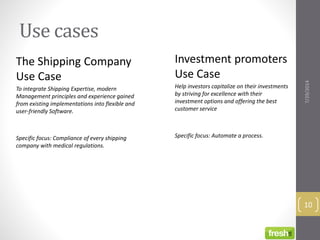
Use cases
The Shipping Company
Use Case
To integrate Shipping Expertise, modern
Management principles and experience gained
from existing implementations into flexible and
user-friendly Software.
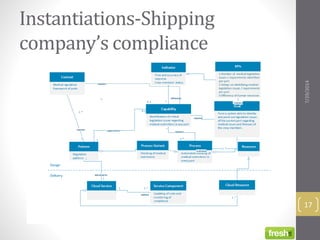
Specific focus: Compliance of every shipping
company with medical regulations.
Investment promoters
Use Case
Help investors capitalize on their investments
by striving for excellence with their
investment options and offering the best
customer service
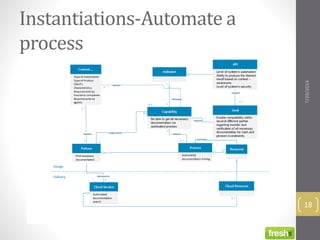
Specific focus: Automate a process.
7/29/2014
10
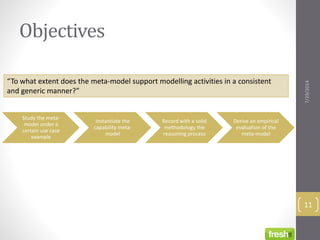
Objectives
7/29/2014
11
Study the meta-
model under a
certain use case
example
Instantiate the
capability meta-
model
Record with a solid
methodology the
reasoning process
Derive an empirical
evaluation of the
meta-model
“To what extent does the meta-model support modelling activities in a consistent
and generic manner?”
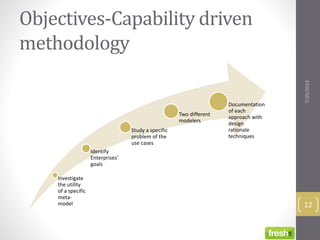
Objectives-Capability driven
methodology
Investigate
the utility
of a specific
meta-
model
Identify
Enterprises’
goals
Study a specific
problem of the
use cases
Two different
modelers
Documentation
of each
approach with
design
rationale
techniques
7/29/2014
12
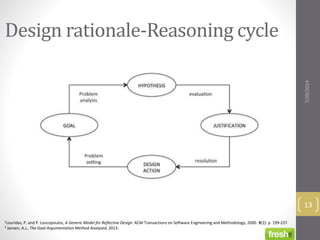
Design rationale-Reasoning cycle
1Louridas, P. and P. Loucopoulos, A Generic Model for Reflective Design. ACM Transactions on Software Engineering and Methodology, 2000. 9(2): p. 199-237.
2 Jansen, A.J., The Goal Argumentation Method Analyzed, 2013.
7/29/2014
13
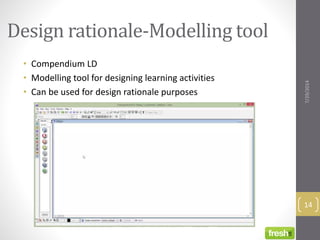
Design rationale-Modelling tool
• Compendium LD
• Modelling tool for designing learning activities
• Can be used for design rationale purposes
7/29/2014
14
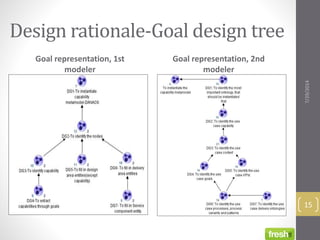
Design rationale-Goal design tree
Goal representation, 1st
modeler
Goal representation, 2nd
modeler
7/29/2014
15
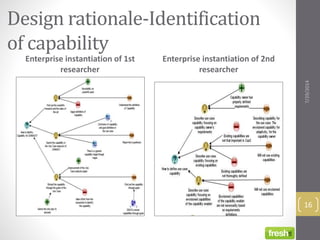
Design rationale-Identification
of capability
Enterprise instantiation of 1st
researcher
Enterprise instantiation of 2nd
researcher
7/29/2014
16
Instantiations-Shipping
company’s compliance
7/29/2014
17
Instantiations-Automate a
process
7/29/2014
18
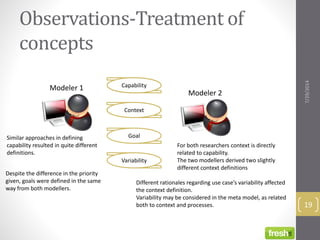
Observations-Treatment of
concepts
7/29/2014
19
Modeler 1
Modeler 2
Capability
Context
Goal
Variability
Similar approaches in defining
capability resulted in quite different
definitions.
For both researchers context is directly
related to capability.
The two modellers derived two slightly
different context definitions
Despite the difference in the priority
given, goals were defined in the same
way from both modellers.
Different rationales regarding use case’s variability affected
the context definition.
Variability may be considered in the meta model, as related
both to context and processes.
Observations-Approach to the
process of modelling
7/29/2014
20
Modeler 1
Modeler 2Method guidance
Validating model
quality
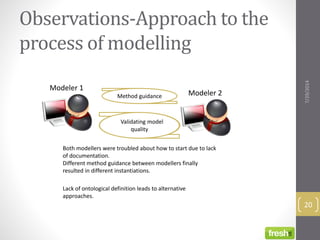
Both modellers were troubled about how to start due to lack
of documentation.
Different method guidance between modellers finally
resulted in different instantiations.
Lack of ontological definition leads to alternative
approaches.
Observations
7/29/2014
21
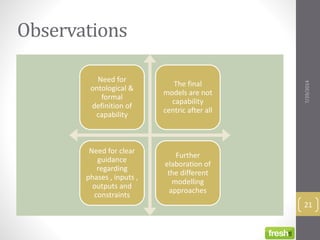
Capability Context
Key
factors
Need for
ontological &
formal
definition of
capability
The final
models are not
capability
centric after all
Need for clear
guidance
regarding
phases , inputs ,
outputs and
constraints
Further
elaboration of
the different
modelling
approaches
Contribution & Future work
7/29/2014
22
Provide feedback
to enhance the
capability meta-
model
Improvement of
capability driven
design activities
? HOW ?
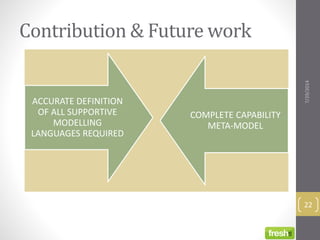
ACCURATE DEFINITION
OF ALL SUPPORTIVE
MODELLING
LANGUAGES REQUIRED
COMPLETE CAPABILITY
META-MODEL
QUESTIONS?
7/29/2014
23

COBI 2014 - An Empirical Evaluation of Capability Modelling using Design Rationale:

  • 1.
    An Empirical Evaluation ofCapability Modelling using Design Rationale George Bravos , Pericles Loucopoulos, Christina Stratigaki, Dimitris Valvis Fresh TL-Harokopio University
  • 2.
    Overview Context Capability meta-model Use cases Objectives Designrationale Instantiations Observations Contribution & Future work 7/29/2014 2
  • 3.
  • 4.
    Context-Business Capability • Itis a way of linking enterprise aspects to software solutions. • Several efforts include: • information system agility1,2, • service-orientation3,4, • software process improvement5 and • business-IT alignment6,7,8 7/29/2014 4 1. Sambamurthy, V., A. Bharadwaj, and V. Grover, Shaping Agility through Digital Options: Reconceptualizing the Role of IT in Contemporary Firms. MIS Quarterly, 2003. 27(2): p. 237-263. 2. Weill, P., M. Subramani, and M. Broadbent, IT Infrastructure for Strategic Agility. Sloan Management Review, 2002. 44(1): p. 57-65. 3. OPENGROUP. ArchiMate - Modelling Language for Enterprise Architecture, V2.0. 2012; Available from: https://www2.opengroup.org/ogsys/catalog/c118. 4. OPENGROUP. TOGAF - Enterprise Architecture Methodology, Version 9.1. 2012; Available from: http://www.opengroup.org/togaf/. 5. Curtis, B., B. Hefley, and S. Miller, People Capability Maturity Model (P-CMM) Version 2.0, Second Edition, 2009, SEI Institute, Carnegie Mellon University. 6. Danesh, M.H. and E. Yu, Modeling Dynamic Capabilities to Reason about Information Systems Flexibility, CAiSE 2014 (Submitted), 2014. 7. Ulrich, W. and M. Rosen, The Business Capability Map: Building a Foundation for Business/IT Alignment, 2012, Cutter Consortium for Business and Enterprise Architecture. 8. Zdravkovic, J., J. Stirna, and M. Henkel, Modeling Business Capabilities and Context Dependent Delivery by Cloud Services, CAiSE 2013, 2013: Valencia, Spain.
  • 5.
  • 6.
    Context-CaaS Objectives • Objective1: To elaborate a CDD methodology and supporting methods for CaaS which is adopted by the industrial partners involved in the project and their customers. • Objective 2: To create and capture best practices for delivery of digital businesses as capability delivery patterns • Objective 3: To develop methods for capability delivery adjustment according to the changes in context. • Objective 4: To establish the CDD environment and to introduce it in business environments by industrial partners. • Objective 5: To validate the capability design and delivery methodology in at least three industrial use cases, to implement capability delivery applications for these industrial cases and to test ability to adjust capability delivery to changing context in real life situations. • Objective 6: To prepare the methodology for successful industrial and academic dissemination, exploitation and uptake 7/29/2014 6
  • 7.
    Context-FR’s role 7/29/2014 7 FreshTL provides theCaaS capabilities to the Enterprises The enterprises are the clients According to their requirements, the CaaS capabilities will be formed Capabilities exist in those companies and not known a-priori by FR The use cases are owned by different companies
  • 8.
    Capability meta-model (1) Earlyversion of the CaaS framework The focus of the meta-model (core components): representation of Goals Processes realizing Goals using required Resources Capability Context KPIs (measure the achievements of goals) Capability formulates the requirements for the ability of accomplishing a Goal, realized by applying a solution described by a capability delivery Pattern. This realization requires certain business Processes, Process Variants and Resources, such as infrastructure or IT components. 7/29/2014 8
  • 9.
  • 10.
    Use cases The ShippingCompany Use Case To integrate Shipping Expertise, modern Management principles and experience gained from existing implementations into flexible and user-friendly Software. Specific focus: Compliance of every shipping company with medical regulations. Investment promoters Use Case Help investors capitalize on their investments by striving for excellence with their investment options and offering the best customer service Specific focus: Automate a process. 7/29/2014 10
  • 11.
    Objectives 7/29/2014 11 Study the meta- modelunder a certain use case example Instantiate the capability meta- model Record with a solid methodology the reasoning process Derive an empirical evaluation of the meta-model “To what extent does the meta-model support modelling activities in a consistent and generic manner?”
  • 12.
    Objectives-Capability driven methodology Investigate the utility ofa specific meta- model Identify Enterprises’ goals Study a specific problem of the use cases Two different modelers Documentation of each approach with design rationale techniques 7/29/2014 12
  • 13.
    Design rationale-Reasoning cycle 1Louridas,P. and P. Loucopoulos, A Generic Model for Reflective Design. ACM Transactions on Software Engineering and Methodology, 2000. 9(2): p. 199-237. 2 Jansen, A.J., The Goal Argumentation Method Analyzed, 2013. 7/29/2014 13
  • 14.
    Design rationale-Modelling tool •Compendium LD • Modelling tool for designing learning activities • Can be used for design rationale purposes 7/29/2014 14
  • 15.
    Design rationale-Goal designtree Goal representation, 1st modeler Goal representation, 2nd modeler 7/29/2014 15
  • 16.
    Design rationale-Identification of capability Enterpriseinstantiation of 1st researcher Enterprise instantiation of 2nd researcher 7/29/2014 16
  • 17.
  • 18.
  • 19.
    Observations-Treatment of concepts 7/29/2014 19 Modeler 1 Modeler2 Capability Context Goal Variability Similar approaches in defining capability resulted in quite different definitions. For both researchers context is directly related to capability. The two modellers derived two slightly different context definitions Despite the difference in the priority given, goals were defined in the same way from both modellers. Different rationales regarding use case’s variability affected the context definition. Variability may be considered in the meta model, as related both to context and processes.
  • 20.
    Observations-Approach to the processof modelling 7/29/2014 20 Modeler 1 Modeler 2Method guidance Validating model quality Both modellers were troubled about how to start due to lack of documentation. Different method guidance between modellers finally resulted in different instantiations. Lack of ontological definition leads to alternative approaches.
  • 21.
    Observations 7/29/2014 21 Capability Context Key factors Need for ontological& formal definition of capability The final models are not capability centric after all Need for clear guidance regarding phases , inputs , outputs and constraints Further elaboration of the different modelling approaches
  • 22.
    Contribution & Futurework 7/29/2014 22 Provide feedback to enhance the capability meta- model Improvement of capability driven design activities ? HOW ? ACCURATE DEFINITION OF ALL SUPPORTIVE MODELLING LANGUAGES REQUIRED COMPLETE CAPABILITY META-MODEL
  • 23.