SEMANTIC WEB
SERVICES
META-MODEL
Agenda
 Classical Web Services
 The Vision
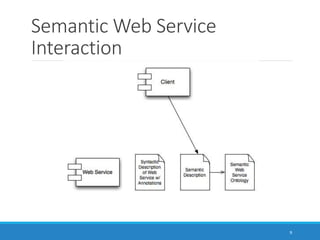
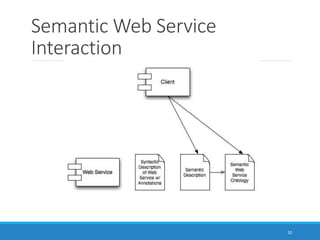
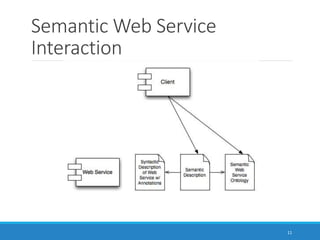
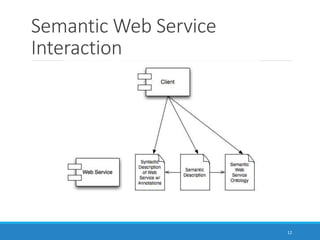
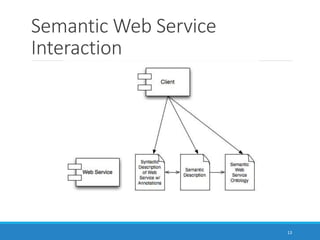
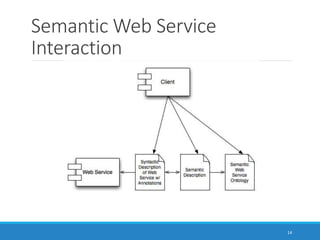
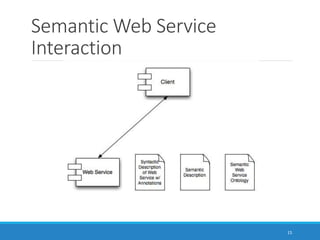
 Semantic Web Service Interaction
 Some Existing Standards
 New Approach
 Meta-model Definition & Building
 Example
2
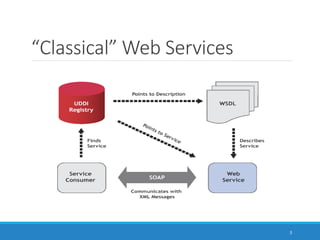
“Classical” Web Services
3
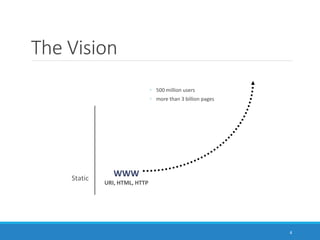
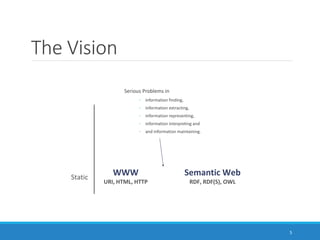
The Vision
Static
◦ 500 million users
◦ more than 3 billion pages
WWW
URI, HTML, HTTP
4
The Vision
WWW
URI, HTML, HTTP
Serious Problems in
◦ information finding,
◦ information extracting,
◦ information representing,
◦ information interpreting and
◦ and information maintaining.
Semantic Web
RDF, RDF(S), OWL
Static
5
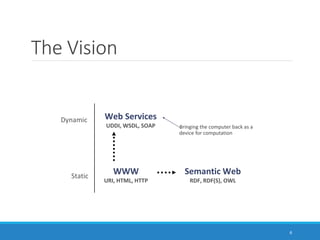
The Vision
WWW
URI, HTML, HTTP
Bringing the computer back as a
device for computation
Semantic Web
RDF, RDF(S), OWL
Dynamic Web Services
UDDI, WSDL, SOAP
Static
6
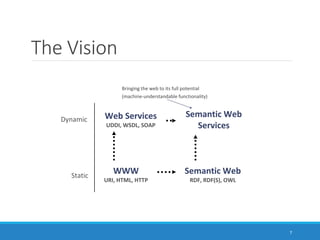
The Vision
WWW
URI, HTML, HTTP
Bringing the web to its full potential
(machine-understandable functionality)
Semantic Web
RDF, RDF(S), OWL
Dynamic Web Services
UDDI, WSDL, SOAP
Static
Semantic Web
Services
7
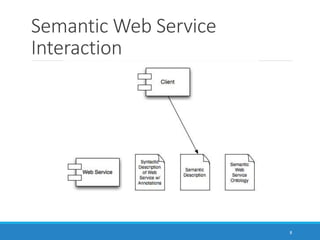
Semantic Web Service
Interaction
8
Semantic Web Service
Interaction
9
Semantic Web Service
Interaction
10
Semantic Web Service
Interaction
11
Semantic Web Service
Interaction
12
Semantic Web Service
Interaction
13
Semantic Web Service
Interaction
14
Semantic Web Service
Interaction
15
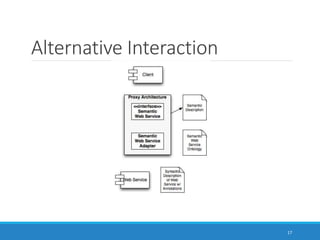
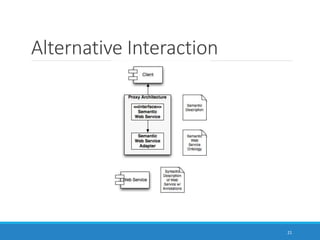
Alternative Interaction
16
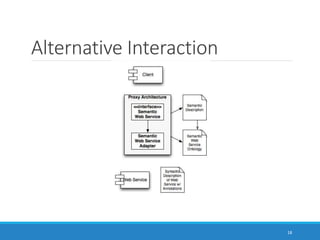
Alternative Interaction
17
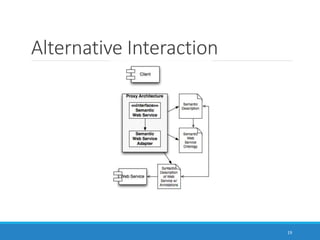
Alternative Interaction
18
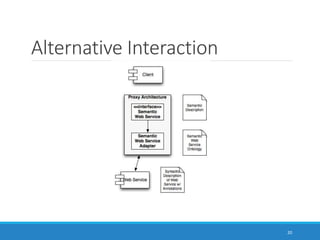
Alternative Interaction
19
Alternative Interaction
20
Alternative Interaction
21
Some Existing Standards
 OWL-S
 WSMO
22
OWL-S
 Semantic markup for web services
 Enables discovery of services that:
o Meet particular requirements
o Adhere to specified constraints
 Invocation by:
o Agents
o Other services
 Automated service composition
o Provide new services
23
OWL-S
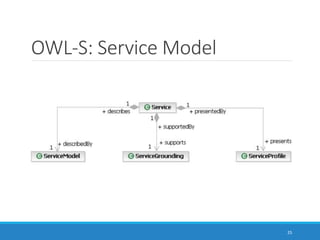
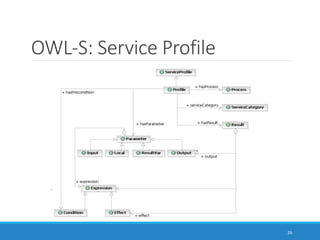
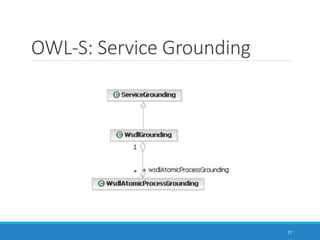
 SWS in OWL-S consists of:
o Service profile
o Description of what the system does
o Used to advertise the service
o Service model
o How it works internally
o Service grounding
o How to access and interact with it
24
OWL-S: Service Model
25
OWL-S: Service Profile
26
OWL-S: Service Grounding
27
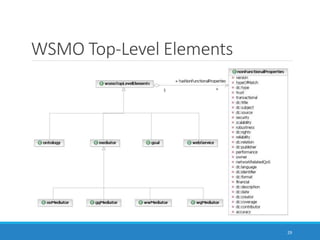
Web Service Modeling Ontology
(WSMO)
 Formal ontology & language
 Consists of 4 main elements:
o Ontologies
o Goals
o Web services
o Mediators
 Comes with a modeling language called WSML
 Most of the elements in WSMO can be described with non-functional
properties
28
WSMO Top-Level Elements
29
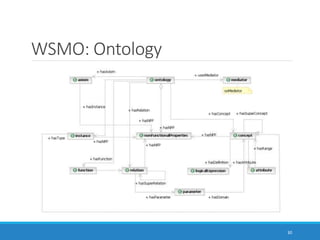
WSMO: Ontology
30
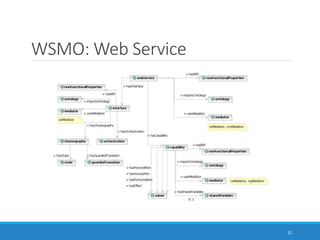
WSMO: Web Service
31
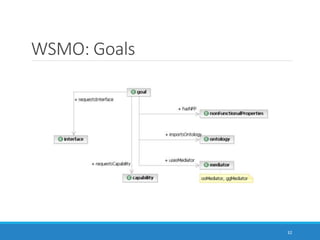
WSMO: Goals
32
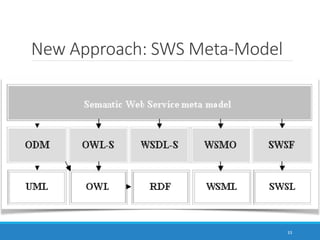
New Approach: SWS Meta-Model
33
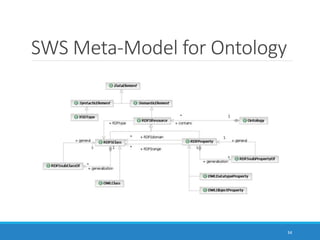
SWS Meta-Model for Ontology
34
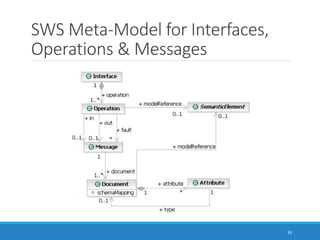
SWS Meta-Model for Interfaces,
Operations & Messages
35
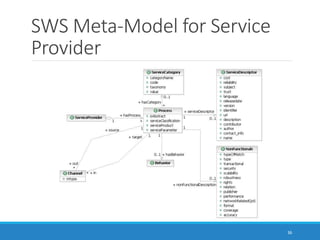
SWS Meta-Model for Service
Provider
36
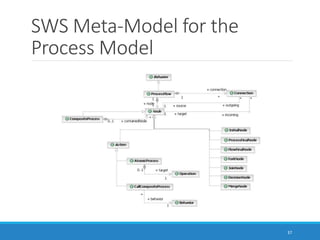
SWS Meta-Model for the
Process Model
37
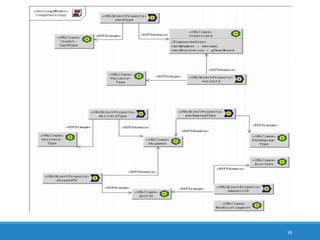
Example: CongoBuy
38
 Bookbuying company
o www.congo.com
39
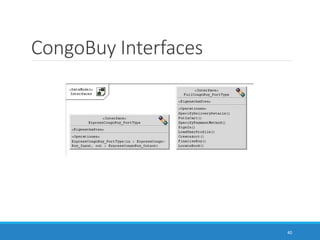
CongoBuy Interfaces
40
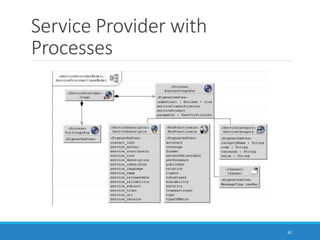
Service Provider with
Processes
41
Thank you!
PRESENTED BY
42
Abdalmassih Yakeen
SUPERVISOR
Dr. Bassem Qussaybah

Semantic Web Services Meta-model

Editor's Notes

  • #28 The grounding of a service specifies the details of how to access the service – details having mainly to do with protocol and message formats, serialization, transport and addressing. Only the service grounding deals with the concrete level of specification, the service profile and model are only thought of as abstract representations. The main aim of grounding is to concretely realize the inputs and outputs of an atomic process as messages. These further carry the inputs and outputs in a specific defined communicable form.
  • #29 Ontologies: They provide the terminology used by other elements to describe the relevant aspects of the domains of discourse. - Goals: They state the intentions that should be solved by web services and are representations of one or more objectives which need to be fulfilled. - Web Services: A Web Service is a computational entity which is able to achieve a part of or the complete goals a user seeks to fulfill. WSMO web service descriptions describe various aspects of a service and consist of functional, non-functional and the behavioral aspects of a web service. - Mediators to resolve interoperability problems. They describe elements to overcome interoperability and incompatibility problems between different elements on data (ooMediator), process (ggMediator, wgMediator) and protocol level (wwMediator).
  • #30 Ontologies: They provide the terminology used by other elements to describe the relevant aspects of the domains of discourse. - Goals: They state the intentions that should be solved by web services and are representations of one or more objectives which need to be fulfilled. - Web Services: A Web Service is a computational entity which is able to achieve a part of or the complete goals a user seeks to fulfill. WSMO web service descriptions describe various aspects of a service and consist of functional, non-functional and the behavioral aspects of a web service. - Mediators to resolve interoperability problems. They describe elements to overcome interoperability and incompatibility problems between different elements on data (ooMediator), process (ggMediator, wgMediator) and protocol level (wwMediator).
  • #31 The ontology in WSMO consists mostly of concepts, attributes and instances. Each of them can be described using non-functional properties. Concepts can build a taxonomy and are linked to other concepts using attributes. There can be functions and relations using these concepts as parameter and axioms which are logical expressions together with their non-functional properties.
  • #32 Each web service in WSMO builds on one or more ontologies and might use mediators to translate between several ontologies or web services. They are described using interfaces and capabilities. The interface for a complex web service is characterized using the web service orchestration or choreography which is built using an abstract state machine (on states and transitions). The capability describes the functional parameters of the (one-step or multi-step) web service. It specifies the preconditions (the information state of the web service before execution), assumptions (the state of the world before execution), postconditions (the information state of the web service after its execution) and effects (the state of the world after execution).
  • #33 WSMO goals enable the possibility to model the intentions that should be solved by one or more web services. They describe an interface that should be implemented and capabilities that need to be fulfilled. Therefore, ontologies and mediators might be needed to achieve the goal.