
Prof Mike Muller
                                               Graduate School of Public and
                                                 Development Management
                                                            Wits University
Presentation given at IHP-HELP Centre for Water Law, Policy and Science, under the auspices of UNESCO, 21 st June 2011
What is meant by water security?
 Household?
   Reliable services
   Health
 Community?
   Resilience to disasters
   Vulnerability of economy
 National?
   survival of the state and nation?
 Environmental?
   Ecological survival, from local to planet
Framing the issue
A definition of water security
 ‘the reliable availability of an acceptable quantity and
  quality of water for health, livelihoods and production,
  coupled with an acceptable level of water-related risks.’
  Grey and Sadoff (2007).

 Not the same as ‘food security’ and ‘energy security’,
   reliable access to sufficient supplies.

 water security also captures destructive aspects of water
   floods and droughts
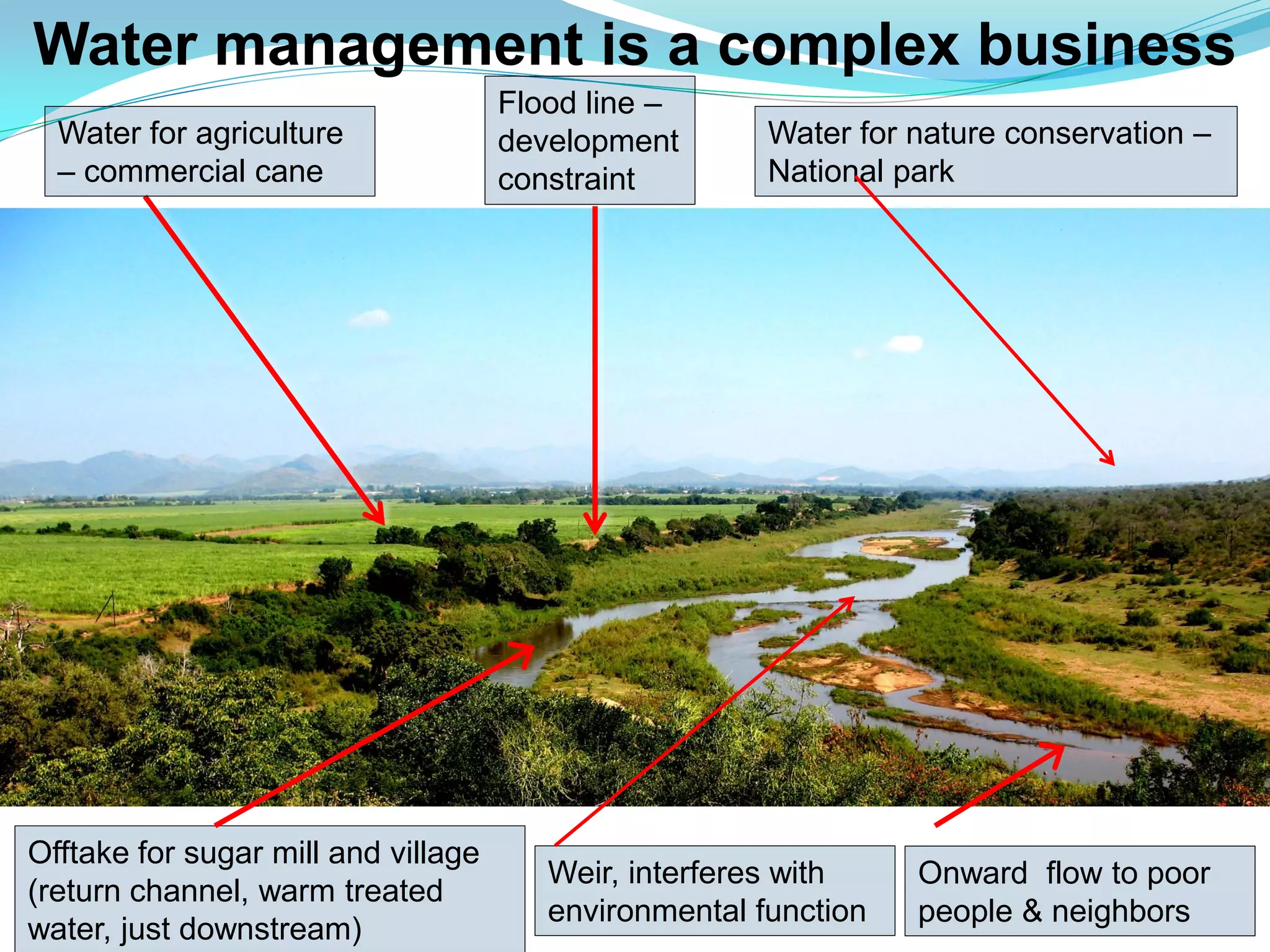
Water management is a complex business
                                     Flood line –
  Water for agriculture              development       Water for nature conservation –
  – commercial cane                  constraint        National park


Offtake for sugar mill and village
                                        Weir, interferes with    Onward flow to poor
(return channel, warm treated
                                        environmental function   people & neighbors
water, just downstream)
The regional water challenges
 Southern African countries already water stressed
 Likely to get worse, with climate and population
 Conflict inevitable
 Aggravating the challenges:-
    External land and water grabbing ,
    Biofuels promotion
    Loss of ecosystem services making people poorer
 Corruption will exacerbate situation
It’s already happening
 Conflict has happened:-
    invasion of Lesotho by South Africa
    Botswana and Namibia sabre-rattling over Okavango
 Dams and displaced people are a major problem
 China in Angola and Zambia
    Colonising land and water as well as minerals
 Corruption has undermined cooperation
    Lesotho and elsewhere
Part of the problem ?
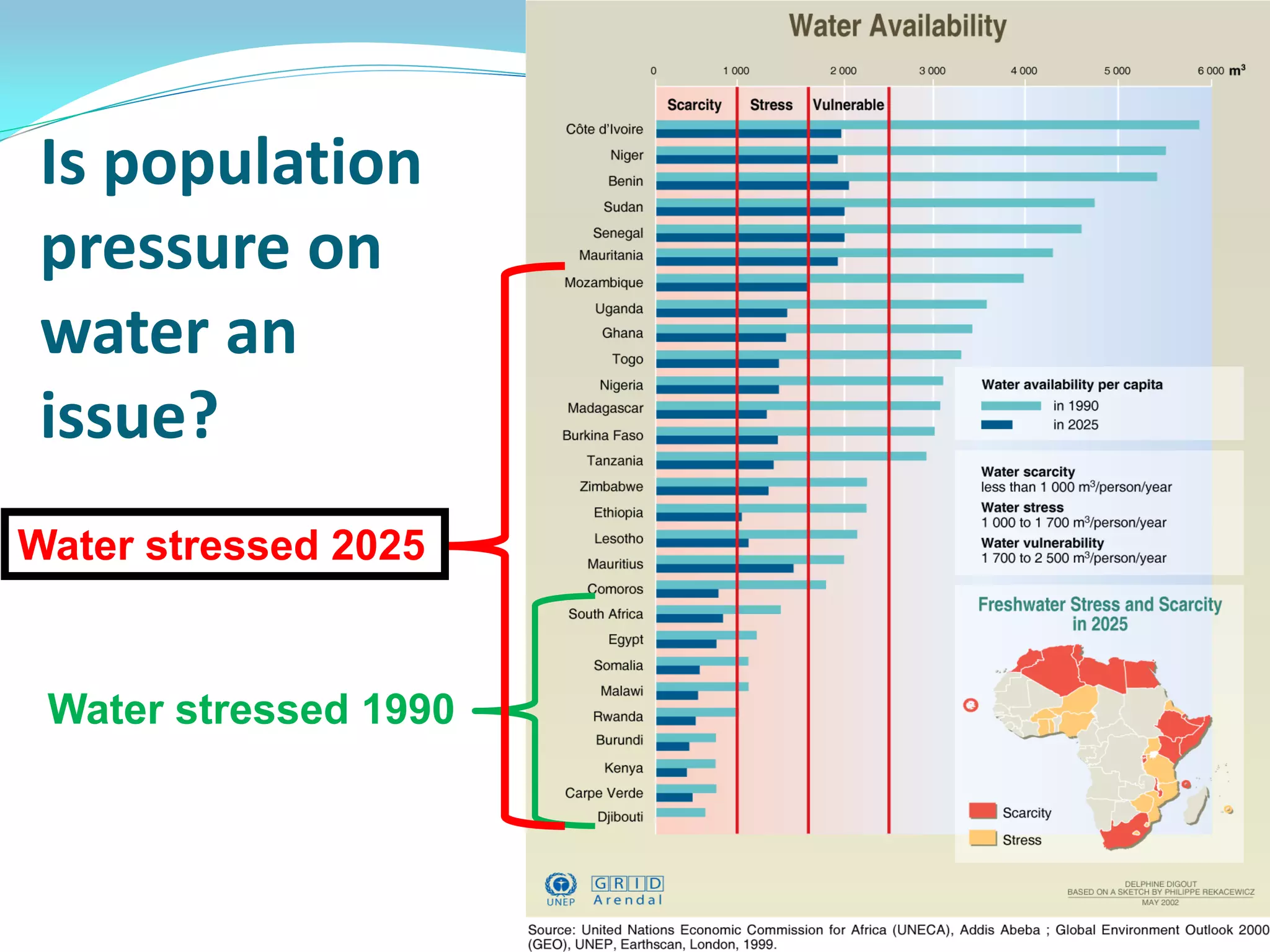
Is population
 pressure on
 water an
 issue?
Water stressed 2025


 Water stressed 1990
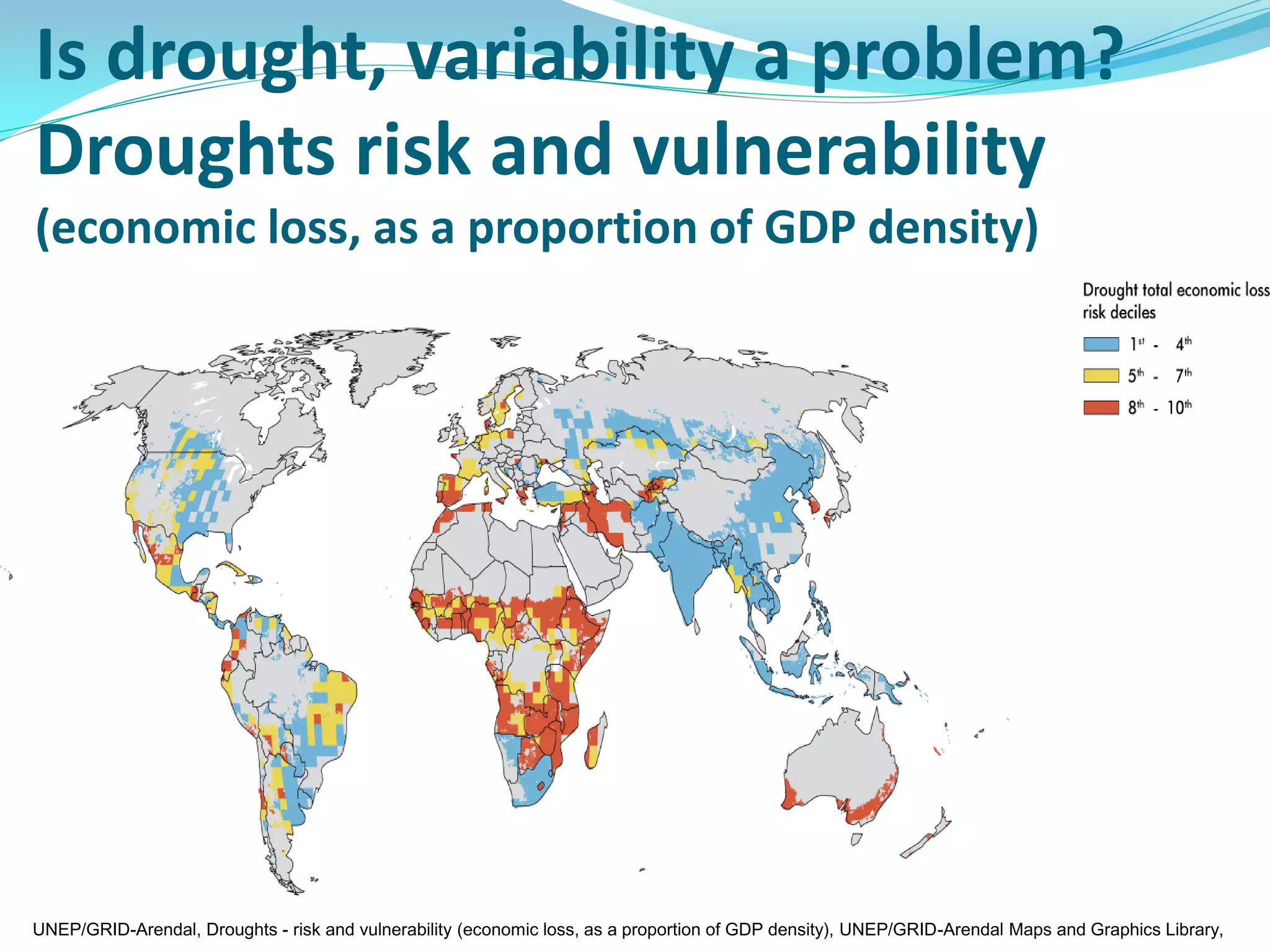
Is drought, variability a problem?
Droughts risk and vulnerability
(economic loss, as a proportion of GDP density)


UNEP/GRID-Arendal, Droughts - risk and vulnerability (economic loss, as a proportion of GDP density), UNEP/GRID-Arendal Maps and Graphics Library,
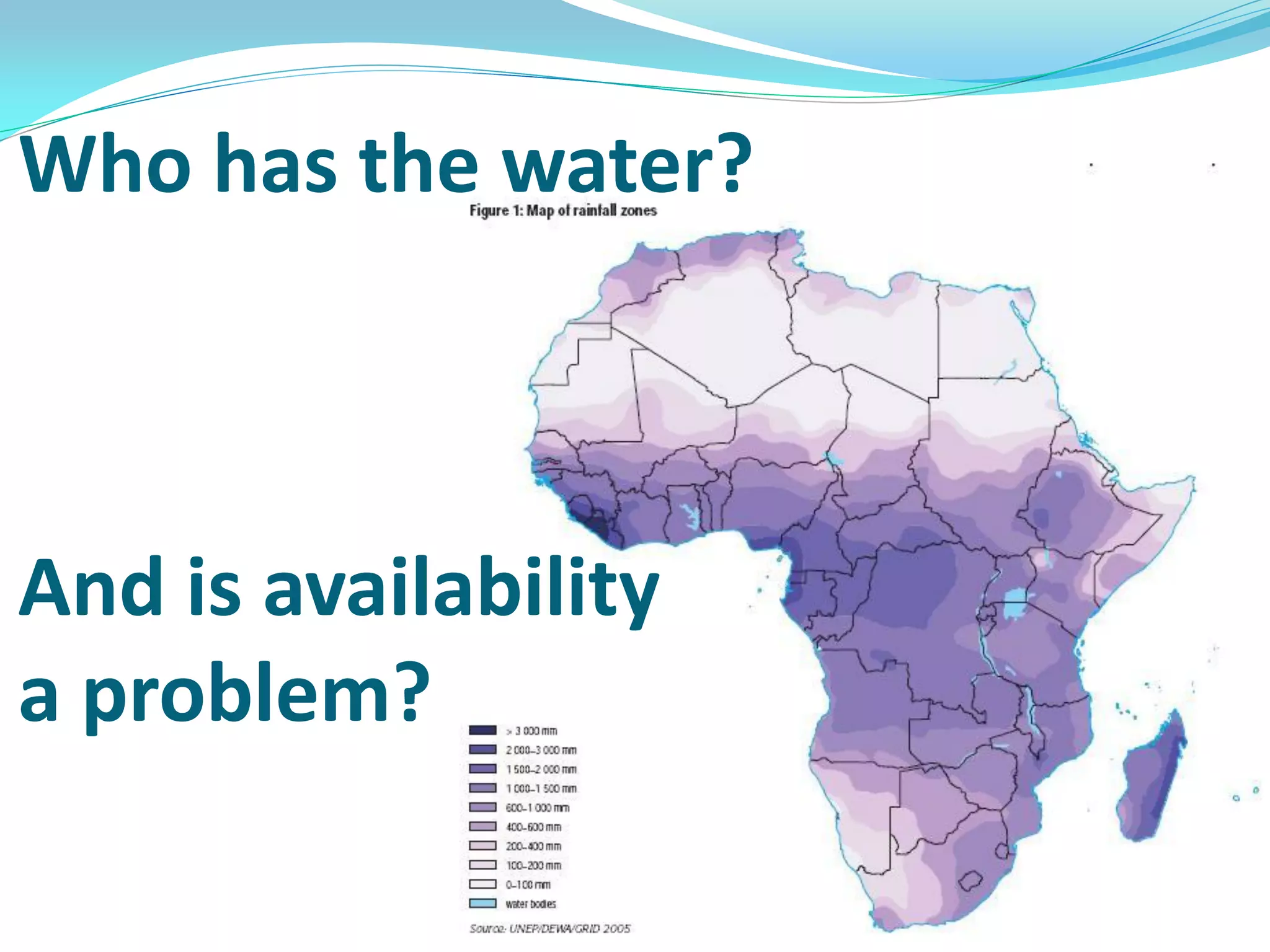
Who has the water?


And is availability
a problem?
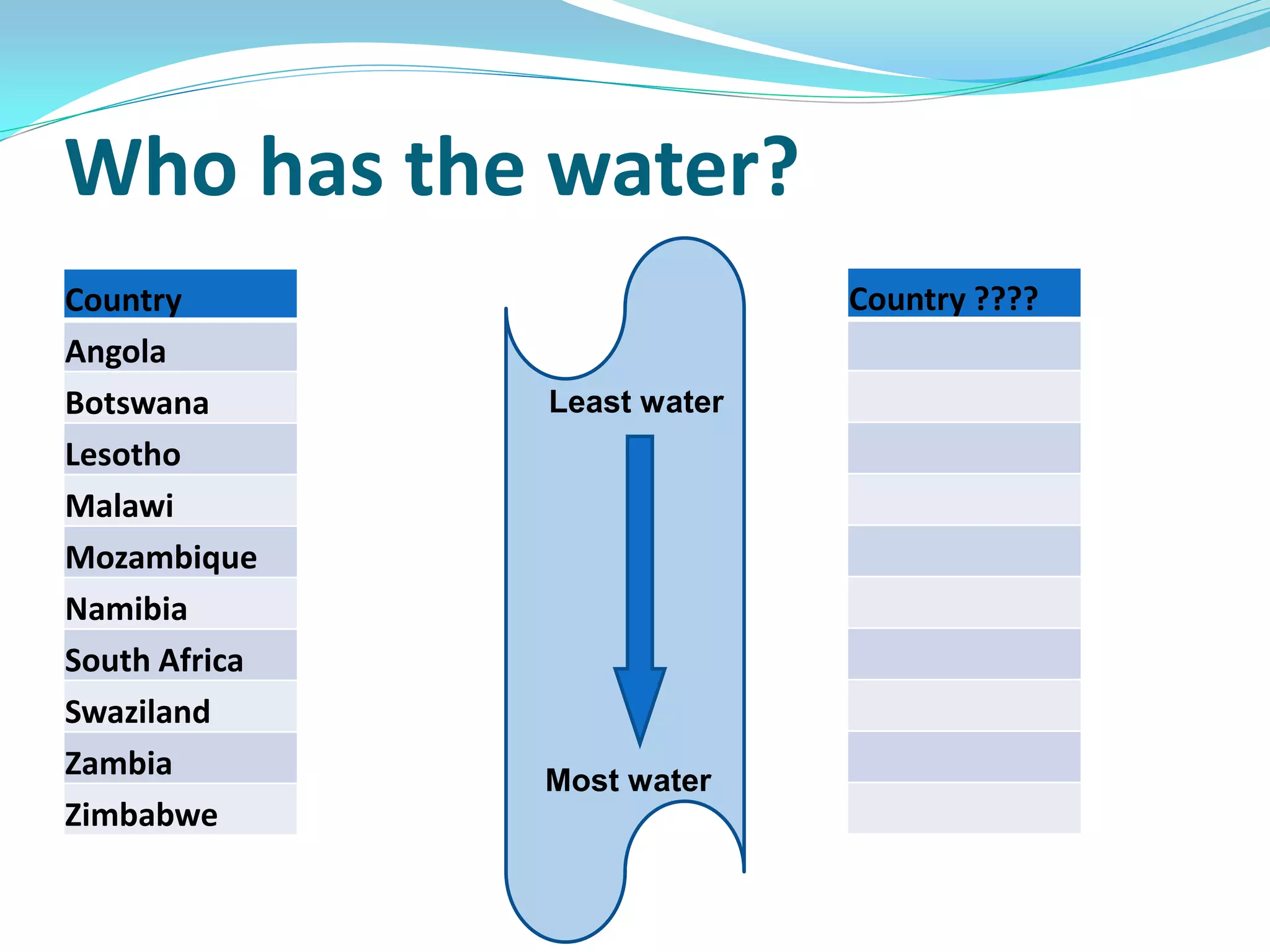
Who has the water?
Country                      Country ????
Angola
Botswana       Least water
Lesotho
Malawi
Mozambique
Namibia
South Africa
Swaziland
Zambia         Most water
Zimbabwe
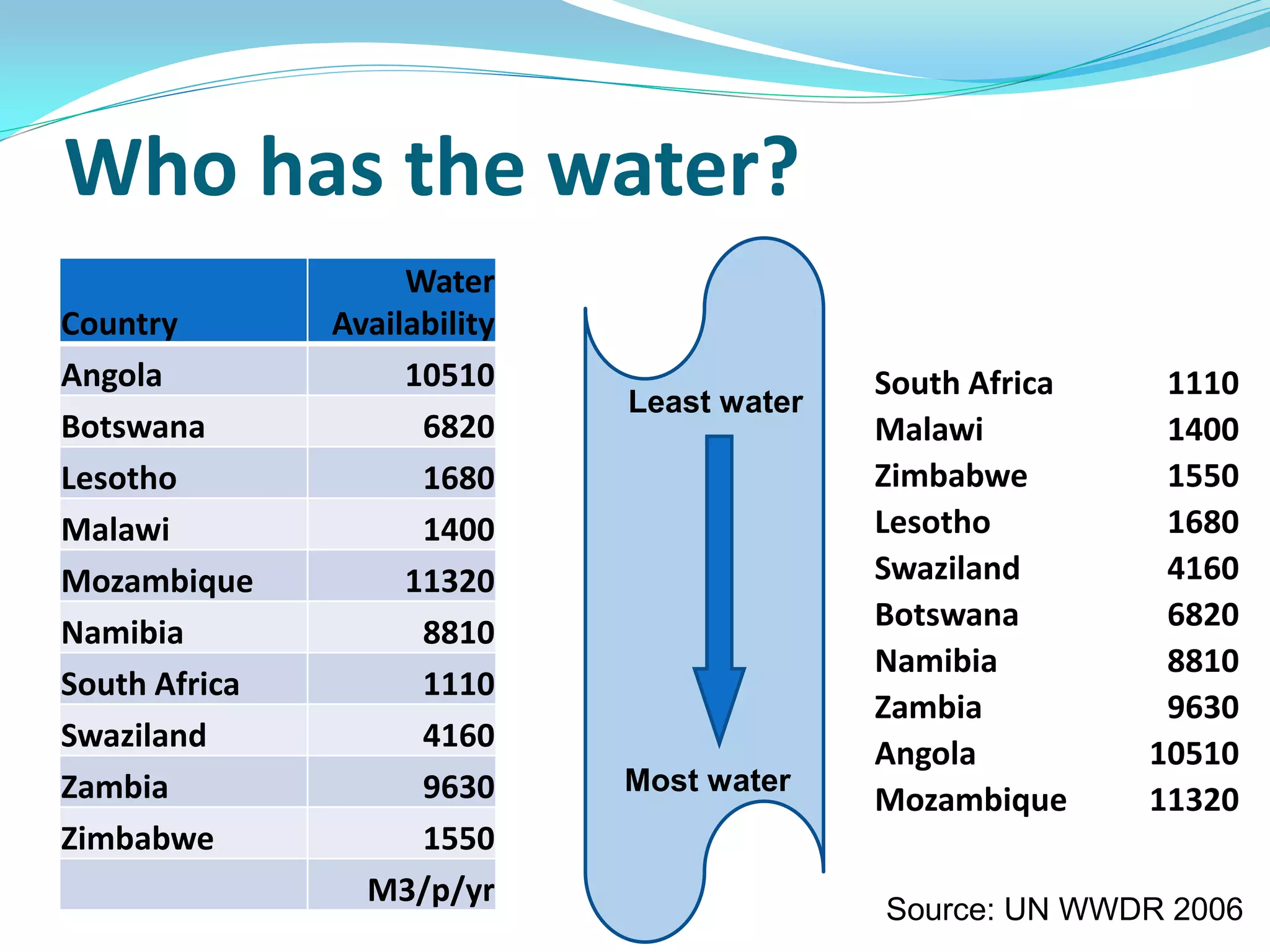
Who has the water?
                    Water
Country        Availability
Angola              10510                   South Africa    1110
                              Least water
Botswana             6820                   Malawi          1400
Lesotho              1680                   Zimbabwe        1550
Malawi               1400                   Lesotho         1680
Mozambique          11320                   Swaziland       4160
                                            Botswana        6820
Namibia              8810
                                            Namibia         8810
South Africa         1110
                                            Zambia          9630
Swaziland            4160
                                            Angola         10510
Zambia               9630     Most water
                                            Mozambique     11320
Zimbabwe             1550
                 M3/p/yr
                                            Source: UN WWDR 2006
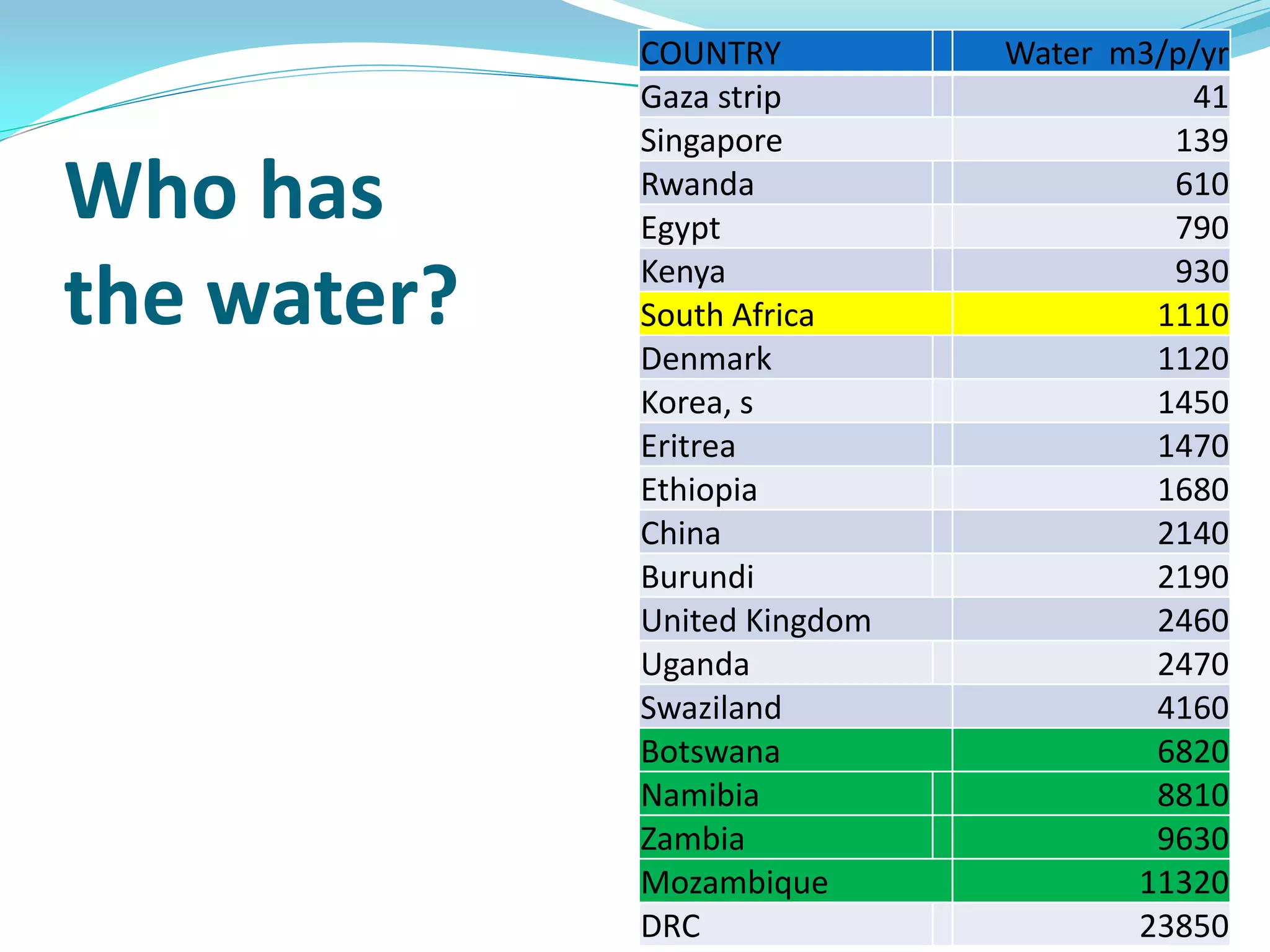
COUNTRY          Water m3/p/yr
             Gaza strip                 41
             Singapore                 139
Who has      Rwanda
             Egypt
                                       610
                                       790
             Kenya                     930
the water?   South Africa             1110
             Denmark                  1120
             Korea, s                 1450
             Eritrea                  1470
             Ethiopia                 1680
             China                    2140
             Burundi                  2190
             United Kingdom           2460
             Uganda                   2470
             Swaziland                4160
             Botswana                 6820
             Namibia                  8810
             Zambia                   9630
             Mozambique              11320
             DRC                     23850
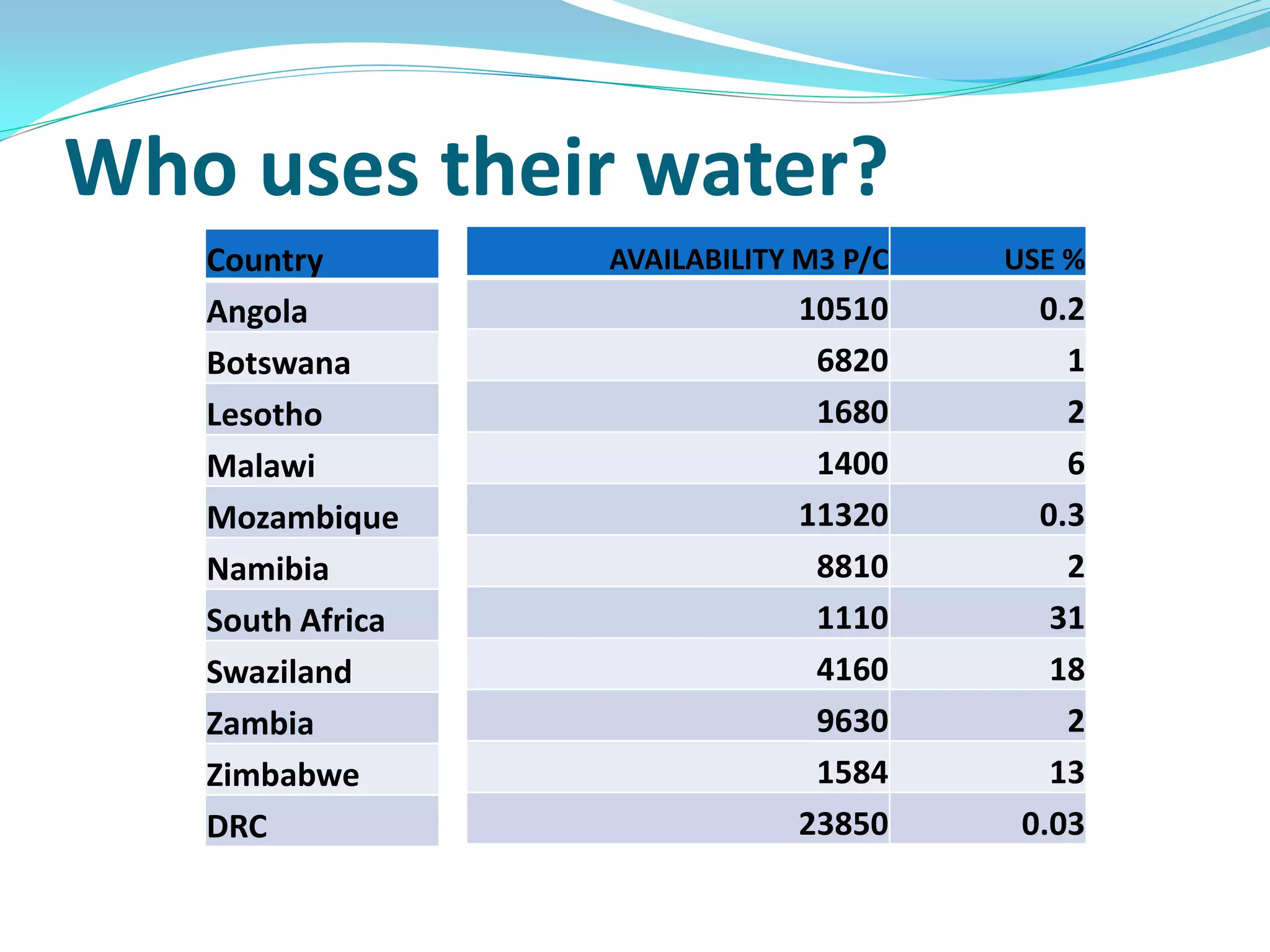
Who uses their water?
   Country        AVAILABILITY M3 P/C   USE %
   Angola                     10510       0.2
   Botswana                    6820         1
   Lesotho                     1680         2
   Malawi                      1400         6
   Mozambique                 11320       0.3
   Namibia                     8810         2
   South Africa                1110        31
   Swaziland                   4160        18
   Zambia                      9630         2
   Zimbabwe                    1584        13
   DRC                        23850      0.03
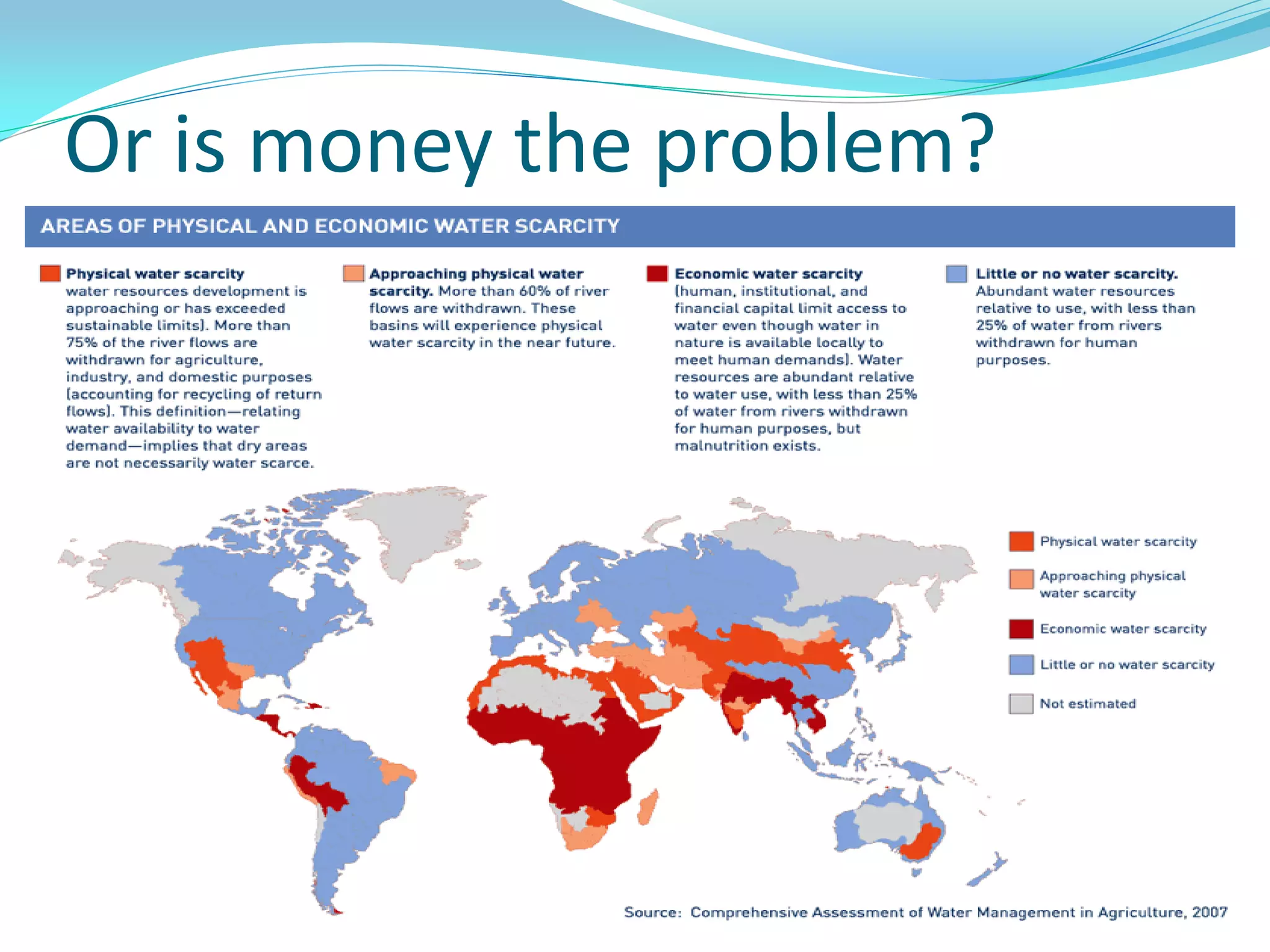
Or is money the problem?
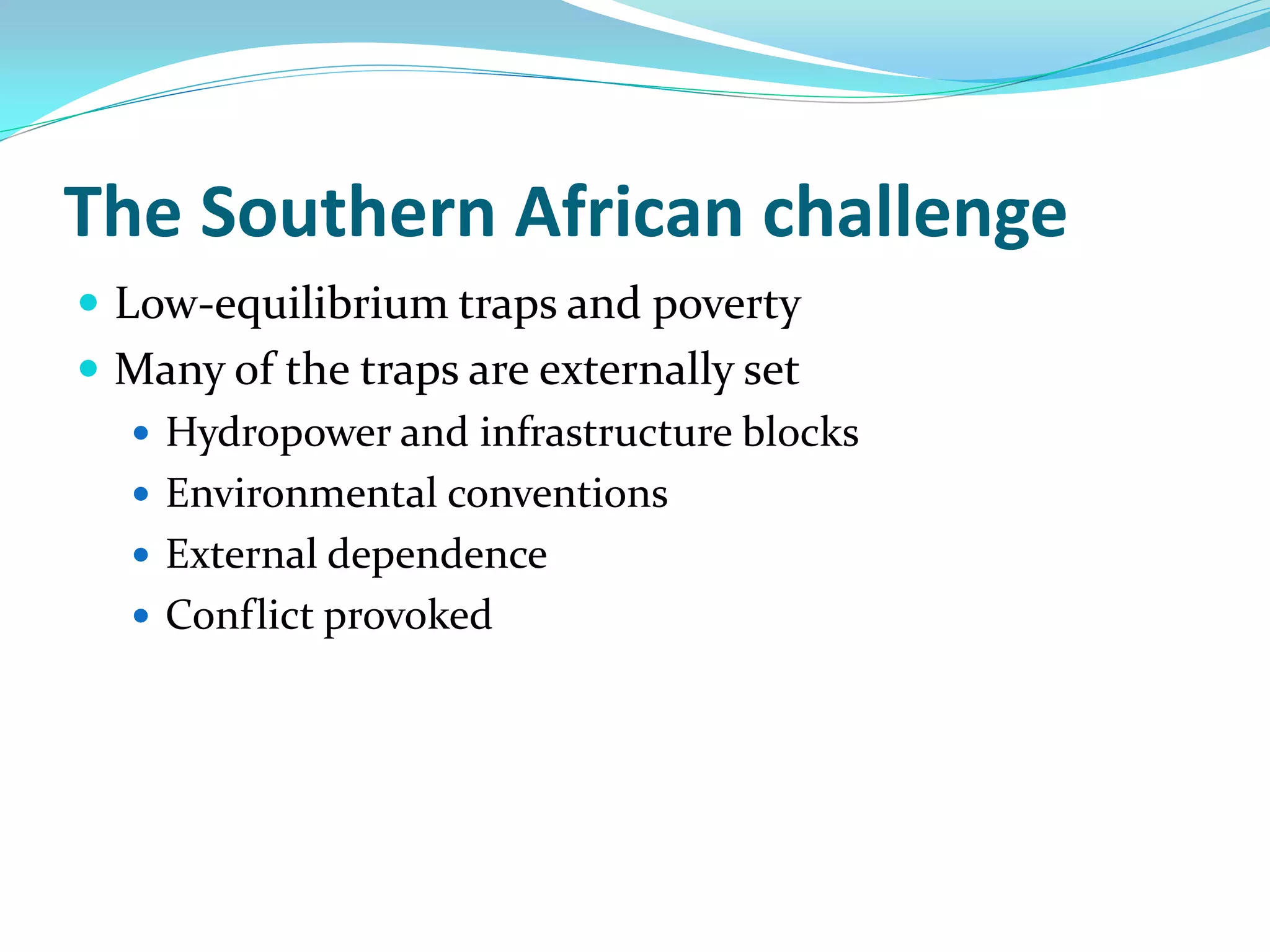
The Southern African challenge
 Low-equilibrium traps and poverty
 Many of the traps are externally set
   Hydropower and infrastructure blocks
   Environmental conventions
   External dependence
   Conflict provoked
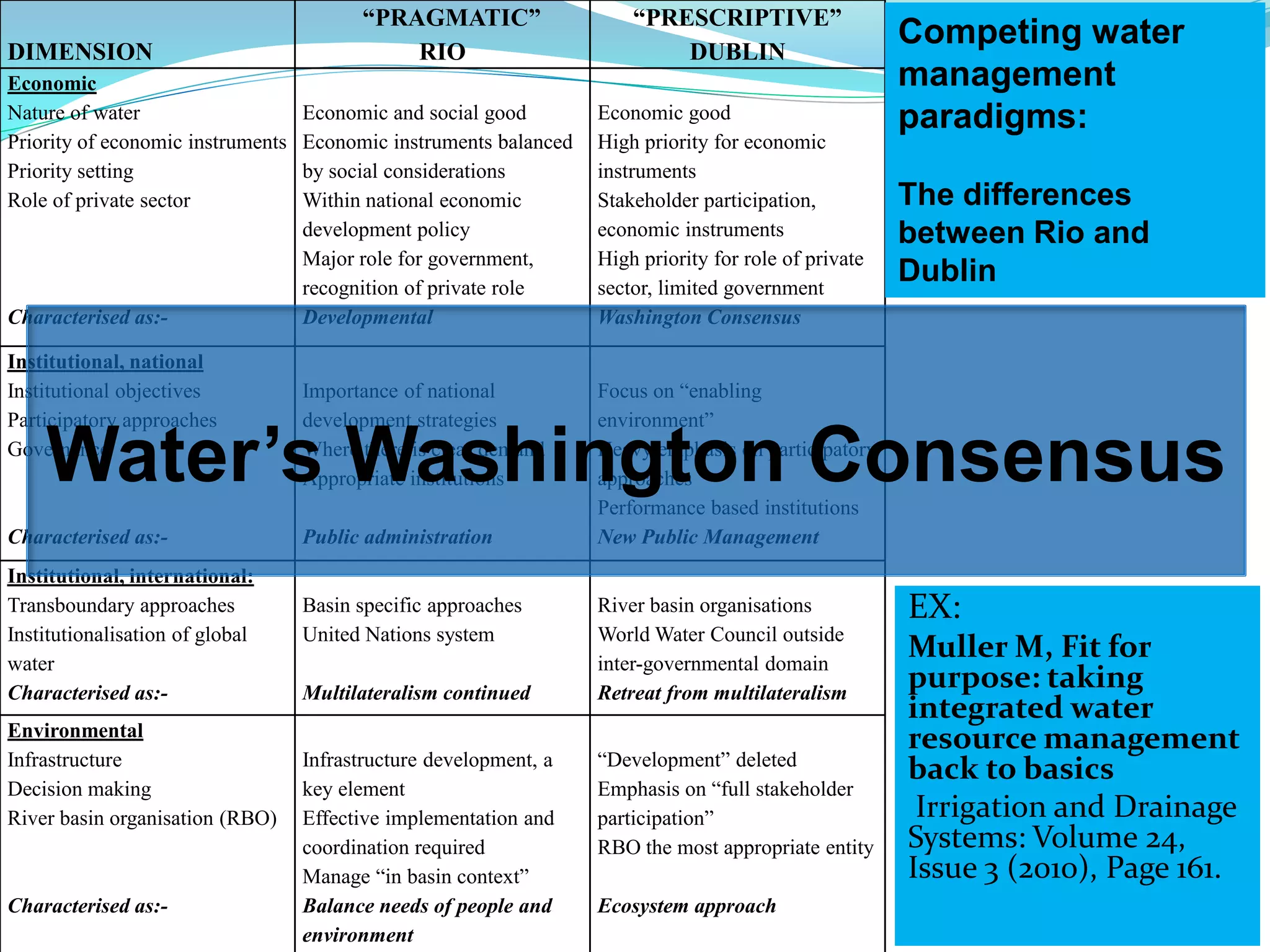
“PRAGMATIC”                   “PRESCRIPTIVE”
DIMENSION                                    RIO                           DUBLIN
                                                                                                       Competing water
Economic                                                                                               management
Nature of water                    Economic and social good        Economic good                       paradigms:
Priority of economic instruments   Economic instruments balanced   High priority for economic
Priority setting                   by social considerations        instruments
Role of private sector             Within national economic        Stakeholder participation,          The differences
                                   development policy              economic instruments                between Rio and
                                   Major role for government,      High priority for role of private
                                   recognition of private role     sector, limited government
                                                                                                       Dublin
Characterised as:-                 Developmental                   Washington Consensus

Institutional, national
Institutional objectives           Importance of national          Focus on “enabling
                                                                   environment”

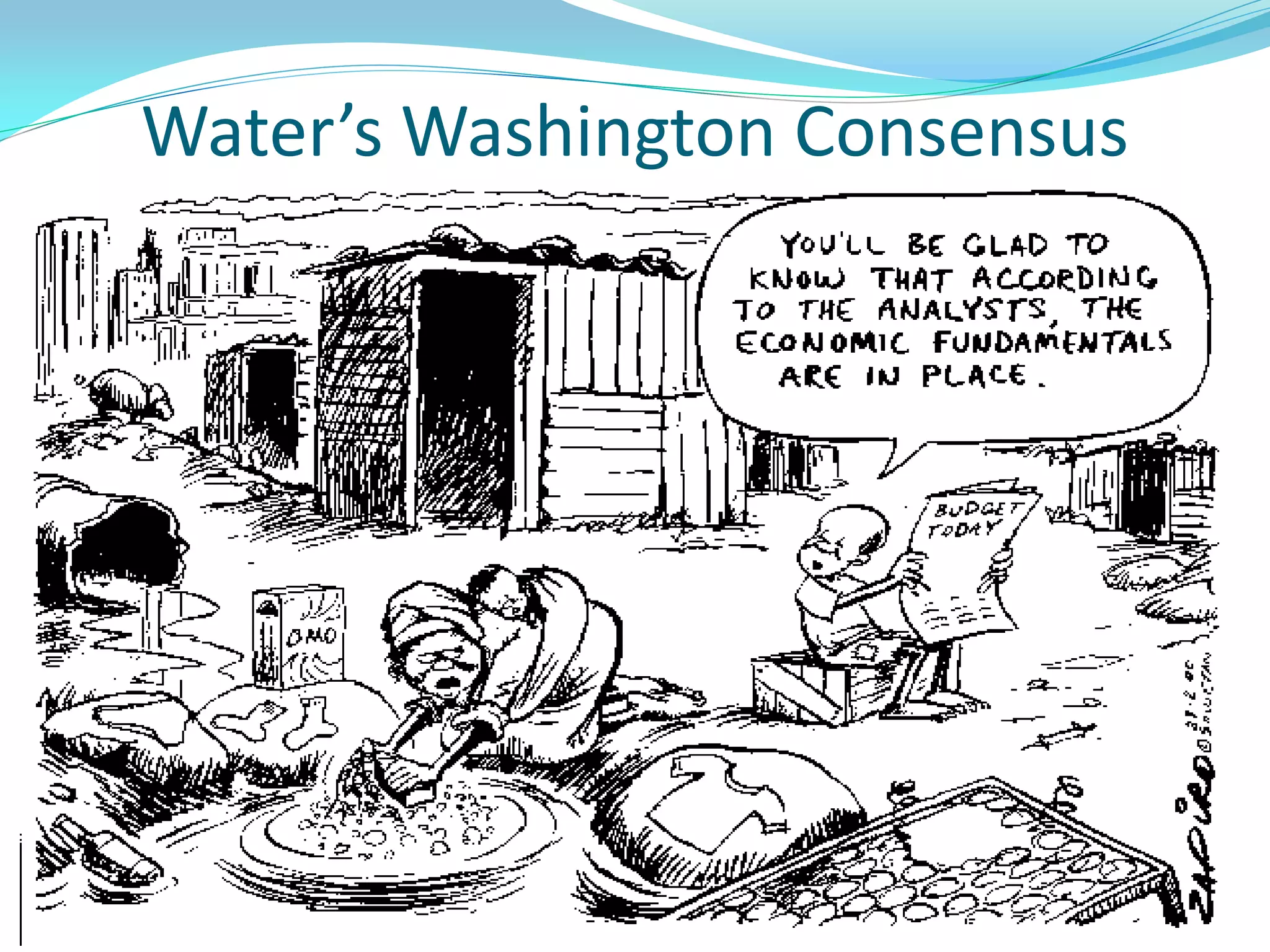
    Water’s Washington Consensus
Participatory approaches           development strategies
Governance                         Where there is clear demand     Heavy emphasis on participatory
                                   Appropriate institutions        approaches
                                                                   Performance based institutions
Characterised as:-                 Public administration           New Public Management
Institutional, international:
Transboundary approaches           Basin specific approaches       River basin organisations           EX:
Institutionalisation of global     United Nations system           World Water Council outside
water                                                              inter-governmental domain
                                                                                                       Muller M, Fit for
Characterised as:-                 Multilateralism continued       Retreat from multilateralism
                                                                                                       purpose: taking
                                                                                                       integrated water
Environmental
                                                                                                       resource management
Infrastructure                     Infrastructure development, a   “Development” deleted
                                                                                                       back to basics
Decision making                    key element                     Emphasis on “full stakeholder
River basin organisation (RBO)     Effective implementation and    participation”                       Irrigation and Drainage
                                   coordination required           RBO the most appropriate entity     Systems: Volume 24,
                                   Manage “in basin context”                                           Issue 3 (2010), Page 161.
Characterised as:-                 Balance needs of people and     Ecosystem approach
                                   environment
Water’s Washington Consensus
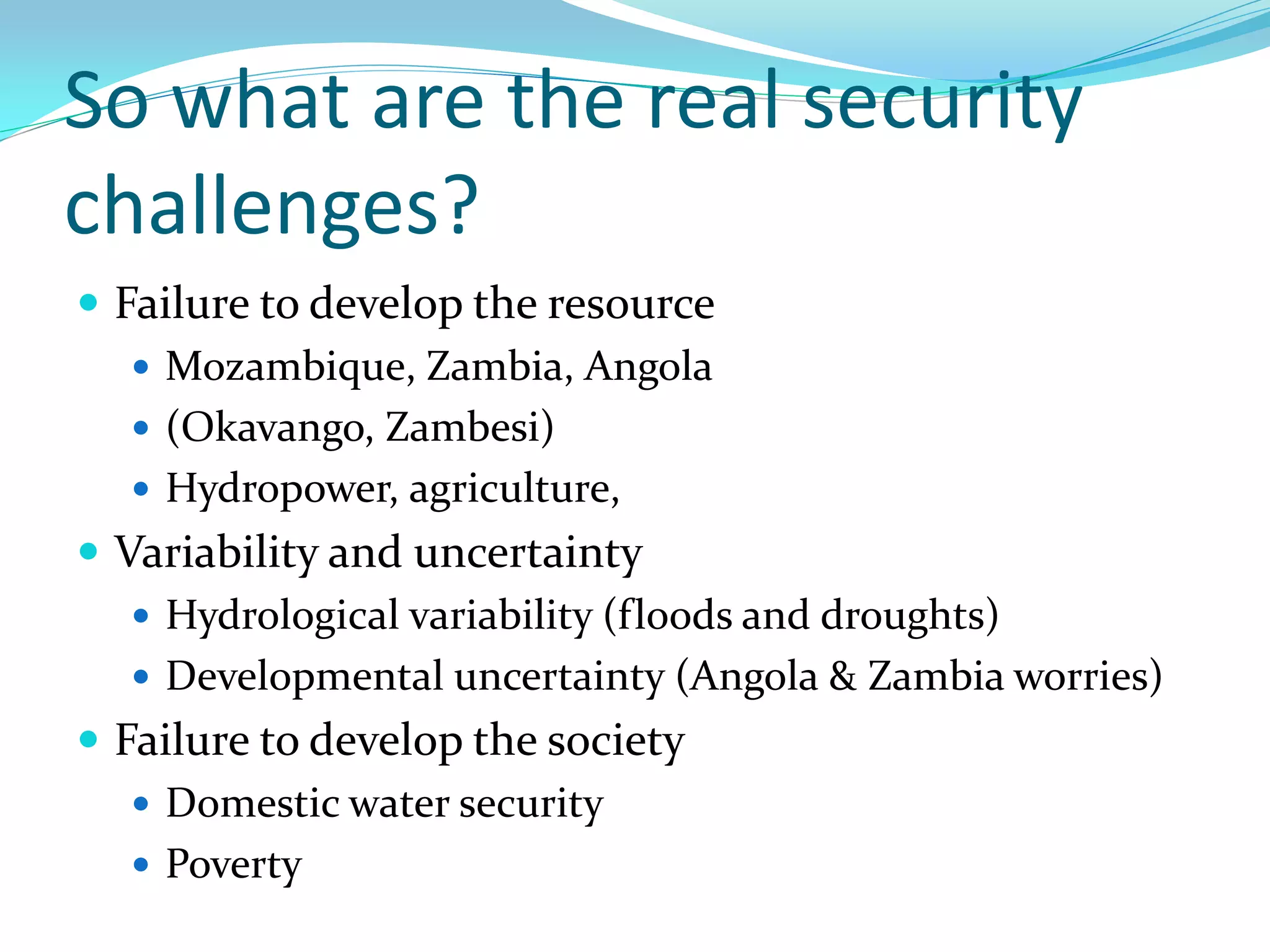
So what are the real security
challenges?
 Failure to develop the resource
    Mozambique, Zambia, Angola
    (Okavango, Zambesi)
    Hydropower, agriculture,
 Variability and uncertainty
    Hydrological variability (floods and droughts)
    Developmental uncertainty (Angola & Zambia worries)
 Failure to develop the society
    Domestic water security
    Poverty
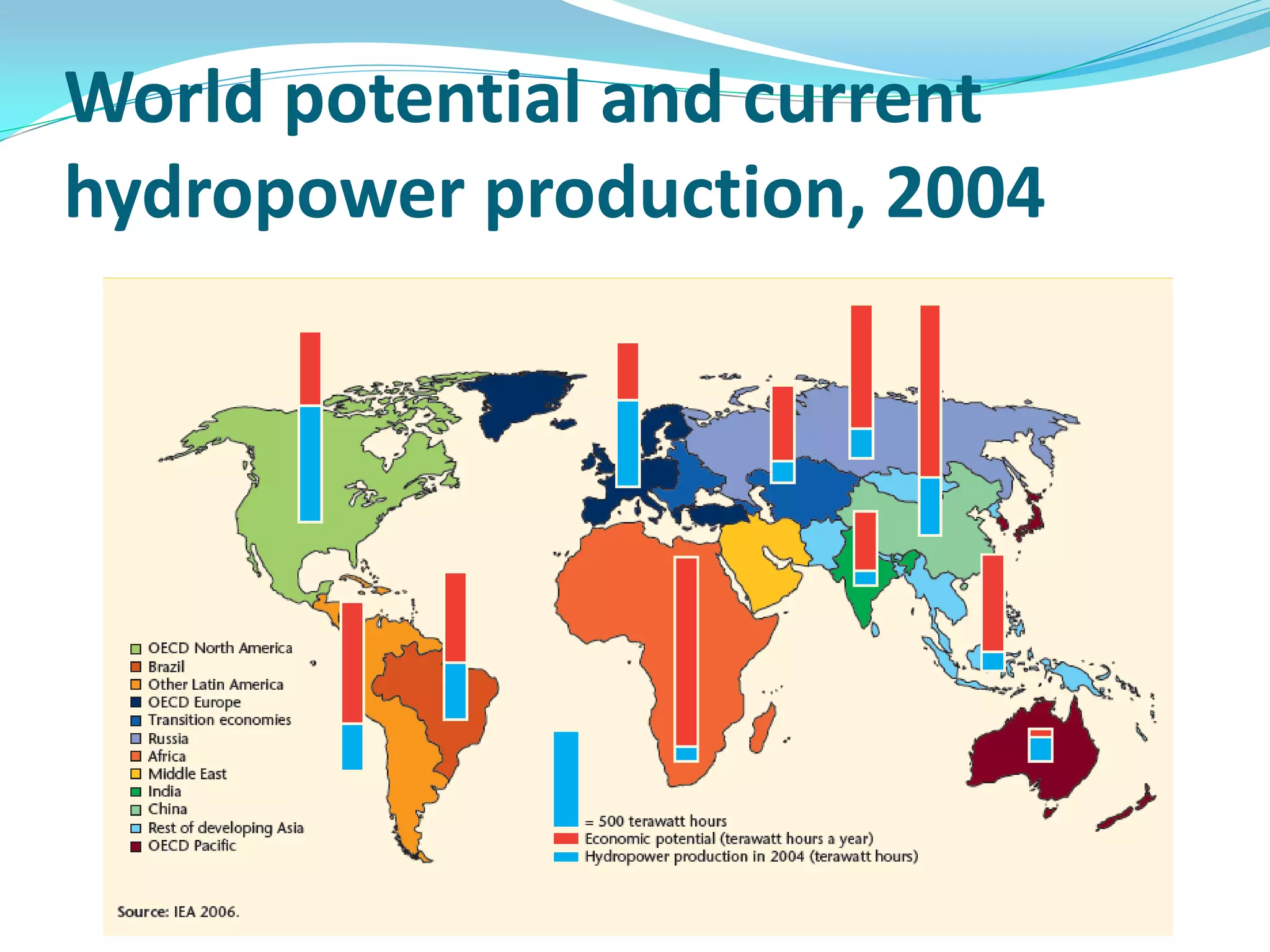
World potential and current
hydropower production, 2004
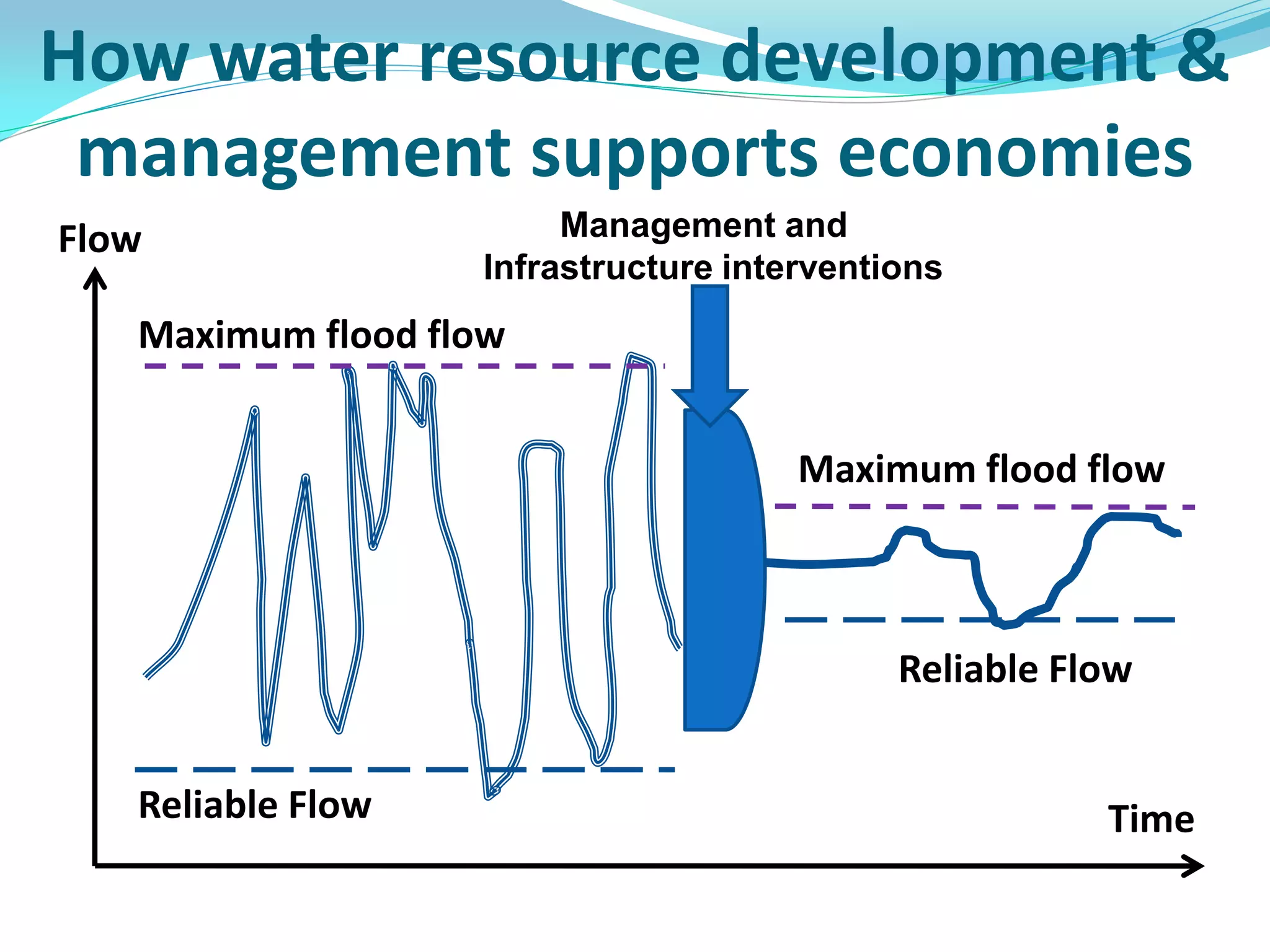
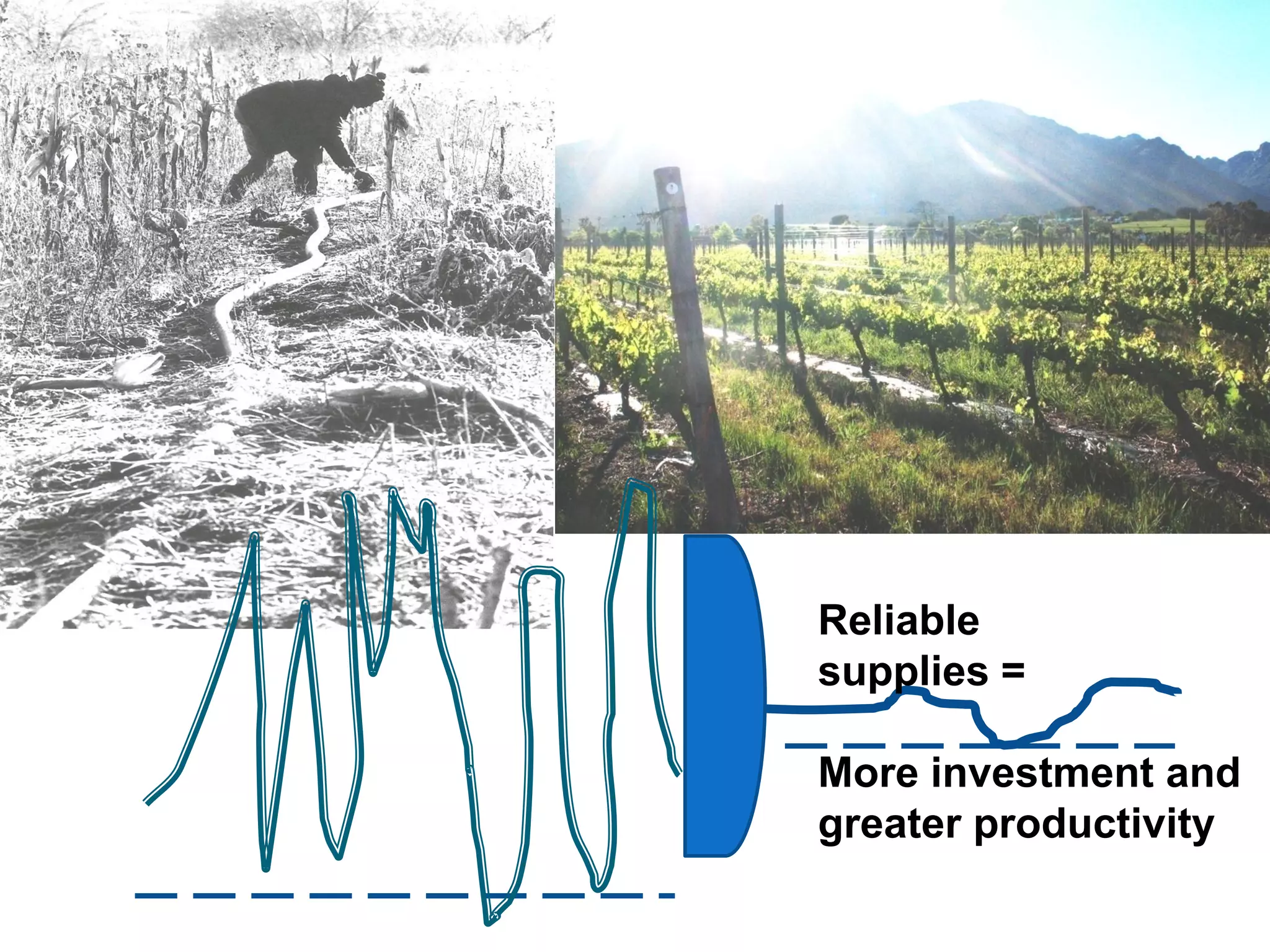
How water resource development &
 management supports economies
Flow                    Management and
                   Infrastructure interventions
   Maximum flood flow


                                      Maximum flood flow


                                            Reliable Flow


   Reliable Flow                                       Time
Reliable
supplies =

More investment and
greater productivity
SA, a potential regional predator?

   Must South Africa look to its neighbours to meet
   future water needs?

   What are the regional cooperation and security
   implications?
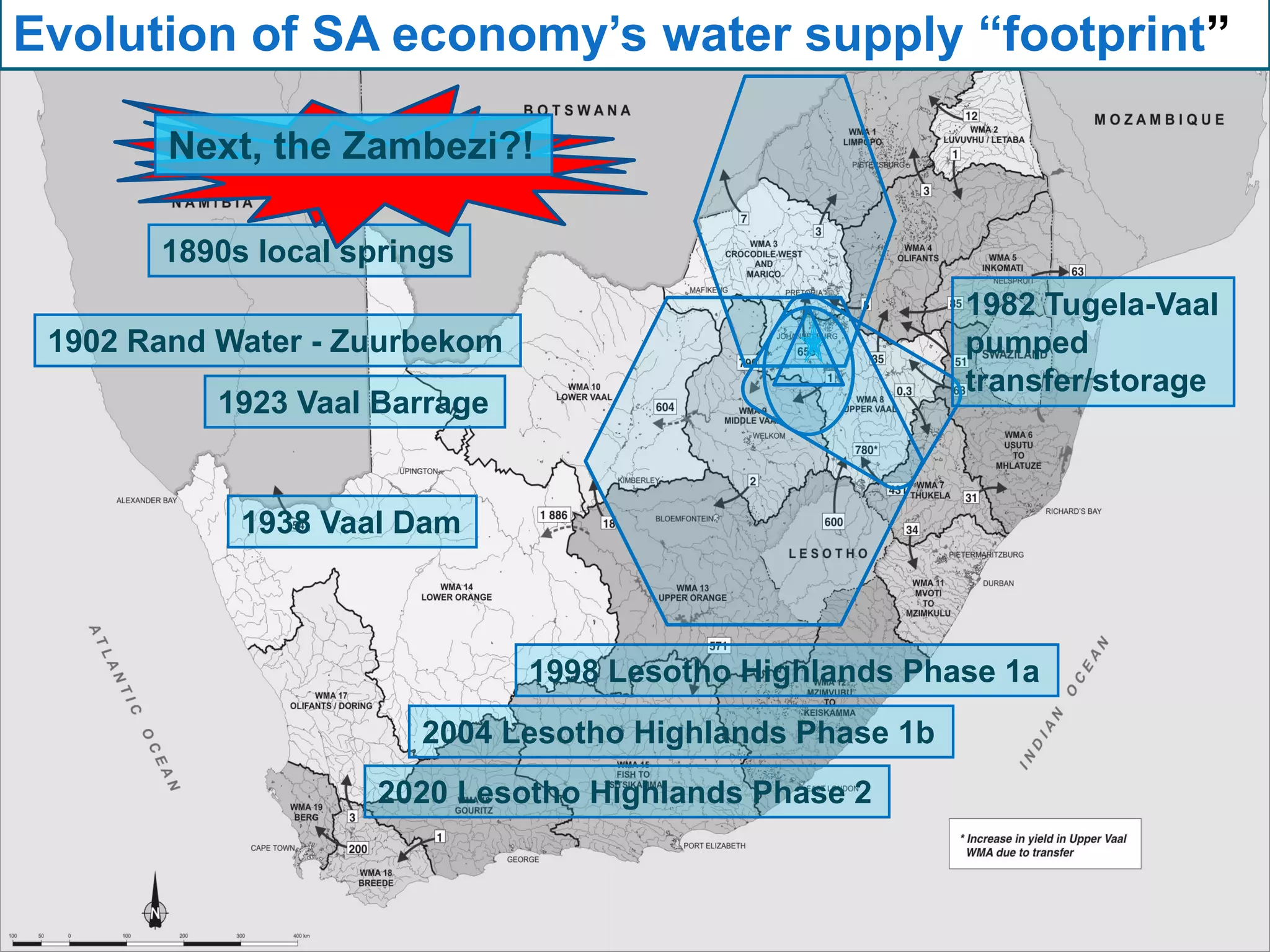
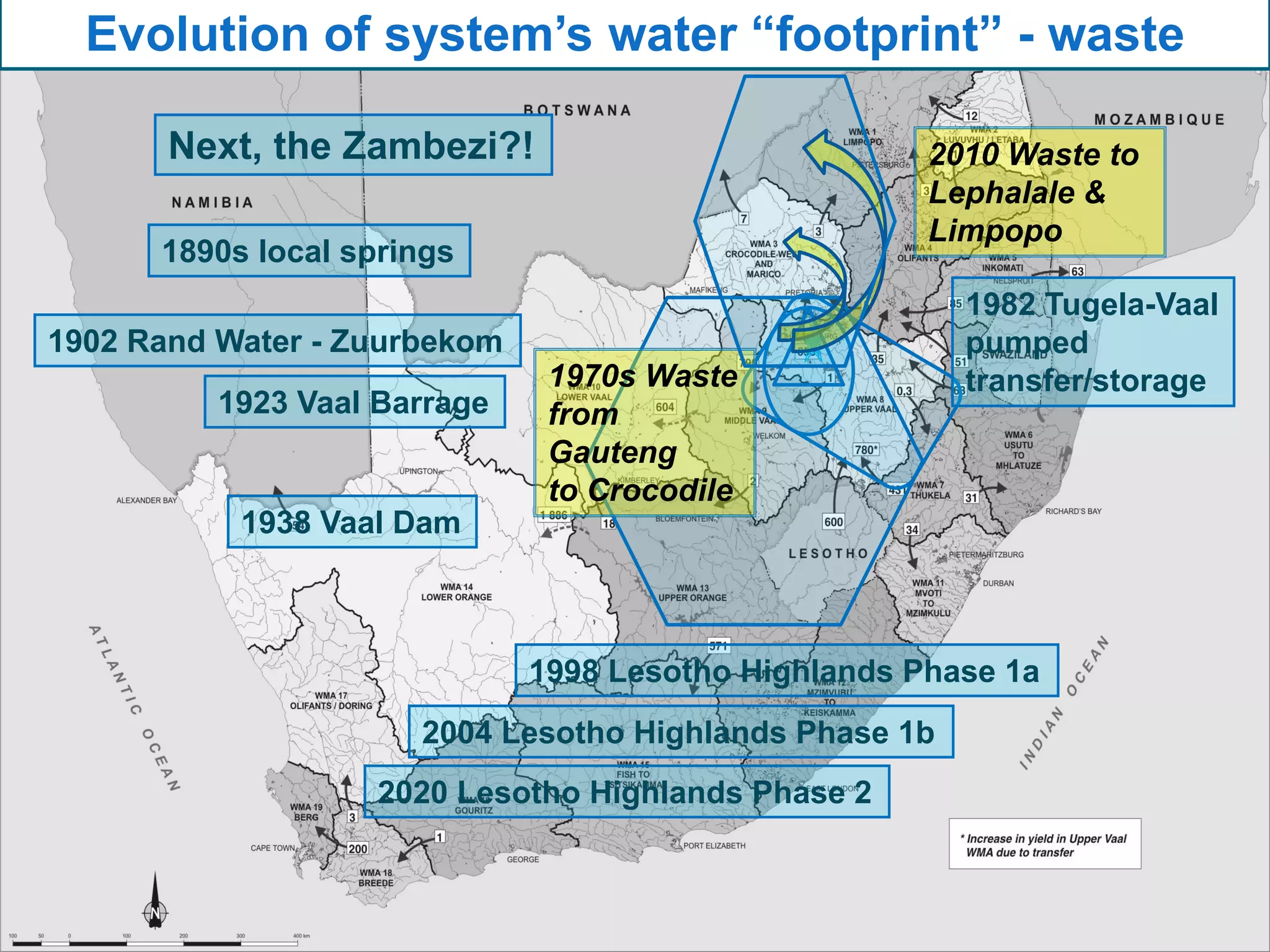
Evolution of SA economy’s water supply “footprint”

        Next, the Zambezi?!

       1890s local springs
                                                         1982 Tugela-Vaal
 1902 Rand Water - Zuurbekom                             pumped
                                                         transfer/storage
           1923 Vaal Barrage


            1938 Vaal Dam


                               1998 Lesotho Highlands Phase 1a
                       2004 Lesotho Highlands Phase 1b
                     2020 Lesotho Highlands Phase 2
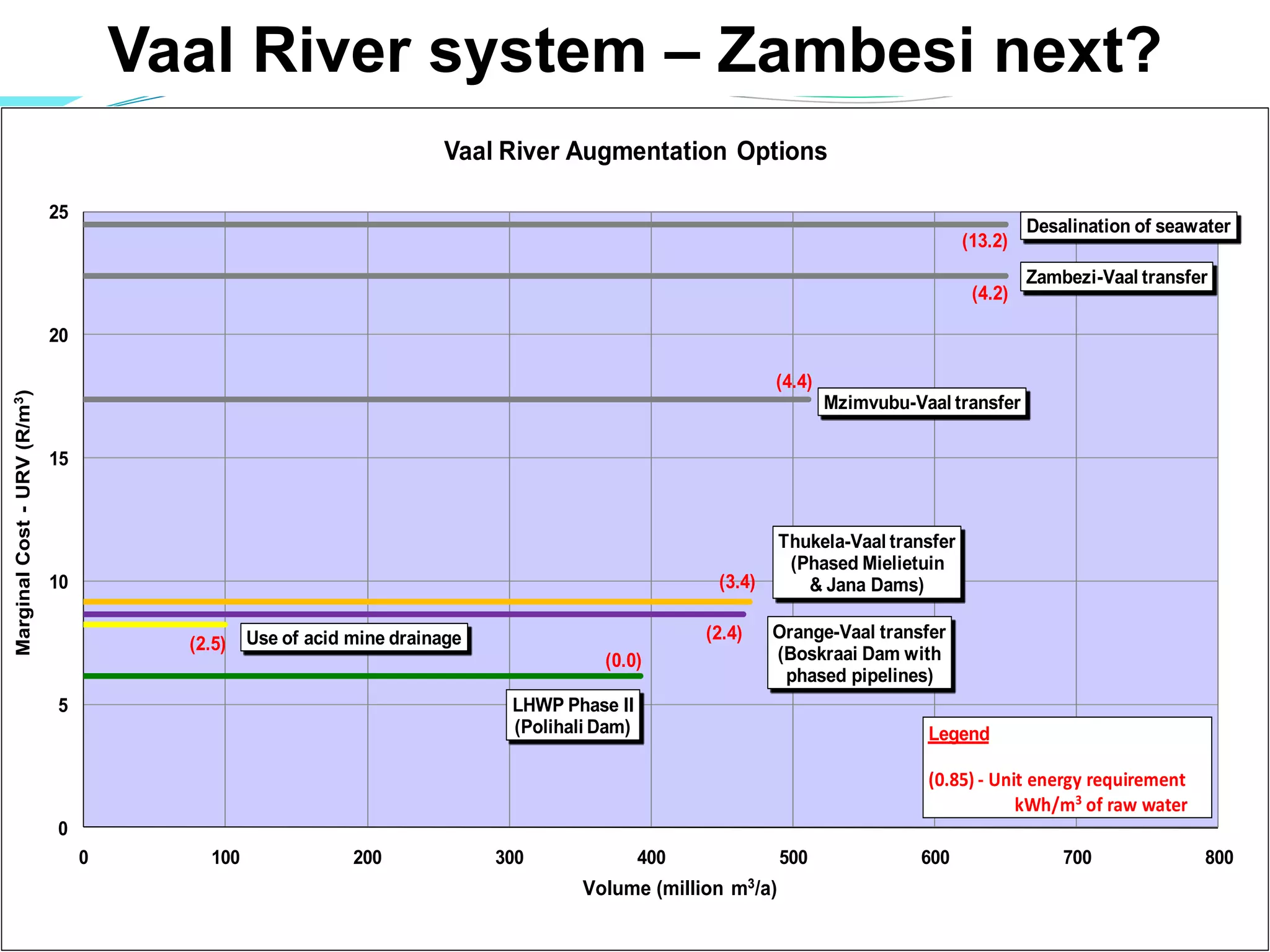
Vaal River system – Zambesi next?
                                                                      Vaal River Augmentation Options

                             25
                                                                                                                                                 Desalination of seawater
                                                                                                                                        (13.2)
                                                                                                                                                 Zambezi-Vaal transfer
                                                                                                                                         (4.2)

                             20

                                                                                                                (4.4)
Marginal Cost - URV (R/m3)


                                                                                                                        Mzimvubu-Vaal transfer

                             15


                                                                                                                Thukela-Vaal transfer
                                                                                                                 (Phased Mielietuin
                             10                                                                      (3.4)         & Jana Dams)

                                                Use of acid mine drainage                           (2.4)       Orange-Vaal transfer
                                        (2.5)
                                                                                       (0.0)                    (Boskraai Dam with
                                                                                                                 phased pipelines)
                             5                                               LHWP Phase II
                                                                             (Polihali Dam)                                        Legend

                                                                                                                                   (0.85) - Unit energy requirement
                                                                                                                                               kWh/m3 of raw water
                             0
                                  0       100               200             300               400               500               600                700              800
                                                                                                            3
                                                                                     Volume (million m /a)
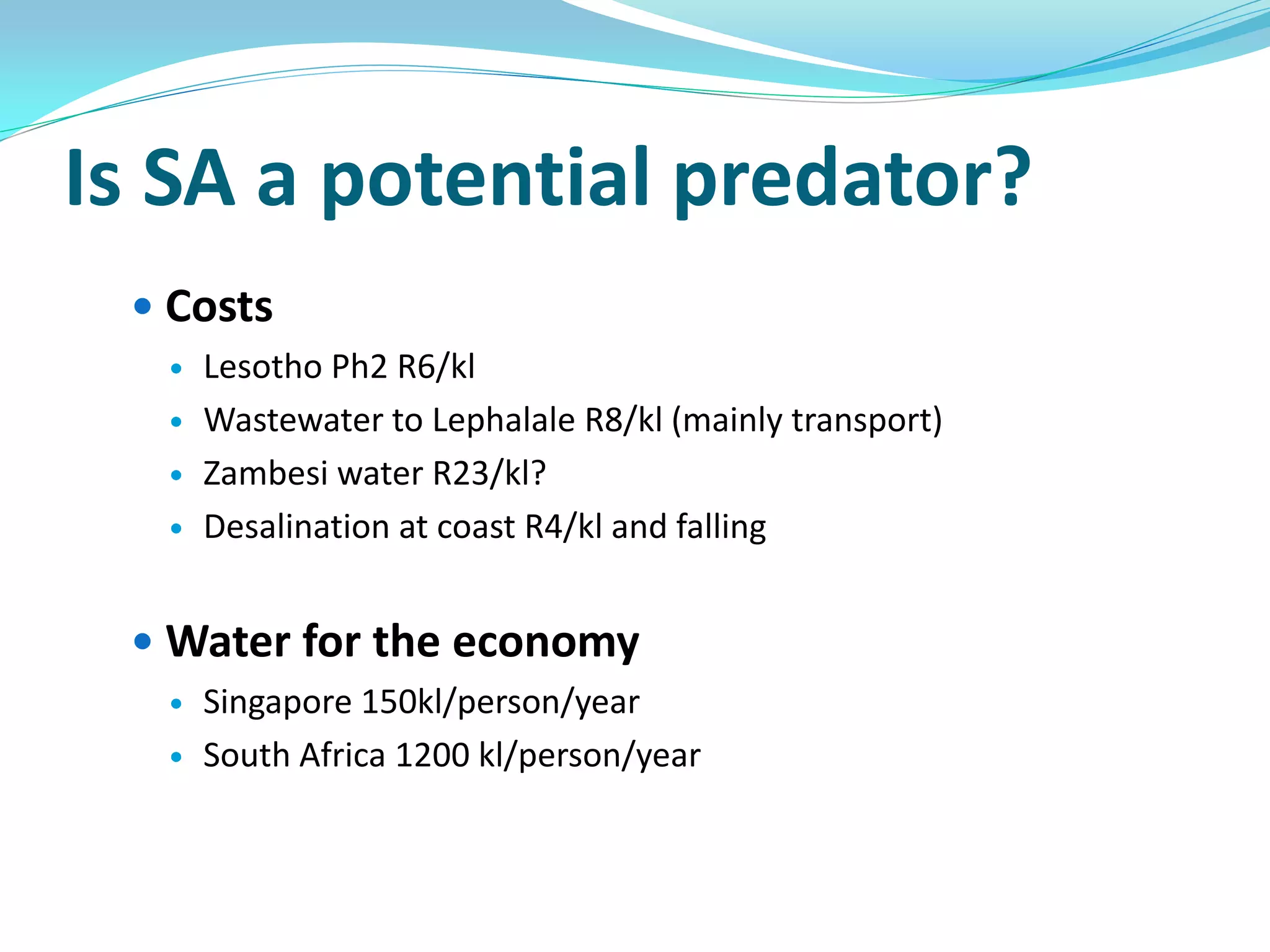
Evolution of system’s water “footprint” - waste

       Next, the Zambezi?!                            2010 Waste to
                                                      Lephalale &
                                                      Limpopo
      1890s local springs
                                                        1982 Tugela-Vaal
1902 Rand Water - Zuurbekom                             pumped
                               1970s Waste              transfer/storage
          1923 Vaal Barrage    from
                               Gauteng
                               to Crocodile
           1938 Vaal Dam


                              1998 Lesotho Highlands Phase 1a
                      2004 Lesotho Highlands Phase 1b
                    2020 Lesotho Highlands Phase 2
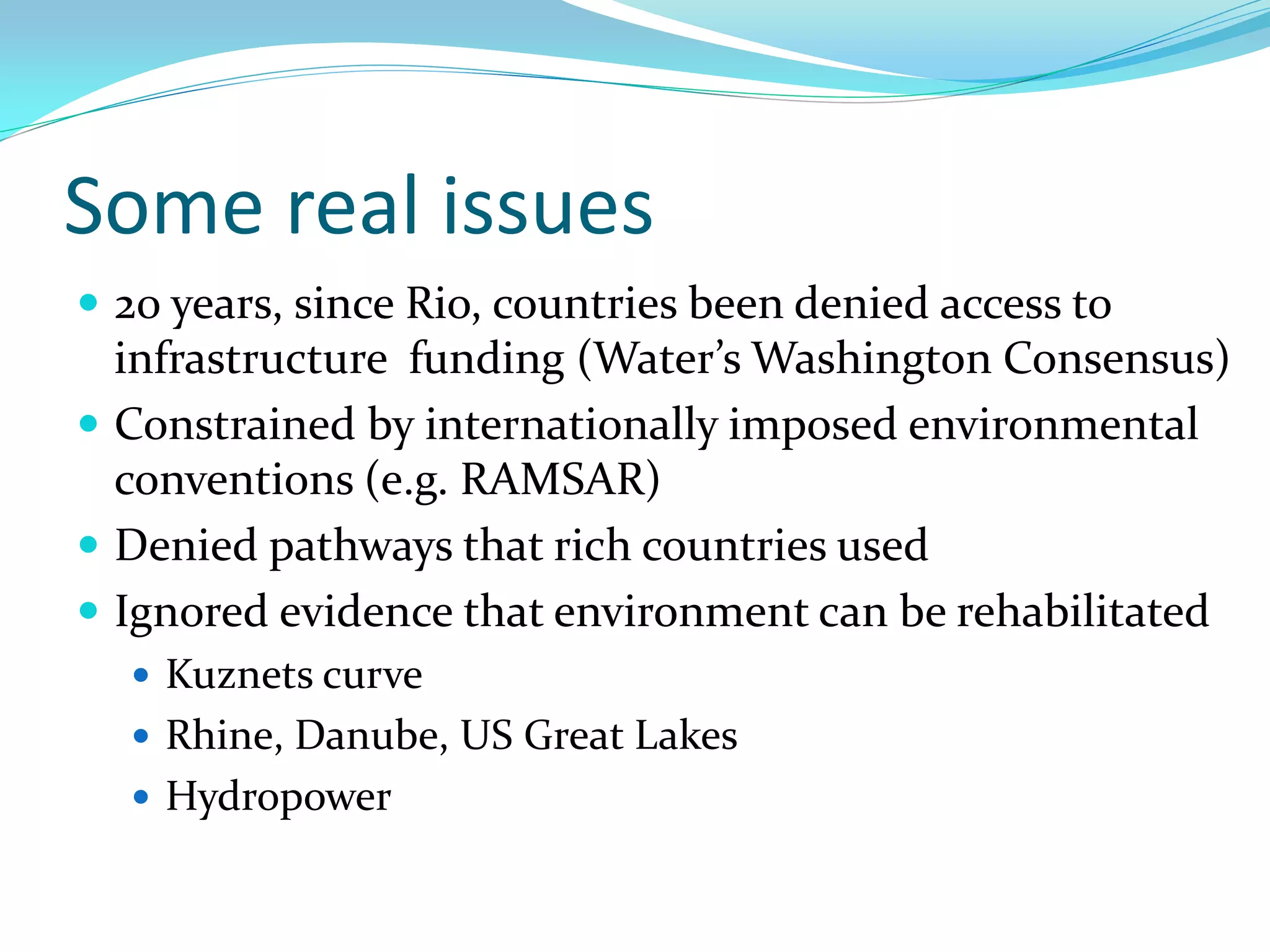
Is SA a potential predator?
  Costs
     Lesotho Ph2 R6/kl
     Wastewater to Lephalale R8/kl (mainly transport)
     Zambesi water R23/kl?
     Desalination at coast R4/kl and falling


  Water for the economy
     Singapore 150kl/person/year
     South Africa 1200 kl/person/year
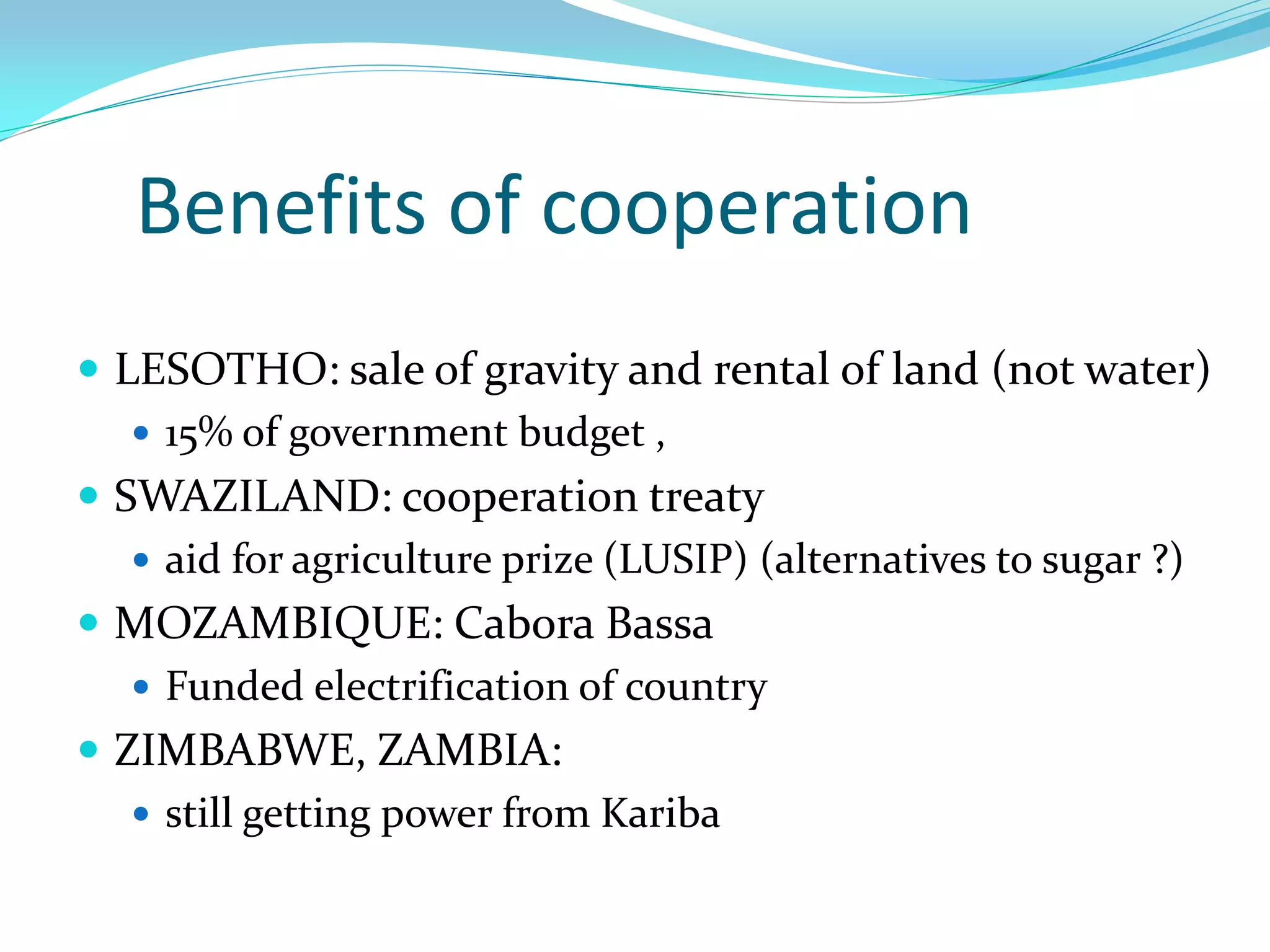
Some real issues
 20 years, since Rio, countries been denied access to
  infrastructure funding (Water’s Washington Consensus)
 Constrained by internationally imposed environmental
  conventions (e.g. RAMSAR)
 Denied pathways that rich countries used
 Ignored evidence that environment can be rehabilitated
   Kuznets curve
   Rhine, Danube, US Great Lakes
   Hydropower
Benefits of cooperation
 LESOTHO: sale of gravity and rental of land (not water)
    15% of government budget ,
 SWAZILAND: cooperation treaty
    aid for agriculture prize (LUSIP) (alternatives to sugar ?)
 MOZAMBIQUE: Cabora Bassa
    Funded electrification of country
 ZIMBABWE, ZAMBIA:
    still getting power from Kariba
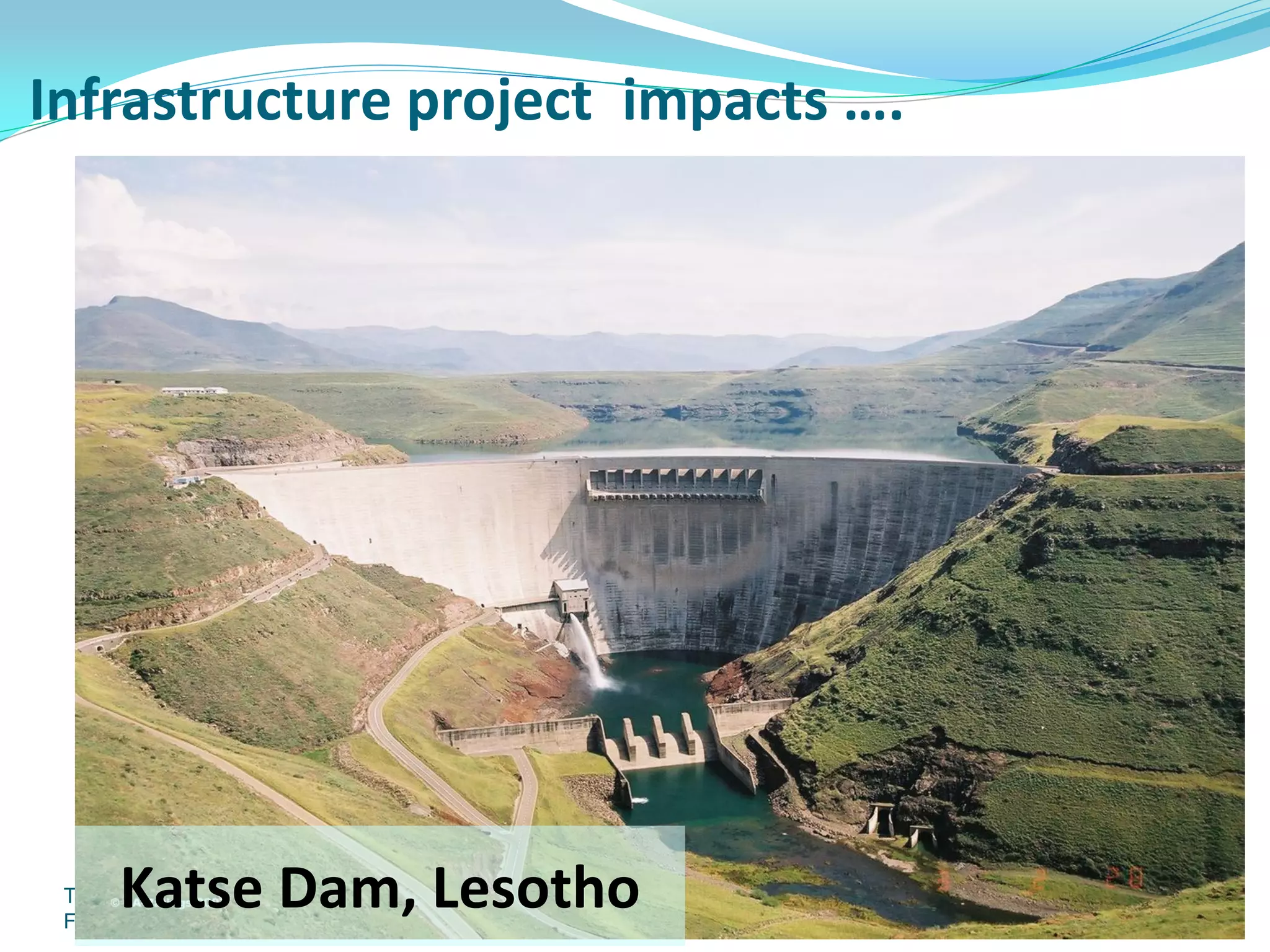
Infrastructure project impacts ….


      Katse Dam, Lesotho
 TCTA Trip to Katse and Mohale
 Feb/Mar 2003                    30
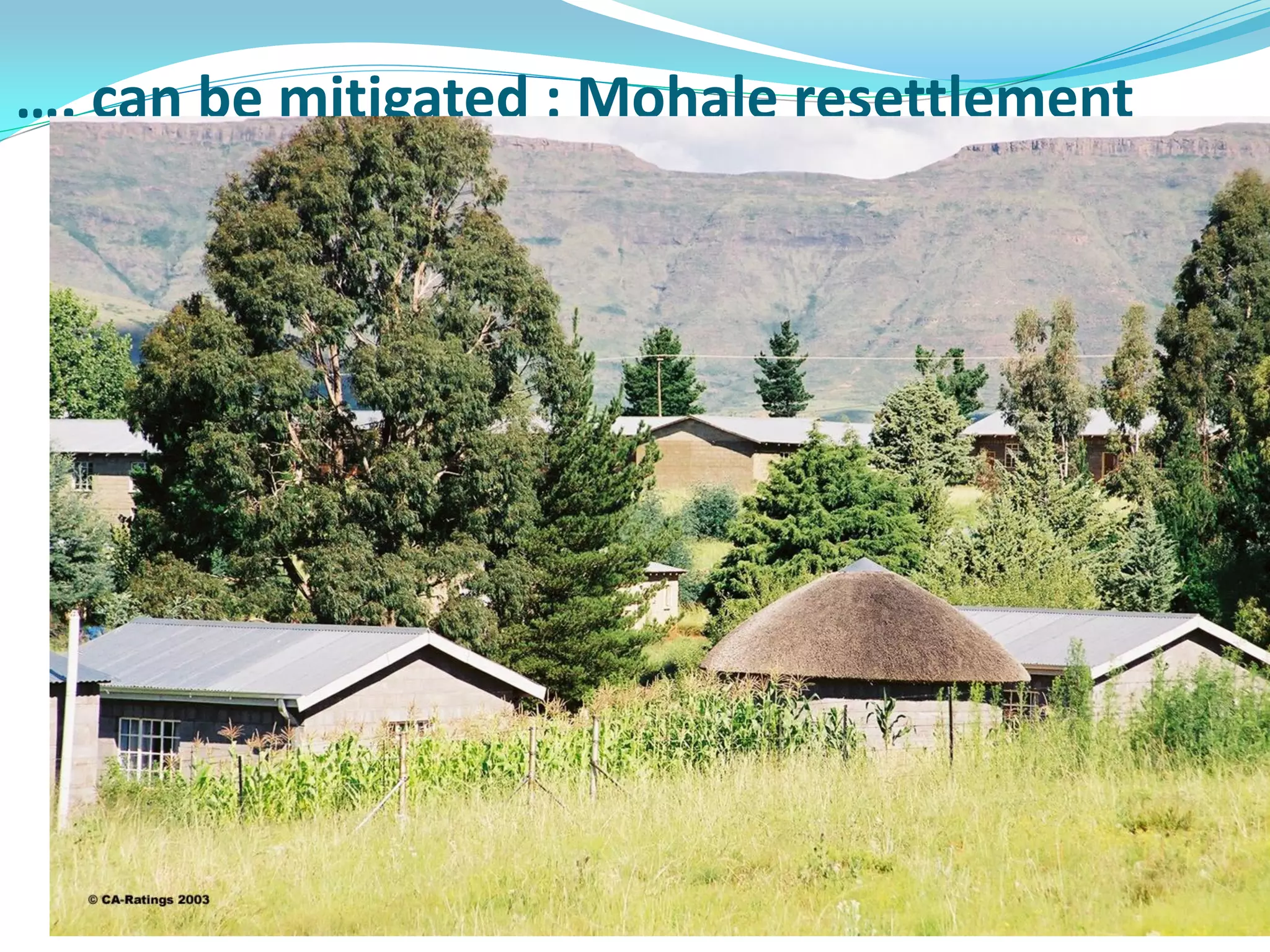
…. can be mitigated : Mohale resettlement


 TCTA Trip to Katse and Mohale
 Feb/Mar 2003                    31
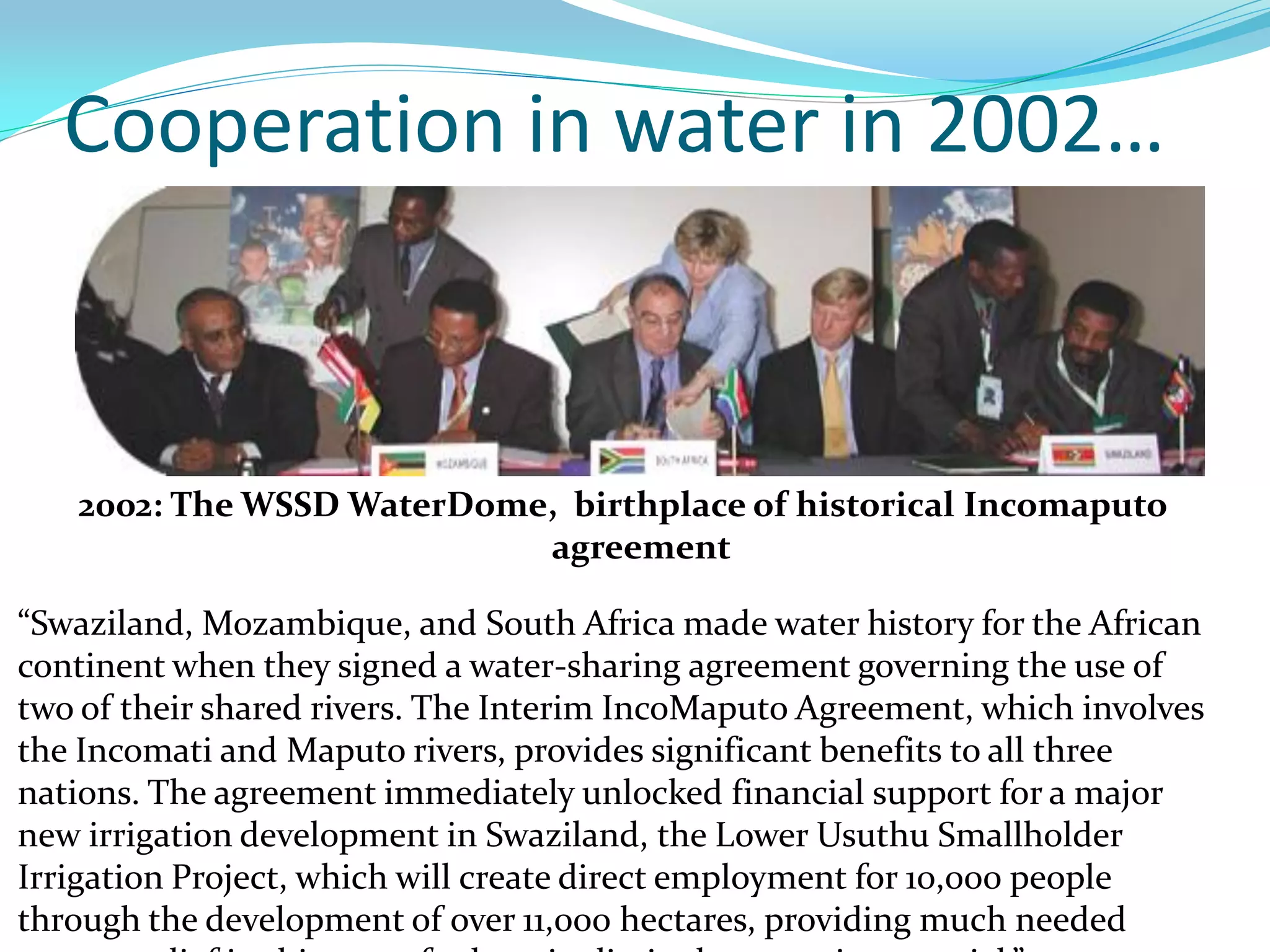
Cooperation in water in 2002…


   2002: The WSSD WaterDome, birthplace of historical Incomaputo
                           agreement

“Swaziland, Mozambique, and South Africa made water history for the African
continent when they signed a water-sharing agreement governing the use of
two of their shared rivers. The Interim IncoMaputo Agreement, which involves
the Incomati and Maputo rivers, provides significant benefits to all three
nations. The agreement immediately unlocked financial support for a major
new irrigation development in Swaziland, the Lower Usuthu Smallholder
Irrigation Project, which will create direct employment for 10,000 people
through the development of over 11,000 hectares, providing much needed
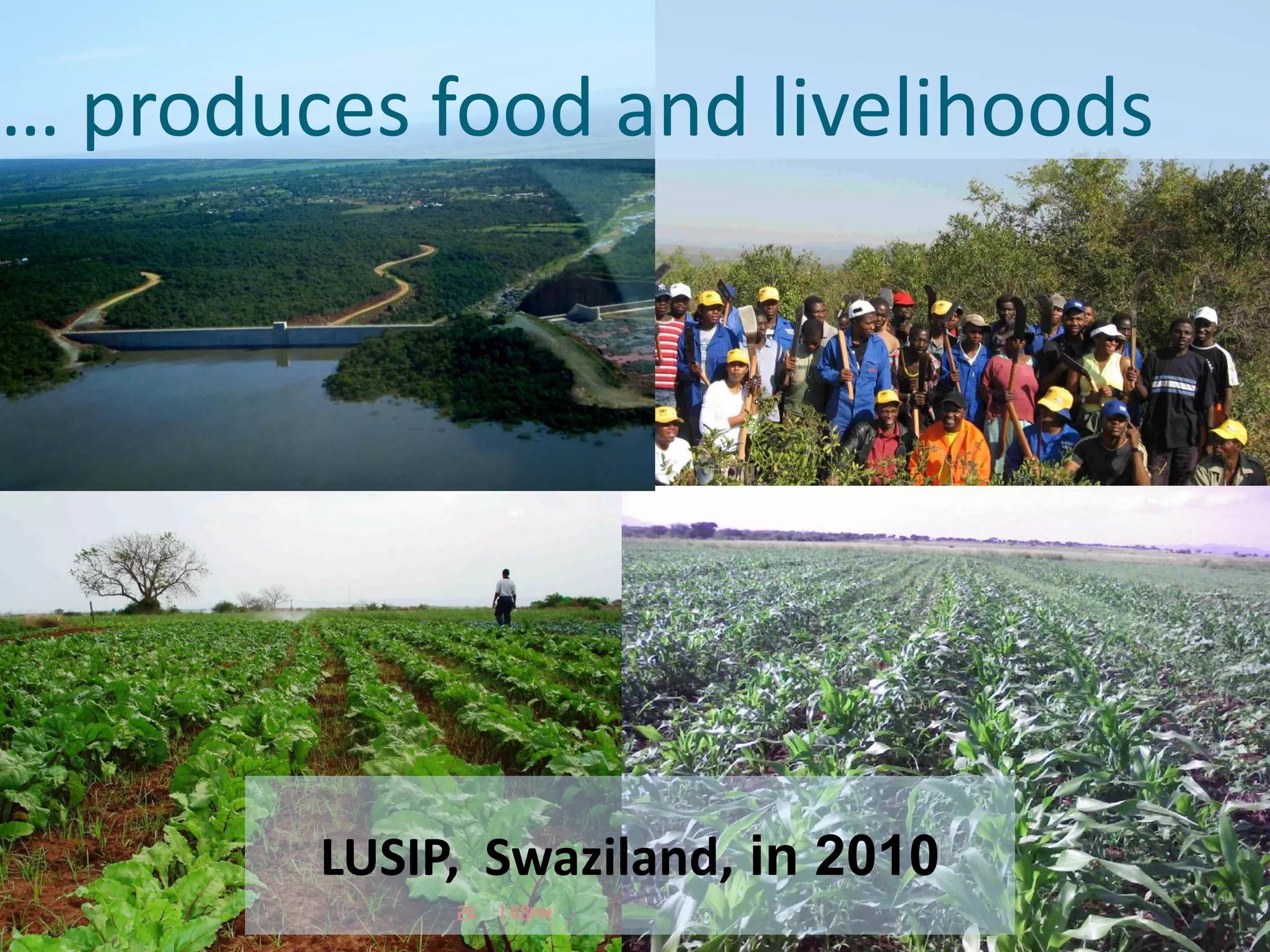
… produces food and livelihoods


        LUSIP, Swaziland, in 2010
About water wars...
“The wars of the next century will be for water”,

“unless we change the way we manage water”.


                                         Ismael Serageldin, 1996
                Former VP Sustainable Development, World Bank
                            Founder of the World Water Council
                                 Head of the Alexandria Library
Napoleon’s African water
management lesson:
 Under a good government, the Nile gains on
 the desert

 Under a bad government, the desert gains on
 the Nile
Conclusions
 To achieve water security, need
    Investments in infrastructure to store and transport water, treat
     and reuse waste water
    robust institutions, able to take and implement decisions
    information and the capacity to predict, plan and cope
 Many societies want to move beyond water security
    to take advantage of benefits derived from wise water use
    “water for growth and development”
    “land and water grabs” and threat, while
    Biofuels displace food ... or
    Better live & livelihoods as well as products and profits?
 Much of Africa still needs to achieve basic water security
 But also needs growth and development
Conclusions
 Perceptions are often wrong, conclusions not
  supported by evidence
 Lead to inappropriate policy reponses
 In world of sovereign and dependent countries,
   Southern Africa dependent over past two decades
   External policy has ignored
                             local preferences
   Imposed external preferences
   Ignored historical evidence
Conclusions
 Challenges
  Financial resources
  Climate variability and change
 Response
   Help region to manage water in support of its
    sustainable development
   Support infrastructure development
   Some climate funding to water management
 Will
   Help countries to achieve development goals,
   Make them more resilient to eventual climate change
Thank you!

water security presentation jun 2011

  • 1.
    Prof Mike Muller Graduate School of Public and Development Management Wits University Presentation given at IHP-HELP Centre for Water Law, Policy and Science, under the auspices of UNESCO, 21 st June 2011
  • 2.
    What is meantby water security?  Household?  Reliable services  Health  Community?  Resilience to disasters  Vulnerability of economy  National?  survival of the state and nation?  Environmental?  Ecological survival, from local to planet
  • 3.
    Framing the issue Adefinition of water security  ‘the reliable availability of an acceptable quantity and quality of water for health, livelihoods and production, coupled with an acceptable level of water-related risks.’ Grey and Sadoff (2007).  Not the same as ‘food security’ and ‘energy security’,  reliable access to sufficient supplies.  water security also captures destructive aspects of water  floods and droughts
  • 4.
    Water management isa complex business Flood line – Water for agriculture development Water for nature conservation – – commercial cane constraint National park Offtake for sugar mill and village Weir, interferes with Onward flow to poor (return channel, warm treated environmental function people & neighbors water, just downstream)
  • 5.
    The regional waterchallenges  Southern African countries already water stressed  Likely to get worse, with climate and population  Conflict inevitable  Aggravating the challenges:-  External land and water grabbing ,  Biofuels promotion  Loss of ecosystem services making people poorer  Corruption will exacerbate situation
  • 6.
    It’s already happening Conflict has happened:-  invasion of Lesotho by South Africa  Botswana and Namibia sabre-rattling over Okavango  Dams and displaced people are a major problem  China in Angola and Zambia  Colonising land and water as well as minerals  Corruption has undermined cooperation  Lesotho and elsewhere
  • 7.
    Part of theproblem ?
  • 8.
    Is population pressureon water an issue? Water stressed 2025 Water stressed 1990
  • 9.
    Is drought, variabilitya problem? Droughts risk and vulnerability (economic loss, as a proportion of GDP density) UNEP/GRID-Arendal, Droughts - risk and vulnerability (economic loss, as a proportion of GDP density), UNEP/GRID-Arendal Maps and Graphics Library,
  • 10.
    Who has thewater? And is availability a problem?
  • 11.
    Who has thewater? Country Country ???? Angola Botswana Least water Lesotho Malawi Mozambique Namibia South Africa Swaziland Zambia Most water Zimbabwe
  • 12.
    Who has thewater? Water Country Availability Angola 10510 South Africa 1110 Least water Botswana 6820 Malawi 1400 Lesotho 1680 Zimbabwe 1550 Malawi 1400 Lesotho 1680 Mozambique 11320 Swaziland 4160 Botswana 6820 Namibia 8810 Namibia 8810 South Africa 1110 Zambia 9630 Swaziland 4160 Angola 10510 Zambia 9630 Most water Mozambique 11320 Zimbabwe 1550 M3/p/yr Source: UN WWDR 2006
  • 13.
    COUNTRY Water m3/p/yr Gaza strip 41 Singapore 139 Who has Rwanda Egypt 610 790 Kenya 930 the water? South Africa 1110 Denmark 1120 Korea, s 1450 Eritrea 1470 Ethiopia 1680 China 2140 Burundi 2190 United Kingdom 2460 Uganda 2470 Swaziland 4160 Botswana 6820 Namibia 8810 Zambia 9630 Mozambique 11320 DRC 23850
  • 14.
    Who uses theirwater? Country AVAILABILITY M3 P/C USE % Angola 10510 0.2 Botswana 6820 1 Lesotho 1680 2 Malawi 1400 6 Mozambique 11320 0.3 Namibia 8810 2 South Africa 1110 31 Swaziland 4160 18 Zambia 9630 2 Zimbabwe 1584 13 DRC 23850 0.03
  • 15.
    Or is moneythe problem?
  • 16.
    The Southern Africanchallenge  Low-equilibrium traps and poverty  Many of the traps are externally set  Hydropower and infrastructure blocks  Environmental conventions  External dependence  Conflict provoked
  • 17.
    “PRAGMATIC” “PRESCRIPTIVE” DIMENSION RIO DUBLIN Competing water Economic management Nature of water Economic and social good Economic good paradigms: Priority of economic instruments Economic instruments balanced High priority for economic Priority setting by social considerations instruments Role of private sector Within national economic Stakeholder participation, The differences development policy economic instruments between Rio and Major role for government, High priority for role of private recognition of private role sector, limited government Dublin Characterised as:- Developmental Washington Consensus Institutional, national Institutional objectives Importance of national Focus on “enabling environment” Water’s Washington Consensus Participatory approaches development strategies Governance Where there is clear demand Heavy emphasis on participatory Appropriate institutions approaches Performance based institutions Characterised as:- Public administration New Public Management Institutional, international: Transboundary approaches Basin specific approaches River basin organisations EX: Institutionalisation of global United Nations system World Water Council outside water inter-governmental domain Muller M, Fit for Characterised as:- Multilateralism continued Retreat from multilateralism purpose: taking integrated water Environmental resource management Infrastructure Infrastructure development, a “Development” deleted back to basics Decision making key element Emphasis on “full stakeholder River basin organisation (RBO) Effective implementation and participation” Irrigation and Drainage coordination required RBO the most appropriate entity Systems: Volume 24, Manage “in basin context” Issue 3 (2010), Page 161. Characterised as:- Balance needs of people and Ecosystem approach environment
  • 18.
  • 19.
    So what arethe real security challenges?  Failure to develop the resource  Mozambique, Zambia, Angola  (Okavango, Zambesi)  Hydropower, agriculture,  Variability and uncertainty  Hydrological variability (floods and droughts)  Developmental uncertainty (Angola & Zambia worries)  Failure to develop the society  Domestic water security  Poverty
  • 20.
    World potential andcurrent hydropower production, 2004
  • 21.
    How water resourcedevelopment & management supports economies Flow Management and Infrastructure interventions Maximum flood flow Maximum flood flow Reliable Flow Reliable Flow Time
  • 22.
    Reliable supplies = More investmentand greater productivity
  • 23.
    SA, a potentialregional predator?  Must South Africa look to its neighbours to meet future water needs?  What are the regional cooperation and security implications?
  • 24.
    Evolution of SAeconomy’s water supply “footprint” Next, the Zambezi?! 1890s local springs 1982 Tugela-Vaal 1902 Rand Water - Zuurbekom pumped transfer/storage 1923 Vaal Barrage 1938 Vaal Dam 1998 Lesotho Highlands Phase 1a 2004 Lesotho Highlands Phase 1b 2020 Lesotho Highlands Phase 2
  • 25.
    Vaal River system– Zambesi next? Vaal River Augmentation Options 25 Desalination of seawater (13.2) Zambezi-Vaal transfer (4.2) 20 (4.4) Marginal Cost - URV (R/m3) Mzimvubu-Vaal transfer 15 Thukela-Vaal transfer (Phased Mielietuin 10 (3.4) & Jana Dams) Use of acid mine drainage (2.4) Orange-Vaal transfer (2.5) (0.0) (Boskraai Dam with phased pipelines) 5 LHWP Phase II (Polihali Dam) Legend (0.85) - Unit energy requirement kWh/m3 of raw water 0 0 100 200 300 400 500 600 700 800 3 Volume (million m /a)
  • 26.
    Evolution of system’swater “footprint” - waste Next, the Zambezi?! 2010 Waste to Lephalale & Limpopo 1890s local springs 1982 Tugela-Vaal 1902 Rand Water - Zuurbekom pumped 1970s Waste transfer/storage 1923 Vaal Barrage from Gauteng to Crocodile 1938 Vaal Dam 1998 Lesotho Highlands Phase 1a 2004 Lesotho Highlands Phase 1b 2020 Lesotho Highlands Phase 2
  • 27.
    Is SA apotential predator?  Costs  Lesotho Ph2 R6/kl  Wastewater to Lephalale R8/kl (mainly transport)  Zambesi water R23/kl?  Desalination at coast R4/kl and falling  Water for the economy  Singapore 150kl/person/year  South Africa 1200 kl/person/year
  • 28.
    Some real issues 20 years, since Rio, countries been denied access to infrastructure funding (Water’s Washington Consensus)  Constrained by internationally imposed environmental conventions (e.g. RAMSAR)  Denied pathways that rich countries used  Ignored evidence that environment can be rehabilitated  Kuznets curve  Rhine, Danube, US Great Lakes  Hydropower
  • 29.
    Benefits of cooperation LESOTHO: sale of gravity and rental of land (not water)  15% of government budget ,  SWAZILAND: cooperation treaty  aid for agriculture prize (LUSIP) (alternatives to sugar ?)  MOZAMBIQUE: Cabora Bassa  Funded electrification of country  ZIMBABWE, ZAMBIA:  still getting power from Kariba
  • 30.
    Infrastructure project impacts…. Katse Dam, Lesotho TCTA Trip to Katse and Mohale Feb/Mar 2003 30
  • 31.
    …. can bemitigated : Mohale resettlement TCTA Trip to Katse and Mohale Feb/Mar 2003 31
  • 32.
    Cooperation in waterin 2002… 2002: The WSSD WaterDome, birthplace of historical Incomaputo agreement “Swaziland, Mozambique, and South Africa made water history for the African continent when they signed a water-sharing agreement governing the use of two of their shared rivers. The Interim IncoMaputo Agreement, which involves the Incomati and Maputo rivers, provides significant benefits to all three nations. The agreement immediately unlocked financial support for a major new irrigation development in Swaziland, the Lower Usuthu Smallholder Irrigation Project, which will create direct employment for 10,000 people through the development of over 11,000 hectares, providing much needed
  • 33.
    … produces foodand livelihoods LUSIP, Swaziland, in 2010
  • 34.
    About water wars... “Thewars of the next century will be for water”, “unless we change the way we manage water”. Ismael Serageldin, 1996 Former VP Sustainable Development, World Bank Founder of the World Water Council Head of the Alexandria Library
  • 35.
    Napoleon’s African water managementlesson:  Under a good government, the Nile gains on the desert  Under a bad government, the desert gains on the Nile
  • 36.
    Conclusions  To achievewater security, need  Investments in infrastructure to store and transport water, treat and reuse waste water  robust institutions, able to take and implement decisions  information and the capacity to predict, plan and cope  Many societies want to move beyond water security  to take advantage of benefits derived from wise water use  “water for growth and development”  “land and water grabs” and threat, while  Biofuels displace food ... or  Better live & livelihoods as well as products and profits?  Much of Africa still needs to achieve basic water security  But also needs growth and development
  • 37.
    Conclusions  Perceptions areoften wrong, conclusions not supported by evidence  Lead to inappropriate policy reponses  In world of sovereign and dependent countries,  Southern Africa dependent over past two decades  External policy has ignored local preferences  Imposed external preferences  Ignored historical evidence
  • 38.
    Conclusions  Challenges Financial resources  Climate variability and change  Response  Help region to manage water in support of its sustainable development  Support infrastructure development  Some climate funding to water management  Will  Help countries to achieve development goals,  Make them more resilient to eventual climate change
  • 39.

Editor's Notes

  • #9 But don’t underestimate the importance of population.Population is the main factor which has moved most African countries towards being water stressed if not actually water scarce
  • #15 And we can do quite a lot with not very muchI will first show you a table from Southern Africa so as not to tread on the toes of the Nile family.This table shows how much water countries have, per personThen what % of that water they actually abstract and useThe reason for showing this is to show that SA, a country with a relatively well developed economy and very little water per person, almost water scarce, uses 30% of water to sustain a large economy ... That’s a far bigger % than most of the other countries,