Anthony ScalettaGeography of AfricaApril 8, 2010Inside Africa's Water Crisis
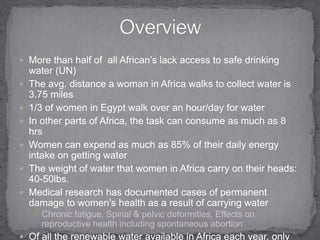
More than half of  all African’s lack access to safe drinking water (UN) The avg. distance a woman in Africa walks to collect water is 3.75 miles 1/3 of women in Egypt walk over an hour/day for waterIn other parts of Africa, the task can consume as much as 8 hrsWomen can expend as much as 85% of their daily energy intake on getting waterThe weight of water that women in Africa carry on their heads: 40-50lbs. Medical research has documented cases of permanent damage to women's health as a result of carrying waterChronic fatigue, Spinal & pelvic deformities, Effects on reproductive health including spontaneous abortionOf all the renewable water available in Africa each year, only 4% is used Most Africans lack Wells, Canals, Pumps, Reservoirs, & Irrigation SystemsOverview
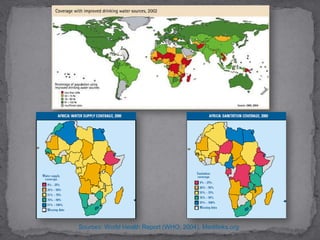
Sources: World Health Report (WHO, 2004), Medilinks.org
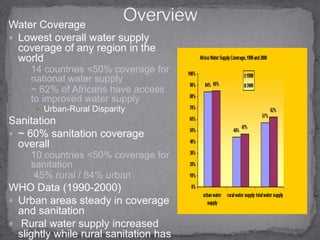
OverviewWater CoverageLowest overall water supply coverage of any region in the world14 countries <50% coverage for national water supply~ 62% of Africans have access to improved water supplyUrban-Rural Disparity Sanitation ~ 60% sanitation coverage overall 10 countries <50% coverage for sanitation 45% rural / 84% urban WHO Data (1990-2000)Urban areas steady in coverage and sanitation Rural water supply increased slightly while rural sanitation has fallen
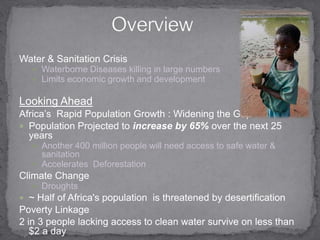
Water & Sanitation CrisisWaterborne Diseases killing in large numbersLimits economic growth and developmentLooking AheadAfrica’s  Rapid Population Growth : Widening the GapPopulation Projected to increase by 65% over the next 25 yearsAnother 400 million people will need access to safe water & sanitation Accelerates  Deforestation Climate ChangeDroughts  ~ Half of Africa's population  is threatened by desertificationPoverty Linkage2 in 3 people lacking access to clean water survive on less than $2 a dayOverview
Poverty & Lack of Water AccessAccess to clean water is the most essential necessity for all people Water ScarcityAn environmental constraint that hinders development Creates Social Conflicts btw. various water usersIndividuals, Communities, Industries, Livestock, Wildlife, and Agricultural Users Lack of water perpetuates the Poverty Trap Closely linked to human welfare and healthMost costly for those that can least afford it (urban slums/remote villages)Time and energy spent obtaining water impacts ability to pursue income or education Poverty in Rural AfricaPoor households in the agricultural subsistence economy hit the hardest 1994 Tanzania Case Study: Limited water resources #1 cause of rural poverty
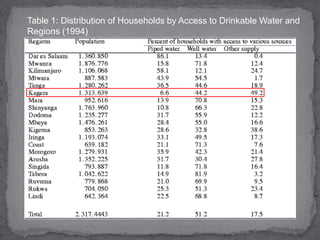
Table 1: Distribution of Households by Access to Drinkable Water and Regions (1994)
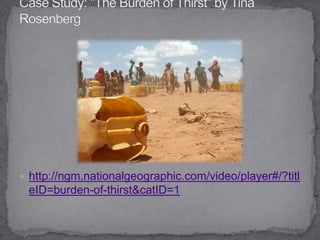
Case Study: "The Burden of Thirst" by Tina Rosenberg http://ngm.nationalgeographic.com/video/player#/?titleID=burden-of-thirst&catID=1
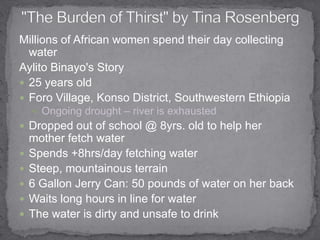
Millions of African women spend their day collecting waterAylito Binayo's Story 25 years oldForo Village, Konso District, Southwestern EthiopiaOngoing drought – river is exhausted Dropped out of school @ 8yrs. old to help her mother fetch waterSpends +8hrs/day fetching water Steep, mountainous terrain 6 Gallon Jerry Can: 50 pounds of water on her backWaits long hours in line for waterThe water is dirty and unsafe to drink"The Burden of Thirst" by Tina Rosenberg
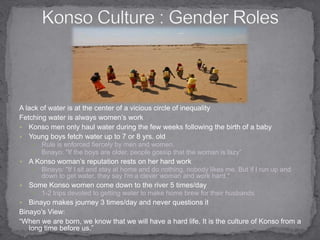
Konso Culture : Gender Roles A lack of water is at the center of a vicious circle of inequalityFetching water is always women’s work Konso men only haul water during the few weeks following the birth of a babyYoung boys fetch water up to 7 or 8 yrs. old Rule is enforced fiercely by men and women. Binayo: "If the boys are older, people gossip that the woman is lazy”A Konso woman’s reputation rests on her hard workBinayo: "If I sit and stay at home and do nothing, nobody likes me. But if I run up and down to get water, they say I'm a clever woman and work hard."Some Konso women come down to the river 5 times/day1-2 trips devoted to getting water to make home brew for their husbandsBinayo makes journey 3 times/day and never questions it Binayo’s View:“When we are born, we know that we will have a hard life. It is the culture of Konso from a long time before us.”
Sanitation Issues in KonsoProper hand washing alone can cut diarrheal diseases by 45 %Every drop counts when that water is carried up a mountainBinayo makes do w/ 2.5 gals/day (Avg. American: +100 gals/day )Washes her hands w/ water "maybe once a day”She washes her own body only occasionally Washes clothes once a year"We don't even have enough water for drinking—how can we wash our clothes?" 2007 Survey:No households in Konso District had water w/ soap near their latrines to wash their handsBinayo's family recently dug a latrine but cannot afford to buy soapVillager to Outreach Worker: “You tell me to use soap, then give me the money to buy it.”
HealthForo Village Health Clinic: 70% suffer from waterborne diseasesDiarrheaBacteria & Parasites : Lack of proper hygiene/sanitation  Drinking untreated river waterKonso District Health Center ~ Half of all patients suffer from waterborne diseasesLimited water resources Runs out of water 4 months out of yearRelies on government to truck in river water Not enough water for disinfection Sanitation Issues in Konso
Responses to the Water CrisisBringing clean water closer to people's homes is key40% of households in Sub-Saharan Africa: >30 Minutes from nearest water sourceDirect access to clean water transforms communities  Promotes Grassroots development Allows more time to grow food, raise animals, seek education & generate income GovernmentWater is commonly addressed at the District and Local Governmental levels in most of AfricaLack the funds and technological expertise needed to provide wellsNo political representation for rural villages  NGOsPrimary Implementers of Water SchemesTendency to breakdown after NGO moves-on 2007 Survey of Konso District: 9 out of 35 projects still functioning Repairs not possible: Lack of money, or spare part to far away  Sustainability and Community involvement crucial
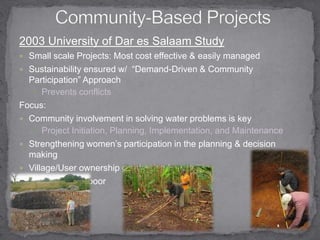
Community-Based Projects 2003 University of Dar es Salaam StudySmall scale Projects: Most cost effective & easily managed Sustainability ensured w/  “Demand-Driven & Community Participation” ApproachPrevents conflicts  Focus:Community involvement in solving water problems is keyProject Initiation, Planning, Implementation, and Maintenance Strengthening women’s participation in the planning & decision making Village/User ownership emphasized Empowers the poor
WaterAidUK-based international NGO Mission:   To transform lives by improving access to safe water, hygiene & sanitation in the    	world's poorest communities.WaterAid in Konso District, Ethiopia Installed RWH System at the District Health Center
 Sand Dam Construction
Capture and filter water that would otherwise drain away
 Methane capturing toilets for communal kitchen use WASH (Water, Sanitation, Hygiene) Community-Based Program Involves local community in designing, building, & maintaining new water projects
 7 Person Committee- w/ mandatory minimum of 4 women
 Works w/WaterAid to plan projects and involves the village in construction
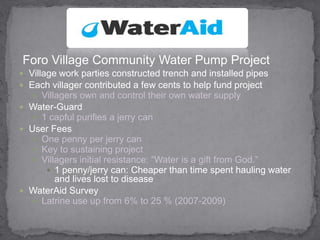
 Maintains and runs the project  Foro Village Community Water Pump ProjectVillage work parties constructed trench and installed pipes Each villager contributed a few cents to help fund project Villagers own and control their own water supply Water-Guard1 capful purifies a jerry can User FeesOne penny per jerry canKey to sustaining projectVillagers initial resistance: “Water is a gift from God.”1 penny/jerry can: Cheaper than time spent hauling water and lives lost to disease WaterAid SurveyLatrine use up from 6% to 25 % (2007-2009)
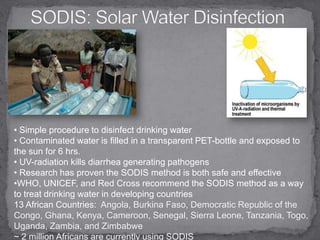
SODIS: Solar Water Disinfection  Simple procedure to disinfect drinking water

Inside Africa\'s Water Crisis

  • 1.
    Anthony ScalettaGeography ofAfricaApril 8, 2010Inside Africa's Water Crisis
  • 2.
    More than halfof all African’s lack access to safe drinking water (UN) The avg. distance a woman in Africa walks to collect water is 3.75 miles 1/3 of women in Egypt walk over an hour/day for waterIn other parts of Africa, the task can consume as much as 8 hrsWomen can expend as much as 85% of their daily energy intake on getting waterThe weight of water that women in Africa carry on their heads: 40-50lbs. Medical research has documented cases of permanent damage to women's health as a result of carrying waterChronic fatigue, Spinal & pelvic deformities, Effects on reproductive health including spontaneous abortionOf all the renewable water available in Africa each year, only 4% is used Most Africans lack Wells, Canals, Pumps, Reservoirs, & Irrigation SystemsOverview
  • 3.
    Sources: World HealthReport (WHO, 2004), Medilinks.org
  • 4.
    OverviewWater CoverageLowest overallwater supply coverage of any region in the world14 countries <50% coverage for national water supply~ 62% of Africans have access to improved water supplyUrban-Rural Disparity Sanitation ~ 60% sanitation coverage overall 10 countries <50% coverage for sanitation 45% rural / 84% urban WHO Data (1990-2000)Urban areas steady in coverage and sanitation Rural water supply increased slightly while rural sanitation has fallen
  • 5.
    Water & SanitationCrisisWaterborne Diseases killing in large numbersLimits economic growth and developmentLooking AheadAfrica’s Rapid Population Growth : Widening the GapPopulation Projected to increase by 65% over the next 25 yearsAnother 400 million people will need access to safe water & sanitation Accelerates Deforestation Climate ChangeDroughts ~ Half of Africa's population is threatened by desertificationPoverty Linkage2 in 3 people lacking access to clean water survive on less than $2 a dayOverview
  • 6.
    Poverty & Lackof Water AccessAccess to clean water is the most essential necessity for all people Water ScarcityAn environmental constraint that hinders development Creates Social Conflicts btw. various water usersIndividuals, Communities, Industries, Livestock, Wildlife, and Agricultural Users Lack of water perpetuates the Poverty Trap Closely linked to human welfare and healthMost costly for those that can least afford it (urban slums/remote villages)Time and energy spent obtaining water impacts ability to pursue income or education Poverty in Rural AfricaPoor households in the agricultural subsistence economy hit the hardest 1994 Tanzania Case Study: Limited water resources #1 cause of rural poverty
  • 7.
    Table 1: Distributionof Households by Access to Drinkable Water and Regions (1994)
  • 8.
    Case Study: "TheBurden of Thirst" by Tina Rosenberg http://ngm.nationalgeographic.com/video/player#/?titleID=burden-of-thirst&catID=1
  • 9.
    Millions of Africanwomen spend their day collecting waterAylito Binayo's Story 25 years oldForo Village, Konso District, Southwestern EthiopiaOngoing drought – river is exhausted Dropped out of school @ 8yrs. old to help her mother fetch waterSpends +8hrs/day fetching water Steep, mountainous terrain 6 Gallon Jerry Can: 50 pounds of water on her backWaits long hours in line for waterThe water is dirty and unsafe to drink"The Burden of Thirst" by Tina Rosenberg
  • 10.
    Konso Culture :Gender Roles A lack of water is at the center of a vicious circle of inequalityFetching water is always women’s work Konso men only haul water during the few weeks following the birth of a babyYoung boys fetch water up to 7 or 8 yrs. old Rule is enforced fiercely by men and women. Binayo: "If the boys are older, people gossip that the woman is lazy”A Konso woman’s reputation rests on her hard workBinayo: "If I sit and stay at home and do nothing, nobody likes me. But if I run up and down to get water, they say I'm a clever woman and work hard."Some Konso women come down to the river 5 times/day1-2 trips devoted to getting water to make home brew for their husbandsBinayo makes journey 3 times/day and never questions it Binayo’s View:“When we are born, we know that we will have a hard life. It is the culture of Konso from a long time before us.”
  • 11.
    Sanitation Issues inKonsoProper hand washing alone can cut diarrheal diseases by 45 %Every drop counts when that water is carried up a mountainBinayo makes do w/ 2.5 gals/day (Avg. American: +100 gals/day )Washes her hands w/ water "maybe once a day”She washes her own body only occasionally Washes clothes once a year"We don't even have enough water for drinking—how can we wash our clothes?" 2007 Survey:No households in Konso District had water w/ soap near their latrines to wash their handsBinayo's family recently dug a latrine but cannot afford to buy soapVillager to Outreach Worker: “You tell me to use soap, then give me the money to buy it.”
  • 12.
    HealthForo Village HealthClinic: 70% suffer from waterborne diseasesDiarrheaBacteria & Parasites : Lack of proper hygiene/sanitation Drinking untreated river waterKonso District Health Center ~ Half of all patients suffer from waterborne diseasesLimited water resources Runs out of water 4 months out of yearRelies on government to truck in river water Not enough water for disinfection Sanitation Issues in Konso
  • 13.
    Responses to theWater CrisisBringing clean water closer to people's homes is key40% of households in Sub-Saharan Africa: >30 Minutes from nearest water sourceDirect access to clean water transforms communities Promotes Grassroots development Allows more time to grow food, raise animals, seek education & generate income GovernmentWater is commonly addressed at the District and Local Governmental levels in most of AfricaLack the funds and technological expertise needed to provide wellsNo political representation for rural villages NGOsPrimary Implementers of Water SchemesTendency to breakdown after NGO moves-on 2007 Survey of Konso District: 9 out of 35 projects still functioning Repairs not possible: Lack of money, or spare part to far away Sustainability and Community involvement crucial
  • 14.
    Community-Based Projects 2003University of Dar es Salaam StudySmall scale Projects: Most cost effective & easily managed Sustainability ensured w/ “Demand-Driven & Community Participation” ApproachPrevents conflicts Focus:Community involvement in solving water problems is keyProject Initiation, Planning, Implementation, and Maintenance Strengthening women’s participation in the planning & decision making Village/User ownership emphasized Empowers the poor
  • 15.
    WaterAidUK-based international NGOMission: To transform lives by improving access to safe water, hygiene & sanitation in the world's poorest communities.WaterAid in Konso District, Ethiopia Installed RWH System at the District Health Center
  • 16.
    Sand DamConstruction
  • 17.
    Capture and filterwater that would otherwise drain away
  • 18.
    Methane capturingtoilets for communal kitchen use WASH (Water, Sanitation, Hygiene) Community-Based Program Involves local community in designing, building, & maintaining new water projects
  • 19.
    7 PersonCommittee- w/ mandatory minimum of 4 women
  • 20.
    Works w/WaterAidto plan projects and involves the village in construction
  • 21.
    Maintains andruns the project Foro Village Community Water Pump ProjectVillage work parties constructed trench and installed pipes Each villager contributed a few cents to help fund project Villagers own and control their own water supply Water-Guard1 capful purifies a jerry can User FeesOne penny per jerry canKey to sustaining projectVillagers initial resistance: “Water is a gift from God.”1 penny/jerry can: Cheaper than time spent hauling water and lives lost to disease WaterAid SurveyLatrine use up from 6% to 25 % (2007-2009)
  • 22.
    SODIS: Solar WaterDisinfection Simple procedure to disinfect drinking water