1                                                                                              1
 2
 1NAME OF THE COURSE                    : MA IN ENVIRONMENT & DEVELOPMENT
 2NAME OF THE STUDENT                   : CHHANDAM GHOSH DASTIDAR
 3E MAIL ID                             : chhandamghoshdastidar@yahoo.com
 4TASK NO.                              : 3.4 (INTERNAL ASSESSMENT-1)
 5

 6

 7

 83.4 : SHORT ESSAY ON GLOBAL AND NATIONAL FRESH WATER SCENARIO
 9AND THE NEED FOR MANAGEMENT STRATEGIES.

10Global Fresh water scenario :
11
12
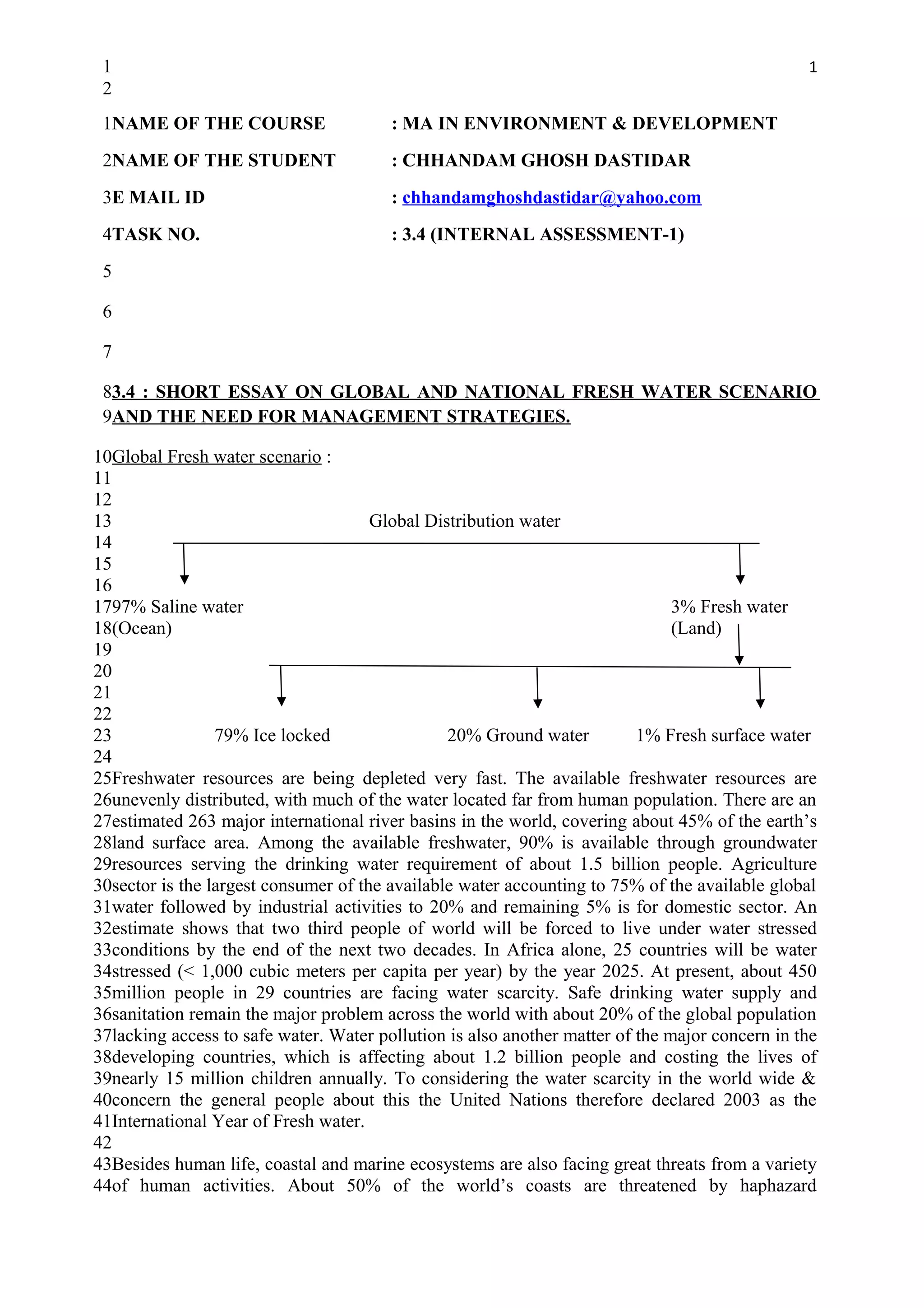
13                                    Global Distribution water
14
15
16
1797% Saline water                                                             3% Fresh water
18(Ocean)                                                                      (Land)
19
20
21
22
23               79% Ice locked                 20% Ground water          1% Fresh surface water
24
25Freshwater resources are being depleted very fast. The available freshwater resources are
26unevenly distributed, with much of the water located far from human population. There are an
27estimated 263 major international river basins in the world, covering about 45% of the earth’s
28land surface area. Among the available freshwater, 90% is available through groundwater
29resources serving the drinking water requirement of about 1.5 billion people. Agriculture
30sector is the largest consumer of the available water accounting to 75% of the available global
31water followed by industrial activities to 20% and remaining 5% is for domestic sector. An
32estimate shows that two third people of world will be forced to live under water stressed
33conditions by the end of the next two decades. In Africa alone, 25 countries will be water
34stressed (< 1,000 cubic meters per capita per year) by the year 2025. At present, about 450
35million people in 29 countries are facing water scarcity. Safe drinking water supply and
36sanitation remain the major problem across the world with about 20% of the global population
37lacking access to safe water. Water pollution is also another matter of the major concern in the
38developing countries, which is affecting about 1.2 billion people and costing the lives of
39nearly 15 million children annually. To considering the water scarcity in the world wide &
40concern the general people about this the United Nations therefore declared 2003 as the
41International Year of Fresh water.
42
43Besides human life, coastal and marine ecosystems are also facing great threats from a variety
44of human activities. About 50% of the world’s coasts are threatened by haphazard
1                                                                                             2
 2
 1developmental activities. Land based activities amount to 80% marine pollution leading to
 2severe eutrophication in several seas. Increasing marine pollution is resulting in the decrease
 3in yield of marine fisheries, which can be seen as inland and marine aquaculture production
 4contributes 30% of the total global fish yield.
 5
 6Initial work on a World Water Scenarios project began in 2009 under UNESCO-WWAP, with
 7support from Italy, the World Water Council, the International Forum Committee, and
 8Norway, and resulted in two initial reports released at the World Water Forum in Marseille in
 9March 2012. The fourth edition of the World Water Development Report included a section
10on the analysis of the drivers, and a literature survey summary of existing qualitative and
11quantitative global and regional water-related scenarios was produced that served as
12background information for UN-DESA at Rio+20.
13
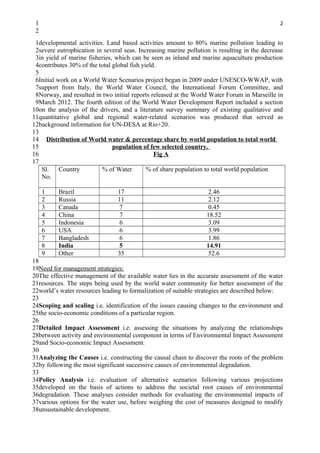
14 Distribution of World water & percentage share by world population to total world
15                             population of few selected country.
16                                              Fig A
17
   Sl.     Country        % of Water         % of share population to total world population
   No.

     1    Brazil                 17                                 2.46
     2    Russia                 11                                 2.12
     3    Canada                  7                                 0.45
     4    China                   7                                18.52
     5    Indonesia               6                                 3.09
     6    USA                     6                                 3.99
     7    Bangladesh              6                                 1.86
     8    India                   5                                14.91
     9    Other                  35                                 52.6
18
19Need for management strategies:
20The effective management of the available water lies in the accurate assessment of the water
21resources. The steps being used by the world water community for better assessment of the
22world’s water resources leading to formalization of suitable strategies are described below:
23
24Scoping and scaling i.e. identification of the issues causing changes to the environment and
25the socio-economic conditions of a particular region.
26
27Detailed Impact Assessment i.e. assessing the situations by analyzing the relationships
28between activity and environmental component in terms of Environmental Impact Assessment
29and Socio-economic Impact Assessment.
30
31Analyzing the Causes i.e. constructing the causal chain to discover the roots of the problem
32by following the most significant successive causes of environmental degradation.
33
34Policy Analysis i.e. evaluation of alternative scenarios following various projections
35developed on the basis of actions to address the societal root causes of environmental
36degradation. These analyses consider methods for evaluating the environmental impacts of
37various options for the water use, before weighing the cost of measures designed to modify
38unsustainable development.
1                                                                                              3
 2
 1Better Implementation in Field i.e. stringent control and enforcement with quality control in
 2the field actions to implement the designed measures in sustainable way. That means -
 3• Direct measures to control water use and land use (regulatory, technological)
 4• Indirect measures that affect behavior (incentives, taxes)
 5• Institutional changes for improved management of resources
 6• Improvement in the operation of water management systems
 7• Direct measures that increase the availability of supply (reservoirs, pipelines)
 8• Measures that improve technology and the efficiency of water use.
 9
10Different strategies apply to different circumstances. Watersheds that have little or no control
11over natural flows and are largely dependent on precipitation must implement a different set
12of water management strategies than river basins with a high degree of control in the form of
13reservoirs, canals, levees, and so forth. Similarly, rapidly urbanizing areas will require
14different responses than agricultural regions. There is no standard prescribed approach.
15However, a rational management strategy undertaken to deal with the reasonably foreseeable
16needs of a region in the absence of climate change, according to the principles espoused in
17Agenda 21, also will serve to offset many of the possible adverse consequences of climate
18change.
19
20Indian Fresh water scenario:
21
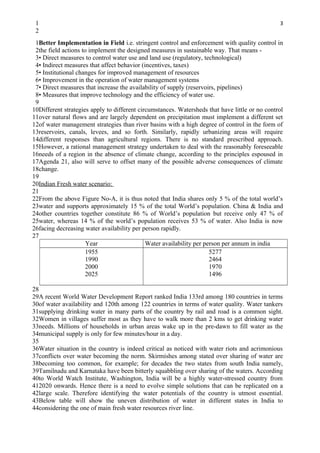
22From the above Figure No-A, it is thus noted that India shares only 5 % of the total world’s
23water and supports approximately 15 % of the total World’s population. China & India and
24other countries together constitute 86 % of World’s population but receive only 47 % of
25water, whereas 14 % of the world’s population receives 53 % of water. Also India is now
26facing decreasing water availability per person rapidly.
27
                      Year                   Water availability per person per annum in india
                      1955                                            5277
                      1990                                            2464
                      2000                                            1970
                      2025                                            1496

28
29A recent World Water Development Report ranked India 133rd among 180 countries in terms
30of water availability and 120th among 122 countries in terms of water quality. Water tankers
31supplying drinking water in many parts of the country by rail and road is a common sight.
32Women in villages suffer most as they have to walk more than 2 kms to get drinking water
33needs. Millions of households in urban areas wake up in the pre-dawn to fill water as the
34municipal supply is only for few minutes/hour in a day.
35
36Water situation in the country is indeed critical as noticed with water riots and acrimonious
37conflicts over water becoming the norm. Skirmishes among stated over sharing of water are
38becoming too common, for example; for decades the two states from south India namely,
39Tamilnadu and Karnataka have been bitterly squabbling over sharing of the waters. According
40to World Watch Institute, Washington, India will be a highly water-stressed country from
412020 onwards. Hence there is a need to evolve simple solutions that can be replicated on a
42large scale. Therefore identifying the water potentials of the country is utmost essential.
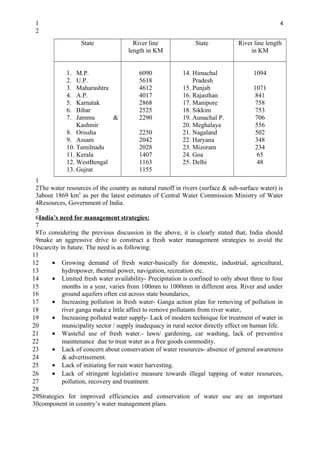
43Below table will show the uneven distribution of water in different states in India to
44considering the one of main fresh water resources river line.
1                                                                                              4
 2
                   State               River line              State            River line length
                                     length in KM                                   in KM


             1.  M.P.                    6090             14. Himachal                1094
             2.  U.P.                    5618                 Pradesh
             3.  Maharashtra             4612             15. Punjab                  1071
             4.  A.P.                    4017             16. Rajasthan                841
             5.  Karnatak                2868             17. Manipore                 758
             6.  Bihar                   2525             18. Sikkim                   753
             7.  Jammu       &           2290             19. Aunachal P.              706
                 Kashmir                                  20. Meghalaya                556
             8. Orissha                  2250             21. Nagaland                 502
             9. Assam                    2042             22. Haryana                  348
             10. Tamilnadu               2028             23. Mizoram                  234
             11. Kerala                  1407             24. Goa                       65
             12. WestBengal              1163             25. Delhi                     48
             13. Gujrat                  1155
 1
 2The water resources of the country as natural runoff in rivers (surface & sub-surface water) is
 3about 1869 km3 as per the latest estimates of Central Water Commission Ministry of Water
 4Resources, Government of India.
 5
 6India’s need for management strategies:
 7
 8To considering the previous discussion in the above, it is clearly stated that, India should
 9make an aggressive drive to construct a fresh water management strategies to avoid the
10scarcity in future. The need is as following:
11
12     • Growing demand of fresh water-basically for domestic, industrial, agricultural,
13          hydropower, thermal power, navigation, recreation etc.
14     • Limited fresh water availability- Precipitation is confined to only about three to four
15          months in a year, varies from 100mm to 1000mm in different area. River and under
16          ground aquifers often cut across state boundaries,
17     • Increasing pollution in fresh water- Ganga action plan for removing of pollution in
18          river ganga make a little affect to remove pollutants from river water,
19     • Increasing polluted water supply- Lack of modern technique for treatment of water in
20          municipality sector / supply inadequacy in rural sector directly effect on human life.
21     • Wasteful use of fresh water.- lawn/ gardening, car washing, lack of preventive
22          maintenance due to treat water as a free goods commodity.
23     • Lack of concern about conservation of water resources- absence of general awareness
24          & advertisement.
25     • Lack of initiating for rain water harvesting.
26     • Lack of stringent legislative measure towards illegal tapping of water resources,
27          pollution, recovery and treatment.
28
29Strategies for improved efficiencies and conservation of water use are an important
30component in country’s water management plans.
1                                                                                           5
 2
 1Water recycling, improved efficiencies in water use and reallocation of water rights offer
 2substantial potential for stretching water supplies.
 3
 4CONCLUSIONS
 5
 6New sources of fresh water will be developed, and no doubt water will be used with
 7increasing efficiency. Water conservation and reuse should be adopted as rule for sustainable
 8future use. Solutions that work over time, however, must respect the limits imposed by the
 9global water cycle. At least, until renewable energy can be coupled inexpensively with
10desalination technologies, sustainable development of water resources means working with
11the limited 41,000 cubic kilometers of water that the water cycle provides each year. After
12allowing for flooding and for meeting the nature's needs, a quarter to a third of that amount
13may be considered as the upper limit of water available for sustainable human use.
14
15
16
17
18    _____________________________END____________________________________
19
1                                                                                           5
 2
 1Water recycling, improved efficiencies in water use and reallocation of water rights offer
 2substantial potential for stretching water supplies.
 3
 4CONCLUSIONS
 5
 6New sources of fresh water will be developed, and no doubt water will be used with
 7increasing efficiency. Water conservation and reuse should be adopted as rule for sustainable
 8future use. Solutions that work over time, however, must respect the limits imposed by the
 9global water cycle. At least, until renewable energy can be coupled inexpensively with
10desalination technologies, sustainable development of water resources means working with
11the limited 41,000 cubic kilometers of water that the water cycle provides each year. After
12allowing for flooding and for meeting the nature's needs, a quarter to a third of that amount
13may be considered as the upper limit of water available for sustainable human use.
14
15
16
17
18    _____________________________END____________________________________
19

Chhandam3.4

  • 1.
    1 1 2 1NAME OF THE COURSE : MA IN ENVIRONMENT & DEVELOPMENT 2NAME OF THE STUDENT : CHHANDAM GHOSH DASTIDAR 3E MAIL ID : chhandamghoshdastidar@yahoo.com 4TASK NO. : 3.4 (INTERNAL ASSESSMENT-1) 5 6 7 83.4 : SHORT ESSAY ON GLOBAL AND NATIONAL FRESH WATER SCENARIO 9AND THE NEED FOR MANAGEMENT STRATEGIES. 10Global Fresh water scenario : 11 12 13 Global Distribution water 14 15 16 1797% Saline water 3% Fresh water 18(Ocean) (Land) 19 20 21 22 23 79% Ice locked 20% Ground water 1% Fresh surface water 24 25Freshwater resources are being depleted very fast. The available freshwater resources are 26unevenly distributed, with much of the water located far from human population. There are an 27estimated 263 major international river basins in the world, covering about 45% of the earth’s 28land surface area. Among the available freshwater, 90% is available through groundwater 29resources serving the drinking water requirement of about 1.5 billion people. Agriculture 30sector is the largest consumer of the available water accounting to 75% of the available global 31water followed by industrial activities to 20% and remaining 5% is for domestic sector. An 32estimate shows that two third people of world will be forced to live under water stressed 33conditions by the end of the next two decades. In Africa alone, 25 countries will be water 34stressed (< 1,000 cubic meters per capita per year) by the year 2025. At present, about 450 35million people in 29 countries are facing water scarcity. Safe drinking water supply and 36sanitation remain the major problem across the world with about 20% of the global population 37lacking access to safe water. Water pollution is also another matter of the major concern in the 38developing countries, which is affecting about 1.2 billion people and costing the lives of 39nearly 15 million children annually. To considering the water scarcity in the world wide & 40concern the general people about this the United Nations therefore declared 2003 as the 41International Year of Fresh water. 42 43Besides human life, coastal and marine ecosystems are also facing great threats from a variety 44of human activities. About 50% of the world’s coasts are threatened by haphazard
  • 2.
    1 2 2 1developmental activities. Land based activities amount to 80% marine pollution leading to 2severe eutrophication in several seas. Increasing marine pollution is resulting in the decrease 3in yield of marine fisheries, which can be seen as inland and marine aquaculture production 4contributes 30% of the total global fish yield. 5 6Initial work on a World Water Scenarios project began in 2009 under UNESCO-WWAP, with 7support from Italy, the World Water Council, the International Forum Committee, and 8Norway, and resulted in two initial reports released at the World Water Forum in Marseille in 9March 2012. The fourth edition of the World Water Development Report included a section 10on the analysis of the drivers, and a literature survey summary of existing qualitative and 11quantitative global and regional water-related scenarios was produced that served as 12background information for UN-DESA at Rio+20. 13 14 Distribution of World water & percentage share by world population to total world 15 population of few selected country. 16 Fig A 17 Sl. Country % of Water % of share population to total world population No. 1 Brazil 17 2.46 2 Russia 11 2.12 3 Canada 7 0.45 4 China 7 18.52 5 Indonesia 6 3.09 6 USA 6 3.99 7 Bangladesh 6 1.86 8 India 5 14.91 9 Other 35 52.6 18 19Need for management strategies: 20The effective management of the available water lies in the accurate assessment of the water 21resources. The steps being used by the world water community for better assessment of the 22world’s water resources leading to formalization of suitable strategies are described below: 23 24Scoping and scaling i.e. identification of the issues causing changes to the environment and 25the socio-economic conditions of a particular region. 26 27Detailed Impact Assessment i.e. assessing the situations by analyzing the relationships 28between activity and environmental component in terms of Environmental Impact Assessment 29and Socio-economic Impact Assessment. 30 31Analyzing the Causes i.e. constructing the causal chain to discover the roots of the problem 32by following the most significant successive causes of environmental degradation. 33 34Policy Analysis i.e. evaluation of alternative scenarios following various projections 35developed on the basis of actions to address the societal root causes of environmental 36degradation. These analyses consider methods for evaluating the environmental impacts of 37various options for the water use, before weighing the cost of measures designed to modify 38unsustainable development.
  • 3.
    1 3 2 1Better Implementation in Field i.e. stringent control and enforcement with quality control in 2the field actions to implement the designed measures in sustainable way. That means - 3• Direct measures to control water use and land use (regulatory, technological) 4• Indirect measures that affect behavior (incentives, taxes) 5• Institutional changes for improved management of resources 6• Improvement in the operation of water management systems 7• Direct measures that increase the availability of supply (reservoirs, pipelines) 8• Measures that improve technology and the efficiency of water use. 9 10Different strategies apply to different circumstances. Watersheds that have little or no control 11over natural flows and are largely dependent on precipitation must implement a different set 12of water management strategies than river basins with a high degree of control in the form of 13reservoirs, canals, levees, and so forth. Similarly, rapidly urbanizing areas will require 14different responses than agricultural regions. There is no standard prescribed approach. 15However, a rational management strategy undertaken to deal with the reasonably foreseeable 16needs of a region in the absence of climate change, according to the principles espoused in 17Agenda 21, also will serve to offset many of the possible adverse consequences of climate 18change. 19 20Indian Fresh water scenario: 21 22From the above Figure No-A, it is thus noted that India shares only 5 % of the total world’s 23water and supports approximately 15 % of the total World’s population. China & India and 24other countries together constitute 86 % of World’s population but receive only 47 % of 25water, whereas 14 % of the world’s population receives 53 % of water. Also India is now 26facing decreasing water availability per person rapidly. 27 Year Water availability per person per annum in india 1955 5277 1990 2464 2000 1970 2025 1496 28 29A recent World Water Development Report ranked India 133rd among 180 countries in terms 30of water availability and 120th among 122 countries in terms of water quality. Water tankers 31supplying drinking water in many parts of the country by rail and road is a common sight. 32Women in villages suffer most as they have to walk more than 2 kms to get drinking water 33needs. Millions of households in urban areas wake up in the pre-dawn to fill water as the 34municipal supply is only for few minutes/hour in a day. 35 36Water situation in the country is indeed critical as noticed with water riots and acrimonious 37conflicts over water becoming the norm. Skirmishes among stated over sharing of water are 38becoming too common, for example; for decades the two states from south India namely, 39Tamilnadu and Karnataka have been bitterly squabbling over sharing of the waters. According 40to World Watch Institute, Washington, India will be a highly water-stressed country from 412020 onwards. Hence there is a need to evolve simple solutions that can be replicated on a 42large scale. Therefore identifying the water potentials of the country is utmost essential. 43Below table will show the uneven distribution of water in different states in India to 44considering the one of main fresh water resources river line.
  • 4.
    1 4 2 State River line State River line length length in KM in KM 1. M.P. 6090 14. Himachal 1094 2. U.P. 5618 Pradesh 3. Maharashtra 4612 15. Punjab 1071 4. A.P. 4017 16. Rajasthan 841 5. Karnatak 2868 17. Manipore 758 6. Bihar 2525 18. Sikkim 753 7. Jammu & 2290 19. Aunachal P. 706 Kashmir 20. Meghalaya 556 8. Orissha 2250 21. Nagaland 502 9. Assam 2042 22. Haryana 348 10. Tamilnadu 2028 23. Mizoram 234 11. Kerala 1407 24. Goa 65 12. WestBengal 1163 25. Delhi 48 13. Gujrat 1155 1 2The water resources of the country as natural runoff in rivers (surface & sub-surface water) is 3about 1869 km3 as per the latest estimates of Central Water Commission Ministry of Water 4Resources, Government of India. 5 6India’s need for management strategies: 7 8To considering the previous discussion in the above, it is clearly stated that, India should 9make an aggressive drive to construct a fresh water management strategies to avoid the 10scarcity in future. The need is as following: 11 12 • Growing demand of fresh water-basically for domestic, industrial, agricultural, 13 hydropower, thermal power, navigation, recreation etc. 14 • Limited fresh water availability- Precipitation is confined to only about three to four 15 months in a year, varies from 100mm to 1000mm in different area. River and under 16 ground aquifers often cut across state boundaries, 17 • Increasing pollution in fresh water- Ganga action plan for removing of pollution in 18 river ganga make a little affect to remove pollutants from river water, 19 • Increasing polluted water supply- Lack of modern technique for treatment of water in 20 municipality sector / supply inadequacy in rural sector directly effect on human life. 21 • Wasteful use of fresh water.- lawn/ gardening, car washing, lack of preventive 22 maintenance due to treat water as a free goods commodity. 23 • Lack of concern about conservation of water resources- absence of general awareness 24 & advertisement. 25 • Lack of initiating for rain water harvesting. 26 • Lack of stringent legislative measure towards illegal tapping of water resources, 27 pollution, recovery and treatment. 28 29Strategies for improved efficiencies and conservation of water use are an important 30component in country’s water management plans.
  • 5.
    1 5 2 1Water recycling, improved efficiencies in water use and reallocation of water rights offer 2substantial potential for stretching water supplies. 3 4CONCLUSIONS 5 6New sources of fresh water will be developed, and no doubt water will be used with 7increasing efficiency. Water conservation and reuse should be adopted as rule for sustainable 8future use. Solutions that work over time, however, must respect the limits imposed by the 9global water cycle. At least, until renewable energy can be coupled inexpensively with 10desalination technologies, sustainable development of water resources means working with 11the limited 41,000 cubic kilometers of water that the water cycle provides each year. After 12allowing for flooding and for meeting the nature's needs, a quarter to a third of that amount 13may be considered as the upper limit of water available for sustainable human use. 14 15 16 17 18 _____________________________END____________________________________ 19
  • 6.
    1 5 2 1Water recycling, improved efficiencies in water use and reallocation of water rights offer 2substantial potential for stretching water supplies. 3 4CONCLUSIONS 5 6New sources of fresh water will be developed, and no doubt water will be used with 7increasing efficiency. Water conservation and reuse should be adopted as rule for sustainable 8future use. Solutions that work over time, however, must respect the limits imposed by the 9global water cycle. At least, until renewable energy can be coupled inexpensively with 10desalination technologies, sustainable development of water resources means working with 11the limited 41,000 cubic kilometers of water that the water cycle provides each year. After 12allowing for flooding and for meeting the nature's needs, a quarter to a third of that amount 13may be considered as the upper limit of water available for sustainable human use. 14 15 16 17 18 _____________________________END____________________________________ 19