Overview to Subsea
System
Sandeep S Rangapure
R 160206025
M.Tech ƛ Pipeline Engineering
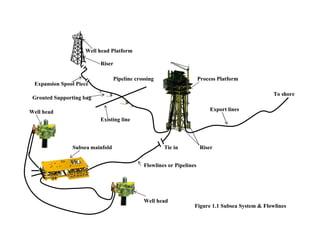
Well head Platform
Riser
Process Platform

Pipeline crossing
Expansion Spool Piece

To shore

Grouted Supporting bag
Export lines

Well head
Existing line

Subsea mainfold

Tie in

Riser

Flowlines or Pipelines

Well head
Figure 1.1 Subsea System & Flowlines
Introduction
Subsea Pipelines are used for the transportation
of offshore Hydrocarbons from one Platform to
another and or Platform to Shore
DIFFERENT TYPES OF OFFSHORE PRODUCTION UNITS
Pipelines are used for a number of purposes in the development of
offshore hydrocarbon resources These include e.g.:

 Export (transportation) pipelines
 Pipeline bundles.
 Flowlines to transfer product from a platform to export lines
 Water injection or chemical injection Flowlines
 Flowlines to transfer product between platforms
 Subsea manifolds and satellite wells;
SUBMARINE PIPELINE SYSTEMS


PIPELINE
 Pipeline is defined as the part of a pipeline system which is
located below the water surface at maximum tide (except for
pipeline risers)
 Pipeline may be resting wholly or intermittently on, or buried
below, the sea bottom


PIPELINE COMPONENTS
 Any items which are integral part of pipeline system such as
flanges, tees, bends, reducers and valves


PIPELINE SYSTEM
 An inter connected system of submarine pipelines, their risers,
supports, isolation valves, all integrated piping components,
associated piping system and the corrosion protection system
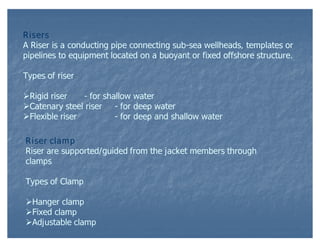
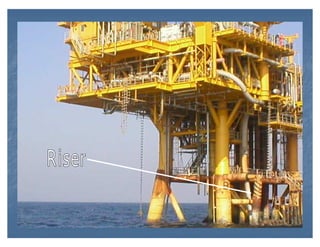
Risers
A Riser is a conducting pipe connecting sub-sea wellheads, templates or
pipelines to equipment located on a buoyant or fixed offshore structure.
Types of riser
Rigid riser
- for shallow water
Catenary steel riser - for deep water
Flexible riser
- for deep and shallow water
Riser clamp
Riser are supported/guided from the jacket members through
clamps
Types of Clamp
Hanger clamp
Fixed clamp
Adjustable clamp
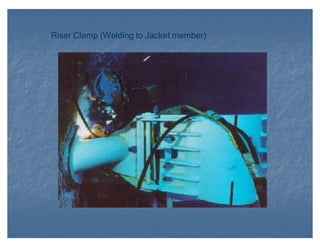
Riser Clamp (Welding to Jacket member)
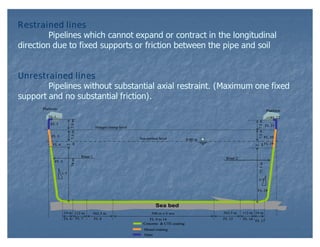
Restrained lines
Pipelines which cannot expand or contract in the longitudinal
direction due to fixed supports or friction between the pipe and soil

Unrestrained lines
Pipelines without substantial axial restraint. (Maximum one fixed
support and no substantial friction).
Platform

Platform

FL 1

FL 3
FL 4

Hanger clamp level
Sea surface level

Riser 1

FL 21
FL 20
FL 19

Riser 2
73.5 m

74 m

FL 5

0.00 m

2
m

FL 2

7.5 m 7.5 m

2
m 7.5 m 7.5 m

FL 22

1:7

1:7
FL 18

Sea bed
14 m 112 m
FL 6

FL 7

562.5 m
FL 8

500 m x 6 nos
FL 9 to 14
Concrete  CTE coating
Monel coating
Paint

562.5 m

112 m 14 m

FL 15

FL 16

FL 17
SUBSEA PIPELINE DESIGN ACTIVITIES
 Pipeline Sizing
 Pipeline Material Selection
 Pipeline Mechanical Design
 Pipeline Stability Analysis
 Pipeline Span Analysis
 Pipeline Crossing Design
 Pipeline Cathodic Protection System Design
PIPELINE SIZING


In general it means fixing up the pipeline nominal
diameter (6Ɛ,10Ɛ etc.,) which deals with the important
aspects like...
 

MAXIMUM FLOW RATE CONDITION


CHECK FOR THE FLOW CONDITION (pressure drop 
flow velocity)


CHECK FOR SECONDARY CRITERIA like Ʀ.
# Flow regime (mix of hydro carbon, single/multi phase
flow)

# Temperature profile

# Erosion velocity
D

t
PIPELINE MATERIAL SELECTION
The governing parameters for the particular type of material to
be used are
 

Temperature


Pressure


Surrounding Environment.
Environment.


Corrosive elements (CO2 and H2 S)

Carbon steel (Carbon - Manganese Steel) C.S.Nace, C.R.A.
Steel)
p
API - 5L of Grade Ranges From X - 42 to X - 80
p

 X-80 - Toughness and Weldability are limitations

p

API - 5L X- 52 ,60  65 Grades are commonly used.
used.
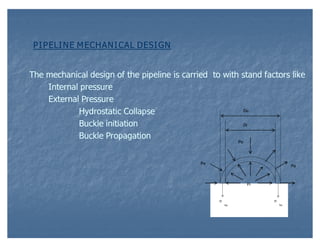
PIPELINE MECHANICAL DESIGN
The mechanical design of the pipeline is carried to with stand factors like
Internal pressure
External Pressure
Do
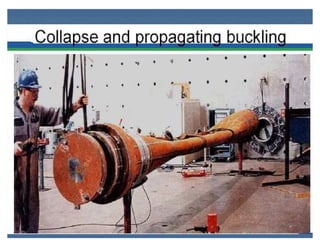
Hydrostatic Collapse
Di
Buckle initiation
Buckle Propagation
Po

Po

Po

Pi

W

W
ho

ho
PIPELINE SPAN ANALYSIS
Causes of the Pipeline Spans are

Uneven Seabed on Selected route

Pipeline Crossing seabed rock outcrop

Sand Waves

Scour
All these result in spanning and cause
Excessive yielding (Results in High Bending
Moments)
Buckle Initiation and there by Propagation

Longitudinal loads
Unsupported length
PIPELINE STABILITY
Pipeline once installed at the sea bed should be sufficiently stable
to avoid any overstressing, deterioration of coating etc., due to
wave and current generated movements

PIPELINE STABILITY

Vertical stability

Lateral stability
Vertical stability


Sinking in to the sea bed during maximum fluid density
condition.
Floating of Buried Pipeline during Empty condition  Soil
Liquefaction.
The Pipe sinkage is determined as the depth at which the applied
pipe pressure equals the soil bearing resistance.
Soil deformation(pipe sinkage)H,is given by:
sinkage)H
H = D/2-[(D/2)2 ± (B/2)2]1/2
D/2-

Where,
D = Overall pipe outside diameter including pipe coatings
B = Projected contact area between pipe and soil =P/qu
Where,
qu = CNC +1/2BK NK
+1/2BK
qu = Ultimate bearing capacity of soil
P = Pipe submerged weight including pipe coatings and in water
filled condition per unit length.
Lateral stability
 It is the capacity to resist the lateral forces due to


Environmental loads.
Forces to be considered for Lateral stability analysis
Submerged weight WS
Lateral resistance R
Friction Q
Drag force FD
Lift force FL
The stability criterion is expressed as
(Ws - FL) Q u (FD + FI) S

Where,
S
Ws
FL
FD
FI
Q

=
=
=
=
=
=

safety factor (1.1)
submerged weight of pipeline/unit
length, for nominal wall thickness
(t), N/m
hydrodynamic lift force, N/m
hydrodynamic drag force, N/m
hydrodynamic inertia force, N/m
lateral coefficient of friction between
pipe and seabed.
Methods of Pipeline stabilization


Increase Pipeline wall thickness
Provide Concrete Weight Coating
Lay the Pipeline in Open trench
Trench and bury the Pipeline
Provide Concrete Mattress over Pipeline
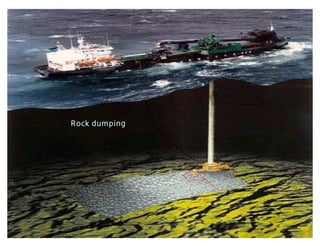
Stabilize Pipeline by Rock dumping
Increase in
Pipewall thickness

Providing
Concrete coating
Sea bed
Tren h

all

Natural fill
Buried pipe- Natural Fill

Jetted in pipe

Tremie concrete

rmor rock

Back fill
Bedding

Buried pipe- Armor Cover

Bedding

Buried pipe- Concrete Cover

Stabilization Methods for buried Submarine pipeline
Trenching

Concrete Mattress
Rock dumping
PIPELINE CROSSING ANALYSIS


Crossings are designed to Give a Physical separation
Between The Proposed Line  Existing Line.


To Avoid Interfacing Of Cathodic Protection Between
The Two Lines
A min of 300mm gap is Provided b/w the lines as per the DNVDNVCode.
Crossing analysis methodology

»

Pipeline Crossing Span Calculation.
Pipeline Dynamic Span Calculation

»

Number of Supports to be Provided.

»

Pipeline Crossing Flexibility analysis

»

Pipeline Crossing Support design against,

»


Bearing capacity


Over turning


Sliding


Settlement
PIPELINE CATHODIC PROTECTION SYSTEM DESIGN
The Subsea pipelines are provided with sacrificial anodes made of
Aluminum or Zinc to protect against marine corrosion
Important parameters for Anode Design
*

Surface area of the Pipeline

*

Fluid and Anode temperature

*

Break down

*

Design service life of Anodes
MAJOR DESIGN CODES AND STANDARDS
DNV 1981
DNV 2000

- Rules for submarine pipeline system
- Submarine pipeline system

API 5L

- Specification for line pipe

BS 8010

- Code of practice for pipeline

NACE RP 0169 - Recommended practice,control of external
corrosion on underground or submerged
metallic piping.
OISD 141

- Design and construction requirements for
cross country hydrocarbon pipeline.

ASME B 31.8
system.

-Gas transmission and distribution piping

ASME B 31.4

- Pipeline transportation systems for liquid
hydrocarbon and other liquids
subsea

subsea

  • 1.
    Overview to Subsea System SandeepS Rangapure R 160206025 M.Tech ƛ Pipeline Engineering
  • 2.
    Well head Platform Riser ProcessPlatform Pipeline crossing Expansion Spool Piece To shore Grouted Supporting bag Export lines Well head Existing line Subsea mainfold Tie in Riser Flowlines or Pipelines Well head Figure 1.1 Subsea System & Flowlines
  • 3.
    Introduction Subsea Pipelines areused for the transportation of offshore Hydrocarbons from one Platform to another and or Platform to Shore
  • 4.
    DIFFERENT TYPES OFOFFSHORE PRODUCTION UNITS
  • 5.
    Pipelines are usedfor a number of purposes in the development of offshore hydrocarbon resources These include e.g.: Export (transportation) pipelines Pipeline bundles. Flowlines to transfer product from a platform to export lines Water injection or chemical injection Flowlines Flowlines to transfer product between platforms Subsea manifolds and satellite wells;
  • 6.
    SUBMARINE PIPELINE SYSTEMS PIPELINE Pipeline is defined as the part of a pipeline system which is located below the water surface at maximum tide (except for pipeline risers) Pipeline may be resting wholly or intermittently on, or buried below, the sea bottom PIPELINE COMPONENTS Any items which are integral part of pipeline system such as flanges, tees, bends, reducers and valves PIPELINE SYSTEM An inter connected system of submarine pipelines, their risers, supports, isolation valves, all integrated piping components, associated piping system and the corrosion protection system
  • 7.
    Risers A Riser isa conducting pipe connecting sub-sea wellheads, templates or pipelines to equipment located on a buoyant or fixed offshore structure. Types of riser Rigid riser - for shallow water Catenary steel riser - for deep water Flexible riser - for deep and shallow water Riser clamp Riser are supported/guided from the jacket members through clamps Types of Clamp Hanger clamp Fixed clamp Adjustable clamp
  • 9.
    Riser Clamp (Weldingto Jacket member)
  • 10.
    Restrained lines Pipelines whichcannot expand or contract in the longitudinal direction due to fixed supports or friction between the pipe and soil Unrestrained lines Pipelines without substantial axial restraint. (Maximum one fixed support and no substantial friction). Platform Platform FL 1 FL 3 FL 4 Hanger clamp level Sea surface level Riser 1 FL 21 FL 20 FL 19 Riser 2 73.5 m 74 m FL 5 0.00 m 2 m FL 2 7.5 m 7.5 m 2 m 7.5 m 7.5 m FL 22 1:7 1:7 FL 18 Sea bed 14 m 112 m FL 6 FL 7 562.5 m FL 8 500 m x 6 nos FL 9 to 14 Concrete CTE coating Monel coating Paint 562.5 m 112 m 14 m FL 15 FL 16 FL 17
  • 11.
    SUBSEA PIPELINE DESIGNACTIVITIES Pipeline Sizing Pipeline Material Selection Pipeline Mechanical Design Pipeline Stability Analysis Pipeline Span Analysis Pipeline Crossing Design Pipeline Cathodic Protection System Design
  • 12.
    PIPELINE SIZING In generalit means fixing up the pipeline nominal diameter (6Ɛ,10Ɛ etc.,) which deals with the important aspects like...   MAXIMUM FLOW RATE CONDITION   CHECK FOR THE FLOW CONDITION (pressure drop flow velocity)   CHECK FOR SECONDARY CRITERIA like Ʀ. # Flow regime (mix of hydro carbon, single/multi phase flow) # Temperature profile # Erosion velocity
  • 13.
  • 14.
    PIPELINE MATERIAL SELECTION Thegoverning parameters for the particular type of material to be used are   Temperature   Pressure   Surrounding Environment. Environment.   Corrosive elements (CO2 and H2 S) Carbon steel (Carbon - Manganese Steel) C.S.Nace, C.R.A. Steel) p API - 5L of Grade Ranges From X - 42 to X - 80 p X-80 - Toughness and Weldability are limitations p API - 5L X- 52 ,60 65 Grades are commonly used. used.
  • 15.
    PIPELINE MECHANICAL DESIGN Themechanical design of the pipeline is carried to with stand factors like Internal pressure External Pressure Do Hydrostatic Collapse Di Buckle initiation Buckle Propagation Po Po Po Pi W W ho ho
  • 17.
    PIPELINE SPAN ANALYSIS Causesof the Pipeline Spans are Uneven Seabed on Selected route Pipeline Crossing seabed rock outcrop Sand Waves Scour All these result in spanning and cause Excessive yielding (Results in High Bending Moments) Buckle Initiation and there by Propagation Longitudinal loads Unsupported length
  • 19.
    PIPELINE STABILITY Pipeline onceinstalled at the sea bed should be sufficiently stable to avoid any overstressing, deterioration of coating etc., due to wave and current generated movements PIPELINE STABILITY Vertical stability Lateral stability
  • 20.
    Vertical stability Sinking into the sea bed during maximum fluid density condition. Floating of Buried Pipeline during Empty condition Soil Liquefaction. The Pipe sinkage is determined as the depth at which the applied pipe pressure equals the soil bearing resistance. Soil deformation(pipe sinkage)H,is given by: sinkage)H H = D/2-[(D/2)2 ± (B/2)2]1/2 D/2- Where, D = Overall pipe outside diameter including pipe coatings B = Projected contact area between pipe and soil =P/qu Where, qu = CNC +1/2BK NK +1/2BK qu = Ultimate bearing capacity of soil P = Pipe submerged weight including pipe coatings and in water filled condition per unit length.
  • 21.
    Lateral stability Itis the capacity to resist the lateral forces due to Environmental loads. Forces to be considered for Lateral stability analysis Submerged weight WS Lateral resistance R Friction Q Drag force FD Lift force FL
  • 22.
    The stability criterionis expressed as (Ws - FL) Q u (FD + FI) S Where, S Ws FL FD FI Q = = = = = = safety factor (1.1) submerged weight of pipeline/unit length, for nominal wall thickness (t), N/m hydrodynamic lift force, N/m hydrodynamic drag force, N/m hydrodynamic inertia force, N/m lateral coefficient of friction between pipe and seabed.
  • 23.
    Methods of Pipelinestabilization Increase Pipeline wall thickness Provide Concrete Weight Coating Lay the Pipeline in Open trench Trench and bury the Pipeline Provide Concrete Mattress over Pipeline Stabilize Pipeline by Rock dumping
  • 24.
  • 25.
    Sea bed Tren h all Naturalfill Buried pipe- Natural Fill Jetted in pipe Tremie concrete rmor rock Back fill Bedding Buried pipe- Armor Cover Bedding Buried pipe- Concrete Cover Stabilization Methods for buried Submarine pipeline
  • 26.
  • 27.
  • 28.
    PIPELINE CROSSING ANALYSIS Crossingsare designed to Give a Physical separation Between The Proposed Line Existing Line. To Avoid Interfacing Of Cathodic Protection Between The Two Lines A min of 300mm gap is Provided b/w the lines as per the DNVDNVCode.
  • 29.
    Crossing analysis methodology » PipelineCrossing Span Calculation. Pipeline Dynamic Span Calculation » Number of Supports to be Provided. » Pipeline Crossing Flexibility analysis » Pipeline Crossing Support design against, » Bearing capacity Over turning Sliding Settlement
  • 30.
    PIPELINE CATHODIC PROTECTIONSYSTEM DESIGN The Subsea pipelines are provided with sacrificial anodes made of Aluminum or Zinc to protect against marine corrosion Important parameters for Anode Design * Surface area of the Pipeline * Fluid and Anode temperature * Break down * Design service life of Anodes
  • 33.
    MAJOR DESIGN CODESAND STANDARDS DNV 1981 DNV 2000 - Rules for submarine pipeline system - Submarine pipeline system API 5L - Specification for line pipe BS 8010 - Code of practice for pipeline NACE RP 0169 - Recommended practice,control of external corrosion on underground or submerged metallic piping. OISD 141 - Design and construction requirements for cross country hydrocarbon pipeline. ASME B 31.8 system. -Gas transmission and distribution piping ASME B 31.4 - Pipeline transportation systems for liquid hydrocarbon and other liquids