Web Base Instruction
(WBI)
Mr.M.Deivam,
Assistant Professor in ICT in Education,
Dept. of Education,
Gandhigram Rural Institute – Deemed University,
Gandhigram, Dindigul district, Tamilnadu – 624 302
Introduction
• As the internet technology is an introduced it makes a new revolution in
information technology. The wide use of internet also affects the methods
of education. It is a global network and gives the concept of global
classroom where any number of students can interact with each other at
any time. The www gives attractive features to Web Based Education, which
are:-
• The ability to have multimedia documents.
• The hyper text/hypermedia capability.
• www, network basis, allowing for distance/formal(regular) learning.
• (Pawar, 2001; Sekar and Devanathan, 2011) Web-Based Instruction refers to
providing a learning environment that is mediated and supported via the
Internet/Intranet and connected to a computer with hyperlinks to resources
outside the instructional domain. The instruction is designed so that the
computer displays lessons in response to learner/user interactions (Farid,
2008).
Meaning
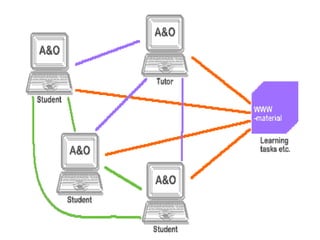
• Web-based learning is one way to learn, using web-based
technologies or tools in a learning process. In other words,
learner uses mainly computers to interact with the teacher,
other students and learning material. Web-based learning
consists of technology that supports traditional classroom
training and online learning environments. "Pure" web-
based courses are wholly based on computer and online
possibilities. In this case all the communication and
learning activities are done online.
• Web-based learning can be also formal or informal. Formal
web-based learning is purposed and learning activities are
organised by teachers. Informal learning takes place while
you are searching material from the Internet. It is self-
paced, depending on your goals and ambition to learn.
Definition
• Khan (1997) defines Web-Based Instruction
(WBI) as: “...a hypermedia-based instructional
program which utilizes the attributes and
resources of the World Wide Web to create a
meaningful learning environment where
learning is fostered and supported.”
TYPES OF WEB BASED
INSTUCTION
• Asynchronous: In asynchronous the education
module is to be installed from a particular
website and then we can unpack it offline on our
machine. In this case there is no mutual
interaction of student with teacher
• Synchronous: In synchronous type there is
synchronization among the students and teacher
on-line. This synchronous web based education
provides the most emerging concept of E-leaning.
Need &Significance of WBI
• Reasons for the growth of WBI include:
Growth of distance education economically
(reliable and inexpensive source)as compared
to computer based training, live broadcasts,
video tapes, and so on,
• enables learners who prefer or are required to
learn outside traditional classrooms to attend
classes at their homes or offices
Cont.,
• Enhancing student learning;
• Spending more time with students working in small
groups or one-on-one;
• Reducing repetitive teaching tasks;
• Reducing paper flow and management, and;
• Providing improved instructional materials;
• Web based instruction frees the students from space
and time. In such a setting the students are to follow
the instructional content at their own learning pace
and needs
Development of WBI
• An introduction to the principles of Web-
Based Instruction (WBI) and its role in creating
learning environment that utilize the
attributes and resources of the Internet and
the World Wide Web Emphasis will be placed
on pedagogical, technological, organizational,
institutional, and ethical issues related to the
design, development, and delivery of WBI.
Cont.,
• Navigation: Navigation is the process of
reading, and controlling the movement of a
craft or vehicle from one place to another
• Interactivity: In computers, interactivity is the
dialouge that occurs between a human being
(or possibly another live creature) and a
computer program.
Cont.,
• Graphics: Graphics are visual presentations on some
surface, such as a wall, canvas, computer screen, paper, or
stone to brand, inform, illustrate, or entertain. Examples
are photographs, drawings, line, art, graphs, diagrams,
typography, numbers, symbols, geometric designs, maps,
engineering drawings, or other images.
• Image : An imitation, representation, or similitude of any
person, things, or act, sculptured, drawn, painted, or
otherwise made perceptible to the sight, a visible
presentation, a copy, a likeness, an effigy, a picture, a
semblance.
Cont.,
• Animation: Animation is the rapid display of a
sequence of images of 2-D artwork or model position
in order to create an illusion of movement.
• Teaching and learning: In practical development,
student-centred approaches and student active
learning have been adopted as an appropriate teaching
technology, Effective teaching means designing the
teaching/learning context so that students have every
encouragement to react with the level of cognitive
engagement (Sekar and Devanathan, 2011).
WBI Design
• Instructional design is a systematic process
that Instructional designers should follow in
order to achieve the creation of efficient and
effective instruction.
ADDIE Model
• ADDIE model was initially developed by
Florida State University
• This model originally contained several steps
under the five original phases (Analyse,
Design, Develop, Implement, and Evaluation)
Analyse
• Analysis refers to the gathering of information
about the learner, the task to be completed,
and the projects overall goals.
Design
• In this phase, instructional designer begin to
create his project.
Develop
• The third phase, Development, related to the
creation of the activities being implemented.
This stage is where the blueprints in the
design phase are assembled.
Implement
• This stage allows the instructional designer to
test all materials to identify if they are
functional and appropriate for the intended
learner.
Evaluate
• The final phase, evaluate, ensures the
materials achieved the desired goals.
Advantages of WBI
• WBI is advantages to remote learners
• WBI is auto instructional or self instructional
• WBI is cost effective and has flexible timing
• WBI is both formal and non-formal setting of
education
• WBI is very helpful for large group of students
• Learner can also undergo training from any place
or location
• WBI can repeat the lesson several times for the
convenience of the learner.
Thank You

Web base instruction

  • 1.
    Web Base Instruction (WBI) Mr.M.Deivam, AssistantProfessor in ICT in Education, Dept. of Education, Gandhigram Rural Institute – Deemed University, Gandhigram, Dindigul district, Tamilnadu – 624 302
  • 3.
    Introduction • As theinternet technology is an introduced it makes a new revolution in information technology. The wide use of internet also affects the methods of education. It is a global network and gives the concept of global classroom where any number of students can interact with each other at any time. The www gives attractive features to Web Based Education, which are:- • The ability to have multimedia documents. • The hyper text/hypermedia capability. • www, network basis, allowing for distance/formal(regular) learning. • (Pawar, 2001; Sekar and Devanathan, 2011) Web-Based Instruction refers to providing a learning environment that is mediated and supported via the Internet/Intranet and connected to a computer with hyperlinks to resources outside the instructional domain. The instruction is designed so that the computer displays lessons in response to learner/user interactions (Farid, 2008).
  • 4.
    Meaning • Web-based learningis one way to learn, using web-based technologies or tools in a learning process. In other words, learner uses mainly computers to interact with the teacher, other students and learning material. Web-based learning consists of technology that supports traditional classroom training and online learning environments. "Pure" web- based courses are wholly based on computer and online possibilities. In this case all the communication and learning activities are done online. • Web-based learning can be also formal or informal. Formal web-based learning is purposed and learning activities are organised by teachers. Informal learning takes place while you are searching material from the Internet. It is self- paced, depending on your goals and ambition to learn.
  • 5.
    Definition • Khan (1997)defines Web-Based Instruction (WBI) as: “...a hypermedia-based instructional program which utilizes the attributes and resources of the World Wide Web to create a meaningful learning environment where learning is fostered and supported.”
  • 6.
    TYPES OF WEBBASED INSTUCTION • Asynchronous: In asynchronous the education module is to be installed from a particular website and then we can unpack it offline on our machine. In this case there is no mutual interaction of student with teacher • Synchronous: In synchronous type there is synchronization among the students and teacher on-line. This synchronous web based education provides the most emerging concept of E-leaning.
  • 7.
    Need &Significance ofWBI • Reasons for the growth of WBI include: Growth of distance education economically (reliable and inexpensive source)as compared to computer based training, live broadcasts, video tapes, and so on, • enables learners who prefer or are required to learn outside traditional classrooms to attend classes at their homes or offices
  • 8.
    Cont., • Enhancing studentlearning; • Spending more time with students working in small groups or one-on-one; • Reducing repetitive teaching tasks; • Reducing paper flow and management, and; • Providing improved instructional materials; • Web based instruction frees the students from space and time. In such a setting the students are to follow the instructional content at their own learning pace and needs
  • 9.
    Development of WBI •An introduction to the principles of Web- Based Instruction (WBI) and its role in creating learning environment that utilize the attributes and resources of the Internet and the World Wide Web Emphasis will be placed on pedagogical, technological, organizational, institutional, and ethical issues related to the design, development, and delivery of WBI.
  • 10.
    Cont., • Navigation: Navigationis the process of reading, and controlling the movement of a craft or vehicle from one place to another • Interactivity: In computers, interactivity is the dialouge that occurs between a human being (or possibly another live creature) and a computer program.
  • 11.
    Cont., • Graphics: Graphicsare visual presentations on some surface, such as a wall, canvas, computer screen, paper, or stone to brand, inform, illustrate, or entertain. Examples are photographs, drawings, line, art, graphs, diagrams, typography, numbers, symbols, geometric designs, maps, engineering drawings, or other images. • Image : An imitation, representation, or similitude of any person, things, or act, sculptured, drawn, painted, or otherwise made perceptible to the sight, a visible presentation, a copy, a likeness, an effigy, a picture, a semblance.
  • 12.
    Cont., • Animation: Animationis the rapid display of a sequence of images of 2-D artwork or model position in order to create an illusion of movement. • Teaching and learning: In practical development, student-centred approaches and student active learning have been adopted as an appropriate teaching technology, Effective teaching means designing the teaching/learning context so that students have every encouragement to react with the level of cognitive engagement (Sekar and Devanathan, 2011).
  • 13.
    WBI Design • Instructionaldesign is a systematic process that Instructional designers should follow in order to achieve the creation of efficient and effective instruction.
  • 14.
    ADDIE Model • ADDIEmodel was initially developed by Florida State University • This model originally contained several steps under the five original phases (Analyse, Design, Develop, Implement, and Evaluation)
  • 15.
    Analyse • Analysis refersto the gathering of information about the learner, the task to be completed, and the projects overall goals.
  • 16.
    Design • In thisphase, instructional designer begin to create his project.
  • 17.
    Develop • The thirdphase, Development, related to the creation of the activities being implemented. This stage is where the blueprints in the design phase are assembled.
  • 18.
    Implement • This stageallows the instructional designer to test all materials to identify if they are functional and appropriate for the intended learner.
  • 19.
    Evaluate • The finalphase, evaluate, ensures the materials achieved the desired goals.
  • 20.
    Advantages of WBI •WBI is advantages to remote learners • WBI is auto instructional or self instructional • WBI is cost effective and has flexible timing • WBI is both formal and non-formal setting of education • WBI is very helpful for large group of students • Learner can also undergo training from any place or location • WBI can repeat the lesson several times for the convenience of the learner.
  • 21.