Lloyd Dean Joint Actions
Aims By the end of the lesson you should be able to: State the major joint actions within the body Draw diagrams for each joint action Apply gym based examples of the different types of movement for each joint action
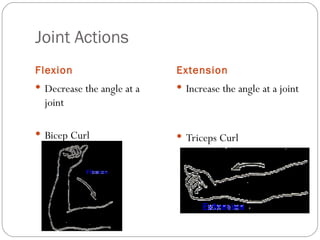
Joint Actions Flexion Extension Decrease the angle at a joint Bicep Curl Increase the angle at a joint Triceps Curl
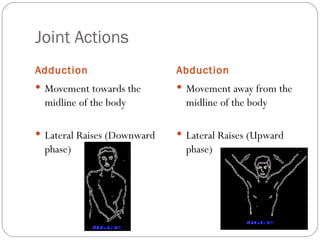
Joint Actions Adduction Abduction Movement towards the midline of the body Lateral Raises (Downward phase) Movement away from the midline of the body Lateral Raises (Upward phase)
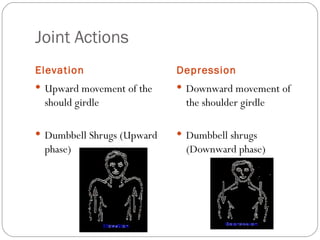
Joint Actions Elevation Depression Upward movement of the should girdle Dumbbell Shrugs (Upward phase) Downward movement of the shoulder girdle Dumbbell shrugs (Downward phase)
Joint Actions Plantar Flexion Dorsiflexion Movement that brings the sole of the foot downwards with toes pointed Running Movement that brings the top of the foot towards the shin Leg Extension (Machine)
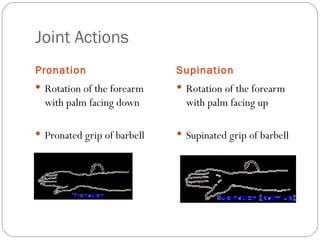
Joint Actions Pronation  Supination Rotation of the forearm with palm facing down Pronated grip of barbell Rotation of the forearm with palm facing up Supinated grip of barbell
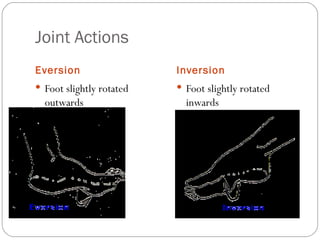
Joint Actions Eversion Inversion Foot slightly rotated outwards Foot slightly rotated inwards
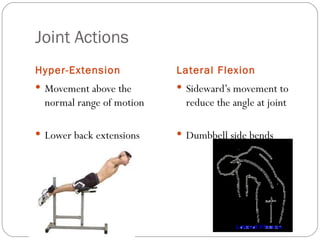
Joint Actions Hyper-Extension Lateral Flexion Movement above the normal range of motion Lower back extensions Sideward’s movement to reduce the angle at joint Dumbbell side bends
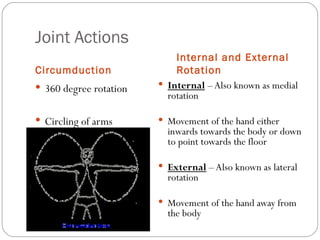
Joint Actions Circumduction Internal and External Rotation 360 degree rotation Circling of arms Internal  – Also known as medial rotation Movement of the hand either inwards towards the body or down to point towards the floor External  – Also known as lateral rotation Movement of the hand away from the body
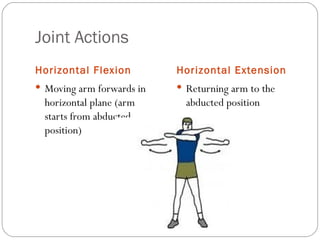
Joint Actions Horizontal Flexion Horizontal Extension Moving arm forwards in horizontal plane (arm starts from abducted position) Returning arm to the abducted position

Joint actions

  • 1.
  • 2.
    Aims By theend of the lesson you should be able to: State the major joint actions within the body Draw diagrams for each joint action Apply gym based examples of the different types of movement for each joint action
  • 3.
    Joint Actions FlexionExtension Decrease the angle at a joint Bicep Curl Increase the angle at a joint Triceps Curl
  • 4.
    Joint Actions AdductionAbduction Movement towards the midline of the body Lateral Raises (Downward phase) Movement away from the midline of the body Lateral Raises (Upward phase)
  • 5.
    Joint Actions ElevationDepression Upward movement of the should girdle Dumbbell Shrugs (Upward phase) Downward movement of the shoulder girdle Dumbbell shrugs (Downward phase)
  • 6.
    Joint Actions PlantarFlexion Dorsiflexion Movement that brings the sole of the foot downwards with toes pointed Running Movement that brings the top of the foot towards the shin Leg Extension (Machine)
  • 7.
    Joint Actions Pronation Supination Rotation of the forearm with palm facing down Pronated grip of barbell Rotation of the forearm with palm facing up Supinated grip of barbell
  • 8.
    Joint Actions EversionInversion Foot slightly rotated outwards Foot slightly rotated inwards
  • 9.
    Joint Actions Hyper-ExtensionLateral Flexion Movement above the normal range of motion Lower back extensions Sideward’s movement to reduce the angle at joint Dumbbell side bends
  • 10.
    Joint Actions CircumductionInternal and External Rotation 360 degree rotation Circling of arms Internal – Also known as medial rotation Movement of the hand either inwards towards the body or down to point towards the floor External – Also known as lateral rotation Movement of the hand away from the body
  • 11.
    Joint Actions HorizontalFlexion Horizontal Extension Moving arm forwards in horizontal plane (arm starts from abducted position) Returning arm to the abducted position