Air Masses
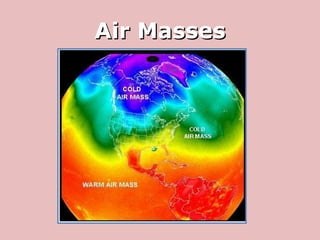
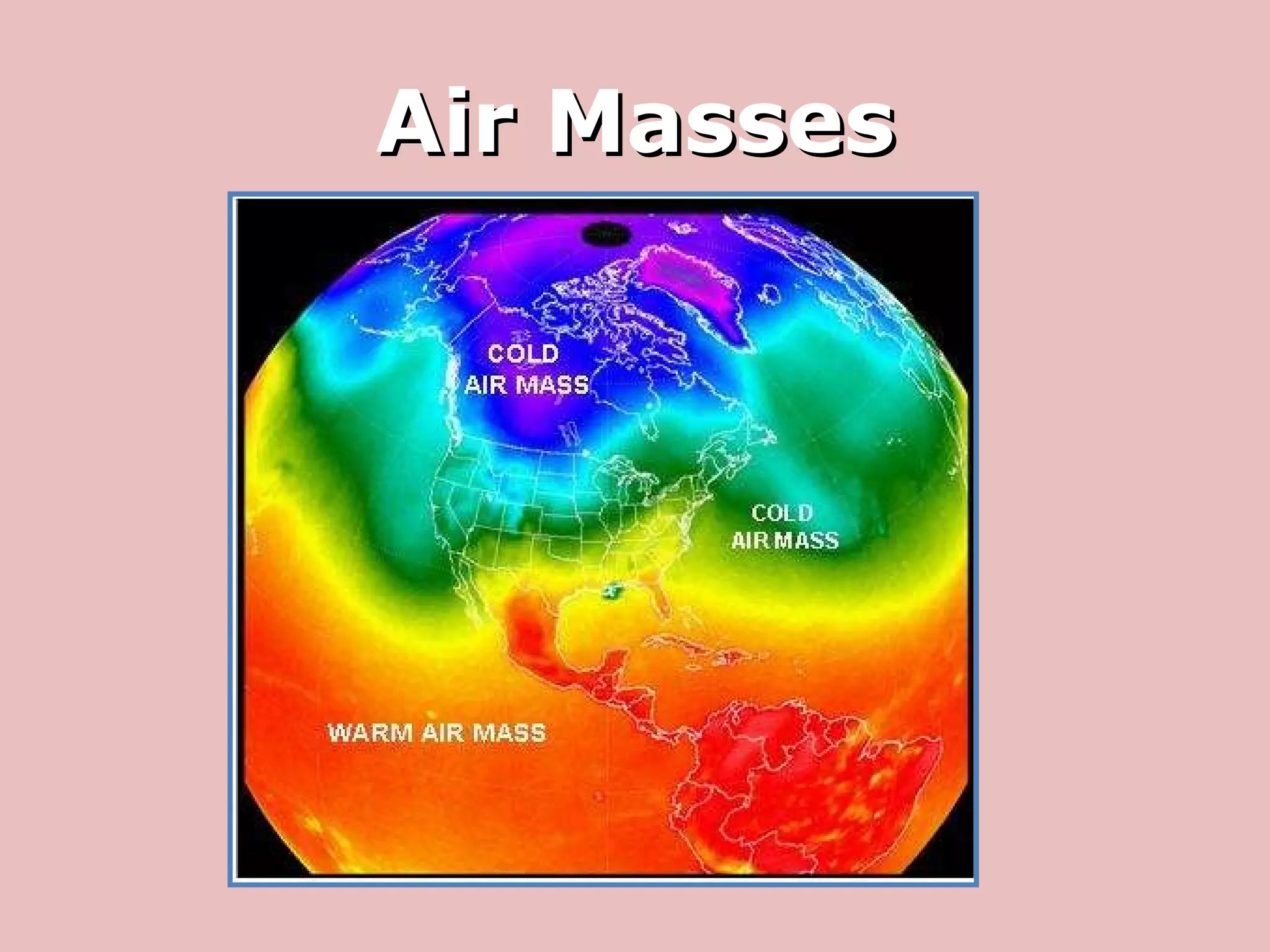
Definition: Air mass  - a large dome of air which has similar horizontal temperature and moisture characteristics throughout. Very similar to a balloon.
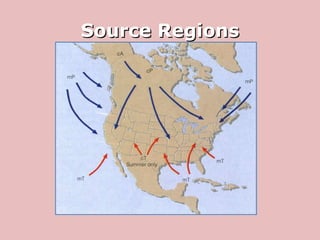
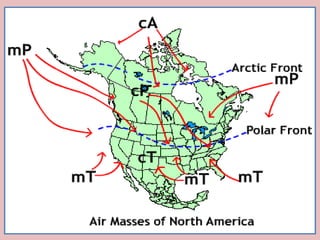
Continental Arctic (cA):  Frigid – record low temperatures Dry - very low dew points Dense - very high barometric pressure Usually originate north of the Arctic Circle Siberian Express   Usually once or twice a winter very rarely form during the summer because the sun warms the Arctic.
Continental polar (cP):  Cold and dry - stable Usually originates in NW Territory of Canada Influences mainly the northern USA Responsible for clear and pleasant weather during the summer  Usually in winter Creates troughs in the polar jet stream Lake effect snow in Great Lakes areas
Maritime polar (mP): Cool and moist - unstable  Originate over N. Atlantic and N. Pacific Main Influence - the Pacific Northwest and the Northeast.  can form any time of the year  Generally not as cold as  cP  air masses
Maritime tropical (mT):  Warm and very moist – unstable Originate in the Gulf of Mexico and the Southern Atlantic Ocean Influences the eastern USA  Most prevalent during summer  Responsible for hot, humid summer days across the South and the East.
Continental Tropical (cT):   Very Hot and very dry – stable aloft  Originates in Desert Southwest and northern Mexico  Occurs in the summer, rarely in winter Usually keeps the Desert Southwest scorching above 100 o F during summer Generally clear skies, hot, low humidity
Source Regions
 
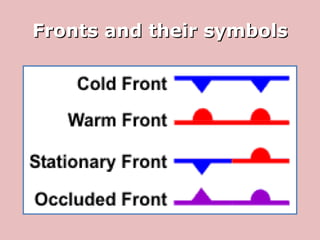
Fronts and their symbols
Fronts: Boundary between two air masses Characterized by shift in weather Cold Warm Stationary Occluded
5 Characteristics of a Front Sharp temperature changes over a relatively short distance. Changes in air moisture content Shifts in wind direction Pressure changes Clouds and precipitation
 
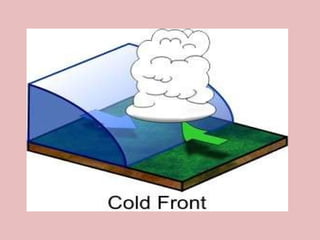
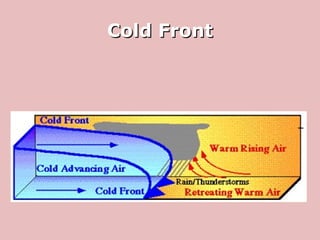
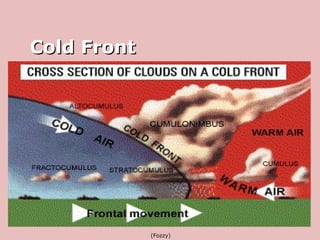
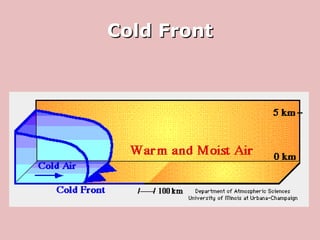
Cold Fronts Temperature – drops rapidly Pressure – rises steadily Clouds – Vertical building Precipitation – Heavy along front Winds – Strong and shifting Typically move faster than warm front
Cold Front
(Fozzy) Cold Front
Cold Front
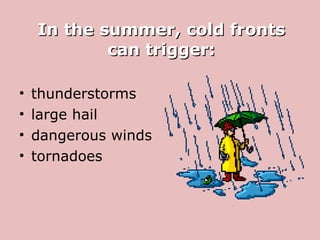
In the summer, cold fronts can trigger: thunderstorms large hail dangerous winds tornadoes
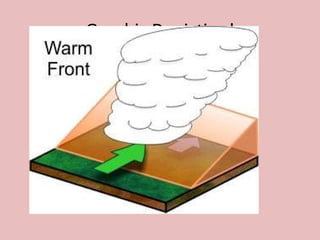
Graphic Depiction!
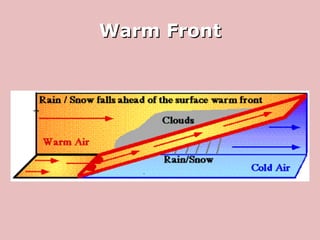
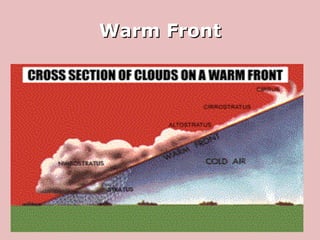
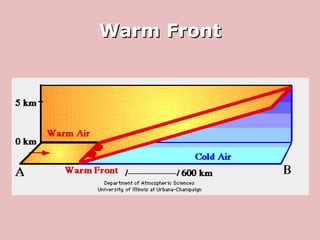
Warm Fronts Temperature – rises slowly Pressure – slight rise, then fall Clouds – strato- and cirro- Precipitation – long, steady Winds – variable and light Typically will have affect for days
Warm Front
Warm Front
Warm Front
Effects of warm fronts Slow-moving warm front can mean days of wet weather before warm air  Sometimes water vapor in warm fronts condense to produce rain snow sleet  freezing rain
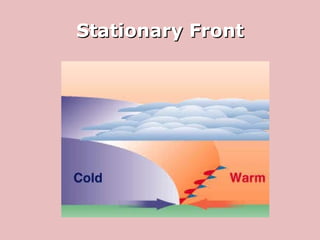
Stationary Front
Stationary Fronts Temperature – stagnent Pressure – slightly fluctuates Clouds – altocumulus Precipitation – none Winds – variable and light Can last for days weeks
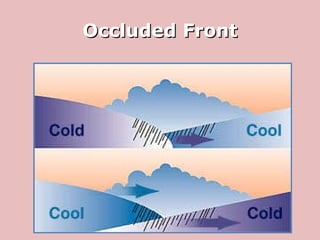
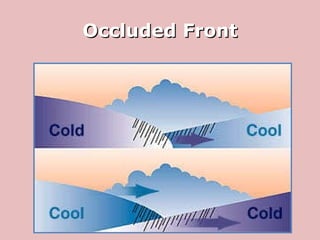
Occluded Front
Occluded Fronts Temperature –  Warm – gets milder Cold – gets colder Pressure –  Warm - slight drop Cold – slight rise Clouds – cumulus Precipitation – steady and light Winds – variable and light
Occluded Front

Air Masses

  • 1.
  • 2.
    Definition: Air mass - a large dome of air which has similar horizontal temperature and moisture characteristics throughout. Very similar to a balloon.
  • 3.
    Continental Arctic (cA): Frigid – record low temperatures Dry - very low dew points Dense - very high barometric pressure Usually originate north of the Arctic Circle Siberian Express Usually once or twice a winter very rarely form during the summer because the sun warms the Arctic.
  • 4.
    Continental polar (cP): Cold and dry - stable Usually originates in NW Territory of Canada Influences mainly the northern USA Responsible for clear and pleasant weather during the summer Usually in winter Creates troughs in the polar jet stream Lake effect snow in Great Lakes areas
  • 5.
    Maritime polar (mP):Cool and moist - unstable Originate over N. Atlantic and N. Pacific Main Influence - the Pacific Northwest and the Northeast. can form any time of the year Generally not as cold as cP air masses
  • 6.
    Maritime tropical (mT): Warm and very moist – unstable Originate in the Gulf of Mexico and the Southern Atlantic Ocean Influences the eastern USA Most prevalent during summer Responsible for hot, humid summer days across the South and the East.
  • 7.
    Continental Tropical (cT): Very Hot and very dry – stable aloft Originates in Desert Southwest and northern Mexico Occurs in the summer, rarely in winter Usually keeps the Desert Southwest scorching above 100 o F during summer Generally clear skies, hot, low humidity
  • 8.
  • 9.
  • 10.
  • 11.
    Fronts: Boundary betweentwo air masses Characterized by shift in weather Cold Warm Stationary Occluded
  • 12.
    5 Characteristics ofa Front Sharp temperature changes over a relatively short distance. Changes in air moisture content Shifts in wind direction Pressure changes Clouds and precipitation
  • 13.
  • 14.
    Cold Fronts Temperature– drops rapidly Pressure – rises steadily Clouds – Vertical building Precipitation – Heavy along front Winds – Strong and shifting Typically move faster than warm front
  • 15.
  • 16.
  • 17.
  • 18.
    In the summer,cold fronts can trigger: thunderstorms large hail dangerous winds tornadoes
  • 19.
  • 20.
    Warm Fronts Temperature– rises slowly Pressure – slight rise, then fall Clouds – strato- and cirro- Precipitation – long, steady Winds – variable and light Typically will have affect for days
  • 21.
  • 22.
  • 23.
  • 24.
    Effects of warmfronts Slow-moving warm front can mean days of wet weather before warm air Sometimes water vapor in warm fronts condense to produce rain snow sleet freezing rain
  • 25.
  • 26.
    Stationary Fronts Temperature– stagnent Pressure – slightly fluctuates Clouds – altocumulus Precipitation – none Winds – variable and light Can last for days weeks
  • 27.
  • 28.
    Occluded Fronts Temperature– Warm – gets milder Cold – gets colder Pressure – Warm - slight drop Cold – slight rise Clouds – cumulus Precipitation – steady and light Winds – variable and light
  • 29.