“The Art of Quoting”
      from They Say / I Say
One of our key premises is
that to launch an effective
argument you need to write
the arguments of others into
your text. One of the best
ways to do this is by not
only summarizing what “they
say,” but by quoting their
exact words.
The main problem with
quotation arises when
writers assume that
quotations speak for
themselves. Because the
meaning of a quotation is
obvious to them, many
writers assume that this
meaning will also be
obvious to their readers,
when often it is not.
In a way,
quotations are
orphans: words
that have been
taken from their
original contexts
and that need to
be integrated into
their new textual
surroundings.
Quoting what
“they say” must
always be
connected with
what you say.
Finding relevant
quotations is only
part of your job;
you also need to
present them in a
way that makes
their relevance
and meaning clear
to your readers.
Since quotations do
not speak for
themselves, you need
to build a frame around
them in which you do
that speaking for them.
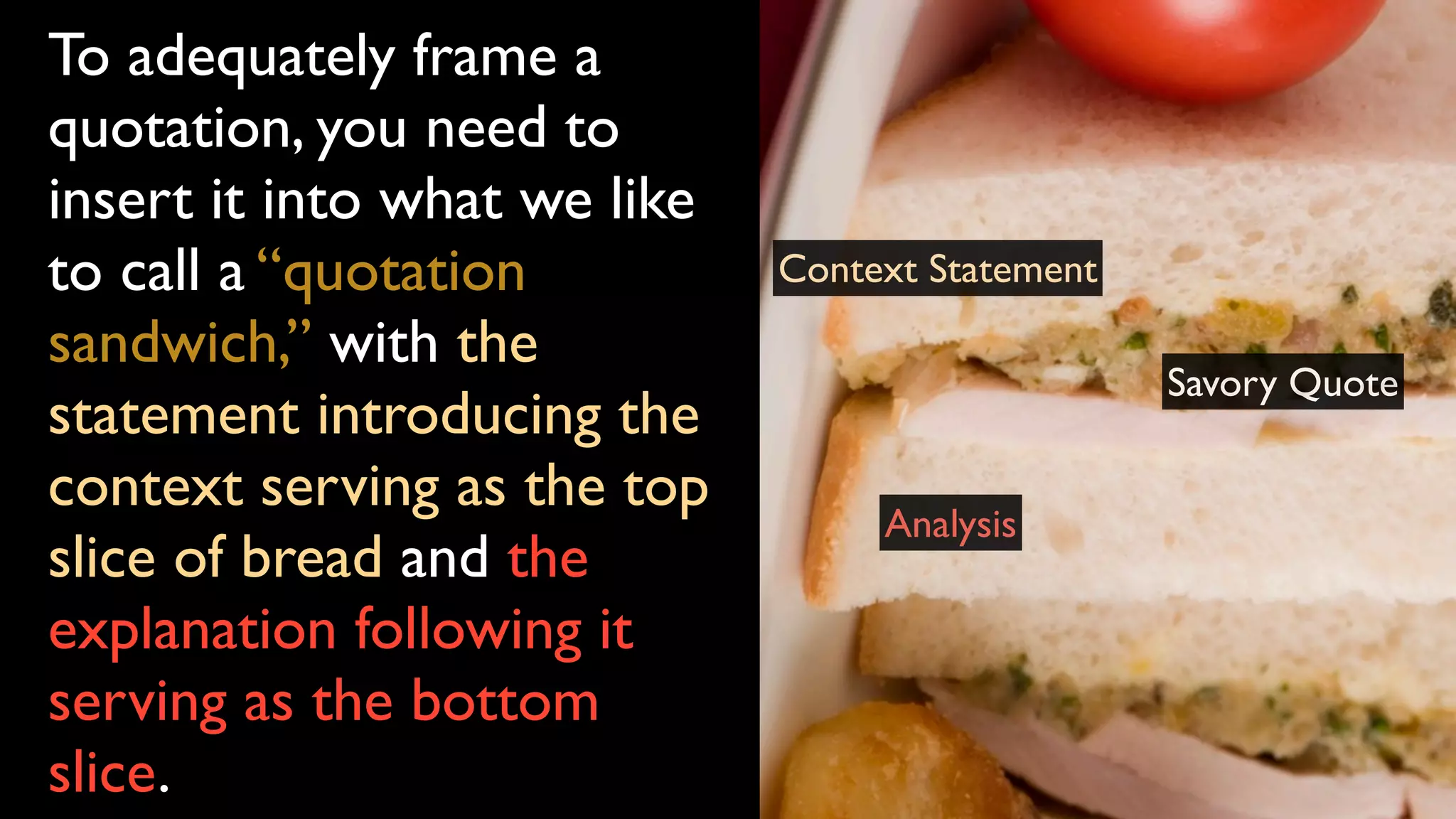
To adequately frame a
quotation, you need to
insert it into what we like
to call a “quotation          Context Statement
sandwich,” with the
                                                  Savory Quote
statement introducing the
context serving as the top
                                   Analysis
slice of bread and the
explanation following it
serving as the bottom
slice.
CONTEXT: The
introductory or lead-
in claims should
explain who is
speaking or what is
happening, and set up
what the quotation
says.
Quote: Repeats a
significant passage
from the novel. The
quote is significant
if it supports the
essay writer’s
thesis or main idea.
Analysis: The follow-
up statements
should explain why
you consider the
quotation to be
important and what
you take it to say.
Templates for Introducing
Quotations
X states, “_____” (PN).
In [name of book], X maintains that
“_____” (PN).
In X’s view, “_____” (PN).
Templates for Explaining
Quotations
Basically, X is saying _____.
In other words, X believes _____.
X’s point is that _____.

Integrating quotes

  • 1.
    “The Art ofQuoting” from They Say / I Say
  • 2.
    One of ourkey premises is that to launch an effective argument you need to write the arguments of others into your text. One of the best ways to do this is by not only summarizing what “they say,” but by quoting their exact words.
  • 3.
    The main problemwith quotation arises when writers assume that quotations speak for themselves. Because the meaning of a quotation is obvious to them, many writers assume that this meaning will also be obvious to their readers, when often it is not.
  • 4.
    In a way, quotationsare orphans: words that have been taken from their original contexts and that need to be integrated into their new textual surroundings.
  • 5.
    Quoting what “they say”must always be connected with what you say.
  • 6.
    Finding relevant quotations isonly part of your job; you also need to present them in a way that makes their relevance and meaning clear to your readers.
  • 7.
    Since quotations do notspeak for themselves, you need to build a frame around them in which you do that speaking for them.
  • 8.
    To adequately framea quotation, you need to insert it into what we like to call a “quotation Context Statement sandwich,” with the Savory Quote statement introducing the context serving as the top Analysis slice of bread and the explanation following it serving as the bottom slice.
  • 9.
    CONTEXT: The introductory orlead- in claims should explain who is speaking or what is happening, and set up what the quotation says.
  • 10.
    Quote: Repeats a significantpassage from the novel. The quote is significant if it supports the essay writer’s thesis or main idea.
  • 11.
    Analysis: The follow- upstatements should explain why you consider the quotation to be important and what you take it to say.
  • 12.
    Templates for Introducing Quotations Xstates, “_____” (PN). In [name of book], X maintains that “_____” (PN). In X’s view, “_____” (PN).
  • 13.
    Templates for Explaining Quotations Basically,X is saying _____. In other words, X believes _____. X’s point is that _____.

Editor's Notes