Embedding Quotations


       AP English Language/Literature
                  Kortman
Adapted by J. Krajeck (2007) w/thanks to Dr. C. Butler, Sandy Valley
                               H.S.
Don’t … Strand Quotations!
 S.Q.’s are quotations with NO
  home….NEVER begin a paragraph
  with a quotation that has no
  speaker or interpreted meaning
  from YOU [as the writer]
 Stranded quotations are the
  proverbial “fishes out of water.”
  Also called “Island Quotations.”
Paraphrase or Summarize
 If the sentence is not quotation-worthy,
  then use a paraphrase or summary type
  sentence, e.g., George said that he
  would never talk to his sister again.
 (It is not necessary for the audience to
  know George’s exact words, only that
  he will not be talking to his sister…thus,
  George’s words are not “quotation-
  worthy.)
He/ She said
 Simple sentence tag (Use of author/character
  name is preferred: Hawthorne implies…)
 He said, “There is a full moon tonight.”
 Comma before quote
 Capitalize first word
 Period before end quote
 Use more precise terms for says: believes,
  maintains, suggests, implies
 (This is typical “dialogue” style and does NOT
  offer the “so what” analysis.)
Embedded sentence,Type I
 George said that “no one could
  compare with the great LeBron James.”
 No comma before quote
 No cap for first word of quote
 No quotes if you change the line
  completely: He said that he wanted to
  go first.
 (However, notice that this type of
  sentence does NOT offer the “so what”
  feature.)
Embedded Sentence, Type II
 The fact that “Elizabeth wanted a gown
  more beautiful than anyone else’s”
  shows how vain she is.
 The line “Look upon my works, ye
  mighty, and despair” captures the
  arrogance of the ruler.
 * Now THESE embedded sentences
  offer the “so what” feature. Identify the
  “so what” in each.
Divided
“You are,” she said reluctantly,
 “the best pitcher we have seen
 yet.”
Comma before end quote
Comma before second half of
 quote
No cap for second half
Speaker Details
John Smith, the author of
 Chocolate Rules, believes,
 “Nothing can take the place of
 the simple M&M candy.”
Appositive
Comma on either side of
 appositive
Intro summary (Colon)
 Frost repeats the last line to convey
  a sense of weariness: “And I have
  miles to go before I sleep. / And I
  have miles to go before I sleep.”
 Full sentence before the colon that
  summarizes idea of quote
 Full sentence for quote
 / means a line break for a poem
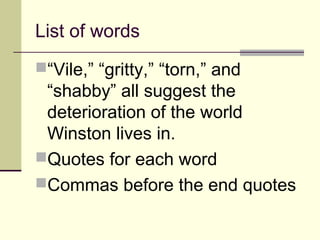
List of words
“Vile,” “gritty,” “torn,” and
 “shabby” all suggest the
 deterioration of the world
 Winston lives in.
Quotes for each word
Commas before the end quotes
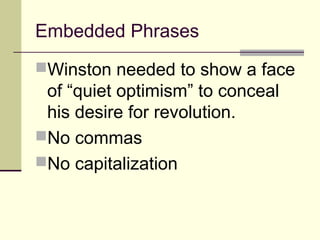
Embedded Phrases
Winston needed to show a face
 of “quiet optimism” to conceal
 his desire for revolution.
No commas
No capitalization

Embedded quotes

  • 1.
    Embedding Quotations AP English Language/Literature Kortman Adapted by J. Krajeck (2007) w/thanks to Dr. C. Butler, Sandy Valley H.S.
  • 2.
    Don’t … StrandQuotations!  S.Q.’s are quotations with NO home….NEVER begin a paragraph with a quotation that has no speaker or interpreted meaning from YOU [as the writer]  Stranded quotations are the proverbial “fishes out of water.” Also called “Island Quotations.”
  • 3.
    Paraphrase or Summarize If the sentence is not quotation-worthy, then use a paraphrase or summary type sentence, e.g., George said that he would never talk to his sister again.  (It is not necessary for the audience to know George’s exact words, only that he will not be talking to his sister…thus, George’s words are not “quotation- worthy.)
  • 4.
    He/ She said Simple sentence tag (Use of author/character name is preferred: Hawthorne implies…)  He said, “There is a full moon tonight.”  Comma before quote  Capitalize first word  Period before end quote  Use more precise terms for says: believes, maintains, suggests, implies  (This is typical “dialogue” style and does NOT offer the “so what” analysis.)
  • 5.
    Embedded sentence,Type I George said that “no one could compare with the great LeBron James.”  No comma before quote  No cap for first word of quote  No quotes if you change the line completely: He said that he wanted to go first.  (However, notice that this type of sentence does NOT offer the “so what” feature.)
  • 6.
    Embedded Sentence, TypeII  The fact that “Elizabeth wanted a gown more beautiful than anyone else’s” shows how vain she is.  The line “Look upon my works, ye mighty, and despair” captures the arrogance of the ruler.  * Now THESE embedded sentences offer the “so what” feature. Identify the “so what” in each.
  • 7.
    Divided “You are,” shesaid reluctantly, “the best pitcher we have seen yet.” Comma before end quote Comma before second half of quote No cap for second half
  • 8.
    Speaker Details John Smith,the author of Chocolate Rules, believes, “Nothing can take the place of the simple M&M candy.” Appositive Comma on either side of appositive
  • 9.
    Intro summary (Colon) Frost repeats the last line to convey a sense of weariness: “And I have miles to go before I sleep. / And I have miles to go before I sleep.”  Full sentence before the colon that summarizes idea of quote  Full sentence for quote  / means a line break for a poem
  • 10.
    List of words “Vile,”“gritty,” “torn,” and “shabby” all suggest the deterioration of the world Winston lives in. Quotes for each word Commas before the end quotes
  • 11.
    Embedded Phrases Winston neededto show a face of “quiet optimism” to conceal his desire for revolution. No commas No capitalization