EWRT 1A: Class 6
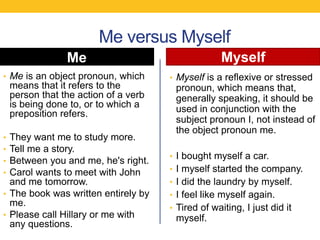
Me versus Myself 
Me 
• Me is an object pronoun, which 
means that it refers to the 
person that the action of a verb 
is being done to, or to which a 
preposition refers. 
• They want me to study more. 
• Tell me a story. 
• Between you and me, he's right. 
• Carol wants to meet with John 
and me tomorrow. 
• The book was written entirely by 
me. 
• Please call Hillary or me with 
any questions. 
Myself 
• Myself is a reflexive or stressed 
pronoun, which means that, 
generally speaking, it should be 
used in conjunction with the 
subject pronoun I, not instead of 
the object pronoun me. 
• I bought myself a car. 
• I myself started the company. 
• I did the laundry by myself. 
• I feel like myself again. 
• Tired of waiting, I just did it 
myself.
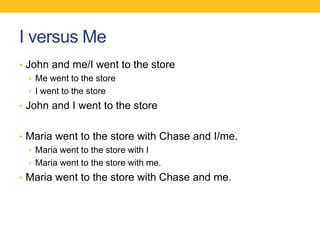
I versus Me 
• John and me/I went to the store 
• Me went to the store 
• I went to the store 
• John and I went to the store 
• Maria went to the store with Chase and I/me. 
• Maria went to the store with I 
• Maria went to the store with me. 
• Maria went to the store with Chase and me.
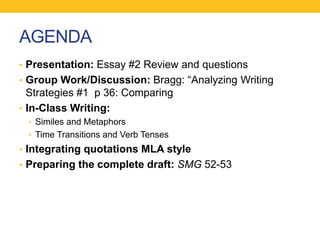
AGENDA 
• Presentation: Essay #2 Review and questions 
• Group Work/Discussion: Bragg: “Analyzing Writing 
Strategies #1 p 36: Comparing 
• In-Class Writing: 
• Similes and Metaphors 
• Time Transitions and Verb Tenses 
• Integrating quotations MLA style 
• Preparing the complete draft: SMG 52-53
ESSAY #2 
Finishing it up!
Review 
• Introduction/Long quotation 
• Transition/Thesis 
• Intro to event 
• Description of places 
• Description of people 
• Climax (with sentence strategy) 
• Dialogue (or 2) 
• Significance 
• Concluding strategy
You must introduce your quotation 
• So, you have your long quotation, and you are all ready to 
jump off of it to start your narrative portion of the essay. 
There is a bit of a trick here, though. You can’t just begin 
your essay with a quotation from the book. You have to 
introduce it to the reader. 
• There are a number of ways to do this. One way is to 
briefly introduce the novel and the author. Another way is 
to summarize the context of quotation before you present 
it. Then after it, you can do a brief explanation of how it 
connects to your own story. Or, you can use another 
introduction, but you must have your own words before 
you insert a quotation from the novel! 
• Take a moment and write a brief introduction to your 
quotation.
USING 
FIGURES OF 
SPEECH
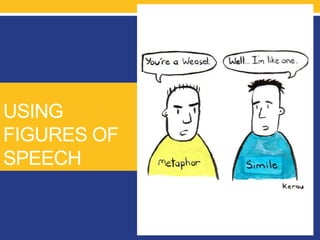
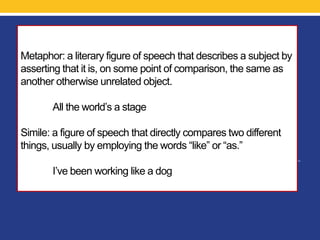
Metaphor: a literary figure of speech that describes a subject by 
asserting that it is, on some point of comparison, the same as 
another otherwise unrelated object. 
All the world’s a stage 
Simile: a figure of speech that directly compares two different 
things, usually by employing the words “like” or “as.” 
I’ve been working like a dog
Bragg: “Analyzing Writing Strategies #1 p 36 
• In your groups, review “Analyzing Writing 
Strategies” #1. 
• Locate the comparisons in paragraphs 1, 3, 
7, 9, 13, and 16. 
• Discuss the strength of metaphors and 
similes and how you might use them in 
your own writing.
• Formulate 5-7 metaphors or similes 
appropriate to your essay.
A WELL-TOLD STORY 
A Sentence Strategy: 
Time Transitions and Verb Tenses
As you draft a remembered 
event essay, you will be trying 
to help readers follow the 
sequence of actions in time. 
To prevent readers from 
becoming confused about the 
chronology, writers use a 
combination of time 
transitions and verb tenses to 
help readers understand 
when the event occurred and 
when particular actions 
occurred in relation to other 
actions.
Cite calendar or clock time to establish when the 
event took place and to help readers follow the 
action over time. Writers often situate the event in 
terms of the date or time. Brandt, for example, 
establishes in the opening paragraph that the event 
occurred when she went to the mall for “a day of last-minute 
Christmas sopping.” Early in her 
essay, Dillard identifies when the event took place: 
“On one weekday morning after Christmas . . .” 
(par. 3). You can also use calendar time to 
establish the time the event began; if your narrative 
Covers several days, you might readers a series of time cues 
throughout the essay so we can easily follow the progression: 
“A year before his death”; “That August, I had turned 22”; and 
so on.
Use temporal transitions combined with appropriate verb 
tenses to help readers follow a sequence of actions. 
Writers can employ temporal transitions such as after, 
before, in the meantime, and simultaneously to help 
readers keep track of the sequence of actions: 
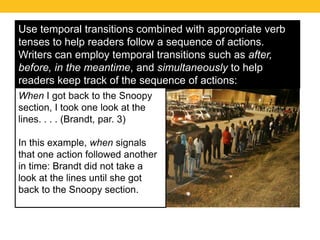
When I got back to the Snoopy 
section, I took one look at the 
lines. . . . (Brandt, par. 3) 
In this example, when signals 
that one action followed another 
in time: Brandt did not take a 
look at the lines until she got 
back to the Snoopy section.
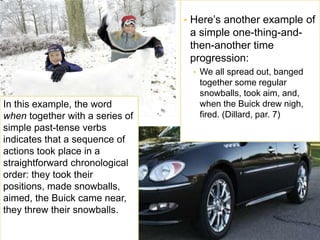
• Here’s another example of 
a simple one-thing-and-then- 
another time 
progression: 
• We all spread out, banged 
together some regular 
snowballs, took aim, and, 
when the Buick drew nigh, 
fired. (Dillard, par. 7) 
In this example, the word 
when together with a series of 
simple past-tense verbs 
indicates that a sequence of 
actions took place in a 
straightforward chronological 
order: they took their 
positions, made snowballs, 
aimed, the Buick came near, 
they threw their snowballs.
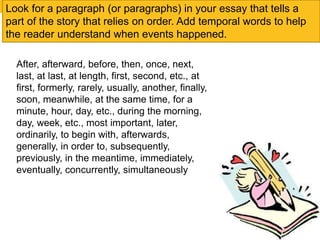
Look for a paragraph (or paragraphs) in your essay that tells a 
part of the story that relies on order. Add temporal words to help 
the reader understand when events happened. 
After, afterward, before, then, once, next, 
last, at last, at length, first, second, etc., at 
first, formerly, rarely, usually, another, finally, 
soon, meanwhile, at the same time, for a 
minute, hour, day, etc., during the morning, 
day, week, etc., most important, later, 
ordinarily, to begin with, afterwards, 
generally, in order to, subsequently, 
previously, in the meantime, immediately, 
eventually, concurrently, simultaneously
INTEGRATING QUOTATIONS 
MLA STYLE 
make sure you have integrated your quotations 
correctly
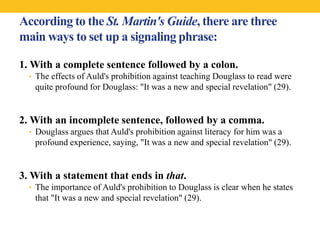
According to the St. Martin's Guide, there are three 
main ways to set up a signaling phrase: 
1. With a complete sentence followed by a colon. 
• The effects of Auld's prohibition against teaching Douglass to read were 
quite profound for Douglass: "It was a new and special revelation" (29). 
2. With an incomplete sentence, followed by a comma. 
• Douglass argues that Auld's prohibition against literacy for him was a 
profound experience, saying, "It was a new and special revelation" (29). 
3. With a statement that ends in that. 
• The importance of Auld's prohibition to Douglass is clear when he states 
that "It was a new and special revelation" (29).
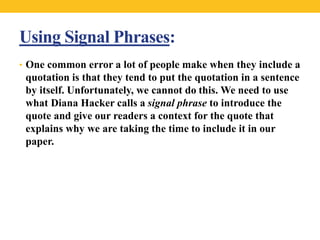
Using Signal Phrases: 
• One common error a lot of people make when they include a 
quotation is that they tend to put the quotation in a sentence 
by itself. Unfortunately, we cannot do this. We need to use 
what Diana Hacker calls a signal phrase to introduce the 
quote and give our readers a context for the quote that 
explains why we are taking the time to include it in our 
paper.
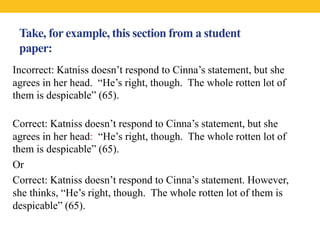
Take, for example, this section from a student 
paper: 
Incorrect: Katniss doesn’t respond to Cinna’s statement, but she 
agrees in her head. “He’s right, though. The whole rotten lot of 
them is despicable” (65). 
Correct: Katniss doesn’t respond to Cinna’s statement, but she 
agrees in her head: “He’s right, though. The whole rotten lot of 
them is despicable” (65). 
Or 
Correct: Katniss doesn’t respond to Cinna’s statement. However, 
she thinks, “He’s right, though. The whole rotten lot of them is 
despicable” (65).
Long quotations 
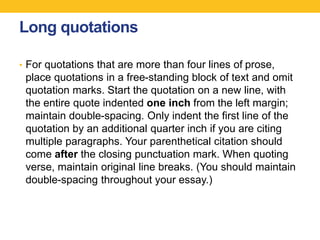
• For quotations that are more than four lines of prose, 
place quotations in a free-standing block of text and omit 
quotation marks. Start the quotation on a new line, with 
the entire quote indented one inch from the left margin; 
maintain double-spacing. Only indent the first line of the 
quotation by an additional quarter inch if you are citing 
multiple paragraphs. Your parenthetical citation should 
come after the closing punctuation mark. When quoting 
verse, maintain original line breaks. (You should maintain 
double-spacing throughout your essay.)
For example, when citing more than 
four lines of prose, use the following 
example: 
The classroom was noisy as the MUN students filed in[. . .] Mr. Mustard 
began in the middle of the program, and the room quieted down as we strained 
to hear the narrator’s voice: 
I look up at the buildings, these immense buildings They are so 
enormous. And along the edges of each enormous building are 
the nets. Because right at the time that I am making this visit, 
there has been an epidemic of suicides at the Foxconn plant. 
Week after week, worker after worker has been climbing all the 
way up to the tops of these enormous buildings, and then 
throwing themselves off, killing themselves in a brutal and public 
manner, not thinking very much about just how bad this makes 
Foxconn look. Foxconn's response to month after month of 
suicides has been to put up these nets. (Mr. Daisey and the 
Apple Factory) 
Hanging 
indent for 
long 
quotation: 10 
spaces
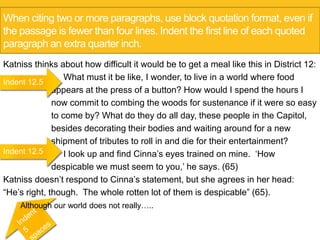
When citing two or more paragraphs, use block quotation format, even if 
the passage is fewer than four lines. Indent the first line of each quoted 
paragraph an extra quarter inch. 
Katniss thinks about how difficult it would be to get a meal like this in District 12: 
What must it be like, I wonder, to live in a world where food 
appears at the press of a button? How would I spend the hours I 
now commit to combing the woods for sustenance if it were so easy 
to come by? What do they do all day, these people in the Capitol, 
besides decorating their bodies and waiting around for a new 
shipment of tributes to roll in and die for their entertainment? 
I look up and find Cinna’s eyes trained on mine. ‘How 
despicable we must seem to you,’ he says. (65) 
Indent 12.5 
Indent 12.5 
Katniss doesn’t respond to Cinna’s statement, but she agrees in her head: 
“He’s right, though. The whole rotten lot of them is despicable” (65). 
Although our world does not really…..
SMG52-53 
Preparing 
the 
complete 
draft
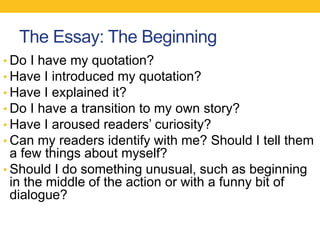
The Essay: The Beginning 
• Do I have my quotation? 
• Have I introduced my quotation? 
• Have I explained it? 
• Do I have a transition to my own story? 
• Have I aroused readers’ curiosity? 
• Can my readers identify with me? Should I tell them 
a few things about myself? 
• Should I do something unusual, such as beginning 
in the middle of the action or with a funny bit of 
dialogue?
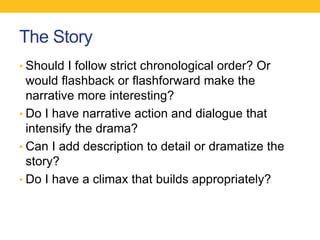
The Story 
• Should I follow strict chronological order? Or 
would flashback or flashforward make the 
narrative more interesting? 
• Do I have narrative action and dialogue that 
intensify the drama? 
• Can I add description to detail or dramatize the 
story? 
• Do I have a climax that builds appropriately?
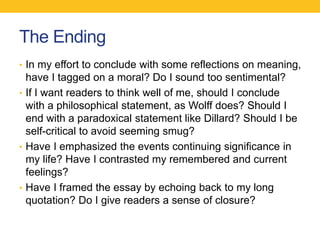
The Ending 
• In my effort to conclude with some reflections on meaning, 
have I tagged on a moral? Do I sound too sentimental? 
• If I want readers to think well of me, should I conclude 
with a philosophical statement, as Wolff does? Should I 
end with a paradoxical statement like Dillard? Should I be 
self-critical to avoid seeming smug? 
• Have I emphasized the events continuing significance in 
my life? Have I contrasted my remembered and current 
feelings? 
• Have I framed the essay by echoing back to my long 
quotation? Do I give readers a sense of closure?
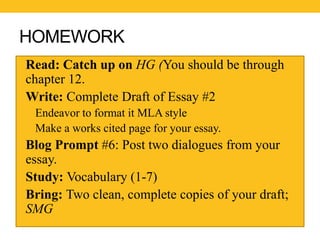
HOMEWORK 
• Read: Catch up on HG (You should be through 
chapter 12. 
•Write: Complete Draft of Essay #2 
• Endeavor to format it MLA style 
• Make a works cited page for your essay. 
• Blog Prompt #6: Post two dialogues from your 
essay. 
• Study: Vocabulary (1-7) 
• Bring: Two clean, complete copies of your draft; 
SMG

Class 6

  • 1.
  • 2.
    Me versus Myself Me • Me is an object pronoun, which means that it refers to the person that the action of a verb is being done to, or to which a preposition refers. • They want me to study more. • Tell me a story. • Between you and me, he's right. • Carol wants to meet with John and me tomorrow. • The book was written entirely by me. • Please call Hillary or me with any questions. Myself • Myself is a reflexive or stressed pronoun, which means that, generally speaking, it should be used in conjunction with the subject pronoun I, not instead of the object pronoun me. • I bought myself a car. • I myself started the company. • I did the laundry by myself. • I feel like myself again. • Tired of waiting, I just did it myself.
  • 3.
    I versus Me • John and me/I went to the store • Me went to the store • I went to the store • John and I went to the store • Maria went to the store with Chase and I/me. • Maria went to the store with I • Maria went to the store with me. • Maria went to the store with Chase and me.
  • 4.
    AGENDA • Presentation:Essay #2 Review and questions • Group Work/Discussion: Bragg: “Analyzing Writing Strategies #1 p 36: Comparing • In-Class Writing: • Similes and Metaphors • Time Transitions and Verb Tenses • Integrating quotations MLA style • Preparing the complete draft: SMG 52-53
  • 5.
  • 6.
    Review • Introduction/Longquotation • Transition/Thesis • Intro to event • Description of places • Description of people • Climax (with sentence strategy) • Dialogue (or 2) • Significance • Concluding strategy
  • 7.
    You must introduceyour quotation • So, you have your long quotation, and you are all ready to jump off of it to start your narrative portion of the essay. There is a bit of a trick here, though. You can’t just begin your essay with a quotation from the book. You have to introduce it to the reader. • There are a number of ways to do this. One way is to briefly introduce the novel and the author. Another way is to summarize the context of quotation before you present it. Then after it, you can do a brief explanation of how it connects to your own story. Or, you can use another introduction, but you must have your own words before you insert a quotation from the novel! • Take a moment and write a brief introduction to your quotation.
  • 8.
  • 9.
    Metaphor: a literaryfigure of speech that describes a subject by asserting that it is, on some point of comparison, the same as another otherwise unrelated object. All the world’s a stage Simile: a figure of speech that directly compares two different things, usually by employing the words “like” or “as.” I’ve been working like a dog
  • 10.
    Bragg: “Analyzing WritingStrategies #1 p 36 • In your groups, review “Analyzing Writing Strategies” #1. • Locate the comparisons in paragraphs 1, 3, 7, 9, 13, and 16. • Discuss the strength of metaphors and similes and how you might use them in your own writing.
  • 11.
    • Formulate 5-7metaphors or similes appropriate to your essay.
  • 12.
    A WELL-TOLD STORY A Sentence Strategy: Time Transitions and Verb Tenses
  • 13.
    As you drafta remembered event essay, you will be trying to help readers follow the sequence of actions in time. To prevent readers from becoming confused about the chronology, writers use a combination of time transitions and verb tenses to help readers understand when the event occurred and when particular actions occurred in relation to other actions.
  • 14.
    Cite calendar orclock time to establish when the event took place and to help readers follow the action over time. Writers often situate the event in terms of the date or time. Brandt, for example, establishes in the opening paragraph that the event occurred when she went to the mall for “a day of last-minute Christmas sopping.” Early in her essay, Dillard identifies when the event took place: “On one weekday morning after Christmas . . .” (par. 3). You can also use calendar time to establish the time the event began; if your narrative Covers several days, you might readers a series of time cues throughout the essay so we can easily follow the progression: “A year before his death”; “That August, I had turned 22”; and so on.
  • 15.
    Use temporal transitionscombined with appropriate verb tenses to help readers follow a sequence of actions. Writers can employ temporal transitions such as after, before, in the meantime, and simultaneously to help readers keep track of the sequence of actions: When I got back to the Snoopy section, I took one look at the lines. . . . (Brandt, par. 3) In this example, when signals that one action followed another in time: Brandt did not take a look at the lines until she got back to the Snoopy section.
  • 16.
    • Here’s anotherexample of a simple one-thing-and-then- another time progression: • We all spread out, banged together some regular snowballs, took aim, and, when the Buick drew nigh, fired. (Dillard, par. 7) In this example, the word when together with a series of simple past-tense verbs indicates that a sequence of actions took place in a straightforward chronological order: they took their positions, made snowballs, aimed, the Buick came near, they threw their snowballs.
  • 17.
    Look for aparagraph (or paragraphs) in your essay that tells a part of the story that relies on order. Add temporal words to help the reader understand when events happened. After, afterward, before, then, once, next, last, at last, at length, first, second, etc., at first, formerly, rarely, usually, another, finally, soon, meanwhile, at the same time, for a minute, hour, day, etc., during the morning, day, week, etc., most important, later, ordinarily, to begin with, afterwards, generally, in order to, subsequently, previously, in the meantime, immediately, eventually, concurrently, simultaneously
  • 18.
    INTEGRATING QUOTATIONS MLASTYLE make sure you have integrated your quotations correctly
  • 19.
    According to theSt. Martin's Guide, there are three main ways to set up a signaling phrase: 1. With a complete sentence followed by a colon. • The effects of Auld's prohibition against teaching Douglass to read were quite profound for Douglass: "It was a new and special revelation" (29). 2. With an incomplete sentence, followed by a comma. • Douglass argues that Auld's prohibition against literacy for him was a profound experience, saying, "It was a new and special revelation" (29). 3. With a statement that ends in that. • The importance of Auld's prohibition to Douglass is clear when he states that "It was a new and special revelation" (29).
  • 20.
    Using Signal Phrases: • One common error a lot of people make when they include a quotation is that they tend to put the quotation in a sentence by itself. Unfortunately, we cannot do this. We need to use what Diana Hacker calls a signal phrase to introduce the quote and give our readers a context for the quote that explains why we are taking the time to include it in our paper.
  • 21.
    Take, for example,this section from a student paper: Incorrect: Katniss doesn’t respond to Cinna’s statement, but she agrees in her head. “He’s right, though. The whole rotten lot of them is despicable” (65). Correct: Katniss doesn’t respond to Cinna’s statement, but she agrees in her head: “He’s right, though. The whole rotten lot of them is despicable” (65). Or Correct: Katniss doesn’t respond to Cinna’s statement. However, she thinks, “He’s right, though. The whole rotten lot of them is despicable” (65).
  • 22.
    Long quotations •For quotations that are more than four lines of prose, place quotations in a free-standing block of text and omit quotation marks. Start the quotation on a new line, with the entire quote indented one inch from the left margin; maintain double-spacing. Only indent the first line of the quotation by an additional quarter inch if you are citing multiple paragraphs. Your parenthetical citation should come after the closing punctuation mark. When quoting verse, maintain original line breaks. (You should maintain double-spacing throughout your essay.)
  • 23.
    For example, whenciting more than four lines of prose, use the following example: The classroom was noisy as the MUN students filed in[. . .] Mr. Mustard began in the middle of the program, and the room quieted down as we strained to hear the narrator’s voice: I look up at the buildings, these immense buildings They are so enormous. And along the edges of each enormous building are the nets. Because right at the time that I am making this visit, there has been an epidemic of suicides at the Foxconn plant. Week after week, worker after worker has been climbing all the way up to the tops of these enormous buildings, and then throwing themselves off, killing themselves in a brutal and public manner, not thinking very much about just how bad this makes Foxconn look. Foxconn's response to month after month of suicides has been to put up these nets. (Mr. Daisey and the Apple Factory) Hanging indent for long quotation: 10 spaces
  • 24.
    When citing twoor more paragraphs, use block quotation format, even if the passage is fewer than four lines. Indent the first line of each quoted paragraph an extra quarter inch. Katniss thinks about how difficult it would be to get a meal like this in District 12: What must it be like, I wonder, to live in a world where food appears at the press of a button? How would I spend the hours I now commit to combing the woods for sustenance if it were so easy to come by? What do they do all day, these people in the Capitol, besides decorating their bodies and waiting around for a new shipment of tributes to roll in and die for their entertainment? I look up and find Cinna’s eyes trained on mine. ‘How despicable we must seem to you,’ he says. (65) Indent 12.5 Indent 12.5 Katniss doesn’t respond to Cinna’s statement, but she agrees in her head: “He’s right, though. The whole rotten lot of them is despicable” (65). Although our world does not really…..
  • 25.
    SMG52-53 Preparing the complete draft
  • 26.
    The Essay: TheBeginning • Do I have my quotation? • Have I introduced my quotation? • Have I explained it? • Do I have a transition to my own story? • Have I aroused readers’ curiosity? • Can my readers identify with me? Should I tell them a few things about myself? • Should I do something unusual, such as beginning in the middle of the action or with a funny bit of dialogue?
  • 27.
    The Story •Should I follow strict chronological order? Or would flashback or flashforward make the narrative more interesting? • Do I have narrative action and dialogue that intensify the drama? • Can I add description to detail or dramatize the story? • Do I have a climax that builds appropriately?
  • 28.
    The Ending •In my effort to conclude with some reflections on meaning, have I tagged on a moral? Do I sound too sentimental? • If I want readers to think well of me, should I conclude with a philosophical statement, as Wolff does? Should I end with a paradoxical statement like Dillard? Should I be self-critical to avoid seeming smug? • Have I emphasized the events continuing significance in my life? Have I contrasted my remembered and current feelings? • Have I framed the essay by echoing back to my long quotation? Do I give readers a sense of closure?
  • 29.
    HOMEWORK • Read:Catch up on HG (You should be through chapter 12. •Write: Complete Draft of Essay #2 • Endeavor to format it MLA style • Make a works cited page for your essay. • Blog Prompt #6: Post two dialogues from your essay. • Study: Vocabulary (1-7) • Bring: Two clean, complete copies of your draft; SMG