Documentation Review
        The Basics
When you document sources in your paper,
it is best to remember two basics . . .
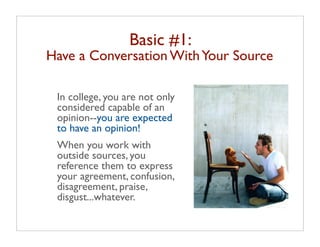
Basic #1:
Have a Conversation With Your Source

 In college, you are not only
 considered capable of an
 opinion--you are expected
 to have an opinion!
 When you work with
 outside sources, you
 reference them to express
 your agreement, confusion,
 disagreement, praise,
 disgust...whatever.
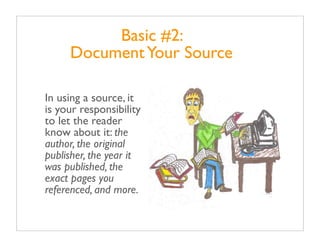
Basic #2:
     Document Your Source

In using a source, it
is your responsibility
to let the reader
know about it: the
author, the original
publisher, the year it
was published, the
exact pages you
referenced, and more.
Having the Conversation


There are a few pointers to setting up a
successful commentary in your paper.
 •   Always introduce the source appropriately.
 •   Make sure you set up the context of the referenced material.
 •   Always follow up with your insight.
Introducing the Source

  You can introduce the source in a few ways.
Attributions: The first time you use a source in your paper,
you should fully introduce the author of the source. This
explains your source and adds to your credibility. This includes
the complete name of the author and some explanation
regarding the author’s expertise--his/her degree, job title, or
even the name of the text they wrote.

                Author’s Complete Name          Author’s Expertise


Virginia Woolf, British writer and founder of Hogarth Press,
claims in her speech “Professions for Women,” “Killing the
Angel in the House was part of the occupation of a woman
writer” (403).
Introducing the Source


Signal Phrases: Using signal phrases (asserts,
denies, writes, disagrees, believes, denounces, expresses,
etc.) helps you seamlessly incorporate the outside
text into your essay.
                  Signal Phrase


Gates writes, “Nevertheless, the blind pursuit of
attainment in sports is having a devastating
effect” (406).
Context
It’s sometimes tricky to introduce a quote, because the quote alone
will not help the reader understand the context in which it occurred.
In these cases, you need to set up the quote context.
Signal Phrase Without Context:
Woolf asks, “How are you going to furnish it, how are you going to
decorate it?” (405).
Signal Phrase With Context:
In discussing the achievements of professional women, specifically
through the symbol of a room in a house, Woolf asks of women,
“How are you going to furnish it, how are you going to decorate
it?” (405).
Which would make more sense to you, as the reader?
Introducing the Source


Colons: One can write a complete sentence of their
own (rather than a phrase) to introduce a quote. In
these cases, colons are used.

       Note the complete sentence (not phrase) used to introduce the quote.


Pauline Kael explains her feelings towards her job: “I consider
myself one of the lucky ones because I really enjoy what I
do” (155).
Introducing the Source


Blending a Quote: Yet another way to work with
a quote is to blend it into your own sentence. This
works best when you want to quote words or short
phrases.


Kael feels like “one of the lucky ones” when it comes to her job as
a film critic (155).
Introducing the Source

Ellipses
Woolf writes, “Even when the path is nominally
open . . . there are many phantoms and
obstacles” (404).
Brackets
Woolf writes, “How are you [professional women]
going to furnish it?” (405).
Following Up With Your Insight


Correctly introducing a quote is not enough to be
successful. There should be a reason why you decided to
use a quote. Therefore, comment! What is so
enlightening about the quote?
Following Up With Your Insight


Gates writes, “Nevertheless, the blind pursuit of attainment in sports
is having a devastating effect” (406).

What could I follow with?
Gates writes, “Nevertheless, the blind pursuit of attainment in sports
is having a devastating effect” (406). His use of the word ‘blind’ in
describing this vocational road is fitting, as Gates assumes most are
not even aware of other possibilities within clearer reach.
By adding YOUR insight, your paper becomes your own. It is not a bunch
of quotes sewn together; it is your conversation with another author’s
ideas.
Following Up With Your Insight


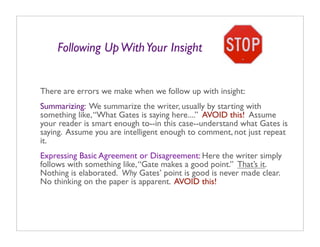
There are errors we make when we follow up with insight:
Summarizing: We summarize the writer, usually by starting with
something like, “What Gates is saying here....” AVOID this! Assume
your reader is smart enough to--in this case--understand what Gates is
saying. Assume you are intelligent enough to comment, not just repeat
it.
Expressing Basic Agreement or Disagreement: Here the writer simply
follows with something like, “Gate makes a good point.” That’s it.
Nothing is elaborated. Why Gates’ point is good is never made clear.
No thinking on the paper is apparent. AVOID this!
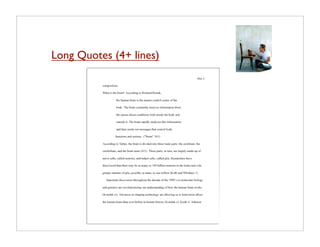
Long Quotes (4+ lines)
Document Your Source


 Sources are documented two ways in your
 paper.
    • In the Paper
    • In the Works Cited Page
Document Your Source:
  In-Text Citations


In-text citations are brief bits of information that
follow the direct use of a quote, paraphrase of
summary. They usually include the following:
    •The last name of the author
    •The page number of the information referenced.
Document Your Source:
  In-Text Citations

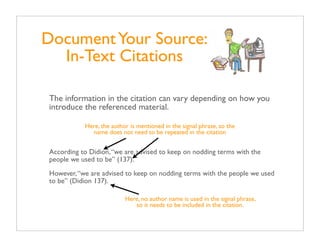
The information in the citation can vary depending on how you
introduce the referenced material.

           Here, the author is mentioned in the signal phrase, so the
             name does not need to be repeated in the citation


According to Didion, “we are advised to keep on nodding terms with the
people we used to be” (137).
However, “we are advised to keep on nodding terms with the people we used
to be” (Didion 137).

                          Here, no author name is used in the signal phrase,
                             so it needs to be included in the citation.
Document Your Source:
  In-Text Citations
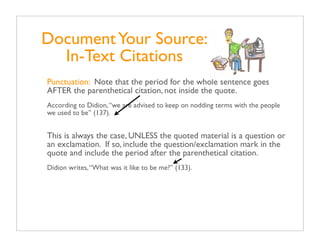
Punctuation: Note that the period for the whole sentence goes
AFTER the parenthetical citation, not inside the quote.
According to Didion, “we are advised to keep on nodding terms with the people
we used to be” (137).


This is always the case, UNLESS the quoted material is a question or
an exclamation. If so, include the question/exclamation mark in the
quote and include the period after the parenthetical citation.
Didion writes, “What was it like to be me?” (133).

Documentation_Basics

  • 1.
  • 2.
    When you documentsources in your paper, it is best to remember two basics . . .
  • 3.
    Basic #1: Have aConversation With Your Source In college, you are not only considered capable of an opinion--you are expected to have an opinion! When you work with outside sources, you reference them to express your agreement, confusion, disagreement, praise, disgust...whatever.
  • 4.
    Basic #2: Document Your Source In using a source, it is your responsibility to let the reader know about it: the author, the original publisher, the year it was published, the exact pages you referenced, and more.
  • 5.
    Having the Conversation Thereare a few pointers to setting up a successful commentary in your paper. • Always introduce the source appropriately. • Make sure you set up the context of the referenced material. • Always follow up with your insight.
  • 6.
    Introducing the Source You can introduce the source in a few ways. Attributions: The first time you use a source in your paper, you should fully introduce the author of the source. This explains your source and adds to your credibility. This includes the complete name of the author and some explanation regarding the author’s expertise--his/her degree, job title, or even the name of the text they wrote. Author’s Complete Name Author’s Expertise Virginia Woolf, British writer and founder of Hogarth Press, claims in her speech “Professions for Women,” “Killing the Angel in the House was part of the occupation of a woman writer” (403).
  • 7.
    Introducing the Source SignalPhrases: Using signal phrases (asserts, denies, writes, disagrees, believes, denounces, expresses, etc.) helps you seamlessly incorporate the outside text into your essay. Signal Phrase Gates writes, “Nevertheless, the blind pursuit of attainment in sports is having a devastating effect” (406).
  • 8.
    Context It’s sometimes trickyto introduce a quote, because the quote alone will not help the reader understand the context in which it occurred. In these cases, you need to set up the quote context. Signal Phrase Without Context: Woolf asks, “How are you going to furnish it, how are you going to decorate it?” (405). Signal Phrase With Context: In discussing the achievements of professional women, specifically through the symbol of a room in a house, Woolf asks of women, “How are you going to furnish it, how are you going to decorate it?” (405). Which would make more sense to you, as the reader?
  • 9.
    Introducing the Source Colons:One can write a complete sentence of their own (rather than a phrase) to introduce a quote. In these cases, colons are used. Note the complete sentence (not phrase) used to introduce the quote. Pauline Kael explains her feelings towards her job: “I consider myself one of the lucky ones because I really enjoy what I do” (155).
  • 10.
    Introducing the Source Blendinga Quote: Yet another way to work with a quote is to blend it into your own sentence. This works best when you want to quote words or short phrases. Kael feels like “one of the lucky ones” when it comes to her job as a film critic (155).
  • 11.
    Introducing the Source Ellipses Woolfwrites, “Even when the path is nominally open . . . there are many phantoms and obstacles” (404). Brackets Woolf writes, “How are you [professional women] going to furnish it?” (405).
  • 12.
    Following Up WithYour Insight Correctly introducing a quote is not enough to be successful. There should be a reason why you decided to use a quote. Therefore, comment! What is so enlightening about the quote?
  • 13.
    Following Up WithYour Insight Gates writes, “Nevertheless, the blind pursuit of attainment in sports is having a devastating effect” (406). What could I follow with? Gates writes, “Nevertheless, the blind pursuit of attainment in sports is having a devastating effect” (406). His use of the word ‘blind’ in describing this vocational road is fitting, as Gates assumes most are not even aware of other possibilities within clearer reach. By adding YOUR insight, your paper becomes your own. It is not a bunch of quotes sewn together; it is your conversation with another author’s ideas.
  • 14.
    Following Up WithYour Insight There are errors we make when we follow up with insight: Summarizing: We summarize the writer, usually by starting with something like, “What Gates is saying here....” AVOID this! Assume your reader is smart enough to--in this case--understand what Gates is saying. Assume you are intelligent enough to comment, not just repeat it. Expressing Basic Agreement or Disagreement: Here the writer simply follows with something like, “Gate makes a good point.” That’s it. Nothing is elaborated. Why Gates’ point is good is never made clear. No thinking on the paper is apparent. AVOID this!
  • 15.
  • 16.
    Document Your Source Sources are documented two ways in your paper. • In the Paper • In the Works Cited Page
  • 17.
    Document Your Source: In-Text Citations In-text citations are brief bits of information that follow the direct use of a quote, paraphrase of summary. They usually include the following: •The last name of the author •The page number of the information referenced.
  • 18.
    Document Your Source: In-Text Citations The information in the citation can vary depending on how you introduce the referenced material. Here, the author is mentioned in the signal phrase, so the name does not need to be repeated in the citation According to Didion, “we are advised to keep on nodding terms with the people we used to be” (137). However, “we are advised to keep on nodding terms with the people we used to be” (Didion 137). Here, no author name is used in the signal phrase, so it needs to be included in the citation.
  • 19.
    Document Your Source: In-Text Citations Punctuation: Note that the period for the whole sentence goes AFTER the parenthetical citation, not inside the quote. According to Didion, “we are advised to keep on nodding terms with the people we used to be” (137). This is always the case, UNLESS the quoted material is a question or an exclamation. If so, include the question/exclamation mark in the quote and include the period after the parenthetical citation. Didion writes, “What was it like to be me?” (133).