Master of Human Resource and Organisational
Development

JOHARI WINDOW
By: Vineetha.C (60)
MHROD
Background on the Johari Window
• Two psychologists, Joseph Luft and Harry
Ingrham , originally developed the window.
• A model for getting and giving feedback.

.

• Enhance individual as well as team effectiveness
and productivity.
• Build a strong and effective team.
Continue…
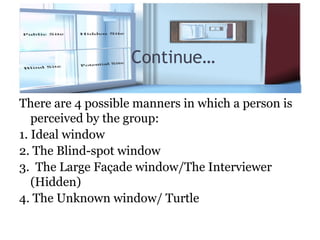
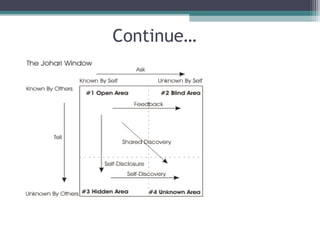
There are 4 possible manners in which a person is
perceived by the group:
1. Ideal window
2. The Blind-spot window
3. The Large Façade window/The Interviewer
(Hidden)
4. The Unknown window/ Turtle
Continue…
Open Arena
• The Ideal Window reflects a high degree of trust in
the group or in any relationship significant to the
person.

• The Arena suggests that much of your behaviour
is open to your group members. Because of your
openness, other group members do not need to
interpret (or misinterpret) your behaviour.
Blind Arena
• You tell the group what you think of them, how
you feel about what is going on in the group, and
where you stand on group issues.
• Not open to feedback.
• Either you may be a poor listener or you may
respond to feedback in such a way that group
members are reluctant to continue to give you
feedback.
Hidden Arena
• You may respond to the group norm to maintain
a reasonable level of participation by asking for
information.Such as: "What do you think about
this?" "How would you have acted if you were in
my shoes?" "How do you feel about what I just
said?" "What is your opinion of the group?“
• Characterized as the Interviewer, may eventually
evoke reactions of irritation, distrust, and
withholding.
Unknown Arena
• You do not know much about yourself, nor does
the group know much about you. You may be the
silent member in the group who neither gives
nor asks for feedback.
• Your shell keeps people from getting in and you
from getting out.
The New India Assurance Corporation
limited
• Founded by the House of Tata Founder member Sir
Dorab Tata. (1919)
• Type

Public company

• Industry

Financial services

• Headquarters Mumbai, India
• Chairman Cum Managing Director G.Srinivasan
• Products

General Insurance which includes Health
About the company
• Largest general insurance company of India on the basis
of gross premium collection inclusive of foreign
operations.
• Largest Non-Life insurer in Afro-Asia excluding Japan
• First domestic company to be rated by an International
Rating Agency.["A-" (Excellent) rating by A. M. Best &
Co (Europe), ]
• First company to set up an Aviation Insurance
Department in 1946.
• First company to handle the Hull Insurance
requirements of the Indian Shipping Fleet.
• Pioneer in Satellite insurance.
Objectives of study
• To study the behavior of employees at the New
India Assurance Corporation limited in terms of
their self awareness.
• To analyze the openness of male and female
employees in the New India Assurance
Corporation limited.
Questionnaire
Respond to each of the 20 statements using the
following scale:
Assign a point value to the A and B statements as
follows:
• The total point value for A and B added together is 5.
• If statement A is most similar to what you would do,
mark 5 for A and 0 for B.
• If A is not wholly satisfactory, but in your judgment
better than B, mark 4 or 3 for A and 1 or 2 for B, and
so on.
1) If a friend of mine had a "personality conflict" with a mutual acquaintance of ours with whom
it was important for him/her to get along, I would:
_____ A. Tell my friend that I felt s/he was partially responsible for any problems with this
other person and try to let him/her know how the person was being affected by
him/her.
_____ B. Not get involved because I wouldn't be able to continue to get along with both of
them once I had entered in any way.
2) If one of my friends and I had a heated argument in the past and I realized that s/he was ill at
ease around me from that time on, I would:
_____ A. Avoid making things worse by discussing his/her behavior and just let the whole
thing drop.
_____ B. Bring up his/her behavior and ask him/her how s/he felt the argument had affected
our relationship.
3) If a friend began to avoid me and act in an aloof and withdrawn manner, I would:
_____ A. Tell him/her about his/her behavior and suggest that s/he tell me what was on
his/her mind.
_____ B. Follow his/her lead and keep our contact brief and aloof since that seems to be what
s/he wants.
4) If two of my friends and I were talking and one of my friends slipped and brought up a
personal problem of mine that involved the other friend, of which s/he was not yet aware, I
would
5) If a friend of mine were to tell me that, in his/her opinion, I was doing things that made me
less effective than I might be in social situations, I would:
_____ A. Ask him/her to spell out or describe what s/he has observed and suggest changes I
might make.
_____ B. Resent his/her criticism and let him/her know why I behave the way I do.
6) If one of my friends aspired to an office in our organization for which I felt s/he was
unqualified, and if s/he had been tentatively assigned to that position by the leader of our
group, I would:
_____ A. Not mention my misgivings to either my friend or the leader of our group and let
them handle it in their own way.
_____ B. Tell my friend and the leader of our group of my misgivings and then leave the final
decision up to them.
7) If I felt that one of my friends was being unfair to me and his/her other friends, but none of
them had mentioned anything about it, I would:
_____ A. Ask several of these people how they perceived the situation to see if they felt s/he
was being unfair.
_____ B. Not ask the others how they perceived our friend, but wait for them to bring it up
with me.
8) If I were preoccupied with some personal matters and a friend told me that I had become
irritated with him/her and others and that I was jumping on him/her for unimportant
things, I would:
_____ A. Tell him/her I was preoccupied and would probably be on edge for a while and would
prefer not to be bothered.
_____ B. Listen to his/her complaints but not try to explain my actions to him/her.
9) If I had heard some friends discussing an ugly rumor about a friend of mine which I knew
could hurt him/her and s/he asked me what I knew about it, if anything, I would:
_____ A. Say I didn't know anything about it and tell him/her no one would believe a rumour
like that anyway.
_____ B. Tell him/her exactly what I had heard, when I had heard it, and from whom I had
heard it.
10) If a friend pointed out the fact that I had a personality conflict with another friend with
whom it was important for me to get along, I would:
_____ A. Consider his/her comments out of line and tell him/her I didn't want to discuss the
matter any further.
_____ B. Talk about it openly with him/her to find out how my behavior was being affected by
this.
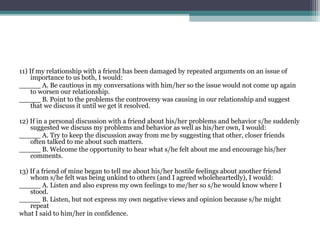
11) If my relationship with a friend has been damaged by repeated arguments on an issue of
importance to us both, I would:
_____ A. Be cautious in my conversations with him/her so the issue would not come up again
to worsen our relationship.
_____ B. Point to the problems the controversy was causing in our relationship and suggest
that we discuss it until we get it resolved.
12) If in a personal discussion with a friend about his/her problems and behavior s/he suddenly
suggested we discuss my problems and behavior as well as his/her own, I would:
_____ A. Try to keep the discussion away from me by suggesting that other, closer friends
often talked to me about such matters.
_____ B. Welcome the opportunity to hear what s/he felt about me and encourage his/her
comments.
13) If a friend of mine began to tell me about his/her hostile feelings about another friend
whom s/he felt was being unkind to others (and I agreed wholeheartedly), I would:
_____ A. Listen and also express my own feelings to me/her so s/he would know where I
stood.
_____ B. Listen, but not express my own negative views and opinion because s/he might
repeat
what I said to him/her in confidence.
14) If I thought an ugly rumor was being spread about me and suspected that one of my friends
had quite likely heard it, I would:
_____ A. Avoid mentioning the issue and leave it to him/her to tell me about it if s/he wanted
to.
_____ B. Risk putting him/her on the spot by asking him/her directly what s/he knew about
the whole thing.
15) If I had observed a friend in social situations and thought that s/he was doing a number of
things which hurt his/her relationships, I would:
_____ A. Risk being seen as a busy body and tell him/her what I had observed and my
reactions to it.
_____ B. Keep my opinion to myself rather than be seen as interfering in things that are none
of my business.
16) If two friends and I were talking and one of them inadvertently mentioned a personal
problem which involved me, but of which I knew nothing, I would:
_____ A. Press them for information about the problem and their opinions about it.
_____ B. Leave it up to my friends to tell me or not tell me, letting them change the subject if
they wished.
17) If a friend seemed to be preoccupied and began to jump on me for seemingly unimportant things, and
became irritated with me and others without real cause, I would:
_____ A. Treat him/her with kid gloves for awhile on the assumption that s/he was having some temporary
personal problems which were none of my business.
_____ B. Try to talk to him/her about it and point out to him/her how his/her behavior was affecting people.
18) If I had begun to dislike certain habits of a friend to the point that it was interfering with my enjoying
his/her company, I would:
_____ A. Say nothing to him/her directly, but let him/her know my feelings by ignoring him/her whenever
his/her annoying habits were obvious.
_____ B. Get my feelings out in the open and clear the air so that we could continue our friendship
comfortably and enjoyably.
19) In discussing social behavior with one of my more sensitive friends, I would:
_____ A. Avoid mentioning his/her flaws and weaknesses so as not to hurt his/her feelings.
_____ B. Focus on his/her flaws and weaknesses so s/he could improve his/her interpersonal skills.
20) If I knew I might be assigned to an important position in our group and my friends' attitudes toward me
had become rather negative, I would:
_____ A. Discuss my shortcomings with my friends so I could see where to improve.
_____ B. Try to figure out my own shortcomings by myself so I could improve.
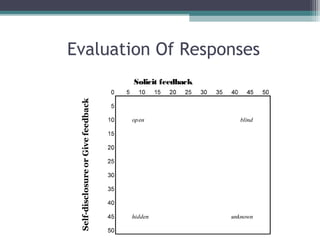
Evaluation Of Responses
Solicit feedback
Research methodology
Chi Square Test
Hypothesis:
Null hypothesis:
H0: There is no significant difference between the
openness of males and females employees in the
New India Assurance Corporation limited.

Alternate hypothesis:
H1: There is significant difference between the
openness of males and females employees in the
New India Assurance Corporation limited .
Data Collection
• Mode of data collection: Survey form
• Sample size: 62
• Sample composition:
Females: 18
Males: 44
DATA_TABLE
DATA
GENDER

OPEN_AR
ENA
(NO:OF)

NOT_OPE
N_ARENA
(NO:OF)

TOTAL

MALE

18

26

44

FEMALE

9

9

18

TOTAL

27

35

62

TABLE OF EXPECTED FREQUENCY
19.16

24.84

44

7.84

10.16

18

27

35

62
Calculations

1. Degrees of freedom (df) = 1
2. Level of significance (alpha) = 5%
Chi square statistic, X2critical= 3.84
Calculated value of Chi square statistic
X2calculated= ∑ (O - E)2/ E = 0.428474
O

E

(O-E)^2

(O-E)^2/E

18

19.16

1.3456

0.07023

9

7.84

1.3456

0.171633

26

24.84

1.3456

0.054171

9

10.16

1.3456

0.132441
Conclusion
• Since X2calculated < X2critical , we can accept the null hypothesis
that there is no significant difference between the
openness of males and females employees in the New
India Assurance Corporation limited.
Suggestions
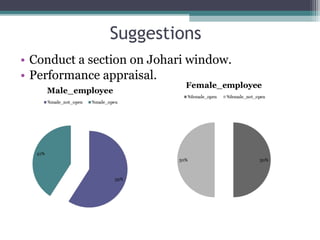
• Conduct a section on Johari window.
• Performance appraisal.
To Improve
• Ideal window
No need to self-disclose/give or receive feedback
• Blind spot
Need to receive feedback
• Hidden area
Need to self-disclose/give feedback
• Unknown
Need to self-disclose/give and receive feedback
References

• New India Assurance Retrieved March 22,2013,from
http://en.wikipedia.org/wiki/New_India_Assurance
• New India Assurance Co. Ltd Retrieved March 22,2013, from
http://www.policybazaar.com/finance/general-insurance/the-new-india-assurance

• Retrieved March 22,2013 , from
http://www.iloveindia.com/finance/insurance/companies/new-india-assurance.htm
• A Study on Performance Appraisal at New India Assurance Company Ltd
Retrieved March 26,2013,from https://www.lappublishing.com/catalog/details//store/gb/book/978-3-659-24479-7/astudy-on-performance-appraisal-at-new-india-assurance-company-ltd
• THANK YOU…..

Johari window

  • 1.
    Master of HumanResource and Organisational Development JOHARI WINDOW By: Vineetha.C (60) MHROD
  • 2.
    Background on theJohari Window • Two psychologists, Joseph Luft and Harry Ingrham , originally developed the window. • A model for getting and giving feedback. . • Enhance individual as well as team effectiveness and productivity. • Build a strong and effective team.
  • 3.
    Continue… There are 4possible manners in which a person is perceived by the group: 1. Ideal window 2. The Blind-spot window 3. The Large Façade window/The Interviewer (Hidden) 4. The Unknown window/ Turtle
  • 4.
  • 5.
    Open Arena • TheIdeal Window reflects a high degree of trust in the group or in any relationship significant to the person. • The Arena suggests that much of your behaviour is open to your group members. Because of your openness, other group members do not need to interpret (or misinterpret) your behaviour.
  • 6.
    Blind Arena • Youtell the group what you think of them, how you feel about what is going on in the group, and where you stand on group issues. • Not open to feedback. • Either you may be a poor listener or you may respond to feedback in such a way that group members are reluctant to continue to give you feedback.
  • 7.
    Hidden Arena • Youmay respond to the group norm to maintain a reasonable level of participation by asking for information.Such as: "What do you think about this?" "How would you have acted if you were in my shoes?" "How do you feel about what I just said?" "What is your opinion of the group?“ • Characterized as the Interviewer, may eventually evoke reactions of irritation, distrust, and withholding.
  • 8.
    Unknown Arena • Youdo not know much about yourself, nor does the group know much about you. You may be the silent member in the group who neither gives nor asks for feedback. • Your shell keeps people from getting in and you from getting out.
  • 9.
    The New IndiaAssurance Corporation limited • Founded by the House of Tata Founder member Sir Dorab Tata. (1919) • Type Public company • Industry Financial services • Headquarters Mumbai, India • Chairman Cum Managing Director G.Srinivasan • Products General Insurance which includes Health
  • 10.
    About the company •Largest general insurance company of India on the basis of gross premium collection inclusive of foreign operations. • Largest Non-Life insurer in Afro-Asia excluding Japan • First domestic company to be rated by an International Rating Agency.["A-" (Excellent) rating by A. M. Best & Co (Europe), ] • First company to set up an Aviation Insurance Department in 1946. • First company to handle the Hull Insurance requirements of the Indian Shipping Fleet. • Pioneer in Satellite insurance.
  • 11.
    Objectives of study •To study the behavior of employees at the New India Assurance Corporation limited in terms of their self awareness. • To analyze the openness of male and female employees in the New India Assurance Corporation limited.
  • 12.
    Questionnaire Respond to eachof the 20 statements using the following scale: Assign a point value to the A and B statements as follows: • The total point value for A and B added together is 5. • If statement A is most similar to what you would do, mark 5 for A and 0 for B. • If A is not wholly satisfactory, but in your judgment better than B, mark 4 or 3 for A and 1 or 2 for B, and so on.
  • 13.
    1) If afriend of mine had a "personality conflict" with a mutual acquaintance of ours with whom it was important for him/her to get along, I would: _____ A. Tell my friend that I felt s/he was partially responsible for any problems with this other person and try to let him/her know how the person was being affected by him/her. _____ B. Not get involved because I wouldn't be able to continue to get along with both of them once I had entered in any way. 2) If one of my friends and I had a heated argument in the past and I realized that s/he was ill at ease around me from that time on, I would: _____ A. Avoid making things worse by discussing his/her behavior and just let the whole thing drop. _____ B. Bring up his/her behavior and ask him/her how s/he felt the argument had affected our relationship. 3) If a friend began to avoid me and act in an aloof and withdrawn manner, I would: _____ A. Tell him/her about his/her behavior and suggest that s/he tell me what was on his/her mind. _____ B. Follow his/her lead and keep our contact brief and aloof since that seems to be what s/he wants. 4) If two of my friends and I were talking and one of my friends slipped and brought up a personal problem of mine that involved the other friend, of which s/he was not yet aware, I would
  • 14.
    5) If afriend of mine were to tell me that, in his/her opinion, I was doing things that made me less effective than I might be in social situations, I would: _____ A. Ask him/her to spell out or describe what s/he has observed and suggest changes I might make. _____ B. Resent his/her criticism and let him/her know why I behave the way I do. 6) If one of my friends aspired to an office in our organization for which I felt s/he was unqualified, and if s/he had been tentatively assigned to that position by the leader of our group, I would: _____ A. Not mention my misgivings to either my friend or the leader of our group and let them handle it in their own way. _____ B. Tell my friend and the leader of our group of my misgivings and then leave the final decision up to them. 7) If I felt that one of my friends was being unfair to me and his/her other friends, but none of them had mentioned anything about it, I would: _____ A. Ask several of these people how they perceived the situation to see if they felt s/he was being unfair. _____ B. Not ask the others how they perceived our friend, but wait for them to bring it up with me.
  • 15.
    8) If Iwere preoccupied with some personal matters and a friend told me that I had become irritated with him/her and others and that I was jumping on him/her for unimportant things, I would: _____ A. Tell him/her I was preoccupied and would probably be on edge for a while and would prefer not to be bothered. _____ B. Listen to his/her complaints but not try to explain my actions to him/her. 9) If I had heard some friends discussing an ugly rumor about a friend of mine which I knew could hurt him/her and s/he asked me what I knew about it, if anything, I would: _____ A. Say I didn't know anything about it and tell him/her no one would believe a rumour like that anyway. _____ B. Tell him/her exactly what I had heard, when I had heard it, and from whom I had heard it. 10) If a friend pointed out the fact that I had a personality conflict with another friend with whom it was important for me to get along, I would: _____ A. Consider his/her comments out of line and tell him/her I didn't want to discuss the matter any further. _____ B. Talk about it openly with him/her to find out how my behavior was being affected by this.
  • 16.
    11) If myrelationship with a friend has been damaged by repeated arguments on an issue of importance to us both, I would: _____ A. Be cautious in my conversations with him/her so the issue would not come up again to worsen our relationship. _____ B. Point to the problems the controversy was causing in our relationship and suggest that we discuss it until we get it resolved. 12) If in a personal discussion with a friend about his/her problems and behavior s/he suddenly suggested we discuss my problems and behavior as well as his/her own, I would: _____ A. Try to keep the discussion away from me by suggesting that other, closer friends often talked to me about such matters. _____ B. Welcome the opportunity to hear what s/he felt about me and encourage his/her comments. 13) If a friend of mine began to tell me about his/her hostile feelings about another friend whom s/he felt was being unkind to others (and I agreed wholeheartedly), I would: _____ A. Listen and also express my own feelings to me/her so s/he would know where I stood. _____ B. Listen, but not express my own negative views and opinion because s/he might repeat what I said to him/her in confidence.
  • 17.
    14) If Ithought an ugly rumor was being spread about me and suspected that one of my friends had quite likely heard it, I would: _____ A. Avoid mentioning the issue and leave it to him/her to tell me about it if s/he wanted to. _____ B. Risk putting him/her on the spot by asking him/her directly what s/he knew about the whole thing. 15) If I had observed a friend in social situations and thought that s/he was doing a number of things which hurt his/her relationships, I would: _____ A. Risk being seen as a busy body and tell him/her what I had observed and my reactions to it. _____ B. Keep my opinion to myself rather than be seen as interfering in things that are none of my business. 16) If two friends and I were talking and one of them inadvertently mentioned a personal problem which involved me, but of which I knew nothing, I would: _____ A. Press them for information about the problem and their opinions about it. _____ B. Leave it up to my friends to tell me or not tell me, letting them change the subject if they wished.
  • 18.
    17) If afriend seemed to be preoccupied and began to jump on me for seemingly unimportant things, and became irritated with me and others without real cause, I would: _____ A. Treat him/her with kid gloves for awhile on the assumption that s/he was having some temporary personal problems which were none of my business. _____ B. Try to talk to him/her about it and point out to him/her how his/her behavior was affecting people. 18) If I had begun to dislike certain habits of a friend to the point that it was interfering with my enjoying his/her company, I would: _____ A. Say nothing to him/her directly, but let him/her know my feelings by ignoring him/her whenever his/her annoying habits were obvious. _____ B. Get my feelings out in the open and clear the air so that we could continue our friendship comfortably and enjoyably. 19) In discussing social behavior with one of my more sensitive friends, I would: _____ A. Avoid mentioning his/her flaws and weaknesses so as not to hurt his/her feelings. _____ B. Focus on his/her flaws and weaknesses so s/he could improve his/her interpersonal skills. 20) If I knew I might be assigned to an important position in our group and my friends' attitudes toward me had become rather negative, I would: _____ A. Discuss my shortcomings with my friends so I could see where to improve. _____ B. Try to figure out my own shortcomings by myself so I could improve.
  • 19.
  • 20.
    Research methodology Chi SquareTest Hypothesis: Null hypothesis: H0: There is no significant difference between the openness of males and females employees in the New India Assurance Corporation limited. Alternate hypothesis: H1: There is significant difference between the openness of males and females employees in the New India Assurance Corporation limited .
  • 21.
    Data Collection • Modeof data collection: Survey form • Sample size: 62 • Sample composition: Females: 18 Males: 44
  • 22.
  • 23.
  • 24.
    Calculations 1. Degrees offreedom (df) = 1 2. Level of significance (alpha) = 5% Chi square statistic, X2critical= 3.84 Calculated value of Chi square statistic X2calculated= ∑ (O - E)2/ E = 0.428474 O E (O-E)^2 (O-E)^2/E 18 19.16 1.3456 0.07023 9 7.84 1.3456 0.171633 26 24.84 1.3456 0.054171 9 10.16 1.3456 0.132441
  • 25.
    Conclusion • Since X2calculated< X2critical , we can accept the null hypothesis that there is no significant difference between the openness of males and females employees in the New India Assurance Corporation limited.
  • 26.
    Suggestions • Conduct asection on Johari window. • Performance appraisal.
  • 27.
    To Improve • Idealwindow No need to self-disclose/give or receive feedback • Blind spot Need to receive feedback • Hidden area Need to self-disclose/give feedback • Unknown Need to self-disclose/give and receive feedback
  • 28.
    References • New IndiaAssurance Retrieved March 22,2013,from http://en.wikipedia.org/wiki/New_India_Assurance • New India Assurance Co. Ltd Retrieved March 22,2013, from http://www.policybazaar.com/finance/general-insurance/the-new-india-assurance • Retrieved March 22,2013 , from http://www.iloveindia.com/finance/insurance/companies/new-india-assurance.htm • A Study on Performance Appraisal at New India Assurance Company Ltd Retrieved March 26,2013,from https://www.lappublishing.com/catalog/details//store/gb/book/978-3-659-24479-7/astudy-on-performance-appraisal-at-new-india-assurance-company-ltd
  • 29.