Staphylococci
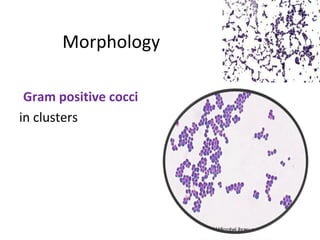
Morphology
Gram positive cocci
in clusters
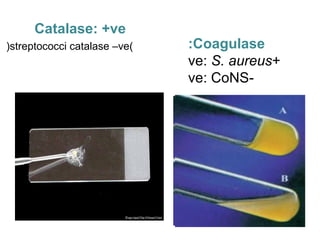
Catalase: +ve
(streptococci catalase –ve)

:Coagulase
ve: S. aureus+
ve: CoNS-
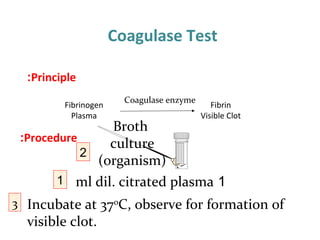
Coagulase Test
:Principle
Fibrinogen
Plasma

Coagulase enzyme

Fibrin
Visible Clot

Broth
:Procedure
culture
2
(organism)
1 ml dil. citrated plasma 1

3 Incubate at 37oC, observe for formation of

visible clot.
S.aureus
((coagulase +ve staphylococci
Morphology
Gram positive cocci
in clusters
Culture
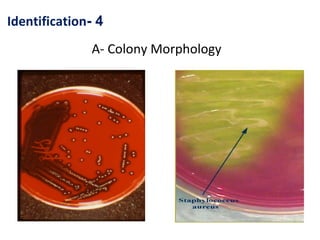
(Nutrient agar (golden yellow endopigment
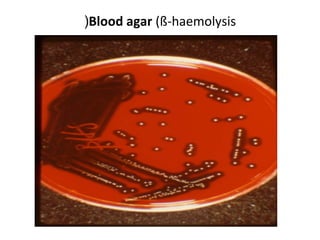
(Blood agar (ß-haemolysis
(Mannitol-Salt agar (MSA
• Selective, differential medium.
• 7.5% sodium chloride + mannitol
sugar.
S. aureus (ferment(

• Mannitol

Acid
(yellow(
CoNS (No fermentation(

• Mannitol

No acid
(Red(
Virulence Factors for Pyogenic Diseases
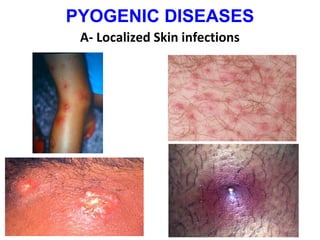
PYOGENIC DISEASES
A- Localized Skin infections
B- Staphylococcal Pneumonia
C- Invasive Infections
•
•
•
•
•

Bacteremia.
Osteomyelitis.
Acute bacterial endocarditis.
Meningitis.
Septicemia.
Diagnosis of Pyogenic Diseases
:Specimen -1
Abscess ----- pus
Endocarditis ----- blood
Meningitis --- CSF, blood
Pneumonia ----- sputum
UTI ----- urine

Direct detection- 2
Culture- 3
Blood

Other than blood
(pus, CSF, urine)

subculture
Identification- 4
A- Colony Morphology
B- Microscopy
C- Biochemical Reactions
Coagulase-1

Catalase-3

Clumping factor-2
Toxin-Mediated Diseases
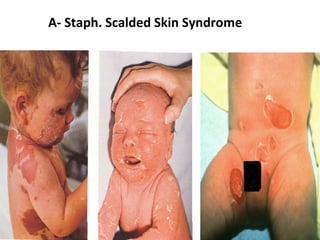
A- SSS

Exfoliatin

B- TSS

TSST-1

C- Food poisoning

Enterotoxins
A- Staph. Scalded Skin Syndrome
B- Toxic Shock Syndrome
Predisposing factors:
- First observed in Menstruating
females using tampons )tampon
retained in vagina for 4-5 days(
- Any staphylococcal lesion can
predispose to TSS.

Virulence factor: TSST-1
Diagnosis:
clinical picture.
culture: for isolation & identification.
ELISA: for toxin detection in blood
C- Staph. aureus food poisoning
I.P:
1- 6 hrs.
Clinical picture:
Colic, vomiting, mild
Diarrhea, but no fever
Diagnosis:
1. Specimen: food, vomitus, stools.
2. Culture: on MSA.
3. ELISA: for toxin detection in sample or in isolated
organism.

4. Strain typing: to trace source of infection )e.g. phage
typing(.
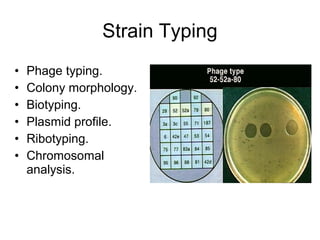
Strain Typing
•
•
•
•
•
•

Phage typing.
Colony morphology.
Biotyping.
Plasmid profile.
Ribotyping.
Chromosomal
analysis.
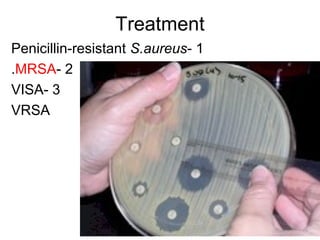
Treatment
Penicillin-resistant S.aureus- 1
.MRSA- 2
VISA- 3
VRSA
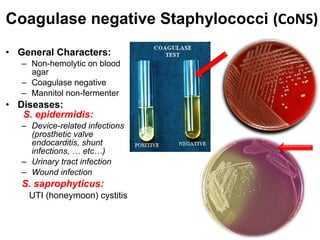
Coagulase negative Staphylococci (CoNS)
• General Characters:
– Non-hemolytic on blood
agar
– Coagulase negative
– Mannitol non-fermenter

• Diseases:
S. epidermidis:
– Device-related infections
(prosthetic valve
endocarditis, shunt
infections, … etc…)
– Urinary tract infection
– Wound infection

S. saprophyticus:
UTI (honeymoon) cystitis
Case 1
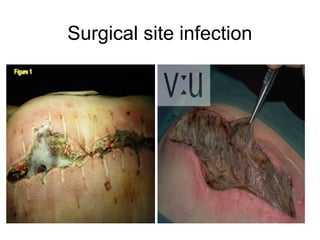
A man underwent an emergency operation for
perforated appendix. He required admission
to the Intensive Care Unit. On the 5th day
of hospitalization he developed fever, and
the wound was erythematous, swollen,
with purulent discharge (Surgical site
infection “SSI”). The surgeon requested
bacteriological examination (culture and
sensitivity) of the wound pus
Surgical site infection
Specimen
• Wound swabs were
obtained.
• Gram staining &

Microscopy
Gram-positive
cocci arranged in
clusters amongst pus
cells.
Culture

On Blood agar →
Beta-hemolysis

On nutrient agar →
Golden yellow pigment

On MSA →
Yellow colonies
Identification:
Film from colonies

Gram-positive cocci
in clusters
Biochemical reactions

Catalase +ve

Coagulase +ve

Clumping
factor +ve
Which organism is causing this
condition?
• Gram-positive cocci in clusters, catalase positive

staphylococci
• β-hemolysis , golden yellow pigment, yellow
colonies on MSA and coagulase positivity

S. aureus
.
Antimicrobial susceptibility “Disc
diffusion”
the organism is
resistant: to
oxacillin, penicillin,
erythromycin,
& gentamicin
but sensitive to:
vancomycin.
How do you interpret the
?susceptibility data
The organism is multi-resistant, including
oxacillin-resistant
methicillin-resistant S. aureus (MRSA).
Name other diseases caused by
.this organism
1. Pyogenic infections
a. Localized skin infections, e.g. folliculitis, furuncles,
abscess.
b. Staph pneumonia
c. Invasive staph. infections, e.g. endocarditis, cellulitis,
osteomyelitis, and septic arthritis
2. Toxin-mediated diseases
, a. Toxic shock syndrome
,b. Scalded skin syndrome
c. Food poisoning.
Case 2
A group of people shared a carbohydrate- rich
meal. 1-6 hours later, they manifested vomiting,
diarrhea but no fever. The condition was mild and
self- limited.
a) What could be the clinical diagnosis?
b) What is the possible causative organism?
c) What is the virulence factor responsible for this
condition?
d) What is the mechanism of action of such
virulence factor?
e) What is the laboratory test that is used to trace the
source of this outbreak?
MCQs
1. All the following are characteristic features
of staphylococci except:
a)
b)
c)
d)
e)

Gram positive cocci.
Arranged in clusters.
Catalase negative .
Usually grow on simple media.
Usually inhabit skin and mucosa.
2. The following medium is used to isolate S.
aureus from specimens contaminated by
other bacteria:
a) Nutrient agar.
b) MacConkey's agar.
c) Blood agar .
d) Mannitol salt agar.
e) Chocolate agar
3. The localized nature of S. aureus lesions is due
to:
a) Adhesins.
b) Protein A.
c) Staphylocoagulase
d) Staphylokinase
e) Exfoliatin
4. S. aureus growth can be identified by the
following characters except:

a) Colony on blood agar is golden yellow.
b) Colony on blood agar is surrounded with a clear
zone.
c) Colony on Mannitol salt agar is rose pink.
d) Protein A positive.
e) Coagulase test positive.
5. One of the following is a S. aureus toxinmediated disease:
a) Folliculitis
b) Staphylococcal pneumonia.
c) Toxic shock syndrome.
d) Osteomyelitis
e) Carbuncles
6. Staphylococcal strain typing is used :
a) To diagnose staphylococcal pyogenic diseases.
b) To differentiate between coagulase -ve and
coagulase +ve staphylococci.
c) To differentiate between staphylococci &
streptococci.
d) To trace the source of outbreaks of S. aureus in
the epidemiological studies.
e) To identify enterotoxin-producing strains of S.
aureus.
Staphylococci - Prac. Microbiology

Staphylococci - Prac. Microbiology

  • 1.
  • 2.
  • 3.
    Catalase: +ve (streptococci catalase–ve) :Coagulase ve: S. aureus+ ve: CoNS-
  • 4.
    Coagulase Test :Principle Fibrinogen Plasma Coagulase enzyme Fibrin VisibleClot Broth :Procedure culture 2 (organism) 1 ml dil. citrated plasma 1 3 Incubate at 37oC, observe for formation of visible clot.
  • 5.
  • 6.
  • 7.
  • 8.
  • 9.
    (Mannitol-Salt agar (MSA •Selective, differential medium. • 7.5% sodium chloride + mannitol sugar. S. aureus (ferment( • Mannitol Acid (yellow( CoNS (No fermentation( • Mannitol No acid (Red(
  • 10.
    Virulence Factors forPyogenic Diseases
  • 11.
  • 13.
  • 14.
  • 15.
    Diagnosis of PyogenicDiseases :Specimen -1 Abscess ----- pus Endocarditis ----- blood Meningitis --- CSF, blood Pneumonia ----- sputum UTI ----- urine Direct detection- 2
  • 16.
    Culture- 3 Blood Other thanblood (pus, CSF, urine) subculture
  • 17.
  • 18.
  • 19.
  • 20.
    Toxin-Mediated Diseases A- SSS Exfoliatin B-TSS TSST-1 C- Food poisoning Enterotoxins
  • 21.
    A- Staph. ScaldedSkin Syndrome
  • 22.
    B- Toxic ShockSyndrome Predisposing factors: - First observed in Menstruating females using tampons )tampon retained in vagina for 4-5 days( - Any staphylococcal lesion can predispose to TSS. Virulence factor: TSST-1 Diagnosis: clinical picture. culture: for isolation & identification. ELISA: for toxin detection in blood
  • 23.
    C- Staph. aureusfood poisoning I.P: 1- 6 hrs. Clinical picture: Colic, vomiting, mild Diarrhea, but no fever Diagnosis: 1. Specimen: food, vomitus, stools. 2. Culture: on MSA. 3. ELISA: for toxin detection in sample or in isolated organism. 4. Strain typing: to trace source of infection )e.g. phage typing(.
  • 24.
    Strain Typing • • • • • • Phage typing. Colonymorphology. Biotyping. Plasmid profile. Ribotyping. Chromosomal analysis.
  • 25.
  • 26.
    Coagulase negative Staphylococci(CoNS) • General Characters: – Non-hemolytic on blood agar – Coagulase negative – Mannitol non-fermenter • Diseases: S. epidermidis: – Device-related infections (prosthetic valve endocarditis, shunt infections, … etc…) – Urinary tract infection – Wound infection S. saprophyticus: UTI (honeymoon) cystitis
  • 27.
    Case 1 A manunderwent an emergency operation for perforated appendix. He required admission to the Intensive Care Unit. On the 5th day of hospitalization he developed fever, and the wound was erythematous, swollen, with purulent discharge (Surgical site infection “SSI”). The surgeon requested bacteriological examination (culture and sensitivity) of the wound pus
  • 28.
  • 29.
    Specimen • Wound swabswere obtained. • Gram staining & Microscopy Gram-positive cocci arranged in clusters amongst pus cells.
  • 30.
    Culture On Blood agar→ Beta-hemolysis On nutrient agar → Golden yellow pigment On MSA → Yellow colonies
  • 31.
  • 32.
  • 33.
    Which organism iscausing this condition? • Gram-positive cocci in clusters, catalase positive staphylococci • β-hemolysis , golden yellow pigment, yellow colonies on MSA and coagulase positivity S. aureus .
  • 34.
    Antimicrobial susceptibility “Disc diffusion” theorganism is resistant: to oxacillin, penicillin, erythromycin, & gentamicin but sensitive to: vancomycin.
  • 35.
    How do youinterpret the ?susceptibility data The organism is multi-resistant, including oxacillin-resistant methicillin-resistant S. aureus (MRSA).
  • 36.
    Name other diseasescaused by .this organism 1. Pyogenic infections a. Localized skin infections, e.g. folliculitis, furuncles, abscess. b. Staph pneumonia c. Invasive staph. infections, e.g. endocarditis, cellulitis, osteomyelitis, and septic arthritis 2. Toxin-mediated diseases , a. Toxic shock syndrome ,b. Scalded skin syndrome c. Food poisoning.
  • 37.
    Case 2 A groupof people shared a carbohydrate- rich meal. 1-6 hours later, they manifested vomiting, diarrhea but no fever. The condition was mild and self- limited. a) What could be the clinical diagnosis? b) What is the possible causative organism? c) What is the virulence factor responsible for this condition? d) What is the mechanism of action of such virulence factor? e) What is the laboratory test that is used to trace the source of this outbreak?
  • 38.
  • 39.
    1. All thefollowing are characteristic features of staphylococci except: a) b) c) d) e) Gram positive cocci. Arranged in clusters. Catalase negative . Usually grow on simple media. Usually inhabit skin and mucosa.
  • 40.
    2. The followingmedium is used to isolate S. aureus from specimens contaminated by other bacteria: a) Nutrient agar. b) MacConkey's agar. c) Blood agar . d) Mannitol salt agar. e) Chocolate agar
  • 41.
    3. The localizednature of S. aureus lesions is due to: a) Adhesins. b) Protein A. c) Staphylocoagulase d) Staphylokinase e) Exfoliatin
  • 42.
    4. S. aureusgrowth can be identified by the following characters except: a) Colony on blood agar is golden yellow. b) Colony on blood agar is surrounded with a clear zone. c) Colony on Mannitol salt agar is rose pink. d) Protein A positive. e) Coagulase test positive.
  • 43.
    5. One ofthe following is a S. aureus toxinmediated disease: a) Folliculitis b) Staphylococcal pneumonia. c) Toxic shock syndrome. d) Osteomyelitis e) Carbuncles
  • 44.
    6. Staphylococcal straintyping is used : a) To diagnose staphylococcal pyogenic diseases. b) To differentiate between coagulase -ve and coagulase +ve staphylococci. c) To differentiate between staphylococci & streptococci. d) To trace the source of outbreaks of S. aureus in the epidemiological studies. e) To identify enterotoxin-producing strains of S. aureus.