Global Initiative for Asthma Management 2009:  Please visit:   http://crisbertcualteros.page.tl
GLOBAL INITIATIVES FOR ASTHMA (GINA) Initiated in 1989 US National Heart, Lung and Blood Institute National Institute of Health World Health Organization OBJECTIVES: To increase appreciation for global public health perspectives of asthma Recommend diagnostic and management strategies Identify areas for future investigations
Objectives: To present and compare the GINA 2002 with GINA 2006-07 guidelines To update clinicians with the newer approach to the management in children
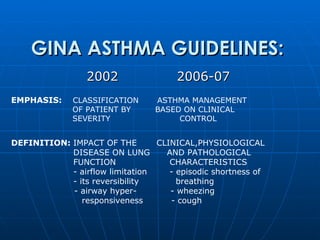
GINA ASTHMA GUIDELINES:   2002   2006-07 EMPHASIS:  CLASSIFICATION  ASTHMA MANAGEMENT    OF PATIENT BY   BASED ON CLINICAL   SEVERITY  CONTROL DEFINITION:  IMPACT OF THE  CLINICAL,PHYSIOLOGICAL  DISEASE ON LUNG  AND PATHOLOGICAL FUNCTION  CHARACTERISTICS - airflow limitation  - episodic shortness of - its reversibility  breathing   - airway hyper-  - wheezing responsiveness  - cough
GINA ASTHMA GUIDELINES:   2002   2006-07 PATHOLOGY:   Acute and Chronic Inflammation     Inflammation is persistent        Inflammation affects all airways    more  in the medium sized bronchi
GINA ASTHMA GUIDELINES:   2002   2006 -07 Pathophysiology:   Airway Narrowing : - Airway smooth muscle contraction - Airway edema - Airway thickening - Mucus hypersecretion Airway Hyperresponsiveness
GINA ASTHMA   GUIDELINES : 2002     2006 - 07 Asthma is a  chronic inflammatory   disorder   of the  airways is associated with   airway hyperresponsiveness recurrent episodes of wheezing Breathlessness chest tightness coughing
GINA ASTHMA GUIDELINES: 2002     2006-07 Factors Influencing the Development and Expression of Asthma HOST FACTORS Genetic, e.g., Genes pre-disposing to atopy Genes pre-disposing to airway hyperresponsiveness Obesity Sex ENVIRONMENTAL FACTORS Allergens Indoor: Domestic mites, furred animals(dogs, cats, mice) cockroach allergen, fungi, molds, yeast Outdoor: Pollens, fungi, molds, yeasts Infections (predominantly viral) Occupational sensitizers Tobacco smoke Passive smoking Active smoking Outdoor/Indoor Air Pollution Diet
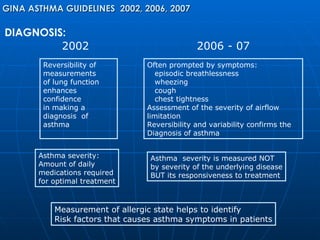
GINA ASTHMA GUIDELINES  2002, 2006, 2007 DIAGNOSIS: Reversibility of measurements of lung function  enhances confidence in making a diagnosis  of asthma Often prompted by symptoms: episodic breathlessness wheezing cough chest tightness Assessment of the severity of airflow limitation Reversibility and variability confirms the Diagnosis of asthma Asthma severity: Amount of daily medications required for optimal treatment Asthma  severity is measured NOT by severity of the underlying disease BUT its responsiveness to treatment 2002 2006 - 07 Measurement of allergic state helps to identify Risk factors that causes asthma symptoms in patients
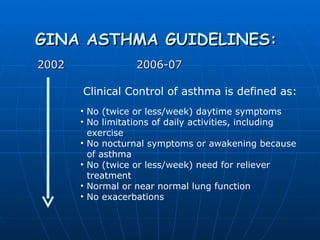
GINA ASTHMA GUIDELINES: 2002     2006-07 Clinical Control of asthma is defined as:  No (twice or less/week) daytime symptoms No limitations of daily activities, including  exercise No nocturnal symptoms or awakening because  of asthma No (twice or less/week) need for reliever  treatment Normal or near normal lung function No exacerbations
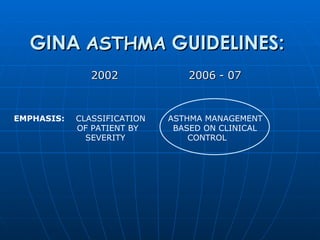
EMPHASIS:   CLASSIFICATION  ASTHMA MANAGEMENT    OF PATIENT BY   BASED ON CLINICAL   SEVERITY  CONTROL 2002     2006 - 07 GINA  ASTHMA  GUIDELINES:
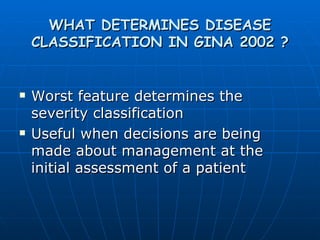
WHAT DETERMINES DISEASE CLASSIFICATION IN GINA 2002 ? Worst feature determines the severity classification Useful when decisions are being made about management at the initial assessment of a patient
ASTHMA SEVERITY (GINA 2002)   Involves both the severity of the underlying disease and its responsiveness to treatment. May change over months or years
VALUE OF GINA 2002 GUIDELINES Cross sectional means of characterizing patients with asthma who are not on inhaled corticosteroids treatment No maintenance Newly diagnosed No previous consult No longer recommended as basis for ongoing treatment
ASTHMA CONTROL (GINA 2006) Refers to control of the clinical symptoms of the disease Treatment is aimed at controlling the clinical features of disease
GINA ASTHMA GUIDELINES: Questions to consider in the Diagnosis of Asthma Has the patient had an attack or recurrent attacks of wheezing? Does the patient have a troublesome cough at night? Does the patient wheeze or cough after exercise? Does the patient experience wheezing, chest tightness or cough after exposure to airborne allergens or pollutants? Do the patient’s colds “go to the chest” or take more than 10 days  to clear up? Are symptoms improved by appropriate asthma treatment?
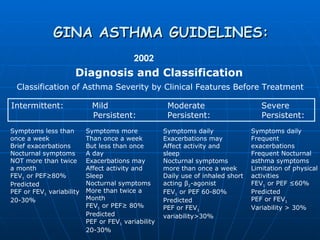
GINA ASTHMA GUIDELINES: Diagnosis and Classification 2002 Classification of Asthma Severity by Clinical Features Before Treatment Intermittent:   Mild    Moderate  Severe Persistent:   Persistent:  Persistent: Symptoms less than  once a week Brief exacerbations Nocturnal symptoms NOT more than twice a month FEV 1  or PEF≥80%  Predicted PEF or FEV 1  variability 20-30% Symptoms more Than once a week But less than once A day Exacerbations may  Affect activity and Sleep Nocturnal symptoms More than twice a Month FEV 1  or PEF≥ 80% Predicted PEF or FEV 1  variability 20-30% Symptoms daily Exacerbations may Affect activity and  sleep Nocturnal symptoms  more than once a week Daily use of inhaled short acting  β 2 -agonist FEV 1  or PEF 60-80% Predicted PEF or FEV 1  variability>30% Symptoms daily Frequent  exacerbations Frequent Nocturnal asthma symptoms Limitation of physical activities FEV 1  or PEF ≤60% Predicted PEF or FEV 1   Variability > 30%
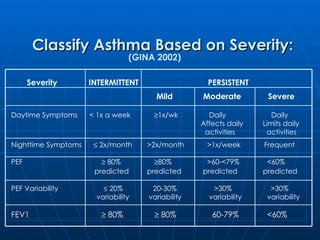
Classify Asthma Based on Severity: Severity  INTERMITTENT  PERSISTENT   Mild Moderate  Severe   Daytime Symptoms  < 1x a week   1x/wk    Daily  Daily   Affects daily  Limits daily   activities  activities Nighttime Symptoms    2x/month   >2x/month    >1x/week  Frequent PEF    80%   80%    >60-<79% <60%   predicted     predicted  predicted  predicted PEF Variability    20%   20-30%  >30%   >30%   variability  variability    variability variability FEV1     80%    80%   60-79% <60% (GINA 2002)
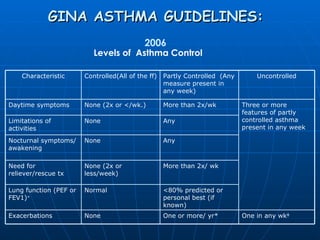
GINA ASTHMA GUIDELINES: 2006 Levels of  Asthma Control Characteristic Controlled(All of the ff) Partly Controlled  (Any measure present in any week) Uncontrolled Daytime symptoms None (2x or </wk.) More than 2x/wk Three or more features of partly controlled asthma present in any week Limitations of activities None  Any Nocturnal symptoms/ awakening None Any Need for reliever/rescue tx None (2x or less/week) More than 2x/ wk Lung function (PEF or FEV1) + Normal <80% predicted or personal best (if known) Exacerbations  None One or more/ yr* One in any wk ╪
Asthma in Acute Exacerbation GINA ASTHMA GUIDELINES: 2002    2006-07
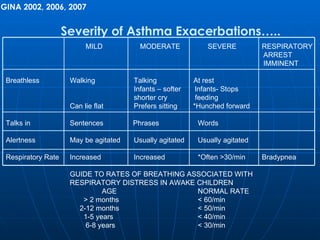
  Severity of Asthma Exacerbations…..   MILD  MODERATE   SEVERE RESPIRATORY   ARREST    IMMINENT Breathless Walking Talking   At rest Infants – softer  Infants- Stops shorter cry  feeding Can lie flat Prefers sitting  *Hunched forward Talks in Sentences  Phrases Words Alertness May be agitated Usually agitated Usually agitated Respiratory Rate Increased Increased *Often >30/min Bradypnea GUIDE TO RATES OF BREATHING ASSOCIATED WITH RESPIRATORY DISTRESS IN AWAKE CHILDREN AGE NORMAL RATE   > 2 months < 60/min   2-12 months < 50/min   1-5 years < 40/min   6-8 years < 30/min GINA 2002, 2006, 2007
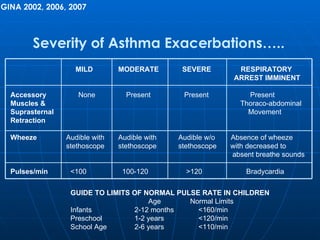
MILD   MODERATE   SEVERE  RESPIRATORY   ARREST IMMINENT   Accessory   None   Present   Present   Present Muscles &   Thoraco-abdominal Suprasternal   Movement Retraction  Wheeze   Audible with  Audible with   Audible w/o  Absence of wheeze   stethoscope  stethoscope   stethoscope  with decreased to   absent breathe sounds Pulses/min <100   100-120   >120   Bradycardia GUIDE TO LIMITS OF NORMAL PULSE RATE IN CHILDREN   Age   Normal Limits Infants 2-12 months <160/min Preschool 1-2 years <120/min School Age 2-6 years <110/min Severity of Asthma Exacerbations….. GINA 2002, 2006, 2007
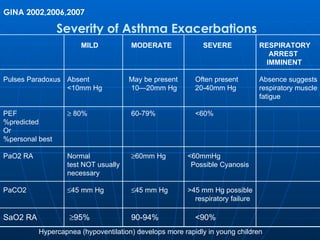
Severity of Asthma Exacerbations   MILD MODERATE   SEVERE RESPIRATORY   ARREST    IMMINENT Pulses Paradoxus Absent   May be present Often present Absence suggests <10mm Hg 10—20mm Hg 20-40mm Hg respiratory muscle fatigue PEF   80% 60-79% <60% %predicted Or %personal best PaO2 RA Normal   60mm Hg  <60mmHg test NOT usually   Possible Cyanosis necessary PaCO2  45 mm Hg  45 mm Hg  >45 mm Hg possible respiratory failure SaO2 RA    95% 90-94% <90% Hypercapnea (hypoventilation) develops more rapidly in young children GINA 2002,2006,2007
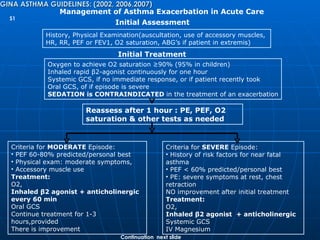
GINA ASTHMA GUIDELINES: (2002, 2006,2007) Management of Asthma Exacerbation in Acute Care Initial Assessment History, Physical Examination(auscultation, use of accessory muscles,  HR, RR, PEF or FEV1, O2 saturation, ABG’s if patient in extremis) Initial Treatment Oxygen to achieve O2 saturation ≥90% (95% in children) Inhaled rapid  β 2-agonist continuously for one hour Systemic GCS, if no immediate response, or if patient recently took Oral GCS, of if episode is severe SEDATION is CONTRAINDICATED  in the treatment of an exacerbation Reassess after 1 hour : PE, PEF, O2 saturation & other tests as needed  Criteria for  MODERATE  Episode: PEF 60-80% predicted/personal best Physical exam: moderate symptoms, Accessory muscle use Treatment:  O2,  Inhaled  β 2 agonist + anticholinergic every 60 min Oral GCS Continue treatment for 1-3 hours,provided There is improvement Criteria for  SEVERE  Episode: History of risk factors for near fatal asthma PEF < 60% predicted/personal best PE: severe symptoms at rest, chest  retraction NO improvement after initial treatment Treatment: O2, Inhaled  β 2 agonist  + anticholinergic Systemic GCS IV Magnesium Continuation  next slide S1
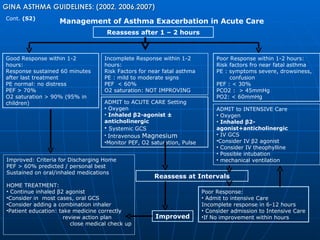
GINA ASTHMA GUIDELINES: (2002, 2006,2007) Reassess after 1 – 2 hours  Good Response within 1-2 hours: Response sustained 60 minutes  after last treatment PE normal: no distress PEF > 70% O2 saturation > 90% (95% in children) Incomplete Response within 1-2 hours: Risk Factors for near fatal asthma PE : mild to moderate signs PEF  < 60% O2 saturation: NOT IMPROVING Poor Response within 1-2 hours: Risk factors fro near fatal asthma PE : symptoms severe, drowsiness, confusion PEF : < 30% PCO2 :  > 45mmHg PO2: < 60mmHg ADMIT to ACUTE CARE Setting Oxygen Inhaled  β 2-agonist ± anticholinergic Systemic GCS Intravenous  Magnesium Monitor PEF, O2 saturation, Pulse ADMIT to INTENSIVE Care Oxygen Inhaled  β 2-agonist+anticholinergic  IV GCS Consider IV  β 2 agonist Consider IV theophylline Possible intubation  mechanical ventilation Reassess at Intervals Poor Response: Admit to intensive Care Incomplete response in 6-12 hours Consider admission to Intensive Care If No improvement within hours Improved Improved: Criteria for Discharging Home PEF > 60% predicted / personal best Sustained on oral/inhaled medications HOME TREATMENT: Continue inhaled  β 2 agonist Consider in  most cases, oral GCS Consider adding a combination inhaler Patient education: take medicine correctly   review action plan close medical check up Management of Asthma Exacerbation in Acute Care Cont.  (S2)
Inhaled  β 2 -agonists are the mainstay of therapy in acute asthma.
However, once response to the initial  β 2 -agonists is minimal, incomplete or  poor … COMBINATION of INHALED  β 2 -AGONIST and INHALED ANTICHOLINERGIC is RECOMMENDED
What is the role of Salbutamol – Ipratropium  in acute asthmatic attacks?
INTERMITTENT - no added benefit over Salbutamol alone  if attack is mild However,  any moderate to severe  attack of asthma regardless of severity classification can benefit from the combination.
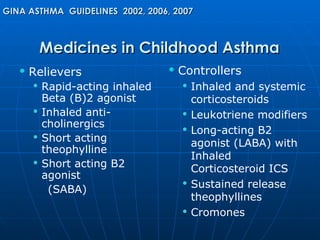
Medicines in Childhood Asthma Relievers Rapid-acting inhaled Beta (B)2 agonist Inhaled anti-cholinergics Short acting theophylline Short acting B2 agonist (SABA) Controllers Inhaled and systemic corticosteroids Leukotriene modifiers Long-acting B2 agonist (LABA) with Inhaled Corticosteroid ICS Sustained release theophyllines Cromones GINA ASTHMA  GUIDELINES  2002, 2006, 2007
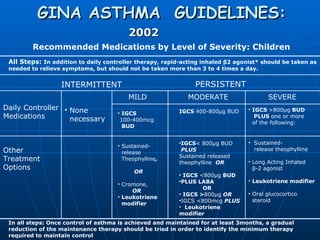
GINA ASTHMA  GUIDELINES: Recommended Medications by Level of Severity: Children 2002 Daily Controller Medications Other Treatment Options INTERMITTENT PERSISTENT MILD   MODERATE  SEVERE None  necessary  IGCS 100-400mcg BUD  IGCS  400-800µg BUD IGCS < 800µg BUD PLUS Sustained released theophylline  OR IGCS  <800µg  BUD PLUS LABA  OR IGCS > 800µg  OR IGCS <800mcg  PLUS   Leukotriene modifier  IGCS  >800µg  BUD PLUS  one or more of the following: Sustained- release theophylline Long Acting Inhaled β -2 agonist Leukotriene modifier Oral glucocortico steroid Sustained- release Theophylline ,  OR Cromone,  OR Leukotriene  modifier All Steps:  In addition to daily controller therapy, rapid-acting inhaled  β 2 agonist* should be taken as needed to relieve symptoms, but should not be taken more than 3 to 4 times a day.  In all steps: Once control of asthma is achieved and maintained for at least 3months, a gradual reduction of the maintenance therapy should be tried in order to identify the minimum therapy required to maintain control
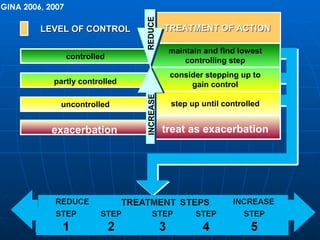
GINA 2006, 2007 maintain and find lowest controlling step consider stepping up to gain control step up until controlled treat as exacerbation TREATMENT OF ACTION controlled partly controlled uncontrolled exacerbation LEVEL OF CONTROL INCREASE REDUCE
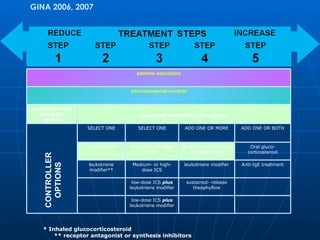
GINA 2006, 2007 CONTROLLER OPTIONS * Inhaled glucocorticosteroid  ** receptor antagonist or synthesis inhibitors asthma education environmental control as needed rapid acting  β 2- agonist as needed rapid acting  β 2- agonist SELECT ONE SELECT ONE ADD ONE OR MORE ADD ONE OR BOTH low-dose ICS* low-dose ICS  plus  LABA Medium- or high-dose ICS  plus  LABA Oral gluco-corticosteroid leukotriene modifier** Medium- or high-dose ICS leukotriene modifier Anti-IgE treatment low-dose ICS  plus  leukotriene modifier sustained- release theophylline low-dose ICS  plus  leukotriene modifier
Inhaled Corticosteroids: Cornerstone in the Management Of Asthma GINA ASTHMA  GUIDELINES  2002, 2006-07
Inhaled Corticosteroids Most effective long-term control for persistent asthma Small risk for adverse events at recommended dosage Benefits of daily use Reduction of asthma symptoms frequency of exacerbations airway inflammation airway responsiveness asthma mortality Improvement of  lung function quality of life
Inhaled Corticosteroids Adverse Events Small risk for adverse events at recommended doses Reduce potential for adverse events by: Using spacer Rinsing mouth
Maintenance Therapy: GINA ASTHMA  GUIDELINES  2002,2006,2007 Stepping Down When asthma is controlled with: IGCS alone  in medium to high dose a 50% reduction in dose  should be attempted at 3 months interval  (Evidence B) IGCS  in   low dose of alone treatment may be switched to once- daily dosing  (Evidence A)  Combination of IGCS and LABA, reduce dose of IGCS by 50%  while continuing LABA  (Evidence B)  If control is maintained,  further reduce IGCS until low dose is reached, when LABA may be  stopped . (Evidence D) OR  switch the combination treatment to  once daily dosing  OR discontinue  the LABA at an earlier stage  and substitute the combination with IGCS monotherapy. In some  patients these alternative approaches lead to loss of asthma  control  (Evidence B)
IGCS and controllers other the LABA , reduce dose of IGCS by 50% until low dose of IGCS is reached, then may stop combination treatment  (Evidence D) Controller treatment may be stopped  if the patient’s asthma remains controlled on the lowest dose of controller  and no recurrence of symptoms for ONE YEAR  (Evidence D) Stepping Down cont. Maintenance Therapy: GINA ASTHMA  GUIDELINES  2002,2006,2007
Maintenance Therapy: GINA ASTHMA  GUIDELINES  2002,2006,2007 Stepping Up  When asthma is NOT controlled with: Rapid onset, short acting or long acting  β 2 agonist  bronchodilators .  Repeated dosing with bronchodilators in this class provides  temporary relief until the cause of the days signals the need for  review and possible increase of controller therapy. Inhaled glucocorticosteroids . Temporarily doubling the dose of  IGCS has not been demonstrated to effective and is no longer  recommended (Evidence A). A fourfold or greater increase has  been demonstrated to be equivalent to a short course of Oral GCS  (Evidence A)
Maintenance Therapy: GINA ASTHMA  GUIDELINES  2002,2006,2007 Stepping Up  Combination of Inhaled Glucocorticosteroids and rapid  and LABA   (formoterol)  for combined relief and control.  The use of the combination of a rapid and long acting  β 2- agonist(formoterol) and an inhaled glucocorticosteroid  (budesonide) in a single inhaler both as a controller and a r reliever is effective in maintaining a high level of asthma control  and reduces exacerbation requiring systemic GCS and  hospitalization (Evidence A)
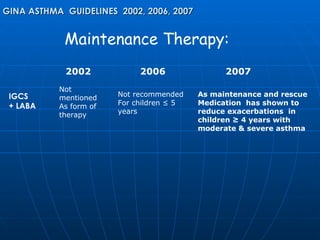
Maintenance Therapy: GINA ASTHMA  GUIDELINES  2002, 2006, 2007 2002    2006  2007  IGCS  + LABA Not mentioned As form of  therapy Not recommended For children ≤ 5 years As maintenance and rescue Medication  has shown to reduce exacerbations  in children ≥ 4 years with moderate & severe asthma
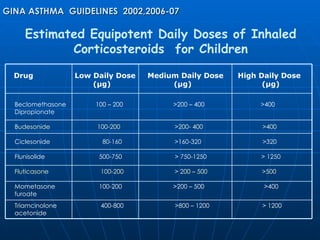
Estimated Equipotent Daily Doses of Inhaled Corticosteroids  for Children Drug   Low Daily Dose  Medium Daily Dose  High Daily Dose  (µg) (µg)   (µg) Beclomethasone    100 – 200   >200 – 400   >400 Dipropionate Budesonide   100-200  >200- 400    >400 Ciclesonide   80-160 >160-320   >320 Flunisolide   500-750  > 750-1250  > 1250 Fluticasone   100-200 > 200 – 500  >500 Mometasone    100-200  >200 – 500   >400 furoate Triamcinolone    400-800  >800 – 1200  > 1200 acetonide GINA ASTHMA  GUIDELINES  2002,2006-07
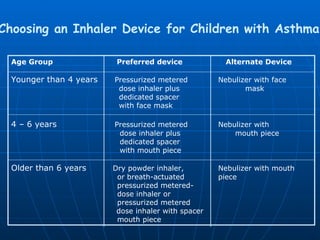
Choosing an Inhaler Device for Children with Asthma Age Group   Preferred device  Alternate Device Younger than 4 years   Pressurized metered   Nebulizer with face dose inhaler plus   mask dedicated spacer  with face mask 4 – 6 years   Pressurized metered   Nebulizer with    dose inhaler plus mouth piece   dedicated spacer   with mouth piece Older than 6 years   Dry powder inhaler,   Nebulizer with mouth   or breath-actuated   piece   pressurized metered-   dose inhaler or    pressurized metered dose inhaler with spacer   mouth piece
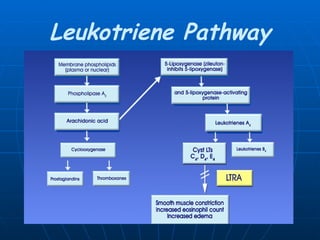
Leukotriene Pathway
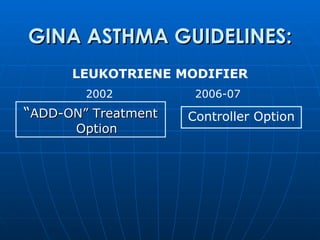
“ ADD-ON” Treatment Option GINA ASTHMA GUIDELINES: 2002  2006-07   LEUKOTRIENE MODIFIER Controller Option
LEUKOTRIENE MODIFIER Children Younger  than 5 Years Provide clinical benefit at all levels of severity (but less than ICS) Partial protection against exercise-induced bronchoconstriction within hours after administration Add on in children where asthma is insufficiently controlled by low dose of ICS
Provide clinical benefit at all levels of severity (but less than ICS) Partial protection against exercise-induced bronchoconstriction within hours after administration Add on in children where asthma is insufficiently controlled by low dose of ICS Reduce viral induced asthma exacerbation LEUKOTRIENE MODIFIER Children Older than 5 Years
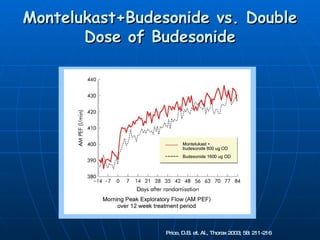
Montelukast+Budesonide vs. Double Dose of Budesonide Price, D.B. et. Al., Thorax 2003; 58: 211-216
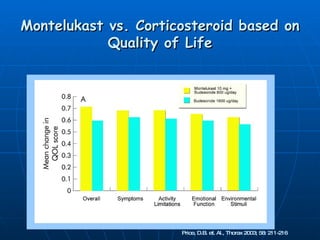
Montelukast vs. Corticosteroid based on Quality of Life Price, D.B. et. Al., Thorax 2003; 58: 211-216
Salamat!

Global Initiative For Asthma Guidelines 2008

  • 1.
    Global Initiative forAsthma Management 2009: Please visit: http://crisbertcualteros.page.tl
  • 2.
    GLOBAL INITIATIVES FORASTHMA (GINA) Initiated in 1989 US National Heart, Lung and Blood Institute National Institute of Health World Health Organization OBJECTIVES: To increase appreciation for global public health perspectives of asthma Recommend diagnostic and management strategies Identify areas for future investigations
  • 3.
    Objectives: To presentand compare the GINA 2002 with GINA 2006-07 guidelines To update clinicians with the newer approach to the management in children
  • 4.
    GINA ASTHMA GUIDELINES: 2002 2006-07 EMPHASIS: CLASSIFICATION ASTHMA MANAGEMENT OF PATIENT BY BASED ON CLINICAL SEVERITY CONTROL DEFINITION: IMPACT OF THE CLINICAL,PHYSIOLOGICAL DISEASE ON LUNG AND PATHOLOGICAL FUNCTION CHARACTERISTICS - airflow limitation - episodic shortness of - its reversibility breathing - airway hyper- - wheezing responsiveness - cough
  • 5.
    GINA ASTHMA GUIDELINES: 2002 2006-07 PATHOLOGY: Acute and Chronic Inflammation Inflammation is persistent Inflammation affects all airways more in the medium sized bronchi
  • 6.
    GINA ASTHMA GUIDELINES: 2002 2006 -07 Pathophysiology: Airway Narrowing : - Airway smooth muscle contraction - Airway edema - Airway thickening - Mucus hypersecretion Airway Hyperresponsiveness
  • 7.
    GINA ASTHMA GUIDELINES : 2002 2006 - 07 Asthma is a chronic inflammatory disorder of the airways is associated with airway hyperresponsiveness recurrent episodes of wheezing Breathlessness chest tightness coughing
  • 8.
    GINA ASTHMA GUIDELINES:2002 2006-07 Factors Influencing the Development and Expression of Asthma HOST FACTORS Genetic, e.g., Genes pre-disposing to atopy Genes pre-disposing to airway hyperresponsiveness Obesity Sex ENVIRONMENTAL FACTORS Allergens Indoor: Domestic mites, furred animals(dogs, cats, mice) cockroach allergen, fungi, molds, yeast Outdoor: Pollens, fungi, molds, yeasts Infections (predominantly viral) Occupational sensitizers Tobacco smoke Passive smoking Active smoking Outdoor/Indoor Air Pollution Diet
  • 9.
    GINA ASTHMA GUIDELINES 2002, 2006, 2007 DIAGNOSIS: Reversibility of measurements of lung function enhances confidence in making a diagnosis of asthma Often prompted by symptoms: episodic breathlessness wheezing cough chest tightness Assessment of the severity of airflow limitation Reversibility and variability confirms the Diagnosis of asthma Asthma severity: Amount of daily medications required for optimal treatment Asthma severity is measured NOT by severity of the underlying disease BUT its responsiveness to treatment 2002 2006 - 07 Measurement of allergic state helps to identify Risk factors that causes asthma symptoms in patients
  • 10.
    GINA ASTHMA GUIDELINES:2002 2006-07 Clinical Control of asthma is defined as: No (twice or less/week) daytime symptoms No limitations of daily activities, including exercise No nocturnal symptoms or awakening because of asthma No (twice or less/week) need for reliever treatment Normal or near normal lung function No exacerbations
  • 11.
    EMPHASIS: CLASSIFICATION ASTHMA MANAGEMENT OF PATIENT BY BASED ON CLINICAL SEVERITY CONTROL 2002 2006 - 07 GINA ASTHMA GUIDELINES:
  • 12.
    WHAT DETERMINES DISEASECLASSIFICATION IN GINA 2002 ? Worst feature determines the severity classification Useful when decisions are being made about management at the initial assessment of a patient
  • 13.
    ASTHMA SEVERITY (GINA2002) Involves both the severity of the underlying disease and its responsiveness to treatment. May change over months or years
  • 14.
    VALUE OF GINA2002 GUIDELINES Cross sectional means of characterizing patients with asthma who are not on inhaled corticosteroids treatment No maintenance Newly diagnosed No previous consult No longer recommended as basis for ongoing treatment
  • 15.
    ASTHMA CONTROL (GINA2006) Refers to control of the clinical symptoms of the disease Treatment is aimed at controlling the clinical features of disease
  • 16.
    GINA ASTHMA GUIDELINES:Questions to consider in the Diagnosis of Asthma Has the patient had an attack or recurrent attacks of wheezing? Does the patient have a troublesome cough at night? Does the patient wheeze or cough after exercise? Does the patient experience wheezing, chest tightness or cough after exposure to airborne allergens or pollutants? Do the patient’s colds “go to the chest” or take more than 10 days to clear up? Are symptoms improved by appropriate asthma treatment?
  • 17.
    GINA ASTHMA GUIDELINES:Diagnosis and Classification 2002 Classification of Asthma Severity by Clinical Features Before Treatment Intermittent: Mild Moderate Severe Persistent: Persistent: Persistent: Symptoms less than once a week Brief exacerbations Nocturnal symptoms NOT more than twice a month FEV 1 or PEF≥80% Predicted PEF or FEV 1 variability 20-30% Symptoms more Than once a week But less than once A day Exacerbations may Affect activity and Sleep Nocturnal symptoms More than twice a Month FEV 1 or PEF≥ 80% Predicted PEF or FEV 1 variability 20-30% Symptoms daily Exacerbations may Affect activity and sleep Nocturnal symptoms more than once a week Daily use of inhaled short acting β 2 -agonist FEV 1 or PEF 60-80% Predicted PEF or FEV 1 variability>30% Symptoms daily Frequent exacerbations Frequent Nocturnal asthma symptoms Limitation of physical activities FEV 1 or PEF ≤60% Predicted PEF or FEV 1 Variability > 30%
  • 18.
    Classify Asthma Basedon Severity: Severity INTERMITTENT PERSISTENT Mild Moderate Severe Daytime Symptoms < 1x a week  1x/wk Daily Daily Affects daily Limits daily activities activities Nighttime Symptoms  2x/month >2x/month >1x/week Frequent PEF  80%  80% >60-<79% <60% predicted predicted predicted predicted PEF Variability  20% 20-30% >30% >30% variability variability variability variability FEV1  80%  80% 60-79% <60% (GINA 2002)
  • 19.
    GINA ASTHMA GUIDELINES:2006 Levels of Asthma Control Characteristic Controlled(All of the ff) Partly Controlled (Any measure present in any week) Uncontrolled Daytime symptoms None (2x or </wk.) More than 2x/wk Three or more features of partly controlled asthma present in any week Limitations of activities None Any Nocturnal symptoms/ awakening None Any Need for reliever/rescue tx None (2x or less/week) More than 2x/ wk Lung function (PEF or FEV1) + Normal <80% predicted or personal best (if known) Exacerbations None One or more/ yr* One in any wk ╪
  • 20.
    Asthma in AcuteExacerbation GINA ASTHMA GUIDELINES: 2002 2006-07
  • 21.
    Severityof Asthma Exacerbations….. MILD MODERATE SEVERE RESPIRATORY ARREST IMMINENT Breathless Walking Talking At rest Infants – softer Infants- Stops shorter cry feeding Can lie flat Prefers sitting *Hunched forward Talks in Sentences Phrases Words Alertness May be agitated Usually agitated Usually agitated Respiratory Rate Increased Increased *Often >30/min Bradypnea GUIDE TO RATES OF BREATHING ASSOCIATED WITH RESPIRATORY DISTRESS IN AWAKE CHILDREN AGE NORMAL RATE > 2 months < 60/min 2-12 months < 50/min 1-5 years < 40/min 6-8 years < 30/min GINA 2002, 2006, 2007
  • 22.
    MILD MODERATE SEVERE RESPIRATORY ARREST IMMINENT Accessory None Present Present Present Muscles & Thoraco-abdominal Suprasternal Movement Retraction Wheeze Audible with Audible with Audible w/o Absence of wheeze stethoscope stethoscope stethoscope with decreased to absent breathe sounds Pulses/min <100 100-120 >120 Bradycardia GUIDE TO LIMITS OF NORMAL PULSE RATE IN CHILDREN Age Normal Limits Infants 2-12 months <160/min Preschool 1-2 years <120/min School Age 2-6 years <110/min Severity of Asthma Exacerbations….. GINA 2002, 2006, 2007
  • 23.
    Severity of AsthmaExacerbations MILD MODERATE SEVERE RESPIRATORY ARREST IMMINENT Pulses Paradoxus Absent May be present Often present Absence suggests <10mm Hg 10—20mm Hg 20-40mm Hg respiratory muscle fatigue PEF  80% 60-79% <60% %predicted Or %personal best PaO2 RA Normal  60mm Hg <60mmHg test NOT usually Possible Cyanosis necessary PaCO2  45 mm Hg  45 mm Hg >45 mm Hg possible respiratory failure SaO2 RA  95% 90-94% <90% Hypercapnea (hypoventilation) develops more rapidly in young children GINA 2002,2006,2007
  • 24.
    GINA ASTHMA GUIDELINES:(2002, 2006,2007) Management of Asthma Exacerbation in Acute Care Initial Assessment History, Physical Examination(auscultation, use of accessory muscles, HR, RR, PEF or FEV1, O2 saturation, ABG’s if patient in extremis) Initial Treatment Oxygen to achieve O2 saturation ≥90% (95% in children) Inhaled rapid β 2-agonist continuously for one hour Systemic GCS, if no immediate response, or if patient recently took Oral GCS, of if episode is severe SEDATION is CONTRAINDICATED in the treatment of an exacerbation Reassess after 1 hour : PE, PEF, O2 saturation & other tests as needed Criteria for MODERATE Episode: PEF 60-80% predicted/personal best Physical exam: moderate symptoms, Accessory muscle use Treatment: O2, Inhaled β 2 agonist + anticholinergic every 60 min Oral GCS Continue treatment for 1-3 hours,provided There is improvement Criteria for SEVERE Episode: History of risk factors for near fatal asthma PEF < 60% predicted/personal best PE: severe symptoms at rest, chest retraction NO improvement after initial treatment Treatment: O2, Inhaled β 2 agonist + anticholinergic Systemic GCS IV Magnesium Continuation next slide S1
  • 25.
    GINA ASTHMA GUIDELINES:(2002, 2006,2007) Reassess after 1 – 2 hours Good Response within 1-2 hours: Response sustained 60 minutes after last treatment PE normal: no distress PEF > 70% O2 saturation > 90% (95% in children) Incomplete Response within 1-2 hours: Risk Factors for near fatal asthma PE : mild to moderate signs PEF < 60% O2 saturation: NOT IMPROVING Poor Response within 1-2 hours: Risk factors fro near fatal asthma PE : symptoms severe, drowsiness, confusion PEF : < 30% PCO2 : > 45mmHg PO2: < 60mmHg ADMIT to ACUTE CARE Setting Oxygen Inhaled β 2-agonist ± anticholinergic Systemic GCS Intravenous Magnesium Monitor PEF, O2 saturation, Pulse ADMIT to INTENSIVE Care Oxygen Inhaled β 2-agonist+anticholinergic IV GCS Consider IV β 2 agonist Consider IV theophylline Possible intubation mechanical ventilation Reassess at Intervals Poor Response: Admit to intensive Care Incomplete response in 6-12 hours Consider admission to Intensive Care If No improvement within hours Improved Improved: Criteria for Discharging Home PEF > 60% predicted / personal best Sustained on oral/inhaled medications HOME TREATMENT: Continue inhaled β 2 agonist Consider in most cases, oral GCS Consider adding a combination inhaler Patient education: take medicine correctly review action plan close medical check up Management of Asthma Exacerbation in Acute Care Cont. (S2)
  • 26.
    Inhaled β2 -agonists are the mainstay of therapy in acute asthma.
  • 27.
    However, once responseto the initial β 2 -agonists is minimal, incomplete or poor … COMBINATION of INHALED β 2 -AGONIST and INHALED ANTICHOLINERGIC is RECOMMENDED
  • 28.
    What is therole of Salbutamol – Ipratropium in acute asthmatic attacks?
  • 29.
    INTERMITTENT - noadded benefit over Salbutamol alone if attack is mild However, any moderate to severe attack of asthma regardless of severity classification can benefit from the combination.
  • 30.
    Medicines in ChildhoodAsthma Relievers Rapid-acting inhaled Beta (B)2 agonist Inhaled anti-cholinergics Short acting theophylline Short acting B2 agonist (SABA) Controllers Inhaled and systemic corticosteroids Leukotriene modifiers Long-acting B2 agonist (LABA) with Inhaled Corticosteroid ICS Sustained release theophyllines Cromones GINA ASTHMA GUIDELINES 2002, 2006, 2007
  • 31.
    GINA ASTHMA GUIDELINES: Recommended Medications by Level of Severity: Children 2002 Daily Controller Medications Other Treatment Options INTERMITTENT PERSISTENT MILD MODERATE SEVERE None necessary IGCS 100-400mcg BUD IGCS 400-800µg BUD IGCS < 800µg BUD PLUS Sustained released theophylline OR IGCS <800µg BUD PLUS LABA OR IGCS > 800µg OR IGCS <800mcg PLUS Leukotriene modifier IGCS >800µg BUD PLUS one or more of the following: Sustained- release theophylline Long Acting Inhaled β -2 agonist Leukotriene modifier Oral glucocortico steroid Sustained- release Theophylline , OR Cromone, OR Leukotriene modifier All Steps: In addition to daily controller therapy, rapid-acting inhaled β 2 agonist* should be taken as needed to relieve symptoms, but should not be taken more than 3 to 4 times a day. In all steps: Once control of asthma is achieved and maintained for at least 3months, a gradual reduction of the maintenance therapy should be tried in order to identify the minimum therapy required to maintain control
  • 32.
    GINA 2006, 2007maintain and find lowest controlling step consider stepping up to gain control step up until controlled treat as exacerbation TREATMENT OF ACTION controlled partly controlled uncontrolled exacerbation LEVEL OF CONTROL INCREASE REDUCE
  • 33.
    GINA 2006, 2007CONTROLLER OPTIONS * Inhaled glucocorticosteroid ** receptor antagonist or synthesis inhibitors asthma education environmental control as needed rapid acting β 2- agonist as needed rapid acting β 2- agonist SELECT ONE SELECT ONE ADD ONE OR MORE ADD ONE OR BOTH low-dose ICS* low-dose ICS plus LABA Medium- or high-dose ICS plus LABA Oral gluco-corticosteroid leukotriene modifier** Medium- or high-dose ICS leukotriene modifier Anti-IgE treatment low-dose ICS plus leukotriene modifier sustained- release theophylline low-dose ICS plus leukotriene modifier
  • 34.
    Inhaled Corticosteroids: Cornerstonein the Management Of Asthma GINA ASTHMA GUIDELINES 2002, 2006-07
  • 35.
    Inhaled Corticosteroids Mosteffective long-term control for persistent asthma Small risk for adverse events at recommended dosage Benefits of daily use Reduction of asthma symptoms frequency of exacerbations airway inflammation airway responsiveness asthma mortality Improvement of lung function quality of life
  • 36.
    Inhaled Corticosteroids AdverseEvents Small risk for adverse events at recommended doses Reduce potential for adverse events by: Using spacer Rinsing mouth
  • 37.
    Maintenance Therapy: GINAASTHMA GUIDELINES 2002,2006,2007 Stepping Down When asthma is controlled with: IGCS alone in medium to high dose a 50% reduction in dose should be attempted at 3 months interval (Evidence B) IGCS in low dose of alone treatment may be switched to once- daily dosing (Evidence A) Combination of IGCS and LABA, reduce dose of IGCS by 50% while continuing LABA (Evidence B) If control is maintained, further reduce IGCS until low dose is reached, when LABA may be stopped . (Evidence D) OR switch the combination treatment to once daily dosing OR discontinue the LABA at an earlier stage and substitute the combination with IGCS monotherapy. In some patients these alternative approaches lead to loss of asthma control (Evidence B)
  • 38.
    IGCS and controllersother the LABA , reduce dose of IGCS by 50% until low dose of IGCS is reached, then may stop combination treatment (Evidence D) Controller treatment may be stopped if the patient’s asthma remains controlled on the lowest dose of controller and no recurrence of symptoms for ONE YEAR (Evidence D) Stepping Down cont. Maintenance Therapy: GINA ASTHMA GUIDELINES 2002,2006,2007
  • 39.
    Maintenance Therapy: GINAASTHMA GUIDELINES 2002,2006,2007 Stepping Up When asthma is NOT controlled with: Rapid onset, short acting or long acting β 2 agonist bronchodilators . Repeated dosing with bronchodilators in this class provides temporary relief until the cause of the days signals the need for review and possible increase of controller therapy. Inhaled glucocorticosteroids . Temporarily doubling the dose of IGCS has not been demonstrated to effective and is no longer recommended (Evidence A). A fourfold or greater increase has been demonstrated to be equivalent to a short course of Oral GCS (Evidence A)
  • 40.
    Maintenance Therapy: GINAASTHMA GUIDELINES 2002,2006,2007 Stepping Up Combination of Inhaled Glucocorticosteroids and rapid and LABA (formoterol) for combined relief and control. The use of the combination of a rapid and long acting β 2- agonist(formoterol) and an inhaled glucocorticosteroid (budesonide) in a single inhaler both as a controller and a r reliever is effective in maintaining a high level of asthma control and reduces exacerbation requiring systemic GCS and hospitalization (Evidence A)
  • 41.
    Maintenance Therapy: GINAASTHMA GUIDELINES 2002, 2006, 2007 2002 2006 2007 IGCS + LABA Not mentioned As form of therapy Not recommended For children ≤ 5 years As maintenance and rescue Medication has shown to reduce exacerbations in children ≥ 4 years with moderate & severe asthma
  • 42.
    Estimated Equipotent DailyDoses of Inhaled Corticosteroids for Children Drug Low Daily Dose Medium Daily Dose High Daily Dose (µg) (µg) (µg) Beclomethasone 100 – 200 >200 – 400 >400 Dipropionate Budesonide 100-200 >200- 400 >400 Ciclesonide 80-160 >160-320 >320 Flunisolide 500-750 > 750-1250 > 1250 Fluticasone 100-200 > 200 – 500 >500 Mometasone 100-200 >200 – 500 >400 furoate Triamcinolone 400-800 >800 – 1200 > 1200 acetonide GINA ASTHMA GUIDELINES 2002,2006-07
  • 43.
    Choosing an InhalerDevice for Children with Asthma Age Group Preferred device Alternate Device Younger than 4 years Pressurized metered Nebulizer with face dose inhaler plus mask dedicated spacer with face mask 4 – 6 years Pressurized metered Nebulizer with dose inhaler plus mouth piece dedicated spacer with mouth piece Older than 6 years Dry powder inhaler, Nebulizer with mouth or breath-actuated piece pressurized metered- dose inhaler or pressurized metered dose inhaler with spacer mouth piece
  • 44.
  • 45.
    “ ADD-ON” TreatmentOption GINA ASTHMA GUIDELINES: 2002 2006-07 LEUKOTRIENE MODIFIER Controller Option
  • 46.
    LEUKOTRIENE MODIFIER ChildrenYounger than 5 Years Provide clinical benefit at all levels of severity (but less than ICS) Partial protection against exercise-induced bronchoconstriction within hours after administration Add on in children where asthma is insufficiently controlled by low dose of ICS
  • 47.
    Provide clinical benefitat all levels of severity (but less than ICS) Partial protection against exercise-induced bronchoconstriction within hours after administration Add on in children where asthma is insufficiently controlled by low dose of ICS Reduce viral induced asthma exacerbation LEUKOTRIENE MODIFIER Children Older than 5 Years
  • 48.
    Montelukast+Budesonide vs. DoubleDose of Budesonide Price, D.B. et. Al., Thorax 2003; 58: 211-216
  • 49.
    Montelukast vs. Corticosteroidbased on Quality of Life Price, D.B. et. Al., Thorax 2003; 58: 211-216
  • 50.