NEPHROTIC
SYNDROME
BY
DR.MALIHA
PGR PEADS UNIT 4
DEFINATION
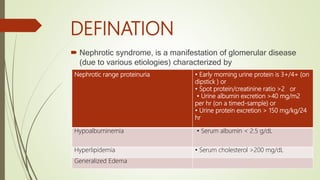
 Nephrotic syndrome, is a manifestation of glomerular disease
(due to various etiologies) characterized by
Nephrotic range proteinuria • Early morning urine protein is 3+/4+ (on
dipstick ) or
• Spot protein/creatinine ratio >2 or
• Urine albumin excretion >40 mg/m2
per hr (on a timed-sample) or
• Urine protein excretion > 150 mg/kg/24
hr
Hypoalbuminemia • Serum albumin < 2.5 g/dL
Hyperlipidemia • Serum cholesterol >200 mg/dL
Generalized Edema
ETIOLOGY
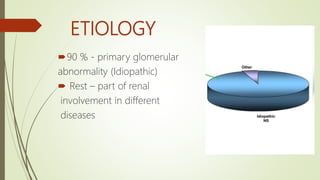
90 % - primary glomerular
abnormality (Idiopathic)
 Rest – part of renal
involvement in different
diseases
incidence
 2 to 7 cases per 100,000 children
 Male-to-female ratio is reported to be 2:1 for
children and 1:1 in adolescents and adults.
 MCNS peaks between 2-5 years of age.
92% of these will experience remission of their
disease when treated .
 Adolescents are more likely to have a more
aggressive cause of the nephrotic syndrome.
CAUSES
 Genetic
 Secondary
Idiopathic or Primary
GENETIC CAUSES
• Finnish type Congenital Nephrotic Syndrome
 • Focal Segmental Glomerulosclerosis
 • Diffuse Mesangial Sclerosis
• Denys- Drash Syndrome
• Nail – Patella Syndrome
 • Alport Syndrome
 • Charcot-Marie-tooth disease
• Cockayne syndrome • Galloway-Mowat
Syndrome
Secondary causes
 Infectious – Hepatitis (B,C) , HIV-1, Malaria, Syphilis,
Toxoplasmosis ,CMV , filariasis
 Inflammatory – Glomerulonephritis
 Immunological – Castleman Disease, Kimura Disease, Bee
sting, Food allergens , serum sickness.
 Neoplastic – Lymphoma, Leukemia
 Drug induced – Penicillamine, Gold, NSAIDS, Pamidronate,
Mercury, Lithium , interferon,
Idiopathic
 Minimal Change disease ( >75 % )
 Focal segmental Glomerulosclerosis(10%)
Mesangio proliferative (5%)
 Membranoproliferative GN (5%)
Membranous Nephropathy (<5%)
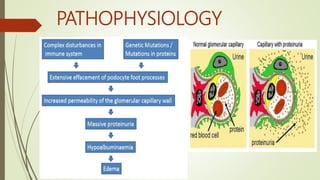
PATHOPHYSIOLOGY
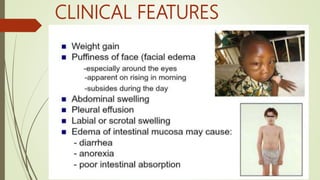
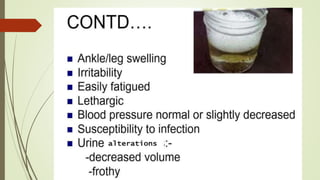
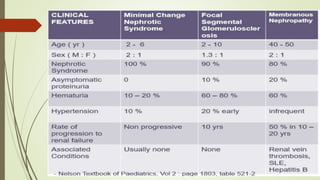
CLINICAL FEATURES
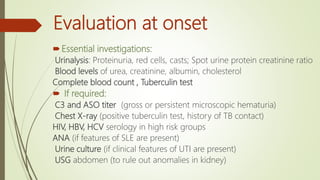
Evaluation at onset
Essential investigations:
Urinalysis: Proteinuria, red cells, casts; Spot urine protein creatinine ratio
Blood levels of urea, creatinine, albumin, cholesterol
Complete blood count , Tuberculin test
 If required:
C3 and ASO titer (gross or persistent microscopic hematuria)
Chest X-ray (positive tuberculin test, history of TB contact)
HIV, HBV, HCV serology in high risk groups
ANA (if features of SLE are present)
Urine culture (if clinical features of UTI are present)
USG abdomen (to rule out anomalies in kidney)
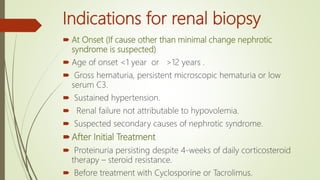
Indications for renal biopsy
 At Onset (If cause other than minimal change nephrotic
syndrome is suspected)
 Age of onset <1 year or >12 years .
 Gross hematuria, persistent microscopic hematuria or low
serum C3.
 Sustained hypertension.
 Renal failure not attributable to hypovolemia.
 Suspected secondary causes of nephrotic syndrome.
After Initial Treatment
 Proteinuria persisting despite 4-weeks of daily corticosteroid
therapy – steroid resistance.
 Before treatment with Cyclosporine or Tacrolimus.
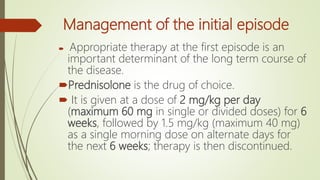
Management of the initial episode
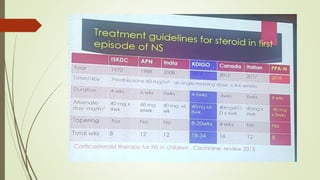
 Appropriate therapy at the first episode is an
important determinant of the long term course of
the disease.
Prednisolone is the drug of choice.
 It is given at a dose of 2 mg/kg per day
(maximum 60 mg in single or divided doses) for 6
weeks, followed by 1.5 mg/kg (maximum 40 mg)
as a single morning dose on alternate days for
the next 6 weeks; therapy is then discontinued.
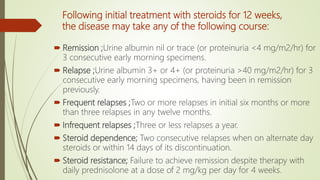
Following initial treatment with steroids for 12 weeks,
the disease may take any of the following course:
 Remission ;Urine albumin nil or trace (or proteinuria <4 mg/m2/hr) for
3 consecutive early morning specimens.
 Relapse ;Urine albumin 3+ or 4+ (or proteinuria >40 mg/m2/hr) for 3
consecutive early morning specimens, having been in remission
previously.
 Frequent relapses ;Two or more relapses in initial six months or more
than three relapses in any twelve months.
 Infrequent relapses ;Three or less relapses a year.
 Steroid dependence; Two consecutive relapses when on alternate day
steroids or within 14 days of its discontinuation.
 Steroid resistance; Failure to achieve remission despite therapy with
daily prednisolone at a dose of 2 mg/kg per day for 4 weeks.
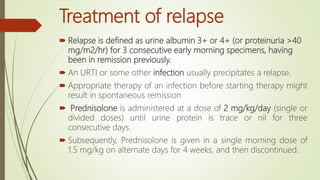
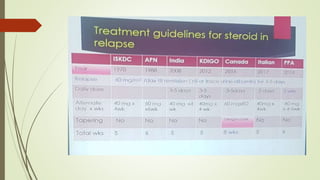
Treatment of relapse
 Relapse is defined as urine albumin 3+ or 4+ (or proteinuria >40
mg/m2/hr) for 3 consecutive early morning specimens, having
been in remission previously.
 An URTI or some other infection usually precipitates a relapse.
 Appropriate therapy of an infection before starting therapy might
result in spontaneous remission
 Prednisolone is administered at a dose of 2 mg/kg/day (single or
divided doses) until urine protein is trace or nil for three
consecutive days.
 Subsequently, Prednisolone is given in a single morning dose of
1.5 mg/kg on alternate days for 4 weeks, and then discontinued.
Infrequent Relapses
An infrequent relapses is defined as initial
responder with three or less relapses a year.
 They are managed using standard
prednisolone regimen for each relapse.
 Such children are at a low risk for developing
steroid toxicity.
Management of Frequent Relapses and
Steroid Dependence
 Frequent relapse is defined as Two or more relapses in initial six
months or more than three relapses in any twelve months.
 Steroid dependence is defined as occurrence 2 consecutive
relapses when on alternate day steroids or within 14 days of its
discontinuation.
 Following treatment of a relapse, prednisolone is gradually tapered
to maintain the patient in remission on alternate day dose of 0.5-0.7
mg/kg.
 A close monitoring of growth and blood pressure, and evaluation
for features of steroid toxicity (cushingoid features – obesity,
hirsutism, striae, hypertension, impaired glucose tolerance, posterior
subcapsular opacities, emotional problems & growth retardation) is
essential
Continue……
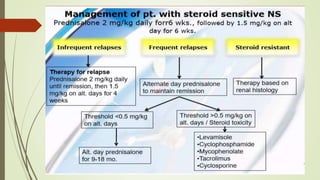
 If prednisolone threshold to maintain remission less than 0.5-0.7mg/kg on
alternate day and there is no steroid toxicity, it is continued for 9-18 months.
And then breakthrough relapses are treated with standard therapy of
relapse.
 If prednisolone threshold to maintain remission greater than 0.5-0.7mg/kg
on alternate day and there is steroid toxicity, addition of following
immunomodulators is suggested.
Levamisole
Cyclophosphamide
Calcineurin inhibitors: Cyclosporin (CsA), Tacrolimus
Mycophenolate mofetil (MMF)
Levamisole
Dose & duration: 2-2.5 mg/kg on alternate days for 12-24
months
Concomitant steroid therapy: Prednisolone dose is gradually
tapered to 0.25-0.5 mg/kg over a period of 8 months. Occasionally,
it might be possible to discontinue Prednisolone.
 Monitoring: The leukocyte count should be monitored every 3-4
months.
Cyclophosphamide
 Dose & duration: 2-2.5 mg/kg/day for 12 weeks. Should be started
following remission of proteinuria.
 Concomitant steroid therapy: Prednisolone dose is gradually tapered to 1
mg/kg over a period of 6 months and then stopped.
 Monitoring: Total leukocyte counts are monitored every 2 weeks temporarily
discontinued if the count falls below 4000/mm3
Mycophenolate mofetil (MMF)
 Dose & duration: 800-1200 mg/m2/day for 12-24 months.
 Concomitant steroid therapy: Prednisolone is gradually tapered
over 12-24 months. Recent trials supported its use as a steroid
sparing agent.
 Monitoring: Leukocyte counts every 1-2 months; Withheld if count
falls below 4000/mm3
Calcineurin inhibitor : Cyclosporin (CsA)
 Dose & duration: 4-5 mg/kg daily for 12-24 months.
Tacrolimus
 Dose & duration: 0.1-0.2 mg/kg daily for 12-24 months.
 Concomitant steroid therapy: Prednisolone is gradually
tapered to 0.25-0.5 mg/kg over 8 or more months. Occasionally it can
be discontinued.
 Monitoring: Plasma CsA levels should be kept between 80-120 ng/mL.
Serum creatinine and glucose is monitored every 2-3 months.
 Lipid profile is checked annually.
 A repeat kidney biopsy, to examine for histological evidence of
nephrotoxicity, should be done if duration of treatment is extended beyond 2
years.
Choice of immunomodulator:
 First choice is Levamisole or Cyclophosphamide.
 Cyclophosphamide is preferred in patients showing poor
compliance or difficult follow up, where 12 weeks therapy is
beneficial.
 Relapses occurring during immunomodulator therapy must be
treated with regular Prednisolone relapse regimen.
 If there are two or more relapses over 6 months while on
treatment with any of them, its replacement with an alternative
medication should be considered.
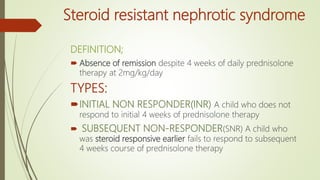
Steroid resistant nephrotic syndrome
DEFINITION;
 Absence of remission despite 4 weeks of daily prednisolone
therapy at 2mg/kg/day
TYPES:
INITIAL NON RESPONDER(INR) A child who does not
respond to initial 4 weeks of prednisolone therapy
 SUBSEQUENT NON-RESPONDER(SNR) A child who
was steroid responsive earlier fails to respond to subsequent
4 weeks course of prednisolone therapy
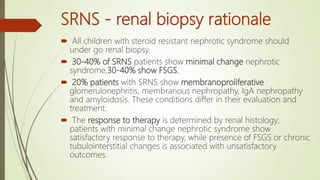
SRNS - renal biopsy rationale
 All children with steroid resistant nephrotic syndrome should
under go renal biopsy.
 30-40% of SRNS patients show minimal change nephrotic
syndrome,30-40% show FSGS.
 20% patients with SRNS show membranoproliferative
glomerulonephritis, membranous nephropathy, IgA nephropathy
and amyloidosis. These conditions differ in their evaluation and
treatment.
 The response to therapy is determined by renal histology;
patients with minimal change nephrotic syndrome show
satisfactory response to therapy, while presence of FSGS or chronic
tubulointerstitial changes is associated with unsatisfactory
outcomes.
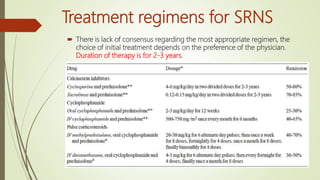
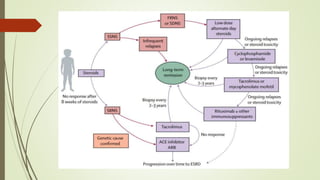
Treatment regimens for SRNS
 There is lack of consensus regarding the most appropriate regimen, the
choice of initial treatment depends on the preference of the physician.
Duration of therapy is for 2-3 years.
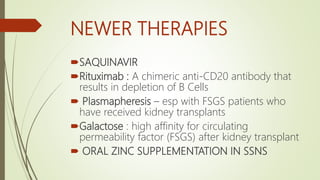
NEWER THERAPIES
SAQUINAVIR
Rituximab : A chimeric anti-CD20 antibody that
results in depletion of B Cells
 Plasmapheresis – esp with FSGS patients who
have received kidney transplants
Galactose : high affinity for circulating
permeability factor (FSGS) after kidney transplant
 ORAL ZINC SUPPLEMENTATION IN SSNS
SRNS - Management
 All patients with SRNS should receive treatment with angiotensin
converting enzyme inhibitors (e.g., Enalapril, Ramipril).
 These agents should be avoided if the estimated GFR is <30
ml/minute/1.73 m2.
 Angiotensin receptor blockers (e.g., Losartan, Valsartan) may be
used in patients intolerant to ACE inhibitors, or as add-on therapy
to achieve better antihypertensive and antiproteinuric effect.
 Dyslipidemia should be managed by HMG CoA reductase
inhibitors (e.g. Atrovastatin (10-20 mg daily).
 Target LDL level should be <130 mg/dL.
Dietary management
 A balanced diet, adequate in protein (1.5-2 g/kg) and calories
is recommended. Patients with persistent proteinuria should
receive 2-2.5 g/kg of protein daily.
 Not more than 30% calories should be derived from fat.
 Treatment with corticosteroids stimulates appetite, so
adequate physical activity is to be ensured to prevent excessive
weight gain.
 Patients on prolonged (>3 months) treatment with steroids
should receive daily supplements of oral calcium (250-500
mg/day) and vitamin D (125-250 IU/day).
 Reduction of salt intake (1-2 g per day) is advised for those
with persistent edema.
 Fluid restriction is needed in addition to Sodium restriction in
children with persistent edema.
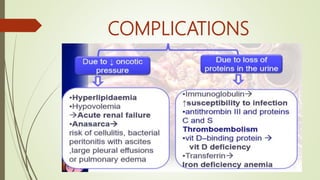
COMPLICATIONS
 PEM due to protein loss
 Infections: – S. pneumonia , H. influenza – VPDs
 Thrombotic complications
 Iron, copper, zinc, and vitamin D deficiencies
 Hypovolemia and Acute renal Failure
 Edema
 Loss of various binding proteins, (Thyroxine and vit D)
 Hyperlipidemia.
 Steroid Toxicity
COMPLICATIONS
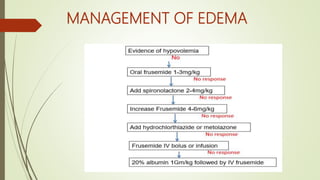
MANAGEMENT OF EDEMA
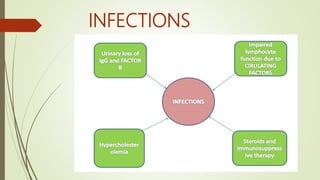
INFECTIONS
INFECTIONS….
Tuberculosis:
 Mantoux test is to be done before starting steroid therapy.
 Those with Mantoux positive but show no evidence of TB,
should receive INH prophylaxis (10 mg/kg/day) for 6 months.
 Those showing evidence of active tuberculosis should
receive standard anti-tubercular therapy.
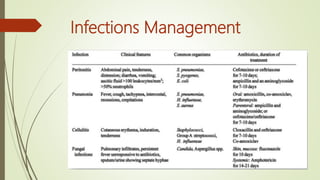
Infections Management
IMMUNISATION
 some vaccines like hepatitis B ,MMR, meningococcal vaccine can
precipitate a relapse.
 Live vaccines are administered once the child is off the
immunosuppressive medications for 4 weeks .
PNEMACOCCAL VACCINE
 <2 years : 2-4 doses of PCV
 Unimmunized 2-5 yrs. : one dose of PCV followed by PPV23
8weeks later
 > 5 years :one dose of PPV23
VARICELLA VACCINE
1– 12 years : one dose
13 years and older :2 doses separated by 4 weeks apart
Steroids during stress
 Supplementation of steroids during surgery ,
anesthesia and serious infections
• IV hydrocortisone 2-4mg/kg/day followed by oral
prednisolone 0.3-1 mg/kg/day during stress and
then tapered
Education of parent
 Parents should be provided information about the course,
complications & outcome of the disease.
 Urine examination with dipstick method at home. Daily during
relapse or during periods of infection. Once or twice a week
during remission.
 Maintain a dairy containing information about proteinuria,
medications & infections.
 Ensure that the child participates in all activities and sports
during periods of remission. No restrictions are imposed.
 As infections constitute significant proportion of morbidity,
need for appropriate immunization should be stressed.
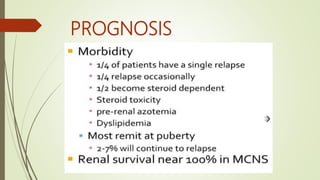
PROGNOSIS
CONGENITAL NEPHROTIC SYNDROME
 Presents in first 3 months of life
 Etiology: heterogenous Finnish form –NPHS1 mutation, AR
NPHS2,PLCE 1 mutation , intrauterine infections
 CLINICAL FEATURES: anasarca, hypoalbuminemia ,oliguria
 HISTOLOGY: microcystic dilatation of proximal tubules in NPHS1
 Antenatal SREENING: Elevated levels of AFP in maternal serum
and amniotic fluid.
 COMPLICATIONS: FTT, recurrent infections ,hypothyroidism and
progression to renal failure by 2-3 years
Treatment: supportive until weight (9Kg) suitable for renal
transplantation.
Nephrotic syndrome

Nephrotic syndrome

  • 1.
  • 2.
    DEFINATION  Nephrotic syndrome,is a manifestation of glomerular disease (due to various etiologies) characterized by Nephrotic range proteinuria • Early morning urine protein is 3+/4+ (on dipstick ) or • Spot protein/creatinine ratio >2 or • Urine albumin excretion >40 mg/m2 per hr (on a timed-sample) or • Urine protein excretion > 150 mg/kg/24 hr Hypoalbuminemia • Serum albumin < 2.5 g/dL Hyperlipidemia • Serum cholesterol >200 mg/dL Generalized Edema
  • 3.
    ETIOLOGY 90 % -primary glomerular abnormality (Idiopathic)  Rest – part of renal involvement in different diseases
  • 4.
    incidence  2 to7 cases per 100,000 children  Male-to-female ratio is reported to be 2:1 for children and 1:1 in adolescents and adults.  MCNS peaks between 2-5 years of age. 92% of these will experience remission of their disease when treated .  Adolescents are more likely to have a more aggressive cause of the nephrotic syndrome.
  • 5.
  • 6.
    GENETIC CAUSES • Finnishtype Congenital Nephrotic Syndrome  • Focal Segmental Glomerulosclerosis  • Diffuse Mesangial Sclerosis • Denys- Drash Syndrome • Nail – Patella Syndrome  • Alport Syndrome  • Charcot-Marie-tooth disease • Cockayne syndrome • Galloway-Mowat Syndrome
  • 7.
    Secondary causes  Infectious– Hepatitis (B,C) , HIV-1, Malaria, Syphilis, Toxoplasmosis ,CMV , filariasis  Inflammatory – Glomerulonephritis  Immunological – Castleman Disease, Kimura Disease, Bee sting, Food allergens , serum sickness.  Neoplastic – Lymphoma, Leukemia  Drug induced – Penicillamine, Gold, NSAIDS, Pamidronate, Mercury, Lithium , interferon,
  • 8.
    Idiopathic  Minimal Changedisease ( >75 % )  Focal segmental Glomerulosclerosis(10%) Mesangio proliferative (5%)  Membranoproliferative GN (5%) Membranous Nephropathy (<5%)
  • 9.
  • 10.
  • 13.
    Evaluation at onset Essentialinvestigations: Urinalysis: Proteinuria, red cells, casts; Spot urine protein creatinine ratio Blood levels of urea, creatinine, albumin, cholesterol Complete blood count , Tuberculin test  If required: C3 and ASO titer (gross or persistent microscopic hematuria) Chest X-ray (positive tuberculin test, history of TB contact) HIV, HBV, HCV serology in high risk groups ANA (if features of SLE are present) Urine culture (if clinical features of UTI are present) USG abdomen (to rule out anomalies in kidney)
  • 14.
    Indications for renalbiopsy  At Onset (If cause other than minimal change nephrotic syndrome is suspected)  Age of onset <1 year or >12 years .  Gross hematuria, persistent microscopic hematuria or low serum C3.  Sustained hypertension.  Renal failure not attributable to hypovolemia.  Suspected secondary causes of nephrotic syndrome. After Initial Treatment  Proteinuria persisting despite 4-weeks of daily corticosteroid therapy – steroid resistance.  Before treatment with Cyclosporine or Tacrolimus.
  • 15.
    Management of theinitial episode  Appropriate therapy at the first episode is an important determinant of the long term course of the disease. Prednisolone is the drug of choice.  It is given at a dose of 2 mg/kg per day (maximum 60 mg in single or divided doses) for 6 weeks, followed by 1.5 mg/kg (maximum 40 mg) as a single morning dose on alternate days for the next 6 weeks; therapy is then discontinued.
  • 16.
    Following initial treatmentwith steroids for 12 weeks, the disease may take any of the following course:  Remission ;Urine albumin nil or trace (or proteinuria <4 mg/m2/hr) for 3 consecutive early morning specimens.  Relapse ;Urine albumin 3+ or 4+ (or proteinuria >40 mg/m2/hr) for 3 consecutive early morning specimens, having been in remission previously.  Frequent relapses ;Two or more relapses in initial six months or more than three relapses in any twelve months.  Infrequent relapses ;Three or less relapses a year.  Steroid dependence; Two consecutive relapses when on alternate day steroids or within 14 days of its discontinuation.  Steroid resistance; Failure to achieve remission despite therapy with daily prednisolone at a dose of 2 mg/kg per day for 4 weeks.
  • 17.
    Treatment of relapse Relapse is defined as urine albumin 3+ or 4+ (or proteinuria >40 mg/m2/hr) for 3 consecutive early morning specimens, having been in remission previously.  An URTI or some other infection usually precipitates a relapse.  Appropriate therapy of an infection before starting therapy might result in spontaneous remission  Prednisolone is administered at a dose of 2 mg/kg/day (single or divided doses) until urine protein is trace or nil for three consecutive days.  Subsequently, Prednisolone is given in a single morning dose of 1.5 mg/kg on alternate days for 4 weeks, and then discontinued.
  • 18.
    Infrequent Relapses An infrequentrelapses is defined as initial responder with three or less relapses a year.  They are managed using standard prednisolone regimen for each relapse.  Such children are at a low risk for developing steroid toxicity.
  • 19.
    Management of FrequentRelapses and Steroid Dependence  Frequent relapse is defined as Two or more relapses in initial six months or more than three relapses in any twelve months.  Steroid dependence is defined as occurrence 2 consecutive relapses when on alternate day steroids or within 14 days of its discontinuation.  Following treatment of a relapse, prednisolone is gradually tapered to maintain the patient in remission on alternate day dose of 0.5-0.7 mg/kg.  A close monitoring of growth and blood pressure, and evaluation for features of steroid toxicity (cushingoid features – obesity, hirsutism, striae, hypertension, impaired glucose tolerance, posterior subcapsular opacities, emotional problems & growth retardation) is essential
  • 20.
    Continue……  If prednisolonethreshold to maintain remission less than 0.5-0.7mg/kg on alternate day and there is no steroid toxicity, it is continued for 9-18 months. And then breakthrough relapses are treated with standard therapy of relapse.  If prednisolone threshold to maintain remission greater than 0.5-0.7mg/kg on alternate day and there is steroid toxicity, addition of following immunomodulators is suggested. Levamisole Cyclophosphamide Calcineurin inhibitors: Cyclosporin (CsA), Tacrolimus Mycophenolate mofetil (MMF)
  • 21.
    Levamisole Dose & duration:2-2.5 mg/kg on alternate days for 12-24 months Concomitant steroid therapy: Prednisolone dose is gradually tapered to 0.25-0.5 mg/kg over a period of 8 months. Occasionally, it might be possible to discontinue Prednisolone.  Monitoring: The leukocyte count should be monitored every 3-4 months.
  • 22.
    Cyclophosphamide  Dose &duration: 2-2.5 mg/kg/day for 12 weeks. Should be started following remission of proteinuria.  Concomitant steroid therapy: Prednisolone dose is gradually tapered to 1 mg/kg over a period of 6 months and then stopped.  Monitoring: Total leukocyte counts are monitored every 2 weeks temporarily discontinued if the count falls below 4000/mm3 Mycophenolate mofetil (MMF)  Dose & duration: 800-1200 mg/m2/day for 12-24 months.  Concomitant steroid therapy: Prednisolone is gradually tapered over 12-24 months. Recent trials supported its use as a steroid sparing agent.  Monitoring: Leukocyte counts every 1-2 months; Withheld if count falls below 4000/mm3
  • 23.
    Calcineurin inhibitor :Cyclosporin (CsA)  Dose & duration: 4-5 mg/kg daily for 12-24 months. Tacrolimus  Dose & duration: 0.1-0.2 mg/kg daily for 12-24 months.  Concomitant steroid therapy: Prednisolone is gradually tapered to 0.25-0.5 mg/kg over 8 or more months. Occasionally it can be discontinued.  Monitoring: Plasma CsA levels should be kept between 80-120 ng/mL. Serum creatinine and glucose is monitored every 2-3 months.  Lipid profile is checked annually.  A repeat kidney biopsy, to examine for histological evidence of nephrotoxicity, should be done if duration of treatment is extended beyond 2 years.
  • 24.
    Choice of immunomodulator: First choice is Levamisole or Cyclophosphamide.  Cyclophosphamide is preferred in patients showing poor compliance or difficult follow up, where 12 weeks therapy is beneficial.  Relapses occurring during immunomodulator therapy must be treated with regular Prednisolone relapse regimen.  If there are two or more relapses over 6 months while on treatment with any of them, its replacement with an alternative medication should be considered.
  • 26.
    Steroid resistant nephroticsyndrome DEFINITION;  Absence of remission despite 4 weeks of daily prednisolone therapy at 2mg/kg/day TYPES: INITIAL NON RESPONDER(INR) A child who does not respond to initial 4 weeks of prednisolone therapy  SUBSEQUENT NON-RESPONDER(SNR) A child who was steroid responsive earlier fails to respond to subsequent 4 weeks course of prednisolone therapy
  • 27.
    SRNS - renalbiopsy rationale  All children with steroid resistant nephrotic syndrome should under go renal biopsy.  30-40% of SRNS patients show minimal change nephrotic syndrome,30-40% show FSGS.  20% patients with SRNS show membranoproliferative glomerulonephritis, membranous nephropathy, IgA nephropathy and amyloidosis. These conditions differ in their evaluation and treatment.  The response to therapy is determined by renal histology; patients with minimal change nephrotic syndrome show satisfactory response to therapy, while presence of FSGS or chronic tubulointerstitial changes is associated with unsatisfactory outcomes.
  • 28.
    Treatment regimens forSRNS  There is lack of consensus regarding the most appropriate regimen, the choice of initial treatment depends on the preference of the physician. Duration of therapy is for 2-3 years.
  • 29.
    NEWER THERAPIES SAQUINAVIR Rituximab :A chimeric anti-CD20 antibody that results in depletion of B Cells  Plasmapheresis – esp with FSGS patients who have received kidney transplants Galactose : high affinity for circulating permeability factor (FSGS) after kidney transplant  ORAL ZINC SUPPLEMENTATION IN SSNS
  • 30.
    SRNS - Management All patients with SRNS should receive treatment with angiotensin converting enzyme inhibitors (e.g., Enalapril, Ramipril).  These agents should be avoided if the estimated GFR is <30 ml/minute/1.73 m2.  Angiotensin receptor blockers (e.g., Losartan, Valsartan) may be used in patients intolerant to ACE inhibitors, or as add-on therapy to achieve better antihypertensive and antiproteinuric effect.  Dyslipidemia should be managed by HMG CoA reductase inhibitors (e.g. Atrovastatin (10-20 mg daily).  Target LDL level should be <130 mg/dL.
  • 31.
    Dietary management  Abalanced diet, adequate in protein (1.5-2 g/kg) and calories is recommended. Patients with persistent proteinuria should receive 2-2.5 g/kg of protein daily.  Not more than 30% calories should be derived from fat.  Treatment with corticosteroids stimulates appetite, so adequate physical activity is to be ensured to prevent excessive weight gain.  Patients on prolonged (>3 months) treatment with steroids should receive daily supplements of oral calcium (250-500 mg/day) and vitamin D (125-250 IU/day).  Reduction of salt intake (1-2 g per day) is advised for those with persistent edema.  Fluid restriction is needed in addition to Sodium restriction in children with persistent edema.
  • 32.
    COMPLICATIONS  PEM dueto protein loss  Infections: – S. pneumonia , H. influenza – VPDs  Thrombotic complications  Iron, copper, zinc, and vitamin D deficiencies  Hypovolemia and Acute renal Failure  Edema  Loss of various binding proteins, (Thyroxine and vit D)  Hyperlipidemia.  Steroid Toxicity
  • 33.
  • 34.
  • 35.
  • 36.
    INFECTIONS…. Tuberculosis:  Mantoux testis to be done before starting steroid therapy.  Those with Mantoux positive but show no evidence of TB, should receive INH prophylaxis (10 mg/kg/day) for 6 months.  Those showing evidence of active tuberculosis should receive standard anti-tubercular therapy.
  • 37.
  • 38.
    IMMUNISATION  some vaccineslike hepatitis B ,MMR, meningococcal vaccine can precipitate a relapse.  Live vaccines are administered once the child is off the immunosuppressive medications for 4 weeks . PNEMACOCCAL VACCINE  <2 years : 2-4 doses of PCV  Unimmunized 2-5 yrs. : one dose of PCV followed by PPV23 8weeks later  > 5 years :one dose of PPV23 VARICELLA VACCINE 1– 12 years : one dose 13 years and older :2 doses separated by 4 weeks apart
  • 39.
    Steroids during stress Supplementation of steroids during surgery , anesthesia and serious infections • IV hydrocortisone 2-4mg/kg/day followed by oral prednisolone 0.3-1 mg/kg/day during stress and then tapered
  • 40.
    Education of parent Parents should be provided information about the course, complications & outcome of the disease.  Urine examination with dipstick method at home. Daily during relapse or during periods of infection. Once or twice a week during remission.  Maintain a dairy containing information about proteinuria, medications & infections.  Ensure that the child participates in all activities and sports during periods of remission. No restrictions are imposed.  As infections constitute significant proportion of morbidity, need for appropriate immunization should be stressed.
  • 41.
  • 45.
    CONGENITAL NEPHROTIC SYNDROME Presents in first 3 months of life  Etiology: heterogenous Finnish form –NPHS1 mutation, AR NPHS2,PLCE 1 mutation , intrauterine infections  CLINICAL FEATURES: anasarca, hypoalbuminemia ,oliguria  HISTOLOGY: microcystic dilatation of proximal tubules in NPHS1  Antenatal SREENING: Elevated levels of AFP in maternal serum and amniotic fluid.  COMPLICATIONS: FTT, recurrent infections ,hypothyroidism and progression to renal failure by 2-3 years Treatment: supportive until weight (9Kg) suitable for renal transplantation.