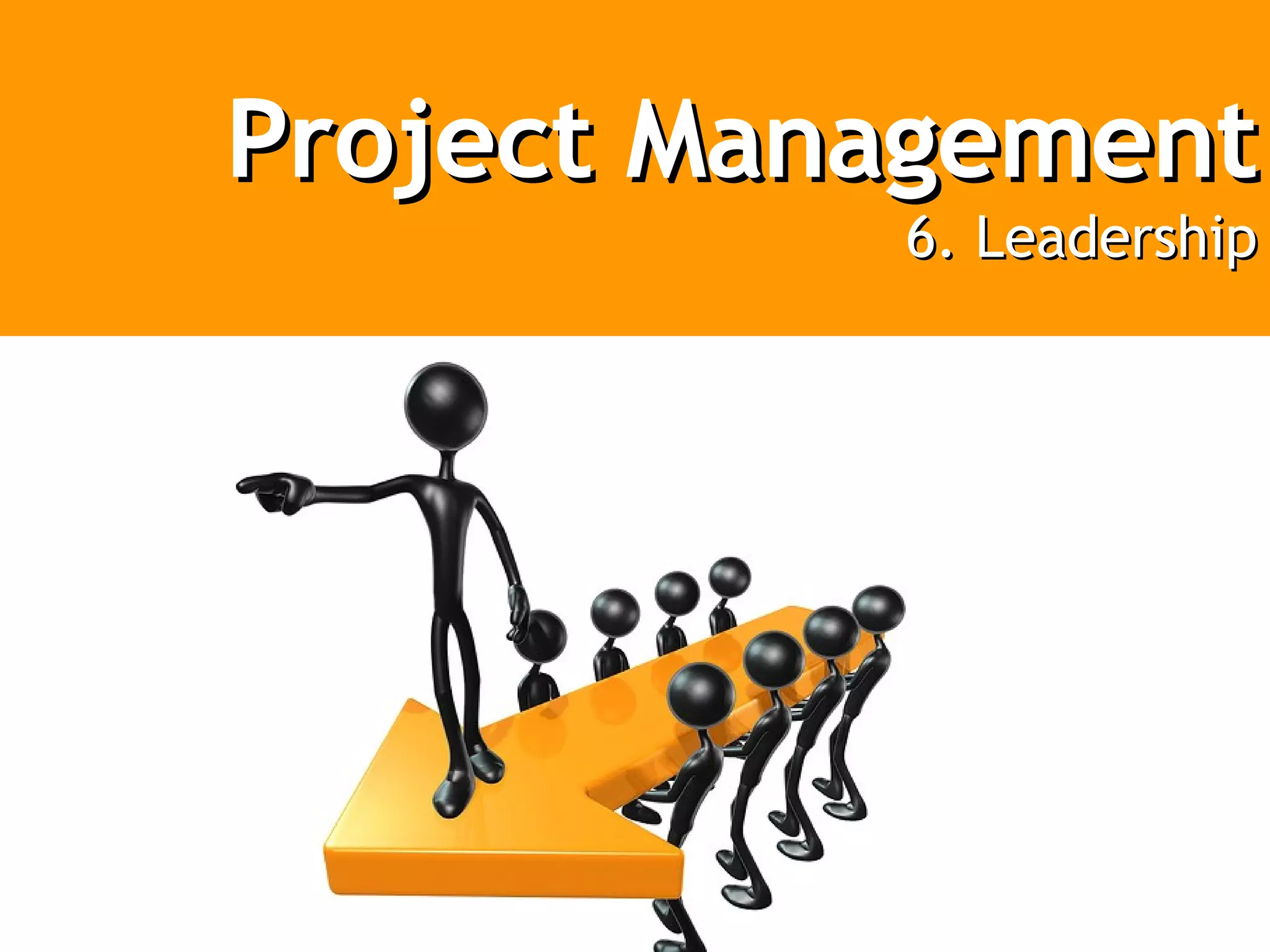
Project Management 6. Leadership
week 6
Develop and facilitate leadership,  team building,  performance management,  conflict management skills  in an IT environment.
Gray & Larson, 2006, Ch 10.
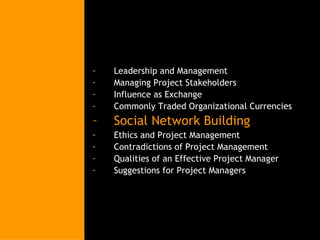
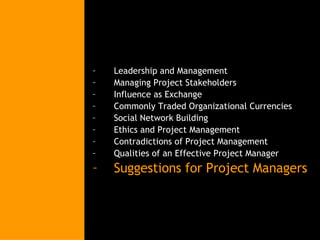
Leadership and Management Managing Project Stakeholders Influence as Exchange Commonly Traded Organizational Currencies Social Network Building Ethics and Project Management Contradictions of Project Management Qualities of an Effective Project Manager Suggestions for Project Managers
management
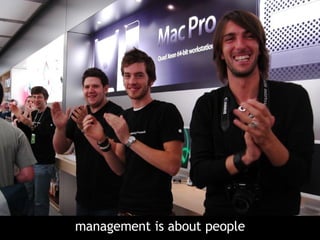
management is about people
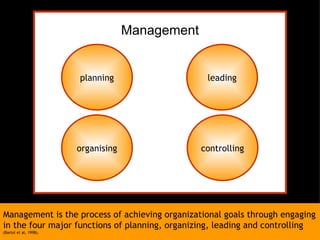
Management is the process of achieving organizational goals through engaging in the four major functions of planning, organizing, leading and controlling  (Bartol et al, 1998). What is Management?
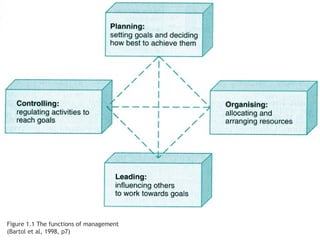
planning is the process of setting goals and deciding best way to achieve them planning
organizing is the process of allocating and arranging human and other resources organising
leading is the process of influencing others leading
What is controlling about? controlling
Management is the process of achieving organizational goals through engaging in the four major functions of planning, organizing, leading and controlling  (Bartol et al, 1998). Management planning organising leading controlling
Figure 1.1 The functions of management ( Bartol et al, 1998 , p7)
Management is the process of achieving organizational goals through engaging in the four major functions of planning, organizing, leading and controlling  (Bartol et al, 1998). What is Leadership?
The process of influencing others to achieve organizational goals  (Bartol et al, 1998).
People accept a leader’s influence because leaders have power
Where does power come from?
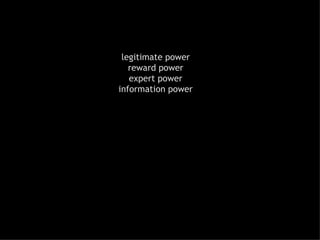
legitimate power reward power expert power information power
legitimate power reward power expert power information power An example
legitimate power reward power expert power information power An example I am your manager
legitimate power reward power expert power information power An example I have the authority to give you a performance bonus
legitimate power reward power expert power information power Another example
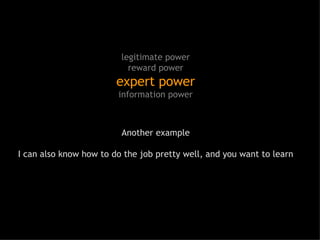
legitimate power reward power expert power information power Another example I can also know how to do the job pretty well, and you want to learn
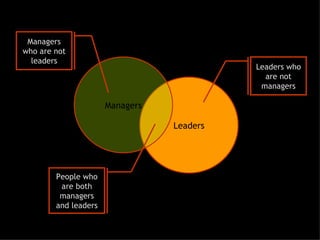
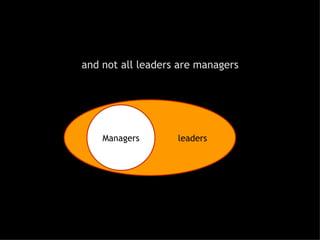
Leaders Managers Managers who are not leaders Leaders who are not managers People who are both managers and leaders
leader and manager are often used interchangeably Leaders Managers
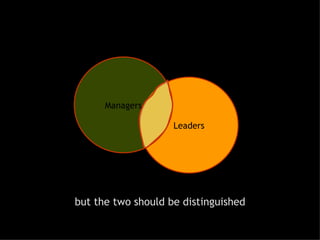
but the two should be distinguished Leaders Managers
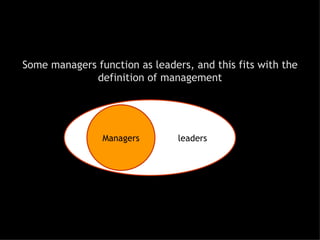
Some managers function as leaders, and this fits with the definition of management leaders Managers
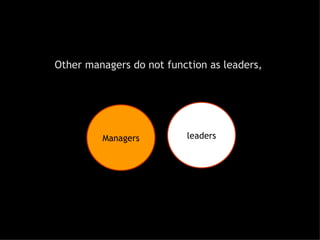
Other managers do not function as leaders,  leaders Managers
and not all leaders are managers leaders Managers
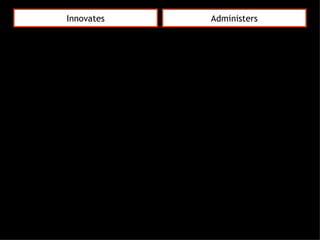
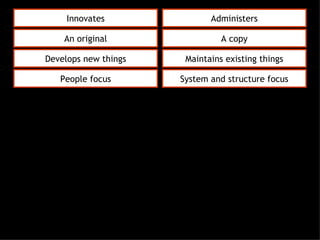
Innovates Administers
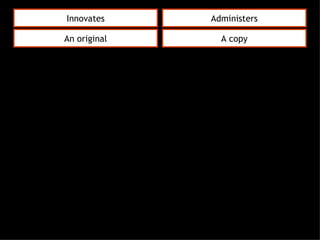
Innovates Administers An original A copy
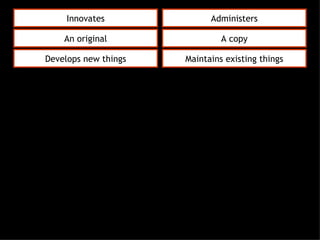
Innovates Administers An original A copy Develops new things Maintains existing things
Innovates Administers An original A copy Develops new things Maintains existing things People focus System and structure focus
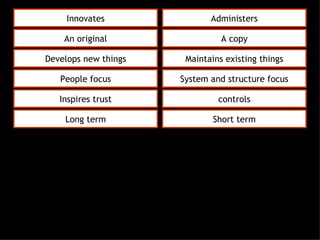
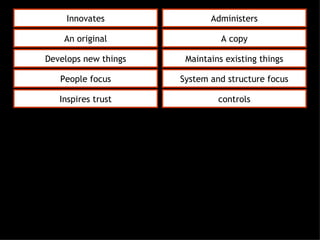
Innovates Administers An original A copy Develops new things Maintains existing things People focus System and structure focus Inspires trust controls
Innovates Administers An original A copy Develops new things Maintains existing things People focus System and structure focus Inspires trust controls Long term Short term
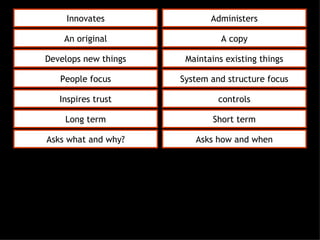
Innovates Administers An original A copy Develops new things Maintains existing things People focus System and structure focus Inspires trust controls Long term Short term Asks what and why? Asks how and when
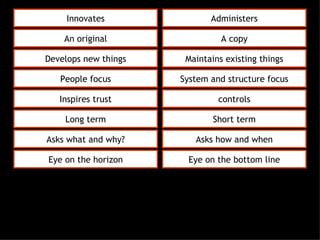
Innovates Administers An original A copy Develops new things Maintains existing things People focus System and structure focus Inspires trust controls Long term Short term Asks what and why? Asks how and when Eye on the horizon Eye on the bottom line
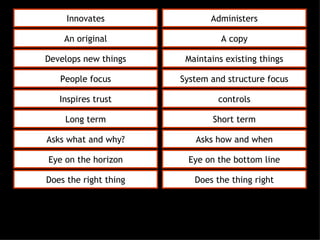
Innovates Administers An original A copy Develops new things Maintains existing things People focus System and structure focus Inspires trust controls Long term Short term Asks what and why? Asks how and when Eye on the horizon Eye on the bottom line Does the right thing Does the thing right
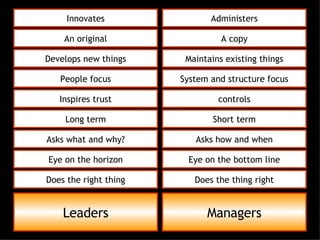
Leaders Managers Innovates Administers An original A copy Develops new things Maintains existing things People focus System and structure focus Inspires trust controls Long term Short term Asks what and why? Asks how and when Eye on the horizon Eye on the bottom line Does the right thing Does the thing right
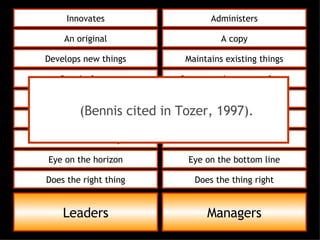
Leaders Managers Innovates Administers An original A copy Develops new things Maintains existing things People focus System and structure focus Inspires trust controls Long term Short term Asks what and why? Asks how and when Eye on the horizon Eye on the bottom line Does the right thing Does the thing right (Bennis cited in Tozer, 1997).
http://www.slideshare.net/tommyland/management-vs-leadership-on-linkedin Leadership and Managers are not the same thing
Do projects need leaders or managers?
A project manager has many roles and responsibilities
Managing projects is managing complexity
Formulate plans and objectives
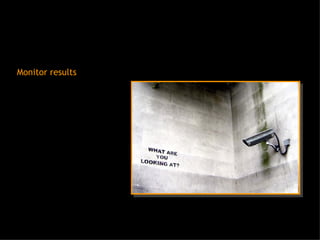
Monitor results
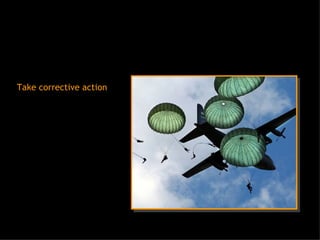
Take corrective action
Expedite activities
Solve technical problems
Serve as peacemaker
Make tradeoffs among time, costs, and project scope
Recognize the need to change to keep the project on track
Initiate change
Provide direction and motivation
Innovate and adapt as necessary
Integrate assigned resources
Formulate plans and objectives Monitor results Take corrective action Expedite activities Solve technical problems Serve as peacemaker Make tradeoffs among time, costs, and project scope Recognize the need to change to keep the project on track Initiate change Provide direction and motivation Innovate and adapt as necessary Integrate assigned resources
Leadership and Management Managing Project Stakeholders Influence as Exchange Commonly Traded Organizational Currencies Social Network Building Ethics and Project Management Contradictions of Project Management Qualities of an Effective Project Manager Suggestions for Project Managers
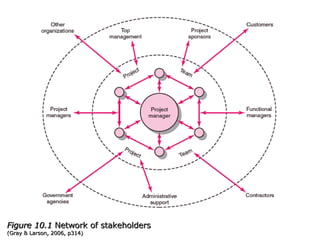
What are stakeholders?
You can’t do it all and get it all done
Projects usually involve a vast web of relationships
Hands-on work is not the same as leading
More pressure and more involvement
More pressure and more involvement  will  reduce your effectiveness  as a leader
What’s important to you
What’s important to you  likely
What’s important to you  likely  isn’t as important to someone else
Different groups have different stakes
Different groups have different stakes  (responsibilities, agendas, and priorities)  in the outcome of a project.
Remember
Remember Project management is tough, exciting, and rewarding .
Remember Project management is tough, exciting, and rewarding . so persevere
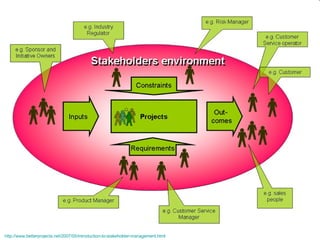
http://www.betterprojects.net/2007/05/introduction-to-stakeholder-management.html
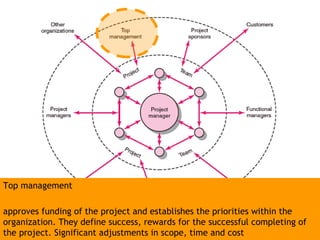
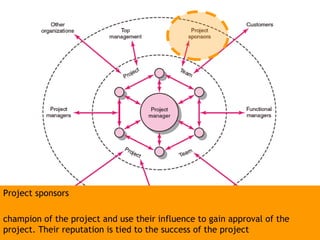
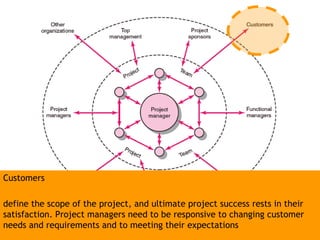
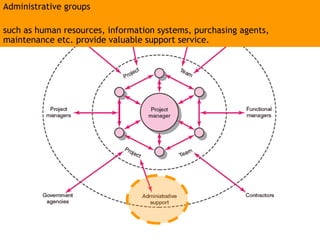
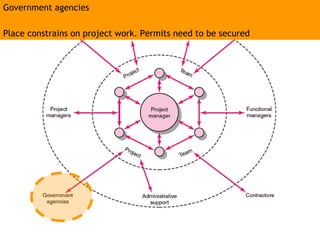
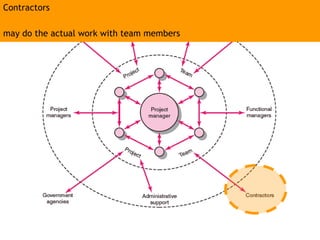
Figure 10.1  Network of stakeholders ( Gray & Larson, 2006 , p314)
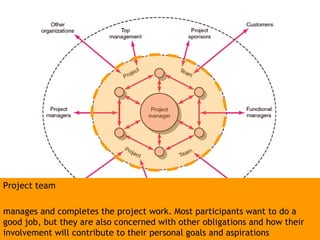
Project team manages and completes the project work. Most participants want to do a good job, but they are also concerned with other obligations and how their involvement will contribute to their personal goals and aspirations
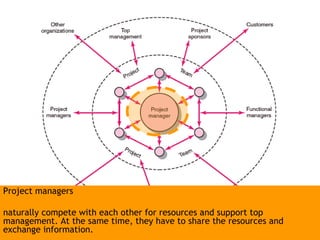
Project managers naturally compete with each other for resources and support top management. At the same time, they have to share the resources and exchange information.
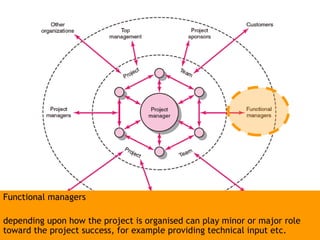
Functional managers depending upon how the project is organised can play minor or major role toward the project success, for example providing technical input etc.
Top management approves funding of the project and establishes the priorities within the organization. They define success, rewards for the successful completing of the project. Significant adjustments in scope, time and cost
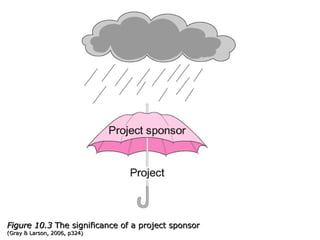
Project sponsors champion of the project and use their influence to gain approval of the project. Their reputation is tied to the success of the project
Customers define the scope of the project, and ultimate project success rests in their satisfaction. Project managers need to be responsive to changing customer needs and requirements and to meeting their expectations
Administrative groups  such as human resources, information systems, purchasing agents, maintenance etc. provide valuable support service.
Government agencies Place constrains on project work. Permits need to be secured
Contractors may do the actual work with team members
Leadership and Management Managing Project Stakeholders Influence as Exchange Commonly Traded Organizational Currencies Social Network Building Ethics and Project Management Contradictions of Project Management Qualities of an Effective Project Manager Suggestions for Project Managers
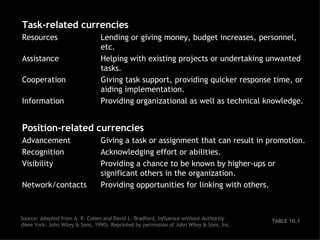
TABLE 10.1 Task-related currencies  Resources  Lending or giving money, budget increases, personnel, etc. Assistance  Helping with existing projects or undertaking unwanted tasks. Cooperation  Giving task support, providing quicker response time, or aiding implementation.  Information  Providing organizational as well as technical knowledge. Position-related currencies   Advancement  Giving a task or assignment that can result in promotion. Recognition  Acknowledging effort or abilities. Visibility  Providing a chance to be known by higher-ups or significant others in the organization. Network/contacts  Providing opportunities for linking with others. Source: Adapted from A. R. Cohen and David L. Bradford,  Influence without Authority  (New York: John Wiley & Sons, 1990). Reprinted by permission of John Wiley & Sons, Inc.
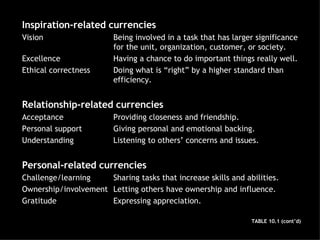
TABLE 10.1 (cont’d) Inspiration-related currencies Vision  Being involved in a task that has larger significance for the unit, organization, customer, or society. Excellence  Having a chance to do important things really well. Ethical correctness  Doing what is “right” by a higher standard than efficiency. Relationship-related currencies Acceptance  Providing closeness and friendship. Personal support  Giving personal and emotional backing. Understanding  Listening to others’ concerns and issues. Personal-related currencies Challenge/learning  Sharing tasks that increase skills and abilities. Ownership/involvement  Letting others have ownership and influence. Gratitude  Expressing appreciation.
Leadership and Management Managing Project Stakeholders Influence as Exchange Commonly Traded Organizational Currencies Social Network Building Ethics and Project Management Contradictions of Project Management Qualities of an Effective Project Manager Suggestions for Project Managers
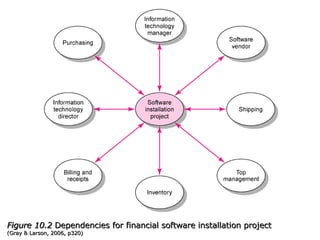
Mapping Dependencies for social networks
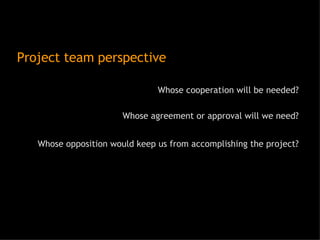
Project team perspective Whose cooperation will be needed? Whose agreement or approval will we need? Whose opposition would keep us from accomplishing the project?
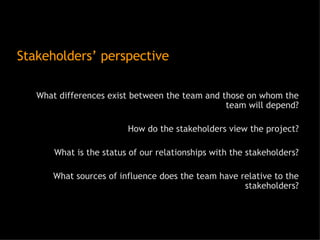
Stakeholders’ perspective What differences exist between the team and those on whom the team will depend? How do the stakeholders view the project? What is the status of our relationships with the stakeholders? What sources of influence does the team have relative to the stakeholders?
Figure 10.2  Dependencies for financial software installation project ( Gray & Larson, 2006 , p320)
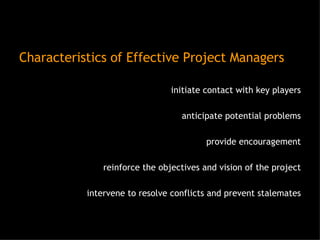
Characteristics of Effective Project Managers initiate contact with key players anticipate potential problems provide encouragement reinforce the objectives and vision of the project intervene to resolve conflicts and prevent stalemates
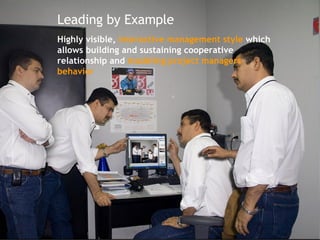
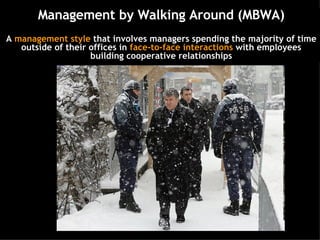
Management by Walking Around (MBWA) A  management style  that involves managers spending the majority of time outside of their offices in  face-to-face interactions  with employees building cooperative relationships
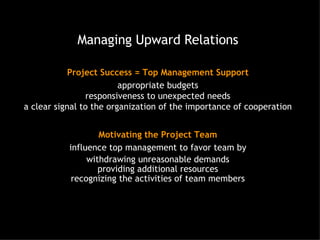
Managing Upward Relations Project Success = Top Management Support appropriate budgets responsiveness to unexpected needs a clear signal to the organization of the importance of cooperation Motivating the Project Team influence top management to favor team by withdrawing unreasonable demands providing additional resources recognizing the activities of team members
Figure 10.3  The significance of a project sponsor ( Gray & Larson, 2006 , p324)
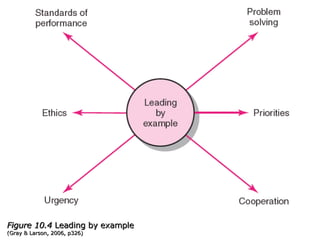
Leading by Example Highly visible,  interactive management style  which allows building and sustaining cooperative relationship and  modeling project managers behavior
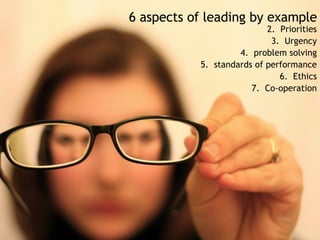
6 aspects of leading by example Priorities Urgency problem solving standards of performance Ethics Co-operation
Figure 10.4  Leading by example ( Gray & Larson, 2006 , p326)
Leadership and Management Managing Project Stakeholders Influence as Exchange Commonly Traded Organizational Currencies Social Network Building Ethics and Project Management Contradictions of Project Management Qualities of an Effective Project Manager Suggestions for Project Managers
Industry ethical guidelines www.pmi.org
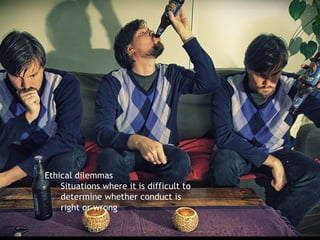
Ethical dilemmas Situations where it is difficult to determine whether conduct is right or wrong
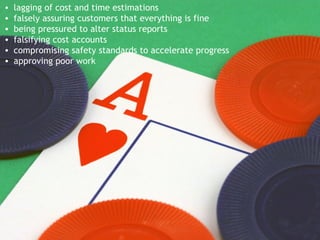
lagging of cost and time estimations falsely assuring customers that everything is fine being pressured to alter status reports falsifying cost accounts compromising safety standards to accelerate progress approving poor work
Leadership and Management Managing Project Stakeholders Influence as Exchange Commonly Traded Organizational Currencies Social Network Building Ethics and Project Management Contradictions of Project Management Qualities of an Effective Project Manager Suggestions for Project Managers
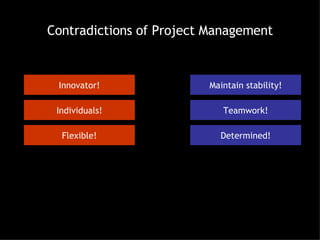
Contradictions of Project Management
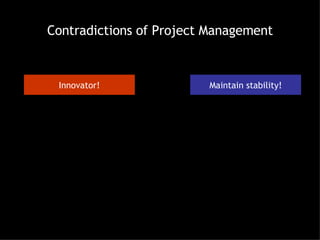
Contradictions of Project Management Innovator! Maintain stability!
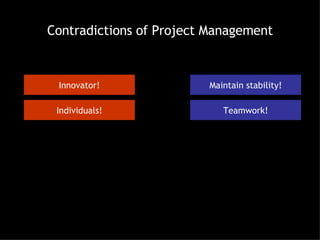
Contradictions of Project Management Innovator! Maintain stability! Individuals! Teamwork!
Contradictions of Project Management Innovator! Maintain stability! Individuals! Teamwork! Flexible! Determined!
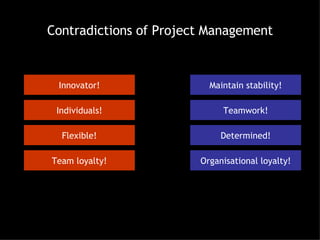
Contradictions of Project Management Innovator! Maintain stability! Individuals! Teamwork! Flexible! Determined! Team loyalty! Organisational loyalty!
Leadership and Management Managing Project Stakeholders Influence as Exchange Commonly Traded Organizational Currencies Social Network Building Ethics and Project Management Contradictions of Project Management Qualities of an Effective Project Manager Suggestions for Project Managers
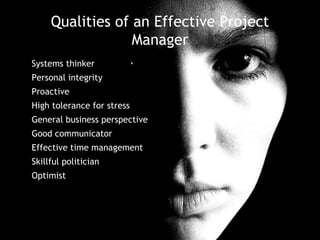
Qualities of an Effective Project Manager Systems thinker Personal integrity Proactive High tolerance for stress General business perspective Good communicator Effective time management Skillful politician Optimist
Leadership and Management Managing Project Stakeholders Influence as Exchange Commonly Traded Organizational Currencies Social Network Building Ethics and Project Management Contradictions of Project Management Qualities of an Effective Project Manager Suggestions for Project Managers
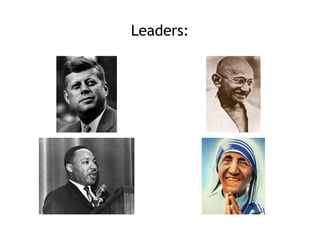
Leaders:
References Bartol, K. et al. (1998). Management – A pacific rim focus (2 nd  ed.). Roseville, NSW: McGraw-Hill. Greenberg, J. & Baron, R. (1993). Behavior in organizations (4 th  ed.). Syd., NSW: Allyn and Bacon. Tozer, J. (1997). Leading initiative – Leadership, teamwork and the bottom line. Port Melb., Vic: Butterworth-Heinemann.
Next Week Gray & Larson, 2006, Ch. 11 . Reading: Managing Project Teams Topic:
http://flickr.com/photos/lumaxart/2137729430/ http://flickr.com/photos/lukemontague/257339079/ http://flickr.com/photos/dunechaser/2019456693/ http://flickr.com/photos/shadows_and_light/2072085898/sizes/sq/ http://flickr.com/photos/mjthomas43/289435126/sizes/sq/ http://flickr.com/photos/trvr3307/127632207/sizes/sq/ http://flickr.com/photos/imranchaudhry/2208102635/sizes/sq/ http://flickr.com/photos/soldiersmediacenter/397708723/sizes/sq/ http://flickr.com/photos/beija-flor/52292046/sizes/sq/ http://flickr.com/photos/maniya/2731402919/sizes/sq/ http://flickr.com/photos/skistz/398429879/sizes/sq/ http://flickr.com/photos/jeffbelmonte/8228640/sizes/sq/ http://flickr.com/photos/craigwbrown/118034346/sizes/sq/ http://flickr.com/photos/cindy47452/2479210076/sizes/sq/ http://flickr.com/photos/gadl/366202554/sizes/sq/ http://flickr.com/photos/cmbellman/2775956184/sizes/sq/in/photostream/
http://flickr.com/photos/cmbellman/2772343336/sizes/sq/ http://flickr.com/photos/ppdigital/2327873620/sizes/sq/in/set-72157603263059146/ http://flickr.com/photos/jenicra84/2174260506/sizes/sq/ http://flickr.com/photos/eticas/2282480520/sizes/sq/ http://flickr.com/photos/worldeconomicforum/374706891/sizes/sq/ http://flickr.com/photos/meredithfarmer/315541970/sizes/sq/
BetterProjects.net Title page pic care of lumaxart & CC @ Flickr http://flickr.com/photos/lumaxart/2137729430/

The Project Management Process - Week 6 Leadership

  • 1.
  • 2.
  • 3.
    Develop and facilitateleadership, team building, performance management, conflict management skills in an IT environment.
  • 4.
    Gray & Larson,2006, Ch 10.
  • 5.
    Leadership and ManagementManaging Project Stakeholders Influence as Exchange Commonly Traded Organizational Currencies Social Network Building Ethics and Project Management Contradictions of Project Management Qualities of an Effective Project Manager Suggestions for Project Managers
  • 6.
    Leadership and ManagementManaging Project Stakeholders Influence as Exchange Commonly Traded Organizational Currencies Social Network Building Ethics and Project Management Contradictions of Project Management Qualities of an Effective Project Manager Suggestions for Project Managers
  • 7.
  • 8.
  • 9.
    Management is theprocess of achieving organizational goals through engaging in the four major functions of planning, organizing, leading and controlling (Bartol et al, 1998). What is Management?
  • 10.
    planning is theprocess of setting goals and deciding best way to achieve them planning
  • 11.
    organizing is theprocess of allocating and arranging human and other resources organising
  • 12.
    leading is theprocess of influencing others leading
  • 13.
    What is controllingabout? controlling
  • 14.
    Management is theprocess of achieving organizational goals through engaging in the four major functions of planning, organizing, leading and controlling (Bartol et al, 1998). Management planning organising leading controlling
  • 15.
    Figure 1.1 Thefunctions of management ( Bartol et al, 1998 , p7)
  • 16.
    Management is theprocess of achieving organizational goals through engaging in the four major functions of planning, organizing, leading and controlling (Bartol et al, 1998). What is Leadership?
  • 17.
    The process ofinfluencing others to achieve organizational goals (Bartol et al, 1998).
  • 18.
    People accept aleader’s influence because leaders have power
  • 19.
    Where does powercome from?
  • 20.
    legitimate power rewardpower expert power information power
  • 21.
    legitimate power rewardpower expert power information power An example
  • 22.
    legitimate power rewardpower expert power information power An example I am your manager
  • 23.
    legitimate power rewardpower expert power information power An example I have the authority to give you a performance bonus
  • 24.
    legitimate power rewardpower expert power information power An example I have the authority to give you a performance bonus
  • 25.
    legitimate power rewardpower expert power information power Another example
  • 26.
    legitimate power rewardpower expert power information power Another example I can also know how to do the job pretty well, and you want to learn
  • 27.
    legitimate power rewardpower expert power information power Another example I can also know how to do the job pretty well, and you want to learn
  • 28.
    Leaders Managers Managerswho are not leaders Leaders who are not managers People who are both managers and leaders
  • 29.
    leader and managerare often used interchangeably Leaders Managers
  • 30.
    but the twoshould be distinguished Leaders Managers
  • 31.
    Some managers functionas leaders, and this fits with the definition of management leaders Managers
  • 32.
    Other managers donot function as leaders, leaders Managers
  • 33.
    and not allleaders are managers leaders Managers
  • 34.
  • 35.
    Innovates Administers Anoriginal A copy
  • 36.
    Innovates Administers Anoriginal A copy Develops new things Maintains existing things
  • 37.
    Innovates Administers Anoriginal A copy Develops new things Maintains existing things People focus System and structure focus
  • 38.
    Innovates Administers Anoriginal A copy Develops new things Maintains existing things People focus System and structure focus Inspires trust controls
  • 39.
    Innovates Administers Anoriginal A copy Develops new things Maintains existing things People focus System and structure focus Inspires trust controls Long term Short term
  • 40.
    Innovates Administers Anoriginal A copy Develops new things Maintains existing things People focus System and structure focus Inspires trust controls Long term Short term Asks what and why? Asks how and when
  • 41.
    Innovates Administers Anoriginal A copy Develops new things Maintains existing things People focus System and structure focus Inspires trust controls Long term Short term Asks what and why? Asks how and when Eye on the horizon Eye on the bottom line
  • 42.
    Innovates Administers Anoriginal A copy Develops new things Maintains existing things People focus System and structure focus Inspires trust controls Long term Short term Asks what and why? Asks how and when Eye on the horizon Eye on the bottom line Does the right thing Does the thing right
  • 43.
    Leaders Managers InnovatesAdministers An original A copy Develops new things Maintains existing things People focus System and structure focus Inspires trust controls Long term Short term Asks what and why? Asks how and when Eye on the horizon Eye on the bottom line Does the right thing Does the thing right
  • 44.
    Leaders Managers InnovatesAdministers An original A copy Develops new things Maintains existing things People focus System and structure focus Inspires trust controls Long term Short term Asks what and why? Asks how and when Eye on the horizon Eye on the bottom line Does the right thing Does the thing right (Bennis cited in Tozer, 1997).
  • 45.
  • 46.
    Do projects needleaders or managers?
  • 47.
    A project managerhas many roles and responsibilities
  • 48.
    Managing projects ismanaging complexity
  • 49.
  • 50.
  • 51.
  • 52.
  • 53.
  • 54.
  • 55.
    Make tradeoffs amongtime, costs, and project scope
  • 56.
    Recognize the needto change to keep the project on track
  • 57.
  • 58.
  • 59.
    Innovate and adaptas necessary
  • 60.
  • 61.
    Formulate plans andobjectives Monitor results Take corrective action Expedite activities Solve technical problems Serve as peacemaker Make tradeoffs among time, costs, and project scope Recognize the need to change to keep the project on track Initiate change Provide direction and motivation Innovate and adapt as necessary Integrate assigned resources
  • 62.
    Leadership and ManagementManaging Project Stakeholders Influence as Exchange Commonly Traded Organizational Currencies Social Network Building Ethics and Project Management Contradictions of Project Management Qualities of an Effective Project Manager Suggestions for Project Managers
  • 63.
  • 64.
    You can’t doit all and get it all done
  • 65.
    Projects usually involvea vast web of relationships
  • 66.
    Hands-on work isnot the same as leading
  • 67.
    More pressure andmore involvement
  • 68.
    More pressure andmore involvement will reduce your effectiveness as a leader
  • 69.
  • 70.
  • 71.
    What’s important toyou likely isn’t as important to someone else
  • 72.
    Different groups havedifferent stakes
  • 73.
    Different groups havedifferent stakes (responsibilities, agendas, and priorities) in the outcome of a project.
  • 74.
  • 75.
    Remember Project managementis tough, exciting, and rewarding .
  • 76.
    Remember Project managementis tough, exciting, and rewarding . so persevere
  • 77.
  • 78.
    Figure 10.1 Network of stakeholders ( Gray & Larson, 2006 , p314)
  • 79.
    Project team managesand completes the project work. Most participants want to do a good job, but they are also concerned with other obligations and how their involvement will contribute to their personal goals and aspirations
  • 80.
    Project managers naturallycompete with each other for resources and support top management. At the same time, they have to share the resources and exchange information.
  • 81.
    Functional managers dependingupon how the project is organised can play minor or major role toward the project success, for example providing technical input etc.
  • 82.
    Top management approvesfunding of the project and establishes the priorities within the organization. They define success, rewards for the successful completing of the project. Significant adjustments in scope, time and cost
  • 83.
    Project sponsors championof the project and use their influence to gain approval of the project. Their reputation is tied to the success of the project
  • 84.
    Customers define thescope of the project, and ultimate project success rests in their satisfaction. Project managers need to be responsive to changing customer needs and requirements and to meeting their expectations
  • 85.
    Administrative groups such as human resources, information systems, purchasing agents, maintenance etc. provide valuable support service.
  • 86.
    Government agencies Placeconstrains on project work. Permits need to be secured
  • 87.
    Contractors may dothe actual work with team members
  • 88.
    Leadership and ManagementManaging Project Stakeholders Influence as Exchange Commonly Traded Organizational Currencies Social Network Building Ethics and Project Management Contradictions of Project Management Qualities of an Effective Project Manager Suggestions for Project Managers
  • 89.
    Leadership and ManagementManaging Project Stakeholders Influence as Exchange Commonly Traded Organizational Currencies Social Network Building Ethics and Project Management Contradictions of Project Management Qualities of an Effective Project Manager Suggestions for Project Managers
  • 90.
    TABLE 10.1 Task-relatedcurrencies Resources Lending or giving money, budget increases, personnel, etc. Assistance Helping with existing projects or undertaking unwanted tasks. Cooperation Giving task support, providing quicker response time, or aiding implementation. Information Providing organizational as well as technical knowledge. Position-related currencies Advancement Giving a task or assignment that can result in promotion. Recognition Acknowledging effort or abilities. Visibility Providing a chance to be known by higher-ups or significant others in the organization. Network/contacts Providing opportunities for linking with others. Source: Adapted from A. R. Cohen and David L. Bradford, Influence without Authority (New York: John Wiley & Sons, 1990). Reprinted by permission of John Wiley & Sons, Inc.
  • 91.
    TABLE 10.1 (cont’d)Inspiration-related currencies Vision Being involved in a task that has larger significance for the unit, organization, customer, or society. Excellence Having a chance to do important things really well. Ethical correctness Doing what is “right” by a higher standard than efficiency. Relationship-related currencies Acceptance Providing closeness and friendship. Personal support Giving personal and emotional backing. Understanding Listening to others’ concerns and issues. Personal-related currencies Challenge/learning Sharing tasks that increase skills and abilities. Ownership/involvement Letting others have ownership and influence. Gratitude Expressing appreciation.
  • 92.
    Leadership and ManagementManaging Project Stakeholders Influence as Exchange Commonly Traded Organizational Currencies Social Network Building Ethics and Project Management Contradictions of Project Management Qualities of an Effective Project Manager Suggestions for Project Managers
  • 93.
    Mapping Dependencies forsocial networks
  • 94.
    Project team perspectiveWhose cooperation will be needed? Whose agreement or approval will we need? Whose opposition would keep us from accomplishing the project?
  • 95.
    Stakeholders’ perspective Whatdifferences exist between the team and those on whom the team will depend? How do the stakeholders view the project? What is the status of our relationships with the stakeholders? What sources of influence does the team have relative to the stakeholders?
  • 96.
    Figure 10.2 Dependencies for financial software installation project ( Gray & Larson, 2006 , p320)
  • 97.
    Characteristics of EffectiveProject Managers initiate contact with key players anticipate potential problems provide encouragement reinforce the objectives and vision of the project intervene to resolve conflicts and prevent stalemates
  • 98.
    Management by WalkingAround (MBWA) A management style that involves managers spending the majority of time outside of their offices in face-to-face interactions with employees building cooperative relationships
  • 99.
    Managing Upward RelationsProject Success = Top Management Support appropriate budgets responsiveness to unexpected needs a clear signal to the organization of the importance of cooperation Motivating the Project Team influence top management to favor team by withdrawing unreasonable demands providing additional resources recognizing the activities of team members
  • 100.
    Figure 10.3 The significance of a project sponsor ( Gray & Larson, 2006 , p324)
  • 101.
    Leading by ExampleHighly visible, interactive management style which allows building and sustaining cooperative relationship and modeling project managers behavior
  • 102.
    6 aspects ofleading by example Priorities Urgency problem solving standards of performance Ethics Co-operation
  • 103.
    Figure 10.4 Leading by example ( Gray & Larson, 2006 , p326)
  • 104.
    Leadership and ManagementManaging Project Stakeholders Influence as Exchange Commonly Traded Organizational Currencies Social Network Building Ethics and Project Management Contradictions of Project Management Qualities of an Effective Project Manager Suggestions for Project Managers
  • 105.
  • 106.
    Ethical dilemmas Situationswhere it is difficult to determine whether conduct is right or wrong
  • 107.
    lagging of costand time estimations falsely assuring customers that everything is fine being pressured to alter status reports falsifying cost accounts compromising safety standards to accelerate progress approving poor work
  • 108.
    Leadership and ManagementManaging Project Stakeholders Influence as Exchange Commonly Traded Organizational Currencies Social Network Building Ethics and Project Management Contradictions of Project Management Qualities of an Effective Project Manager Suggestions for Project Managers
  • 109.
  • 110.
    Contradictions of ProjectManagement Innovator! Maintain stability!
  • 111.
    Contradictions of ProjectManagement Innovator! Maintain stability! Individuals! Teamwork!
  • 112.
    Contradictions of ProjectManagement Innovator! Maintain stability! Individuals! Teamwork! Flexible! Determined!
  • 113.
    Contradictions of ProjectManagement Innovator! Maintain stability! Individuals! Teamwork! Flexible! Determined! Team loyalty! Organisational loyalty!
  • 114.
    Leadership and ManagementManaging Project Stakeholders Influence as Exchange Commonly Traded Organizational Currencies Social Network Building Ethics and Project Management Contradictions of Project Management Qualities of an Effective Project Manager Suggestions for Project Managers
  • 115.
    Qualities of anEffective Project Manager Systems thinker Personal integrity Proactive High tolerance for stress General business perspective Good communicator Effective time management Skillful politician Optimist
  • 116.
    Leadership and ManagementManaging Project Stakeholders Influence as Exchange Commonly Traded Organizational Currencies Social Network Building Ethics and Project Management Contradictions of Project Management Qualities of an Effective Project Manager Suggestions for Project Managers
  • 117.
  • 118.
    References Bartol, K.et al. (1998). Management – A pacific rim focus (2 nd ed.). Roseville, NSW: McGraw-Hill. Greenberg, J. & Baron, R. (1993). Behavior in organizations (4 th ed.). Syd., NSW: Allyn and Bacon. Tozer, J. (1997). Leading initiative – Leadership, teamwork and the bottom line. Port Melb., Vic: Butterworth-Heinemann.
  • 119.
    Next Week Gray& Larson, 2006, Ch. 11 . Reading: Managing Project Teams Topic:
  • 120.
    http://flickr.com/photos/lumaxart/2137729430/ http://flickr.com/photos/lukemontague/257339079/ http://flickr.com/photos/dunechaser/2019456693/http://flickr.com/photos/shadows_and_light/2072085898/sizes/sq/ http://flickr.com/photos/mjthomas43/289435126/sizes/sq/ http://flickr.com/photos/trvr3307/127632207/sizes/sq/ http://flickr.com/photos/imranchaudhry/2208102635/sizes/sq/ http://flickr.com/photos/soldiersmediacenter/397708723/sizes/sq/ http://flickr.com/photos/beija-flor/52292046/sizes/sq/ http://flickr.com/photos/maniya/2731402919/sizes/sq/ http://flickr.com/photos/skistz/398429879/sizes/sq/ http://flickr.com/photos/jeffbelmonte/8228640/sizes/sq/ http://flickr.com/photos/craigwbrown/118034346/sizes/sq/ http://flickr.com/photos/cindy47452/2479210076/sizes/sq/ http://flickr.com/photos/gadl/366202554/sizes/sq/ http://flickr.com/photos/cmbellman/2775956184/sizes/sq/in/photostream/
  • 121.
    http://flickr.com/photos/cmbellman/2772343336/sizes/sq/ http://flickr.com/photos/ppdigital/2327873620/sizes/sq/in/set-72157603263059146/ http://flickr.com/photos/jenicra84/2174260506/sizes/sq/http://flickr.com/photos/eticas/2282480520/sizes/sq/ http://flickr.com/photos/worldeconomicforum/374706891/sizes/sq/ http://flickr.com/photos/meredithfarmer/315541970/sizes/sq/
  • 122.
    BetterProjects.net Title pagepic care of lumaxart & CC @ Flickr http://flickr.com/photos/lumaxart/2137729430/