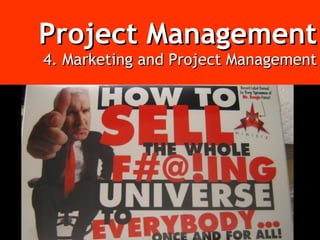
Project Management 4. Marketing and Project Management
week 5
Anthony F. Tardugno; Thomas R. DiPasquale; Robert E. Matthews  (2000)  IT Services: Costs, Metrics, Benchmarking, and Marketingby  Prentice Hall, ISBN-10: 0-13-019195-7Print ISBN-13: 978-0-13-019195-3, Chapter 5 James Cadle and Donald Yeates (2004)  Project Management for Information Systems ,  Pearson Education, ISBN 0 273 68580 5, Chapter 17
Why is marketing important?
What is Marketing? Evolution of Marketing Implementing Marketing Market Classification Developing Marketing Strategies Marketing Research   Selling the Project
What is Marketing?
What is Marketing? Marketing is a process of planning and executing the conception, pricing, promotion, and distribution of ideas, goods and services to create exchanges that satisfy individual and organizational objectives
What is Marketing? Plan & Execute Exchange Satisfaction Conception Pricing Promotion Distribution People & Organisations Goods and Services
8
Selling Buying Exchange
Distribution Transport Storage Selling Buying
Selling Buying Transport Storage Facilitating functions Finance Risk Taking Standardize Gather Market Info
Selling Buying Transport Storage Finance Gather Market Info 8 Standardize Risk Taking
 
The marketing mix Price Promotion Product Place
The marketing mix Price Promotion Product Place People Process Physicals
The marketing mix Price Promotion Product Place People Process Physicals Personalization Peer to Peer Participation Predictive models
2. Evolution of Marketing
19C WW1 20’s 30’s WW2 50’s 60’s 70’s 80’s 90’s Now Advertising industry develops Customer orientation What Next? Industrial Revolution Demand outpaced supply Production exceeds supply Marketing Mix (4 Ps)
Figure 11.2 Evolution of the customer orientation  (Pride, Hughes & Kapoor, 1998, p321) 20’s 30’s 50’s 60’s 19C Now
Permission marketing Now
The Marketing Concept is a business philosophy that involves the  entire organization   in the  process of satisfying  customers needs   while achieving organizational goals
The American Marketing Association (AMA) states,  "Marketing is an organizational function and a set of processes for creating, communicating and delivering value to customers and for managing customer relationships in ways that benefit the organization and its stakeholders.” www.marketingpower.com
3. Implementing Marketing
http://www.altadvertising.com/pdf%20files/salesvmarketing.pdf   Is Your Business "Sales" or "Marketing" Driven? By Les Altenberg
 
Understand potential and existing customers Identify their wants and needs Look at the market – are their needs being met? Can you deliver the goods? Can you do it well, fast or cheap? How do customers feel about your brand image? Look at specific customer stories Mobilize your resources Build and sell your product
 
Organizations need to reflect on implementation of marketing concept Ask questions: Can the product be improved? Is it being promoted properly? Is it being distributed efficiently? Is the price too high? Make modifications on basis of this feedback
4. Market Classification
A group of individuals, organizations, or both that have needs for products in a given category and the ability, willingness, and authority to purchase such products What is a Market?
There are different types of markets Consumer Reseller Industrial Producer  Government Institutional
Consumer Purchasers and/or household members who intent to consume or benefit from the purchased products and who do not buy products in order to make a profit Consumer Reseller Industrial Producer  Government Institutional
Industrial Purchases products for use in day-to-day operations or in making other products for profit. Producers  consist of individuals and business organizations that intend to make a profit by buying certain products to use in the manufacture of other products Governments  at all levels, purchase goods and services to maintain operations and to provide citizens with products such as roads, education, water, defense And  institutional  organizations include churches, civic clubs, charitable groups. Not driven by profit, ROI  Consumer Reseller Industrial Producer  Government Institutional
Resellers consist of intermediaries such as wholesalers, and retailers who buy finished products and sell them for profit. Consumer Reseller Industrial Producer  Government Institutional
For the IT organization marketing entails knowing primary internal markets
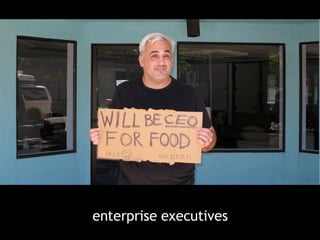
enterprise executives
operation and line managers
work-area managers
Production/end users
You need to predict their requirements, develop feedback mechanisms for performance, and services relevant to the group
For example
Marketing to enterprise executives should focus on governance issues  (e.g., decision making, funding, metrics, and architecture)
Marketing to managers should focus on the changes and possibilities caused by IT's impact on business and the business's impact on IT
5. Developing Marketing Strategies
A Marketing Strategy is  a plan that will enable an organization to make the best use of its resources
Marketing Strategies consist of  selection and analysis of target market  &  creation and maintenance of an appropriate marketing mix.
A target market is a group of persons for whom a firm develops and maintains a marketing mix suitable for their specific needs and preferences
How to select a Target Market
Examine potential markets for effects on sales, costs and profits
Determine if you have sufficient resources to produce marketing mix
Ensure fit with the organization’s overall objectives
Analyze strength and number of competitor already selling
Take either total market approach or market segmentation approach
Figure 11.3  General approaches for selecting target markets  (Pride, Hughes & Kapoor, 1998, p324)
Creating a Marketing Mix Common to use a wide variety of segmentation bases  (see Table 11.2) Organizations control important elements of marketing which must combine in a way to reach the target market (marketing mix) Organizations can vary elements of the marketing mix product; design, brand name, packaging … price; base price, discounts distribution; storage, transportation promotion; information
(Pride, Hughes & Kapoor, 1998, p325)
Figure 11.4  The marketing mix and the marketing environment  (Pride, Hughes & Kapoor, 1998, p327)
6. Marketing Research
Marketing Research is  the process of systematically gathering, recording and analyzing data concerning a particular marketing problem
Conducting marketing research: define the problem make a preliminary investigation plan the research gather factual information interpret the information reach a conclusion
Figure 11.5  Marketing information system  (Pride, Hughes & Kapoor, 1998, p331)
Marketing Trends – Effect on IT Industry? Growth in prime spending group Decline in teenage population Increase in the number of senior citizens Better educated population, with greater purchasing power Greater number of women working Shorter workweek; more leisure time
7. Selling the Project
Buying and Buyers Research shows buyers go through identified stages when they buy
Figure 17.1  The buying cycle  (Cadle & Yates, 2005, p280)
Systems development projects have buying committees and don’t often follow the stages
Committee buying influences: economic decision maker; authority to spend technical experts; evaluate merit of solution end-users; indirect effect on purchase, concerned about affect on them champion or coach; assist in preparing solution
Selling is an asking process
People who are most successful in selling systems development project or consultancy assignments  ask lots of questions
Example: customer’s situation customer’s problems implications of problems payoff or benefit from meeting the needs
Prepare proposal for a potential buyer.   When assessing proposals you should include: terms of reference technical details of the solution outlines advantages aimed at all readers/buyers clear diagrams cross-references and navigational aids summarized statement of costs executive summary
Who is the Target Market?


Review Marketing approaches  have developed from a product-orientation to a customer-orientation – IT industry slow to catch on . Markets are groups  that have needs for products and can be classified as; consumer, industrial, and reseller. Marketing strategy  is a plan to make the best use of resources, and consists of the target market, and marketing mix. Marketing research   can provide valuable information such as; education, retirement age, birth rates etc… to project managers. Buyers progress   through stages when they buy, these include; need, options, concerns, implementation and change. Large IT projects have buying committees. Selling is a process   of asking, and includes creation of proposal for buyer includes; terms, details, advantages, diagrams etc…
Next Week References  Pride, W., Hughes, R. & Kapoor, J.  Business  (2nd ed.). Boston, MA.: Houghton Mifflin. Gray & Larson, 2006, Ch 10. Reading: Project Leadership. Topic:
http://flickr.com/photos/spine/272900992/ http://wendy.kinesisinc.com/ http://flickr.com/photos/7-how-7/95677126/ http://flickr.com/photos/missrogue/115899126/in/photostream/ http://flickr.com/photos/liveu4/134980839/ http://flickr.com/photos/liveu4/133041494/in/photostream/ http://flickr.com/photos/roadsidepictures/225771856/ http://flickr.com/photos/furnari/126438084/ http://flickr.com/photos/untitlism/2609684221/ http://flickr.com/photos/jek-a-go-go/1235462170/ http://flickr.com/photos/26158685@N04/2767676288/ http://flickr.com/photos/edyson/516871444/ http://flickr.com/photos/dunechaser/160405659/ http://flickr.com/photos/peterkaminski/860512054/ http://flickr.com/photos/mateus27_24-25/2224073271/ http://flickr.com/photos/storeyland/343438012/ http://flickr.com/photos/mattandbecky/28052539/ http://flickr.com/photos/calavera/65098350/
BetterProjects.net Title page pic care of rick & CC @ Flickr http://flickr.com/photos/spine/272900992/

The Project Management Process - Week 5

  • 1.
    Project Management 4.Marketing and Project Management
  • 2.
  • 3.
    Anthony F. Tardugno;Thomas R. DiPasquale; Robert E. Matthews (2000) IT Services: Costs, Metrics, Benchmarking, and Marketingby Prentice Hall, ISBN-10: 0-13-019195-7Print ISBN-13: 978-0-13-019195-3, Chapter 5 James Cadle and Donald Yeates (2004) Project Management for Information Systems , Pearson Education, ISBN 0 273 68580 5, Chapter 17
  • 4.
    Why is marketingimportant?
  • 5.
    What is Marketing?Evolution of Marketing Implementing Marketing Market Classification Developing Marketing Strategies Marketing Research Selling the Project
  • 6.
  • 7.
    What is Marketing?Marketing is a process of planning and executing the conception, pricing, promotion, and distribution of ideas, goods and services to create exchanges that satisfy individual and organizational objectives
  • 8.
    What is Marketing?Plan & Execute Exchange Satisfaction Conception Pricing Promotion Distribution People & Organisations Goods and Services
  • 9.
  • 10.
  • 11.
  • 12.
    Selling Buying TransportStorage Facilitating functions Finance Risk Taking Standardize Gather Market Info
  • 13.
    Selling Buying TransportStorage Finance Gather Market Info 8 Standardize Risk Taking
  • 14.
  • 15.
    The marketing mixPrice Promotion Product Place
  • 16.
    The marketing mixPrice Promotion Product Place People Process Physicals
  • 17.
    The marketing mixPrice Promotion Product Place People Process Physicals Personalization Peer to Peer Participation Predictive models
  • 18.
    2. Evolution ofMarketing
  • 19.
    19C WW1 20’s30’s WW2 50’s 60’s 70’s 80’s 90’s Now Advertising industry develops Customer orientation What Next? Industrial Revolution Demand outpaced supply Production exceeds supply Marketing Mix (4 Ps)
  • 20.
    Figure 11.2 Evolutionof the customer orientation (Pride, Hughes & Kapoor, 1998, p321) 20’s 30’s 50’s 60’s 19C Now
  • 21.
  • 22.
    The Marketing Conceptis a business philosophy that involves the entire organization in the process of satisfying customers needs while achieving organizational goals
  • 23.
    The American MarketingAssociation (AMA) states, "Marketing is an organizational function and a set of processes for creating, communicating and delivering value to customers and for managing customer relationships in ways that benefit the organization and its stakeholders.” www.marketingpower.com
  • 24.
  • 25.
    http://www.altadvertising.com/pdf%20files/salesvmarketing.pdf Is Your Business "Sales" or "Marketing" Driven? By Les Altenberg
  • 26.
  • 27.
    Understand potential andexisting customers Identify their wants and needs Look at the market – are their needs being met? Can you deliver the goods? Can you do it well, fast or cheap? How do customers feel about your brand image? Look at specific customer stories Mobilize your resources Build and sell your product
  • 28.
  • 29.
    Organizations need toreflect on implementation of marketing concept Ask questions: Can the product be improved? Is it being promoted properly? Is it being distributed efficiently? Is the price too high? Make modifications on basis of this feedback
  • 30.
  • 31.
    A group ofindividuals, organizations, or both that have needs for products in a given category and the ability, willingness, and authority to purchase such products What is a Market?
  • 32.
    There are differenttypes of markets Consumer Reseller Industrial Producer Government Institutional
  • 33.
    Consumer Purchasers and/orhousehold members who intent to consume or benefit from the purchased products and who do not buy products in order to make a profit Consumer Reseller Industrial Producer Government Institutional
  • 34.
    Industrial Purchases productsfor use in day-to-day operations or in making other products for profit. Producers consist of individuals and business organizations that intend to make a profit by buying certain products to use in the manufacture of other products Governments at all levels, purchase goods and services to maintain operations and to provide citizens with products such as roads, education, water, defense And institutional organizations include churches, civic clubs, charitable groups. Not driven by profit, ROI Consumer Reseller Industrial Producer Government Institutional
  • 35.
    Resellers consist ofintermediaries such as wholesalers, and retailers who buy finished products and sell them for profit. Consumer Reseller Industrial Producer Government Institutional
  • 36.
    For the ITorganization marketing entails knowing primary internal markets
  • 37.
  • 38.
  • 39.
  • 40.
  • 41.
    You need topredict their requirements, develop feedback mechanisms for performance, and services relevant to the group
  • 42.
  • 43.
    Marketing to enterpriseexecutives should focus on governance issues (e.g., decision making, funding, metrics, and architecture)
  • 44.
    Marketing to managersshould focus on the changes and possibilities caused by IT's impact on business and the business's impact on IT
  • 45.
  • 46.
    A Marketing Strategyis a plan that will enable an organization to make the best use of its resources
  • 47.
    Marketing Strategies consistof selection and analysis of target market & creation and maintenance of an appropriate marketing mix.
  • 48.
    A target marketis a group of persons for whom a firm develops and maintains a marketing mix suitable for their specific needs and preferences
  • 49.
    How to selecta Target Market
  • 50.
    Examine potential marketsfor effects on sales, costs and profits
  • 51.
    Determine if youhave sufficient resources to produce marketing mix
  • 52.
    Ensure fit withthe organization’s overall objectives
  • 53.
    Analyze strength andnumber of competitor already selling
  • 54.
    Take either totalmarket approach or market segmentation approach
  • 55.
    Figure 11.3 General approaches for selecting target markets (Pride, Hughes & Kapoor, 1998, p324)
  • 56.
    Creating a MarketingMix Common to use a wide variety of segmentation bases (see Table 11.2) Organizations control important elements of marketing which must combine in a way to reach the target market (marketing mix) Organizations can vary elements of the marketing mix product; design, brand name, packaging … price; base price, discounts distribution; storage, transportation promotion; information
  • 57.
    (Pride, Hughes &Kapoor, 1998, p325)
  • 58.
    Figure 11.4 The marketing mix and the marketing environment (Pride, Hughes & Kapoor, 1998, p327)
  • 59.
  • 60.
    Marketing Research is the process of systematically gathering, recording and analyzing data concerning a particular marketing problem
  • 61.
    Conducting marketing research:define the problem make a preliminary investigation plan the research gather factual information interpret the information reach a conclusion
  • 62.
    Figure 11.5 Marketing information system (Pride, Hughes & Kapoor, 1998, p331)
  • 63.
    Marketing Trends –Effect on IT Industry? Growth in prime spending group Decline in teenage population Increase in the number of senior citizens Better educated population, with greater purchasing power Greater number of women working Shorter workweek; more leisure time
  • 64.
  • 65.
    Buying and BuyersResearch shows buyers go through identified stages when they buy
  • 66.
    Figure 17.1 The buying cycle (Cadle & Yates, 2005, p280)
  • 67.
    Systems development projectshave buying committees and don’t often follow the stages
  • 68.
    Committee buying influences:economic decision maker; authority to spend technical experts; evaluate merit of solution end-users; indirect effect on purchase, concerned about affect on them champion or coach; assist in preparing solution
  • 69.
    Selling is anasking process
  • 70.
    People who aremost successful in selling systems development project or consultancy assignments ask lots of questions
  • 71.
    Example: customer’s situationcustomer’s problems implications of problems payoff or benefit from meeting the needs
  • 72.
    Prepare proposal fora potential buyer. When assessing proposals you should include: terms of reference technical details of the solution outlines advantages aimed at all readers/buyers clear diagrams cross-references and navigational aids summarized statement of costs executive summary
  • 73.
    Who is theTarget Market?
  • 74.
  • 75.
  • 76.
  • 77.
  • 78.
    Review Marketing approaches have developed from a product-orientation to a customer-orientation – IT industry slow to catch on . Markets are groups that have needs for products and can be classified as; consumer, industrial, and reseller. Marketing strategy is a plan to make the best use of resources, and consists of the target market, and marketing mix. Marketing research can provide valuable information such as; education, retirement age, birth rates etc… to project managers. Buyers progress through stages when they buy, these include; need, options, concerns, implementation and change. Large IT projects have buying committees. Selling is a process of asking, and includes creation of proposal for buyer includes; terms, details, advantages, diagrams etc…
  • 79.
    Next Week References Pride, W., Hughes, R. & Kapoor, J. Business (2nd ed.). Boston, MA.: Houghton Mifflin. Gray & Larson, 2006, Ch 10. Reading: Project Leadership. Topic:
  • 80.
    http://flickr.com/photos/spine/272900992/ http://wendy.kinesisinc.com/ http://flickr.com/photos/7-how-7/95677126/http://flickr.com/photos/missrogue/115899126/in/photostream/ http://flickr.com/photos/liveu4/134980839/ http://flickr.com/photos/liveu4/133041494/in/photostream/ http://flickr.com/photos/roadsidepictures/225771856/ http://flickr.com/photos/furnari/126438084/ http://flickr.com/photos/untitlism/2609684221/ http://flickr.com/photos/jek-a-go-go/1235462170/ http://flickr.com/photos/26158685@N04/2767676288/ http://flickr.com/photos/edyson/516871444/ http://flickr.com/photos/dunechaser/160405659/ http://flickr.com/photos/peterkaminski/860512054/ http://flickr.com/photos/mateus27_24-25/2224073271/ http://flickr.com/photos/storeyland/343438012/ http://flickr.com/photos/mattandbecky/28052539/ http://flickr.com/photos/calavera/65098350/
  • 81.
    BetterProjects.net Title pagepic care of rick & CC @ Flickr http://flickr.com/photos/spine/272900992/