Strategic
Management
& MSME
By- Sachin Mohanty (19MBA004)
Ravenshaw University
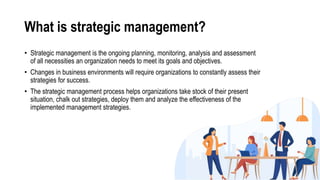
What is strategic management?
• Strategic management is the ongoing planning, monitoring, analysis and assessment
of all necessities an organization needs to meet its goals and objectives.
• Changes in business environments will require organizations to constantly assess their
strategies for success.
• The strategic management process helps organizations take stock of their present
situation, chalk out strategies, deploy them and analyze the effectiveness of the
implemented management strategies.
Why strategic management?
• Strategic management is generally thought to have financial and nonfinancial benefits.
• A strategic management process helps an organization and its leadership to think about and plan
for its future existence, fulfilling a chief responsibility of a board of directors.
• Strategic management sets a direction for the organization and its employees.
• Unlike once-and-done strategic plans, effective strategic management continuously plans,
monitors and tests an organization's activities, resulting in greater operational efficiency, market
share and profitability.
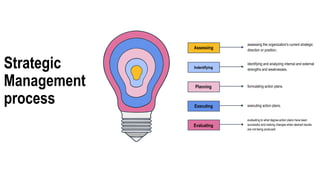
assessing the organization's current strategic
direction or position.
identifying and analyzing internal and external
strengths and weaknesses.
formulating action plans.
executing action plans.
evaluating to what degree action plans have been
successful and making changes when desired results
are not being produced
Assessing
Indentifying
Planning
Executing
Evaluating
Strategic
Management
process
Strategic Management process (Cont.)
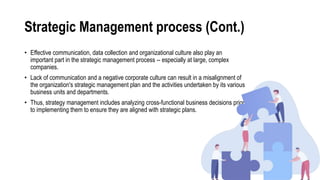
• Effective communication, data collection and organizational culture also play an
important part in the strategic management process -- especially at large, complex
companies.
• Lack of communication and a negative corporate culture can result in a misalignment of
the organization's strategic management plan and the activities undertaken by its various
business units and departments.
• Thus, strategy management includes analyzing cross-functional business decisions prior
to implementing them to ensure they are aligned with strategic plans.
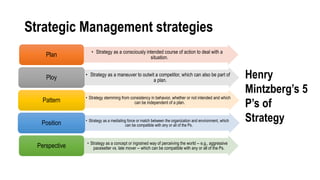
Strategic Management strategies
• Strategy as a consciously intended course of action to deal with a
situation.
Plan
• Strategy as a maneuver to outwit a competitor, which can also be part of
a plan.
Ploy
• Strategy stemming from consistency in behavior, whether or not intended and which
can be independent of a plan.
Pattern
• Strategy as a mediating force or match between the organization and environment, which
can be compatible with any or all of the Ps.
Position
• Strategy as a concept or ingrained way of perceiving the world -- e.g., aggressive
pacesetter vs. late mover -- which can be compatible with any or all of the Ps.
Perspective
Henry
Mintzberg’s 5
P’s of
Strategy
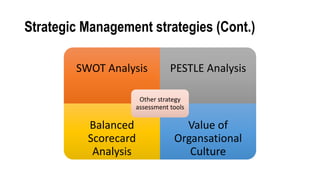
Strategic Management strategies (Cont.)
SWOT Analysis PESTLE Analysis
Balanced
Scorecard
Analysis
Value of
Organsational
Culture
Other strategy
assessment tools
Strategic management in MSME
Assessment
• Taking a week or two to scrutinize your industry, competition and the general state of business
in the local economy.
• Thinking about how trends have changed over the last couple of years, and where they might
be headed, as you go through your daily tasks. Take notes as ideas arise.
• After that, taking time to consider your target customer, what she values, and how you can
meet her needs.
• Last, spending time looking at each sector of your enterprise: how it operates, whether it is
efficient, and how it fulfills the needs of your customers.
Strategic management in MSME (Cont.)
Positioning
• Positioning is just another way of asking yourself what you want to accomplish in your
business. The most important aspect of positioning is that it sets a specific direction for
your business.
• If you know the direction you want your company to take, align the various elements of
your enterprise with that directional goal.
• This avoids wasting time and effort on activities that don't add to your bottom line.
• With alignment of your total enterprise in mind, delay making any changes until you have
positioned your company and set a direction.
Strategic management in MSME (Cont.)
Write it Down
• It is important to write down your plan, even if it's no more than a few pages based on the
notes you made.
• Start with your positioning statement, detailing your directional goal.
• Then list benchmarks toward that goal, such as leasing the space next door, hiring
additional staff and buying new equipment. Include estimates of the cost.
• The rest of your strategic plan is an action plan for your operations, inventory, marketing
and customer service, designed to meet those benchmarks. The value of a written
strategic plan is that it serves as a touchstone.
Strategic management in MSME (Cont.)
Implementation
• Ensure the success of your strategic plan by taking steps to properly implement it.
• Hold brainstorming sessions with your key employees. Including suppliers and
customers in your sessions may also be beneficial.
• Keep your plan on target by holding regular meetings with managers and employees to
discuss how business is progressing and how to deal with problems.
• Communication with your employees is the best way to ensure the successful
implementation and execution of your strategic plan.
• If during implementation you see a better way, change the plan accordingly.
Strategic
Management
in
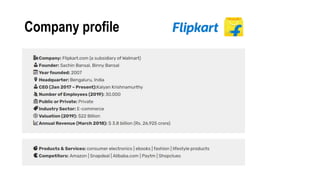
Company profile
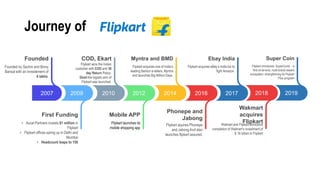
Journey of
2007
Founded by Sachin and Binny
Bansal with an investement of
4 lakhs.
Founded
2010
Flipkart wins the Indian
customer with COD and 30
day Return Policy.
Ekart the logistic arm of
Flipkart was launched.
COD, Ekart
2014
Flipkart acquires one of India’s
leading fashion e-tailers, Myntra
and launches Big Million Days.
Myntra and BMD
2009
• Accel Partners invests $1 million in
Flipkart
• Flipkart offices spring up in Delhi and
Mumbai
• Headcount leaps to 150
First Funding
2012
Flipkart launches its
mobile shopping app
Mobile APP
2016
Flipkart aquires Phonepe
and Jabong And also
launches flipkart assured.
Phonepe and
Jabong
2017
Flipkart acquires eBay’s India biz to
fight Amazon.
Ebay India
2018
Walmart and Flipkart announce
completion of Walmart’s investment of
$ 16 billion in Flipkart
Wakmart
acquires
Flipkart
2019
Flipkart introduces ‘SuperCoins’ - a
first-of-its-kind, multi-brand reward
ecosystem, strengthening its Flipkart
Plus program
Super Coin
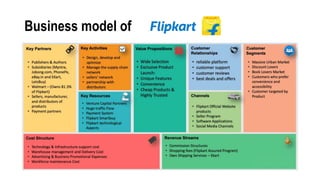
Business model of
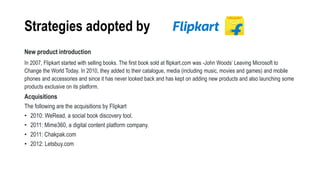
Strategies adopted by
New product introduction
In 2007, Flipkart started with selling books. The first book sold at flipkart.com was -John Woods’ Leaving Microsoft to
Change the World Today. In 2010, they added to their catalogue, media (including music, movies and games) and mobile
phones and accessories and since it has never looked back and has kept on adding new products and also launching some
products exclusive on its platform.
Acquisitions
The following are the acquisitions by Flipkart
• 2010: WeRead, a social book discovery tool.
• 2011: Mime360, a digital content platform company.
• 2011: Chakpak.com
• 2012: Letsbuy.com
Strategies adopted by
Acclaims and accomplishments
• Flipkart broke even in March 2010 and claims to have had at least 100% growth every quarter since its founding. As of
today, Flipkart employs over 30000 people.
• Flipkart is the third largest online shopping store after E-Bay and Amazon.
• From a start-up with an investment of just four lakhs rupees, Flipkart has grown into a $3.8 billion-revenue online retail
giant in 13 years.
• Flipkart.com, the country’s first billion-dollar-valued Internet Company, is surely in a state of perpetual excitement.
• Flipkart has become a large-scale e-commerce in India. And the key to the company’s success lies in its payment-on-
delivery model, which helped overcome the average Indian consumer’s misgivings and built trust.
• In the 2019 Flipkart’s Big Billion Days campaign- it got more than 70 billion views in 6days, more than 50% shoppers
came in from Tier-2 cities and beyond.
(Cont.)
Strategies adopted by
Product Strategy
• Flipkart is set out to create something for the Indian market – a service that was specifically built keeping the Indian
consumer in mind.
• As far as entrepreneurship is concerned, Flipkart believes that the core focus for every start-up, regardless of the
industry, should be the same – and that is customer focus.
• Consistent customer service is the hallmark of Flipkart. Discounts cannot replace the customer’s satisfaction of being
serviced promptly and efficiently.
• Similarly, the trust-building exercise is accorded a lot of importance. Flipkart connects with customers in real-time, through
Facebook and Twitter. Honesty is the best policy for this e-commerce trailblazer.
(Cont.)
Strategies adopted by
Operational Strategy
• Flipkart began operations on the consignment model – goods were procured from suppliers on demand, based on the
orders received through the website. However, eventually, the books-to-electronics e-shop adopted the warehouse
model.
• The company has its own warehouses, and maintains its own inventory. Sales projection determines the inventory, and
the available inventory accounts for the sales made; it’s a self-feeding cycle of sorts.
• On the operational front, issues faced by the company pertain to delay in deliveries, or faulty products. As a customer-
centric, none of these issues can remain unresolved for long. They faced significant challenges in reverse logistics. It’s a
big task to track unsuccessful orders, which are quite costly to manage.
• So to tackle this they started their own delivery company ‘E-kart’ which reduced a great cost and delivery time and at the
same time added revenue by rendering delivery services to other companies as well.
(Cont.)
Strategies adopted by
Branding
• Flipkart went for a major brand makeover, making it look more ‘up market’. There have been large newspaper ads, TVCs
and a lot of web ads.
• “No Kidding, No Worries”, the recent advertising and branding campaign of Flipkart is a unique example of “Trap Them
Young”. An in-depth analysis of recent advertisement campaign of Flipkart strongly conveys Indian youth’s sentiments
and their desire. The story board of adverts, features kids in adult situations, like a beauty parlor, a cafe, and an office.
The Hinglish language & the happening places is the heart of No Kidding, No Worries advertisement series. The creative
director succeeds to keep KOOLNESS of Brand Flipkart.
• Flipkart attacks the online fears --- Fear of wrong product – 30 day replacement guarantee, Fear of giving credit card
details online – Cash on Delivery feature, Fear of not getting the original product – Original products with original
warrantee
(Cont.)
Strategies adopted by
Flipkart’s strategy in solving problems in E-commerce
• Discoverability: It is the case with any venture on the web, “How does the customer find us?
• Payments: Flipkart had at least 4 different Payment Gateways integrated. They introduced Cash-on-Delivery. Then they
are also accepting EMI’s, E-Wallets, UPI payments and Flipkart Pay Later service.
• Inventory: Flipkart manages is inventory very well with end to end information system form the placement of order to
delivery and to tackle this they have their own warehouse and management system.
• Delivery: So to tackle this they started their own delivery company ‘E-kart’ which reduced a great cost and delivery time
and at the same time added revenue by rendering delivery services to other companies as well.
• Marketing: Flipkart has been very active in digital marketing and has used it very wisely to attract customers to its
platform. It has given numerous lucrative discounts and offers also. Flipkart has also tried to reach out through TV
commercials and billboards . Fiipkart has also relied on word of mouth market from satisfied customers
(Cont.)
Strategies adopted by
Pricing Strategies
So looking at the major cost factors that affect the E-Commerce that are taken care of by Flipkart are Supply Chain
(procurement and shipping), Manpower and time spent on each order, Competition.
Tackling Competition
To tackle such a huge competition Flipkart has adopted the following strategies like great app and website, efficient delivery
system, great products and hot deals, excellent communication, great customer retention rate, credible and easy payment
system and many more.
(Cont.)
Future strategies of
• Flipkart launches B2B marketplace for kiranas, small sellers – ‘Flipkart Wholesale’ and has already started operations
in Delhi, Gurugram and Bengaluru.
• Quote of one of their recent ads “Bulk shopping now made simpler with Flipkart Wholesale! Get the best margins
on a wide range of quality products. Order now! ”
• The app is currently available for Android users only to get products delivered at their shops. Eligible sellers and kiranas
can also get up to 15 days of credit to stock up shop with products through Flipkart Wholesale’s Easy Credit benefit.
• While the marketplace is yet to launch the grocery category, but the credit limit offered is up to Rs 5,000 for grocery and
up to Rs 10,000 for fashion.
• For a due amount between Rs 100 and Rs 5,000, sellers would have to pay Rs 50 late fees.
• Similarly, for the amount due between Rs 5,000 and Rs 10,000; Rs 10,000 and Rs 25,0000; and above Rs 25,000, the
late fees to be charged would be Rs 100, Rs 250, and Rs 500 respectively.
Future strategies of
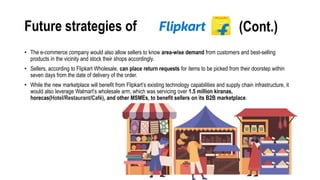
• The e-commerce company would also allow sellers to know area-wise demand from customers and best-selling
products in the vicinity and stock their shops accordingly.
• Sellers, according to Flipkart Wholesale, can place return requests for items to be picked from their doorstep within
seven days from the date of delivery of the order.
• While the new marketplace will benefit from Flipkart’s existing technology capabilities and supply chain infrastructure, it
would also leverage Walmart’s wholesale arm, which was servicing over 1.5 million kiranas,
horecas(Hotel/Restaurant/Café), and other MSMEs, to benefit sellers on its B2B marketplace.
(Cont.)
Any Questions?
“Building a visionary
company requires one
percent vision and 99
percent alignment”
—Jim Collins and Jerry Porras, Built to
Last

Strategic Management & MSME

  • 1.
    Strategic Management & MSME By- SachinMohanty (19MBA004) Ravenshaw University
  • 2.
    What is strategicmanagement? • Strategic management is the ongoing planning, monitoring, analysis and assessment of all necessities an organization needs to meet its goals and objectives. • Changes in business environments will require organizations to constantly assess their strategies for success. • The strategic management process helps organizations take stock of their present situation, chalk out strategies, deploy them and analyze the effectiveness of the implemented management strategies.
  • 3.
    Why strategic management? •Strategic management is generally thought to have financial and nonfinancial benefits. • A strategic management process helps an organization and its leadership to think about and plan for its future existence, fulfilling a chief responsibility of a board of directors. • Strategic management sets a direction for the organization and its employees. • Unlike once-and-done strategic plans, effective strategic management continuously plans, monitors and tests an organization's activities, resulting in greater operational efficiency, market share and profitability.
  • 4.
    assessing the organization'scurrent strategic direction or position. identifying and analyzing internal and external strengths and weaknesses. formulating action plans. executing action plans. evaluating to what degree action plans have been successful and making changes when desired results are not being produced Assessing Indentifying Planning Executing Evaluating Strategic Management process
  • 5.
    Strategic Management process(Cont.) • Effective communication, data collection and organizational culture also play an important part in the strategic management process -- especially at large, complex companies. • Lack of communication and a negative corporate culture can result in a misalignment of the organization's strategic management plan and the activities undertaken by its various business units and departments. • Thus, strategy management includes analyzing cross-functional business decisions prior to implementing them to ensure they are aligned with strategic plans.
  • 6.
    Strategic Management strategies •Strategy as a consciously intended course of action to deal with a situation. Plan • Strategy as a maneuver to outwit a competitor, which can also be part of a plan. Ploy • Strategy stemming from consistency in behavior, whether or not intended and which can be independent of a plan. Pattern • Strategy as a mediating force or match between the organization and environment, which can be compatible with any or all of the Ps. Position • Strategy as a concept or ingrained way of perceiving the world -- e.g., aggressive pacesetter vs. late mover -- which can be compatible with any or all of the Ps. Perspective Henry Mintzberg’s 5 P’s of Strategy
  • 7.
    Strategic Management strategies(Cont.) SWOT Analysis PESTLE Analysis Balanced Scorecard Analysis Value of Organsational Culture Other strategy assessment tools
  • 8.
    Strategic management inMSME Assessment • Taking a week or two to scrutinize your industry, competition and the general state of business in the local economy. • Thinking about how trends have changed over the last couple of years, and where they might be headed, as you go through your daily tasks. Take notes as ideas arise. • After that, taking time to consider your target customer, what she values, and how you can meet her needs. • Last, spending time looking at each sector of your enterprise: how it operates, whether it is efficient, and how it fulfills the needs of your customers.
  • 9.
    Strategic management inMSME (Cont.) Positioning • Positioning is just another way of asking yourself what you want to accomplish in your business. The most important aspect of positioning is that it sets a specific direction for your business. • If you know the direction you want your company to take, align the various elements of your enterprise with that directional goal. • This avoids wasting time and effort on activities that don't add to your bottom line. • With alignment of your total enterprise in mind, delay making any changes until you have positioned your company and set a direction.
  • 10.
    Strategic management inMSME (Cont.) Write it Down • It is important to write down your plan, even if it's no more than a few pages based on the notes you made. • Start with your positioning statement, detailing your directional goal. • Then list benchmarks toward that goal, such as leasing the space next door, hiring additional staff and buying new equipment. Include estimates of the cost. • The rest of your strategic plan is an action plan for your operations, inventory, marketing and customer service, designed to meet those benchmarks. The value of a written strategic plan is that it serves as a touchstone.
  • 11.
    Strategic management inMSME (Cont.) Implementation • Ensure the success of your strategic plan by taking steps to properly implement it. • Hold brainstorming sessions with your key employees. Including suppliers and customers in your sessions may also be beneficial. • Keep your plan on target by holding regular meetings with managers and employees to discuss how business is progressing and how to deal with problems. • Communication with your employees is the best way to ensure the successful implementation and execution of your strategic plan. • If during implementation you see a better way, change the plan accordingly.
  • 12.
  • 13.
  • 14.
    Journey of 2007 Founded bySachin and Binny Bansal with an investement of 4 lakhs. Founded 2010 Flipkart wins the Indian customer with COD and 30 day Return Policy. Ekart the logistic arm of Flipkart was launched. COD, Ekart 2014 Flipkart acquires one of India’s leading fashion e-tailers, Myntra and launches Big Million Days. Myntra and BMD 2009 • Accel Partners invests $1 million in Flipkart • Flipkart offices spring up in Delhi and Mumbai • Headcount leaps to 150 First Funding 2012 Flipkart launches its mobile shopping app Mobile APP 2016 Flipkart aquires Phonepe and Jabong And also launches flipkart assured. Phonepe and Jabong 2017 Flipkart acquires eBay’s India biz to fight Amazon. Ebay India 2018 Walmart and Flipkart announce completion of Walmart’s investment of $ 16 billion in Flipkart Wakmart acquires Flipkart 2019 Flipkart introduces ‘SuperCoins’ - a first-of-its-kind, multi-brand reward ecosystem, strengthening its Flipkart Plus program Super Coin
  • 15.
  • 16.
    Strategies adopted by Newproduct introduction In 2007, Flipkart started with selling books. The first book sold at flipkart.com was -John Woods’ Leaving Microsoft to Change the World Today. In 2010, they added to their catalogue, media (including music, movies and games) and mobile phones and accessories and since it has never looked back and has kept on adding new products and also launching some products exclusive on its platform. Acquisitions The following are the acquisitions by Flipkart • 2010: WeRead, a social book discovery tool. • 2011: Mime360, a digital content platform company. • 2011: Chakpak.com • 2012: Letsbuy.com
  • 17.
    Strategies adopted by Acclaimsand accomplishments • Flipkart broke even in March 2010 and claims to have had at least 100% growth every quarter since its founding. As of today, Flipkart employs over 30000 people. • Flipkart is the third largest online shopping store after E-Bay and Amazon. • From a start-up with an investment of just four lakhs rupees, Flipkart has grown into a $3.8 billion-revenue online retail giant in 13 years. • Flipkart.com, the country’s first billion-dollar-valued Internet Company, is surely in a state of perpetual excitement. • Flipkart has become a large-scale e-commerce in India. And the key to the company’s success lies in its payment-on- delivery model, which helped overcome the average Indian consumer’s misgivings and built trust. • In the 2019 Flipkart’s Big Billion Days campaign- it got more than 70 billion views in 6days, more than 50% shoppers came in from Tier-2 cities and beyond. (Cont.)
  • 18.
    Strategies adopted by ProductStrategy • Flipkart is set out to create something for the Indian market – a service that was specifically built keeping the Indian consumer in mind. • As far as entrepreneurship is concerned, Flipkart believes that the core focus for every start-up, regardless of the industry, should be the same – and that is customer focus. • Consistent customer service is the hallmark of Flipkart. Discounts cannot replace the customer’s satisfaction of being serviced promptly and efficiently. • Similarly, the trust-building exercise is accorded a lot of importance. Flipkart connects with customers in real-time, through Facebook and Twitter. Honesty is the best policy for this e-commerce trailblazer. (Cont.)
  • 19.
    Strategies adopted by OperationalStrategy • Flipkart began operations on the consignment model – goods were procured from suppliers on demand, based on the orders received through the website. However, eventually, the books-to-electronics e-shop adopted the warehouse model. • The company has its own warehouses, and maintains its own inventory. Sales projection determines the inventory, and the available inventory accounts for the sales made; it’s a self-feeding cycle of sorts. • On the operational front, issues faced by the company pertain to delay in deliveries, or faulty products. As a customer- centric, none of these issues can remain unresolved for long. They faced significant challenges in reverse logistics. It’s a big task to track unsuccessful orders, which are quite costly to manage. • So to tackle this they started their own delivery company ‘E-kart’ which reduced a great cost and delivery time and at the same time added revenue by rendering delivery services to other companies as well. (Cont.)
  • 20.
    Strategies adopted by Branding •Flipkart went for a major brand makeover, making it look more ‘up market’. There have been large newspaper ads, TVCs and a lot of web ads. • “No Kidding, No Worries”, the recent advertising and branding campaign of Flipkart is a unique example of “Trap Them Young”. An in-depth analysis of recent advertisement campaign of Flipkart strongly conveys Indian youth’s sentiments and their desire. The story board of adverts, features kids in adult situations, like a beauty parlor, a cafe, and an office. The Hinglish language & the happening places is the heart of No Kidding, No Worries advertisement series. The creative director succeeds to keep KOOLNESS of Brand Flipkart. • Flipkart attacks the online fears --- Fear of wrong product – 30 day replacement guarantee, Fear of giving credit card details online – Cash on Delivery feature, Fear of not getting the original product – Original products with original warrantee (Cont.)
  • 21.
    Strategies adopted by Flipkart’sstrategy in solving problems in E-commerce • Discoverability: It is the case with any venture on the web, “How does the customer find us? • Payments: Flipkart had at least 4 different Payment Gateways integrated. They introduced Cash-on-Delivery. Then they are also accepting EMI’s, E-Wallets, UPI payments and Flipkart Pay Later service. • Inventory: Flipkart manages is inventory very well with end to end information system form the placement of order to delivery and to tackle this they have their own warehouse and management system. • Delivery: So to tackle this they started their own delivery company ‘E-kart’ which reduced a great cost and delivery time and at the same time added revenue by rendering delivery services to other companies as well. • Marketing: Flipkart has been very active in digital marketing and has used it very wisely to attract customers to its platform. It has given numerous lucrative discounts and offers also. Flipkart has also tried to reach out through TV commercials and billboards . Fiipkart has also relied on word of mouth market from satisfied customers (Cont.)
  • 22.
    Strategies adopted by PricingStrategies So looking at the major cost factors that affect the E-Commerce that are taken care of by Flipkart are Supply Chain (procurement and shipping), Manpower and time spent on each order, Competition. Tackling Competition To tackle such a huge competition Flipkart has adopted the following strategies like great app and website, efficient delivery system, great products and hot deals, excellent communication, great customer retention rate, credible and easy payment system and many more. (Cont.)
  • 23.
    Future strategies of •Flipkart launches B2B marketplace for kiranas, small sellers – ‘Flipkart Wholesale’ and has already started operations in Delhi, Gurugram and Bengaluru. • Quote of one of their recent ads “Bulk shopping now made simpler with Flipkart Wholesale! Get the best margins on a wide range of quality products. Order now! ” • The app is currently available for Android users only to get products delivered at their shops. Eligible sellers and kiranas can also get up to 15 days of credit to stock up shop with products through Flipkart Wholesale’s Easy Credit benefit. • While the marketplace is yet to launch the grocery category, but the credit limit offered is up to Rs 5,000 for grocery and up to Rs 10,000 for fashion. • For a due amount between Rs 100 and Rs 5,000, sellers would have to pay Rs 50 late fees. • Similarly, for the amount due between Rs 5,000 and Rs 10,000; Rs 10,000 and Rs 25,0000; and above Rs 25,000, the late fees to be charged would be Rs 100, Rs 250, and Rs 500 respectively.
  • 24.
    Future strategies of •The e-commerce company would also allow sellers to know area-wise demand from customers and best-selling products in the vicinity and stock their shops accordingly. • Sellers, according to Flipkart Wholesale, can place return requests for items to be picked from their doorstep within seven days from the date of delivery of the order. • While the new marketplace will benefit from Flipkart’s existing technology capabilities and supply chain infrastructure, it would also leverage Walmart’s wholesale arm, which was servicing over 1.5 million kiranas, horecas(Hotel/Restaurant/Café), and other MSMEs, to benefit sellers on its B2B marketplace. (Cont.)
  • 25.
  • 26.
    “Building a visionary companyrequires one percent vision and 99 percent alignment” —Jim Collins and Jerry Porras, Built to Last